2018 3rd International Conference on Computational Modeling, Simulation and Applied Mathematics (CMSAM 2018) ISBN: 978-1-60595-035-8
Urban Anti-terrorism Environment Modeling and Simulation Application
Based on Unity3D
Wei-zheng SUN, Sheng-jie MAO, Zhen LAI and Yan-yan HUANG
*School of automation, Nanjing University of Science and Technology, Nanjing 210094, Jiangsu
*Corresponding author
Keywords: Urban three-dimensional model, Anti-terrorism, Creator, Unity 3D.
Abstract. In view of the fact that the simulation environment of urban anti-terrorism exercises is not realistic enough and the cost of components is really high, this paper proposes a method based on modeling and simulation to carry out anti-terrorism simulation and training. The main contents include the establishment of an overall modeling and simulation framework, the use of creator tools for modeling urban models, and the use of 3Dmax modeling for anti-terrorist characters. The rendering of all models and animations are done using Unity3D. Finally, taking the combat process of rounding up terrorists in a CBD as an example, simulation and deduction are carried out using the model and environment above. The results show that the simulation’s effect is realistic and the exercise plan offers a reference.
Introduction
At present, terrorist attacks often occur in the prosperous and crowded urban areas, such as the 9-11 attacks etc. These incidents show that the main problem is that in prosperous cities, where wealth and people are concentrated, it is very costly to conduct anti-terrorism exercises. By referring to some of the literature, modeling and simulation technology can play a good supporting role in military exercises, which is highly concerned by people. This paper constructed the environment needed for urban anti-terrorism exercises by unity3D and related modeling tools, and combine the characteristics of actual anti-terrorism processes to carry out research on anti-terrorism.
Modeling Method Framework and Modeling Tools
Modeling Framework
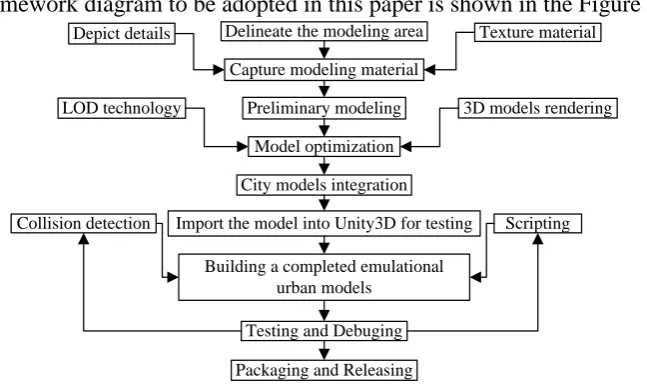
The modeling framework diagram to be adopted in this paper is shown in the Figure 1.
Delineate the modeling area
Capture modeling material
Depict details Texture material
Preliminary modeling
Model optimization
LOD technology 3D models rendering
City models integration
Import the model into Unity3D for testing
Building a completed emulational urban models
Collision detection Scripting
Testing and Debuging
[image:1.595.140.464.542.736.2]Packaging and Releasing
Figure 1. Simulation system design framework.
The main contents in the figure above are as follow:
The second part is the simulation rendering section. Including integrating all models and rendering the scene with unity3D to form a complete counter-terrorism simulation environment and completing animation and script writing at the same time.
The third part is to use the background of a CBD as an example to carry out anti-terrorism simulation.
Modeling and Simulation Tool
In this paper, modeling and simulation are carried out by creator, 3dmax and Unity3d.
This article mainly uses creator to model, map and optimize buildings in selected scenes. The key technology is to use the LOD technology to draw the model system, and enhance the texture mapping technology in terms of fidelity.
3dmax is mainly used to model characters, including terrorists and anti-terrorist forces, and also to map some models through 3dmax.
Unity3d is used for the integration of scene and character, and human-computer interaction programming. Its Asset store function can be used to obtain some minor models to save time.
Modeling Design of the Main Scene
Modeling of Major Buildings
Buildings are an important element of anti-terrorism sites. This paper mainly focuses on crowded business district and buildings. In this paper, the establishment of such models adopts internal and external fine modeling methods. This paper obtains the relevant resource data such as the floor plan through the network, and truly restores the internal structure of the house for the simulation unit to operate within it. Now take the Jinao International Shopping Center as an example to introduce the modeling of major buildings, its flow chart is shown in Figure 2.
Establish foundation based on floor plan
Put a floor plan on the foundation and build the wall of each floor of the building according to the floor plan
Establish a ceiling model for each floor
Arrange single-layer structures in arrays
Handling external details
Establish the auxiliary building and build the junction of the main building
[image:2.595.155.439.417.580.2]Do the same for the auxiliary building
Figure 2. House model construction flow chart.
As shown in Figure 3(a)-3(g), according to the floor plan, this paper builds walls and stairs, and divides different walls into different parent nodes, so as to assign different textures or materials to different walls later. In the process of constructing the ceiling model, appropriate space should be reserved as a passage for stairs and elevators. Since most of the floors of the current building are the same, in the process of building the model, the simulation system allows the floors within the active range to be arrayed using a single layer structure as shown in Figure 3(d). While the unreachable space is replaced by a texture-processed square. The auxiliary building is built in the same way.
[image:2.595.54.540.704.768.2]Background Block Modeling
[image:3.595.170.417.166.212.2]The background block in this project includes a series of buildings which are duplicated, less likely to be attacked, and less complex. For this type of buildings, this paper use fuzzy processing when modeling, which is shown in Figure 4. That is to use a simple polygon with a small number of sides to build the model, and then use the texture to display the details of the model, and then use the corresponding model each time in the scene, simply copy and paste to simplified unnecessary steps.
Figure 4. Background building group model.
Modeling of Ground Surface Physical Entities
Surface physical entity models include traffic lights, trash cans, road pavements, fences, fountain pools, and other objects in urban street environments. These objects play a role in increasing the realism of the simulation environment in the project, and do not affect the specific process of the simulation. Therefore, this type of object model mainly uses the Asset store in Unity3d to directly download the preset model.
Optimize Models and Integrate Scenarios
The optimization of the model is mainly to LOD processing each model. As shown in Figure 5, Figure. 5-A shows the model when the number of faces is 100%. Figure 5-B shows the model when the number of faces is 60%. The engine can make full use of device performance and storage space by exhibiting different complexity at different distances.
The integration of all models into a complete anti-terrorism scene is mainly done in Unity3d. First post a map of the city on Terrian and place the buildings one by one according to the layout. Figure 6 shows the urban scene that has been imported and placed in Unity3D.
Model Mapping
[image:3.595.178.413.516.685.2]Some textures in 3d max can't be displayed in Unity3D in the correct format. This paper map these textures in creator first, then import the model into 3d max. Figure 7 shows the performance in Unity3D after the picture is attached in Figure 6.
Figure 5. The model of Jiaye Mansion Hotel.
Figure 6. Scenes in Unity3d. Figure 7. Jinao Building.
Testing and Optimization of Integrated Scenarios
The test of the scene is mainly to test the speed of the scene rendering calculation and the correctness of the size and relative position of each model. After the test is completed, the simulation of the counter-terrorism deduction can be performed on this basis.
Characters Modeling
categories: terrorists and anti-terrorist forces. They are distinguished by helmets and costumes. The action of the model in the scene is realized by programming the Animation Controller in Unity3D. The process of modeling is shown in Figure 8.
Figure 8. The establishment process and actual performance of the character model.
Model Application Integration
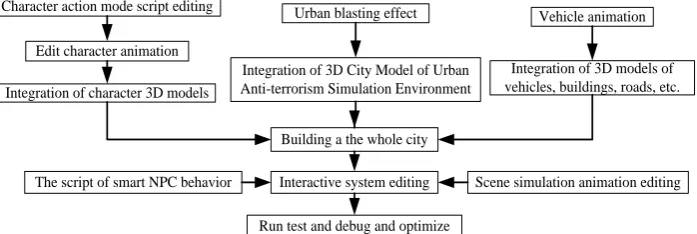
The application integration framework of the model is shown in Figure 9. According to the flow chart, the integrated application of the model is mainly divided into three parts. The first is the final completion of the urban anti-terrorism simulation 3D environment. The second is the placement of models such as characters and vehicles on the city's three-dimensional simulation model. The third is the realization of the anti-terrorism simulation function.
Urban blasting effect
Run test and debug and optimize
Vehicle animation Character action mode script editing
Edit character animation
Integration of character 3D models
Integration of 3D City Model of Urban Anti-terrorism Simulation Environment
Integration of 3D models of vehicles, buildings, roads, etc.
Building a the whole city
The script of smart NPC behavior Interactive system editing Scene simulation animation editing
Figure 9. Model application integration framework.
Realization of Anti-terrorism Simulation System Function
[image:4.595.125.474.310.427.2]Initial deployment of police force
Operate that police unit Are there any policemen arriving at
the intersection? Are all police forces deployed?
All units begin to act
Whether to block the intersection?
Is it blocked in all directions?
Simulation End
YES
YES
YES
YES
Choose direction of movement
NO
Enter the engagement interface
Has it successfully intercepted terrorists?
YES
YES
Begin
End
NO
NO
[image:5.595.190.417.69.356.2]NO NO
Figure 10. Simulation system design flow chart.
Behavioral Design of Anti-Terrorism and Terrorist Chess Pieces
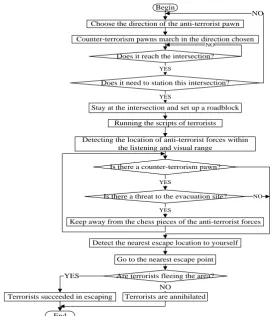
The task of the anti-terrorist force is to control terrorists in a fixed area or to kill them in a limited area and time. These chess pieces of the anti-terrorist force are controlled by the simulator. The simulator can allocate all the police forces in the area at a macro level.
Choose the direction of the anti-terrorist pawn
Counter-terrorism pawns march in the direction chosen
Does it reach the intersection?
NO
Does it need to station this intersection?
YES
Stay at the intersection and set up a roadblock
YES
Begin
NO
Running the scripts of terrorists
Detecting the location of anti-terrorist forces within the listening and visual range
Detect the nearest escape location to yourself Is there a counter-terrorism pawn?
Is there a threat to the evacuation site?
YES
Keep away from the chess pieces of the anti-terrorist forces
YES
Go to the nearest escape point
Are terrorists fleeing the area?
Terrorists are annihilated Terrorists succeeded in escaping
YES
NO
End
[image:6.595.158.431.68.385.2]NO
Figure 11. Anti-terrorism pawn behavior design flow chart.
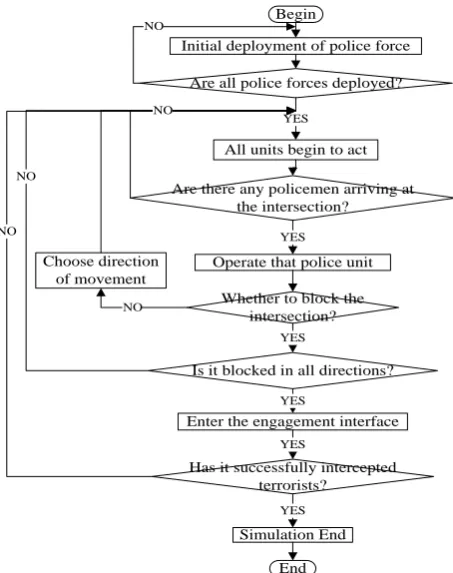
The simulator needs to deploy the police force in the entire area. When a certain anti-terrorist unit reaches a certain intersection, the entire simulation process will be suspended until the counter-terrorism pawn at the intersection is operated.
Behavior Design of Terrorists and Anti-terrorism Forces in the Scene of Firefight
When the siege is successful, the terrorists will not surrender. Instead they will be more likely to attack by firing back, breaking through barriers and taking suicide attacks. At this time, the main task of the anti-terrorism forces in the scene is to shoot down the terrorists as well as terrorists’ vehicles, also, minimize the damage.
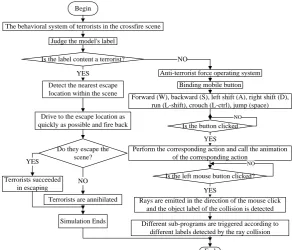
The aim of terrorists in the scene of firefight is to tear a hole as much as possible in the encirclement force, and to create chaos and kill the police. The terrorist and anti-terrorism forces' behavior design in the firefight is shown in Figure 12.
Implementation of Scene Function
The behavioral system of terrorists in the crossfire scene
Detect the nearest escape location within the scene
Drive to the escape location as quickly as possible and fire back
Do they escape the scene?
NO
Terrorists are annihilated Begin
Is the label content a terrorist?
YES
NO Judge the model's label
Terrorists succeeded in escaping
YES
Simulation Ends
Anti-terrorist force operating system
Binding mobile button
Forward (W), backward (S), left shift (A), right shift (D), run (L-shift), crouch (L-ctrl), jump (space)
Is the button clicked
YES
Perform the corresponding action and call the animation of the corresponding action
Is the left mouse button clicked?
YES
Rays are emitted in the direction of the mouse click and the object label of the collision is detected
Different sub-programs are triggered according to different labels detected by the ray collision
End
NO
[image:7.595.150.443.70.320.2]NO
Figure 12. Anti-terrorist force control system design flow chart.
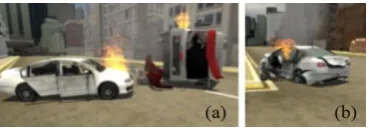
Figure 13. The opening animation. Figure 14. Crossfire scene.
Example Analysis
Background
The case in this paper takes the jin’ao Building’s being attacked by terrorists as an example. Terrorists try to escape the city after a bomb attack on a certain floor of the building, and try to create chaos and enlarge damage along the way. The anti-terrorist rapid reaction force was alerted to the attack site to block the target, then the simulation began.
Activities of Terrorists and Counter-terrorism Forces
The figure shows the anti-terrorism simulation environment used in this case. The terrorists start from the red dot in Figure 15, and when they arrive at the border of the map, they are considered to escape the containment. The red line is the initial escape path of the terrorist. The starting point of the anti-terrorist force is at the blue dot position. The escape route of the terrorists will be updated in real time with the movement of the anti-terrorist forces.
Fire Fight Scene
Figure 15. Activities of terrorists and counter-terrorism. Figure 16. The performance of Crossfire scene.
Summary
This paper starts from the establishment of urban three-dimensional model, the construction of anti-terrorism simulation environment, the design of anti-terrorism forces and terrorist behavior, and finally forms a complete urban three-dimensional model and anti-terrorism deduction system. From the results, the system has certain practical significance for the anti-terrorism rehearsal in the prosperous urban areas. It can further improve the actual urban anti-terrorism program and improve the security management level from the macro- and micro-level aspects of urban anti-terrorism.
Acknowledgement
This research is financially supported by the Nanjing University of Science and Technology's undergraduate research and training program for "ten million" project. (No. 201710288056), National Fund of Nature Science (No. 61374186)and Key projects of international scientific and technological innovation cooperation between governments (No. 2016YFE0108000).
References
[1] Lis P. Terrorism, Armed Conflict and Foreign Aid[J]. Peace Economics Peace Science & Public Policy, 2014, 20(4):655-667.
[2] Pape, Robert A. The Strategic Logic of Suicide Terrorism[J]. American Political Science Review, 2003, 97(3):343-361.
[3] Sönmez S F, Apostolopoulos Y, Tarlow P, et al. Tourism in crisis: managing the effects of terrorism.[J]. Journal of Travel Research, 1999, 38(1):13.
[4] Batty M. Urban modelling and planning: reflections, retrodictions and prescriptions[J]. Journal of Political Economy, 1987, 70(5):1-1.
[5] Chen F, Kusaka H, Bornstein R, et al. The integrated WRF/urban modelling system: development, evaluation, and applications to urban environmental problems[J]. International Journal of Climatology, 2011, 31(2):273-288.
[6] Lu G P, Xue G H, Chen Z. Design and Implementation of Virtual Interactive Scene Based on Unity 3D[J]. Advanced Materials Research, 2011, 317-319:2162-2167.