2018 International Conference on Information, Electronic and Communication Engineering (IECE 2018) ISBN: 978-1-60595-585-8
A Brief Review on Coding for Electromagnetic Wireless
Nanosensor Networks
Long-jun HUANG
Department of Computer Science and Engineering, Shaoxing University, Shaoxing 312000, China
Keywords: Wireless nanosensor networks, Coding, Energy efficiency.
Abstract. Given that a single nanosensor in Electromagnetic wireless nanosensor networks (EM-WNSNs) has very limited energy storage capacity, ensuring energy efficiency has become an essential and basic topic for EM-WNSNs. At present, coding is one of the effective methods to solve the issue of energy efficiency in EM-WNSNs. By focusing on existing coding for EM-WNSNs, we classify and compare the coding methods. Furthermore, we discuss the research trends on coding for EM-WNSNs.
Introduction
Electromagnetic (EM) wireless nanosensor networks (EM-WNSNs) [1], which consist of numerous nanosensors that can communicate with each other by electromagnetic communication, present unprecedented and promising applications in the biomedical, industrial, environmental, and military fields. To enable communications among nanosensors, two main means can be used, that is, molecular communications (MC) (the WNSN that uses MC is called MC-WNSN in this study) [2] and electromagnetic communications [1]. EM-WNSNs adopt the electromagnetic wave in the terahertz (THz) band (0.1–10 THz) as information carrier [3].
Given the extremely limited battery capacity of each nanosensor, energy efficiency is one of the most important challenges in EM-WNSNs. Energy-harvesting systems at nanoscale offer EM-WNSNs infinite lifetime when the nanosensors can harvest sufficient energy. However, a nanosensor needs a significant amount of time to restore its energy via energy harvesting systems at nanoscale. In other words, the energy-harvesting rate of current energy harvesting systems at nanoscale remains insufficient to ensure reliable data transmission [4]. Therefore, the existing energy harvesting systems at nanoscale are not mature and remain under research.
In EM-WNSNs, communication energy consumption (CEC) is the major type of energy consumption, which consists of both transmission energy consumption (TEC) and reception energy consumption (REC). Coding at the transmitter can reduce the number of “1” bits to be transmitted, thereby decreasing the TEC of nanosensors. Moreover, this approach can decrease the REC of nanosensors by optimizing the lengths of source-words and code-words. Thus, we can save the CEC by coding in EM-WNSNs, thereby resulting in higher energy efficiency.
In [5], the authors compare channel coding schemes in MC-WNSN. In MC-WNSN, the authors discuss the network coding, forward and reverse coding, error correction coding, and convolutional code. In EM-WNSNs, the thought of low weight (the number of “1” bits) coding originates from minimum energy (ME) codes [6] based on on–off keying (OOK) for wireless communication.
Recently, several energy efficient codes for EM-WNSNs are investigated. In [3], the authors investigate the energy-efficient code based on TS-OOK modulation by considering both TEC and REC, that is, CEC. In [7], the authors compare automatic repeat-reQuest (ARC), minimum energy coding (MEC) with Hamming distance constraint, and low-weight channel coding (LWC) [8] in terms of bit error rate (BER) in EM-WNSNs. In [9], the authors compare several low-weight codes for EM-WNSNs in terms of energy efficiency, channel capacity, communication reliability, and so on.
coding and variable-length coding. In general, the variable-length coding schemes are more complex than fixed-length coding schemes, and the algorithms [10] to construct the variable-length codes have high time complexity. In addition, variable-length coding can result in a source-word error when a bit error occurs [9]. Given the very limited capabilities of nanosensors in terms of energy storage, computation, and process, the fixed-length coding schemes with low time complexity are more suitable for EM-WNSNs. In this paper, focusing on the existing coding schemes for EM-WNSNs, we classify and compare the coding methods, and then discuss the further development trend of research on coding for EM-WNSNs. Notably, we present communication-energy-consumption minimization coding (CEC-MC), which is based on ME, and we consider optimizing both TEC and REC.
Coding Methods
At present, the coding schemes for EM-WNSNs are based on time spread on-off keying (TS-OOK) [8] in general. Coding is a mapping from the set of source-words to the set of code-words (codebook). In [4], a TS-OOK-based coding scheme is shown, which can decrease the average code-word weight (ACW) of the codebook.
We focus on the coding schemes for EM-WNSNs as follows: LWC (2011) [11], MEC (2013) [12], minimum transmission energy coding (MTE, 2013) [13], variable-length superior lowest-weight code (SLW, 2014) [10], nanonetwork minimum energy coding (NME, 2014) [14], pulse position coding (PPC, 2015) [15], ACW-minimization coding (ACW-MC, 2016) [3], energy optimization coding (EOC, 2017) [4], and CEC-MC presented in the paper.
MTE and ACW-MC focus on the scenarios of source-words with equal occurrence probability; however, MEC, NME, and EOC focus on the scenarios of source-words with unequal occurrence probability. In addition, by using constant code-word weight, LWC and PPC can be adopted in the scenarios of source-words with equal or unequal occurrence probability.
[image:2.595.117.478.492.607.2]We let m, n, and d denote source-word length, code-word length, and Hamming distance, respectively. For m 3, the coding dictionaries (table of mapping relations between code-words and source-words) of different codes are shown in Tables 1 and 2.
Table 1. Coding dictionary of different codes for source-words with the equal occurrence probability.
Source-word LWC PPC MTE ACW-MC SLW 111 00011 00000001 0000 00101 1 110 00101 00000010 0001 00011 01 101 01001 00000100 0010 10000 001 011 10001 00001000 0100 01000 0001 100 11000 00010000 1000 00100 00001 010 01100 00100000 1001 00010 000001 001 00110 01000000 1010 00001 0000001 000 01010 10000000 0101 00000 0000000
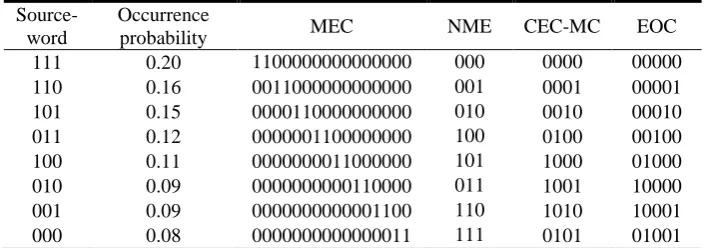
Table 2. Coding dictionary of different codes for source-words with the unequal occurrence probability.
Source-word
Occurrence
probability MEC NME CEC-MC EOC 111 0.20 1100000000000000 000 0000 00000 110 0.16 0011000000000000 001 0001 00001 101 0.15 0000110000000000 010 0010 00010 011 0.12 0000001100000000 100 0100 00100 100 0.11 0000000011000000 101 1000 01000 010 0.09 0000000000110000 011 1001 10000 001 0.09 0000000000001100 110 1010 10001 000 0.08 0000000000000011 111 0101 01001
[image:2.595.121.476.630.754.2]with unequal occurrence probability, MEC (n 16,d 4), NME (n 3), EOC (n 5), and CEC-MC (n 4) are shown in Table 2, where CEC-MC is a coding scheme that we present in this paper. For the scenarios of source-words with unequal occurrence probability, CEC-MC jointly considers both TEC and REC, which is a coding scheme based on ME; that is, it maps the code-words with less weight to source-words with higher occurrence probability after constructing an optimal codebook with minimum ACW by using the constructing algorithm of ACW-MC. In addition, it optimizes CEC by solving an optimization problem based on its energy consumption model.
Coding schemes with constant code-word weight
LWC and PPC are two coding schemes with constant code-word weight, which can be adopted in the scenarios of source-words with equal or unequal occurrence probability. They may map a code-word in the codebook to any source-word. For code-word length n and code-word weight u,
!
( )! !
u n
n C
n u u possible code-words exist. To construct the one-to-one mapping relation between the
code-words and K 2m source-words with length m, the constraint must be satisfied Cun2m [8].
PPC is a special case of LWC with constant code-word weight u 1. The code-word length of PPC satisfies the constraint n 2m.
Coding schemes under constraint of maximum code-word weight
MTE and ACW-MC are two coding schemes under constraint of maximum code-word weight (MCW) [13]; these schemes focus on the scenarios of source-words with equal occurrence probability. MTE and ACW-MC map a source-word into a longer code-word. MTE maps a code-word to any source-word, but ACW-MC maps a source-word into a code-word with less or equal weight after constructing the optimal codebook with minimum ACW in general.
MTE only considers the TEC and minimizes energy consumption per bit by obtaining both the optimal source-word and code-word lengths. However, ACW-MC minimizes ACW by obtaining the optimal code-word length for a given source-word length, which considers both TEC and REC; that is, CEC. In [16], the authors modify MTE by considering REC.
Coding schemes to minimize weighted-ACW
MEC and CEC-MC are two coding schemes to minimize the weighted-ACW, which focus on the scenarios of source-words with unequal occurrence probability. Similar to ME, MEC and CEC-MC map a code-word with less weight to a source-word with higher occurrence probability, thereby possibly minimizing the weighted-ACW. MEC minimizes the weighted-ACW under the constraint of Hamming distance, thereby resulting in a longer code-word, which is expressed in [12].
The optimal codebook of CEC-MC can be obtained by adopting the construction method of ACW-MC; that is, it constructs the optimal codebook by generating code-words in the ascending order of code-word weight (from 0 to MCW).
Coding schemes for real-time symbol stream
NME and EOC are two coding schemes that focus on real-time symbol streams. They need to first divide real-time symbol streams into several types of source-words and count the frequency of every type of source-word. In this case, each type of source-word generally has different occurrence probabilities. Then, they map a code-word with lower weight to a source-word with higher frequency. For NME, an improved ME, the code-word length n is equal to the source-word length
m, that is, n m. Recently, based on NME, the authors presented simple and energy-efficient image compression [17] and proposed simple block nanocode (SBN) [18] for nanocommunications; this approach uses NME followed by a simple block code to ensure reliability. For EOC, an improved NME, the code-word length is larger than the source-word length. Based on the optimal source-word and code-word lengths by solving an optimization problem, the optimal codebook of EOC can be constructed by the method of ACW-MC.
Variable-length Coding schemes
code-word in the codebook. As a typical variable-length code, PFC can be uniquely decipherable and decoded instantaneously, which is highly desirable for any coding scheme. However, the higher complexity of the algorithm [10] to construct the optimal codebook has more limitations in EM-WNSNs. SLW [10] is a PFC with both the minimum ACW and ACL. For given K2m
source-words, the codebook is
2 1
1, 01, 001, , 0 01, 0 0
K K
. In this case, the ACW and ACL are
(K1) /K and ( 2 K 2) / (2 K)
K , respectively. For source-word length m3, SLW is shown in Table 1. To minimize the TEC, a code-word in the SLW codebook can be mapped to any source-word. However, in a scenario of source-words with different occurrence probabilities, if we must minimize both TEC and REC, that is, CEC, a shorter code-word should be mapped to a source-word with higher occurrence probability. In [16], the authors presented variable-length minimum communication energy (V-MCE) code to minimize the CEC, which is an improved PFC [10].
Research Trend on Coding for EM-WNSNs
In our opinion, the research trend of coding for EM-WNSNs mainly includes the development of both theories and methods, the comprehensive tradeoff of network performance, and the practical applications of coding schemes in EM-WNSNs, which is discussed in detail as follows:
(1) Development of theories and methods
As discussed, some research topics on fixed-length or variable-length coding for EM-WNSNs exist. However, the coding methods and theories should be further developed. The comprehensive energy consumption models should be investigated based on the feature of THz channel, such as the path loss and molecular absorption, and the density of nanosensors. In EM-WNSNs, because of the limitation of nanosensors, the coding algorithm should be efficient. The existing studies on coding for EM-WNSNs consider the coding algorithm with high time complexity, such as [10], as an offline problem. We should extend the classic theory of information and coding to study the research issues on coding for EM-WNSNs with the development of THz communication theory. In addition, in EM-WNSNs, we should modify and use the existing works in MC-WNSN, WSNs, and network coding, such as error correction codes and joint source-channel coding.
(2) Comprehensive tradeoff of network performance
Given the features of THz channel in terms of path loss, molecular absorption, and multi-user interference, it is prone to transmission error in pulse-based EM-WNSNs. Therefore, the communication reliability of coding must be considered in addition to energy efficiency. In [8], the authors show that a lower channel error probability occurs by reducing the code-word weight to mitigate the molecular absorption noise and the multi-user interference in EM-WNSNs. The authors also show that an optimal code-word weight exists, which can maximize the information rate [8]. The information rate is an important metric to assess the performance of the THz channel in EM-WNSNs. In addition, the code-word after coding generally becomes longer than the source-word, thereby resulting in longer delay and smaller throughput. Therefore, the coding research for EM-WNSNs should jointly consider energy efficiency, communication reliability, information rate, delay, throughput, and so on. In addition, the coding can be investigated from the point-to-point, end-to-end, and network communication perspectives. Moreover, coding based on other modulation schemes other than OOK-based modulation should be investigated in the future.
(3) Practical applications of coding schemes
schemes are used at the design stage. Moreover, the remaining energy of nanosensors as well as the adaptive dynamic adjustment of the parameters and coding/decoding algorithms should be considered in runtime. Notably, from the view of practical applications, the coding schemes consider the source-words with unequal occurrence probability in general. Therefore, the coding that focuses on this case, such as MEC and CEC-MC, should be further investigated.
Conclusion
EM-WNSN is a new type of WSNs that involves many research issues on theories and technologies to be investigated and solved. The research on coding for EM-WNSNs remains in its infancy. Although some studies on coding for EM-WNSNs are available, in-depth research is necessary. To promote the research on coding for EM-WNSNs, we analyzed and discussed some typical existing coding schemes and CEC-MC (a coding scheme presented here) for EM-WNSNs in terms of coding scheme method. Moreover, we discussed the research trends on coding for EM-WNSNs, which include the development of theories and methods, the comprehensive tradeoff of network performance, and the practical applications of coding schemes.
Acknowledgments
This research was financially supported by the Science Foundation of Shaoxing University under Grant No. 20175012.
References
[1] I.F. Akyildiz, J.M. Jornet. Electromagnetic wireless nanosensor networks, Nano Commun. Netw., 1 (2010) 3-19.
[2] I.F. Akyildiz, F. Brunetti, C. Blázquez. Nanonetworks: a new communication paradigm, Comput. Netw., 52 (2008) 2260-2279.
[3] L. Huang, W. Wang, S. Shen. Energy-efficient coding for electromagnetic nanonetworks in the terahertz band, Ad Hoc Netw., 40 (2016) 15-25.
[4] L.J. Huang, X.W. Yao, W.L. Wang, S.G. Shen. EOC: energy optimization coding for wireless nanosensor networks in the terahertz band, IEEE Access, 5 (2017) 2583-2590.
[5] Y. Lu, M.D. Higgins, M.S. Leeson. Comparison of channel coding schemes for molecular communications systems, IEEE T. Commun., 63 (2015) 3991-4001.
[6] C. Erin, H.H. Asada. Energy optimal codes for wireless communications, in: Proc of the 38th IEEE Conference on Decision and Control, 1999, pp. 4446-4453.
[7] N. Akkari, J.M. Jornet, P. Wang, E. Fadel, L. Elrefaei, M.G.A. Malik, S. Almasri, I.F. Akyildiz. Joint physical and link layer error control analysis for nanonetworks in the terahertz band, Wirel. Netw., 22 (2016) 1221-1233.
[8] J.M. Jornet. Low-weight error-prevention codes for electromagnetic nanonetworks in the terahertz band, Nano Commun. Netw., 5 (2014) 35-44.
[9] M.A. Zainuddin, E. Dedu, J. Bourgeois. Low-weight code comparison for electromagnetic wireless nanocommunication, IEEE Internet of Things Journal, 3 (2016) 38-48.
[10] K. Chi, Y. Zhu, X. Jiang, V.C.M. Leung. Energy-efficient prefix-free codes for wireless nano-sensor networks using OOK modulation, IEEE T. Wirel. Commun., 13 (2014) 2670-2682.
[12] M. Kocaoglu, O.B. Akan. Minimum energy channel codes for nanoscale wireless communications, IEEE T. Wirel. Commun., 12 (2013) 1492-1500.
[13] K. Chi, Y. Zhu, X. Jiang, X. Tian. Optimal coding for transmission energy minimization in wireless nanosensor networks, Nano Commun. Netw., 4 (2013) 120-130.
[14] M.A. Zainuddin, E. Dedu, J. Bourgeois. Nanonetwork minimum energy coding, in: Proc of IEEE UTC-ATC-ScalCom, 2014, pp. 96-103.
[15] X. Yao, X. Pan, C. Zhao, C. Wang, W. Wang, S. Yang. Pulse position coding for information capacity promotion in electromagnetic nanonetworks, in: Proc of the 2nd ACM International Conference on Nanoscale Computing and Communication, 2015.
[16] K. Chi, Y. Zhu, Y. Li, D. Zhang, V. Leung. Coding schemes to minimize energy consumption of communication links in wireless nanosensor networks, IEEE Internet of Things Journal, 3 (2016) 480-493.
[17] M.A. Zainuddin, E. Dedu, J. Bourgeois. Simple and energy efficient image compression for pulse-based communication in THz band, in: Proc of the 31st IEEE International Conference on Advanced Information Networking and Applications, 2017, pp. 112-119.