A Generic Approach for Team Selection in Multi–
player Games using Genetic Algorithm
S. M. Aqil Burney
Department of Computer Science, University of Karachi, Karachi-75270,
Pakistan
Nadeem Mahmood
Department of Computer Science, University of Karachi, Karachi-75270,
Pakistan
Kashif Rizwan
Department of Computer Science & IT, Federal Urdu University, Karachi,
Pakistan
Usman Amjad
Department of Computer Science, University of Karachi, Karachi-75270,
Pakistan
ABSTRACT
The best team selection is always the requirement of management in different domains and in different organizations including government, project, industry, business and sports. The traditional team selection process is really lengthy, awkward and unclear due to manual process and personal judgments; which may lead to a disaster. These conflicting constraints and personal judgments can be translated into software for better and quick solution.
This paper presents a solution to this problem with the help of genetic algorithm to find the optimal solution for the problem of cricket team selection and formation. Our approach is the combination of the existing quantitative approaches with some new extensions such as attributes regarding personal performances, team performance and the combination of players. Secondly our method is just not specific for cricket team but it is converted to generic model for other multiplayer games. We propose an adaptation of island genetic algorithm to optimize the selection of multiplayer sports team having multiple conflicting constraints with mixed crossover where the fitness of common solution is used to drive the selection.
General Terms
Genetic Algorithm, Sports, Optimization.
Keywords
Player Selection, Genetic Computing, Multi-Player Sports, Team Selection, Cricket.
1.
INTRODUCTION
Process of team selection in multi-player sports is a complex decision due to many factors. The performance of the team depends upon the combination of team players selected with respect to the performance, event, opponent and the playing conditions. The confidence of the team is dependent on various factors which may include the recent performance of the players, the quality and fairness of the game, satisfaction of selection board or committee including coaches and captain; moreover the spectators. Aforesaid factors significantly improve the chances of win with an optimal team selection. Team Selection in multiplayer sports such as football, hockey and cricket is a daunting task. Composition of the team depends on many factors which include the player‟s individual performance, combination of players, physical fitness, playing conditions and above all, the confidence of the selection committee on the players. Selection of players in a team is always a difficult decision making task and it has many dimensions. There are finite set of variables with many constraints. The best team selection is a real world problem for sports management and associations especially in multi-player sports. Team selection problem may
rise in various domains i.e., software project team, in HRM for promotion, software testing criterion and bench mark selection etc.
The manual team selection process may have many drawbacks such as personal liking and disliking, personal grudges between team selection committee and players and external pressures (social, political etc.). Poor team selection lead to failure and the selection committee and sports organizing authorities will become accountable to the people who love sports. It also effects the loyalty of players due to non-optimal and substandard selection of combination; causing global damages for the side. The team selection procedure also takes and ample amount of time and chances of defacement exists. This may results in a bad performance in the game and the morale of the whole team shattered. To avoid this vague practice of team selection a scientific and more effective procedure can give an optimistic result in a lesser amount of time [1]. We have proposed a software based solution for the optimal team combination by using evolutionary programming technique called genetic algorithm [2].
We have applied our proposed GA for the selection of cricket team as it is one of the most popular games in South-East Asia and specifically in India and Pakistan. Cricket team is comprised of 11 players categorized as bowlers, batsman and wicket keeper. However there are other categories as well such as all-rounder (a bowler who can bat or vice versa). Similarly batsman can be categorized as (top order or middle order). Cricket has different formats test cricket (5 day match), one day international (50 over match) and T-20 (20 over match). Team selections are based on the format of the cricket a player may be rated well for test cricket may not be considered for one day international or vice versa. Very few research papers found in the literature regarding GA in team selection, however [4] and [7] presented GA based solution for optimal cricket team selection.
The next section gives a brief introduction of genetic algorithm and the problem definition. Next section presents the flow chart of applying genetic algorithm to team selection process. Finally the players data is processed using the propose model and results are displayed.
2.
GENETIC ALGORITHM IN A NUT
SHELL
alternative methods to solving problem by outperforming the classical methods in many problems domain [6].
Team selection is also an optimization problem as the selection committee looks for the best combination available with given constraints. GA, as discussed earlier considered being the best tool for optimization in such problems [5]. GA with its power of computation can solve this problem in a much desirable and efficient manner which can make the job of selection committee much easier.
Let‟s consider a pool of 100 players and the task of the selection committee to select 15 players for the competition. There may be many combinations of best team players, provided the realities and constraints. Selecting the best team (optimal) combination is the main objective and we also call this the fittest combination. The procedure of finding the
fittest combination is a time consuming task and the resultant or the survivor among the fit candidates leads. In other words, we have to find the “Survivor of the fittest”.
2.1 Working of GA in Context
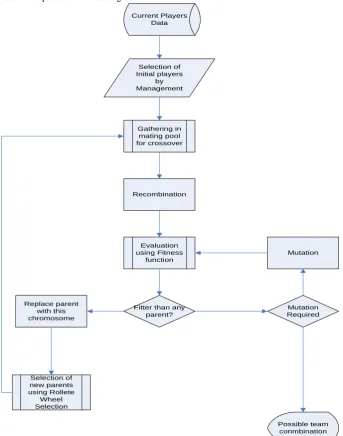
[image:2.595.142.486.237.674.2]GA works by initializing the population (Chromosomes) as elaborated below (see Figure 1). Secondly, Selection is made randomly (Rolette wheel selection algorithm may be used to avoid the influence of initial population), using the fitness function. Now the process of Crossover is to be made and at last Mutation (Optional). This will be repeated in a cycle till the user intervene or fittest combination found.
Fig 1: Procedural Flow for proposed method of team selection using GA
Nevertheless, inspired by natural phenomenon, heuristics, and techniques, the Genetic Algorithms (GAs) are, so far, the better in finding the solution of problems in the domain where; very little knowledge base is available. GA is a unfussy yet strong algorithm which can work very well in a variety of environments. Therefore very little priory
knowledge is enough to find a coherent solution. The solution provided by GA is in fact brings a good quality. Here, feasibility evaluation is required to find the best solution for any specific problem provided by the GA analogy i.e., selection, crossover and/or mutation.
Current Players Data
Selection of Initial players
by Management
Gathering in mating pool for crossover
Recombination
Evaluation using Fitness
function
Fitter than any parent? Replace parent
with this chromosome
Selection of new parents using Rollete
Wheel Selection
Mutation Required
Mutation
1
( )
Pr( )
(
)
ii n
j j
Fitness k
k
Fitness k
1 2 3 4 5 6 7 8 9 10 11 12 13 14 15 16
Fig 3: Structure of team using GA approach
16 17 18 27 12 21 22 31
50
70 71 72 83 89 96 91
Fig 4: Calculated one of the best chromosome for proposed team of 16 players
2.2 Limitation and Way Out of GA
Besides many strong problem solving strengths, GAs are superseded by any other modal specific algorithms, where universe of discourse is not complex, so, this is in fact very true that it has boundaries as well and eventually not successful in every situation [6]. One other issue is their time complexity which makes it not suitable for the real time applications. But to override this problem, we may pose the implementation of this Modality in parallel computation; to reduce the time complexity limitations and attain success. GA launched with all candidate solutions. A Model of modal is required to be formulated so the fitness or the degree of happiness can be calculated for feasible solution. Feasible solutions in the universe of discourse are collected based on following major steps.
a. Evaluation or the degree of fitness is tagged up to respective candidate after calculation. Initially, various pairs of candidate solutions are selected with higher degree of fitness. These candidate solutions are then dispatched to the mating pool for Crossover.
b. Mutation is performed if necessary.
Step–„a‟ & step–„b‟ continue-on in iteration till a suitable, necessary and sufficient solution with a particular number of generations have attained. That is again based on the degree of happiness for the specific situation. Evaluation and cost of fitness function may be matter of concern and settlement standard is the modality when better candidates are not improving well; after various iteration.
--- (i)
Where,
Pr( )
k
i= fitness of current kth chromosome
n = number of genes or size of chromosome (i.e., total number of players)
i = number of currently available players j = Number of all available players
An approach to designate a fair chance to the best candidates is mentioned in equation (i). Better generations are replaced with if parents are not better.
3.
MODULAR APPROACH FOR TEAM
SELECTION USING GA
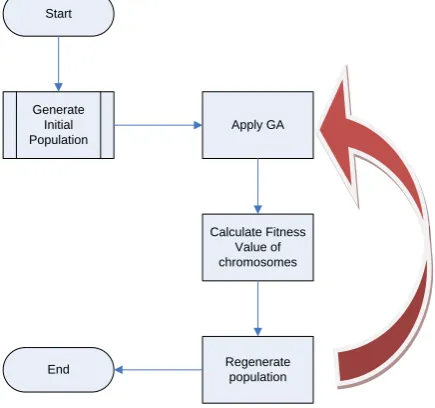
Eventually, a modular approach as shown in (see Figure 2) is proposed to adopt appropriate optimization technique considering different possibilities in aforesaid team selection problem [8].
[image:3.595.318.536.98.302.2]GA is allowed to evolve until best chromosome is not obtained. Stopping criteria of GA is discussed in next section.
Fig 2: Modular approach for team selection using GA
3.1 Generate Initial Population
In the proposed method we have made initial population of 10 chromosomes, initialized randomly. Our chromosomes contains randomly generated player IDs from the available set of players.
3.2 Applying GA
After generation of initial population, Crossover and Mutation operations are applied. Crossover is applied on two randomly selected chromosomes from our population. Similarly Mutation is applied on a randomly selected chromosome with a mutation rate of 0.5.
3.3 Calculate Fitness Values of
Chromosomes
In the next step fitness values of chromosomes are calculated using equation (ii) and equation (iii).
3.4 Regenerate Population
New population is generated using best 5 chromosomes from population based on fitness values calculated in above step. Other five chromosomes are newly generated randomly to complete set of 10 chromosomes.
Generate Initial Population
Apply GA
Calculate Fitness Value of chromosomes Start
4. GA FOR PLAYER SELECTION
Team is a combination of different types of players (see Figure 3) which shows a sample chromosome for a team of 16 players with 4 types of player categories. The description of squad is further elaborated in Table-1.
W = number of type-1 players. (Gene 1 to Gene 8)
(W = 8 in our case)
X = number of type-2 players. (Gene 9) (X= 1 in our case)
Y = number of type-3 players. (Gene 10 to Gene 14)
(Y = 5 in our case)
Z = number of type-4 players. (Gene 15 to Gene 16)
(Z = 2 in our case)
Table 1: Description of cricket team squad (16 players)
S. No. Type of player Description No. Of players
1. Type-1 Specialized batsman 8
2.
Type-2 Wicket keeper 1
4.
Type-3 Specialized bowler 5
3.
Type-4 All rounder 2
4.1 Fitness Function
(
)
1
(
)
(
)
1 (
)
i i i i i
GL
LMW
GP
FP
LMW
--- (ii)
/
k i
i n
F
FP n
--- (iii)
Where,
k
F
= Averagefitness of kth chromosomen = Number of genes or size of chromosome (i.e., total number of players) (16 in above case)
i = Number of available players
(FP)i = Fitness of ith player
(GP)i = Number of games played by ith player (gene)
(GL)i = Numbers of games lose by ith player (gene) (LMW)i= Number of games won by ith player (gene)
4.2 Resolving Tie between two players
If a tie occurs at some point during experiment, i.e., two or more players with same fitness value gather in the mating pool, it will be resolved using fitness values and experience values of players in tie or a Heuristic as given below:
--- (iv)
--- (v)
Where,
E (P)i = experience(fitness) of ith player
E (P)j = experience(fitness) of j
th
player
f (P) = difference in fitness value of current pair of player (having tie)5. Results & Discussion
There may be various combinations exist; pitching an optimal solution is inevitable. Therefore, genetic algorithm like heuristic algorithm may be tailored to solve this problem. We have applied proposed method on currently available players of Pakistan cricket team, shown above in Table 3. Based on our proposed fitness function of GA, we obtained fitness values of all players shown below in Table 2. Based on these fitness values following team combination is obtained shown below in Table 4 and (see Figure 4) that shows best chromosome evolved after 2257 generations of GA. Our obtained fitness value for this chromosome is
[image:4.595.359.500.378.706.2]0.9544220740625.
Table 2: Fitness values of players (calculated w.r.t. table-2)
Player ID Fitness Value (FP)
1 0.532307692 2 0.786259542 3 0.896296296 4 0.948717949 5 0.931712963 6 0.905555556 7 0.587443946 8 0.918604651 9 0.602409639 10 0.466666667 11 0.892335766 12 0.902702703 13 0.863636364 14 0.916666667 15 0.785714286 16 0.769230769 17 0.860759494 18 0.9296875 19 0.631578947 20 0.919831224 21 0.927350427 22 0.916666667 23 0.777777778 24 0.727272727
25 1
26 0.75
( )
i(
j)
Experience
E P
E P
|
f P
( ) |
Experience
Table 3: History of Pakistan Cricket Players for fitness evaluation
Player
ID Player Name
Matches
Played Won Lost
No. of wins (last M matches)
Specification
1 Shahid Afridi 325 173 152 0 ALL
2 Abdul Razzaq 262 143 112 1 ALL
3 Fawad Alam 27 13 14 4 BAT
4 Misbah-ul-Haq 78 52 24 5 BAT
5 Mohammad Yousuf 288 164 118 5 BAT
6 Umar Gul 90 55 34 3 BOW
7 Younis khan 223 125 92 0 BAT
8 Umar Akmal 43 21 21 5 BAT
9 M. Sami 83 48 33 0 BOW
10 Saeed Ajmal 45 21 24 0 BOW
11 Kamran Akmal 137 74 59 3 WC
12 Imran Farhat 37 19 18 4 BAT
13 Taufeeq Umar 22 13 9 2 BAT
14 Sohail Tanvir 36 23 12 3 BOW
15 Asad Shafiq 21 12 9 1 BAT
16 Azhar Mahmood 143 73 66 1 ALL
17 Imran Nazir 79 45 33 2 BAT
18 Shoaib Malik 192 106 81 5 ALL
19 Ahmed Shehzad 19 11 7 0 BAT
20 Mohammad Hafeez 79 39 38 5 BAT
21 Salman Butt 78 43 34 5 BAT
22 Mohammad Asif 38 16 19 5 BOW
23 Mohammad Amir 15 5 10 2 BOW
24 Wahab Riaz 22 15 6 0 BOW
25 Sarfaraz Ahmed 6 3 0 4 WC
26 Zulqurnan Haider 2 2 0 1 WC
Table 4: Proposed team combination as per GA approach
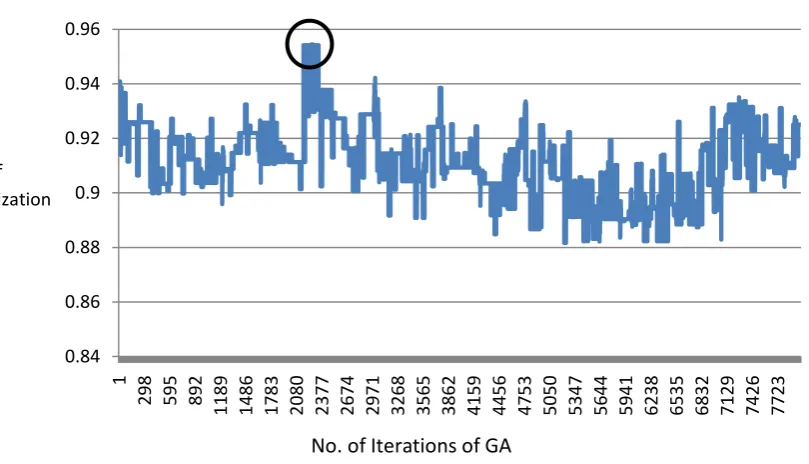
[image:5.595.250.345.528.753.2]We fixed stopping criteria for GA that if no change in fitness value occurs after 10000 iterations then stop. (see Figure 5) which shows convergence graph of GA. (see Figure 6) that
[image:6.595.56.507.162.464.2]shows variations in GA fitness values with respect to iterations. Best chromosome is obtained after 2257 generations.
Fig 5: An evaluation of GA computation on players’ data (using table-2 & table-3)
Fig 6: A map of variations in computation of GA fitness values
6 6.2 6.4 6.6 6.8 7 7.2 7.4 7.6
1
346 691 1036 1381 1726 2071 2416 2761 3106 3451 3796 4141 4486 4831 5176 5521 5866 6211 6556 6901 7246 7591 7936 8281 8626 8971 9316 9661
0.84 0.86 0.88 0.9 0.92 0.94 0.96
1
298 595 892 1189 1486 1783 2080 2377 2674 2971 3268 3565 3862 4159 4456 4753 5050 5347 5644 5941 6238 6535 6832 7129 7426 7723
No. of Iterations of GA
Improvement in results (Optimization)
No. of Iterations of GA
[image:6.595.81.486.446.678.2]6. CONCLUSION AND FUTURE WORK
A generic approach for multi player team selection has been developed using genetic algorithm. This automated process will select team on the basis of the previous outcomes i.e. either win or lose. This algorithm also takes care of the recent performance of the players by considering last M matches. We have applied this algorithm to cricket team selection; however it can be applied to any multiplayer sports. There are constraints which are specific to sports and this algorithm is flexible to accommodate those constraints. We have tested the algorithm on bunch (top) of Pakistani cricket players for test team selection. The results indicate the usefulness of the proposed algorithm. Extended version of above mentioned work with complex and specific domain with a flavor of constraint satisfaction problem solving technique would be more effective. Furthermore the individual performance of the player may also be included for team selection process.
7. REFERENCES
[1] B. Feng, Z. Jiang, Z. Fan, N. Fu, “A method for member selection of cross-functional teams using the individual and collaborative performances”. European Journal of Operational Research. June 16, 2010;203(3):652-661. Available from: Business Source Complete, Ipswich, MA.
[2] J. R. Koza, Genetic Programming. Cambridge, MA: (1992) The MIT Press/Bradford Books.
[3] Melanie Mitchell. An introduction to genetic algorithms. MIT Press, Cambridge, Massachusetts, 1996.
[4] S. N. Omkar, “Cricket team selection using genetic algorithm”, in: Proceedings of the International Congress on Sport Dynamics, Melbourne, Australia, (2003), pp. 1–9.
[5] A. Popov, Genetic Algorithms for optimization User Manual, 2005, Hamburg.
[6] F. Rothlauf. Representations for Genetic and Evolutionary Algorithms. Springer, Heidelberg, 2nd edition 2006.
[7] S. Siva Sathya Md. Shad Jamal, “Applying Genetic Algorithm to Select an Optimal Cricket Team”. International Conference on Advances in Computing, Communication and Control (ICAC3’09), January 23– 24, 2009, Mumbai, Maharashtra, India.
[8] Khan Z. A., Burney S. M. Aqil, Naseem J., Rizwan K., “Optimization of Power Consumption in VLSI Circuit”, IJCSI International Journal of Computer Science Issues, Vol. 8, Issue 2, March 2011.