Thyristor Compact Modeling based on Gummel-Poon
Model Including Parameter Extraction Procedure
Ahmed Shaker
Lecturer of Engineering Physics
Faculty of Engineering Ain Shams University
Cairo, Egypt
Gihan T. Sayah
Lecturer of Electronic Engineering Nuclear Materials
Authority Cairo, Egypt
Mohamed Abouelatta
Lecturer of Electronic Engineering Faculty of Engineering
Ain Shams University Cairo, Egypt
Abdelhalim Zekry
Professor of Electronic Engineering Faculty of Engineering
Ain Shams University Cairo, Egypt
ABSTRACT
In this paper, an improved approach for the modeling of power thyristors is presented. A modified two-transistor configuration based on the Gummel-Poon model is applied.
This model takes into account the conductivity modulation and carrier-carrier scattering by using nonlinear current sources. The current gain of the transistor is studied relating it to the injection level in order to provide a more insight of some SPICE parameters. The design parameters of the thyristor are related to circuit parameters using some analytical expressions. Then, the SPICE model parameters are extracted using Silvaco. The simulation results are compared with measurements showing good agreement indicating that the developed model could efficiently describe the performance of the thyristor under various practical operating conditions.
General Terms
Thyristor Modeling, TCAD, PSPICE.
Keywords
Modeling, Gummel-Poon, Conductivity Modulation, Design Parameters, Parameter extraction.
1.
INTRODUCTION
Several thyristor models have been developed for use in circuit simulators. Some models were developed by solving the semiconductor equations numerically. Ma and Lauritzen [1] developed a physical SCR (Silicon Controlled Rectifier) model by employing the Lumped-Charge modeling technique to simplify the device physics. The model parameters were few and didn't describe the performance of the device completely. A model based on the Fourier-series approach was implemented for system simulation using Matlab [2]. This approach was first proposed by Kallala [3] whose model was implemented in ESACAP [4].
Other models were based on the two-transistor configuration assuming Ebers-Moll model. Williams [5] developed a dc and ac model by applying the Ebers-Moll BJT model to the two-transistor configuration. Because relatively few model parameters can be extracted from measured data, this model is not proper for simulation purposes. Brambilla et al. [6] developed a numerical SCR model based on the Ebers-Moll equations and a topology represented by the three-junction devices. The parameter extraction of these models was not provided which limits the applicability of these models.
The two-transistor model based on Gummel-Poon BJT model was a motivation for many published papers. The first who considered that modeling technique was Hu and Ki [7]. Then, a composite model for the GTO (Gate Turn OFF) was introduced by Xiangning et al. [8]. A parametric sensitive analysis was performed with the complete composite model, and comparison between experiment and SPICE simulations was provided. Good results of this model indicate the validity of the model and the superiority to use the Gummel-Poon model instead of the Ebers-Moll model.
Recently, Sayah et al. [9] proposed a SPICE model based also on the Gummel-Poon model and taking conductivity modulation into account. The advantage of this work is that a full parameter extraction sequence is provided [10]. This modeling technique is chosen in this paper as a starting point for the model. Some effects are added by modeling the conductivity modulation of the base region including the carrier-carrier scattering which is important to accurately adjust the static characteristics. Also, a detailed study is provided to demonstarte the variation of the current gains of the two transistor components of the model with the injection level in order to provide an accurate identification of the SPICE parameters of the model. An extraction of the design parameters is provided based on some analytical expressions and a trimming of these parameters is done using measurements. Finally, a case study is taken and its design parameters are extracted. Static and dynamic behaviors using SPICE simulations are compared with measurements showing good agreement.
2.
MODEL DESCRIPTION
2.1
Main Structure
The basic structure of the thyristor is shown in Fig. 1(a) which also indicates the emitter short appearing as a simple resistance Rsh. The resistance of the lightly doped n-base layer
of the thyristor to the anode current flow is modeled by the resistance Rnb. The complete model is represented in Fig. 1(b)
Fig 1 (a) Basic structure of the thyristor and (b) The two-transistor SPICE model
2.2
Conductivity Modulation and
Carrier-Carrier Scattering
Concerning the resistance of the low-doped n-base, it could be modeled as follows:
[(
)
]
nB nb
n p n DB
W
R
qA
p
N
(1)where ∆p is the average excess hole concentration in the n-base. The sum of mobilities could be expressed in terms of the average excess hole concentration as [11]:
o o n p o
n
p
n
(2)Then inserting Eq. 2 into Eq. 1 leads to:
1
(
)
o o n DB
nb nB nB o
qA
n
p
qA
N
R
W
W
p
n
(3)It could be deduced from the previous equation that the n-base resistance could be expressed in terms of three basic resistances; Ronb, Rlim, and Rmod. Ronb is the unmodulated base
lim
o o
qA
n
(6)mod nB
o
W
R
qA
p
(7)The excess hole concentration can be approximately expressed in terms of the anode current as [12]:
A
(
nB pB)
p
qA W
W
p
I
(8)Finally the voltage drop on the conductivity modulated n-base is modeled as:
V
nB
I R
A nb (9)It is emphasized that the resistance Rnb accounts for the total
resistor effect of the n-base which is the base region of the pnp transistor, so Rnb = 0 is used for the SPICE pnp BJT
component in the simulation.
3.
NPN AND PNP CURRENT GAINS
One of main issues that should be covered well is the study of the DC current gains (dc alphas) and the small-signal current gains (ac alphas). These alphas play an important role in the modeling of the thyristor considering the two-transistor model. Although many contributions are found in literature considering the measurements and simulation of various thyristor structures [13], the phenomenon of alpha behavior according to the injection level is not covered well.
It is important to study this effect because the proposed model depends on some parameters which is very important to be modeled well or the results will deviate noticeably from measurements. Some of the vital model parameters are the SPICE parameters IKF and IKR. These parameters could be
determined falsely leading to simulation errors. When injection levels are not taken into consideration, there will be errors in evaluating the current gains that couldn’t be ignored. To study this effect in details, a thyristor structure whose fabrication details are given in [14] and [15] is simulated. A process simulator Athena Silvaco [16] is used for simulation of the fabrication processes and a device simulator Atlas Silvaco [17] is used for simulation of the terminal characteristics. First the thyristor is decomposed of its two constitute two transistors. Each transistor is virtually fabricated and simulated separately. Then the alphas of the each component are determined. The comparison with measurements is done whenever possible.
[image:2.595.56.282.64.460.2]Fig 2 Transistors components of the thyristor: (a) pnp and (b) npn
Fig 3 Doping profiles of the thyristor components: (a) pnp and (b) npn
The simulated thyristor structure is presented in [14]. The n-base width is about 180 µm with doping of 2×1014 cm-3. The p-base is an epitaxial layer whose doping is ranging from 1×1016 cm-3 to about 1×1018 cm-3. Now considering this thyristor structure and dividing it to its two transistor equivalence following the measurement technique by Gerlach [15] as shown in Fig. 2. The corresponding doping profiles are shown in Fig. 3.
Fig 4 The transfer characteristics of the pnp; all currents are given per width
In order to obtain the alphas of each transistor, DC simulations are carried out, using Silvaco, in which the base current is varied in fine steps (such as to prevent simulation convergence) for different values of VCE. A family of IC-VCE
curves results. For instance, in the case of the pnp transistor, Fig. 4 shows these family of curves. All important physical semiconductor parameters are taken into account like the carrier-carrier scattering, band gap narrowing, and doping-dependent lifetime and mobility. Using the resulting I-V characteristics, the alphas are easily extracted.
Fig 5 DC current gain of the pnp considering constant lifetime
(b) (a)
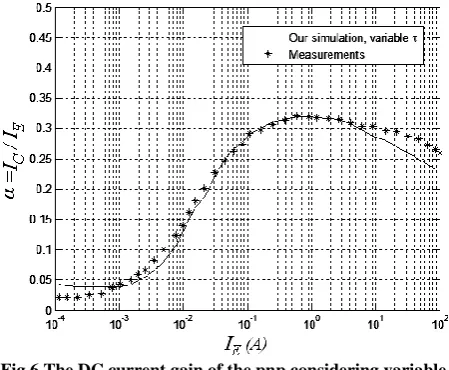
[image:3.595.91.503.270.438.2] [image:3.595.55.288.540.740.2] [image:3.595.317.538.566.750.2]reach a good fit between simulation and measurements, a behavioral model is applied for the injection-dependent lifetime. Unfortunately, there is no such model in Silvaco. So, the lifetime is changed manually by incrementing it with current.
Fig 6 The DC current gain of the pnp considering variable lifetime
The conclusion is that the value of IKF expected by regular
simulation is far from reality. The actual value is considerably larger than the value obtained by direct extraction. The problem when using a small value of IKF is that the summation
of alphas may be below unity. In such case, the thyristor will be OFF while it should be ON. So, in the presented circuit model of the thyristor, IKF is chosen to take a higher value
than extracted.
4.
IDENTIFICATION OF DESIGN
PARAMETERS
First a quick review of the main design and circuit parameters of the thyristor model used is provided. Then the relations between these parameters are provided. The main design and technological parameters for the power thyristor are:
1) Active die area, A 2) n-base width, WnB
3) n-base concentration, NDB
4) Effective minority-carrier, and high-level lifetimes in the wide n-base, τp, and τHL
5) p-base width, WpB
6) p-base concentration, NAB
An estimated value of the active die area A can be obtained from the forward current IF (which should be indicated in the
device datasheet). The current density J for most power thyristors is ranging from 100 A/cm2 to 500 A/cm2. Then, similar to power diodes [18], the initial value of A can be estimated as:
A
I
FJ
(10)4.2
Minority-Carrier Lifetime
The minority-carrier lifetime in the n-base could be related approximately to either the turn-off time or the fall time of the thyristor. The turn-off time tq (which is usually
found in datasheets) is related to τp via the following relation
[19]:
t
q
4.6 to 6.9
p (11)When the thyristor is commutated from a forward current IF to
a reverse current IR, the fall time tf of the reverse recovery
current IR (which is the time required for IR to be reduced from
90% to 10% of its initial value at the storage delay time) is also directly related to the lifetime τp, and it is given by [12]:
t
f
2.3
p (12)4.3
n-base Width and Doping
The actual breakdown voltage for the thyristor in the reverse-blocking mode is governed by the open-base transistor (P1N1P2) breakdown phenomenon. The optimization of the n-base width and doping is studied such that to obtain a specific value for the breakdown VR (which is also called
VBR(AK)). Following the approach given by Baliga [20], VR is
varied for some selected different values of τp (= 1, 5, and 10
µs). The optimum base width and doping theoretically calculated are shown in Fig. 7 for different values of VR.
To validate this theoretical approach, a typical thyristor structure is examined whose profile is shown in Fig. 8(a) with a wide n-base width of 360 µm and n-base doping of 2.1×1013 cm-3 [20]. The n-base doping is varied from 1×10¹³ to 7×1013 cm-3 and the breakdown voltage is calculated for each case. The lifetimes are fixed at τn = τp = 3 µs. The comparison
Fig 7 Optimum base width and base doping for τp = 1, 5, and 10 µs
Fig 8 (a) Doping profile of a thyristor, (b) Comparison between analytical model and Silvaco simulations for breakdown calculations
4.4
p-base Width and Doping
The p-base doping could be related to the breakdown voltage between the gate and cathode VBR(GK). A simple analytical
expression is used considering the critical electrical field concept:
2
2
r o Max B
AB
E
V
qN
(13)where EMax is the maximum electric field in the junction
which is given by [21]:
E
Max
4010
N
B1/8 (14)Then, knowing VBR of the gate-to-cathode junction, Eq. 13 and
Eq. 14 are solved to find the p-base doping NAB. This doping
should practically in the range of 1×10¹⁶-1×1017 cm-3 to obtain
a reasonable gain for the internal npn BJT component of the thyristor [20].
The base width WpB (or equivalently WP2) may be found based
upon the constraint about the forward voltage drop or the average ON-state voltage. The method relies on assuming a PIN diode behavior for the thyristor and calculating the forward characteristics [22]. This is practically accepted for cases when high injection prevails. In this case, the equivalent base diode width is WN1 + WP2 (where WN1 is the N-base
width).
5.
SIMULATION AND RESULTS
The BT151 is taken as a study case to validate the proposed model. Some selected design specifications from its datasheet are shown in Table 1. The main DC constraints are repetitive maximum voltage VRRM, the peak reverse gate voltage VRGM,
and the forward current IF. The main dynamic constraint is the
turn-off time tq at a certain condition.
(b) (a)
[image:5.595.67.533.312.512.2]followed. The die active area could be found by assuming a forward current density of 200 A/cm2 as an average value for a small thyristor. This gives an area of A = 0.0375 cm2. To extract the minority-carrier lifetime τp, the value of tq
specified in the datasheet is used. From Eq. 11, a maximum possible τp is required. Noting that tq is given at a temperature
of 125 ºC, the value of τp = 15.2 µs obtained should be
corrected to get it at room temperature. Using the temperature dependence of the lifetime given in [23], τp could be
calculated at room temperature which is about 10 µs. Next, consider the breakdown voltage from anode-to-cathode. Assuming a margin of about 400 V (50% safety factor is assumed), then the breakdown voltage VBR(AK) ≈ 1200 V.
From Fig. 7 the n-base width and doping are obtained. The values are NDB = 7.6×10
13
cm-3 and WnB = 175 µm. For the
breakdown voltage from gate-to-cathode, consider the datasheet constraint VRGM. Then VBR(GK) ≈ 5 V. Using Eq. 13
and Eq. 14: NAB = 2.18×1017 cm-3.
Now, for p-base width WpB, consider the forward voltage drop
at a certain condition as given in the datasheet. Applying a DC model of the power PIN diode [22], and taking τHL ≈ 20 µs, a
suitable WpB is found such that VF (forward voltage) doesn’t
exceed 1.4 V at a current of 23 A. A value of WpB ≈ 70 µm
was found from these calculations. To check that the values are all in the correct range, the DC I-V characteristics are simulated and compared with that given in the datasheet. Fig. 9 shows the difference between simulation and datasheet typical values for temperature of 125 ºC. A good match is seen, assuming h-parameters of 3×10-14 cm4/s on the average which is a suitable typical value.
Fig 9 Comparison between simulation and datasheet DC characteristics
o
m j
where Cm is the measured capacitance between the gate and
the anode. Cjo is the junction capacitance at zero bias which is
given by:
2
or o DB j
q
N
C
A
(16)From capacitance measurement: Cj = 85.4 pF and φ = 0.75 V.
Then the area A could be obtained from Eq. 16: A = 0.03 cm2 which is not far from the value obtained shortly. The difference may occur due to the uncertainty in determining the doping levels.
To complete the thyristor model one has to take into consideration the emitter shorts. A simplified model was proposed in [10]. From the model, the emitter short resistance was estimated to be Rsh ≈ 300 Ω. Table 2 shows a summary of
the design parameters that that will be used in simulation.
Table 2 Design parameters used for simulations
Once these values for the technological parameters of the thyristor are extracted, Athena is used to fabricate virtually the two transistors. Then a built-in simulator in Silvaco called QUICKBIP is used to extract the Gummel-Poon SPICE parameters [24]. QUICKBIP is fully automated and takes all important bipolar semiconductor parameters into consideration. The extracted SPICE parameters for the pnp transistor and npn transistor are shown in Table 3. The values of IKF and IKR are not reliable for simulation as stated previously. Instead, suitable high values are used for SPICE simulation.
Physical parameter Symbol Value
n-base doping concentration of
the pnp transistor NDB 7.6×1013 cm-3
p-base doping concentration of
the npn transistor NAB 2.18×1017 cm-3
n-base width of pnp transistor WnB 175 μm
p- base width of npn transistor WpB 70 μm
Area of the junction A 0.0375 cm2 Lifetime of minority carriers τp 10 μs
Table 3 Extracted SPICE parameters for the pnp and npn transistors
SPICE parameter Symbol npn pnp
Saturation current IS 5.6×10⁻¹⁴ A 1×10-12 A
Base-emitter saturation current ISE 2×10-14 A 4.7×10⁻¹¹ A
Base-collector saturation current ISC 7.3×10⁻¹⁴ A 6×10-11 A
Forward knee current IKF 125 mA 190 mA
Reverse knee current IKR 0 61 mA
Maximum forward current gain BF 4.5 2.5
Maximum reverse current gain BR 1.2 2
Base-emitter built-in potential VJE 0.88 V 0.3 V
Base-collector built-in potential VJC 0.3 V 0.3 V
Emitter-base junction capacitance CJE 2000 pF 60 pF
Collector-base junction capacitance CJC 54 pF 52 pF
Emitter-base capacitance gradient factor MJE 0.34 0.5
Collector-base capacitance gradient factor MJC 0.5 0.5
Ideal forward transit time TF 0.3 μs 6 μs
Ideal reverse transit time TR 1.5 μs 5 μs
Forward current emission coefficient NF 0.95 1
Reverse current emission coefficient NR 1 1
Low-current base-emitter emission coefficient NE 1.7 1.2
Low-current base-collector emission coefficient NC 1 1.2
5.3
Simulation Results
In this section, using the thyristor model parameters determined in the previous section, the static and dynamic characteristics of the thyristor under study are simulated. In order to turn-ON the thyristor, the gate current IG must be
[image:7.595.288.533.87.621.2]increased to a certain value. This value is found to be about 2.45 mA from measurements. The I-V characteristics in this case are a full thyristor curve having the conventional S-shape as shown in Fig. 10. Also, Fig. 11 shows the measured and simulated I-V curves for the diode mode of operation of the thyristor for different anode ranges. The results show good agreement between the simulation and measurements which indicates the usefulness of the model used for static characteristics.
Fig 10 Measured and simulated I-V characteristics of the thyristor at the turn-ON point (IG = 2.45 mA)
Fig 11 Measured and simulated I-V characteristics in the diode mode for (a) IG = 8 mA, and (b) IG = 9.5 mA
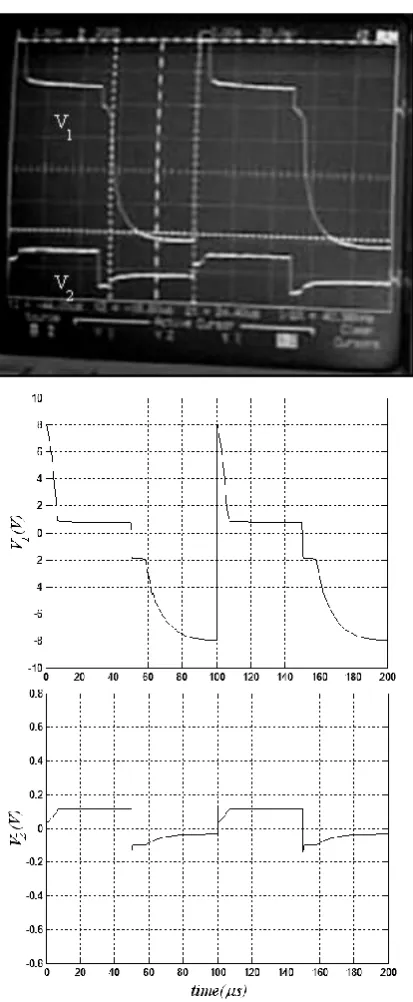
For the dynamic characteristics, the circuit shown in Fig. 12 is used for measurements and SPICE simulation. Fig. 13 shows the measured [9] and simulated switching waveforms at the same applied signals (square waveform of amplitude =16 V p-p, and frequency = 10 kHz). The waveforms are similar in shape and there is a good quantitative agreement between measured and simulated waveforms. This proves the validity of the model in tracing the dynamic behavior as well as the static one.
(a)
[image:7.595.60.275.510.685.2]Fig 13 Measured and simulated switching waveforms of the anode to cathode voltage
VAK = V1 and the anode current IA ≈ V2 /R3
7.
REFERENCES
[1] C. L. Ma, P. O. Lauritzen, P. Turkes, and H. J. Mattausch, “A physically-based lumped-charge SCR model,” In PESC 93 Rec., pp. 53-59, 1993.
[2] www.mathworks.com
[3] M. Kallala, “Représentation distribuée de la dynamique des charges dans la base large des thyristors Gate-Turn-off; application à un modèle de GTO pour la CA0 des circuits,” Thèse de Doctorat de l'INSA de Toulouse, France, no d'ordre 317, 1994.
[4] http://www.tsr-be.com/logiciel/index.html
[5] B. W. Williams, “State-space thyristor computer model,” Proc. Inst. Elect. Eng., Vol. 124, pp. 743-746, 1977. [6] A. Brambilla and E. Dallago, “A circuit level simulation
model of PNPN devices,” IEEE Trans. Computer-Aided Design, Vol. 9. pp. 1254-1264, 1990.
[7] C. Hu and W. F. Ki, "Toward a practical computer-aid for thyristor circuit design," in PESC Rec., IEEE Power Electronics Specialists Conference, 1980, pp. 174-179. [8] H. Xiangning, M. Li, and Q. Zhaoming, “A complete
composite GTO model for circuit simulations,” Journal of Electronics, vol. 15, no 2, pp. 130-137, 1998.
[9] G. T. Sayah, A. Zekry, H. F. Ragaie, and F. A. Soliman, “A SPICE model of a thyristor with high injection effects and conductivity modulation,” Proc. of the 15th International Conf. on Microelectronics (ICM), 2003, pp. 344-347.
[10]G. Sayah, “Modeling and simulation of large area electronic devices,” M. Sc. Thesis, Ain Shmas University, Faculty of Engineering, Cairo, 2002. [11]A. G. M. Strollo, “A New SPICE Model of Power P-I-N
Diode Based on Asymptotic Waveform Evaluation,” IEEE Trans. Power Electronics, Vol. 12, No. 1, pp. 12-20, 1997.
[12]W. Gerlach, “Thyristoren,” Sringer-Verlag, 1981. [13]M. Hatle, and J. Vobecky, “A new approach to the
simulation of small-signal current gains of pnpn structures,” IEEE Trans. Elect. Dev., Vol. 40. No. 10, 1993.
[image:8.595.64.271.230.732.2][15]W. Gerlach, “Power devices physics,” PHD Notes, unpublished.
[16]SILVACO International, 2D Process Simulation Software, Santa Clara, CA: Silvaco International. [17]SILVACO International, 2D Device Simulation
Software, Santa Clara, CA: Silvaco International. [18]H. Garrab et al., “On the extraction of PiN diode design
parameters for validation of integrated power converter design,” IEEE Trans. On Power Electronics, Vol. 20, No. 3, pp. 660-670, 2005.
[19]P. D. Taylor, “Thyristor design and realization,” chapter 3, New York: Wiley, 1993.
[20]B. J. Baliga, “Fundamentals of power semiconductor devices,” chapter 8, New York: Springer, 2008.
[21]S. M. Sze, “Physics of Semiconductor Devices,” chapter 2, New York: Wiley, 1981.
[22]F. Berz, “A simplified theory of the p-i-n diode,” Solid State Electronics, Vol. 20, Issue 8, 1977, pp. 709-714. [23]X. Kang, A. Caiafa, E. Santi, J.L. Hudgins, and P.R.
Palmer, “Parameter extraction for a power diode circuit simulator model including temperature dependent effects,” IEEE APEC Conf. Rec., pp. 452-458, Dallas, March 2002.