NEMIDSOFT, A Web-based Software as an Aid to the
Identification of Nematodes
1.
The genus
Merlinius
Siddiqi, 1970
(Nematoda:Tylenchida)
Ali Chenari Bouket
Department of Plant Protection, Faculty of Agriculture, University of Tabriz, 29 Bahman Avenue, University of Tabriz, Tabriz, Iran
ABSTRACT
The genus Merlinius includes plant-parasitic nematode species and is of great practical importance. This paper describes a web-based identification tool (which has been described by the authors under the name of Nemidsoft) that uses morphological characters and morphometrical data. The characters and data used are the same as the polytomous keys of Brzeski (1998) [1] and Handoo et al. (2007) [2]. For each specimen examined, the software compares characters of the unknown specimen with all 32 species of the genus accepted by Handoo et al. (2007) [2] that submitted in database. One or more than one species is suggested to the user by the software. Additional data of the suggested species (in some species) such as, images of the species, PDF of full-text or abstract of the reference article is present. A later step of the program has been adopted for analysis of cyst forming genus Heterodera.
Keywords
Database, Morphological characters, Morphometrical data, Nemidsoft, Web-based software
1.
INTRODUCTION
Biodiversity is the study of the variety of living beings. For the study of biodiversity in the phylum Nematoda, we need to be able to identify nematodes. For biodiversity, identification of nematodes is not limited to the recognition of a few economically important species but it means being able to put a name on any species observed. It also means being able to recognize that a specimen belongs to a new species [3]. The basis of any study of biodiversity is the morphological description of the existing species as they appear to us. Such descriptions must make it possible to identify other specimens of the described species. Once this done, other aspects of the well characterized species can be studied, including its genome, its ecology (relationships with its environment), its biology (feeding reproduction, host-parasitic relationships), its geographical distribution, its interest as a biological marker, and more. But except for some unicellular organisms such as viruses, certain bacteria, etc., the basis of all these studies will always be the morphological description of the species [4]. The large-scale identification must be done by biologists who are not expert taxonomists. It is argued that printed identification aids are too rigid and unreliable, and molecular identification aid is too limited. Only computer identification tools are flexible, reliable and general enough to give a non-taxonomist the possibility to identify any species [3]. Our
knowledge about morphology and anatomy and about the various other scientific fields represent an enormous amount of facts, which must be classified and stored in a way that supports easy retrieval. This is particularly true if the various experts that are interested in biodiversity want to be able to access data in fields with which they are not familiar. Only computer science offers some hope to put this huge mass of knowledge in order and store it in such a way that the data of interest can be retrieved easily [5]. If an universal data format were established for the description and illustrations or photos of new species and used in a database freely accessible through the internet together with properly designed software, such a database could allow any scientists with minimal training in nematode morphology (including molecular biologists) to identify the specimens they are working on. Development of such software would be a difficult task but not an impossible one [3]. For example the Generic Biological Information System Nemys (http://nemys.ugent.be/index.asp)
or General Identification System Genisys
(http://genysys.prd.fr/genisys_home.html) are published in the web. Some of desktop-based programs that developed in plant nematology are: NEMAID [6]; MARINEMA [7]; PARANEMA [7]; DORY [8]; DITYL [9]; USE OF BIKEY 7 [10]. Bye the way, identification keys for the computer are not always faster than printed ones [11], particularly if non-metrical data are used. A comparison of shapes, the structure of the front region with images in the identification key can only be made by viewing the specimens with a microscope. A printed key can easily be used next the microscope, but the combination of microscope and computer necessary for utilization of identification software has only recently been applied [12]. In this paper, the concepts we will present, have been developed over the last 2 years by a team consisting of one nematologist (ACB) and one computer engineer (AK) from a knowledge-based IT corporation Omni Net of Baran®. The project was called Nemidsoft (Nematode Identification Software). We believe that our software could readily be extended to identification of other biological groups.
characters. Tarjan (1973) [14] agreed with Siddiqi (1970) [13] that the six incisure character is consistent and easily recognisable and that establishment of Merlinius made the unwieldy genus Tylenchorhynchus less cumbersome, and Merlinius, therefore, justifiable. The present authors agree with both Siddiqi (1970) [13] and Tarjan (1973) [14] because their action makes it easier to handle this complex and large group of nematodes. At present Merlinius comprises 32 valid species of worldwide distribution that parasitize a wide variety of plants. The history of Merlinius was discussed by Hooper (1978) [15]. Fortuner and Luc (1987) [16] included Merlinius in the subfamily Telotylenchinae in the family Belonolaimidae. In a review of species of agriculturally important Tylenchorhynchus, Merlinius and Amplimerlinius, Anderson and Potter (1991) [17] also presented a good historical background of stunt nematode taxonomy. Brzeski (1998) [1] included all species of Merlinius in Geocenamus and gave a key to only 19 species and a compendium for 77 species. However, he concluded that the genus Geocenamus may be a collective group that could be split into separate genera, but additional investigations, including scanning electron microscope studies of cephalic structure, were needed for more of the species before any action could be taken. A number of taxonomic changes to stunt nematodes were proposed by different workers [18, 19, 20, 21, 22, 23, 24, 25, 26, 27, 28, 29, 16, 30, 31, 32, 33, 34, 35, 36]. In the study of Handoo et al. (2007) [2] Merlinius is defined as containing only those species with six lines in the lateral field. A desktop computer software based on cluster analysis for determination of Tylenchorhynchus and Merlinius have been developed [33]. In this study, we design a web-based software not only for Merlinius species but for all the genera and their species. Although, the completion of its details will be gradual and time-consuming work. The Merlinius section of the software is the same as in the polytomous key of Handoo et al. (2007) [2] which have not been replaced, but only supported by the software.
2.
METHODS
The software was developed in ASP.NET web language. The database was supported by SQL-Server. Nemidsoft is freely accessible through the web, www.nemidsoft.net. In the software, for every genus, morphological characters (as character and character states) and morphometrical data (as minimum and maximum data states) were defined. For example, in Merlinius Siddiqi, 1970 (based on Handoo et al. 2007 [2]); diagnostic morphometric data include: L, a, b, c, V, Lip annules, Stylet, Tail annules, c', Spicule and Gubernaculum length; and morphological characters and their states contain Tail shape (conoid, subcylindrical, cylindrical-rounded, sub-cylindrical-rounded); Tail terminus (finely rounded-pointed, broadly rounded, sub-hemispherical, hemispherical, rounded, bluntly pointed, bluntly pointed-indented, truncate, sharply pointed, pointed acute, filiform pointed, pointed); Tail tip (smooth, annulated, smooth-indented, smooth, finely rounded mucro); Lip region (offset, continuous, conoid, conoid-offset, conoid-narrow, narrow). In the program, there is not any limitations in the definition of all species of all genera of nematodes. Nemidsoft is very user-friendly and can be extended to other types of livings such as fungi, insects, etc. More information and more details about the species such as images, movies (about the biology of the nematodes) can be attached to the Wiki page of the species.
3.
DESCRIPTION OF THE USER
INTERFACE
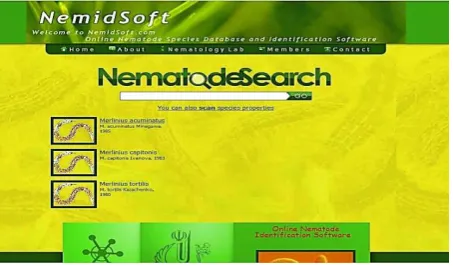
[image:2.595.317.549.150.300.2]In Nemidsoft homepage (http://www.nemidsoft.net), there are two main icons; Go to Database and Search in Database
[image:2.595.318.548.433.583.2](Fig. 1).
Fig. 1. Homepage of the Nemidsoft.
In Go to Database menu the user must fill in the form with his/her username and password to enter and see the database contents. Creation of ID for users is supported by Administrator of the website. Users must send their request to receive the ID through the Contact menu. After log in, the user can see the contents of the database such as Search,
Scan, Genera and Users icons without any possibility to edit or delete them (Fig. 2).
Fig. 2. Database layout of the Nemidsoft.
Fig. 3. The Search section of the program.
In Scan menu (the most important menu of the program), the user can choose the genus name via a combo-list. After select the genus and click on Go, the user can fill in the scan form based on morphological features. None of the characters were defined as a required matter. By mouse clicking on Scan, the software compares the entry with submitted information in the database and finally, one or more than one species are proposed to the user (Fig. 4).
Fig.4. The Scan section with a form that the user must be fill in with morphological features of the unknown species.
None of the characters were defined as required icons.
[image:3.595.316.549.175.327.2]Based on the details of the species, the user can decide to choose the most similar species that it is highly matched to his/her unknown species (Fig. 5).
Fig. 5. Search result page of the program.
[image:3.595.55.283.371.511.2]We try to complete the details of the species via adding the descriptions and photos, but many of the references are unavailable or under copyright rules and we cannot use them in completing the database of the program. So, our trying to complete the program will be a gradual work. In Genera icon, user can see the genera that have been defined to the program with their species. Some of Genera labeled with "in progress" that it means the process of completeness of the genera are not finished, and it is under maintenance (Fig. 6).
Fig. 6. The Genera section of the program.
In both genera and species with clicking on the name of the fungus, a page is opened as "wiki page". In this page, properties of the genera and species are present. In User icon, every user can see her/his profile and complete and/or edit it and can see the database of the genus. A hypothetical user ID of the site is: email: [email protected]; Password: user2012.
4. RESULTS
A serious problem in biodiversity studies is the limited availability and accessibility of data which are widely spread in several books, journals and off-line databases, as well as stored in biological collections, making it very time consuming to compile the necessary information. So, we consider Nemidsoft is useful for the rapid and accurate identification of nematodes. By the way, the program can be extended to some other icons such as gene sequence search
without substantial costs. In fact, polyphasic taxonomy is better than monophasic only based on morphologic or molecular characters. But, molecular data is not always available. In contrast, morphologic features is easier to obtain than molecular data.
5. DISCUSSION AND CONCLUSIONS
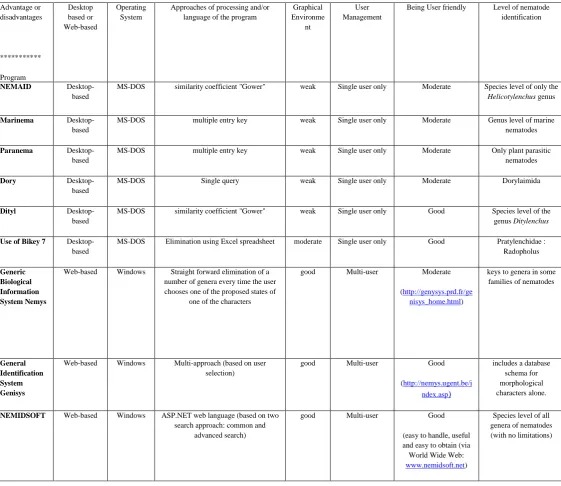
[image:3.595.57.284.606.739.2]"Gower", Helicotylenchus; Marinema [7], multiple entry key, Marine nematodes; Paranema [7], multiple entry key, plant parasitic nematodes; Dory [8], Dorylaimida; Dityl [9], similarity coefficient "Gower", Ditylenchus; Use of Bikey 7 [10], Elimination using Excel spreadsheet, Pratylenchidae : Radopholus. The web-based identification programs have many advantages over the desktop-based programs of the late 1980s. First, household computer usage in U.S increased from 22.8% in 1993 to 61.8% in 2003 [38]. In addition, broadband Internet access is becoming more common, and wireless Internet access via cell technology allows access for users in remote areas. Increasingly, common smart phones also provide Internet access without the expense or weight of the laptop; users can either directly access the website or have news emailed to their phone. Another factor favoring web-based systems is the ability to access and integrate or complete data from widely separated locations. For example, definition of many administrators for the website is possible. So, several administrators, probably around the world can enter and edit their data in the Nemidsoft and in the other hand, simultaneous completeness of the program will happen. Perhaps, the greatest advantages of the web-based programs over the desktop-based is that changes in the details of the database at the server instantly propagated to all users at the next log in; so errors can be quickly corrected without having to send out notices the users need to update their systems. One of the web-based nematode database and identification tool is the Generic Biological Information System Nemys, includes keys to genera in some families, but the identification characters used are ad hoc characters, each one being defined and valid only for the family considered, which means that the database is far from being generic. In general, the identification process in Nemys seems to be a straightforward elimination of a number of genera every time the user chooses one of the proposed states of one of the characters. Such a system does not degrade gracefully when the user makes a single mistake [4]. Another example of such web-based system is General Identification System Genisys, includes a database schema for morphological characters alone [3]. Genysis must not rely on a single approach but must help the identifier with all possible approaches by providing him/her with a set of tools. The user will then be free to select the tool deemed most appropriate at each step of an identification session [39, 40].
The present software supports the most successful and most general key of the genera, especially the genus Merlinius by simplifying the handling of morphological features and morphometrical data. Our aim is to facilitate of the identification of nematode species and to present and further develop software which is easy to handle, useful and easy to obtain (via World Wide Web: www.nemidsoft.net). This simple aim also implies a development for the near future; Nemidsoft will not only support the most important identification key of the genus Merlinius, but also of the other genera such as Heterodera, Tylencholaimellus , Tylenchorhynchus and etc. Existing printed references or desktop computerized identification tools cannot be trusted to non-taxonomists for identification of all the specimens collected. A freely accessible identification tool via internet such as the one outlined here, probably can solve this problem. The comparative study of existing programs is presented in Table 1. The biggest technical problem to date have been related to different web browsers. Most of the open source browsers have few problems. Among these, such as Mozilla Firefox, Internet Explorer, Maxthon and Google Chrome, Mozilla Firefox has a high compatibility with
Nemidsoft. Probably, several changes in settings of other browser must be done to ensure compatibility with Nemidsoft.
6. ACKNOWLEDGMENT
I thank Dr. G. Niknam (Associate Professor of Nematology, Department of Plant Protection, Faculty of Agriculture, University of Tabriz) for his financial support to design the program, Dr. H. Mojtahedi from USDA and Mr. Amin Khodabande (AK) from the OmniNet of Baran for their valuable comments and great helps to do the project.
7. REFERENCES
[1] Brzeski, M.W. 1998. Nematodes of Tylenchina in Poland and temperate Europe. Warszawa, Poland, Muzeum i Instytutu Zoologii Polska Akademia Nauk, 397 pp.
[2] Handoo, Z.A., Khan, A. & Islam, S. 2007. A key and diagnostic compendium to the species of the genus Merlinius Siddiqi, 1970 (Nematoda: Tylenchida) with description of Merlinius khuzdarensis n.sp. asoociated with date palm. Nematology 9, 251-266.
[3] Diederich, J, Fortuner, R and Milton, J. 2000. Genysis and computer-assisted identification of nematodes. Nematology. 2: 17-30.
[4] Luc, M, Doucet, M.E, Fortuner, R, Castillo, P, Decraemer, W and Lax P. 2010. Usefulness of morphological data for the study of nematode biodiversity. Nematology. 12: 495-504.
[5] Fortuner, R. 2002. Uniformity and representation of taxonomic and other characters and semi-automatic extraction using computer tools. Nematology. 4: 583-591.
[6] Fortuner, R and Wong, Y. 1985. Review of the genus Helicotylenchus Steiner, 1945. 1. A computer program for identification of the species. Revue de Nematologie 7, 385-392.
[7] Tarjan, A.C. 1989. Multiple entry identification keys. In: Fortuner, R. (Ed.). Nematode identification and expert system technology. New York, USA. Plenum Publishing Corp, pp. 27-30.
[8] Zullini, A. and Marganelli, G. 1989. A new A new computer program for nematode identification. Computer Applications in the Bioscience 5, 243-244. [9] Viscardi, T. and Brzeski, M.W. 1993. DITYL:
Computerized key for species identification of Ditylenchus (Nematoda: Anguinidae). Fundamental and Applied Neamtology 16, 389-392.
[10] Ryss, A. 1997. Computerized identification of species of the genus Radopholus (Tylenchida: Pretylenchidae). Russian Journal of Nematology 5, 137-142.
[11] Tardivel, G.M and Morse, D.R. 1998. The role of the user in computer based species identification. In: Bridge P, Jeffries P, Morse DR, Scott PR (eds.), Information technology, plant pathology and biodiversity. pp. 247-259. Wallingford, UK, CAB International.
1922 (Nematoda: Dorylaimoidea), Nematology. 4: 845-852.
[13] Siddiqi, M. R. 1970. On the plant-parasitic nematode genera Merlinius gen. n. and Tylenchorhynchus Cobb and the classification of the families Dolichodoridae n. rank. Proceedings of the Helminthological Society of Washington 37, 68-77.
[14] Tarjan, A.C. 1973. A synopsis of the genera and species in the Tylenchorhynchinae (Tylenchoidea, Nematoda). Proceedings of the Helminthological Society of Washington 40, 123-140.
[15] Hooper, D.J. 1978. The Tylenchidae. The
identification of stunt nematodes
(Tylenchorhynchinae, Merliniinae and Trophurinae), especially those in Western Europe. In: Anon. Spiral and stunt nematodes. Manual prepared for workshop sponsored by the Nematology Group of the Association of Applied Biologists, Rothamsted Experiment Station, UK, pp. 1-21.
[16] Fortuner, R. and Luc, M. 1987. A reappraisal of Tylenchina (Nemata). 6. The family Belonolaimidae Whitehead, 1960. Revue de Nématologie 10, 183-202. [17] Anderson, R.V. and Potter, J.W. 1991. Stunt nematodes:
Tylenchorhynchus, Merlinius, and related genera. In: Nickle, W.R. (Ed.). Manual of agricultural nematology. New York, USA, Marcel Dekker, pp. 529-586.
[18] Siddiqi, M.R. 1979. Taxonomy of the plant nematode sub- family Merliniinae Siddiqi, 1970, with descriptions of Merlinius processus n. sp., M. loofi n. sp. and Amplimerlinius glo- bigerus n. sp. from Europe. Systematic Parasitology 1, 43-60.
[19] Siddiqi, M.R. 1986. Tylenchida parasites of plants and insects. Wallingford, UK, CABI Publishing, 645 pp.
[20] Siddiqi, M.R. 2000. Tylenchida parasites of plants and insects, 2nd edition. Wallingford, UK, CABI Publishing, 833 pp.
[21] Baldwin, J.G and Bell, A.H. 1981. Pararotylenchus n. gen. (Pararotylenchinae n. subfam., Hoplolaimidae) with six new species and two new combinations. Journal of Nematology 13,111-128.
[22] Lewis, S.A. and Golden, A.M. 1981. Description of Trilineellus clathrocutis n. gen; n. sp. (Tylenchorhynchinae: Tylenchida Thorne, 1949) with a key to species and observations on Tylenchorhynchus sensu stricto. Journal of Nematology 13, 135-141. [23] Sturhan, D. 1981. Studies on Geocenamus species from
Germany (Nematode: Dolichodoridae). Nematologica 27, 306-314.
[24] Anderson, R.V. and Ebsary, B.A. 1982. Canadian species of Merlinius Siddiqi, 1970 and a diagnosis and description for Mulveyotus hyalacus n. gen., n. sp. (Nematoda: Tylenchorhynchidae). Canadian Journal of Zoology 60, 521-529.
[25] Jairajpuri, M.S. 1982. Some studies on Tylenchorhynchinae: The subgenus Bitylenchus Filipjev, 1934, with description of Tylenchorhynchus (Bitylenchus) depressus n. sp. and a key to species of Bitylenchus. Mededelingen van de Fakulteit
Landbouwwetenschappen Rijksuniversiteit Gent 47, 765-770.
[26] Mulk, M.M. and Siddiqi, M.R. 1982. Three new species of hoplolaimid nematodes from South America. Indian Journal of Nematology 12, 124-131.
[27] Powers, T.O., Baldwin, J.G. and Bell, A.H. 1983. Taxonomic limits of the genus Nagelus (Thorne and Malek, 1968) Siddiqi, 1979 with a description of Nagelus borealis n. sp. from Alaska. Journal of Nematology 15, 582-593.
[28] Jairajpuri, M.S. and Hunt, D.J. 1984. The taxonomy of Tylenchorhynchinae (Nematoda: Tylenchida) with longitudinal striae and ridges. Systematic Parasitology 6, 261-268.
[29] Skwiercz, A.T. 1984. Two new species of the genus Scutylenchus Jairajpuri, 1971 (Tylenchoidea: Nematoda) from Poland with a key to the species. Revue de Nématologie 7, 87-93.
[30] Golden, A.M., Maqbool, M.A. and Handoo, Z.A. 1987. Description of two new species of Tylenchorhynchus Cobb, 1913 (Nematoda: Tylenchida), with details on morphology and variation of T. claytoni. Journal of Nematology 19, 58-68.
[31] Maqbool, M.A. and Shahina, F. 1987. Nematodes of northern areas in Pakistan. Description of Nagelus saifulmulkensis n. sp. and Merlinius montanus n. sp. (Nematoda: Merliniinae) with notes on three species of Tylenchorhynchus Cobb, 1913. Revue de Nématologie 10, 289-294.
[32] Mahajan, R. 1988. A conspectus of the genus Tylenchorhynchus Cobb, 1913 (Nematoda: Tylenchorhynchinae). Indian Journal of Nematology 18, 199-206.
[33] Rey, J.M. and Mahajan, R. 1988. A computer method for identifying nematode species. 2. Genera Tylenchorhynchus and Merlinius (Nematoda:
Tylenchina). Revue de Nématolo-
gie 11, 269-277.
[34] Esser, R.P. 1991. A computer ready checklist of the genera and species of phytoparasitic nematodes, including a list of mnemonically coded subject categories. Bulletin 13. Florida Department of Agriculture and Consumer Services, Division of Plant Industry, Contribution No. 387, Gainesville, Florida, USA, 185 pp.
[35] Brzeski, M.W. and Dolinski, C.M. 1998. Compendium of the genus Tylenchorhynchus Cobb, 1913 sensu lato (Nematoda: Belonolaimidae). Russian Journal of Nematology 6, 189-199.
[36] Handoo, Z.A. 2000. A key and diagnostic compendium to the species of the genus Tylenchorhynchus Cobb, 1913 (Nematoda: Belonolaimidae). Journal of Nematology 32, 20-34.
[37] Fortuner, R. 1989. Nematode identification and expert system technology. New York, NY, USA, Plenum Publishing Corp, ix + 386 pp.
Washington, D.C.
[39] Diederich, J. and Milton, J. 1989. NEMISYS, an expert system for nematode identification. In: Fortuner, R. (Ed.). Nematode identification and expert system technology. New York, USA, Plenum Publishing Corp, pp. 45-63.
[image:6.595.18.580.183.669.2][40] Diederich, J. and Milton, J. 1993. NEMISYS, an expert workstation, a computer science perspective. In: Fortuner, R. (Ed.). 1993. Advances in computer methods for systematic biology: artificial intelligence, databases, computer vision. Baltimore, MD, USA, The Johns Hopkins University Press, pp. 165-179.
Table 1. The comparative study of existing programs.
Advantage or disadvantages
***********
Program
Desktop based or Web-based
Operating System
Approaches of processing and/or language of the program
Graphical Environme
nt
User Management
Being User friendly Level of nematode identification
NEMAID
Desktop-based
MS-DOS similarity coefficient "Gower" weak Single user only Moderate Species level of only the
Helicotylenchus genus
Marinema
Desktop-based
MS-DOS multiple entry key weak Single user only Moderate Genus level of marine
nematodes
Paranema
Desktop-based
MS-DOS multiple entry key weak Single user only Moderate Only plant parasitic
nematodes
Dory
Desktop-based
MS-DOS Single query weak Single user only Moderate Dorylaimida
Dityl
Desktop-based
MS-DOS similarity coefficient "Gower" weak Single user only Good Species level of the genus Ditylenchus
Use of Bikey 7 Desktop-based
MS-DOS Elimination using Excel spreadsheet moderate Single user only Good Pratylenchidae : Radopholus
Generic Biological Information System Nemys
Web-based Windows Straight forward elimination of a number of genera every time the user chooses one of the proposed states of
one of the characters
good Multi-user Moderate
(http://genysys.prd.fr/ge nisys_home.html)
keys to genera in some families of nematodes
General Identification System Genisys
Web-based Windows Multi-approach (based on user selection)
good Multi-user Good
(http://nemys.ugent.be/i ndex.asp)
includes a database schema for morphological characters alone.
NEMIDSOFT Web-based Windows ASP.NET web language (based on two
search approach: common and advanced search)
good Multi-user Good
(easy to handle, useful and easy to obtain (via World Wide Web:
www.nemidsoft.net)