Real Power Loss Minimization using Big Bang Big
Crunch Algorithm
ABSTRACT
In power system operation, minimizing the power loss in transmission lines and/or minimizing the voltage deviation at the load buses by controlling the reactive power is referred to as optimal reactive power dispatch (ORPD). ORPD is necessary for secured operation of power systems with regard to voltage stability. In this paper, the nature inspired Big Bang – Big Crunch (BB-BC) algorithm is introduced to solve multi constrained optimal reactive power flow problem in power systems. Generator bus voltages, transformer tap positions and switchable shunt capacitor banks are used as variables to control the reactive power flow. Big Bang – Big Crunch algorithm was tested on standard IEEE 30 bus system and the results are compared with other methods to prove the effectiveness of the new algorithm. The results are quite encouraging and the algorithm is found to be simple and easy to implement.
KEYWORDS
Big Bang – Big Crunch Algorithm, Optimal Reactive Power Dispatch, Loss Minimization, Voltage Deviation Minimization.
1.
INTRODUCTION
The increased demand for electric power and the insufficient power generation and transmission facility forces the power system networks is being operated under stressed conditions. The security of a power system is under threat when it is operated at stressed conditions and may result in voltage instability. Nowadays voltage instability has become a new challenge to power system planning and operation. Insufficient reactive power availability or non-optimized reactive power flow may lead a power system to insecure operation under heavily loaded conditions [1]-[2]. By reallocating reactive power generations in the system by adjusting transformer taps, generator voltages and switchable VAR sources, the problem can be solved to a far extent.
Apart from the aforementioned methods, the system losses can also be minimized via redistribution of reactive power in the system for improving the stability of a power system. Large amount of reactive power flow in a system is indicated by the real power loss in the system. Therefore minimizing the real power loss ensures optimized reactive power flow (ORPF) through the lines. Reactive power optimization by real power loss minimization increases the power system economics to some extent. Reactive power optimization by minimization of real power loss has long been attempted for voltage stability improvement [3]-[4].
Optimal reactive power flow is an important tool in terms of secure and operation of power system. It is a powerful concept for power system operation and planning [5]-[6]. In ORPF, the network active power loss is reduced and voltage profile is improved while satisfying a given set of operating and physical
constraints [7]-[8]. Reactive power flow is optimized by properly setting the values of
control parameters. A number of conventional optimization methods
have been exploited for this objective. Techniques such as non linear programming technique [9], gradient based optimization algorithm are used to solve ORPF problem algorithms [10] are used to solve ORPF problem. But it has several disadvantages like large numerical iteration, insufficient convergence properties; which leads to large computation and more execution time.
The recently developed meta-heuristics based algorithms are proving better performance than the conventional methods. They find global best or nearly global best solutions for engineering problems. These algorithms are better utilised for power system optimization. Some of them are Tabu Search [11], Simulated Annealing (SA) [12], Genetic Algorithm (GA) [13], Evolutionary Programming (EP) [14]-[15] Hybrid Evolutionary Programming (HEP) [16], Particle Swarm Optimization PSO [17]-[19], Chaotic Ant Swarm Optimization (CASO) [20], Bacterial Foraging Optimization (BFO) [21], Ant Colony Optimization (ACO) [22], Differential Evolution (DE) [23] and Quantum Genetic Algorithm (QGA) [24] are developed which provides fast and optimal solution.
Conventional methods are sensitive to initial guess of the search point where functions have multiple local minima and not efficient in handling problems of discrete variables [25]. In addition to this a lot of algorithms have been presented to solve optimal reactive power dispatch. Chien-Feng Yang proposed a system for limiting voltage variations by means of switchable shunt reactive compensation and transformer tap setting [26]. Other new optimization techniques are based on using fuzzy logic [27], lagrangian decomposition method [28].
BB-BC algorithm is a recent development and it very simple and easy to implement [29]-[30]. This algorithm has less number of parameters and has good convergence characteristics. In this paper, the BB-BC method is used for ORPD problem. The performance of this method is compared with other algorithms to prove its efficiency.
2.
PROBLEM FORMULATION
The objective of this work is to optimize the reactive power flow in a power system by minimizing the real power loss and sum of load bus voltage deviation. An augmented objective function is formed with the two objective components and weights.
2.1
OBJECTIVE FUNCTION
The objective function of this work is to find the optimal settings of reactive power control variables including the rating shunt of var compensating devices which minimizes the real power loss.
2.1
Real power loss minimization (PL)
The total real power of the system can be calculated as follows
R.Suresh
Assistant Professor, Dept./EEE, SKP Engineering College,
Tiruvannamalai, India
C.Kumar,
PhD.Director – Academic, PG-HOD/EEE, SKP Engineering College,
Tiruvannamalai, India
S.Vignesh
PG student,Dept./EEE, SKP Engineering College,
Tiruvannamalai, India
S.Jaisiva
PG student, Dept./EEE, SKP Engineering College,] (1)
Where, NL is the total number of lines in the system; Gk
is the conductance of the line ‘k’, Vi and Vj are the magnitudes of
the sending end and receiving end voltages of the line; are angles of the end voltages.
2.2 Constraints
The minimization problem is subject to the following equality and inequality constraints
2.2.1 Equality constraints Load Flow Constraints:
The equality constraints represent the load flow equations, which are given below for ith bus:
(2)
(3)
where Pgi , Qgi are the active and reactive power of ith generator,
PDi , QDi the active and reactive power of ith load bus.
2.2.2 Inequality constraints Generator constraints.
Generator voltage and reactive power of ith bus lies
between their upper and lower limits as given below:
i= 1,2,....NG (4) i= 1,2,....NG (5)
Where , are the minimum and maximum voltage of ith
generating unit and Qmin gi , Qmax gi are the minimum and maximum reactive power of ith generating unit.
Load bus constraints.
i= 1,2,....NL (6)
Where , are the minimum and maximum load voltage
of ith unit.
Transmission line constraints.
i= 1,2,...,NTL (9)
Where SL1 is the apparent power flow of ith branch and is the
maximum apparent power flow limit of ith branch.
Transformer tap constraints.
Transformer tap settings are bounded between upper and lower limit as given below:
i= 1,2,...,NT (10)
Where , are the minimum and the minimum and
maximum tap setting limits of ith transformer.
Shunt compensator constraints.
Shunt compensation are restricted by their limits as follows:
, i=1,2....,NC (11)
Where , are the minimum and maximum VAR injection limits of ith shunt capacitor.
3.
BIG BANG – BIG CRUNCH
ALGORITHM
3.1
OVERVIEW
A new nature inspired optimization technique which has low computational time and high convergence speed called BB-BC is introduced recently [29]-[30]. It has two phases, Big bang phase and Big crunch phase.
In Big Bang phase, candidate solutions are randomly distributed over the search space. The main features of Big Bang phase is that the energy dissipation produces disorder and randomness and in a Big Crunch phase, randomly distributed particles are drawn into an order.
The Big Bang-Big Crunch optimization method generates random points in the Big Bang phase and shrinks these points to a single point in the Big Crunch phase after a number sequential Big Bangs and Big Crunches.
The Big Bang phase is followed by the Big Crunch phase. The Big Crunch is a convergence operator that has many inputs but only one output, which is named as the ‘‘centre of mass”, since the only output has been derived by calculating the centre
of mass. The point representing the centre of mass that is denoted by Xc is calculated according to the following equation.
where Xi is a point within an D-dimensional search space
generated, f(Xi) is a fitness function value of this point, NP is the
population size in Big Bang phase. The convergence operator in the Big Crunch phase is different from ‘exaggerated’ selection sin ce the output term may contain additional information (new candidate or member having different parameters than others) than the participating ones, hence differing from the population members. This one step convergence is superior compared to selecting two members and finding their centre of gravity. This method takes the population members as a whole in the Big Crunch phase that acts as a squeezing or contraction operator; and it, therefore, eliminates the necessity for two-by-two combination calculations.
After the Big Crunch phase, the algorithm must create new members to be used as the Big Bang of the next iteration step. This can be done in various ways, the simplest one being jumping to the first step and creating an initial population. The algorithm will have no difference than random search method by so doing since latter iterations will not use the knowledge gained from the previous ones; hence, the convergence of such an algorithm will most probably be very low. In this work, the new candidates are generated around the centre of mass and knowledge of centre of mass of previous iteration is used for better convergence. The parameters to be supplied to normal random point generator are the centre of mass of the previous step and the standard deviation. The deviation term can be fixed, but decreasing its value along with the elapsed iterations produces better results.
3.2 BIG BANG BIG CRUNCH APPLIED TO ORPF:
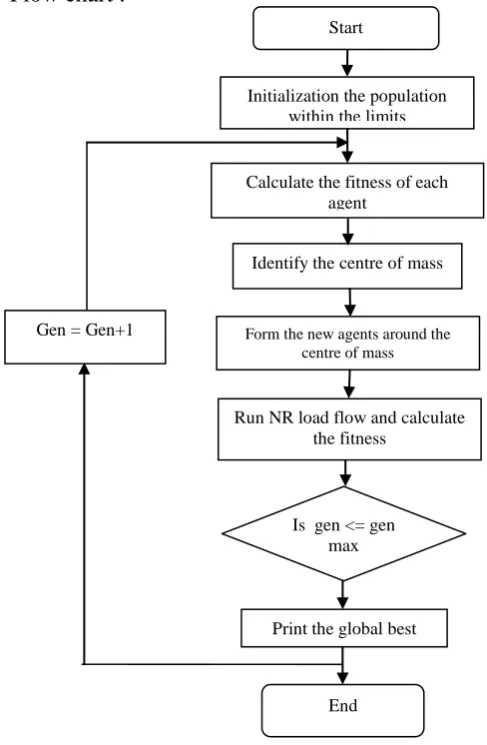
Big Bang Big Crunch algorithm involves the steps shown below in reactive power optimization
manner respecting the limits of searchspace.
Step 2: Calculate the fitness function values of all candidate solution by running the NR load flow. Step 3: Determine the centre of mass which has global best fitness using equation (10).
Step 4: Calculate new candidate around the centre of mass by adding/subtracting a normal randomnumber according to equation (11).
Step 5: Return to step 2 until stopping criteria has been achieved.
Flow chart :
[image:3.595.328.538.76.270.2]
Fig 1.Flow chart for BB-BC algorithm
4.
NUMERICAL RESULTS AND
DISCUSSIONS
The performance of the proposed BB-BC algorithm based reactive power optimization method is tested in the medium size IEEE 30 bus system. The algorithm is coded in MATLAB environment and a Core 2 Duo, 2.8 MHz, 2GB RAM based PC is for the simulation purpose.
Figure 2. Single line diagram of IEEE-30 bus system.
The test system taken has six generating units connected to buses 1,2,5,8,11 and 13. There are 4 regulating transformers connected between bus numbers 6-9, 6-10, 4-12 and 27-28. Two shunt compensators are connected in bus numbers 10 and 24. The system is interconnected by 41 transmission lines. The control variables are generator’s voltages, tap settings of the regulating transformers and var injection of shunt capacitors.
[image:3.595.49.293.189.562.2]The upper and lower bounds of the different control variables are given in table 1.
Table 1. Control variable limits
4.1 Minimization of real power loss
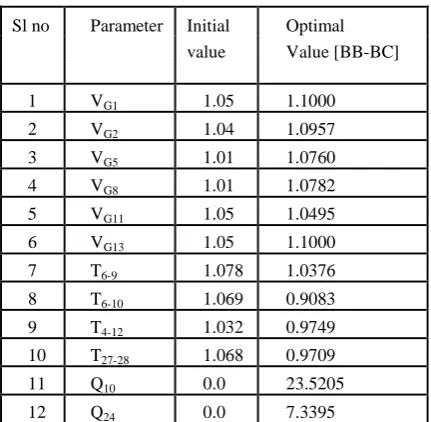
The real power transmission loss minimization is the major component of reactive power optimization and it needs more attention. This case takes only the real power loss minimization as the objective function. The optimal control variables of the overall system obtained by BB-BC algorithm for this case are shown in table 4.
S. No Control Variable Limit
1. Generator voltage (VG) (0.9-1.1) p.u.
2. Tap setting(TP) (0.9 -1.1) p.u.
3. Static Var compensators (Qsvc) (0-25) MVAR
Run NR load flow and calculate
the fitness Initialization the population
within the limits
Calculate the fitness of each agent
Identify the centre of mass
Print the global best Form the new agents around the
centre of mass
End Gen = Gen+1
[image:3.595.316.544.426.536.2]Table 4. Optimal parameter values.
In this case the BB-BC algorithm better optimizes real power loss as shown in table 5. The reduction in loss indicated by BB-BC algorithm is highly encouraging and it is only 4.807 MW.
Table 5. Minimization of objective terms.
[image:4.595.50.275.502.686.2]The good convergence characteristics of BB-BC In the objective of real power loss minimization is plotted in figure 6.
Figure 6. Convergence characteristics of BB-BC
5.
CONCLUSIONS
In this paper, a novel BB-BC Based optimization algorithm is proposed to solve multi-objective optimal reactive power flow
problem. The performance of the proposed algorithm for solving ORPF problems is demonstrated using IEEE-30 bus system. The results are compared to those of other algorithms like PSO and BBO. The test results clearly demonstrate that BB-BC outperforms other reported methods in terms of solution quality. The superiority of the proposed BB-BC method is more pronounced for large system as is evident from IEEE-30 bus system. From all simulation results it may finally be concluded that among all the algorithms, BB-BC based optimization method is capable of achieving global optimal solution. This paper shows that such excellent results with different objective functions shows that makes the proposed BB-BC optimization technique is good in dealing with power system optimization problems.
6. REFERENCES
[1] P.K. Roy , S.P. Ghoshal , S.S. Thakur, “Optimal VAR Control for Improvements in Voltage Profiles and for Real Power Loss Minimization using Biogeography Based Optimization”, Electrical Power and Energy Systems, Vol. 43, No.1, pp. 830–838, December 2012. [2] Abbas Rabiee, Maziar Vanouni, Mostafa Parniani,
“Optimal Reactive Power Dispatch for Improving Voltage Stability Margin Using a Local Voltage Stability Index”, Energy Conversion and Management, Vol. 59, pp. 66-73, July 2012.
[3] Kursat Ayan, Ulas kilic, “Artificial Bee Colony Algorithm Solution for Optimal Reactive Power Flow”, Applied Soft Computing, Vol.12, No. 5, pp. 1477–1482, May 2012.
[4] M. Varadarajan, K.S. Swarup, “Differential Evolutionary Algorithm for Optimal Reactive Power Dispatch, Electrical Power & Energy Systems, Vol. 30, No. 8, pp. 435–441, October 2008.
[5] Amit Saraswat, Ashish Saini, “Multi-Objective Optimal Reactive Power Dispatch Considering Voltage Stability in Power Systems using HFMOEA”, Engineering Applications of Artificial Intelligence, Available online 18 July 2012.
[6] Altaf Q.H. Badar , B.S. Umre, A.S. Junghare, “Reactive Power Control Using Dynamic Particle Swarm Optimization for Real Power Loss Minimization”, Electrical Power & Energy Systems, Vol. 41, No. 1, pp. 133–136, October 2012.
[7] Reza Sirjani , Azah Mohamed, Hussain Shareef, “Optimal Allocation of Shunt Var Compensators in Power Systems Using a Novel Global Harmony Search Algorithm”, Electrical Power & Energy Systems, Vol. 43, No.1, pp. 562–572, December 2012.
[8] Serhat Duman , Ugur Guvenc , Yusuf Sonmez , Nuran Yorukeren, “Optimal Power Flow Using Gravitational Search Algorithm Energy Conversion and Management”, Vol. 59, pp.86–95, July 2012.
[9] Mansour MO, Abdel-Rahman TM, “Non-linear VAR Optimization Using Decomposition and Coordination”, IEEE Transactions on Power Apparatus Systems Vol. PAS-103, No. 2, pp. 246– 55, February 1984.
[10] Mamandur KRC, Chenoweth RD, “Optimal Control of Reactive Power Flow for Improvements in Voltage Profiles and for Real Power Loss Minimization”, IEEE Transactions on Power Apparatus Systems, Vol. PAS-100, No.7, pp. 3185–3193, July 1981.
Sl no Parameter Initial Optimal value Value [BB-BC]
1 VG1 1.05 1.1000
2 VG2 1.04 1.0957
3 VG5 1.01 1.0760
4 VG8 1.01 1.0782
5 VG11 1.05 1.0495
6 VG13 1.05 1.1000
7 T6-9 1.078 1.0376
8 T6-10 1.069 0.9083
9 T4-12 1.032 0.9749
10 T27-28 1.068 0.9709
11 Q10 0.0 23.5205
12 Q24 0.0 7.3395
Sl Parameter Initial BB-BC BBO [1] PSO [1]
No value
[11] Gan D, Qu Z, Cai H, “Large-Scale VAR Optimization and Planning by Tabu Search”, Electric Power Systems Research, Vol. 39, No. 3, pp. 195–204, December 1996. [12] Hsiao YT, Chiang HD, “Applying Network Window
Scheme and a Simulated Annealing Technique to Optimal VAR Planning in Large-Scale Power Systems”, Electric Power SystemsResearch, Vol. 22, No. 1, pp.1– 8, January 2000.
[13] Iba K. “Reactive Power Optimization by Genetic Algorithm”, IEEE Transactions on Power Systems, Vol.9, No. 2, pp. 685–692, May 1994.
[14] Lai LL, Ma JT, “Application of Evolutionary Programming to Reactive Power Planning- Comparison with Nonlinear Programming Approach”, IEEE Transactions on Power Systems, Vol.12, No.1, pp.198– 206, February 1997.
[15] Abido MA, Bakhashwain JM, “Optimal VAR Dispatch Using a Multi Objective Evolutionary Algorithm, Electric Power & Energy Systems, Vol.27, No. 1, pp.13– 20, January 2005.
[16] Swain AK, Morris AK, “A Novel Hybrid Evolutionary Programming Method for Function Optimization”, Proc. 2000 Congress on Evolutionary Computation, Vol. 1, pp. 699–705, 2000.
[17] Yoshida H, Kawata K, Fukuyama Y, Takayama S, Nakanishi Y, “A Particle Swarm Optimization for Reactive Power and Voltage Control Considering Voltage Security Assessment”, IEEE Transactions on Power Systems, Vol.15, No.4, pp. 1232–1239, November 2000.
[18] Esmin AAA, Lambert-Torres G, de Souza ACZ, “A Hybrid Particle Swarm Optimization Applied to Power Loss Minimization”, IEEE Transactions on Power Systems, Vol. 20, No. 2, pp. 859–866, May 2005. [19] Roy Ranjit, Ghoshal SP, “A Novel Crazy Swarm
Optimized Economic Load Dispatch for Various Types of Cost Functions”, Electric Power & Energy Systems, Vol. 30, No. 4 , pp. 242– 253, May 2008.
[20] Cai J, Mab X, Li Q, Li L, Peng H, “A Multi-Objective Chaotic Ant Swarm Optimization for Environmental/Economic Dispatch”, Electric Power & Energy Systems, Vol.32, No.5, pp. 337– 344, June 2010. [21] Ghoshal SP, Chatterjee A, Mukherjee V, “Bio-Inspired
Fuzzy Logic based Tuning of Power System Stabilizer”, Expert Systems with Applications, Vol. 36, No. 5, pp. 9281–9292, July 2009.
[22] Pothiya S, Ngamroo I, Kongprawechnon W, “Ant Colony Optimisation for Economic Dispatch Problem with Non-smooth Cost Functions”, Electric Power & Energy Systems, Vol. 32, No. 5, pp 478–487, June 2010. [23] Shaheen HI, Rashed GI, Cheng SJ, “Optimal Location
and Parameter Setting of UPFC for Enhancing Power System Security based on Differential Evolution Algorithm”, Electric Power& Energy Systems, Vol. 33, No.1, pp. 94–105, Jan 2011.
[24] Lee JC, Lin WM, Liao GC, Tsao TP, “Quantum Genetic Algorithm for Dynamic Economic Dispatch with Valve-Point Effects and Including Wind Power System,”
Electric Power &Energy Systems, Vol. 33, No. 2, pp. 189–197, February 2011.
[25] R. Mallipeddi , S. Jeyadevi , P.N. Suganthan , S. Baskar, “Efficient Constraint Handling for Optimal Reactive Power Dispatch Problems”, Swarm and Evolutionary Computation, Vol.5, pp. 28–36, August 2012.
[26] Chien-Feng Yang , Gordon G. Lai , Chia-Hau Lee , Ching-Tzong Su , Gary W. Chang, “Optimal Setting of Reactive Compensation Devices with an Improved Voltage Stability Index for Voltage Stability Enhancement”, Electric Power & Energy Systems, Vol. 37, No.1, pp. 50– 57, May 2012.
[27] Reza Taghavi, Ali Reza Seifi , Meisam Pourahmadi-Nakhli, “Fuzzy Reactive Power Optimization in Hybrid Power Systems”, Electric Power & Energy Systems, Vol. 42, No.1, pp. 375–383, November 2012.
[28] M. Granadaa, Marcos J. Riderb, J.R.S. Mantovani, M. Shahidehpour, “A Decentralized Approach for Optimal Reactive Power Dispatch Using a Lagrangian Decomposition Method”, Electric Power Systems Research, Vol. 89, pp. 148–156, August 2012.
[29] Osman K. Erol, Ibrahim Eksin, “A New Optimization Method: Big Bang–Big Crunch”, Advances in Engineering Software, Vol. 37, No. 2, pp. 106–111, February 2006.
[30] Dr. H. K. Verma, Yogesh Manekar, “Big Bang Big Crunch Optimization for Determination of Worst Case Loading Margin”, International Journal of Engineering Research and Applications, Vol. 2, No. 4, pp. 421-426, August 2012.
AUTHOR’S PROFILE
R.Suresh received the B.E. (First class) Degree in Electrical and Electronics Engineering from the Madras University in 2003 and the M.E.(First Class with Distinction) degree in Power systems Engineering from Annamalai University, Chidambaram, India in 2007. He is currently pursuing his Ph.D., Degree in Electrical Engineering faculty from Anna University, Chennai , India.He is working as an Assistant Professor of Electrical and Electronics Engineering Department at S.K.P Engineering College, Tiruvannamalai, Tamil Nadu, India. His research areas of interest are Power System (Reactive Power) optimization, Optimization techniques, Operational Planning and Control.
Dr.C.Kumar received his B.E and M.sc (Engg) degree in Electrical and Electronics Engineering from Alagappa Chettiar College of Engineering and Technology Karaikkudi & Thiagarajar College of Engineering Madurai. Tamil Nadu, India during 1975 and 1979 respectively and the Ph.D Degree from Madurai Kamaraj University Madurai – 21. Tamil Nadu, India in the year 2001.He has totally 48 years of teaching experience and at present he is the Director Academic at S.K.P Engineering College, Tiruvannamalai. To his credit he has published & presented more than 54 research papers. Dr. C. Kumar is currently senior member of IEEE, fellow of IE (India), and fellow of IETE (India).
research areas of interest are Power System operation optimization.
S.Jaisiva has completed his Bachelor’s degree in Electrical and Electronics Engineering in 2011. He is currently doing the Post