Procedia Engineering 90 ( 2014 ) 466 – 471
1877-7058 © 2014 The Authors. Published by Elsevier Ltd. This is an open access article under the CC BY-NC-ND license (http://creativecommons.org/licenses/by-nc-nd/3.0/).
Selection and peer-review under responsibility of the Department of Mechanical Engineering, Bangladesh University of Engineering and Technology (BUET)
doi: 10.1016/j.proeng.2014.11.758
ScienceDirect
10th International Conference on Mechanical Engineering, ICME 2013
Comparative study of biodiesel,
*7/
fuel and their blends in
context of engine performance and exhaust emission
H. Sajjad
a*,
H.H. Masjuki
a,
M. Varman
a, Mohammad Mahmudur Rahman Khan
b,
M.I. Arbab
a, S.Imtenan
a, A.
Sanjid
aaCentre for Energy Sciences,University of Malaya ,Kualalumpur 50603 Malaysia b Department of Textile Engineering, Bangladesh University of Business and Technology, Dhaka-1216
Abstract
Crude oil price hikes, energy security concerns and environmental drivers have turned the focus on alternative fuels. Gas to liquid fuel (GTL) derived from Fisher-Tropsch synthesis, is regarded as a promising alternative diesel fuel, considering the adeptness to use directly as a diesel fuel or in blends with petroleum-derived diesel in CI engines. GTL has distinctly different characteristics than fossil diesel fuel due to its paraffinic nature, virtually zero sulphur, low aromatic contents and very high cetane number. In this study, an unmodified single cylinder 4 –stroke diesel engine was used to investigate diesel, GTL fuel and their blends in terms of engine performance and exhaust emission characteristics. GTL and its blends demonstrated improved engine performance increasing maximum power 9.1%, brake thermal efficiency 20% and lowering BSFC 9.1% than diesel. Exhaust emissions also showed diminutions in CO (22~25%), HC (30~40%) and NO (6~8%). These improvements ensure the potential for the
application of GTL diesel blends.
© 2014 The Authors. Published by Elsevier Ltd.
Selection and peer-review under responsibility of the Department of Mechanical Engineering, Bangladesh University of Engineering and Technology (BUET).
Keywords: GTL ; Biodiesel; Fuel-blends ;Engine Performance ; Exhaust Emission.
1. Introduction
The gradual advancement of civilization associated with the growth of transport sector has influenced the excessive usage of fossil fuels, initiating a confrontation of dual exigency between abrupt depletion of fossil fuel as well as
*Corresponding author. Tel.: +60146981838; fax: +60379675317.
E-mail address: [email protected]
© 2014 The Authors. Published by Elsevier Ltd. This is an open access article under the CC BY-NC-ND license (http://creativecommons.org/licenses/by-nc-nd/3.0/).
environmental degradation. The projections up to 2020 demonstrate the increased demand of fossil fuels up to three times that will boost the pollution levels in terms of airborne pathogens (i.e. infections, particles and chemicals), greenhouse effect in context of local, territorial and global spectrum [1]. In these consequences, a strong worldwide drive towards alternative liquid fuels for transportation, mainly driven by emissions reduction, energy security concerns, volatility in the fuel price and the search for renewable fuels to compliment the dwindling world fuel supplies. Gas to Liquid fuels synthesized from natural gas by means of Fisher -Tropsch process can play a promising role as a clean alternative fuel [2]. GTL fuel has several distinguished beneficial properties like higher Cetane number, absence of PAH content, virtually zero sulphur, negligible amounts of aromatics and hetero atomic species like sulphur and nitrogen [2-5]. Higher cetane number leads towards improved combustion that yields lower CO, HC and PM emission [6-8]. NOx emissions can also be reduced by increasing the EGR ratio without significant smoke penalty up
to a certain level [3, 9]. GTL fuel and its blend with diesel and Biodiesels may not only significantly upgrade the fuel properties of these blends but also can achieve low emissions without any major engine modifications and insignificant loss in efficiency [6, 10, 11]. In Malaysia, diesel is now mixed with 5% biodiesel known as B5 diesel. GTL diesel blending with B5 diesel can achieve further improvements in respect of engine performance and emission.
2. Experimental Set up and procedures
2.1.Fuel blend preparation and property analysis
B5 Diesel was mixed with GTL diesel fuel to improve the fuel properties and also the engine performance and emission characteristics. These two fuels were mixed to obtain blends containing 20% and 50% GTL by volume in B5 diesel and are designated as D80G20 and D50G50, and GTL100 is 100% GTL. Calculated volumes of B5 diesel and GTL was taken into a sealed mixing facility, positioned first in a magnetic stirrer and next in a shaker. Blend sample was removed and observed for 12hrs to ensure that no phase separation was occurred.
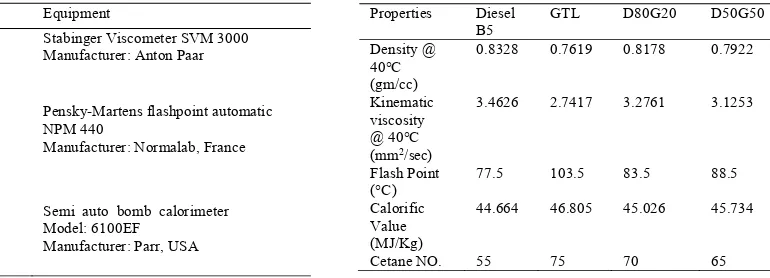
The blended fuels showed improved fuel property with the presence of GTL in blend definitely in terms of kinematic viscosity and density. The apparatus for fuel property analysis and experimental values are depicted in Table 1 and Table 2 respectively.
2.2.Engine Test
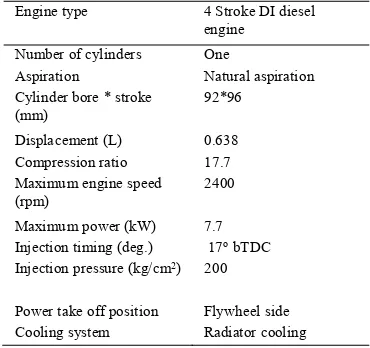
YANMAR TF 120-M diesel engine was used for experimental investigation. The test rig schematic and engine specification are depicted in Fig. 1 and Table 3 respectively. Initial engine run was performed with Diesel before starting the tests with B5 diesel, GTL, D80G20 and D50G50 fuels. Engine testing conditions performed at full load and within speed range of 1200~2400 rpm at an interval of 200rpm. Performance test was governed by
Dynomax-Table 1. Equipment for fuel property testing Table 2: Characteristics of the investigated fuels
Properties Equipment
Density Stabinger Viscometer SVM 3000 Manufacturer: Anton Paar Kinematic
Viscosity
Flash point Pensky-Martens flashpoint automatic NPM 440
Manufacturer: Normalab, France
Calorific
Value Semi auto bomb calorimeter Model: 6100EF Manufacturer: Parr, USA
Properties Diesel
B5 GTL D80G20 D50G50 Density @
40°C (gm/cc)
0.8328 0.7619 0.8178 0.7922
Kinematic viscosity @ 40°C (mm2/sec)
3.4626 2.7417 3.2761 3.1253
Flash Point
(°C) 77.5 103.5 83.5 88.5 Calorific
Value (MJ/Kg)
44.664 46.805 45.026 45.734
[image:2.544.95.480.420.559.2]2000 software in a laptop interfacing to the engine test bed (Fig. 1). BOSCH Exhaust gas analyzer BEA-350 was used to investigate exhaust emissions of fuels.
3. Results and discussion
3.1.Engine Test performance
3.1.1.Engine power output
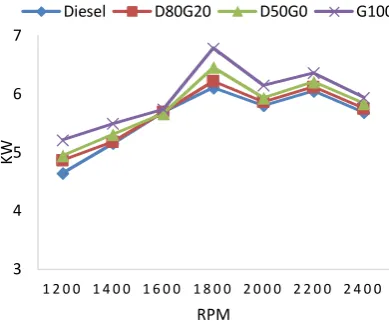
Fig. 2 compares the power output of the test engine fuelled with B5, GTL and their blends. Though the engine was unmodified GTL and its blends showed slightly improved power output than B5 Diesel. At 1800 rpm, highest power achieved by all fuels where GTL demonstrated about 10.1% higher power than B5 diesel. The higher calorific value of GTL and improvement of density and viscosity in the blends improved the atomization process during combustion, that yields improved combustion and also reflected the slight improvement in power output [11, 12].
3.1.2.Brake specific fuel consumption
Fig. 3. Illustrates the brake –specific fuel consumption (BSFC) of GTL-diesel blends versus engine speed. It was observed that both blends improved the BSFC compared to B5 diesel. Lowest BSFC showed by all fuels at 1800 rpm. GTL showed about 9.29% lower BSFC than B5 Diesel. Improvement of BSFC in GTL and GTL-B5 diesel blends than diesel due to higher calorific value of GTL fuel [3, 12].
3.1.3.Brake thermal efficiency
Fig. 4 shows the relationship between brake thermal efficiency (BTE) and speed with GTL, B5 diesel and blended fuels. The brake thermal efficiency of all tested fuels achieved approximately 21 % at 1800 rpm. As can be observed, there is no significant difference in the BTE of all the fuels. In case of GTL operation, the brake thermal efficiency was marginally higher than other fuels [3, 11, 12].
[image:3.544.52.253.99.257.2]Fig 1 Schematic of experimental set up
Table 3: Engine Specification
Engine type 4 Stroke DI diesel engine
Number of cylinders One
Aspiration Natural aspiration Cylinder bore * stroke
(mm) 92*96
Displacement (L) 0.638 Compression ratio 17.7 Maximum engine speed
(rpm) 2400
Maximum power (kW) 7.7 Injection timing (deg.) 17o bTDC
Injection pressure (kg/cm2) 200
[image:3.544.284.469.135.309.2]3.2.Exhaust emission characteristics
3.2.1.CO Emission
Fig. 5 shows variations of the CO emissions for B5 diesel, GTL and their blends at various engine speed ratings. Reductions in CO levels at lower speeds for GTL and its blends relative to diesel are larger than the reductions at higher speeds. GTL showed the best reductions in CO emissions by 22~ 25% on average in all rpm compared to B5 diesel. The mysteries of CO emission reduction of GTL lie within the fuel properties and combustion phenomena of GTL. Higher H/C ratio and very low aromatic content provides improved combustion that favors CO reduction. Higher Cetane number (CN) of GTL induces shortening of ignition delay that prevents less over-lean zones. The lower distillation temperature of GTL induced rapid vaporization, which reduce the probability of flame quenching and ensures lower CO emission [11-12].
3 4 5 6 7
1 2 0 0 1 4 0 0 1 6 0 0 1 8 0 0 2 0 0 0 2 2 0 0 2 4 0 0
KW
RPM
Diesel D80G20 D50G0 G100
350 370 390 410 430 450 470 490
1 2 0 0 1 4 0 0 1 6 0 0 1 8 0 0 2 0 0 0 2 2 0 0 2 4 0 0
gm
/K
w
-h
RPM
Diesel D80G20 D50G0 GTL
16 17 18 19 20 21
1 2 0 0 1 4 0 0 1 6 0 0 1 8 0 0 2 0 0 0 2 2 0 0 2 4 0 0
%
RPM
Diesel D80G20 D50G0 G100
Fig 4 Effect of engine speed on BTE at full load.
rpm
Fig 5 Effect of engine speed on CO emission at full load. Fig2 Effect of engine speed on power at full load. Fig Effect of engine speed on BSFC at full load.
0 1 2 3 4 5
1200 1400 1600 1800 2000 2200 2400
% v
ol
[image:4.544.53.485.54.434.2] [image:4.544.273.481.65.230.2] [image:4.544.58.253.66.227.2]3.2.2.HC emission
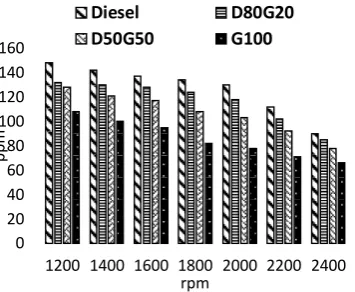
Fig. 6 presents the variations of the HC emissions for B5 diesel, GTL and their blends at various engine speeds. The result demonstrates that all fuels produce low HC emissions with the increment of speed. GTL, D50G50, D80G20 shows lower emissions compared to B5 diesel. In general, GTL shows approximately 40% less HC emissions than diesel. Alike CO emission reduction HC emission reduction can be explained regarding the fuel properties and combustion phenomena of GTL. Higher CN of GTL fuel shortens the ignition delay which prevents formation of over-lean regions. Lower distillation temperature characteristic of GTL ensures proper pace of evaporation and mixing with air to constitute more effective combustible charge which results less unburned HC in exhaust emission [8, 11, 12].
3.2.3.NO Emission
Fig. 7 gives a relation of NO emission with the engine speed for B5 diesel, GTL and blends at a full engine load with variation of speed. Overall, NO emission decreases as the speed increases. Addition of GTL in blends contributes to greater NO emission reduction. D80G20 and D50G50 showed respectively about 2% and 4% decreased NO emission. In general GTL showed 6~7% reduction in NO emission compared to B5 diesel. Higher CN induced shorter ignition delay, followed by lesser premixed charge results in the lower combustion temperature and pressure. It leads towards less NO formation in the cylinder on the basis of the temperature dependent thermal NO formation mechanism [8]. Significant lower Aromatic contents of GTL fuel favors local adiabatic flame temperature which assists in NO reduction [5, 12].
4. Conclusion
A comparative study of B5 diesel, Gas to liquid (GTL) diesel and their blends were investigated using an unmodified single cylinder test engine in terms of engine performance and exhaust emission. The outcome of the investigation can be summarized as follows:
Since GTL has superior fuel property than B5, the blends of these two fuels showed improved fuel properties in terms of viscosity and density. GTL can be operated on unmodified diesel engines also as the performance and emission characteristics are satisfactory, even better than B5 diesel.
0 20 40 60 80 100 120 140 160
1200 1400 1600 1800 2000 2200 2400
ppm
rpm
Diesel D80G20
D50G50 G100
Fig7 Effect of engine speed on NO emission at full load. Fig 6 Effect of engine speed on HC emission at full load.
0 100 200 300 400
1200 1400 1600 1800 2000 2200 2400
ppm
Diesel D80G20
[image:5.544.54.232.321.467.2] [image:5.544.292.464.324.457.2] Engine performance results had demonstrated improvement of GTL in all examined parameters compared to B5 diesel. GTL showed maximum increased power and brake thermal efficiency up to 10.1% and 21% compared to diesel. GTL also showed good improvement of BSFC by lowering the value approximately 9.29% compared to B5 diesel. Exhaust emission experiment had revealed overall significant reduction of CO (22~25%), HC (30~40%) and NO (6~8%) compared to B5 diesel.
D50G50 and D80G20 both these fuel blends showed improved engine performance and exhaust emission compared to B5 diesel. D50G50 showed improved performances and emissions compared to D80G20.
Acknowledgement
The authors would like to appreciate University of Malaya for financial support through High Impact Research grant titled: “Clean Diesel Technology for Military and Civilian Transport Vehicles” having grant number UM.C/HIR/MOHE/ENG/07.
References
[1] Gill SS, Tsolakis A, Dearn KD, Rodríguez-Fernández J. Combustion characteristics and emissions of Fischer–Tropsch diesel fuels in IC engines. Prog. Energy Combust. Sci.. 2011;37:503-23.
[2] Velaers AJ, Goede Sd. The Properties and Injector Nozzle Fouling Performance of Neat GTL and GTL/EN590 Diesel Blends in Various Diesel Engines. SAE Int. J. Fuels Lubr.5(3):1174-1186, 2012, doi:10.4271/2012-01-1692.
[3] Szybist, J. P. Kirby, S. R. Boehman, A. L., NOx Emissions of Alternative Diesel Fuels: A Comparative Analysis of Biodiesel and FT Diesel. Energy Fuels 2005, 19, (4), 1484-1492.
[4] Moon G, Lee Y, Choi K, Jeong D. Emission characteristics of diesel, gas to liquid, and biodiesel-blended fuels in a diesel engine for passenger cars. Fuel. 2010;89:3840-6.
[5] Armas O, Yehliu K, Boehman AL. Effect of alternative fuels on exhaust emissions during diesel engine operation with matched combustion phasing. Fuel. 2010;89:438-56.
[6] Wang H, Hao H, Li X, Zhang K, Ouyang M. Performance of Euro III common rail heavy duty diesel engine fueled with Gas to Liquid. Appl. Energy. 2009;86:2257-61.
[7] Oguma M, Goto S, Oyama K, Sugiyama K, Mori M. The Possibility of Gas to Liquid (GTL) as a Fuel of Direct Injection Diesel Engine. SAE Technical Paper 2002-01-1706, 2002, doi:10.4271/2002-01-1706.
[8] Lapuerta M, Armas O, Hernández JJ, Tsolakis A. Potential for reducing emissions in a diesel engine by fuelling with conventional biodiesel and Fischer–Tropsch diesel. Fuel. 2010;89:3106-13.
[9] Wu T, Huang Z, Zhang W-g, Fang J-h, Yin Q. Physical and Chemical Properties of GTL−Diesel Fuel Blends and Their Effects on Performance and Emissions of a Multicylinder DI Compression Ignition Engine. Energy Fuels. 2007;21:1908-14.
[10] Nabi, M.Kannan, D. Hustad, J., Experimental Investigation of Diesel Combustion and Exhaust Emissions
Fuelled with Fischer-Tropsch-biodiesel Blends: Part-I. SAE Technical Paper 2009-01-2721, 2009, doi:10.4271/2009-01-2721.
[11] Yongcheng H, Longbao Z, Shangxue W, Shenghua L. Study on the performance and emissions of a compression ignition engine fuelled with Fischer-Tropsch diesel fuel. Proc Inst Mech Eng Part D-J Automobile Eng 2006;220(D6):827–35