Multivariable Adaptive Lyapunov Fuzzy
Controller for pH Neutralisation Process
M.F. Zanil
aand M.A. Hussain
ba Chemical and Petroleum Engineering, Faculty of Engineering & Built Environment,
UCSI University, 56000 Kuala Lumpur, Malaysia.
b Chemical Engineering Department, Faculty of Engineering, University of Malaya,
50603 Kuala Lumpur, Malaysia.
Abstract
A multivariable fuzzy logic controller with Lyapunov adaptive control scheme has been developed for a pH neutralisation process. In this study, the nominal neutralisation process condition exhibit nonlinear dynamics and multi-delayed-effects input variables. The proposed controller uses a Takagi-Sugeno fuzzy inference system and it has been optimised by genetic algorithm which minimizing the closed loop error in feedback control system. The optimised structure is used to predict three-difference control action simultaneously. The Lyapunov function is integrated in the fuzzy inference calculation at output membership function. The proposed controller has been tested and compared in several cases such as for set-point tracking, model plant mismatch and unknown disturbance. The adaptive fuzzy controller demonstrate better performance over the conventional PID controller in all the tested cases.
Keywords: Non-linear control; Fuzzy Controller; Adaptive control.
1.
Introduction
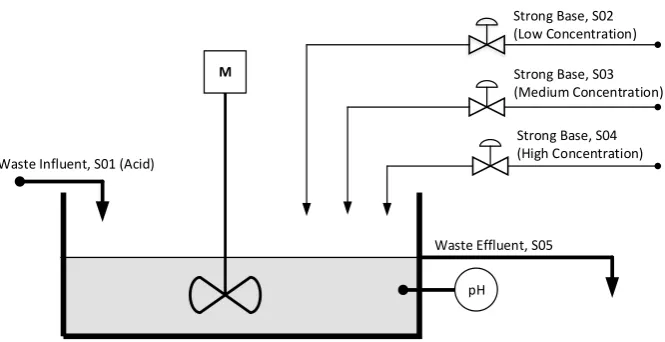
Waste Influent, S01 (Acid)
Strong Base, S02 (Low Concentration)
Strong Base, S03 (Medium Concentration)
Strong Base, S04 (High Concentration)
Waste Effluent, S05 M
[image:2.541.111.444.75.246.2]pH
Figure 1: Scheme of pH neutralisation process
for multiple pH regions is very hard to generalize. Therefore, the need of robust controller performance in this field arise significantly.
The objective of this study is to investigate the multivariable controller for the control of nonlinear pH neutralisation process in continuous stirred tank reactor by using the Lyapunov based adaptive Fuzzy Logic approach. The process using the strong acid equivalent model (Zanil et al., 2014). The control system has been set to regulate the pH reactor at neutral point (pH = 7.0) by manipulating several acid flow rates.
2.
pH Neutralisation
The potential of hydrogen, pH is mathematically defined the negative logarithm of concentration of ion hydrogen. In pH neutralisation modelling, the nonlinearity characteristic are from the logarithm term in the equation. The model (Eq.1) which follows the law of conservation of mass and chemical equilibrium (Gustafsson et al., 1995). The process is assumed isothermal with constant fluid density and no solid formation occurring during experiment. The schematic diagram (Figure 1) illustrate the multi titration streams with single influent and effluent stream.
The model used in the study is as follows:
ܸ݀ݔ
݀ݐ ൌ ܨܥെ ሺܨ ݑǡ ଷ
ୀଵ
ሻݔ െ ݑሺݐ െ ߠሻܥǡ ଷ
ୀଵ
(1)
Where ݔ is the remaining acid concentration in the reactor, ܥǡ ܥ and ܥǡ is the
ݔ ൌ ሾܪାሿ െ ܭ௪
[image:3.541.97.437.69.228.2]ሾܪାሿ (2)
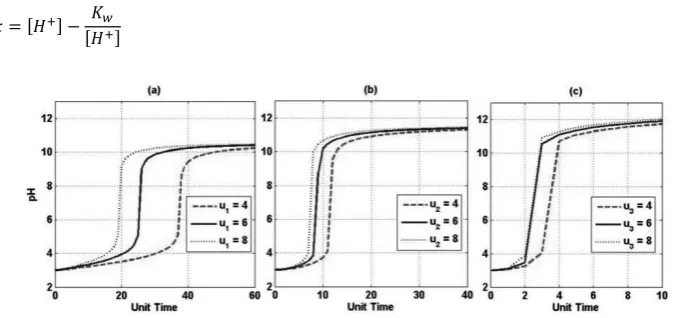
Figure 2: Open loop studies for variation of titration flow rate: (a) Low, (b) Medium, (c) High.
Thus, the hydrogen ion, [H+] as in Eq.3 can be used to simulate the dynamic profile of hydrogen concentration and pH value of the stirred tank reactor.
ܸ ݀
݀ݐ൬ሾܪ
ାሿ െ ܭ௪
ሾܪାሿ൰ ൌ ܨܥെ ሺܨ ݑǡ ଷ
ୀଵ
ሻ ൬ሾܪାሿ െ ܭ௪
ሾܪାሿ൰ െ ݑሺݐ െ ߠሻܥǡ ଷ
ୀଵ
(3)
The pH value is calculated by taking the logarithm of hydrogen concentration. The simulated result for several titration flow rates has been demonstrate in Figure 2 and it is observed that the variation time response over the titration flow rates has significant effect. The pH value inside the reactor shows several dynamic responses over time. The nominal condition that shows in Table 1 has been used for the simulation study.
3.
Control Mechanism
Fuzzy logic consist a set of fuzzy inference that works on approximate reasoning that give a consequence action as the outcome. The structure has been set to receive three inputs and three outputs. The fuzzy logic inference mechanism were computed from the product of input membership function (e, ce and AV) and the fulfilment of fuzzy rules (ܴ). i.e.;
ܴ ܫܨ݁݅ݏܣܣܰܦܿ݁݅ݏܣܣܰܦܣܸ݅ݏܣܶܪܧܰݑଵܷଵǡܣܰܦݑଶ݅ݏܷଶǡܣܰܦݑଷ݅ݏܷଷǡ
Every output membership function can be written as
ܷǡሺ݇ሻ ൌ ܣଵǡ݁ ܣଶǡܿ݁ ܣଷǡܣܸ ܣସǡǢ ݆ ൌ ͳǡ ʹǡ ͵ܽ݊݀݅ ൌ ͳǡʹǤ Ǥ ܰ (4)
The output parameter, ܣǡ has been optimised by genetic algorithm depending on the close loop error analysis; Integral Square Error (ISE). The controller output can be formulated as the summation of average weighted inference value for the active rule,ܴ.
ݑൌ
σ ݓ ሺ݁ǡ ܿ݁ǡ ܣܸሻܷǡ σ ݓ ሺ݁ǡ ܿ݁ǡ ܣܸሻ
(5)
ݓሺ݁ǡ ܿ݁ǡ ܣܸሻ ൌ ݉݅݊ሾߤሺ݁ሻǡ ߤሺܿ݁ሻǡ ߤሺܣܸሻሿ (6)
Table 1: Parameters and value for nominal
Parameter Value Unit
Reactor Volume, Vr 100 Litre
Inlet Influent Concentration, Cb0 3E-3 Mole/Litre Inlet Base Concentration (Low) , Ca0,1 3E-4 Mole/Litre Inlet Base Concentration (Medium) , Ca0,2 3E-3 Mole/Litre Inlet Base Concentration (High) Ca0,3 3E-2 Mole/Litre
Where ݓ is degree of input membership function as Eq. 6 and ߤሺ݁ሻǡ ߤሺܿ݁ሻǡ and
ߤሺܣܸሻ are the input membership function (triangular types) of error, change of error,
and acidic region respectively.
3.1.Adaptive Mechanism
The used of adaptive mechanism is to improve the fuzzy controller performance during the model-mismatch operation in the plant. Let the model identifier approximate the nominal plant response and thus the model error,ߝ ൌ ݕെ ݕ which detect the existing of model-mismatch condition. So, the adjustable parameterǡߛis introduced to minimise
Eq. 7 in the negative gradient;
݀ߠ ݀ݐ ൌ െߛ൬
ͳ ʹߝ
ଶ൰ (7)
The adaptation law is formulated as in Eq. 8
ܷൌ ݀ߠ
݀ݐ ݑൌ െߛ൬ ͳ ʹߝ
ଶ൰ ݑ
(8)
3.2.Control System
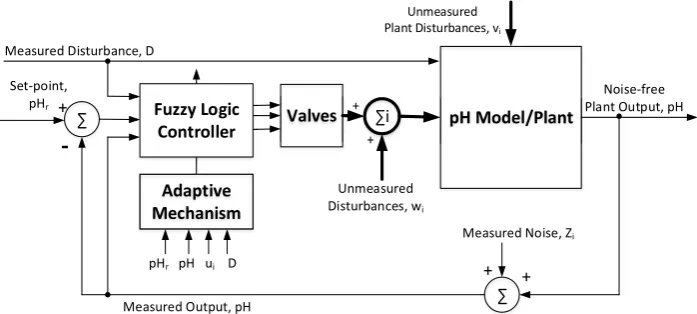
The study use a conventional closed loop control strategy as in Figure 3 and the neutralisation models as stated in Section 2 has been used for the plant block. Measured disturbance is the signal from influent flow rate (base) and the manipulated variable signal at different concentrations. The fuzzy controller send three-output signals to every individual control valve before the change of titration effect takes place.
In the study, unmeasured disturbance and limited-band white noise has been introduced. A servo and regulator case study has been performed throughout the simulation. Several analysis for servo cases has been carried out; acid/base region at the neutral point and within neutral region. Beside, regulator case analysis has been conducted for ± 5% variation in the measured disturbance flow rate. Plant mismatch of ± 10% from nominal volume reactor has been carried out to test the control performance robustness.
pH Model/Plant Valves
∑ ∑i
∑ + + + + +
-Measured Disturbance, D
Unmeasured
Disturbances, wi
Unmeasured
Plant Disturbances, vi
Measured Noise, Zi
Measured Output, pH Set-point,
pHr
Noise-free Plant Output, pH
Adaptive Mechanism
Fuzzy Logic Controller
[image:4.541.98.447.459.616.2]pHr pH ui D
Figure 4: Comparison of control performance for set-point and disturbance rejection cases.
Figure 5: Comparison of control performance for plant mismatch case.
4.
Result and Discussion
Simulation result for set point tracking, load rejection of proposed adaptive controller responses are shown in Figures 4 and 5 respectively. Considering the adaptive fuzzy logic controller, its set point and load changes show smoother response over the entire nonlinear region. Furthermore, there is no oscillation or overshoot in proposed control responses. PID controller has showed slightly overshoot and the settling time is more compared to propose controller. This is due to the sluggish control action at the neutralisation region.
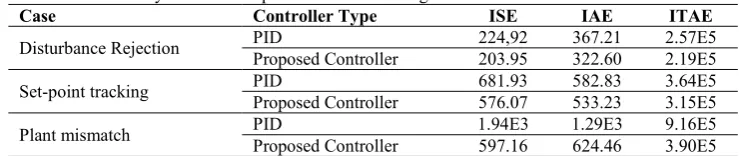
The controller performance based on Integral Square Error (ISE), Integral Absolute Error (IAE), and Integral Total Absolute Error (ITAE) as shown in Table 2.
Table 2. Error analysis of control performance according to the case.
Case Controller Type ISE IAE ITAE
Disturbance Rejection PID Proposed Controller 224,92 203.95 367.21 322.60 2.57E5 2.19E5
Set-point tracking PID 681.93 582.83 3.64E5
[image:5.541.84.454.559.637.2]The result shows that the proposed controller gives best performance, which indicate less error analysis compared to conventional controller for all cases. The conventional controller unable to adapt with the plant mismatch case and therefore the error analysis give large value compare to the proposed controller.
5.
Conclusions
A multivariable adaptive fuzzy logic controller has been proposed for the nonlinear pH neutralisation control system. It is the integration of empirical optimisation fuzzy logic controller with Lyapunov adaptive law. The results has shown superior performance for the proposed controller compared to conventional controller in all studied cases. The proposed controller has a promising potential for other nonlinear control applications.
Acknowledgement
Special thanks to the Department of Chemical & Petroleum Engineering, UCSI University and to University of Malaya Research Grant (Grant number: RP006G-13ICT) for the research funding.
References
S. Salehi, M. Shahrokhi, and A. Nejati, 2009, Adaptive nonlinear control of PH neutralisation processes using fuzzy approximators. Control Engineering Practice, 17(11), 1329-1337. H. Min, H. Bing, and G. Wei, 2006, Process control of pH neutralisation based on adaptive
algorithm of universal learning network. Journal of Process Control, 16(1), 1-7.
S. Menzl, M. Stühler, and R. Benz, 1996, A self adaptive computer-based pH measurement and fuzzy-control system. Water Research, 30(4), 981-991.
S.F. Graebe, M.M. Seron, and G.C. Goodwin, 1996,Nonlinear tracking and input disturbance rejection with application to pH control. Journal of Process Control, 6(2-3), 195-202.
T.K. Gustafsson and K.V. Waller, 1983, Dynamic Modeling and Reaction Invariant Control of Ph. Chemical Engineering Science, 38(3), 389-398.
M.A. Henson and D.E. Seborg, 1994, Adaptive nonlinear control of a pH neutralisation process. Control Systems Technology, IEEE Transactions on, 2(3), 169-182.
N.R.L. Narayanan, P.R. Krishnaswamy, and G.P. Rangaiah, 1997, An adaptive internal model control strategy for pH neutralisation. Chemical Engineering Science, 52(18), 3067-3074. S.W. Sung, I.B. Lee, J.Y. Choi, and J. Lee, 1998, Adaptive control for pH systems. Chemical
Engineering Science, 53(10), 1941-1953.
J.M. Boling, D.E. Seborg, and J.P. Hespanha, 2007, Multi-model adaptive control of a simulated pH neutralisation process. Control Engineering Practice, 15(6), 663-672.
R.A.W. Wright, M. Soroush and C. Kravaris, 1991, Strong acid equivalent control of pH process. Ind. Engng Chem. Res, 30, 2437-2443.
T.K. Gustafsson, B. O. Skrifvars, K. V. Sandstrom, and K.V. Waller, 1995, Modeling of Ph for Control. Industrial & Engineering Chemistry Research, 34(3), 820-827.
McAvoy, 1972, Dynamics of pH in controlled stirred tank reactor. Ind. Engng Chem. Process. Des. Develop, 11, 68-70.