Development of M 90 Grade of Concrete using
Micro Silica
B. Vidya1, K. Srinivasa Rao2
1,2
Civil Engineering Department, Andhra University College of Engineering(A), Visakhapatnam,Andhra Pradesh, India -530003
Abstract: High strength concrete of grade M 90 is developed using ACI code. In addition to this, the factorial design model of
Rougeron and Aitcin is also used in which iso curves were developed relating to the ingredients of concrete. These curves are used for initial trial mixes and optimized further. To develop high strength concrete, it is necessary to reduce the water/binder ratio and increase the binder content. Superplasticizers are used in these concretes to achieve the required workability. High strength concrete of 102 MPa was attained using 10% replacement of cement with micro silica.
Keywords: high strength concrete, micro silica, superplasticizer, compressive strength,
I. INTRODUCTION
High Strength Concrete (HSC) has been generating increased interest among civil and structural engineers. Making HSC is more complicated than producing usual concrete. The reason is that as the compressive strength increases, the concrete properties are no longer related only to the water/binder ratio, the fundamental parameter governing the properties of concrete by virtue of the porosity of the hydrated cement paste. In usual concrete, much water is put into the mixture that both the bulk hydrated cement paste and the transition zone represent the weakest links in concrete microstructure, where mechanical collapse starts to develop when concrete is subjected to a compressive load.
A. The proportioning of HSC consists of three interrelated steps as follows
1) Selection of suitable ingredients: ordinary Portland cement, supplementary cementations materials, aggregates, water and chemical admixtures.
2) Determination of the relative quantities of these materials in order to produce, as economically as possible, a concrete that has the desired rheological properties, strength and durability.
3) Careful quality control of every phase of the concrete making process.
4) The main purpose of concrete mixing is to achieve a uniform mixture of all materials. Mixing is especially important for HSC of low water content. Poorly mixed concrete not only fails to meet the requirement of workability but also affects the
engineering properties.
II. EXPERIMENTAL PROGRAM
An experimental program has been planned to investigate the properties of materials and concrete at fresh and hardened stage. The properties of the materials for the present experimental work are as follows:
A. Cement
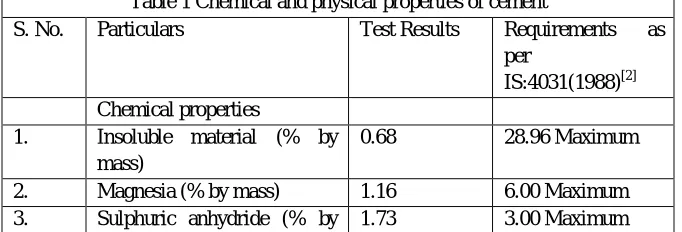
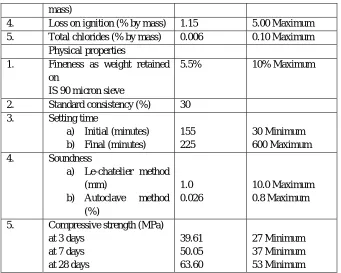
[image:2.612.137.478.610.726.2]Ordinary Portland cement 53 grade is used. Locally available cement which conforms to IS: 12269 (1987)[1] is used for present study. The specific gravity of cement is 3.11. The physical properties of cement are given in Table 1.
Table 1 Chemical and physical properties of cement
S. No. Particulars Test Results Requirements as per
IS:4031(1988)[2] Chemical properties
1. Insoluble material (% by mass)
0.68 28.96 Maximum
mass)
4. Loss on ignition (% by mass) 1.15 5.00 Maximum 5. Total chlorides (% by mass) 0.006 0.10 Maximum
Physical properties
1. Fineness as weight retained on
IS 90 micron sieve
5.5% 10% Maximum
2. Standard consistency (%) 30 3. Setting time
a) Initial (minutes) b) Final (minutes)
155 225
30 Minimum 600 Maximum 4. Soundness
a) Le-chatelier method (mm)
b) Autoclave method (%)
1.0 0.026
10.0 Maximum 0.8 Maximum
5. Compressive strength (MPa) at 3 days
at 7 days at 28 days
39.61 50.05 63.60 27 Minimum 37 Minimum 53 Minimum
B. Fine Aggregate
[image:3.612.137.478.74.347.2]Locally available river bed sand with specific gravity 2.65is used as fine aggregate. The fine aggregate used is conforming to grading Zone II according to the Table 4 of IS: 383 (1970)[3] with fineness modulus of 2.92. Sieve analysis of the sample is given in Table 2. The fine aggregate can be medium sand but not fine sand. Fine sand will not give much strength as in the observations of Aykut Ceiten and Ramon Carrasquillo[4]. Fine aggregate should be free from deleterious materials and organic and inorganic compounds. To avoid bulking, the sand is sufficiently air dried.
Table 2 Sieve analysis of fine aggregate IS sieve size Weight retained
(kg)
% Weight retained
Cumulative percentage weight retained
Percentage finer
80 mm 0 0 0 100
40 mm 0 0 0 100
20 mm 0 0 0 100
10 mm 0 0 0 100
4.75 mm 0.010 1 1 99
2.36 mm 0.030 3 4 96
1.18 mm 0.278 27.80 31.80 68.20 600 µ 0.380 38.05 63.85 36.15
300 µ 0.223 22.30 92.15 7.85
150 µ 0.071 7.15 99.30 0.70
Total 1.0 292.1
Fineness modulus = 292.1/100 = 2.92
C. Coarse Aggregate
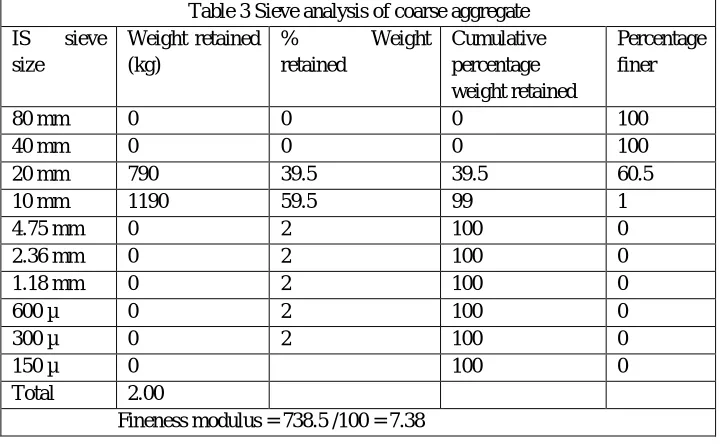
[image:3.612.125.491.447.669.2]in concrete mix, it is wetted and dried alternatively in order to remove the deleterious material and to ensure saturated surface dry condition [5]. Factors such as aggregate coatings, deleterious material in aggregates, shape, texture and testing limitations and coarse aggregates facture faces, may prevent from higher strength being achieved. Grading of the coarse aggregate is made so as to get optimum density. For M 90 grade of concrete aggregate passing through 10 mm was used in mix. The higher the targeted compressive strength, the smaller the maximum size of the coarse aggregate should be [6].
Table 3 Sieve analysis of coarse aggregate IS sieve
size
Weight retained (kg)
% Weight retained Cumulative percentage weight retained Percentage finer
80 mm 0 0 0 100
40 mm 0 0 0 100
20 mm 790 39.5 39.5 60.5
10 mm 1190 59.5 99 1
4.75 mm 0 2 100 0
2.36 mm 0 2 100 0
1.18 mm 0 2 100 0
600 µ 0 2 100 0
300 µ 0 2 100 0
150 µ 0 100 0
Total 2.00
Fineness modulus = 738.5 /100 = 7.38
D. Water
Locally available potable water with a pH value of 7.65 is used which conforms to IS: 3025 (1986) [7]specifications.
E. Admixture
1) Micro Silica: The American Concrete Institute (ACI) defines Micro Silica or silica fume as very fine non-crystalline silica produced in electric arc furnaces as a by-product of the production of elemental silicon or alloys containing silicon [8,9]. It is usually a grey coloured powder with specific gravity 2.2 (from manufacturer’s data). Using micro silica along with chemical admixtures, it is relatively easier to obtain compressive strength greater than 100 MPa [6,9]. Addition of silica fume to concrete improves the durability of concrete. In fact the presence of too much silica fume (> 10 % by weight of cementitious material) makes the mixture stiff [10]. Many researchers[11-22] optimized their design mix by considering silica fume content as 10 % by weight of cementitious material.
2) Super plasticizer: Master Glenium ACE 30 (JP) is a chemical admixture of a new generation based on second-generation poly carboxylic ether polymer with high early strength gains. Master Glenium ACE 30 (JP) is free of chloride and low alkali. It has specific gravity of 1.09 and solids content not less than 34% by weight. It consists of a carboxylic ether polymer with long side chains and short main chains. At the beginning of the mixing process it initiates the same electrostatic dispersion mechanism as the traditional hyperplasticisers, but the short main chains facilitate quick start of hydration process. Rapid adsorption of the molecule onto the cement particles, combined with an efficient dispersion effect maintains workability yet exposes increased surface of the cement grains to react with water. As a result of this effect, it is possible to obtain earlier development of heat of hydration, rapid strength development of the hydration products and as a consequence, higher strengths at a very early age. After conducting preliminary investigations, the dosage of the admixture used in the present mix is fixed as 0.8% of cementitious material.
F. Properties of Materials
Dry rodded density of coarse aggregate = 1700 kg/m3
G. Mix Design for M 90 Grade of Concrete
Optimization of the composition of high strength concrete M 90 was done based on the factorial design model of Rougeron and Aitcin[23].. This technique is based on the statistical analysis obtained from a set of experiments and iso curves were developed relating to the dosage of cement, silica fume, superplastizer, water-binder ratio with a constant aggregate content. The lowest cement dosage adopted in this technique was 353 kg/m3 and the highest one was 682 kg/m3. The selection of the ingredients for high strength concrete is less empirical but Rougeron and Aitcin developed the curves by least laboratory work. These curves are used for initial trial mixes and optimized further.
H. Target Strength
Determine the mean target strength ftfrom the specified characteristic compressive strength at 28-day fck and the level of quality control.
ft = fck + KS
Assuming 5% fall of the results K = 1.65
Where S is the standard deviation assumed for M 90 grade. Target strength = 90 + 1.65*5 = 98.25 N/mm2
1) Choice of Slump :The value of slump is assumed to be less than one inch (25 mm) therefore slump is adjusted to the desired value by addition of superplasticizer.
2) Choice of Maximum Size of Aggregate: Maximum size of coarse aggregate for the strengths greater than 9000 psi (60 MPa) = 10 mm (3/8 inch) as per Table 6.2 from ACI 211.4R (2008)[24].
3) Estimation of Mixing Water and Water Binder Ratio:For compressive strength > 100 MPa, w/b = 0.22 from iso curves developed by Aitcin[6].If saturation point of superplasticizer is not known initially, it is suggested starting with a water content of 145 l/m3 according to Aitcin., 2004
4) Calculation of Cement Content:n Weight of cementitious material = 145/0.22 = 660 kg/m3
5) Estimation of Coarse Aggregate:Volume of coarse aggregate per unit of volume of concrete = 0.65 (from table 6.3 of ACI 211.4R -2008)[24]Bulk density of coarse aggregate of size 10 mm = 1700 kg/m3Quantity of coarse aggregate = 1700*0.65 = 1105 kg/m3
6) Estimation of Fine Aggregate: Volume of water = 145/1000 = 0.145 m3 Volume of cement = 660/ (3.105*1000) = 0.2126 m3
Volume of coarse aggregate (Maximum 10 mm size) = 1105/ (2.78*1000) = 0.3975 m3 Volume of fine aggregate = 1- (0.145+0.2126+0.3975) = 0.245 m3
Quantity of fine aggregate = 0.245*2.65*1000 = 650 kg/m3
7) Mix Proportions : Achieved mix proportions for M90 grade of concrete Cementitious material : Fine aggregate : Coarse aggregate : water 660 kg/m3 : 650 kg/m3 : 1105 kg/m3 : 145 l/m3 1 : 0.985 : 1.674 : 0.22
Before fixing the design mix of M 90 (calculated previously), several trial mixes were tried to optimize the quantities of the ingredients.
I. Casting and Curing of Concrete Specimens
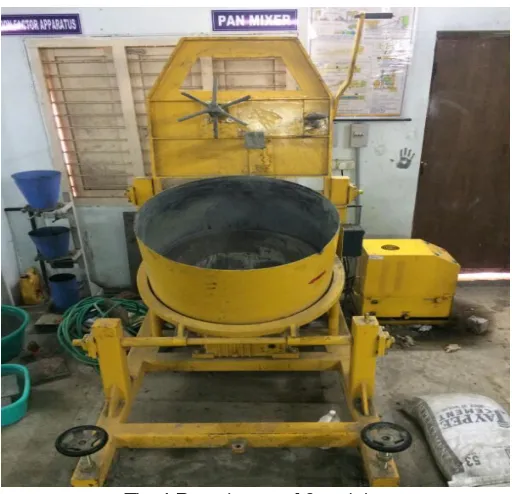
Fig. 1 Pan mixer used for mixing
Usually mixing is done in two different stages for high strength concrete. Dry mixing is done before the addition of water and wet mixing is done after addition of water. After dry mixing of the ingredients for one minute, 60% of water is added to the ingredients and mixed uniformly. The remaining 40% of water is mixed with superplasticizer and is introduced into the mixer and ingredients are mixed for 3 minutes until the mix is uniform. The total mixing time is 4 minutes. After mixing, the concrete is poured on the pre wetted platform then filled into moulds. The moulds are made with cast iron that meets the requirements of IS: 10086 (1982)[25]. The angle between the internal faces internal faces of the cube and beam moulds is 90°± 0.5°. The inner distance between the faces of cube moulds is 100±2 mm. The cube moulds of 150 mm x 150 mm x 150 mm size are used to prepare specimens to conduct compression test. Each and every layer in the concrete in the mould is compacted by means of vibrating table having specification according to IS: 7246 (1974)[26]. All moulds are retained for the period of 24 hours in moist air. Then the specimens are demoulded, marked and are cured in a curing tank with fresh water. The temperature in the tank is maintained at 27°±1°. They are cured for a period of 28 days. All high strength concrete specimens must be water cured as soon as possible before hydration starts. If the external water is not provided to the concrete by that time, shrinkage will develop very quickly and will be responsible for cracks. Hence they are cured for a period of 28 days after demoulding.
J. Compression Test on Specimens
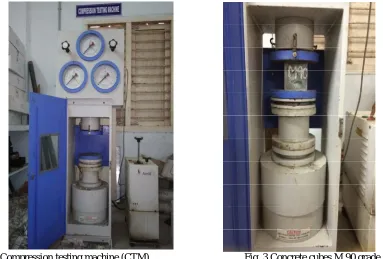
Specimens of 150 mm size cubes are tested, after ensuring surface dried condition. The specimen is placed in the compression testing machine (CTM) of capacity 3000 kN in such a manner that the load is applied to the adjacent side to the direction in which the cube is cast that is, not to the top or bottom side of the casting direction as shown in Fig. 2 and Fig. 3.
The axis of the specimen is carefully aligned with the center of thrust of the spherically seated block which is brought to bear on the specimens. The alignment of the cube can be adjusted by rotating the movable portion gently by hand to obtain uniform seating. The load is applied without shock and increased continuously at rate of approximately 140 kg/sq.cm/min as specified in IS: 516 (1959)[27]. Until the resistance of the specimen to the increasing load breaks down and no greater load can be sustained. The maximum load applied on the specimen is recorded and appearance of the concrete and any usual features in the type of failure is noted.
Fig. 2 Compression testing machine (CTM) Fig. 3 Concrete cubes M 90 grade specimens in CTM
Average of three specimens is taken as compressive strength provided variation is not more than 15 % on the average.
Compressive strength =
Where P is ultimate compressive loadA is area of cross section
K. Results and Discussions
Workability test (compaction factor) was performed on design mix with different dosage of micro silica. Fig. 4 shows the variation in workability with different dosage of micro silica. It is observed that the workability decreases with an increase in the dosage of micro silica.
Fig. 5 shows the variation in compressive strength of concrete with different dosage of micro silica. It is observed that the compressive strength of concrete increases with an increase in dosage of micro silica up to 10 % and further decreased as the mix became stiff. Hence the design mix was optimized having 10% replacement of cementitious material with micro silica. It is observed that the compressive strength of 150 mm cube at the age of 28 days was 102 N/mm2.
III. CONCLUSIONS
High strength concrete having compressive strength more than 100 Mpa is achieved using admixtures such as micro silica and superplasticizer. For high strength concrete, appropriate dosage of superplasticizer is necessary to achieve the target strength which in turn depends on cement- superplasticizer compatibility. Hence the dosage of superplasticizer is fixed as 0.8% of cementitious material.
Based on the study, the following conclusions are drawn.
A. Increase in dosage of micro silica results in decrease in workability of concrete.
[image:7.612.90.473.76.335.2]Fig.4 Variation in workability with different dosage of micro silica
Fig.5 Variation in compressive strength with different dosage of micro silica
REFERENCES
[1]. IS: 12269 (1989), “Specifications for 53 grade ordinary Portland cement”, Bureau of Indian Standards, New Delhi, India. [2]. IS: 4031 (1988), “Methods of physical tests for hydraulic cement”, Bureau of Indian Standards, New Delhi, India.
[3]. IS: 383 (1970), “Specifications for coarse and fine aggregates from natural sources for concrete”, Bureau of Indian Standards, New Delhi, India
[4]. AykutCeiten and Ramon Carrasquillo L (1998), “High performance concrete Influence of coarse Aggregate on mechanical properties”, ACI Material Journal, Vol.95, No.3, May-June, pp. 252-261.
[5]. Vani V.S and SrinivasaRao K (2010), “Effect of silica fume on development of high strength concrete of M 65 grade”, National conference on recent trends in civil engineering – (NCRTCE 10), Department of Civil Engineering, R.V.S College of Engineering and Technology, Dindigul, Tamil Nadiu, 12th March,
Proceedings pp. 245-256.
[6]. Aitcin P C (2004), “High Performance concrete”, E&FN Spon, London.
[7]. IS: 3025 (1986) (parts 22 and 24), “Methods of sampling and tests (chemical and physical) for water and waste water”, Bureau of Indian Standards, New Delhi, India.
[8]. Silica fume User’s manual (2005), Silica Fume Association, US Department of Transportation, April.
[9]. Siddique R and Iqbal Khan (2011), “Supplementary Cementing Materials”, Engineering Materials, Springer-Verlag Berlin Heidelberg.
[10].Rao G.A (2003), “Investigations on performance of silica fume- incorporated cement pastes and mortars”, Cement Concrete Research, Vol.33 (11), 1765-1770. [11].Mohammad Abdul Rashid and Mohammad Abdul Mansur, Considerations in producing high strength concrete, Journal of Civil Engineering, 37(1), pp.53-63
(2009)
[12].Zhou F.P, Barr B.I.G, Lydon F.D (1995), ‘Fracture properties of high strength concrete with varying silica fume content and aggregates’, Cement and Concrete Research, Vol. 25. No. 3, pp. 543-552.
[13].Balendran RV, Maqsood T, Nadeem A (2001), ‘Effect of cooling method on residual compressive strength of high strength concrete cured for 28 days and 180 days And Heated To Elevated Temperatures’, 26th Conference On Our World In Concrete &Structures: 27 - 28 August, Singapore.
0.7 0.75 0.8 0.85 0.9 0.95
0 5 10 15 20
Co m p a ct io n f a ct o r (W o rk a b il it y )
Dosage of micro silica by weight of cementitious material (%)
0 20 40 60 80 100 120
0 5 10 15 20
Co m p re ss iv e st re n g th (N /m m 2 )
[14].Perumal K and Sundararajan R (2006), ‘Effect of partial replacement of cement with silica fume on the strength and durability characteristics of high performance concrete’, 29th Conference on our world in Concrete & Structures: 25 - 26 August.
[15].Vinayagam P (2012), ‘Experimental investigation on high performance concrete using silica fume and super plasticizer’, International Journal of Computer and Communication Engineering, Vol. 1, No. 2, July.
[16].Shannag M.J (2000), ‘High strength concrete containing natural pozzolan and silica fume’, Cement & Concrete Composites vol.22, pp. 399-406.
[17].Kadri E.H, Aggoun S, Kenai S and Kaci1 A (2012), ‘The compressive strength of high performance concrete and ultra-high performance’, Advances in Materials Science and Engineering, Volume 2012, Article ID 361857, 7 pages.
[18].Benjamin Graybeal and Marshall Davis (2008), ‘Cylinder or cube: strength testing of 80 to 200Mpa (11.6 to 29 ksi) ultra-high-performance fiber-reinforced concrete’, ACI Materials Journal, Vol.105, 6 pp. 603-609.
[19].Tarun R. Naik and Rudolph N. Kraus (2002), ‘Temperature effects on high performance concrete’,6th International Symposium on Utilization of High
Strength/High Performance Concrete, June16 –June 20, Leipzig, Germany
[20].BelaouraMebarek , Oudjit Mohamed Nadjib and Bali Abdelrahim (2013), ‘Design of very high performance concrete using local aggregates’, American Journal of Civil Engineering, 1(2):68-73.
[21].K Vedhasakthi and M Saravanan (2014), ‘Development of normal strength and high strength self-curing concrete using super absorbing polymers (sap) and comparison of strength characteristics’, International Journal of Research in Engineering and Technology, Volume: 03 Issue: 10 , October.
[22].Jay D Patel and A J Sheth(2014), ‘High performance concrete using quaternary blend’, International Journal of Innovative Research in Advance Engineering, Vol.1, Issue 5, June.
[23].Rougeron, P. and Aïtcin, P.-C. (1994), “Optimization of the composition of a high performance concrete”, Cement, Concrete, and Aggregates, 16(2), December, 115–24.
[24].ACI 211.4R (2008), “Guide for selecting proportions for high strength concrete using Portland cement and other cementitious materials”, ACI Committee Report, American Concrete Institute.
[25].IS: 10086 (1982), “Specification for moulds for use in tests of cement and concrete”, Bureau of Indian Standards, New Delhi, India. [26].IS: 7246 (1974), “Recommendations for the use of table vibrators for consolidating concrete”, Bureau of Indian Standards, New Delhi, India. [27].IS: 516 (1959), “Methods of tests for strength of concrete”, Bureau of Indian Standards, New Delhi, India.