Technology (IJRASET)
©IJRASET 2015: All Rights are Reserved
100
Internal Management System for Enterprise
Saurabh Kulkarni 1, Ashwini Patil 2, Mihir Pandit 3, Rishabh Tiwari41,2,3,4
Under Guidance of Prof. Prachi Kshirsagar, Department Of Information Technology Padmabhushan Vasantdada Patil Pratishthan’s College of Engineering, Mumbai
Abstract - Technology in our society becomes more complex over years through man’s development of a new technique that could meet the ever-increasing needs in all aspects of information. Todays in era of Start-ups, where many SMB’s(Small and Medium Business) where emerging in many sectors, they faces serious issues in their internal monitoring because, the available tools are costly and as an emerging business it's not affordable, here the proposed system helps to monitor their growth and lacking factors. The proposed system mainly focuses on Hospitality; entitled “Internal Management System for Enterprise” is a web based system which facilitates Online Internal Management and Hotel / Restaurant Reservation for hotel industry. We have choose to make this system online So, that the internal monitoring and lacking factors can be easily monitored by higher authorities and responsible persons from remote locations according to their time and convenience 24x7 and 365 Days. Thing which makes this system Unique is, it provide centralized database which includes all branches which makes easy for higher authorities take glance on their overall business model, By making this system online we are securing enterprise database from catastrophic situations. Also, this system provides daily report generation, inventory monitoring and provides unique ID to each employee to view their personal details, leaves and salary. Also, this system provide online hotel and restaurant reservation system to make reservation’s easy for their guests. This system helps to manage guest’s details and their orders for billing purposes.
I. INTRODUCTION
The Hotel Industry like any other business opens up socio- economic opportunities for both owner and customer. It has the function of providing hospitality services to customers. These customers can be travelers, foreigners, businessmen, tourists, visitors, etc. Customers are mostly constrained in trying to get a room to pass the night, as the usual practice is to look for a hotel when you have arrived in the particular location, walk in and find out whether there is a vacant room. In the case that there is no vacant room, you have to move to next closest hotel to enquire once more. So what happens if you move around sometimes very late in the night in search of a room and all close by hotels are fully booked? Other times you may be lucky to have the contact number of the hotel to reach them to book for a room. But do the hotel attendants really ensure to keep a room for you? You would be lucky to go and get a room booked for you. They are quick to serve those who walk in rather than those who may get access to them on phone to book a room. On other times too, if you have friends or family members in the area you want a room booked, they have to go and do the checking for you. There is no system in place that bonds the hotel and the customer that the customer has actually booked a room and for that matter he is guaranteed a room. This can make customers really stranded especially if it is getting late in the night. Bricks Hotel uses offline booking system to date and likewise. Normally when a the book for booking gets filled, it is damped elsewhere and sometimes disposed which is not a good practice as you cannot analyze data to see trends, and make proper planning. Management is not excited about this since they are not able to keep proper records or details. This obviously can limit their competitiveness since customers cannot book for a room from any location by themselves. The study therefore aimed at developing an online hotel reservation system to enable customer’s book for whatever they need from wherever location they are before lodging into the hotel. The system is to allow for easy access and retrieval of information and reporting. With such a system in place, Bricks Hotel would be more competitive in Accra.
II. LITERATURE SURVEY
In survey we have observed following issues with the current available solutions for internal management system:
Enterprise like Taj group of hotels, lemon tree hotels and Ambassador Group of hotels has centralised database and provide dashboard to employees but they belongs to 5 or 7 star ratings.
Technology (IJRASET)
©IJRASET 2015: All Rights are Reserved
101
Also growing enterprise like our, needs centralised database to monitor their growth and revenue which many emerging enterprise do not have because, available solutions are costly. In conducted survey we realised, there is a strong need to provide management system solution at affordable price.
A. Tools and Technology
So we chose to develop this web application which is very much cost effective and dynamic, affordable by SMB’s. Single administrator will be sufficient to manage the application and database as because majority of the task done by the system automatically without any interruption of human resources .The reason behind this is because we are using open source and powerful technologies for the development purpose for e.g. , MYSQL 2.0 for the database and YII 2.0.6 (PHP framework) for scripting.
Why PHP framework?
We choose to go with PHP framework i.e. YII 2 rather than a core PHP because framework provides following advantages over core PHP scripting:
1) Code and File Organization: Just because you created an “/inc” folder and made a “functions.php” file does not mean your code is organized. When you setup a PHP Framework, it already has a certain folder structure. It is expected from you to follow the same standards and keep everything organized in a certain way. Once you get used to this model, you will never want to go back. Unfortunately for some command line champions that still use vi, this can be a challenge. You will need to work with more files that are smaller in size. But when you use a decent modern code editor or an IDE, it will be a breeze to browse through your application code and find what you need, quickly.
2) Utilities and Libraries: PHP is a great language for web development and provides countless number of tools and libraries. However, if you ever try to build a whole website with PHP alone, you will find yourself either hunting down a lot of 3rd party code and libraries, or have to write them yourself.
All top PHP frameworks come with certain Libraries and Helpers that help you with:
Form Validation
Input/output filtering
Database Abstraction
Technology (IJRASET)
©IJRASET 2015: All Rights are Reserved
102
Email, Calendar, Pagination etc…
The list goes on. Not to mention, there is plenty of plugins provided by the community that you can add to your framework.
3) The MVC Pattern: Yii implements the model-view-controller (MVC) design pattern, which is widely adopted in Web programming. MVC aims to separate business logic from user interface considerations, so that developers can more easily change each part without affecting the other. In MVC, the model represents the information (the data) and the business rules; the view contains elements of the user interface such as text, form inputs; and the controller manages the communication between the model and the view. Besides implementing MVC, Yii also introduces a front-controller, called Application, which encapsulates the execution context for the processing of a request. Application collects some information about a user request and then dispatches it to an appropriate controller for further handling.
The following diagram shows the static structure of a Yii application:
To better explain these guidelines, we assume a Web application consists of several sub-applications, such as -
Front end: a public-facing website for normal end users;
Back end: a website that exposes administrative functionality for managing the application. This is usually restricted to administrative staff;
Console: an application consisting of console commands to be run in a terminal window or as scheduled jobs to support the whole application;
Web API: providing interfaces to third parties for integrating with the application.
The applications may be implemented in terms of modules, or as a Yii application that shares some code with other sub-applications.
a) Model: Models represent the underlying data structure of a Web application. Models are often shared among different sub-applications of a Web application. For example, a LoginForm model may be used by both the front end and the back end of an application; a News model may be used by the console commands, Web APIs, and the front/back end of an application. Therefore, models should contain properties to represent specific data;
Should contain business logic (e.g. validation rules) to ensure the represented data fulfils the design requirement;
May contain code for manipulating data. For example, a SearchForm model, besides representing the search input data, may contain a search method to implement the actual search.
Technology (IJRASET)
©IJRASET 2015: All Rights are Reserved
103
presentational code, such as HTML, and simple PHP code to traverse, format and render data;
Should avoid containing code that performs explicit DB queries. Such code is better placed in models.
Should avoid direct access to $_GET, $_POST, or other similar variables that represent the end user request. This is the controller's job. The view should be focused on the display and layout of the data provided to it by the controller and/or model, but not attempting to access request variables or the database directly.
May access properties and methods of controllers and models directly. However, this should be done only for the purpose of presentation.
c) Controller: Controllers are the glue that binds models, views and other components together into a runnable application. Controllers are responsible for dealing directly with end user requests. Therefore, controllers
May access $_GET, $_POST and other PHP variables that represent user requests;
May create model instances and manage their life cycles. For example, in a typical model update action, the controller may first create the model instance; then populate the model with the user input from$_POST; after saving the model successfully, the controller may redirect the user browser to the model detail page. Note that the actual implementation of saving a model should be located in the model instead of the controller.
Should avoid containing embedded SQL statements, which are better kept in models.
Should avoid containing any HTML or any other presentational markup. This is better kept in views.
d) A Typical Workflow:
A user makes a request with the URL http://www.example.com/index.php?r=post/show&id=1 and the Web server handles the request by executing the bootstrap script index.php.
The bootstrap script creates an Application instance and runs it.
The Application obtains detailed user request information from an application component namedrequest.
The application determines the requested controller and action with the help of an application component named urlManager. For this example, the controller is post, which refers to the PostController class; and the action is show, whose actual meaning is determined by the controller.
The application creates an instance of the requested controller to further handle the user request. The controller determines that the action show refers to a method named actionShow in the controller class. It then creates and executes filters (e.g. access control, benchmarking) associated with this action. The action is executed if it is allowed by the filters.
Technology (IJRASET)
©IJRASET 2015: All Rights are Reserved
104
The action renders a view named show with the Post model. The view reads and displays the attributes of the Post model. The view executes some widgets.
The view rendering result is embedded in a layout.
The action completes the view rendering and displays the result to the user.
4) Security: In PHP you can already find many input and output filtering functions to protect your website against certain attacks. However, manually using these functions can get tiring and you may forget about them every once in a while. With a framework, most of the work can be done for you automatically. Security measures like Cross-site Scripting Prevention, Cross-site Request Forgery Prevention and Cookie Attack Prevention are enabled. Also YII includes client side and server side validation. We can just enable or disable the validation rule. It is not required to write separate validation rule for the inputs like other frameworks. YII has built-in authentication support. It also supports authorization via hierarchical role-based access control.
5) Less Code & Faster Development: There is of course a learning curve for all PHP Frameworks. But once you get over this hump, you will enjoy the benefits of rapid application development.You will write less code, which means less time spent typing. You will not have to chase down 3rd party libraries all the time for every new project because most of them will come with the default framework install. Also, since you are being more organized, it will be much faster to chase down bugs, maintain code, and make changes to existing code.
6) Suitable For Teamwork: The way your project is organized in a PHP Framework also helps you create a suitable environment for teamwork. You can let your designers work on the Views, database guru work on the Models, let the smart programmer build reusable Libraries and Plugins etc… Also you can let someone build unit tests, because they come with tools for that too.
7) Comparison between Frameworks
B. Hotel Reservation Systems
Technology (IJRASET)
©IJRASET 2015: All Rights are Reserved
105
System reports may be generated automatically and may be run daily, weekly, monthly, yearly. It includes Expected Arrivals, Reservation, Property Forecast, Total Booking Activity, Stay Activity, Monthly Booking Activity, Daily Booking Activity and Property Detail.
1) Reservation System For Taj Group of Hotel, Mumbai: Taj Mahal Hotel in Mumbai is one of the hotel chains for Taj Group of Hotel. Its official website consists of many useful functions and is purposed at providing the hotel’s information as well as an online reservation system. Visitors can get the hotel information such as hotel location, room rates, promotions, room description, photo gallery and other hotel facilities from their website (http://www.tajhotels.com/luxury/grand-palaces-and-iconic-hotels/the-taj-mahal-palace-mumbai). It has a virtual tour of the hotel. The places available in virtual tour are lobby, rooms, function rooms, recreation, restaurant and bars. The hotel’s menu bar is on the left hand side of the page. Each visitor has to install a Java app before he/she can view the virtual tour application anyway. For businessperson usage, the website provides a function, which is called meeting planner to assist them to plan their meetings. To reserve a room, there is a form for guests to fill in their reservation details. In addition to room reservation, guests may fill in another form to make special requests for their reservation.The structure of this website is well organized and easy to navigate through. Visitors may get a lot of information from this website. The content of the website is normally up-to-date. These are important to apply in developing such a system, as information is crucial for potential guests. The system must make sure that potential guests get the correct information, such as room rates and hotel location.
III. THE EXISTING SYSTEM
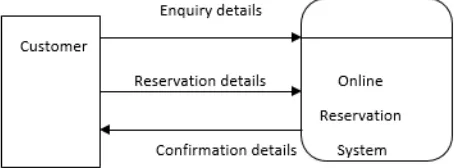
The Bricks Hotel currently runs offline booking system and therefore requires customers to only book for rooms or any other service by walking to the receptionist or calling them on phone or using a third party option. Any enquiry to be made demanding feedback must usually be forwarded to the hotel in person. Sometimes management is given false reports concerning the work flow of the hotel and employees also give falsified pricing information to customers from time to time. From an employee’s account, details of customers are hardly used in the workflow and that also, records are not properly kept; books used to keep records are disposed of when they get filled up. Bricks Hotel hardly advertises and depends on word of mouth adverts by some loyal customers in and around its vicinity.
Fig.1: Context Diagram of Old System
IV. THE PROPOSED SYSTEM
The proposed system is a web based application that allows customers to make enquiries online and book for services providing the required details. It adopts the virtual tour feature that was seen in the Bricks Hotels. The following are solutions the proposed system brings on board:
Well laid out information about Bricks hotel.
The manual booking system is replaced with an online reservation system.
Management can pull reports at any time to tell the current situation in order to put the necessary measures in place.
The system helps secure customer information since no information is disposed off.
Technology (IJRASET)
©IJRASET 2015: All Rights are Reserved
106
System monitoring done by system administrator
Filling forms to make enquiries and reservations
[image:8.612.198.425.162.246.2]Approving or deleting enquiries
Fig. 2: Context Diagram of Proposed System
V. METHODOLOGY
A. Sublime Text Editor
Sublime Text is a cross-platform source code editor with a Python application programming interface (API). It natively supports many programming languages and mark-up languages, and its functionality can be extended by users with plugins, typically community-built and maintained under free-software licenses. Sublime Text is proprietary software; all license revenue accrues to the developer.
B. Google Chrome Web Browser
Google Chrome is a freeware web browser developed by Google. It used the WebKit layout engine until version 27 and, with the exception of its iOS releases, from version 28 and beyond uses the WebKit fork Blink.[14][15][16] It was first released as a beta version for Microsoft Windows on September 2, 2008, and as a stable public release on December 11, 2008. As of October 2015, Stat Counter estimates that Google Chrome has a 56% worldwide usage share of web browsers as a desktop browser. It is also the most popular browser for smartphones, and combined across all platforms at about 45%. Its success has led to Google expanding the 'Chrome' brand name on various other products such as the Chromecast. Google releases the majority of Chrome's source code as an open-source project Chromium. A notable component that is not open source is their version of the built-in Adobe Flash Player, called Pepper Flash Player.
XAMPP is a package of independently-created programs installed on computers that use a Microsoft Windows operating system (techstream.org). XAMPP is an acronym formed from the initials of the operating system Microsoft Windows and the principal components of the package: Apache, MySQL and one of PHP, Perl or Python (adroitcare.wordpress.com). PHP is a scripting language that can manipulate information held in a database and generate web pages dynamically each time content is requested by a browser (www.marolinedesign.com). PHP was used for the server programming which is basically queries used to link the website to the database. Other programs were included, such as phpMyAdmin which provides a graphical user interface for the MySQL database manager.
VI. DESIGN AND DEVELOPMENT OF THE PROPOSED SYSTEM
A. User Interface Design
Technology (IJRASET)
©IJRASET 2015: All Rights are Reserved
107
Fig. 3: User Interface Design
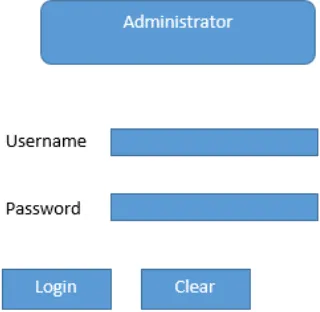
[image:9.612.217.377.280.436.2]1) Administrator Interface Design: The administrator interface has a log in feature for the administrator to gain access to the system.
Fig. 4: Administrator Interface Design
B. Database Design
Table 1: Room details
Field Name Data Type Width Description
RoomNo Int 10 Room Number
RoomType Varchar 20 Room Type
RoomPrice Currency Room Price
Table 2: Admin Details
Field Name Data Type Width Description
Admin_id Int. 10 Admin Id(auto
increment)
Username Varchar 30 Name of
Admin
Password Varchar 10 Password of
Technology (IJRASET)
©IJRASET 2015: All Rights are Reserved
108
Table 3: Customer Details
Field Name Data Type Width Description
Customer_id Int 10 Customer Id
Name Varchar 15 First Name of
Customer
lastName Varchar 20 Last name of
Customer
Location Varchar 20 Residential address
of Customer
Address Varchar 20 Postal address
Email Varchar 15 Email Address
Telephone Varchar 15 Telephone number of
customer
C. Development Of The Proposed System
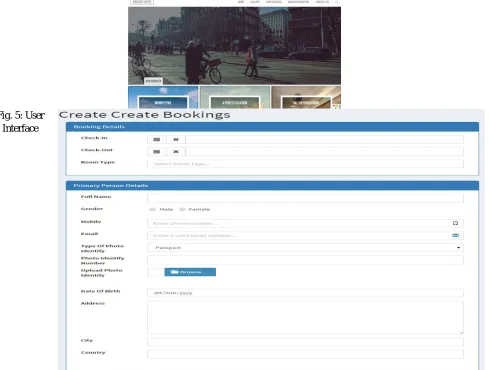
[image:10.612.182.429.87.250.2]There is a proper use of colors, font type and size to make reading easy. Hyperlinks change color to show whether the customer has already visited. Text boxes and buttons are provided to enable users input data. Labels are placed next to the text boxes to help users know what kind of data is required for each box. On the top are menus that help users see what has been hidden by clicking on the hyperlinks. The main page gives a front view image of Bricks Hotel, and to the left, daily information and news concerning the hotel.
Fig. 5: User Interface
[image:10.612.49.538.326.696.2]Technology (IJRASET)
[image:11.612.134.526.45.421.2]©IJRASET 2015: All Rights are Reserved
109
[image:11.612.165.451.293.408.2]Fig. 7: Administrator Interface
Fig 8: Make a Reservation
D. Implementation
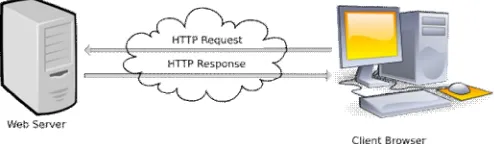
[image:11.612.181.428.526.598.2]A customer’s web browser issues an HTTP request from the Contact page. On clicking the button, the content of the fields are posted from the customer’s browser as a request to the web server. On receiving the request, the web server retrieves the file, Contacts.php from its disk or memory and passes it to the php, php.dll, after processing the file php sends the HTML page to the server.
Fig. 9: Transfer of Request
VII. CONCLUSION
Technology (IJRASET)
©IJRASET 2015: All Rights are Reserved
110
REFERENCES
[1] B.S. Afriyie, Concise ICT Fundamentals Volume One, Trafford Publishing, 2012.
[2] T. Berners-Lee, Web Design Issues, 1998, http://www.w3.org/DesignIssues/RDFnot.html.
[3] H. Bidgoli, Essentials of Software Engineering 2011. V. DeBolt, Mastering Integrating Html and CSS, ISBN: 978-0-470-09754-0, 2007 [4] P. Ghosh, SQL Popcorn, Eastern Economy ed, New Delhi: PHI Learning, 2010.
[5] R. Malloy, Internet and Personal Computing Abstracts: IPCA, Volume 22 Issues, Information Today, Incorporated, 2001, 2001. [6] Official JavaScript documentation https://developer.mozilla.org/en-US/docs/Web/JavaScript/
[7] J. Pan, S. Chen, and N. Nguyen, Intelligent Information and Database Systems: 4th Asian Conference, ACIIDS, Proceedings Part 2, Kaohsiung, Taiwan, 2012.
[8] N. Sfetcu, Web Design & Development, 2014.
[9] M. Taylor, A General Understanding of Microsoft Excel, Visual Studio and Webmatrix2, Mark Taylor and Paragon Publishing, Rothersthorpe, 2013. [10] Yii2 Application development cookbook, second edition by Alexander Makarov
[11] Official Yii2 Documentation http://www.yiiframework.com/doc-2.0/ [12] Responsive Web Design with HTML5 and CSS3 by Ben Frain [13] PHP Reference: Beginner to Intermediate PHP5 by Mario Lurig [14] Official php5 documentation http://www.php.net/docs.php/ [15] Bootstrap Essentials by Snig Bhaumik