Technology (IJRASET)
Implementation of GSM and Zigbee Technology to
Improve the Operational Efficiency of Road
Transportation System
Nnochiri, I.U., M.Eng.,
Department of Computer Science, Michael Okpara University of Agriculture, Umudike, Abia State, Nigeria
Abstract: At the moment, reporting bus station is rely mainly on driver’s manual operation, thus, making mistakes and misleading passengers becomes inevitable when driving the bus. Therefore, this Paper proposes a supervisory system based on Global System for Mobile Communication (GSM) and Zigbee technology to improve the operation efficiency and realize intelligent transportation system. The research introduces an enhanced bus system from the aspect of both hardware and software design. The principle and the feature of GSM SMS and ZIGBEE communication are analyzed. The system takes into account of the respective advantages and disadvantages of GSM, Zigbee and ARM 7, and designs a feasible solution successfully. The designed system will play a good effect from many aspects.
Keywords: Zigbee, Bus, GSM, Transportation, Software
I. INTRODUCTION
With the development of the computer, wireless communications and the rapid development of microelectronics technology, the people’s life standard is constantly enhancing. Thanks to the rapid development of information technology and growth of the Internet through high speed networks, network environments have even been changed from office oriented environments based on business industries and public institutions to the interconnection of digital electronics in the home networks. Buses are offered by the Government as an unrestricted service, worth of which will directly establish the expediency of public travel. It is a significant decisive factor for quality of service standards that bus reaches the station on time and reports which station it is located accurately. As there are dedicated staff members at the start and at the end the punctuality can be guaranteed. So for middle stations, punctuality cannot be guaranteed and cannot find the exact location of the bus.
ZigBee is a specification for a suite of networking, security and application software layers using small, low-power, low-cost, low data rate communication technology based on IEEE 802.15.4 standard for personal area networks. Global system for mobile communication (GSM) is a digital mobile telephony system. GSM digitizes and compresses data, then sends it down through a channel with two other streams of user data, each in its own time slot. In this Paper a supervisory system based on GSM and Zigbee technology to improve the operation efficiency and realize intelligent transportation system was proposes.
II. ZIGBEE AND GSM TECHNOLOGIES
A. Zigbee
Technology (IJRASET)
this topology can play the role of the PAN coordinator. The technical features of Zigbee include:
1) Security: ZigBee provides data integrity check and authentication, and uses AES-128 security algorithm. Each application has the flexibility to determine its safety properties.
2) Reliability: It uses collision avoidance mechanism, and at the same time it reserves a dedicated time slot to require a fixed bandwidth of the communication service, avoid the competition and conflicts when data is sent. MAC layer uses a full confirmation of data transfer mechanisms, and each packet of data sent must wait to receive confirmation.
3) Low cost: The initial cost of module estimates about US$6, and soon will fall between US$1.5 and US$2.5, and ZigBee Protocol is free of royalties.
4) Power saving: As the duty cycle is very short, transmitting and receiving information has lower power consumption, and using the hibernation mode, ZigBee technology ensures that two N size batteries can support from 6 months to 2years. Of course, different applications have power different power consumptions.
5) High network capacity: A ZigBee network can accommodate a maximum of 65536 devices.
6) Short delays: Enhanced communication delays for delay-sensitive applications. Communication delay and sleep wake up time delay are very short. Typical device search delay is 30ms, typical sleep wake up time delay is 15ms, and active channel access delay is 15ms.
Main applications of ZigBee are within short range and data transfer rate among the various electronic equipments is not high. The typical transfer data types are periodical data (such as sensor data), intermittent data (such as lighting control), and repetitive low latency data (such as a mouse).
B. GSM
Global system for mobile communication (GSM) is a digital mobile telephony system. GSM digitizes and compresses data, then sends it down through a channel with two other streams of user data, each in its own time slot. The GSM module communicates with the microcontroller through Universal asynchronous receiver and transmitter (UART) or universal synchronous asynchronous receiver transmitter (USART). To communicate over UART or USART, we just need three basic signals which are namely, RXD (receive), TXD (transmit), GND (common ground) . The (TxD serial port) of microcontroller is connected with (TxD) of the GSM Modem while receive signal of microcontroller (RxD serial port) is connected with receive signal (RxD) of serial interface of GSM Modem. GSM uses cellular networks, which means that mobile phones connect to it by searching for cells in the instantaneous environs. GSM networks operate within the range of 900 MHz to 1800 MHz bands. Some countries in the Africa (including Nigeria) use the 850 MHz and 1900 MHz bands because the 900 and 1800 MHz frequency bands were already allocated.
III. PROPOSED SYSTEM STRUCTURE ANALYSIS
Technology (IJRASET)
Now the passenger who wants to know the location of the bus sends the request message to the station monitor using GSM network as each station monitor contains a unique ID number there will be no chance of occurrence of error and now the station monitor sends the bus information to the passenger who requested to know the information of the bus.
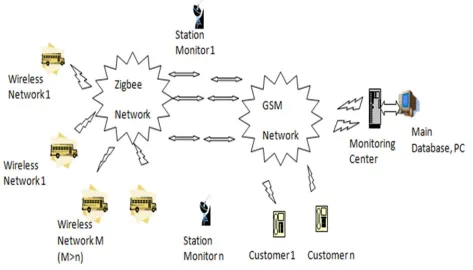
[image:4.612.125.483.165.324.2]Figure 1 presents the structure of bus punctuality enhanced system. As it shows, the system consists of three parts: Monitoring Center, Zigbee[11] coordinator--Station Monitor, Device—Wireless Terminal or Wireless Identification Device .
Figure 1: Station Monitor
The system consists of monitoring center, station monitor and wireless identification device. The following describes hardware structure and the corresponding implementations of the system design process.
A. Station Monitor
The structural framework is shown in Figure2, the station monitor consists of ARM 7[9], GSM module, ZigBee transceiver and so on. Station monitor chooses Lpc 2148 as an MCU, TARANG as ZigBee transceiver and S 900 as GSM module. The resources required for ZigBee coordinator to support multiple connections of ZigBee devices might be relatively more; however, the number of ZigBee devices that establish connection with ZigBee coordinator at the same time will not be large, less demanding on the network layer functions of ZigBee network.
B. Wireless Identification Device
[image:4.612.152.454.561.633.2]As it shown in Figure 3, the wireless identification device contains LPC 2148and TARANG, to be a basic Zigbee device, and a LCD and an oscillator circuit. Therefore, it is suitable for writing the unique identification number of each device while initialization, eliminating the need for an external non-volatile memory. Then the overall structure will be simplified; the cost will decreased.
Figure 2: Wireless Identification Device.
The ARM7 based LPC2148 microcontroller.LPC2148 is 32/16 bit microcontroller with embedded high speed flash memory of 512 KB.
Technology (IJRASET)
IV. SOFTWARE DESIGNSoftware design includes ZigBee protocol software design and application software design.
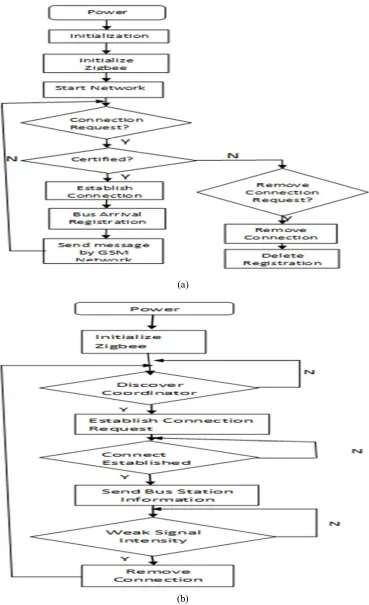
The Station monitor itself is a ZigBee network coordinator, plus GSM module. After power-on, the MCU of station monitor first initializes GSM module and ZigBee protocol stack. The next step for ARM is to scan the channel and assess the idle channel. According to the analysis of channel state, MCU will select appropriate operating channels and select the right network identifier. Then MCU starts the ZigBee network and sends data frames up to network, waiting for the connection request from some one ZigBee device. If MCU has received one message of connection request, it will certify whether the ZigBee device is legal. If yes, MCU can now issue a command to allow ZigBee device to establish connection. When connection established, station monitor will obtain the information of ZigBee device’s identification number, which is on behalf of one bus where the ZigBee device is installed. MCU will register the identification number and at the same time, send one message about what time the bus shall arrive at this bus station. When the bus is leaving bus station, the special signal intensity will decrease continuously. If the signal intensity decreases to some degree, the connection between bus and station monitor will automatically be eliminated. And corresponding, the information of identification number in registration table will be removed. Then the MCU of station monitor send one message that the bus has left the bus station.
[image:5.612.51.524.395.665.2]The workflow of station monitor is shown in Figure 4-a.For Zigbee device-wireless identification device, which is installed on bus, it first initializes the Zigbee protocol stack after power-on. The device starts scanning the channel to find the nearest Zigbee coordinator. When it detects the data frames sent from ZigBee network coordinator and mean while, wireless identification device sends one message of establishing connection request if the signal intensity is stronger than a certain degree. The wireless identification device will obtain the identification number of ZigBee coordinator, and be aware of which station the bus is located; so the bus can report bus station information according to the station identification number. If the signal intensity decreases to some degree, wireless identification device will send one message of request for disconnecting the network which it has joined and, the connection will be eliminated. The workflow of station monitor is shown in Figure 4-b.
Technology (IJRASET)
(a)
[image:6.612.123.492.78.683.2](b)
Technology (IJRASET)
The data that is sent from the station monitor is recorded in the hyper terminal window. It contains the information regarding the bus arrival and departed time. So in this way the punctuality regarding the public transportation can be enhanced.
V. CONCLUSION
The application of GSM and Zigbee technology to the bus monitoring system can solve many problems. In this Way, bus service quality and operational efficiency will improve. GSM technology and Zigbee Technology and ARM used in the system implementation have proven to be a vital tool in monitoring road transportation system. The passenger is also able to get the information about the respective bus. Such kind of system model is also suitable for many other applications of Industrial site.
REFERENCES
[1] Camilli, A., Cugnasca, C.E. , Saraiva, A.M. , Hira-kawa, A.R. and Corrêa, P.L. Anatomy of an application for precision agriculture , Computers and Electronics in Agriculture. Vol. 58, pp 25-36, 2007.
[2] Zigbee Alliance, available at: www.zigbee.org.
[3] Farahani, S. “Zigbee Wireless Networks and Transceivers”, Newnes, USA, 2008.
[4] IEEE Std.802.15.4, Part 15.4: Wireless Medium Access Control (MAC) and Physical Layer (PHY) Specifications for Low-Rate Wireless Personal Area Networks (LR-WPANs), 2006, ©2006 IEEE
[5] David Seal, “ARM Architecture Reference Manual”, Second Edition, Addison Wesley, 2001 [6] Steve furber, “ARM System-on-chip Architecture”, Second Edition, Addison-Wesley, Published 2000.
[7] Rathod K, Parikh N, Parikh A, Shah V, “Wireless automation using Zigbee protocols”, NinthInternational Conference on IEEE, Wireless and Optical Communications Networks (WOCN), 2012
[8] IEEE 802.15.4 2003. Wireless Medium Access Control(MAC) and Physical Layer
[9] Nagarajan R, Dhanasekaran R, “Implementation of wireless data transmission in monitoring and control”, International Conference on IEEE, Communications and Signal Processing (ICCSP), 2013
[10]Michel Mouly and Marie Bernadette pautet:GSM system for mobile communication, published by author 1992,ISBN2-9507190-0-7 [11]Friedhelm Hillebrand(editor):GSM and UMTS,the creation of global mobile communication, Wiley 2001
ABOUT THE AUTHORS