Analyzing Effects of Weld Parameters for
Increasing the Strength of Welded Joint on Mild
Steel Material by Using the MIG Welding Process
Darshan A. Bhatt1, Hardik R. Mehta2
Department of Mechanical Engineering, Indus University, India
Abstract: In Manufacturing the Mechanical Components, joining is the most requisite process. Welding is one such
permanent type of joining methods which can join two or more different or same material parts. Among different types of welding processes, MIG welding is the most widely used for joining the parts as it has significant advantages as compare with other welding processes? So this Research Paper is based on how to increase the strength of Welding joints by applying the MIG Welding process. To achieve the best possible solution we have conducted series of experiments using Mild Steel ( IS 2062) by applying varying welding parameters like voltage, current, welding speed etc.
Keywords: Metal Inert Gas (MIG), Heat Affected Zone (HAZ), American Society of Mechanical Engineers (ASME),
Ultimate Tensile Strength (UTS), Brinell Hardness Number (BHN), Direct Current Electrode Positive (DCEP) I. INTRODUCTION
MIG welding is a welding process in which an electric arc forms between a consumable wire electrode and the work piece metal, which heats the workpiece metals causing them to melt &join. Along with the wire electrode, a shielding gas feeds through the welding gun, which shields the process from contaminants in the air. Four primary methods of metal transfer in MIG called globular, short circuiting, spray and pulsed spray. Nowadays MIG is widely used in various constructions such as steel structures, bridges, autos, motorcycles, construction machinery, pressure vessels and pipelines due to high welding efficiency. The quality of weldments made by MIG is markedly affected by the welding parameters set by a welder like welding current, welding voltage, travel speed, weld joint position, electrode angle.
A. Welding Current
Welding Current used in MIG has the greatest effect on the deposition rate,weld bead size,shape & penetration.In MIG welding metals are generally welded with DCEP( Direct current electrode positive) because it provides the max. heat input to the work & therefore relatively deep penetration can be obtained. When all other welding parameters are held constant, increasing the current will increase the depth and the width of weld penetration & the size of weld bead. If the current is too high, the size of weld bead is large and excessive deep penetration that wastes the filler metal causes burn through &undercut. Too high or too low welding current also affects the strength of weld metal and tensile strength.
B. Welding Voltage
In MIG ,the arc voltage has a decided effect upon the penetration bead reinforcement & bead width .By increasing the arc voltage the weld becomes flatter & wider,the penetration increases until an optimum value of the voltage is reached,at which time it begins to decrease.High and low voltage cause an unstable arc on mild steel.Excessive voltage causes the formation of excessive spatter & porosity in fillet welds,it increases undercut and produces concave fillet welds subject to cracking.Low voltage produces narrower beads with greater convexity but an excessive low voltage may cause porosity and overlapping at the edges of the weld bead.
C. Travel Speed
251
Chemical Composition:-Carbon % Manganese
Max % Sulphur Max % Phosphorous Max % Silicon Max % Carbon Equivalent
0.23 1.50 0.045 0.045 0.40 0.42
Tolerance +0.02
+0.05 +0.005 +0.005 +0.03
Table1. chemical composition of IS 2062
Mechanical Properties:
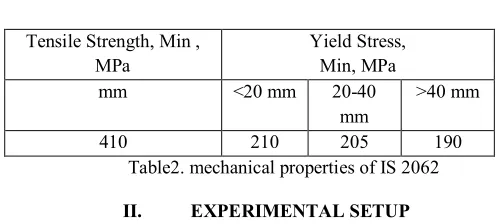
Tensile Strength, Min , MPa
Yield Stress, Min, MPa
mm <20 mm 20-40
mm
>40 mm
410 210 205 190
Table2. mechanical properties of IS 2062
II. EXPERIMENTAL SETUP
In this study, the effect of various welding parameters on the weldability of Mild Steel – IS 2062 specimens having dimensions 300mm×300mm×10 mm welded by MIG welding were investigated. The welding current, arc voltage, welding speed are chosen as welding parameters.
Welding Process : MIG Welding.
Welding Parameters - Welding Current , Arc Voltage & Welding Speed. Dimension : 300mm×300mm×10mm.
Parent Material Grade : IS 2062.
Electrode Wire Specification : Flux Cored Wire AWS A5-20 E-71T-1 Electrode Wire Diameter : 1.2 mm.
[image:3.612.181.430.209.321.2]Shielding Gas - Carbon-Dioxide CO2 Eqipment: (1) Mig Welding Gun (2) Mig Welding Apparatus (3) Pressure Gauge.
Fig. 1 mig welding gun
Fig. 3 pressure gauge
A. Experimental procedure
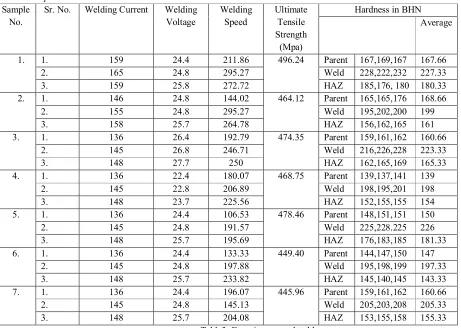
First all we had analyzed readings of welding parameters which is currently being used in premier engineering limited. Then we had applied the various varying welding parameters for increasing the strength of welding joints in mig welding. Sample marked as ‘7’ mentioned in the 'Experimental Result' table is being used by premier engineering limited. The readings mentioned in table for sample '1-6' are carried by ourselves under proper welding standard and as per our experimental setup. Various readings for 'Sample 1-6' (as mentioned in experimental results table) were carried by varying Welding Current, Arc Voltage and Welding Speeds. The effect of each parameter on the welding joint was scrutinized by keeping the rest two parameters constants (though welding speed solely depends on the welder and can't be held constant). For carrying out experimental analysis the dimensions of Weldments were chosen as 300mm×300mm×10mm according to 'Test Method - ASME SEC 9 ASTM A370 . Two pieces of dimensions 300mm×150mm×10mm were welded together and such seven samples were prepared. The range for the selection of Welding Current and Arc Voltage were chosen by referring to 'Manufacturing Technology Volume-1' by 'P.N. Rao'. For the preparation of each sample , welding was carried out in three passes and a back-chip .For each pass , the readings for Welding Current , Arc Voltage and Welding Speed were noted down and checked the Hardness and U.T.S. of the specimen.
B. Experimental Results Sample
No.
Sr. No. Welding Current Welding
Voltage Welding Speed Ultimate Tensile Strength (Mpa)
Hardness in BHN Average
1. 1. 159 24.4 211.86 496.24 Parent 167,169,167 167.66
2. 165 24.8 295.27 Weld 228,222,232 227.33
3. 159 25.8 272.72 HAZ 185,176, 180 180.33
2. 1. 146 24.8 144.02 464.12 Parent 165,165,176 168.66
2. 155 24.8 295.27 Weld 195,202,200 199
3. 158 25.7 264.78 HAZ 156,162,165 161
3. 1. 136 26.4 192.79 474.35 Parent 159,161,162 160.66
2. 145 26.8 246.71 Weld 216,226,228 223.33
3. 148 27.7 250 HAZ 162,165,169 165.33
4. 1. 136 22.4 180.07 468.75 Parent 139,137,141 139
2. 145 22.8 206.89 Weld 198,195,201 198
3. 148 23.7 225.56 HAZ 152,155,155 154
5. 1. 136 24.4 106.53 478.46 Parent 148,151,151 150
2. 145 24.8 191.57 Weld 225,228.225 226
3. 148 25.7 195.69 HAZ 176,183,185 181.33
6. 1. 136 24.4 133.33 449.40 Parent 144,147,150 147
2. 145 24.8 197.88 Weld 195,198,199 197.33
3. 148 25.7 233.82 HAZ 145,140,145 143.33
7. 1. 136 24.4 196.07 445.96 Parent 159,161,162 160.66
2. 145 24.8 145.13 Weld 205,203,208 205.33
3. 148 25.7 204.08 HAZ 153,155,158 155.33
253
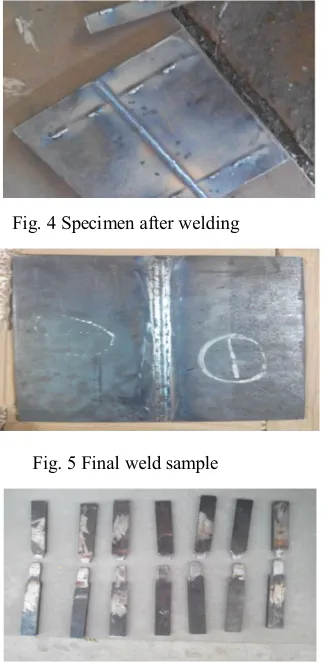
Fig. 4 Specimen after weldingFig. 5 Final weld sample
Fig. 6 samples after tensile test
III. RESULTS & DISCUSSION
A. As compared with sample “7” (company’s own setup), if we increases the welding speed then hardness increases and ultimate tensile strength also increases as this can be shown from sample no.1(experiment result table).
B. If welding speed increases, and voltage decreases then hardness is going to decreases. This can be shown in sample no.4 as compared with company’s own setup.
C. If current kept constant and voltage increases along with increase in welding speed, then hardness increases. (sample no.3 and sample no.7)
IV. CONCLUSION
A. Since from the above results we have concluded that with increasing the welding speed with constant welding voltage and current, hardness increases.
B. For increasing the efficiency of welded joint, we have to increase the two parameters keeping remaining one constant. C. If Voltage decreases and welding Speed increases hardness decreases. If Voltage increases, Current increases and welding
speed decreases then hardness decreases.
REFERENCES
[1] ASM Handbook Volume 6 - Welding , Brazing and Soldering. [2] ASM Handbook Volume 20 - Materials Selection and Design. [3] AWS Welding Handbook Volume 1 - Welding Science and Technology [4] AWS Welding Handbook Volume - 4 Materials and Applications ,Part-1. [5] Manufacturing Technology Volume - 1 by P.N. Rao.
[6] http://www.migtigarc.co.uk/Intro_MIG_Welding.pdf
[7] http://www.kobelco.co.jp/english/welding/events/files/2011GMAW.pdf [8] http://www.ijest.info/docs/IJEST10-02-04-29.pdf
[image:5.612.243.406.72.403.2]