5
XI
November 2017
Experimental Study on Partial Replacement of
Cement by Using Ceramic Waste Powder
S. Manigandan1,G.S.Saravanakumar2
1,2
Assistant Professor CK College of Engineering & Tech Cuddalore, Tamil Nadu, India
Abstract: Concrete has been proved to be one of the most important construction materials more than a century. Ceramic waste is one of the most active researches in civil engineering and construction materials. Ceramic waste powder is settled by sedimentation and then dumped away which results in environmental pollution, in addition to forming dust in summer and threatening both agriculture and public health. Therefore, utilization of the ceramic waste powder in various industrial sectors especially the construction, agriculture, and paper industries would help to protect the environment. It is most essential to develop eco-friendly concrete from ceramic waste. In this research study the (OPC) cement has been replaced by ceramic waste powder accordingly in the range of 10%, 20%, &30% by weight of M-40 grade concrete. Concrete mixtures were produced, tested and compared in terms of compressive strength to the conventional concrete.
Keywords: Ceramic waste material, Compressive Strength, Super plasticizers, Industrial Waste, Low Cost, OPC Cement.
I. INTRODUCTION
In this project we use the ceramic waste materials by replacing partially with cement in the concrete. Ceramics is an inorganic, nonmetallic, solid material comprising metal, nonmetal or metalloid atoms primarily held in ionic and covalent bonds. In India ceramic production is 100 million tons per year. In this ceramic industry, about 15% - 30% production goes as waste. This waste is not recycled in any form at present. However, the ceramic waste is durable, hard and highly resistant of biological, chemical and physical degradation this leads to serious environmental and dust pollution, occupation of vast area of land. The advancement of concrete technology can reduce the consumption of natural resources. They have forced to focus on recovery, reuse of natural resources and find other alternatives. The use of the replacement materials offer cost reduction, energy savings, arguably superior products, and fewer hazards in the environment.
A. Ceramic waste
Ceramic materials is the mixture of clay, powder and water shaping into desired forms. The principle waste coming into the ceramic industry is the ceramic powder, specifically in the powder forms. Ceramic wastes are generated as a waste during the process of dressing and polishing. It is estimated that 15% to 30% waste are produced from total raw material used, and although a portion of this waste may be utilized on-site, such as for excavation pit refill, The disposals of these waste materials acquire large land areas and remain scattered all around, spoiling the aesthetic of the entire region. It is very difficult to find a use of ceramic waste produced. Ceramic waste can be used in concrete to improve its strength and other durability factors. Ceramic waste can be used as a partial replacement of cement or as a partial replacement of fine aggregate sand as a supplementary addition to achieve different properties of concrete.
1) Advantages of Ceramic waste a) Easily available.
b) Corrosion resistance.
c) Harder than conventional structures metals.
d) Low coefficient of friction.
e) Low density
f) Extremely high melting point.
g) Inexpensive.
2) Disadvantages
a) Weak in tension.
b) Poor shock resistance.
B. Cement
The cement used for this study is Ordinary Portland cement conforming to Indian Standard IS 12269 – 1987 of grade 53. Cement is one of the most commonly used products in construction. The major disadvantages in cement production are emission Co2 into the atmosphere. It causes Global warming effect hence it should be reduced.
C. Aggregate
Aggregates are the important constituents in concrete. They give body to the concrete, reduce shrinkage and effect economy. One of the most important factors for producing workable concrete is a good gradation of aggregates. Good gradingimplies that a sample fraction of aggregates in required proportion such that the sample contains minimum voids. Samples of the well graded aggregate containing minimum voids require minimum paste to fill up the voids in the aggregates. Minimum paste means less quantity of cement and less water, which are further mean increased economy, higher strength, lower shrinkage and greater durability.
C. Coarse Aggregate
The fractions from 20 mm to 4.75 mm are used as coarse aggregate. The coarse aggregates from crushed Basalt rock, conforming to IS: 383 is being use. The Flakiness and Elongation Index were maintained well below 15%.
D. Fine aggregate
Those fractions from 4.75 mm to 150microns are termed as fine aggregate. The river sand is used in combination as fine aggregate conforming to the requirements of IS: 383. The river sand is washed and screen, to eliminate deleterious materials and oversize particles.
E. Superplasticizer
Superplasticizer is a water reducer . Historically, lingosulphonates have formed the basis of water-reducing admixtures in the U.S.A and elsewhere, since the early 1940’s. However, research in the early 1960’s in Japan and Germany lead to the development of superplasticizers. In this work we use Conplast ® Sp430.
II. PRELIMINARY TEST ON MATERIALS
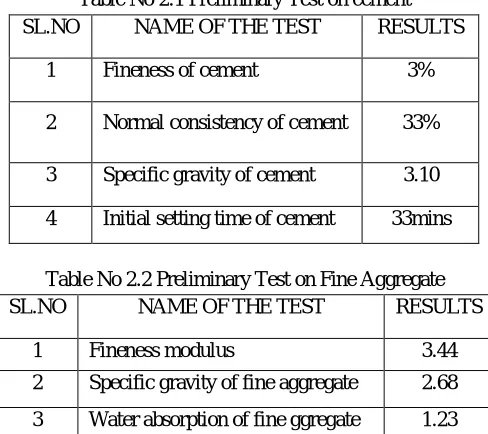
[image:3.612.184.428.492.709.2]The material such as ceramic powder, coarse aggregate, fine aggregate, cement & water are collect in around cuddalore district. The preliminary test are done as per ASTM.
Table No 2.1 Preliminary Test on cement
SL.NO NAME OF THE TEST RESULTS
1 Fineness of cement 3%
2 Normal consistency of cement 33%
3 Specific gravity of cement 3.10
4 Initial setting time of cement 33mins
Table No 2.2 Preliminary Test on Fine Aggregate
SL.NO NAME OF THE TEST RESULTS
1 Fineness modulus 3.44
2 Specific gravity of fine aggregate 2.68
Table No2.3PreliminaryTest on Coarse Aggregate
SL.NO NAME OF THE TEST RESULTS
1 Fineness modulus 3.1
2 Specific gravity of ceramic
material
2.97
A. Ceramic Waste Materials
Table No 2.4 Preliminary Test on ceramic waste materials
III. DESIGN MIX
Water Cement ratio : 0.38
Mix ratios : [1: 1.54: 2.92]
Based on the preliminary test value, the design mix is prepared as per IS: 10262-2009 by using w/c ratio of 0.38 & super plastizer of 17% ,we got the mix proportion of (1:1.54:2.92) for M40 grade of concrete
IV. CUBE CASTING
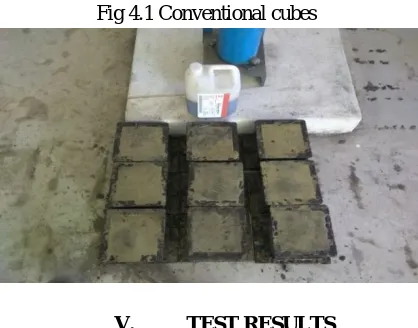
[image:4.612.203.412.470.634.2]Based on Mix Design we cast totally 42 Numbers of cube (6 No of conventional concrete & 12 no. of cube for each 10%,20% & 30% replacement of cement by using ceramic waste).The ceramic cubes are curied by using Normal water .
Fig 4.1 Conventional cubes
V. TEST RESULTS
The compression test is used to determine the behaviour or response of a material while it experiences a compressive load by measuring fundamental variables, such as, strain, stress, and deformation. By testing a material in compression the compressive strength, yield strength, ultimate strength, elastic limit, and the elastic modulus among other parameters may alsodetermined. With the understanding of these different parameters and the values associated with a specific material it may be determined whether or not the material is suited for specific applications or if it will fail under the specified stresses. The test results for concrete shown below
SL.NO NAME OF THE TEST RESULTS
1 Fineness modulus 8.05
2 Specific gravity of coarse
aggregate
2.85
3 Water absorption of coarse
aggregate
Table 5.1 Compression strength of conventional concreteTable 5.2Compressive strength concrete for 10% Replacement of cement by ceramic powder
Table 5.3 Compressive strength concrete for 20% Replacement of cement by ceramic powder
S.NO No of days
curing
Compressive strength (N/mm2)
1 7 26.4
2 14 27.3
3 28 28
Table 5.4 Compressive strength concrete for 30% Replacement of cement by ceramic powder
S.NO No of days Compressive strength
(N/mm2)
1 7 21.5
2 14 23.5
3 28 24
A. Overall Comparison
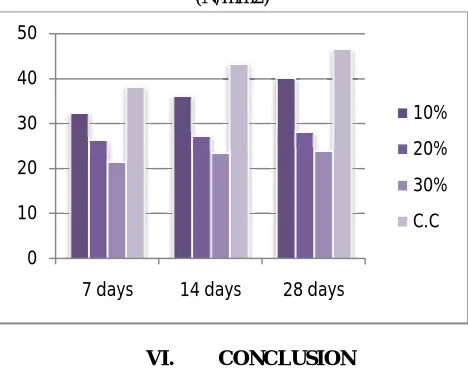
[image:5.612.190.424.505.690.2]The graph shows that the result for comparison of conventional concrete with 10%,20%,30% replacement of cement with ceramic waste materials after 7,14, and 28 days curing by Normal water .
Fig 5.1 Comparison of Compressive strength for Conventional&10%,20%,30% of replacement of ceramic waste concrete. (N/mm2)
VI. CONCLUSION
In this project the cement is replaced with ceramic waste by 10%,20%,&30% by weight we cast totally 36 Number of cubes (such of 9 no of conventional& 9 No of cube for each 10%,20%& 30%replacement of cement by using ceramic waste ) and they are cured in Normal water. we tested the cubes in compressive strength testing machine . The results obtained as
0 10 20 30 40 50
7 days 14 days 28 days
10%
20%
30%
C.C
S.NO No of days
curing
Compressive strength(n/mm2)
1 7 38.2
2 14 43.3
3 28 46.6
S.NO No of days
curing
Compressive strength (N/mm2)
1 7 32.4
2 14 36.2
A. The results shows that 10% replacement of cement by ceramic waste, curing by normal water shows the good results when we compared to the other& also produces more (or) less equal results to conventional concrete.
B. Hence due to 10% replacement of cement there are lot of advantages such cost reduction, minimize the environmental pollution
etc. Hence we recommended to use concrete of ceramic powder of 10%
REFERENCES
A. Hardikpatel, Et Al2015 “ Use of ceramic powder in cement concrete”
B. O. Zimbili, W. Salim, M. Ndambuki (2014) “A Review on the Usage of Ceramic Wastes in Concrete Production”
C. PunitMalikJatinMalhotra, Et Al.(2014) “Mix Design for Concrete with Crushed Ceramic Tiles as Coarse Aggregate”
D. QuShuying, Zheng Bin*, Sun Chen and Li Jin(2014) “Application of Ceramic Wastes in Concrete”
E. .Muhammad fathi bin asrul“Ceramic tiles waste as coarse aggregates partial replacement for concrete production”
F. Amitkumar D. Raval,Et Al (2013) “Ceramic Waste : Effective Replacement Of Cement For Establishing Sustainable Concrete”
G. IS:456-2000,“Plain reinforced concrete – code of practice, Bureau of Indian standards”, New Delhi,India.
H. IS: 383:1970,“Specification for coarse and fine aggregates from natural sources for concrete (second revision), Bureau of Indian standards”, New Delhi,India.
I. IS: 10262:2009,“Recommended guidelines for concrete mix design ,Bureau of Indian standards”, New Delhi,India.
J. IS: 516:1959,“Indian standard method of tests for strength of concrete,Bureau of Indian standards”, New Delhi,India.
AUTHORS
Mr. S.Manigandan obtained PG from Annamalai University. His area of specialization is Structural Engineering. He has Published 3 research papers in International Journals & 2 papers in international conferences. Is a life member of various professional bodies.
Mr.G.S.Saravanakumar obtained PG from Anna University. His area of specialization is Structural Engineering. He has Published 5 papers in international conferences. Is a life member of various professional bodies and recipient of many awards.
Author 1 Photo