Copyright © 2002, American Society for Microbiology. All Rights Reserved.
Differences in Virulence Factors among Clinical Isolates of
Escherichia
coli
Causing Cystitis and Pyelonephritis in Women and Prostatitis
in Men
Joaquim Ruiz,
1* Karine Simon,
1Juan P. Horcajada,
2Maria Velasco,
2Margarita Barranco,
1Gloria Roig,
3Antonio Moreno-Martínez,
2Jose A. Martínez,
2Teresa Jime´nez de Anta,
1Josep Mensa,
2and Jordi Vila
1Servei de Microbiologia1and Servei de Malalties Infeccioses,2Institut Clínic Infecciones i Inmunología, Hospital Clínic-IDIBAPS,
and Centro de Atencio´n Primaria Manso,3Barcelona, Spain
Received 19 August 2002/Accepted 21 September 2002
Differences in the presence of nine urovirulence factors among clinical isolates ofEscherichia colicausing cystitis and pyelonephritis in women and prostatitis in men have been studied. Hemolysin and necrotizing factor type 1 occur significantly more frequently among isolates causing prostatitis than among those causing cystitis (P< 0.0001) or pyelonephritis (P< 0.005). Moreover, thepapGIIIgene occurred more frequently in
E. coliisolates associated with prostatitis (27%) than in those associated with pyelonephritis (9%) (P< 0.05).
Genes encoding aerobactin and PapC occurred significantly less frequently in isolates causing cystitis than in those causing prostatitis (P< 0.01 andP< 0.0001, respectively) and pyelonephritis (P< 0.01 andP< 0.0001, respectively). No differences in the presence of Sat or type 1 fimbriae were found. Finally, AAFII and Bfp fimbriae are no longer considered uropathogenic virulence factors since they were not found in any of the strains analyzed. Overall, the results showed that clinical isolates producing prostatitis need greater virulence than isolates producing pyelonephritis in women or, in particular, cystitis in women (P< 0.05). Overall, the results suggest that clinical isolates producing prostatitis are more virulent that those producing pyelonephri-tis or cystipyelonephri-tis in women.
Urinary tract infections (UTIs) are one of the most common infectious diseases encountered in the clinical practice, mainly being associated with different members of the family
Enter-obacteriaceae. In fact,Escherichia coliis by far the most
pre-dominant pathogen causing UTIs (4, 18, 19, 21).
In general, rates of UTIs are higher among women than among men (15), with cystitis being the most prevalent UTI in women. It is noteworthy that the prevalence of quinolone re-sistance among E. coli strains causing cystitis is significantly higher than the prevalence of quinolone resistance among strains causing urinary parenchymatous infections such as prostatitis and pyelonephritis (2, 23). Velasco et al. (23) found that 20% of the isolates causing cystitis were resistant to cip-rofloxacin, while only 8% of the invasive isolates causing UTIs had a resistant phenotype. Some studies suggest that resistance to the quinolones may be associated with a diminished viru-lence of the uropathogenic strains (16). Moreover, in a recent work (25), the prevalence of different genes encoding certain virulence factors among quinolone-resistant E. coli isolates causing cystitis and pyelonephritis in women was found to be lower than that among quinolone-susceptible strains.
Both host and bacterial factors have been associated with the pathogenesis of these infections (9, 21). Thus, uropatho-genic strains of E. coli are believed to display a variety of virulence properties that help them colonize host mucosal
sur-faces and circumvent host defenses to allow invasion of the normally sterile urinary tract (15, 18, 21). A number of viru-lence determinants have been related to the acquisition or development of UTIs. Among these factors, siderophores, tox-ins, capsules, fimbriae, and others have been described (1, 6, 11–13, 15, 17, 18, 21, 27). Some of these virulence factors, such as necrotizing factor type 1,␣-hemolysin, or the Sat protein (a recently described autotransported protein which acts as a proteolytic toxin), have been found to be located in pathoge-nicity islands (PAI) (3, 5–7, 13).
Different studies analyzing the prevalence of a number of virulence factors in different UTIs have been performed in the past (1, 10, 11, 17). However, the evolution in the knowledge of UTIs makes it necessary to perform a comparative study of the prevalence of both well-established and putative urovirulence factors in UTIs affecting women and men.
The aim of this study was to analyze the prevalence of nine virulence factors in quinolone-susceptible pathogenic E. coli
strains causing invasive UTIs in men (prostatitis) and women (pyelonephritis) and noninvasive UTIs in women (cystitis).
MATERIALS AND METHODS
Microorganisms.A total of 111E. colistrains have been analyzed. Seventy-one isolates (34 causing pyelSeventy-onephritis in women, and 37 causing prostatitis in men) were submitted to the Clinical Microbiology Laboratory of the Hospital Clinic of Barcelona. The remaining 40 isolates were from women with cystitis and were recovered from urine samples submitted to the Clinical Microbiology Lab-oratory of the Primary Care Center Manso or the Clinical Microbiology Labo-ratory of the Hospital Clinic of Barcelona. Only one isolate from each patient was analyzed. Resistance to quinolones was considered an exclusion criterion to avoid the bias produced by the prevalence of certain virulence factors in quin-olone-resistant isolates (25).
* Corresponding author. Mailing address: Servicio de Microbio-logia, Instituto Clínico de Infecciones e InmunoMicrobio-logia, IDIBAPS, Hospital Clínic, C/.Villarroel 170, 08036-Barcelona, Spain. Phone: 34932275522, ext. 2361. Fax: 34932275454. E-mail: joruiz@clinic .ub.es.
4445
on May 15, 2020 by guest
http://jcm.asm.org/
Cystitis was clinically defined as a syndrome involving dysuria, frequency, and urgency, whereas acute pyelonephritis was defined as a syndrome characterized by fever (armpit temperature,⬎38°C), flank pain, and/or lumbar tenderness, often associated with dysuria, urgency, and frequency. Prostatitis was defined by the presence of fever, pyuria, and prostatic tenderness.
Antibacterial susceptibility testing.The susceptibilities of the isolates tested to nalidixic acid and ciprofloxacin were established by the E-test, according to the instructions of the manufacturer (AB-Biodisk, So¨lna, Sweden).
Hemolytic activity.The isolates were tested for the production of hemolysin on 5% sheep blood agar plates. Strains with a clear halo after overnight culture at 37°C were defined as hemolytic.
Expression of type 1 fimbriae.The presence of type 1 fimbriae was determined by agglutination ofSaccharomyces cerevisiaeby the procedure described by An-dreu et al. (1).
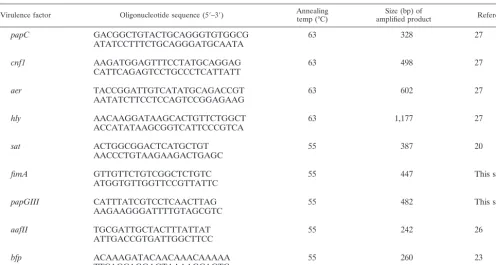
Detection of genes encodingE. coliurovirulence factors.The primers listed in Table 1 were used to amplify and detect some genes encoding urovirulence factors. The presence of thecnf1,papC,aer, andhlygenes was established by use of the conditions described by Yamamoto et al. (27). The PCR conditions used to amplify a fragment of theprsoperon and thesatandfimAgenes were those described by Vila et al. (24), although 35 cycles instead of 30 cycles were used. Finally, the conditions described by Vargas et al. (22) and Vila et al. (26) were used to amplify thebfpandaafgenes, respectively. All samples with negative results were retested at least twice to eliminate the possibility of false-negative results. The strains from randomly selected samples with positive PCR results were recovered, and their sequences were determined by using the dRhodamine Terminator Cycle Sequencing kit (Perkin-Elmer Cetus, Emeryville, Calif.) and analyzed in an automatic DNA sequencer (ABI Prism 377; Perkin-Elmer Cetus) in order to perform a quality control for the PCR products obtained.
Ratio of number of virulence factors per strain.A ratio consisting of the quotient of the number of virulence factors present in the strains causing cystitis, pyelonephritis, and prostatitis to the total number of strains causing those infec-tions was calculated.
Statistical analysis.To establish the significance of the results, the Fisher exact test, the chi-square test, or the Kruskal-Wallis test was used as appropriate. The level of significance was set at aPvalue of⬍0.05.
RESULTS
The presence of nine virulence factors in a set of quinolone-susceptible pathogenic E. coli strains causing different UTIs
was determined by PCR. The prevalence of these virulence factors is shown in Fig. 1.
The most frequently found virulence factor-encoding gene in the E. coli strains studied, independently of whether the strain caused cystitis, pyelonephritis, or postatitis, was the gene for type 1 fimbriae (prevalence range, 89 to 95%). However, a 100% concordance between the presence of the gene and the expression of the fimbriae was found only among the group of strains causing pyelonephritis. The lowest rate of expression of this virulence factor was among the isolates producing pros-tatitis, with 85% of the strains that had the gene expressing it. If we take into account all isolates analyzed, only 76% of the isolates producing prostatitis expressed the gene, while 90 and 94% of the isolates producing cystitis and pyelonephritis, re-spectively, expressed the gene.
In all cases the ␣-hemolysin- and necrotizing factor type 1-encoding genes were present concomitantly. The genes for these two factors were present at a higher frequency among strains causing prostatitis (being present in 81% of the strains, whereas they were present in only 52 and 37% of the strains causing pyelonephritis [P ⬍0.005] and cystitis [P ⬍0.0001], respectively). Only three strains (two strains causing cystitis and another strain causing prostatitis) possessed the gene for
␣-hemolysin but were unable to express it, while all strains with a hemolytic phenotype had the gene encoding␣-hemolysin.
The results show the distributions of type P fimbriae among isolates causing different UTIs. Thus, through the detection of thepapCgene, it was observed that type P fimbriae were more prevalent among isolates causing pyelonephritis and prostatitis than among those causing cystitis (P⬍0.0001 for both com-parisons). The amplification of thepapGIIIgene showed that it was highly prevalent among isolates causing prostatitis com-pared with its prevalence among those causing cystitis and
fimA GTTGTTCTGTCGGCTCTGTC 55 447 This study
ATGGTGTTGGTTCCGTTATTC
papGIII CATTTATCGTCCTCAACTTAG 55 482 This study
AAGAAGGGATTTTGTAGCGTC
aafII TGCGATTGCTACTTTATTAT 55 242 26
ATTGACCGTGATTGGCTTCC
bfp ACAAAGATACAACAAACAAAAA 55 260 23
TTCAGCAGGAGTAAAAGCAGTC
on May 15, 2020 by guest
[image:2.603.45.542.80.345.2]pyelonephritis, although a significant difference was observed only for the latter comparison (P ⬍ 0.05). The low rate of association between positivity forpapCand positivity for pap-GIII, in particular among isolates causing cystitis, is notewor-thy. Thus, only one of five isolates that caused cystitis and that had thepapGIIIgene was positive forpapC. In contrast, there was a 100% association between the presence of thepapGIII
gene and the presence of genes encoding ␣-hemolysin and necrotizing factor type 1.
The gene encoding aerobactin was especially prevalent among strains causing pyelonephritis and prostatitis (59% in both cases), whereas it was found in only 30% of the isolates causing cystitis (P⬍0.01 in both cases). The gene encoding Sat was present in similar proportions among the strains causing different UTIs, with values of 26 and 30% for strains causing pyelonephritis and cystitis, respectively. In both strains causing pyelonephritis and strains causing prostatitis, the gene encod-ing Sat was present concomitantly with the gene encodencod-ing aerobactin. No strains presentingbfpand AAFII were found. The results show that the ratio of the number of uroviru-lence factors analyzed per strain for strains causing cystitis was 2.57 (median, 3), while the ratios for strains causing pyelone-phritis and prostatitis were 3.47, and 4.35, respectively (medi-ans, 3 for each disease). By the Kruskal-Wallis test a statisti-cally significant (P⬍0.05) difference in the levels of virulence of the strains causing cystitis and pyelonephritis was found.
DISCUSSION
The prevalence of nine virulence factors in quinolone-sus-ceptible E. coli isolates causing cystitis, pyelonephritis, and prostatitis has been established. Resistance to quinolones was used as an exclusion criterion since recent studies have shown that quinolone-resistant clinical isolates ofE. coliare under-represented among E. coliisolates causing invasive UTIs (2, 23). Moreover, it has been stated that quinolone resistance may be associated with a selective loss of virulence factors (25). Thus, use of quinolone-resistant isolates causing different
UTIs could result in a bias of the results of the prevalence of urovirulence factors obtained.
The high prevalence of type 1 fimbriae is in accordance with previous results from studies conducted by other investigators (11, 14), who have found a high prevalence of type 1 fimbriae among uropathogenicE. colistrains. Some studies (11) indi-cate that type 1 fimbriae are more important for colonization of the bladder than for colonization of the kidney. Our results showed that the proportions of type 1 fimbriae among isolates producing pyelonephritis and cystitis were equal. However, the rates of expression of this type of fimbria in the present study suggests that this virulence factor has a relatively lower level of importance among the isolates producing prostatitis than among the isolates producing the other two infections ana-lyzed. However, no statistically significant differences were found.
When the strains were analyzed for the presence of thepapC
gene, the results showed a significantly higher frequency of this gene among strains causing pyelonephritis and prostatitis than among those causing cystitis. In addition, the papGIII gene (Prs fimbriae) was detected at a statistically significant higher frequency among the strains causing prostatitis than among those causing pyelonephritis. This high prevalence of type P fimbriae among isolates causing invasive UTIs compared to that among those causing cystitis is in accordance with results previously reported in the literature (11), being related to an increased tropism for the kidney and prostate. The higher prevalence of thepapGIIIgene among isolates causing pros-tatitis than among those causing pyelonephritis has also been described by Mitsumori et al. (17). Although in that study, which included 107 clinical isolates ofE. colicausing prostatitis in men and 76 isolates causing pyelonephritis in women, the prevalence of theprsgene among the strains causing prostatitis was 48% (somewhat higher that that found in our study). The prevalence among the isolates causing pyelonephritis in women was 32% (which, again, was higher than that found in our study). Statistical analysis showed a significant difference (P ⬍ 0.05). In another study by Jantunen et al. (10), the FIG. 1. Prevalence of genes encoding seven virulence factors in three different UTIs. fim, type 1 fimbriae; hly, hemolysin; cnf1, necrotizing factor type 1; aer, aerobactin; sat, autotransported toxin (Sat); pap, type P fimbriae; prs, type P fimbriae (papGIII).ⴱ, statistically significant difference between pyelonephritis and prostatitis; x, statistically significant difference between cystitis and prostatitis; #, statistically significant difference between cystitis and pyelonephritis.
on May 15, 2020 by guest
http://jcm.asm.org/
operon was always found in strains that also had the genes encoding CNF1 and␣-hemolysin. However, some strains with the last two genes did not carry the prsoperon. This may be explained by the presence of a pathogenicity island containing the genes encoding CNF1 and ␣-hemolysin but not the prs
operon. In fact, different pathogenicity islands containing di-verse combinations of genes encoding virulence factors have been described (3, 7). Our results show a higher prevalence of the genes encoding␣-hemolysin and necrotizing factor type 1 among E. coli strains causing prostatitis than among strains causing pyelonephritis and, in particular, those causing cystitis. In fact, these urovirulence factors seem to be the most impor-tant virulence factors among the strains causing prostatitis. This fact is in accordance with the results previously reported by Mitsumori et al. (17), who found higher prevalences of the genes encoding ␣-hemolysin and necrotizing factor type 1 among isolates causing prostatitis (69 and 64%, respectively) than among those causing pyelonephritis (51 and 36%, respec-tively). It is interesting to note that, in contrast with the above-mentioned work, in our study there was a 100% association between the presence of these two genes.
A higher prevalence of aerobactin was found among isolates causing pyelonephritis and prostatitis than among those caus-ing cystitis. This fact may be related to the increased ability of pathogenicE. colistrains to cause cystitis than to cause inva-sive UTIs; this is associated with the lower level of virulence required to produce cystitis than to produce pyelonephritis or prostatitis, as shown by analysis of the general virulence of the strains. The presence of a siderophore may be an important factor in the development of pyelonephritis or prostatitis.
Sat is an autotransporter protein which acts as a proteolytic toxin and which has recently been identified in a uropathogenic
E. coliisolate (6, 8). In our study the prevalence of this toxin
among the different isolates analyzed was low, and the preva-lence was similar among the isolates causing the different forms of UTIs, suggesting that this toxin does not play a special role in the development of any of the three pathologies. It has recently been described that the gene encoding Sat resides within PAI II of E. coli CFT073, which also contains genes encoding the aerobactin system (5). This is in accordance with our results, which seem to suggest a certain level of association between the presence of this factor and the presence of aer-obactin.
It must be noted that statistically significant associations
lence factors inE. coliclinical isolates causing prostatitis than in those causing pyelonephritis and especially those causing cystitis. Moreover␣-hemolysin, necrotizing factor type 1, and Prs fimbriae seem to be especially relevant in isolates causing prostatitis. Further studies are needed both to establish the prevalence of these and other virulence factors in other geo-graphical areas and to corroborate the associations between virulence factors and specific infections detected in the present study.
ACKNOWLEDGMENTS
This work was performed thanks to grants FIS00/0632 and FIS00/ 0997 of the Ministerio de Sanidad of Spain.
We thank Margarita M. Navia for useful suggestions.
REFERENCES
1. Andreu, A., A. E. Stapleton, C. Fennel, H. A. Lockman, M. Xercavins, F. Ferna´ndez, and W. E. Stamm.1997. Urovirulence determinants in Esche-richia colistrains causing prostatitis. J. Infect. Dis.176:464–469.
2. Bla´zquez, R., A. Menasalvas, I. Carpena, C. Ramírez, C. Guerrero, and S. Moreno.1999. Invasive disease caused by ciprofloxacin-resistant uropatho-genicEscherichia coli. Eur. J. Clin. Microbiol. Infect. Dis.18:503–505. 3. Blum, G., V. Falbo, A. Caprioli, and J. Hacker.1995. Gene clusters encoding
the cytotoxic necrotizing factor type 1, Prs-fimbriae and␣-haemolysin from the pathogenicity island II of the uropathogenicEscherichia colistrain J96. FEMS Microbiol. Lett.126:189–196.
4. Chomarat, M.2000. Resistance of bacteria in urinary tract infections. Int. J. Antimicrob. Agents16:483–487.
5. Guyer, D. M., N. W. Gunther IV, and H. L. T. Mobley.2001. Secreted proteins and other features specific to uropathogenicEscherichia coli. J. In-fect. Dis.183(Suppl. 1):S32–S35.
6. Guyer, D. M., I. R. Henderson, J. P. Nataro, and H. L. T. Mobley.2000. Identification of Sat, an autotransporter toxin produced by uropathogenic
Escherichia coli. Mol. Microbiol.38:53–66.
7. Hacker, J., and J. B. Kaper.2000. Pathogenicity islands and the evolution of microbes. Annu. Rev. Microbiol.54:641–679.
8. Henderson, I. R., and J. P. Nataro.2001. Virulence functions of autotrans-porter proteins. Infect. Immun.69:1231–1243.
9. Hooton, T. M.2000. Pathogenesis of urinary tract infections: an update. J. Antimicrob. Chemother.46(Suppl. S1):1–7.
10. Jantunen, M. E., A. Siitonen, O. Koskimies, S. Wikstro¨m, U. M. Ka¨rkka¨inen, E. Salo, and H. Saxen.2000. Predominance of class II papG allele of Esch-erichia coliin pyelonephritis in infants with normal urinary tract anatomy. J. Infect. Dis.181:1822–1824.
11. Johnson, J. R.1991. Virulence factors ofEscherichia coliurinary tract in-fection. Clin. Microbiol. Rev.4:80–128.
12. Johnson, J. R., and A. L. Stell.2000. Extended virulence genotypes of
Escherichia colistrains from patients with urosepsis in relation to phylogeny and host compromise. J. Infect. Dis.181:261–272.
13. Kurazono, H., S. Yamamoto, M. Nakano, G. B. Nair, A. Terai, W. Chai-cumpa, and H. Hayashi.2000. Characterization of a putative virulence island in the chromosome of uropathogenicEscherichia coli possessing a gene encoding a uropathogenic-specific protein. Microb. Pathog.28:183–189. 14. Langermann, S., S. Palaszynski, M. Barnhart, G. Auguste, J. S. Pinkner,
J. Burlein, P. Barren, S. Koening, S. leath, C. H. Jones, and S. J. Hultgren.
on May 15, 2020 by guest
1997. Prevention of mucosalEscherichia coliinfection by FimH-adhesin-based systemic vaccination. Science276:607–611.
15. Lipsky, B. A.1989. Urinary tract infections in men. Epidemiology, patho-physiology, diagnosis, and treatment. Ann. Intern. Med.110:138–150. 16. Martínez-Martínez, L., F. Ferna´ndez, and E. Perea.1999. Relationship
be-tween haemolysin production and resistance to fluoroquinolones among clinical isolates ofEscherichia coli. J. Antimicrob. Chemother.43:277–279. 17. Mitsumori, K., A. Terai, S. Yamamoto, S. Ishitoya, and O. Yoshida.1999.
Virulence characteristicis ofEscherichia coliin acute bacterial prostatitis. J. Infect. Dis.180:1378–1381.
18. Mobley, H. L. T.2000. Virulence of the two primary uropathogens. ASM News66:403–410.
19. Naber, K. G.2000. Treatment options for acute uncomplicated cystitis in adults. J. Antimicrob. Chemother.46(Suppl. S1):23–27.
20. Ruiz, J., M. M. Navia, J. Vila, and J. Gasco´n.2002. Prevalence ofsatgene among clinical isolates ofShigellaspp. causing traveler’s diarrhea: geograph-ical and specific differences. J. Clin. Microbiol.40:1565–1566.
21. Sussman, M., and D. L. Gally.1999. The biology of cystitis: host and bac-terial factors. Annu. Rev. Med.50:149–158.
22. Vargas, M., J. Gasco´n, F. Gallardo, M. T. Jime´nez de Anta, and J. Vila.1998.
Prevalence of diarrheagenicEscherichia coli strains detected by PCR in patients with travelers’ diarrhea. Clin. Microbiol. Infect.4:682–688. 23. Velasco, M., J. P. Horcajada, J. Mensa, A. Moreno-Martínez, J. Vila, J. A.
Martínez, J. Ruiz, M. Barranco, G. Roig, and E. Soriano.2001. Decreased invasive capacity of quinolone resistantEscherichia coli in urinary tract infection. Clin. Infect. Dis.33:1682–1686.
24. Vila, J., J. Ruiz, F. Marco, A. Barcelo´, P. Gon˜i, E. Giralt, and M. T. Jime´nez de Anta.1994. Association between double mutation ingyrAgene of cipro-floxacin-resistant clinical isolates ofEscherichia coliand minimal inhibitory concentration. Antimicrob. Agents Chemother.38:2477–2479.
25. Vila, J., K. Simon, J. Ruiz, J. P. Horcajada, M. Velasco, M. Barranco, A. Moreno, and J. Mensa.2002. Are quinolone-resistant uropathogenic Esch-erichia coliless virulent? J. Infect. Dis.186:1039–1042.
26. Vila, J., M. Vargas, I. R. Henderson, J. Gasco´n, and J. P. Nataro.2000. EnteroaggregativeEscherichia colivirulence factors in traveler’s diarrhea. J. Infect. Dis.182:1780–1783.
27. Yamamoto, S., A. Terai, K. Yuri, H. Kurazono, Y. Takeda, and O. Yoshida.
1995. Detection of virulence factors inEscherichia coliby multiplex poly-merase chain reaction. FEMS Immunol. Med. Microbiol.12:85–90.