http://dx.doi.org/10.4236/ica.2014.51001
Power Factor Correction Rectifier with a Variable
Frequency Voltage Source in Vehicular Application
Amine Toumi, Mohamed Radhouan Hachicha, Moez Ghariani, Rafik Neji
Electric Vehicle and Power Electronics Group (VEEP), Laboratory of Electronics and Information Technology (LETI), National School of Engineers of Sfax (ENIS), University of Sfax, Sfax, Tunisia
Email: [email protected], [email protected], [email protected], [email protected], [email protected]
Received October 6, 2013; revised November 6, 2013; accepted November 13, 2013
Copyright © 2014 Amine Toumi et al. This is an open access article distributed under the Creative Commons Attribution License, which permits unrestricted use, distribution, and reproduction in any medium, provided the original work is properly cited. In accor-dance of the Creative Commons Attribution License all Copyrights © 2014 are reserved for SCIRP and the owner of the intellectual property Amine Toumi et al. All Copyright © 2014 are guarded by law and by SCIRP as a guardian.
ABSTRACT
This paper presents a PFCVF (Power Factor Correction) rectifier that uses a variable frequency source for ternators for electric and hybrid vehicles application. In such application, the frequency of the signal in the al-ternator changes according to the vehicle speed, more over the loading effect on the alal-ternator introduces har-monic currents and increases the alternator apparent power requirements. To overcome these problems and aiming more stability and better design of the alternator, a new third harmonic injection technique is proposed. This technique allows to preserve a good THD (Total Harmonic Distortion) of the input source at any frequency and to decrease losses in semiconductors switches, thereby allowing more stability and reducing the apparent power requirements. A comparative study between the standard and the new technique is made and highlights the effectiveness of the new design. A detailed analysis of the proposed topology is presented and simulations as well as experimental results are shown.
KEYWORDS
Asynchronous Machine; Control-Oriented Vector of Rotor Flux; PWM; Boost Converter; Harmonic Injection; Power Factor Correction; Three-Phase Rectifier; Junction Temperature
1. Introduction
This technology has more than three decades of sustained technological and theoretical development. It can be ful-filled that these high-performance rectifiers conform to modern standards and have been widely accepted in in-dustry. The simplest line-commutated converters use diodes to transform the electrical energy from AC to DC. The major disadvantage of these commutated converters is the reactive power and the generation of harmonics [1-3]. Harmonics have a negative consequence on elec-trical systems operation; so, increasing attention is paid to their generation and control [4,5]. One of the most popular PFC (Power Factor Correction) methods for three-phase input is a full-bridge type pulse with modula-tion (PWM) rectifier. The convenmodula-tional PWM rectifier allows obtaining a sinusoidal input current without har-monics distortion. However, in regard to cost, the con-
ventional PWM rectifier is not the best solution for the PFC [6-9]. One basic method to reduce input current harmonics is the use of multi-pulse connections based on transformers with multiple windings. An extra improve-ment is the use of passive power filters. In the last years, active filters were introduced to reduce the harmonics injected to the mains supply. An additional way of har-monics diminution is the power-factor correction (PFC). Within these converters, controlled power switches like gate-turn-off thyristors (GTOs), insulated gate bipolar transistors (IGBTs), are integrated in the rectifier power circuit to change actively the input current waveform, reducing the distortion [10]. These circuits reduce har-monics and improve the power factor.
In this paper, we present a Power Factor Correction rectifier (PFCVF) that uses a variable frequency source for alternators for electric and hybrid vehicles application. This solution aims to improve stability, minimize losses and reduce alternator apparent power requirements for the sake of a better design, better performance and lower cost. Firstly, we present the synchronous alternator model. In the second section, we describe the third harmonic injection method. As we use a tuned circuit in this injec-tion method, a fixed frequency current injecinjec-tion is ap-plied which is useful only at a fixed frequency source. A new part in the injection method is presented. It gene-rates a sine wave current for injection and can modify the amplitude, the frequency and even the form of the in-jected signal. The new designed circuit works at a large frequency range of the input source. In the third section, thermal modeling of the power module is proposed. Fi-nally, simulations and experimental results are detailed to highlight the effectiveness of the new design.
2. Synchronous Alternator Description
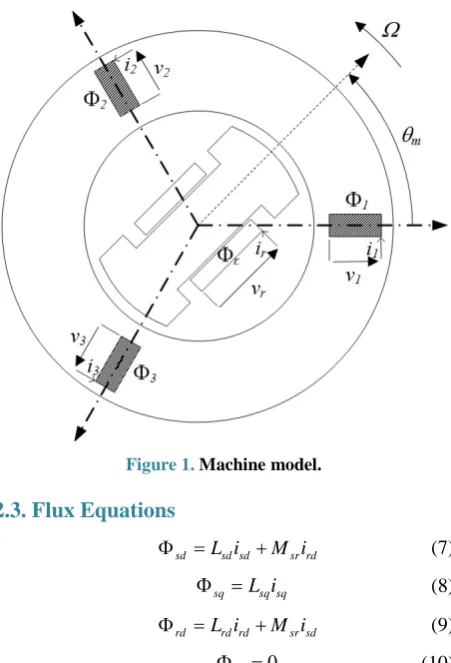
The used machine, is synchronous [11,12] with salient poles; its model is shown in Figure 1.
The dynamic model of this machine can be described as follows:
d d
s s =Rs s+ t
V i Φ (1)
d d
r r =Rr r+ t
V i Φ (2)
where: Vs is the stator voltage vector, and Vr the rotor voltage one.
2.1. Voltage Equations
The rotor iron losses are neglected (the rotor frequencies are very weak compared to the stator frequencies). The voltage equations, according to Park model, in the stator frame are given by the following equations:
d d
sd
sd s sd dq sq
V R i
t ω
Φ
= + − Φ (3)
d d
sq
sq s sq dq sd
V R i
t ω
Φ
= + − Φ (4)
d d
rd rd r rd
V R i
t Φ
= + (5)
2.2. Current Equation
The current equation in stator frame is given by the fol-lowing equation:
r r r ds r I M t τ τ ∂Φ Φ
= +
∂
[image:2.595.311.537.80.412.2] (6)
Figure 1. Machine model.
2.3. Flux Equations
sd L isd sd M isr rd
Φ = + (7)
sq L isq sq
Φ = (8)
rd L ird rd M isr sd
Φ = + (9)
0 rq
Φ = (10)
3. Third Harmonic Current Injection
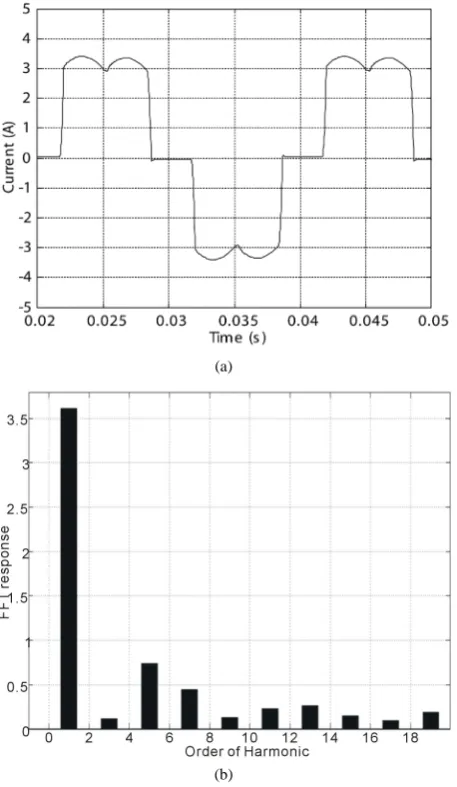
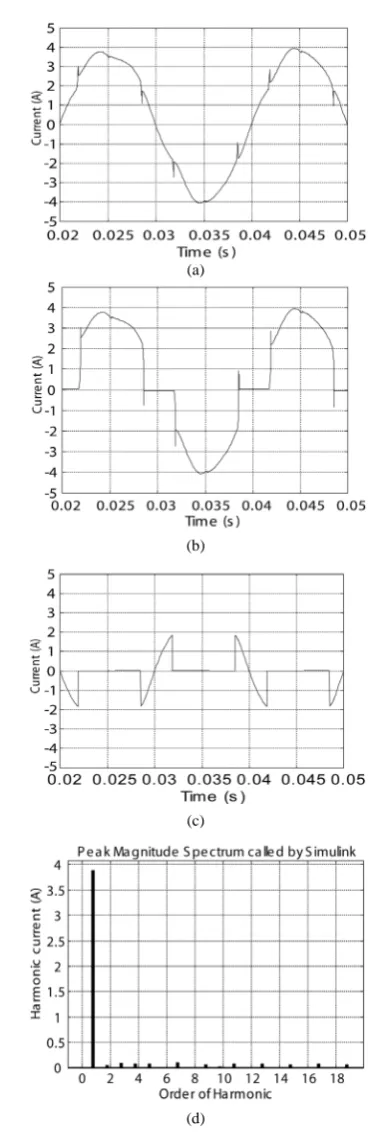
Since one phase voltage cannot be the highest and the lowest at the same time for the given set of phase voltag-es, two of the phases are connected to the load while one phase is unconnected in each point. This results in an input current equal to zero in the time interval when the phase voltage is neither maximal nor minimal. The gaps in the phase currents are the main reason for introducing the current injection methods. Moreover three-phase di-ode bridge rectifier suffers from relatively high total harmonic distortion (THD) in the input currents that can be reduced using the injection method. Figure 2 shows the source current simulation results. We note a disconti-nuity in the source current iS1 as it is shown in Figure 2(a).
The current FFT without injection is shown in Figure 2(b). We notice that the three-phase diode bridge rectifier suf-fers from relatively high THD of the input currents; about 29.11% for the considered circuit.
(a)
(b)
Figure 2. Source current is1 simulation results. (a) Source current is1; (b) Current FFT without injection.
2
2
1
2 2 2
1
% 100%
100% nRMS
n I
RMS
2RMS 3RMS nRMS
RMS
I THD
I
I I I
I ∞
=
= ×
+ + +
= ×
∑
(11)
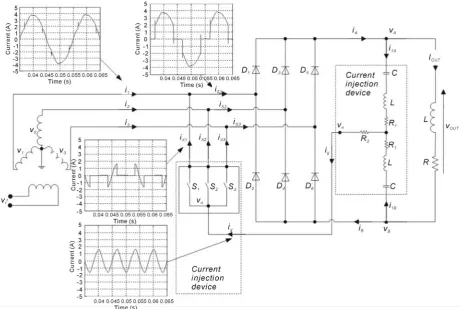
The general scheme of harmonic injection method is presented in Figure 3. It shows a diode bridge rectifier that consists of six diodes, three of them rectify the posi-tive wave and the last three ones rectify the negaposi-tive wave. Two circuits are added, a current injection network and a current injection device. The first circuit produces an injected current ig characterized by a frequency three
times the frequency of the source. In this paper the fre-quency of the current injection is 150 Hz. The second circuit divides into three parts where every part will be injected to each of the input source phase.
3.1. Switching Current Injection Device
The switching current injection device is represented in
Figure 4. It consists of three switches controlled by a logic controller. Every switch is turned on when the spe-cified phase is unconnected to the diode bridge; therefore the current in each phase doesn’t have a discontinuity after injection.
The logic control is driven by simple comparators and logic gates. Figure 5 illustrates the control circuit.
Three comparators give six binary values that describe every intersection between the voltage levels of the input source; a matrix decoder activates the different switches using the logic table below:
v1 > v2 v2 > v3 v3 > v1
A2 A1 A0 Output
0 0 1 S1
0 1 0 S3
0 1 1 S2
1 0 0 S2
1 0 1 S3
1 1 0 S1
3.2. Current Injection Network
Various method of the current injection network was presented in bibliography [13-15]. Figure 6(a) shows the current injection network using a tuned LC circuit. It uses two inductances with two capacitors tuned to reso-nant frequency of 3 Fe (150 Hz), the resistance limits the injected current.
3.3. New Design Circuit Third Harmonic
Current Injection
Figure 6(a) shows the standard current injection network which uses a tuned LC filter. That type of circuit can’t modify the frequency of the injected current, it uses two inductances with two capacitors tuned to resonant fre- quency of 3 Fe (150 Hz); the resistance limits the injected
current. The formula of the resonant circuit is given by:
1
2π
e
F
LC
= (12)
where L = 60 mH and C = 18.75 µF.
The new design uses a switching device to modify the injected current as shown in Figure 6(b).
The inductor L in Figure 6(b) is used as a current ge-nerator source. The current waveform is generated by the activation of two switches; the first one creates the posi-tive form of the injected current and the second one creates the negative form.
[image:3.595.60.289.85.479.2] [image:3.595.310.539.253.355.2] [image:3.595.76.279.519.599.2]Figure 3. General scheme of harmonic injection method.
[image:4.595.315.539.429.620.2]Figure 4. Switching current injection device.
Figure 5. Injection device circuit.
harmonic injected current.
The current flowing through the inductance L can be written as follows:
(a) (b)
Figure 6. Standard and new design current injection net-works. (a) Usng tuned LC circuit. (b) Using a switching device.
1 d
I u t
L
=
∫
⋅ (13)while the voltage across it is given by:
d d I
u L
t
= (14)
Ix1 Ix2 Ix3
vn
S1 S2 S3
Ig
v1
v3 v2
Matrix Decoder
S1
S2
S3 v1>v2
v2>v3
[image:4.595.90.260.576.679.2]Figure 7. Injection network with logic control.
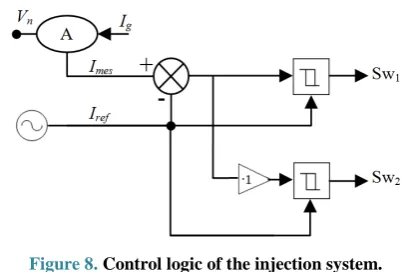
The choice of L reflects the slope of the current de-sired reference; decreasing of this inductance is limited by the switching frequency of the injection circuit. The control logic of the injection system operates in a Schmitt trigger laws; it is described inFigure 8.
4. Thermal Modeling of the Power Hybrid
Module
Because most of the semiconductor device models are implemented in circuit simulators, thermal circuit net-works are the practical models for electro-thermal simu-lations.
Literature proposes some approaches to construct thermal networks equivalent to a discretization of the heat equation. For example the finite difference method (FDM) and the finite element method (FEM) are pro-posed. In the case of vertical power devices, where the thickness LSI is small, compared to other dimensions, it is commonly considered that heat is generated at the top surface of silicon and flows uniformly along the x-axis (perpendicular to the silicon surface). So, the top surface is considered to be a geometrical boundary of the device at x = 0, where the input power P0(t) is assumed to be
uniformly dissipated. In our case we have chosen the (FEM) technique to develop the thermal model of the Diode structure. Each material is represented by a sim-plified 1D thermal model. For the insulation and base- plate layer, a modification have been introduced on the 1D model to take into account the mutual thermal be-tween the different components.
The thermal model of the silicon material can be represented by the equivalent electrical circuit [16-18] shown in Figure 9 where:
(
)
(
)
(
)
1 , 2 , ,
2 1 6 1 1
SI SI SI
cAL cAL L
C C R
n n KA n
ρ
ρ
= = =
[image:5.595.320.524.83.219.2]− − −
[image:5.595.329.517.234.312.2]Figure 8. Control logic of the injection system.
Figure 9. The 1D FEM thermal model of the silicon materi-al.
while n is the number of nodes in the material model. The thermal investigation was performed with the po- wer diode BYT 12P-1000 (12 A/1000 V) (TO220 pack-age) [19,20].
The superposition technique is used to develop the simplified thermal model of the Diode structure. The method simply requires that for each present independent heat source, one test must be performed. During each test, junction temperatures for all devices must be measured [21,22].
The thermal model of the components is implemented in the MATLAB simulator (MATLAB, 2010) in order to estimate the junction temperature of the DIODE. Figure 10
shows the evolution of the maximum junction tempera-ture and the module base-plate temperatempera-ture in the diode as a function of the dissipated power magnitude. These results are obtained by 1D thermal model, by experi-ments and by 3D numerical simulations in stationary conditions. A good agreement between the results of evolution is observed. From the results, it can be deduce that the proposed thermal model is valid.
Figure 11 shows a diagram of an electro-thermal si-mulation technique of power diode modules. An electric-al model is coupled with a thermelectric-al one. The instantane-ous value of the device power loss is injected into the thermal model in which the thermal characteristics of the module are defined. Then, the instantaneous device perature is generated by the thermal model and the tem-peratures of the dependent device model parameters are determined via this instantaneous device temperature. These calculations are performed simultaneously using a circuit simulator. The device and the thermal models are
2C1 2C1
C1C2 C2
R R
Figure 10. The DIODE maximal junction and base-plate temperature as a function dissipated power magnitude (am- bient air 298 K).
Figure 11. Electro-thermal coupling diagram simulation.
essential components of the electro-thermal simulation. This diagram is used to estimate the losses in semicon-ductors switches; it is modeled in SIMULINK/MATLAB environment.
5. Simulation Results and Discussion
The standard circuit injection method works at a fixed speed. The simulation results are shown in Figure 12. The source currents i1 and iS1 and the injected current iX1
are respectively shown in Figures 12(a)-(c). The THD of the source current is shown in Figure 12(d). We perceive a low harmonic distortion at a low speed.
The new design of circuit injection network, shown in
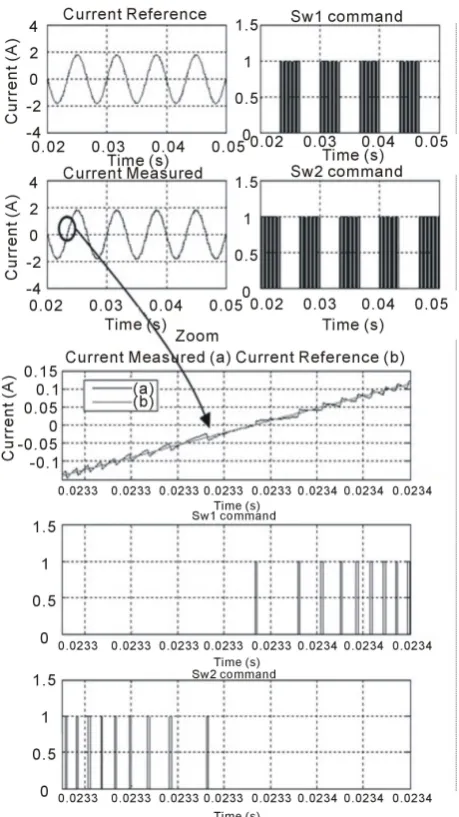
Figure 6(b) uses two switches to generate the injected current. At a variable speed, we change the current re- ference frequency; the Current injection network control tries to follow the current reference. Figure 13 shows the simulation results of the new Current injection net- work control circuit design; the injected current is very close to the reference current. We use a zoom to focus the form of the injected current and the commutation of the two switches. SW1 is used only at the positive form of the
injected current, while SW2 is used at the negative wave
form.
Figure 14 shows the harmonic spectrums of the clas-sical PFC and the proposed PFCVF. We simulate both of the two circuits at different speeds from 1000 to 6000 rpm.
The variation of the harmonic currents according to
(a)
(b)
(c)
(d)
Figure 12. simulation results of standard circuit injection method. (a) Source current i1; (b) Source current iS1; (c) Injected current iX1; (d) THD of the source current.
the order of harmonic for the classical PFC and the pro-posed PFCVF is respectively shown in Figures 14(a)
and(b) for 1000 rpm respectively, Figures 14(c)and (d)
[image:6.595.325.514.75.646.2] [image:6.595.61.286.280.346.2]Figure 13. Simulation results of the new Current injection network control circuit design.
(a)
(b)
(c)
[image:7.595.59.289.84.493.2](e)
(f)
Figure 14. Harmonic spectrums of the classical PFC and the proposed PFCVF. (a) Harmonic spectrum of the classical PFC for 1000 rpm; (b) Harmonic spectrum of the proposed PFCVF for 1000 rpm; (c) Harmonic spectrum of the clas-sical PFC for 3000 rpm; (d) Harmonic spectrum of the proposed PFCVF for 3000 rpm; (e) Harmonic spectrum of the classical PFC for 6000 rpm; (f) Harmonic spectrum of the proposed PFCVF for 6000 rpm.
As shown in Table 1 for 1000 rpm, the proposed PFCVF, presents a THD of 7.4% slightly higher than the classical PFC with a THD of 5.4%. For 2000 rpm; the proposed PFCVF, presents a THD of 5.89% better than the classical PFC with a THD of 11.29%. For 6000 rpm, the proposed PFCVF, presents a THD of 7.35% better than the classical PFC with a THD of 18.21%.
At low speed, the THD is slightly lower in the stand- ard injection circuit; in fact the new current injection network generates a high frequency noise due to the commutation of SW1 and SW2; but at a high speed this
commutation noise is insignificant compared to the
Table 1. THD of the classical PFC and the proposed PFCVF.
RPM Circuit 1 (THD) Circuit 2 FV (THD)
1000 4.97 5.42
3000 11.29 5.89
6000 18.21 7.35
disharmony caused by the standard current injection network. The proposed PFCVF strategy reduces the THD in the machine phase current. Indeed, it improves output voltage, and reduces output total harmonic distortion and voltage stress on semiconductors switches. By adopting PFCVF strategy the THDI value is reduced to 7.35% all
over the machine speed.
Figure 15 shows the motor electromagnetic torque evolution as a function of time, obtained by the classical PFC and the proposed PFCVF corresponding to 3000 rpm.
These results show that the machine torque, in the case of classical PFC, presents a ripple over 60% against 10% in the case of the proposed PFCVF. The proposed PFCVF strategy decreases the machine torque ripple.
Figure 16 shows the temperature variation of the case and the diode junction. Figure 16(a) shows the evolution of the maximal junction temperature in the diode. In the thermal simulation two different rectifiers are used: clas-sical rectifier and PFCVF one. It is clear that the diode junction temperature obtained by PFCVF is lower than that obtained by the classical rectifier. For example, at a time equal to 0.15 s, the diode junction temperature ob-tained by PFCVF rectifier is equal to 327 K whereas the diode junction temperature obtained by classical PFC is equal to 330 K.
Figure 16(b) shows the evolution of the case temper-ature. We clearly see that the diode case temperature obtained by PFCVF rectifier is lower than that obtained by the classical PFC. It proves that the use of the PFCVF rectifier reduces the losses in the semiconductors switch-es. The PFCVF rectifier can be used for a very high power application which needs low stress on power de-vices as diodes.
6. Experimental Evaluation
To verify the analytically obtained results, a 1kW rectifi-er is built; a synchronous machine is used as an altrectifi-ernator to create the three phase voltage system. Figure 17
shows the experimental devices; the alternator is coupled with a controlled DC motor to allow controlling the speed and thus the output signal frequency as shown in
Figure 17(a).
Figure 15. Torque ripple of the alternator.
(a)
[image:9.595.59.290.98.489.2](b)
Figure 16. Variation of the temperature of the case and the diode junction. (a) Junction temperature (K); (b) Case tem- perature (K).
The current injection network uses two 20 mH induc- tors and two 100 µF capacitors; the frequency of the re-sonant circuit is 112 Hz, we had to use a frequency of 37 Hz as a voltage source. The output voltage is fixed to 100 V; a 42 Ω power resistor is used as a charging system and consumes about 4A as an output current.
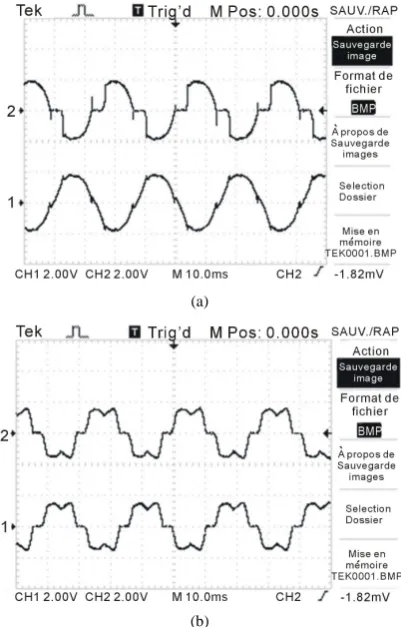
The current results are shown in Figure 18. The waveforms of i1 and iS1 are respectively represented in Figures 18(a) and (b). The waveform of i1 corresponds
to the current which is with injection; we see that it is less polluted by harmonics than the iS1 waveform which
is without injection.
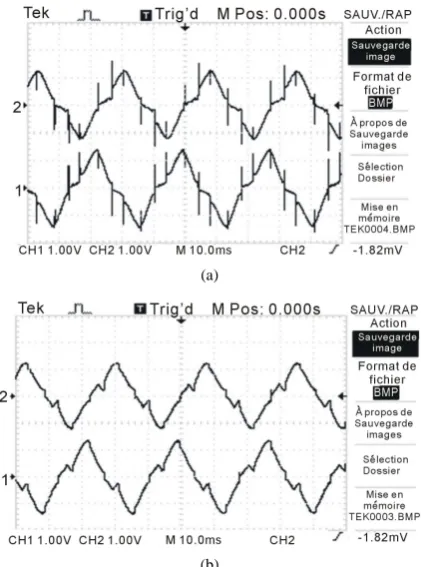
The voltage results are shown in Figure 19. V1 and VS1
waveforms are respectively represented in Figures 19(a)
and (b). The waveform V1 corresponds to the current
with injection, and we see clearly that it is less polluted
(a)
(b)
Figure 17. Experimental devices. (a) Synchronous alterna-tor coupled with a DC moalterna-tor; (b) Switching Current Injec-tion device.
(a)
(b)
Figure 18. Current results. (a) Source current iS1 and i1
using injection circuit; (b) Source current iS1 and i1 without
[image:9.595.323.524.381.695.2](a)
(b)
Figure 19. Voltage results. (a) Source voltage V1 and V2
using injection circuit; (b) Source voltage V1 and V2 without
injection circuit.
by harmonics than the VS1 waveform which is without
injection.
7. Conclusion
In this paper, we presented a PFC rectifier that uses a variable frequency source for electric vehicle application. Comparisons between fixed frequency circuit and varia-ble frequency voltage source are presented. Results prove that the PFCVF strategy reduces the THD. It improves output voltage, and reduces the output total harmonic distortion and voltage stress on semiconductors switches. By adopting the PFCVF strategy, the THD value is re-duced by more than 50%, the Diode junction temperature value is decreased to 335 K. The experimental results highlight the effectiveness of the proposed design.
REFERENCES
[1] M. Malinowski, M. Jasinski and M. P. Kazmierkowski, “Simple Direct Power Control of Three-Phase PWM Re- ctifier Using Space-Vector Modulation (DPC-SVM),” IEEE Transactions on Industrial Electronics, Vol. 51, No. 2, 2004, pp. 447-454.
http://dx.doi.org/10.1109/TIE.2004.825278
[2] S. Choi, A. R. von Jouanne, P. N. Enjeti and I. J. Pitel, “Poliphase Transformer Arrangements with Reduced kVA Capacities for Harmonic Current Reduction in Rec-
tifier Type Utility Interface,” Proceedings of 26th Annual IEEE of Power Electronics Specialists Conference, Vol. 1, Atlanta, 18-22 June 1995, pp. 353-359.
[3] A. Z. Javad and S. Moghani, “Design and Implementation of a novel Vector-Controlled Drive by Direct Injection of Random Signal,” International Review of Electrical En- gineering (IREE), Vol. 4, No. 6, 2009, pp. 1198-1203.
[4] A. Toumi, M. Ghariani, I. Ben Salah and R. Neji “Three- Phase PFC Rectifier Using a Switching Current Injection Device for Vehicle Power Train Applications,” Interna- tional Journal of Electrical Engineering and Transporta- tion, Vol. 6, No. 2, 2010, pp. 15-18.
[5] M. Malinowski, M. Jasinski and M. P. Kazmierkowski, “Simple Direct Power Control of Three-Phase PWM Rectifier Using Space-Vector Modulation (DPC-SVM),” IEEE Transactions on Industrial Electronics, Vol. 51, No. 2, 2004, pp. 447-454.
http://dx.doi.org/10.1109/TIE.2004.825278
[6] P. Rioual, H. Pouliquen and J. P. Louis, “Regulation of a PWM Rectifier in the Unbalanced Network State Using a Generalized Model,” IEEE Transactions on Power Elec- tronics, Vol. 11, No. 3, 1996, pp. 495-502.
http://dx.doi.org/10.1109/63.491644
[7] H. Song and K. Nam, “Dual Current Control Scheme for PWM Converter under Unbalanced Input Voltage Condi- tions,” IEEE Transactions on Industrial Electronics, Vol. 46, No. 5, 1999, pp. 953-959.
http://dx.doi.org/10.1109/41.793344
[8] P. Xiao, K. A. Corzine and G. K. Venayagamoorthy, “Multiple Reference Frame-Based Control of Three- Phase PWM Boost Rectifiers under Unbalanced and Dis- torted Input Conditions,” IEEE Transactions on Power Electronics, Vol. 23, No. 4, 2008, pp. 2006-2017. http://dx.doi.org/10.1109/TPEL.2008.925205
[9] M. Ayadi, El M’Barki, M. Ghariani and R. Neji “A Comparison of PWM Strategies for Multilevel Cascaded and Classical Inverters Applied to the Vectorial Control of Asynchronous Machine,” International Review of Elec- trical Engineering, Vol. 5, No. 5, 2010, pp. 2106-2114.
[10] J. I. Itoh and I. Ashida, “A Novel Three-Phase PFC Rec- tifier Using a Harmonic Current Injection Method,” IEEE Transactions On Power Electronics, Vol. 23, No. 2, 2008. http://dx.doi.org/10.1109/TPEL.2007.915774
[11] W. L. Soong and N. Ertugrul, “Inverterless High-Power Interior Permanent-Magnet Automotive Alternator,” IEEE Transactions on Industry Applications, Vol. 40, No. 4, 2004, pp. 1083-1091.
http://dx.doi.org/10.1109/TIA.2004.830773
[12] M. Ghariani, A. Ltifi, I. Ben Salah, M. Ayadi and R. Neji “New Sliding-Mode Observer for Induction Machine in Electric Propulsion Applications,” International Review on Modelling and Simulations, Vol. 3, No. 4, 2010, pp 493-501.
[13] Y. Li, F. C. Lee, J. Lai and D. Boroyevich, “A Novel Three-Phase Zero-Current-Transition and Quasi-Zero- Voltage-Transition (ZCT-QZVT) Inverter/Rectifier with Reduced Stresses on Devices and Components,” IEEE 2000, pp. 1030-1036.
[image:10.595.67.278.82.366.2]Ac-Dc Converter for Regenerative Braking,” 16th Inter- national Symposium on Power Electronics, Vol. 6, No. 1, 2012, 8 Pages.
[15] B. Singh, B. N. Singh, A. Chandra, K. Al-Haddad, A. Pandey and D. P. Kothari, “A Review of Three-Phase Improved Power Quality AC-DC Converters,” IEEE Transactions on Industrial Electronics, Vol. 51, No. 3, 2004, pp. 641-660.
http://dx.doi.org/10.1109/TIE.2004.825341
[16] A. Rufer, M. Veenstra and K. Gopakumar, “Asymmetric Multilevel Converter for High Resolution Voltage Phasor Generation,” Proceedings of the 1999 EPE Conference, Lausanne, 7-9 September 1999, pp. 1-10.
[17] K. A. Corzine, “A Hysteresis Current-Regulated Control for Multi-Level Drives,” IEEE Transactions on Energy Conversion, Vol. 15, No. 2, 2000, pp. 169-175.
http://dx.doi.org/10.1109/60.866995
[18] A. Ammous, B. Allard and H. Morel, “Transient Temper- ature Measurements and Modeling of IGBT’s under Short
Circuit,” IEEE Transaction Electronic Devices, Vol. 13, No. 1, 1998, pp. 12-25.
[19] E. Farjah, Ch. Scheffer and R. Perret, “Experimental Ther- mal Parameter Extraction Using Non-Destructive Tests,” EPE, Sevilla, 1995, pp. 1245-1248.
[20] M. Ludwig, A. Gaedke, O. Slattery, J. Flannery and S. C. Mathuna, “Characterisation of Cooling Curve for Power Device Die Attach Using a Transient Cooling Curve Measurement,” 0-7803-5692-6/00/$10.00 (c) 2000 IEEE, pp. 1612-1617.
[21] M. Ayadi, M. A. Fakhfakh, M. Ghariani and R. Neji, “Electrothermal Modeling of Hybrid Power,” Microelec- tronics International, Vol. 27, No. 3, 2010, pp. 170-177. http://dx.doi.org/10.1108/13565361011061993
[22] M. Ayadi, M. A. Fakhfakh, M. Ghariani and R. Nej, “Electro-Thermal Simulation of a Three Phase Inverter with Cooling,” Journal of Modelling and Simulation of Systems, Vol. 1, No. 3, 2010, pp. 163-170.
Nomenclature
Rs: Stator resistance per phase (=1.4535 Ω)
Vds, Vqs:d-axis and q-axis stator voltage
Ids, Iqs: d-axis and q-axis stator current
Lr: Rotor inductance per phase (=0.0144 H)
Ls: Stator inductance (=0.0145 H)
M: Mutual inductance of stator and rotor (=0.0130 H)
2
1
r s
M L L σ = −
: Total leakage factor
s s
s
L R
τ
= : Stator time constantΦr: Rotor Flux
ωs: Synchronisation speed
Rr: Rotor resistance per phase referred to stator (=1.4161 Ω).
ωm: Electromechanical angular velocity of the motor
ωg: Electric slip speed
Φs: Stator flux
A: Surface of the silicon material
K: Thermal capacity of the silicon material
LSI : Thickness of the silicon material