http://dx.doi.org/10.4236/ojfd.2014.41006
Numerical Analysis of Electromagnetic
Control of the Boundary Layer Flow on a
Ship Hull
Mohammad Bakhtiari, Hassan Ghassemi
Department of Ocean Engineering, Amirkabir University of Technology, Tehran, Iran Email: [email protected], [email protected]
Received 11 January 2014; revised 11 February 2014; accepted 18 February 2014
Copyright © 2014 by authors and Scientific Research Publishing Inc.
This work is licensed under the Creative Commons Attribution International License (CC BY).
http://creativecommons.org/licenses/by/4.0/
Abstract
In this article, electromagnetic control of turbulent boundary layer on a ship hull is numerically investigated. This study is conducted on the geometry of tanker model hull. For this purpose, a combination of electric and magnetic fields is applied to a region of boundary layer on stern so that produce wall parallel Lorentz forces in streamwise direction as body forces in stern flow. The governing equations including RANS equations with SST k-ω turbulent model coupled with electric potential equation are numerically solved by using Ansys Fluent codes. Accuracy of this turbulent model of Fluent in predicting Turbulent flow around a ship is also tested by comparing with available experimental results that it shows a good agreement with experimental data. The results obtained for ship flow show that by applying streamwise Lorentz forces that are large enough, flow is accelerated. The results are caused to delay or avoid the flow separation in stern, increase the propeller inlet velocity, create uniform flow distribution behind the ship’s hull in order to im-prove the propeller performance, and finally decrease the pressure resistance and total resis-tance.
Keywords
Electromagnetic Control; Boundary Layer; Turbulent Flow; Flow Separation; Resistance
1. Introduction
heat transfer enhancement, and flow-induced noise. Flow control involves passive or active devices that have a beneficial change on the flow field. During the last decade, emphasis has been on the development of active control methods in which energy, or auxiliary power, is introduced into the flow. One of the active control me-thods is MHD control. If a fluid is electrically conducting, eelectromagnetic flow control permits to act directly within the boundary layer by applying directly local Lorentz forces.
Mainly three different force configurations have been investigated in order to control turbulent boundary lay-ers: wall parallel streamwise, wall parallel spanwise and nominally wall normal forces. Wall parallel forces in streamwise direction have been applied, e.g., in the experiments of Henoch and Stace [1] and Weier et al. [2] as well as in the numerical analysis of Crawford and Karniadakis [3]. This force configuration increases instead of reducing wall shear stress, because the acceleration of the near wall fluid leads to a higher slope of the mean ve-locity profile in streamwise direction. However, the momentum gain due to the Lorentz force surpasses the fric-tion drag rise.
Nosenchuck and Brown [4] used nominally wall normal, time dependent forces. Nosenchuck and co-workers reported several successful experiments with a multitude of electromagnetic actuators generating turbulent skin friction reductions.
A circular cylinder equipped with electrodes as well as permanent magnets generating a wall parallel force in streamwise direction was used in the experiments and numerical calculations of Weier et al.[5]. Similar confi-gurations have later been investigated by Kim and Lee [6], Posdziech und Grundmann [7], and Chen and Aubry [8]. While skin friction drag is increased by this force configuration, form drag is strongly reduced for an in-itially separated flow at Reynolds numbers Re = O(100). For stronger forcing, the increase in skin friction drag dominates the form drag decrease. Shatrov and Yakovlev [9] studied numerically the flow around a sphere with a mainly wall parallel Lorentz force at Re up to 1000. For increasing interaction parameter, i.e. the ratio of elec-tromagnetic to inertial forces, the size of the separation region is first reduced. Later, separation is suppressed completely resulting in a strong decrease of form drag. Shatrov and Yakovlev [10] extended the investigated Reynolds number range up to 105 treating the problem of a steady and axially averaged flow. For large Reynolds numbers, the total drag of the sphere was reduced by 4 times and despite the moderate electrical efficiency of
40%
η ≈ , the total energy consumption was reduced as well.
In present study, electromagnetic control of turbulent boundary layer on a ship hull, without free surface ef-fects, is numerically investigated. For this purpose, a combination of electric and magnetic fields is applied to a region of Turbulent boundary layer on stern so that produce wall parallel Lorentz forces in streamwise direction as body forces in stern flow and their effects on flow parameters such as boundary layer thickness, flow separa-tion, wake distribution on propeller plane, pressure distribution on ship hull and resistance is investigated. This study is done on the geometry of a tanker model hull. Very detailed experimental data are available for this ship [11]. For investigation of Lorentz forces effects, calculations are conducted for two cases without applying elec-tromagnetic field and with applying elecelec-tromagnetic field locally to stern flow. For this simulation, RANS equa-tions with SST k-ω turbulent model coupled with electric potential equation are used. This governing equation is numerically solved in computational grid generated around ship hull by using Ansys Fluent 14.5 finite volume codes. Accuracy of SST k-ω turbulent model of Fluent in predicting Turbulent flow around a ship is also tested by comparing with available experimental results that it shows a good agreement with experimental data.
2. Governing Equations
2.1. RANS Equations
In this study, it assumed that fluid is incompressible. The governing equations are the mass and momentum conservations. Using the Reynolds averaging approach, the Navier-Stokes equation can be stated as:
0 i
i u x ∂
=
∂ (1)
( )
(
j)
j i j
i
i i i j
j
i
u p
u u u u u f
t ρ x ρ x x µ x ρ
∂
∂ + ∂ = −∂ + ∂ − ′ ′ +
where −ρu ui′ ′j represents Reynolds stresses and fi is Lorentz body force included in momentom equation for MHD flow
2.2. Turbulent Model
The Reynolds-averaged approach to turbulence modeling requires that the Reynolds stresses in Equation (2) are appropriately modeled. A common method employs the Boussinesq hypothesis to relate the Reynolds stresses to the mean velocity gradients:
2 3 j k t t j k j i i
i j i
u
u u
u u k
x x x
ρ ′ ′ =µ ∂ ∂ ρ µ ∂ δ
− +
∂ ∂ − + ∂
(3) In this article, the two-equation Shear-Stress Transport (SST) k-ω turbulence model is used for modeling tur-bulent viscosity.
The turbulence kinetic energy, k, and the specific dissipation rate, ω, are obtained from the following trans-port equations:
( )
(
)
k k i ti j j
k
k ku G k
t x x σ x
µ
ρ ρ µ ρβ ω∗
∂ ∂ ∂ ∂
+ + +
∂ ∂ =∂ ∂ −
(4)
( )
(
)
t 2j
j j j
u G
t x x ω x ω Dω
µ ω
ρω ρω µ ρβω
σ
∂ + ∂ ∂ + ∂ +
∂ ∂ =∂ ∂ − + (5)
where G k represents the generation of turbulence kinetic energy due to mean velocitygradients:
k min j ,10
j
i i
u
G u u k
x
ρ ∂ ρβ ω∗
′ ′
−
∂
= (6)
Gω represents the generation of ω :
k t
Gω =ναG (7)
k
σ and σω are the turbulent Prandtl numbers for k and ω, respectively:
(
)
1 ,1 1 ,2
1 1 k k k F F σ σ σ =
+ − (8)
(
)
1 ,1 1 ,2
1 1 F F ω ω ω σ σ σ =
+ − (9)
Dω is cross-diffusion term.
The turbulent viscosity, µt, is computed as follows:
2 1 1 1 max , t F k S ρ µ ω α ω α∗ = (10)
where S is the strain rate magnitude, the coefficient α∗ damps the turbulent viscosity causing a low-Reynolds- number correction .
1
F and F2 are blending functions.
2.3. Electric Potential Equation
In general, the electric field E can be expressed as:
t
φ ∂
= −∇ − ∂
A
where φ and A are the scalar potential and the vector potential, respectively. For a static field and assuming
0
b B in which b is induced magnetic field and B0 is imposed magnetic field, Ohm's law can be written as:
(
)
(
0)
σ φ
= −∇ + ×
J U Β (12)
For sufficiently conducting media, the principle of conservation of electric charge gives: 0
∇ ⋅ =J (13) The electric potential equation is thus given by:
(
)
2
0
φ
∇ = ∇ ⋅ U×Β (14)
The current density can then be calculated from Equation (12).
With the knowledge of the induced electric current, the MHD coupling is achieved by introducing additional source terms to the fluid momentum equation. This additional source term is the Lorentz force given by:
0
= ×
F J Β (15)
which has units of
(
N m3)
in the SI system.For MHD flow around a ship hull, the magnetic field induced by the motion of sea water can be neglected compared with the imposed magnetic field. On the other hand, when the electric field is applied, a magnetic field is generated around the electric current. The magnitude of this generated magnetic field is evaluated by in-tegrating Maxwell equation, ∇× =B µj, in the region where the electric field is applied:
B∼µIS (16)
where I is total electric current and S is area of applied electric field.
µ is of
( )
510
O − for sea water, and assuming that I is of 103 Amperes at most, this induced magnetic field can again be neglected, in comparison with the imposed magnetic field. So potential electric equation in which the induced magnetic field is neglected, can be a proper method for MHD flow around a ship hull.
Finally, the governing equations to solve become seven equations including four RANS equations, two trans-port equations for k and ω and one potential equation that must be solved simultaneously.
3. Computational Grid and Boundary Conditions
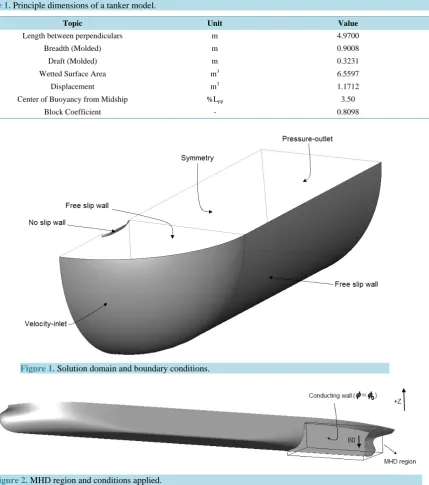
In present study, a tanker model hull is used for calculate on of flow around ship. This model was presented at CFD workshop in Tokyo [11]. Very detailed experimental data of this ship is available for public use. Main di-mensions of this model are shown in Table 1.
Flow around the hull has been considered symmetrical to the center plane of the ship so the calculation is only conducted in on side of the symmetrical plane. Figure 1 shows the computational domain and boundary condi-tions applied for turbulent flow calculacondi-tions. The distance of domain boundaries from the ship hull has been considered large enough in order to apply correct boundary conditions. These boundaries include the surface bellow:
1) A spherical surface with a radius of R=3Lpp, that it's center is on the intersection of aft perpendicular and waterplane
2) A cylindrical surface with a radius of R=3Lpp, that extends for 5Lpp from aft perpendicular to down-stream flow.
For studying of electromagnetic effects on flow, an external magnetic field is applied to a region of flow li-mited to following boundaries (by assuming that the origin is on intersection of aft perpendicular and water-plane):
• In longitudinal direction from x = 0.3 m plane to x = 1.3 m plane
• In transverse direction from hull surface to y = 0.5 m plane
• In vertical direction from z = −0.05 m plane to z = 0.25 m plane
Figure 2 represents MHD region and conditions applied to this region. These conditions are: 1) An external magnetic field of B0=1T applied in z-axis negative direction.
2) “Conducting Wall” boundary condition with electric potential of φ =0 20 V applied on ship hull in MHD region.
Table 1. Principle dimensions of a tanker model.
Topic Unit Value
Length between perpendiculars m 4.9700
Breadth (Molded) m 0.9008
Draft (Molded) m 0.3231
Wetted Surface Area m3 6.5597
Displacement m3 1.1712
Center of Buoyancy from Midship %Lpp 3.50
Block Coefficient - 0.8098
Figure 1. Solution domain and boundary conditions.
Figure 2. MHD region and conditions applied.
inflation layer meshing with high resolution in boundary layer region. In generating near wall mesh, distance of the first computational node from the wall and numbers of nodes placed within the boundary layer is very im-portant and strongly depends on turbulent model used. We use y+ as non-dimensional distance of the first node from the wall.
the resolution of generated mesh is fine enough to obtain a numerical solution with minimum discretization error, calculations have been conducted in four computational mesh with different element sizes and cell numbers.
4. Results and Discussions
As mentioned earlier, to investigate the effect of Lorentz forces, two cases were investigated. In the first case, no electromagnetic field was applied, while for the second case, an electromagnetic field was applied locally to stern flow.
We utilized pressure based solver type with Spatial discretization of Body force weighted for pressure and spatial discretization of second order upwind for other field variables.
Calculations are conducted at Froude number Fn=0.1425 and Reynolds number Rn=4.8 10× 6. The working fluid of water has density ρ=998.2 kg/m3
, viscosity µ =0.001 kg/m s⋅ and electrical conductivity s m
5
σ = .To ensure the convergence of solution , the iterations continues until the residual errors reduce to acceptable value of 4
10− and the total resistance coefficient, Cd, reaches a steady state and in this situation, the imbalance between inlet mass flow rate and outlet mass flow rate is less than 1%.
4.1. Results without MHD
In Table 2, the computed values of resistance coefficients, obtained without free surface effects, are shown. In same table, the total resistance coefficient measured experimentally is also shown. Note a good agreement be-tween the results with a difference of 7%.
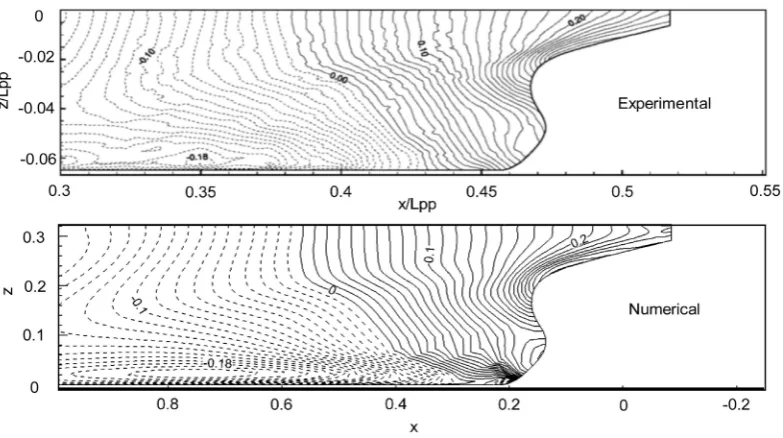
A comparison between the computational and experimental results for pressure coefficient distribution on stern is represented in Figures 3. It can be observed that there is a good agreement between computational and experimental results.
Furthermore, the results obtained from numerical computation for axial velocity distribution on the propeller plane compares with experimental results in Figure 4. Again, we can see that computed results show a good agreement with experimental ones.
4.2. Results with MHD
In this section, the computed results with applying electric potential of φ =0 20volts on ship hull in MHD
re-gion as a boundary condition, and an external magnetic field of B0=1T in z-axis negative direction at this
[image:6.595.120.512.477.696.2]re-gion (see Figure 2) are represented and then, the effects of Lorentz forces distribution caused by this applied conditions on turbulent boundary layer flow around ship hull is investigated.
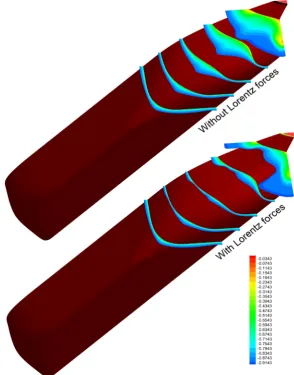
Figure 5 shows the growth of boundary layer flow for two cases (with and without Lorentz forces). The comparison between these two cases demonstrates that the flow is accelerated due to Lorentz forces and boun-dary layer thickness decreases.
Figure 4. Comparison between experimental and numerical axial velocity distribution on the propeller plane.
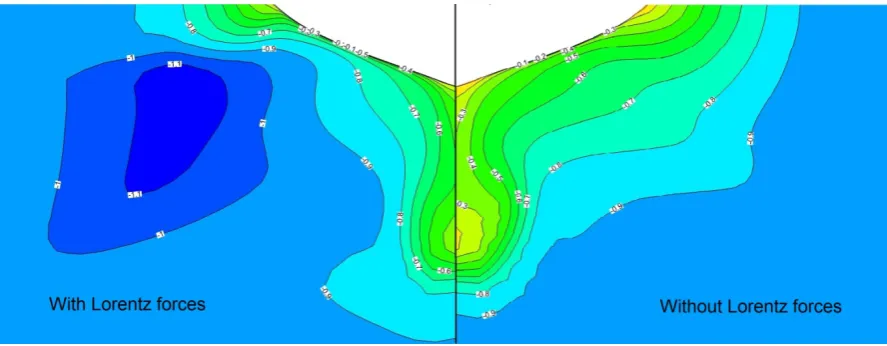
[image:7.595.162.457.324.700.2]Furthermore,Figure 6shows a comparison between two cases for axial velocity distributions computed on the propeller plane. From this comparison, it is clear that propeller inlet velocities have increased due to a decrease in boundary layer thickness and separation, which can lead to enhancement in propeller efficiency.
In Table 3, a comparison between computed values of resistances for two cases (with and without Lorentz forces) is shown.
5. Conclusions
In this article, a combination of electric and magnetic fields producing wall parallel Lorentz forces in streamwise direction as body forces, means which were applied to a region of turbulent boundary layer flow on stern of a ship model and its effects on flow around ship hull without free surface effects were numerically investigated. With regard to the numerical results obtained from the calculations, the following conclusions can be offered:
• By applying wall parallel Lorentz forces in streamwise direction to a region of turbulent boundary layer flow on stern of a ship, we can decrease boundary layer thickness and flow separation on stern.
• This type of Lorentz forces can increase axial velocity on propeller plane and so the wake distribution on propeller is improved that leads to enhancement in propeller efficiency.
[image:8.595.89.533.306.479.2]• The pressure on stern is significantly recovered due to presence of this Lorentz forces, so total ship resistance decreases.
[image:8.595.88.538.616.717.2]Figure 6. Comparison of axial velocity distributions on the propeller plane for two cases.
Table 2. Experimental and computational results for resistance coefficients.
Topic Computational results Experimental results Relative Error
Pressure resistance
coefficient 0.0028 - -
Frictional resistance
coefficient 0.0136 - -
Total resistance
coefficient 0.0164 0.0176 7%
Table 3. Computed resistances and their coefficients.
Topic Without Lorentz forces With Lorentz forces Percent of decrease(−) or increase(+)
Pressure
resistance (N) 2.1846 0.7686 −65%
Frictional
resistance (N) 10.8166 11.4346 +5%
Total
• By using superconducting magnets, we can produce Lorentz forces that are large enough with a much Lower input MHD power. So by lowering the added power due to MHD system, the efficiency of this system can be increased.
References
[1] Henoch, C. and Stace, J. (1995) Experimental Investigation of a Salt Water Turbulent Boundary Layer Modified by an Applied Streamwise Magnetohydrodynamic Body Force. Physics of Fluids, 7, 1371-1383.
http://dx.doi.org/10.1063/1.868525
[2] Weier, T., Fey, U., Gerbeth, G., Mutschke, G., Lielausis, O. and Platacis, E. (2001) Boundary Layer Control by Means of Wall Parallel Lorentz Forces. Magnetohydrodynamics, 37, 177-186.
[3] Crawford, C.H. and Karniadakis, G.E. (1997) Reynolds Stress Analysis of EMHD-Controlled Wall Turbulence: Part I Streamwise Forcing. Physics of Fluids, 9, 788-806. http://dx.doi.org/10.1063/1.869210
[4] Nosenchuck, D. and Brown, G. (1993) Discrete Spatial Control of Wall Shear Stress in a Turbulent Boundary Layer. In: So, R., Speziale, C. and Launder, B., Eds., Near-WallTurbulent Flows, Elsevier, Amsterdam.
[5] Weier, T., Gerbeth, G., Mutschke, G., Platacis, E. and Lielausis, O. (1998) Experiments on Cylinder Wake Stabiliza-tion in an Electrolyte SoluStabiliza-tion by Means of Electromagnetic Forces Localized on the Cylinder Surface. Experimental Thermal and Fluid Science, 16, 84-91. http://dx.doi.org/10.1016/S0894-1777(97)10008-5
[6] Kim, S. and Lee, C. (2000) Investigation of the Flow around a Circular Cylinder under the Influence of an Electro-magnetic Force. Experiments in Fluids, 28, 252-260. http://dx.doi.org/10.1007/s003480050385
[7] Posdziech, O. and Grundmann R. (2001) Electromagnetic Control of Seawater Flow around Circular Cylinders. Euro-pean Journal of Mechanics, 20, 255-274. http://dx.doi.org/10.1016/S0997-7546(00)01111-0
[8] Chen, Z. and Aubry, N. (2005) Active Control of Cylinder Wake. Communications in Nonlinear Science and Numeri-cal Simulation, 10, 205-216. http://dx.doi.org/10.1016/S1007-5704(03)00128-X
[9] Shatrov, V. and Yakovlev, V. (1985) Hydrodynamic Drag of a Ball Containing Aconduction-Type Source of Electro-magnetic Fields. Journal of Applied Mechanics and Technical Physics, 26, 19-24.
http://dx.doi.org/10.1007/BF00919618
[10] Shatrov, V. and Yakovlev, V. (1990) The Possibility of Reducing Hydrodynamic Resistance through Magnetohydro-dynamic Streaming of a Sphere. Magnetohydrodynamics, 26, 114-119.