Munich Personal RePEc Archive
Simulated Evidence on the Distribution
of the Standardized One-Step-Ahead
Prediction Errors in ARCH Processes
Degiannakis, Stavros and Xekalaki, Evdokia
Department of Statistics, Athens University of Economics and
Business, Greece, Department of Statistics, University of California,
Berkeley CA, USA
2007
Online at
https://mpra.ub.uni-muenchen.de/96326/
Simulated Evidence on the Distribution of the Standardized One-Step-Ahead
Prediction Errors in ARCH Processes
*Stavros Degiannakis
Adjunct Lecturer
Department of Statistics, Athens University of
Economics and Business, Greece. Tel.: +30-210-8203-120
FAX.: +30-210-2614-644 E-mail address: [email protected]
and
Adjunct Assistant Professor
Department of Informatics and Biomedicine, University of Central Greece, Lamia.
Tel.: + 30-223-1066-700 Fax.: +30-223-1066-715 Corresponding Author
Evdokia Xekalaki
Professor
Department of Statistics, Athens University of
Economics and Business, Greece. Tel.: +30-210-8203-269
Fax.: +30-210-8238-798 E-mail address: [email protected]
and
Department of Statistics, University of
California, Berkeley CA, USA. Tel.: +510-642-2781
Fax.: +510-642-7892
ABSTRACT
In statistical modeling contexts, the use of one-step-ahead prediction errors for testing hypotheses
on the forecasting ability of an assumed model has been widely considered. Quite often, the testing procedure requires independence in a sequence of recursive standardized prediction errors,
which cannot always be readily deduced particularly in the case of econometric modeling. In this paper, the results of a series of Monte Carlo simulations reveal that independence can be assumed
to hold.
Index terms: ARCH models, Monte Carlo Simulation, One-step-ahead Prediction Errors,
Predictability, Standardized Prediction Error Criterion.
*
I. INTRODUCTION
Defining a standardized prediction error criterion (SPEC), Degiannakis and Xekalaki (2005a)
proposed a model selection algorithm for ARCH models. The algorithm allows switching from
the model used at time t1 for forecasting volatility to another model for use at time
t
and, in particular, to the model with the minimum value of the average squared standardized prediction error. As indicated by the results obtained by Degiannakis and Xekalaki (2005b), the SPEC model selection procedure appears to have a satisfactory performance in selecting the model thatgenerates better volatility predictions. Moreover, the SPEC algorithm exhibited a satisfactory performance on a simulated options market (Xekalaki and Degiannakis 2005) as well as on
trading S&P500 options on a daily basis (Degiannakis and Xekalaki 2001). The general finding is that the prediction performance improves if one switches models over time. In particular,
switching from one model to another governed by the SPEC model selection rule appears to lead to a superior predictive performance. The reason might be traced in that jumping from one model
to the other according to SPEC reflects a sort of a procedure adapting to the changes of the marketplace. However, model selection procedures based on standardized one-step-ahead
prediction errors often require independence in a sequence of recursive standardized prediction errors, which cannot always be readily deduced particularly in the case of econometric modeling.
In this paper, on the basis of the results of a series of Monte Carlo simulations, it is conjectured that independence holds. A theoretical justification can be found in Degiannakis and Xekalaki (2005a).
II. THE ARCH PROCESS
An ARCH process, t, is presented as:
, ,..., , ,...
1 , 0 ~
2 1 2 1 2
. . .
t t t t t
d i i t
t t t
g
N z
z
(1)
where zt is a sequence of independently and identically distributed random variables, with
autocorrelation, Cor
zt,zt
, approximately
1
, 0T
N distributed, t is a time-varying, positive
measurable function of the information set at time t1 and g
. could be a functional form thathas been presented in the ARCH literature.
Since very few financial time series have a constant conditional mean of zero, an ARCH
model can be presented in a th order autoregressive form by letting t
be the innovation process
, ,..., , ,...
1 , 0 ~ , 0 ~ | 2 1 2 1 2 . . . 2 1 1
t t t t t d i i t t t t t t t t i i t i t g N z z N I y c y (2)The most commonly used conditional variance function is the GARCH(1,1)
model: 2 1 1 2 1 1 0 2
t t
t a a b
.
A wide range of proposed ARCH models is covered in surveys such as Bollerslev et al. (1994) and Degiannakis and Xekalaki (2004).
III. SIMULATION OF THE AR(1)GARCH(1,1)PROCESS
In the sequel, a Monte Carlo simulation is used to provide evidence for the assumption of independently and identically distributed standardized one-step-ahead prediction errors. The
procedure consists of three stages:
1. Generate data from the AR(1)GARCH(1,1) process
Generate a series of 32000 values from the standard normal distribution, i.e. z .~. .N
0,1 d i it .
Generate an equal number of values
32000 1 t t
of the innovation ARCH process, by
multiplying the collection
32000 1 t t
z by a specific conditional variance form, or 2
t t
t z
, for
2 1 2 1 2 8 . 0 12 . 0 0001 .
0
t t
t
.
Generate a first order autoregressive processes, yt 0.06yt1t, for the conditional mean,
based on the values
32000 1 t t
of the innovation process.
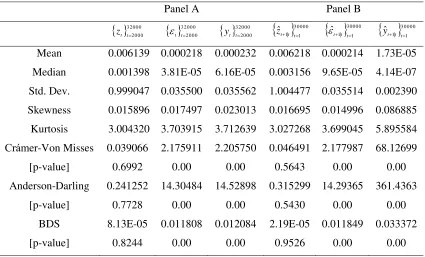
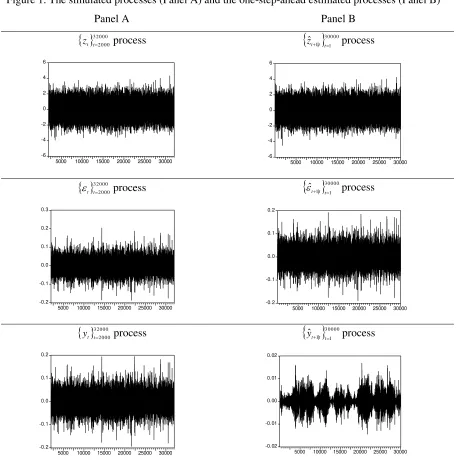
Panel A of Figure 1 plots the simulated processes while panel A of Table 1 presents the relevant
descriptive statistics. According to results obtained in literature (e.g. Engle and Mustafa 1992),
the shocks to the variance, Et
t Et
t t t vt2 2 2 1
2
, generate a martingale difference
sequence. These shocks are neither serially independent nor identically distributed. According to
the Brock et al.’s (1996) BDS test for independence only the process defined by zt is
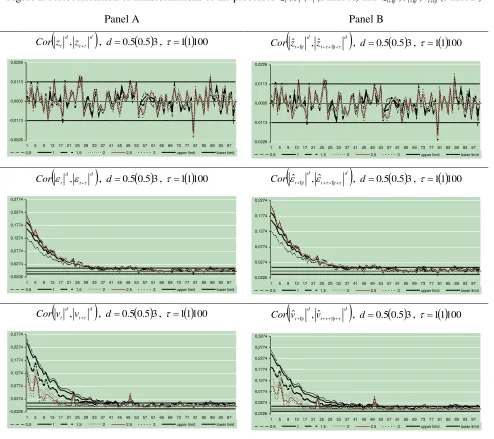
independently distributed. The test is presented for two correlated dimensions but it has been computed for higher values and the results are qualitatively unchanged. Panel A of Figure 2
presents the autocorrelation of transformations of the processes defined by zt,vt,t . The
half-length of the 95% confidence interval for the estimated sample autocorrelation equals
0113 . 0 / 96 .
1 T , in the case of a process with independently and identically normally distributed
components. On the other hand, the processes defined by vt and t are autocorrelated in half of
GARCH(1,1) process and Karanasos (1999) extends the results to the GARCH(p,q) model. He
and Teräsvirta (1999) derive the autocorrelation function of the squared and absolute errors for a
family of first order ARCH processes.
2. Estimate the parameters of the AR(1)GARCH(1,1) model
The AR(1)GARCH(1,1) model is applied, for the data produced from the
AR(1)GARCH(1,1) process. Dropping out the first 1000 data, maximum likelihood estimates of
the parameters are obtained by numerical maximization of the log-likelihood function, using a rolling sample of constant size equal to 1000. At each of a sequence of points in time, the
maximum likelihood parameter vector, ˆt
cˆ1,t,aˆ0,t,aˆ1,t,bˆ1,t
, is being estimated in order to computethe conditional mean and variance:
t t t
t c y
yˆ1| ˆ1,
2 | , 1 2 | , 1 , 0 2 |
1 ˆ ˆ ˆ
ˆt t a t attt bttt
.
(3)
3. Compute the standardized one-step-ahead prediction errors,
1| 1 | 1 1 |
1 ˆ ˆ
ˆ
t t t t t t
t y y
z
According to Degiannakis and Xekalaki (2005a), under the assumption of constancy of
parameters over time,
ˆt ˆt1 ...
ˆT ˆ , the estimated standardized one-step-aheadprediction errors zˆt1|t,zˆt2|t1,...,zˆT1|T are asymptotically independently standard normally distributed.
The one-step-ahead estimated processes are presented in Panel B of Figure 1, while Panel B of Table 1 presents the relevant descriptive statistics. According to the tests of normality and
independence, the one-step-ahead standardized prediction error process,
1 | 1 | 1 1 |1 ˆ ˆ
ˆ
t t t t t t
t y y
z , is
independently normal distributed. Moreover, if zˆ 1| .~..N
0,1 d i i tt , then
T t t t z 1 2 | 1ˆ should be chi-square
distributed with T degrees of freedom, and mean and variance:
T z E T t t t
1 2 | 1ˆ and V z T
T t t t 2 ˆ 1 2 | 1
. (4)
According to Table 2, which presents the descriptive statistics of
T t t t z 1 2 | 1
ˆ , the processes are
chi-square distributed in all the cases. Moreover, if zˆt1|t is a sequence of i.i.d. variables then the
autocorrelation of any transformation of zˆt1|t,
d t t d t t z zCor ˆ1| , ˆ1| , d0, is
1, 0T
N distributed.
Panel B of Figure 2 presents the autocorrelation of transformations of the processes zˆt1|t,ˆt1|t,vˆt1|t.
Since the sum of squared standardized one-step-ahead prediction errors is chi-square distributed,
and the transformations of zˆt1|t are not autocorrelated, our findings point towards the
IV. SIMULATION OF THE GARCH,EGARCH AND TARCH PROCESSES
In the sequel, the assumption that the standardized one-step-ahead prediction errors are
independently and identically distributed is investigated for higher order of autoregressive processes for the conditional mean and conditional variance functions of the following types: The GARCH(p,q) model, Bollerslev (1986):
p i i t i q i i t it a a b
1 2 1
2 0
2
. (5)
The EGARCH(p,q) model, Nelson (1991):
p i i t i qi t i
i t i i t i t i
t a a b
1 2 1 0 2 ln ln
. (6)
The TARCH(p,q) model, Glosten et al. (1993):
p i i t i t t q i i t it a a d b
1 2 1 2 1 1 1 2 0
2
, (7)
where dt 1 if t 0, and dt 0 otherwise.
The procedure followed is comprised of the following steps:
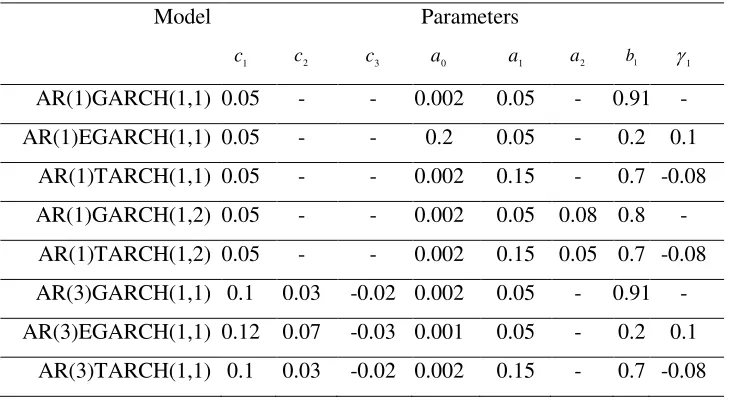
1. Eight processes have been generated with coefficients presented in Table 3
2. Estimate the parameters of the simulated processes
At each of a sequence of points in time, the maximum likelihood parameter vector
t t t t t t t t
t cˆ1,,cˆ2,,cˆ3,,aˆ0,,aˆ1,,aˆ2,,bˆ1,,ˆ1,
ˆ
is being estimated. The models are estimated 30000 times and
the conditional mean and variance are computed in (8)-(11):
The th
order Autoregressive process:
1 1 , | 1 ˆ ˆ i i t t i tt c y
y . (8)
The GARCH(1,q) model:
2| , 1 1 2 | 1 , , 0 2 |
1 ˆ ˆ ˆ
ˆ t tt
q i t i t t i t t
t a a b
. (9)
The EGARCH(1,1) model:
2 | , 1 | | , 1 | | , 1 , 0 2 |1 exp ˆ ˆ ˆ ˆ ln
ˆ t tt
t t t t t t t t t t t t
t a a b
. (10)
The TARCH(1,q) model:
2| , 1 2 | , 1 1 2 | 1 , , 0 2 |
1 ˆ ˆ ˆ ˆ
ˆ q t tt t t tt
i t i t t i t t
t a a d b
. (11)
3. Compute the standardized one-step-ahead prediction errors
1| 1 | 1 1 |
1 ˆ ˆ
ˆ
t t t t t t
t y y
z
independently and identically distributed standardized one-step-ahead prediction errors in this
case too.
Finally, one more set of GARCH(1,1) processes is simulated in order to investigate if
changes in the coefficients affect the distribution of zˆt1|t. We generate a series
20000 1
t t
of 20000
values for each of 18 innovation GARCH(1,1) processes by multiplying the generated values of
t
z by t from 2 1 1 2
1 2
05 . 0 002 .
0
k t
t
t b
, where b k k
* 05 . 0
1 for k1,2,...,18.There is no evidence against the property of independently distributed standardized prediction errors.
V. CONCLUSION
The findings are in support of the hypothesis of independence of the zˆt1|t. Moreover, changes in
the types of conditional variance function, the order of the autoregressive process of the
conditional mean and as well as the values of the coefficients considered do not appear to affect these findings.
REFERENCES
Bollerslev, T. (1986). Generalized Autoregressive Conditional Heteroscedasticity. Journal of
Econometrics, 31, 307-327.
Bollerslev, T., R.F., Engle and D., Nelson (1994). ARCH Models. Ch.49 in R. F. Engle and D. L.
McFadden eds. Handbook of Econometrics, IV Elsevier.
Brock, W., D., Dechert, J., Sheinkman and B., LeBaron (1996). A Test for Independence Based on the Correlation Dimension, Econometric Reviews, 15(3), 197-235.
Degiannakis, S. and E., Xekalaki, (2001). Using a Prediction Error Criterion for Model Selection in Forecasting Option Prices, Athens University of Economics and Business, Department of
Statistics, Technical Report, 131.
Degiannakis, S. and E., Xekalaki (2004). Autoregressive Conditional Heteroscedasticity Models:
A Review. Quality Technology and Quantitative Management, 1(2), 271-324.
Degiannakis, S. and E., Xekalaki (2005a). Predictability and Model Selection in the Context of
ARCH Models, Journal of Applied Stochastic Models in Business and Industry, 21, 55-82. Degiannakis, S. and E., Xekalaki (2005b). Assessing the Performance of a Prediction Error
Criterion Model Selection Algorithm in the Context of ARCH Models, Applied Financial
Economics, forthcoming.
Degiannakis, S. and E., Xekalaki (2005c). On the Independence of the Standardized One-Step-Ahead Prediction Errors in ARCH Models. Paper presented at the 7th Hellenic-European
Ding, Z. and C.W.J., Granger (1996). Modeling Volatility Persistence of Speculative Returns: A
New Approach. Journal of Econometrics, 73, 185-215.
Engle, R.F. and C., Mustafa (1992). Implied ARCH models from options prices, Journal of
Econometrics,52, 289-311.
Glosten, L.R., R., Jagannathan and D.E., Runkle (1993). On the relation between the expected
value and the volatility of the nominal excess return on stocks. Journal of Finance, 48, 1779-1801.
He, C. and T., Teräsvirta (1999). Properties of Moments of a Family of GARCH Processes. Journal of Econometrics, 92, 173-192.
Karanasos, M. (1999). The Second Moment and the Autoregressive Function of the Squared Errors of the GARCH Model. Journal of Econometrics, 90, 63-76.
Nelson, D.B. (1991). Conditional Heteroscedasticity in Asset Returns: A New Approach.
Econometrica, 59, 347-370.
Xekalaki, E. and S., Degiannakis (2005). Evaluating Volatility Forecasts in Option Pricing in the Context of a Simulated Options Market. Computational Statistics and Data Analysis. Special
Issue on Computational Econometrics, 49(2), 611-629.
FIGURES &TABLES
Table 1. Descriptive statistics of the simulated processes (Panel A) and the one-step-ahead
estimated processes (Panel B). The Crámer-Von Misses and Anderson-Darling statistics test the null hypothesis that the process is normally distributed. The BDS statistic tests the null
hypothesis that the process is independently and identically distributed.
Panel A Panel B
32000 2000 t t
z
t 32000t2000
yt t320002000
zˆt1|t t300001
30000 1 | 1
ˆtt t
30000 1 | 1ˆtt t
y
Mean 0.006139 0.000218 0.000232 0.006218 0.000214 1.73E-05
Median 0.001398 3.81E-05 6.16E-05 0.003156 9.65E-05 4.14E-07 Std. Dev. 0.999047 0.035500 0.035562 1.004477 0.035514 0.002390
Skewness 0.015896 0.017497 0.023013 0.016695 0.014996 0.086885 Kurtosis 3.004320 3.703915 3.712639 3.027268 3.699045 5.895584
[image:8.612.109.534.470.727.2]Crámer-Von Misses 0.039066 2.175911 2.205750 0.046491 2.177987 68.12699 [p-value] 0.6992 0.00 0.00 0.5643 0.00 0.00 Anderson-Darling 0.241252 14.30484 14.52898 0.315299 14.29365 361.4363
[p-value] 0.7728 0.00 0.00 0.5430 0.00 0.00
Table 2. Descriptive statistics of
tT t j 1zj j
2 | 1
ˆ , for tT
T 30000. The Crámer-Von Misses andAnderson-Darling statistics test the null hypothesis that the process is chi-squared distributed.
2
T T4 T10 T20
Mean 2.017960 4.035919 10.08980 20.17960
Variance 4.128895 8.334519 21.34030 41.31167
[image:9.612.107.553.121.277.2] [image:9.612.149.516.313.513.2]Crámer-Von Misses 0.110346 0.080465 0.121311 0.112239
[p-value] 0.5364 0.6889 0.4898 0.5274 Anderson-Darling 1.057137 0.590629 1.112229 0.686104
[p-value] 0.3286 0.6569 0.3034 0.5705 Observations 15000 7500 3000 1500
Table 3. Coefficients of the simulated processes.
Model Parameters
1
c c2 c3 a0 a1 a2 b1 1
AR(1)GARCH(1,1) 0.05 - - 0.002 0.05 - 0.91 -
AR(1)EGARCH(1,1) 0.05 - - 0.2 0.05 - 0.2 0.1
AR(1)TARCH(1,1) 0.05 - - 0.002 0.15 - 0.7 -0.08
AR(1)GARCH(1,2) 0.05 - - 0.002 0.05 0.08 0.8 -
AR(1)TARCH(1,2) 0.05 - - 0.002 0.15 0.05 0.7 -0.08
AR(3)GARCH(1,1) 0.1 0.03 -0.02 0.002 0.05 - 0.91 -
AR(3)EGARCH(1,1) 0.12 0.07 -0.03 0.001 0.05 - 0.2 0.1
Figure 1. The simulated processes (Panel A) and the one-step-ahead estimated processes (Panel B)
Panel A Panel B
32000 2000 t t
z process
-6 -4 -2 0 2 4 6
5000 10000 15000 20000 25000 30000
30000 1 | 1ˆtt t
z process
-6 -4 -2 0 2 4 6
5000 10000 15000 20000 25000 30000
32000 2000 t t
process
-0.2 -0.1 0.0 0.1 0.2 0.3
5000 10000 15000 20000 25000 30000
30000 1 | 1ˆtt t
process
-0.2 -0.1 0.0 0.1 0.2
5000 10000 15000 20000 25000 30000
32000 2000 t t
y process
-0.2 -0.1 0.0 0.1 0.2
5000 10000 15000 20000 25000 30000
30000 1 | 1ˆtt t
y process
-0.02 -0.01 0.00 0.01 0.02
Figure 2. Autocorrelation of transformations of the processes zt,t ,vt(Panel A) and zˆt1|t,ˆt1|t,vˆt1|t(Panel B)
Panel A Panel B
d
t d
t z
z
Cor , , d0.5
0.53, 1
1100-0,0226 -0,0113 0,0000 0,0113 0,0226
1 5 9 13 1721 2529 33 3741 45 4953 57 6165 69 7377 81 8589 9397 0,5 1 1,5 2 2,5 3 upper limit lower limit
d
t t d t
t z
z
Cor ˆ1| ,ˆ1| , d0.5
0.53, 1
1100-0,0226 -0,0113 0,0000 0,0113 0,0226
1 5 9 13 17 2125 29 3337 41 4549 5357 61 6569 73 7781 85 8993 97 0,5 1 1,5 2 2,5 3 upper limit lower limit
d
t d t
Cor , , d0.5
0.53, 1
1100-0,0226 0,0274 0,0774 0,1274 0,1774 0,2274 0,2774
1 5 9 13 1721 2529 33 3741 45 4953 57 6165 69 7377 81 8589 9397 0,5 1 1,5 2 2,5 3 upper limit lower limit
d
t t d t t
Corˆ1| ,ˆ1| , d0.5
0.53, 1
1100-0,0226 0,0274 0,0774 0,1274 0,1774 0,2274
1 5 9 13 17 2125 29 3337 41 4549 5357 61 6569 73 7781 85 8993 97 0,5 1 1,5 2 2,5 3 upper limit lower limit
d
t d
t v
v
Cor , , d0.5
0.53, 1
1100-0,0226 0,0274 0,0774 0,1274 0,1774 0,2274 0,2774
1 5 9 13 1721 2529 33 3741 45 4953 57 6165 69 7377 81 8589 9397 0,5 1 1,5 2 2,5 3 upper limit lower limit
d
t t d t
t v
v
Cor ˆ1| ,ˆ1| , d0.5
0.53, 1
1100-0,0226 0,0274 0,0774 0,1274 0,1774 0,2274 0,2774 0,3274