http://dx.doi.org/10.4236/jgis.2014.62010
Quantitative Methods for Comparing
Different Polyline Stream Network Models
Danny L. Anderson1, Daniel P. Ames2, Ping Yang3
1Idaho National Laboratory, Idaho Falls, USA
2Department of Civil and Environmental Engineering, Brigham Young University, Provo, USA 3Texas Institute for Applied Environmental Research, Tarleton State University, Stephenville, USA Email: [email protected]
Received 20 February 2014; revised 20 March 2014; accepted 27 March 2014
Copyright © 2014 by authors and Scientific Research Publishing Inc.
This work is licensed under the Creative Commons Attribution International License (CC BY).
http://creativecommons.org/licenses/by/4.0/
Abstract
Two techniques for exploring relative horizontal accuracy of complex linear spatial features are described and sample source code (pseudo code) is presented for this purpose. The first technique, relative sinuosity, is presented as a measure of the complexity or detail of a polyline network in comparison to a reference network. We term the second technique longitudinal root mean squared error (LRMSE) and present it as a means for quantitatively assessing the horizontal va-riance between two polyline data sets representing digitized (reference) and derived stream and river networks. Both relative sinuosity and LRMSE are shown to be suitable measures of horizon-tal stream network accuracy for assessing quality and variation in linear features. Both techniques have been used in two recent investigations involving extraction of hydrographic features from LiDAR elevation data. One confirmed that, with the greatly increased resolution of LiDAR data, smaller cell sizes yielded better stream network delineations, based on sinuosity and LRMSE, when using LiDAR-derived DEMs. The other demonstrated a new method of delineating stream channels directly from LiDAR point clouds, without the intermediate step of deriving a DEM, showing that the direct delineation from LiDAR point clouds yielded an excellent and much better match, as indicated by the LRMSE.
Keywords
LiDAR, Stream Channels, Accuracy, RMSE, Sinuosity, Terrain Analysis
1. Introduction
our reference data. In some cases, it may not be critical that the modeled or derived dataset perfectly matches the reference dataset, as long as it is a better match than is another dataset. According to Zhang and Goodchild [2],
[When considering] the acquisition of discrete objects by visual interpretation and manual delineation, an extracted (measured) object is different from the corresponding truth due to inaccuracy in object identifica-tion and posiidentifica-tioning... In most discrete representaidentifica-tions, real-world line objects are sampled by polylines that link up ordered vertices with straight line segments. If the real lines are truly curved, ... a polyline repre-sentation will be an approximation, and such differences between polylines and the original curves form part of the uncertainty in modeling objects.
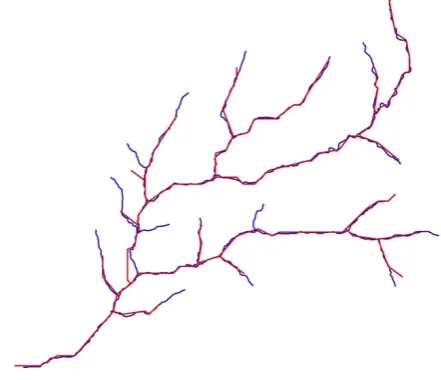
While it is trivial to compare a set of scalar values (with a single magnitude) or a set of vectors (with a mag-nitude and direction), it is more challenging to compare and assess the degree of similarity of sets of polylines. More difficult, still, is the comparison of networks of numerous sets of polylines. For example, inFigure 1, red polylines represent a derived stream network and the blue polylines represent the reference stream network. We can clearly see that the two networks are not identical. But, how do we quantify the differences to compare the quality or similarity of the two networks, or to compare multiple derived networks with each other, relative to the reference network? This paper presents and evaluates two methods and algorithms for performing quantita-tive comparisons of the closeness of fit between derived stream networks and reference data: sinuosity and Lon-gitudinal Root Mean Square Error (LRMSE).
2. Background
Accuracy assessment or validation of feature data accuracy should be a key component of any project employ-ing spatial data. This is particularly necessary when modelemploy-ing or otherwise automatically generatemploy-ing spatial data from computational algorithms or methods (e.g. in the case of the derived stream networks in this study). Such an assessment of accuracy allows one the ability to quantitatively compare methods and results, explore methods for improving techniques and algorithms, and be more confident in the use of spatial data analysis results in de-cision-making processes [3].
Hydrological modeling and watershed resource management require accurate stream networks and watershed boundaries for better understanding the flow of water on the land surface. Methods for deriving detailed hydro-graphic features such as stream networks have been greatly improved in moving from conventional DEMs [4]-[6]
to LiDAR-derived DEMs [7]. Quantitative assessment methods can be used to compare and analyze the differ-ences between stream networks and watersheds derived from elevation data using such methods.
[image:2.595.200.421.499.689.2]Stream channel sinuosity has been defined as the degree to which a river channel departs from a straight line. A variety of sinuosity indices have been proposed [8]-[14]. Sinuosity was employed to improve understanding
of the nature and dynamics of river channel patterns for the river Elemi in southwestern Nigeria, in which the length of a reach was measured along the channel and divided by the airline distance between the two end points of the reach [15]. Factors influencing sinuosity were identified for the Pannagon River, India [16]. Downward, Gurnell, and Brookes [17] presented a methodology for quantifying river channel planform change using GIS variability in stream erosion and sediment transport. Heo et al. [18] studied the meandering channel migration of the Sabine River in the USA, which proved least squares estimation is beneficial for characterization and predic-tion of meandering channel migrapredic-tion.
Work has been done on stream network assessment using root mean square error both in horizontal and ver-tical measurements, which have been adopted as standard methods by the Federal Geographic Data Committee
[19]. Zhang and Goodchild [2] also discuss using RMSE as a measure of errors in continuous variables asso-ciated with spatial data.
Both of these assessment criteria, sinuosity and RMSE, are further explored in this paper as candidates for quantitatively assessing the quality of LiDAR-derived stream networks. Algorithms to implement these methods have been developed and scripts or program codes have been written and used to support two reported investi-gations [7] [20].
3. Methods
The accuracy assessment of a stream network such as the one shown in Figure 1, involves the repeated calcula-tions of the distance between two points. There are 33 polyline segments in the network shown. Each polyline segment is composed of numerous straight-line segments. Each straight-line segment is defined by two points (or vertices), and each point (or vertex) is defined by two coordinates (an ordered pair). The complexity of per-forming data quality assessments on this network is very evident. Additionally, the coordinates (vertices) could exist in any of a large number of coordinate systems, based on map projections. GIS and associated program-ming languages are suitable for dealing with all of the coordinate systems and for converting coordinates be-tween the systems allowing for assessment of stream networks accuracy in any projected (e.g., Universal Trans-verse Mercator—UTM) or geographic (latitude and longitude) coordinate system.
The sinuosity and LRMSE methods described below require computation of distances between two points. Such a computation is trivial in the case of projections that are essentially Cartesian coordinate system (X, Y), where X is the Easting, and Y is the Northing. Here, distance between two points can be calculated using the distance equation that is based on Pythagorean’s Theorem:
(
) (
)
1 22 2
2 1 2 1
d= X −X + Y −Y (1)
In the case of computation of distances between points represented in geographic coordinate systems, one must work with spherical coordinates (r,θ, ϕ), where r is the radius of the earth Re at a particular latitude θ and
longitude ϕ. On very small scales and for comparison purposes, one can compute distances in terms of decimal degrees by applying the common distance equation (Equation (1)) to the geographic coordinate system. Howev-er, a more accurate calculation of distance between two points in geographic coordinates is the Great Circle Arc equation, which, assuming an approximately constant earth radius Re, is:
(
)
1
1 2 1 2 2 1
cos sin sin cos cos cos
e
d =R ⋅ − θ ⋅ θ + θ ⋅ θ ⋅ ϕ ϕ− (2)
objects that constitute the stream network representations.
3.1. Sinuosity
Sinuosity is used to describe the condition of being winding or curving in shape and is used here as a quantita-tive index of stream meandering and as a distincquantita-tive property of channel pattern. Stream sinuosity is often used in the study of the geometry, dynamics, and dimensions of alluvial channels [13]. The absolute value of sinuosi-ty differences between the reference and the derived samples can be used as a measure of modeled network ac-curacy.
Sinuosity (S) is the ratio of stream length to valley length [21] or, in other words, the ratio of stream length to the straight-line distance between end-points. This is also known as the degree of meandering [22], or the ratio of the meandering length (Lm) to the straight-line distance (Ls).
m s
S=L L (3)
Calculating the straight-line distance between two points is simple enough in any computer code using the common distance equation, given as Equation (1) above. But, to calculate the curvilinear distance or length, this equation must be used repeatedly, once for each line segment in the polyline. This is where GIS programming languages have an advantage over non-GIS programming languages. The ability to treat a point or a polyline as an object and operate on it using pre-defined methods created specifically for dealing with geospatial features makes the calculation of the curvilinear distance or length a trivial matter. Also, GIS programming languages simplify repeating the process for multiple polylines all in the same data layer and eliminate the need for com-plicated input/output (I/O) routines to read and write results. The algorithm presented here assumes that a poly-line data layer is selected. The algorithm cycles through each polypoly-line in the data layer and calculates the curvi-linear or meandering length, Lm, as the variable CalfPath, using an appropriate GIS polyline Length function
(e.g., the Avenue ReturnLength method). Then, it calculates the direct-line distance, Ls, between the two
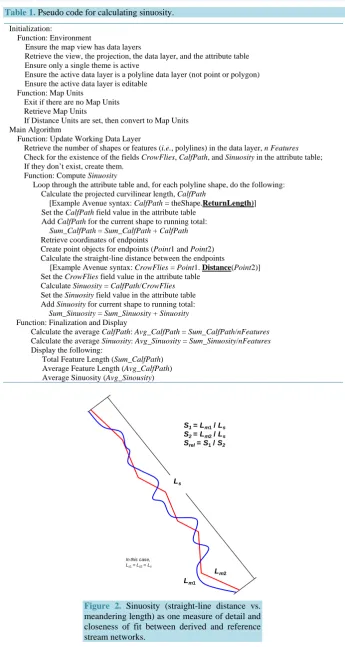
end-points, as the variable CrowFlies, using an appropriate GIS Distance function (e.g., the Avenue Distance me-thod). Sinuosity is then calculated by dividing CalfPath by CrowFlies. These three values are added to the data layer’s attribute table in three new fields. The algorithm also maintains a running sum of the lengths of all fea-tures, calculates the average polyline length and the average sinuosity, and reports these values when the algo-rithm is finished. The algoalgo-rithm is summarized as pseudo code in Table 1.
The basis for using sinuosity is an assumption that, in general, higher sinuosity implies greater detail and, therefore, greater accuracy (see Figure 2). However, the goal is not to maximize sinuosity, but rather obtain the closest possible match of sinuosity between the derived stream network and the reference stream network. If the sinuosity of the derived data is lower than that of the reference data, then less detail and, hence, less accuracy can be inferred. However, if the sinuosity of the derived data is higher than that of the reference data, we can in-fer greater detail, but not necessarily greater accuracy. Indeed, higher sinuosity in the derived data could just mean that the derivation process, in this case stream channel delineation, failed.
Sinuosity for two polylines can be directly compared, or relative sinuosities can be calculated. Relative si-nuosity could be a delta or difference, such as
d r
S S S
∆ = − (4)
Or relative sinuosity could be a ratio (derived sinuosity/reference sinuosity or vice versa), such as,
rel d r
S =S S (5)
One possible pitfall in using sinuosity to compare streams or networks of streams is the result of using ratios (S = Lm/Ls and Srel = Sd/Sr). Although the sinuosity of both the derived streams and the reference streams may
closely match, it is possible to have closely matched sinuosities and yet have the derived stream be half the length of the reference stream. The ratio of Lm to Ls may be the same for both derived and reference streams,
because both Lm to Ls are shortened proportionally. One must also examine and compare straight-line stream
Table 1. Pseudo code for calculating sinuosity.
Initialization:
Function: Environment
Ensure the map view has data layers
Retrieve the view, the projection, the data layer, and the attribute table Ensure only a single theme is active
Ensure the active data layer is a polyline data layer (not point or polygon) Ensure the active data layer is editable
Function: Map Units
Exit if there are no Map Units Retrieve Map Units
If Distance Units are set, then convert to Map Units Main Algorithm
Function: Update Working Data Layer
Retrieve the number of shapes or features (i.e., polylines) in the data layer, n Features
Check for the existence of the fields CrowFlies, CalfPath, and Sinuosity in the attribute table; If they don’t exist, create them.
Function: Compute Sinuosity
Loop through the attribute table and, for each polyline shape, do the following: Calculate the projected curvilinear length, CalfPath
[Example Avenue syntax: CalfPath = theShape.ReturnLength)] Set the CalfPath field value in the attribute table
Add CalfPath for the current shape to running total:
Sum_CalfPath = Sum_CalfPath + CalfPath
Retrieve coordinates of endpoints
Create point objects for endpoints (Point1 and Point2) Calculate the straight-line distance between the endpoints
[Example Avenue syntax: CrowFlies = Point1. Distance(Point2)] Set the CrowFlies field value in the attribute table
Calculate Sinuosity = CalfPath/CrowFlies
Set the Sinuosity field value in the attribute table Add Sinuosity for current shape to running total:
Sum_Sinuosity = Sum_Sinuosity + Sinuosity
Function: Finalization and Display
Calculate the average CalfPath: Avg_CalfPath = Sum_CalfPath/nFeatures
Calculate the average Sinuosity: Avg_Sinuosity = Sum_Sinuosity/nFeatures
Display the following:
[image:5.595.226.397.470.682.2]Total Feature Length (Sum_CalfPath) Average Feature Length (Avg_CalfPath) Average Sinuosity (Avg_Sinousity)
Figure 2. Sinuosity (straight-line distance vs. meandering length) as one measure of detail and closeness of fit between derived and reference stream networks.
Ls
Lm1 Lm2 S1= Lm1/ Ls S2= Lm2/ Ls Srel= S1/ S2
3.2. Longitudinal Root Mean Square Error
The second metric for comparing stream networks is Longitudinal Root Mean Square Error (LRMSE). The Na-tional Standard for Spatial Data Accuracy (NSSDA, 1998) uses root-mean-square error (RMSE) to estimate po-sitional accuracy. RMSE is the square root of the average of the set of squared differences between dataset coordinate values and coordinate values from an independent source of higher accuracy for identical points. Po-sitional errors, also known as displacements or distortions, are understood as the differences between the meas-ured and the assumed true coordinates.
Zhang and Goodchild [2] suggest that “metrics of root-mean-square error (RMSE) are useful indices of errors in continuous variables.” Referencing the American Society for Photogrammetry and Remote Sensing, they state that…
an empirical, site-specific estimate of positional uncertainties can be produced via tests against an inde-pendent source of much higher accuracy (this somewhat circular approach is necessary because no refer-ence source can have perfect accuracy). Depending on the specific requirements, the independent source of higher accuracy may be obtained through land surveying or derived from aerial photography.
For n points with errors εi (i = 1, 2,···,n), observed as the differences in coordinates between the data sets to
be tested and the more accurate reference data, the RMSE is
1 2
1
1 RMSE in i
n =ε
=
∑
(6)where the error εi is the distance between a test or modeled data point (Xi, Yi) and a corresponding reference data
point (Xoi, Yoi). In other words, for Cartesian coordinates,
(
) (
2)
2 1 2i di Xoi Xi Yoi Yi
ε = = − + −
(7)
We define LRMSE as the horizontal root mean square error (RMSE) computed between a number of paired sets of points located along both derived and reference stream network polylines. Thus,
(
) (
2)
2 1 2 11
LRMSE ni Xoi Xi Yoi Yi
n =
= − + −
∑
(8)Our algorithm for deriving LRMSE assumes that two polyline data sets are selected within the GIS environ-ment: one would be the derived stream network and the other would be the reference stream network. For each polyline in the reference data, the reference polyline is divided into m equal-length segments between n evenly spaced points, where m = n – 1. Then, for each reference point, the nearest point on the derived polyline is iden-tified and the distance (di) from that point on the derived polyline to the current point on the reference polyline is
calculated (see Figure 3). LRMSE is then calculated as
1 2
1
LRMSE 1 ni di
n =
=
∑
(9)with m = 100 and n = 101 for our sample data.
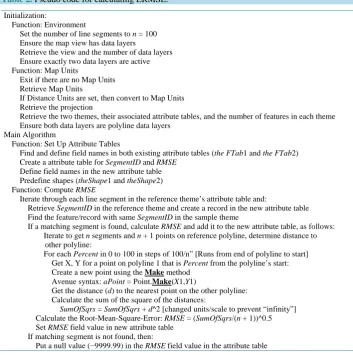
The LRMSE values are stored in a new attribute table. If a stream branch in the reference network is missing in the derived network, then the LRMSE is reported as −9999.99. The algorithm is summarized as pseudo code inTable 2.
LRMSE is used as a measure of how accurately the derived stream networks match the reference networks. The smaller the LRMSE, the closer the fit between derived and reference data. Unlike relative sinuosity, where the goal is to closely match the calculated value for the derived network with the calculated value for the refer-ence network, rather than maximizing the value, the goal with LRMSE is to minimize the value, since the com-parison with the reference is built into the calculation.
Figure 3. Computation of LRMSE between derived stream and reference stream.
Table 2. Pseudo code for calculating LRMSE.
Initialization:
Function: Environment
Set the number of line segments to n = 100 Ensure the map view has data layers
Retrieve the view and the number of data layers Ensure exactly two data layers are active Function: Map Units
Exit if there are no Map Units Retrieve Map Units
If Distance Units are set, then convert to Map Units Retrieve the projection
Retrieve the two themes, their associated attribute tables, and the number of features in each theme Ensure both data layers are polyline data layers
Main Algorithm
Function: Set Up Attribute Tables
Find and define field names in both existing attribute tables (the FTab1 and the FTab2) Create a attribute table for SegmentID and RMSE
Define field names in the new attribute table Predefine shapes (theShape1 and theShape2) Function: Compute RMSE
Iterate through each line segment in the reference theme’s attribute table and:
Retrieve SegmentID in the reference theme and create a record in the new attribute table Find the feature/record with same SegmentID in the sample theme
If a matching segment is found, calculate RMSE and add it to the new attribute table, as follows: Iterate to get n segments and n + 1 points on reference polyline, determine distance to
other polyline:
For each Percent in 0 to 100 in steps of 100/n” [Runs from end of polyline to start] Get X, Y for a point on polyline 1 that is Percent from the polyline’s start: Create a new point using the Make method
Avenue syntax: aPoint = Point.Make(X1,Y1)
Get the distance (d) to the nearest point on the other polyline: Calculate the sum of the square of the distances:
SumOfSqrs = SumOfSqrs + d^2 [changed units/scale to prevent “infinity”] Calculate the Root-Mean-Square-Error: RMSE = (SumOfSqrs/(n + 1))^0.5 Set RMSE field value in new attribute table
If matching segment is not found, then:
Put a null value (−9999.99) in the RMSE field value in the attribute table
[image:7.595.138.492.297.653.2]comparing it with the longer polyline. In this case, the extension of the longer polyline would be ignored and LRMSE would truly indicate a good match, with the exception of extension. Such a change to the code is rec-ommended, but has not yet been implemented and tested. Another solution, which has been used [20], is to ma-nually truncate the longer polyline so that only the common reach is used for comparing the two polylines. Like sinuosity, when using LRMSE, some subjective interpretation of the objective data is still needed.
3.3. Special Considerations
There are several considerations that must be made in using these methods with polylines particularly when im-plemented in the ArcView environment using polyline (typically “shapefile”) formatted data. First, the polylines need to “flow” in the same direction. This means that two polylines, in different stream networks that are being compared, must be constructed in the same order, upstream end to downstream end. The “flow” direction of the polylines can be checked and, if necessary, reversed, using the Line Direction Tool, developed by Jennesse En-terprises (www.jennessent.com).
If the “flow” direction must be changed, the second consideration becomes relevant. If the stream network polyline data contain “ArcZ” lines, then they need to be converted to standard polylines, because “ArcZ” lines are generally not editable. This can be easily accomplished using an Avenue script called PolyShape.Coverter, developed by Deshpande (2000).
Finally, the third consideration is that the polylines need a visual quality check to ensure that there is a one-to-one correspondence between polyline segments. This does not mean that there has to be a polyline in the derived stream network for every polyline in the reference file. If the derived polyline is missing a polyline segment, then the reference segment is ignored. However, corresponding segments in the reference and derived polyline networks must have the same identification number (ID). For example, in two of the three stream net-work geographic areas studied by Yang et al. (2010), discussed in the next section, the number of polylines in the reference network equaled the number of polylines in the derived network, regardless of the coarseness of the delineation, and corresponding polyline segments were assigned matching IDs. However, for coarser deline-ations in the third geographic area, the number of polylines differed between the reference and derived networks. One or two branches were not created in the delineation process. Where the branches were missing, the delinea-tion process failed to create separate polylines on either side of the branch, resulting in a single long polyline in the derived network that was represented by two shorter polylines in the reference network. This longer derived polyline was then automatically compared with either of the two shorter reference polylines or to the missing branch in the reference network, depending on which of the three reference ID numbers was assigned to the de-rived polyline, which skewed the analyses.
To resolve this, the longer derived polylines were manually broken at about the location of the missing branches, and the IDs for the polylines in the derived dataset were changed to ensure matches between ponding reference and derived polylines, so that derived polylines were correctly compared with the corres-ponding reference polylines (see Figure 4).
The accuracy assessment of a stream network such as the one shown in Figure 1, involves the repeated cal-culations of the distance between two points. There are 33 polyline segments in the network shown. Each poly-line segment is composed of numerous straight-poly-line segments. Each straight-poly-line segment is defined by two points (or vertices), and each point (or vertex) is defined by two coordinates (an ordered pair). The complexity of performing data quality assessments on this network is very evident. Additionally, the coordinates (vertices) could exist in any of a large number of coordinate systems, based on map projections. GIS and associated pro-gramming languages are suitable for dealing with all of the coordinate systems and for converting coordinates between the systems allowing for assessment of stream networks accuracy in any projected (e.g., Universal Transverse Mercator—UTM) or geographic (latitude and longitude) coordinate system.
4. Application and Results
Figure 4. Manually breaking polylines to ensure one-to-one corres-pondence.
Figure 5. Average sinuosity for stream networks delineated from LiDAR-derived DEMs.
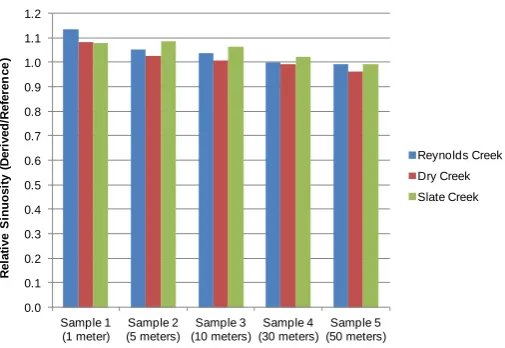
Figure 6. Relative sinuosity (derived/reference) for stream networks delineated from LiDAR-derived DEMs.
A value of 1.0 indicates a perfect match in sinuosity, although not necessarily a perfect overlying match of poly-lines. Note that, for Reynolds Creek, the 30-meter cell size yields a sinuosity that most closely matches the ref-erence; for Dry Creek, the 10-meter cell size yields a sinuosity that most closely matches the refref-erence; and for Slate Creek, the 50-meter cell size yields a sinuosity that most closely matches the reference.
1 2 3 1 3 Polyline broken here 1 2 3 Single polyline w/ ID 1, 2, or 3
Before Correction After Correction
0.0 0.1 0.2 0.3 0.4 0.5 0.6 0.7 0.8 0.9 1.0 1.1 1.2 1.3 1.4
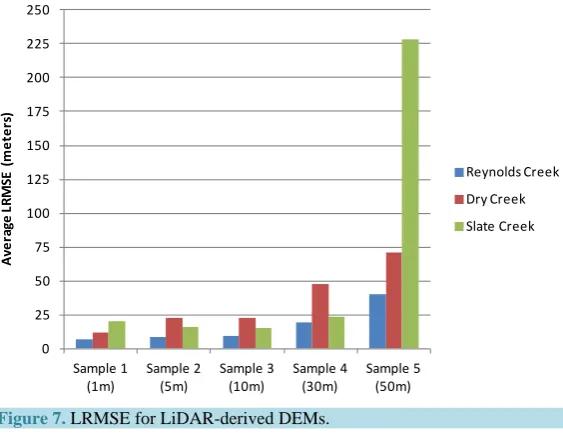
[image:9.595.188.441.461.635.2]Figure 7 shows the average LRMSE for derived stream networks versus reference stream networks for the three study areas. Note that, generally, the LRMSE decreases (indicating better match) as the cell size decreases. Further discussion of these results can be found in Yang et al. (2010).
Anderson and Ames (2010) used the sinuosity and LRMSE techniques to assess a new stream network delin-eation method that works directly from LiDAR point cloud data, for the Fishhook Creek Inlet of Redfish Lake, in Custer County, Idaho. In this case, the LiDAR delineation was compared with a traditional DEM-based grid cell stream network delineation, two standard stream datasets, and a highly detailed reference stream traced from 1-meter resolution National Agricultural Imaging Project or NAIP aerial photography (see Table 3). Note that, while LRMSE indicates that the LiDAR point cloud delineation yielded a much better match to the reference, the DEM-based delineation yielded a relative sinuosity that most closely matched that of the reference. This supports the caution, offered in Section 3.1, that matching sinuosities do not necessarily mean that the polylines match; only that the amount of meandering is similar. LRMSE is the better of the two metrics for determining match. Although the reference and derived polylines differed in length, the longer polylines were manually truncated for fair comparison of the common reach.
5. Conclusion
Networks of polylines can be compared for relative accuracy in terms of sinuosity and LRMSE, to provide quantitative assessment of the quality of the data. Neither sinuosity nor LRMSE should be used blindly; both require some subjective interpretation to ensure that they are used properly and that there are no data anomalies, such as greatly disparate polyline lengths. Nevertheless, using these techniques for comparing polylines or net-works of polyline, one can explore detailed comparisons of stream channel delineations that differ, for example, in the assumptions applied or the derivation processes employed. While LRMSE appears to be a more generally suitable technique, both provide valuable insights when properly used and reviewed. Both techniques have been
Figure 7. LRMSE for LiDAR-derived DEMs.
Table 3. Example of sinuosity and LRMSE results (Fishhook Creek).
Dataset Type Sinuosity Relative sinuosity* LRMSE* (meters)
NAIP Reference 1.67
TIGER2K Standard 1.14 0.68 12.96 PNWRR Standard 1.13 0.68 13.36 TauDEM DEM delineation 1.73 1.04 5.21 avFlowPath LiDAR delineation 1.83 1.10 2.06
*Relative to the NAIP Reference.
0 25 50 75 100 125 150 175 200 225 250
Sample 1
(1m) Sample 2 (5m) Sample 3 (10m) Sample 4 (30m) Sample 5 (50m)
Av
er
ag
e L
RM
SE
(
m
et
er
s)
used in two recent investigations involving extracting of hydrographic features from LiDAR elevation data. In one, it is confirmed that, with the greatly increased resolution of LiDAR data, smaller cell sizes yielded better stream network delineations based on sinuosity and LRMSE when using LiDAR-derived DEMs [7]. The other demonstrated a new method of delineating stream channels directly from LiDAR point clouds [20], without the intermediate step of deriving a DEM. It was shown that the direct delineation from LiDAR point clouds yielded an excellent and much better match, as indicated by the LRMSE.
References
[1] Goodchild, M.F. and Gopal, S. (1989) The Accuracy of Spatial Databases. CRC Press, Boca Raton.
[2] Zhang, J. and Goodchild, M.F. (2002) Uncertainty in Geographical Information. CRC Press, Boca Raton. http://dx.doi.org/10.4324/9780203471326
[3] Congalton, R.G. (2001) Accuracy Assessment and Validation of Remotely Sensed and Other Spatial Information. In-ternational Journal of Wildland Fire, 10, 321-328.
[4] Jenson, S. and Domingue, J. (1988) Extracting Topographic Structure from Digital Elevation Data for Geographic In-formation System Analysis. Photogrammetric Engineering and Remote Sensing, 54, 1593-1600.
[5] Tarboton, D.G., Bras, R.L. and Rodriguez-Iturbe, I. (1991) On the Extraction of Channel Networks from Digital Eleva-tion Data. Hydrological Processes, 5, 81-100. http://dx.doi.org/10.1002/hyp.3360050107
[6] Olivera, F. (2001) Extracting Hydrologic Information from Spatial Data for HMS Modeling. Journal of Hydrologic Engineering, 6, 524-530. http://dx.doi.org/10.1061/(ASCE)1084-0699(2001)6:6(524)
[7] Yang, P., Ames, D., Glenn, N. and Anderson, D. (2010) Effects of LiDAR Derived DEM Resolution on Hydrographic Feature Extraction. AGU Fall Meeting Abstracts, 7.
[8] Leopold, L.B., Wolman, M.G., Wolman, M.G. and Wolman, M.G. (1957) River Channel Patterns: Braided, Meander-ing, and Straight. US Government Printing Office, Washington DC.
[9] Friedkin, J.F. (1945) Laboratory Study of the Meandering of Alluvial Rivers.
[10] Schumm, S. (1963) Sinuosity of Alluvial Rivers on the Great Plains. Geological Society of America Bulletin, 74, 1089- 1100. http://dx.doi.org/10.1130/0016-7606(1963)74[1089:SOAROT]2.0.CO;2
[11] Leopold, L.B., Wolman, M.G. and Miller, J.P. (2012) Fluvial Processes in Geomorphology. Courier Dover Publica-tions, Mineola.
[12] Mueller, J.E. (1968) An Introduction to the Hydraulic and Topographic Sinuosity Indexes 1. Annals of the Association of American Geographers, 58, 371-385. http://dx.doi.org/10.1111/j.1467-8306.1968.tb00650.x
[13] Chorley, R., Schumm, S. and Sugden, D. (1984) Geomorphology, 1984. Methuen, London.
[14] Begin, Z.B. (1985) A Note on the Relationship between Flow Energy and Stream Sinuosity. GSI Current Research, 5, 77-78.
[15] Ebisemiju, F. (1994) The Sinuosity of Alluvial River Channels in the Seasonally Wet Tropical Environment: Case Study of River Elemi, Southwestern Nigeria. Catena, 21, 13-25. http://dx.doi.org/10.1016/0341-8162(94)90028-0
[16] Aswathy, M., Vijith, H. and Satheesh, R. (2008) Factors Influencing the Sinuosity of Pannagon River, Kottayam, Ke-rala, India: An Assessment Using Remote Sensing and GIS. Environmental Monitoring and Assessment, 138, 173-180. http://dx.doi.org/10.1007/s10661-007-9755-6
[17] Downward, S., Gurnell, A. and Brookes, A. (1994) A Methodology for Quantifying River Channel Planform Change Using GIS. IAHS Publications-Series of Proceedings and Reports-Intern Assoc Hydrological Sciences, 224, 449-456.
[18] Heo, J., Duc, T.A., Cho, H.-S. and Choi, S.-U. (2009) Characterization and Prediction of Meandering Channel Migra-tion in the GIS Environment: A Case Study of the Sabine River in the USA. Environmental Monitoring and Assess-ment, 152, 155-165. http://dx.doi.org/10.1007/s10661-008-0304-8
[19] Committee, F.G.D. (1998) Geospatial Positioning Accuracy Standards, Part 3: National Standard for Spatial Data Ac-curacy. Subcommittee for Base Cartographic Data, 25 p.
[20] Anderson, D.L. and Ames, D.P. (2011) A Method for Extracting Stream Channel Flow Paths from LiDAR Point Cloud Data. Journal of Spatial Hydrology, 11, 17 p.
[21] Manual, E. (1993) River Hydraulics.