http://dx.doi.org/10.4236/am.2015.614199
Regular Elements of the Semigroup B
X
(D)
Defined by Semilattices of the Class Σ
2
(X, 8)
and Their Calculation Formulas
Nino Tsinaridze, Shota Makharadze, Guladi Fartenadze
Department of Mathematics, Faculty of Physics, Mathematics and Computer Sciences, Shota Rustaveli Batumi State University, Batumi, Georgia
Received 13 February 2015; accepted 27 December 2015; published 30 December 2015
Copyright © 2015 by authors and Scientific Research Publishing Inc.
This work is licensed under the Creative Commons Attribution International License (CC BY).
http://creativecommons.org/licenses/by/4.0/
Abstract
The paper gives description of regular elements of the semigroup BX(D) which are defined by se-milattices of the class Σ2(X, 8), for which intersection the minimal elements is not empty. When X is
a finite set, the formulas are derived, by means of which the number of regular elements of the semigroup is calculated. In this case the set of all regular elements is a subsemigroup of the semi-group BX(D) which is defined by semilattices of the class Σ2(X, 8).
Keywords
Semilattice, Semigroup, Binary Relation, Regular Element
1. Introduction
An element
α
taken from the semigroup BX( )
D is called a regular element of BX( )
D , if in BX( )
Dthere exists an element β such that α β α α = (see [1][2]).
Definition 1.1. We say that a complete X-semilattice of unions D is an XI-semilattice of unions if it satisfies the following two conditions:
1) ∧
(
D D, t)
∈D for any t∈D
; 2)
(
, t)
t Z
Z D D
∈
=
∧ for any nonempty element Z of D (see ([1], Definition 1.14.2), ([2], Definition 1.14.2)).Definition 1.2. The one-to-one mapping ϕ between the complete X-semilattices of unions
φ
(
Q Q,)
andD′′ is called a complete isomorphism if the condition
( )
( )
11
T D
D T
ϕ ϕ
′∈
′
set D1 of the semilattice D' (see ([1], Definition 6.3.2), ([2], Definition 6.3.2) or [3]).
Definition 1.3. Let
α
be some binary relation of the semigroup BX( )
D . We say that the complete iso-morphism ϕ between the complete semilattices of unions Q and D′ is a completeα
-isomorphism if1) Q V D=
(
,α
)
;2)
ϕ
( )
∅ = ∅ for ∅∈V D(
,α
)
andϕ
( )
Tα
=T for all T∈V D(
,α
)
(see ([1], Definition 6.3.3), ([2], Definition 6.3.3) or [3]).Theorem 1.1.Let R be the set of all regular elements of the semigroup BX
( )
D . Then the followingstate-ments are true:
1) R D
( )
′ ∩R D( )
′′ = ∅ for any D D′ ′′∈Σ, XI( )
D and D′≠D′′;2)
( )
( )
XI
D D
R R D
′∈Σ
′
=
;3) If X is a finite set, then
( )
( )
XI
D D
R R D
′∈Σ
′
=
∑
(see ([1], Theorem 6.3.6) or ([2], Theorem 6.3.6) or[3]).2. Result
By the symbol Σ2
(
X,8)
we denote the class of all X-semilattices of unions whose every element is isomorphic to an X-semilattice of form D={
Z Z Z Z Z Z Z D7, 6, 5, 4, 3, 2, 1,}
, where( ) ( ) ( ) ( ) ( ) ( ) ( ) ( ) ( ) ( ) ( )
{
}
6 3 1 6 4 1 6 4 2
7 4 1 7 4 2 7 5 1
, , ,
, , ,
\ , , 7, 6 , 6, 7 , 5, 4 , 4, 5 , 5, 3 , 3, 5 , 4, 3 , 3, 4 , 2,1 , 1, 2
i j
Z Z Z D Z Z Z D Z Z Z D
Z Z Z D Z Z Z D Z Z Z D
Z Z i j
⊂ ⊂ ⊂ ⊂ ⊂ ⊂ ⊂ ⊂ ⊂
⊂ ⊂ ⊂ ⊂ ⊂ ⊂ ⊂ ⊂ ⊂
≠ ∅ ∈
(see [4]).
Now assume that D∈ Σ2
(
X,8)
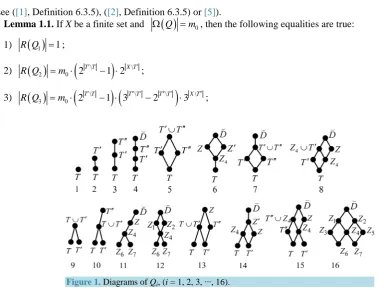
. We introduce the following notation: 1) Q1={ }
T , whereT
∈
D
(see diagram 1 inFigure 1);2) Q2=
{
T T, ′}
, where T T, ′∈D and T⊂T′ (see diagram 2 inFigure 1);3) Q3 =
{
T T T, ′ ′′,}
, where T T T, ′ ′′∈, D and T ⊂T′⊂T′′ (see diagram 3 inFigure 1);4) Q4=
{
T T T D, ′ ′′, , }
, where T T T, ′ ′′∈, D and T ⊂T′⊂T′′⊂D (see diagram 4 in Figure 1); 5) Q5={
T T T T, ′ ′′ ′, , ∪T′′}
, where T T T, ′ ′′∈, D, T ⊂T′, T⊂T′′ and T′\T′′ ≠ ∅, T′′\T′ ≠ ∅(see diagram 5 inFigure 1);
6) Q6=
{
T Z Z Z D, 4, , ′, }
, where T∈{
Z Z7, 6}
, Z Z, ′∈{
Z Z2, 1}
, Z ≠Z′ and Z Z\ ′ ≠ ∅, Z′\Z≠ ∅(see diagram 6 inFigure 1);
7) Q7 =
{
T T T T, ′ ′′ ′, , ∪T D′′, }
, where T T T, ′ ′′∈, D, T⊂T′, T⊂T′′ and T′\T′′ ≠ ∅, T′′\T′ ≠ ∅ (see diagram 7 inFigure 1);8) Q8=
{
T T Z Z, ′, 4, 4∪T Z D′, ,}
, where T∈{
Z Z7, 6}
, T′∈{
Z Z5, 3}
, T⊂T′, Z4∪T′, ,Z∈{
Z Z2 1}
,4
Z ∪T′≠Z, T′\Z4 ≠ ∅, Z4\T′ ≠ ∅ and
(
Z4∪T′)
\Z ≠ ∅, Z \(
Z4∪T′)
≠ ∅(see diagram 8 inFigure 1);
9) Q9=
{
T T T, ′, ∪T′}
, where T T, ′∈D, T T\ ′ ≠ ∅, T′\T ≠ ∅ and T∩ = ∅T′ (see diagram 9 inFigure 1);10) Q10=
{
T T T, ′, ∪T T′ ′′,}
, where T T T, ′ ′′∈, D,(
T∪T′)
⊂T′′, T T\ ′ ≠ ∅, T′\T ≠ ∅ andT∩ = ∅T′ (see diagram 10 inFigure 1);
12) Q12 =
{
Z Z Z Z Z D7, 6, 4, 2, 1, }
, where Z7∩Z6= ∅ (see diagram 12 inFigure 1);13) Q13=
{
T T T, ′, ∪T T Z′ ′′, ,}
, where T T T, ′ ′′, ,Z∈D,(
T∪T′)
⊂Z, T′⊂T′′⊂Z,(
T∪T′)
\T′′≠ ∅,(
)
\
T′′ T∪T′ ≠ ∅ and T∩T′′= ∅ (see diagram 13 inFigure 1);
14) Q14=
{
T T Z Z Z D, ′, 4, , ′, }
, where T T Z Z, ′, , ′∈D, T T, ′∈{
Z Z7, 6}
, T≠T′, Z4⊂Z′⊂D,T′⊂ ⊂Z Z′, Z4 \Z ≠ ∅, Z Z\ 4 ≠ ∅ and T∩ = ∅Z (see diagram 14 inFigure 1);
15) Q15=
{
T T Z T Z T′, , 4, ′′, , ′′∪Z D4,}
, where T T, ′∈{
Z Z7, 6}
, T≠T′, T⊂T′′, T′′∈{
Z Z5, 3}
, Z4⊂Z,(
T
′′ ∪
Z
4)
∪ =
Z
D
, T′′\Z4≠ ∅, Z4\T′′ ≠ ∅,
(
T′′ ∪Z4)
\Z ≠ ∅, Z\(
T′′ ∪Z4)
≠ ∅ andT′∩T′′= ∅ (see diagram 15 inFigure 1);
16) Q16=
{
Z Z Z Z Z Z Z D7, 6, 5, 4, 3, 2, 1, }
, where Z5∩Z3= ∅ (see diagram 16 inFigure 1).Denote by the symbol ∑
( ) (
Qi 1, 2,i= ,16)
the set of all XI-subsemilattices of the semilattice Disomor-phic to Qi. Assume that D′∈ ∑
( )
Qi and denote by the symbol R D( )
′ the set of all regular elements α of the semigroup BX( )
D′ , for which the semilattices V D(
,α
)
and Qi are mutually α isomorphic and(
,)
iV D
α
=Q.Definition 1.4. Let the symbol ∑′XI
(
X D,)
denote the set of all XI-subsemilattices of the semilattice D.Let, further, D D, ′∈ ∑′
(
X D,)
andϑ
XI ⊆ ∑′XI(
X D,)
× ∑′XI(
X D,)
. It is assumed that DϑXID′ if and only if there exists some complete isomorphism ϕ between the semilattices D and D′. One can easily verify that the binary relation ϑXI is an equivalence relation on the set ∑′XI(
X D,)
.Let the symbol QiϑXI denote the ϑXI-class of equivalence of the set ∑′XI
(
X D,)
, where every element isisomorphic to the X-semilattice Qi and
( )
( )
i XI i
D Q
R Q R D
ϑ ∗
′∈
′
=
(see ([1], Definition 6.3.5), ([2], Definition 6.3.5) or [5]).
Lemma 1.1. If X be a finite set and Ω
( )
Q =m0, then the following equalities are true: 1) R Q( )
1 =1;2) R Q
( )
2 =m0⋅(
2T T′\ − ⋅1 2)
X T\ ′; [image:3.595.93.478.435.725.2]3) R Q
( )
3 =m0⋅(
2T T′\ − ⋅1) (
3T T′′ ′\ −2T T′′ ′\)
⋅3X T\ ′′;4) R Q
( )
4 =m0⋅(
2T T′\ − ⋅1) (
3T T′′ ′\ −2T T′′ ′\)
⋅(
4D T\′′ −3D T\′′)
⋅4X D\
;
5) R Q
( )
5 = ⋅2 m0⋅(
2T T′ ′′\ − ⋅1) (
2T T′′ ′\ − ⋅1 4)
X T\( ′∪T′′);6)
( )
(
4\)
( )\ 4(
\ \) (
\ \)
\6 2 0 2 1 2 3 2 3 2 5
X D Z Z Z
Z T Z Z Z Z Z Z Z Z
R Q = ⋅m ⋅ − ⋅ ∩ ′ ⋅ ′ − ′ ⋅ ′ − ′ ⋅
;
7) R Q
( )
7 = ⋅2 m0⋅(
2T T′ ′′\ − ⋅1) (
2T T′′ ′\ − ⋅1)
(
5D T\( ′∪T′′) −4D T\( ′∪T′′))
⋅5X D\
;
8)
( )
(
\) (
4\)
(
\( 4 ) \( 4 ))
\8 2 0 2 1 2 1 3 2 6
X D
Z Z T Z Z T
T Z Z T
R Q = ⋅m ⋅ ′ − ⋅ ′ − ⋅ ∪ ′ − ∪ ′ ⋅
;
9) R Q
( )
9 = ⋅2 m0⋅3X\(T∪T′) ;10) R Q
( )
10 = ⋅2 m0⋅(
4T′′\(T∪T′) −3T′′\(T∪T′))
⋅4X T\ ′′ ;11)
( )
(
\ 4 \ 4)
(
\ \)
\11 2 0 4 3 5 4 5
D Z D Z X D Z Z Z Z
R Q = ⋅m ⋅ − ⋅ − ⋅
;
12)
( )
(
1\ 2 1\ 2) (
2\1 2\1)
\12 4 0 4 3 4 3 6
X D
Z Z Z Z Z Z Z Z
R Q = ⋅m ⋅ − ⋅ − ⋅
;
13) R Q
( )
13 =m0⋅(
2T′′\(T′∪T) − ⋅1 5)
X Z\ ;14)
( )
(
\ 4)
(
\ \)
\14 0 2 1 6 5 6
D Z D Z X D Z Z
R Q =m ⋅ − ⋅ ′ − ′ ⋅
;
15)
( )
(
\)
(
\( 4) \( 4))
\15 0 2 1 4 3 7
X D
Z T Z Z T Z
T Z
R Q =m ⋅ ′′ − ⋅ ′′∪ − ′′∪ ⋅
;
16)
( )
(
5\ 1) (
3\ 2)
\16 2 0 2 1 2 1 8
X D
Z Z Z Z
R Q = ⋅m ⋅ − ⋅ − ⋅
.
Proof. The statements 1)-4) immediately follows from the Theorem 13.1.2 in [1], Theorem 13.1.2 in [2]; the statements 5)-7) immediately follows from the Theorem 13.3.2 in [1], Theorem 13.3.2 in [2]; the statement 8) immediately follows from the Theorem 13.7.5 in [1], Theorem 13.7.5 in [2]; the statements 9)-11) immediately follows from the Theorem 13.2.2 in [1], Theorem 13.2.2 in [2]; the statement 12) immediately follows from the Theorem 13.5.2 in [1], Theorem 13.5.2 in [2]; the statements 13), 14) immediately follows from the Theorem 13.4.2 in [1], Theorem 13.4.2 in [2], the statement 15) immediately follows from the Corollary 13.10.2 in [1]
and the statement 16) immediately follows from the Theorem 2.2 in [4]. The lemma is proved.
Lemma 1.2. Let D=
{
Z Z Z Z Z Z Z D7, 6, 5, 4, 3, 2, 1, }
∈ Σ2(
X, 8)
and Z7∩Z6 ≠ ∅. Then the following sets exhibit all XI-subsemilattices of the given semilattice D:1)
{ }
D ,{ } { } { } { } { } { } { }
Z1 , Z2 , Z3 , Z4 , Z5 , Z6 , Z7 , (see diagram 1 of the Figure 1);2)
{
Z Z7, 5} {
, Z Z7, 4} {
, Z Z7, 2} {
, Z Z7, 1}
,{
Z D7, }
,{
Z Z6, 4} {
, Z Z6, 3} {
, Z Z6, 2} {
, Z Z6, 1}
,{
Z D6,}
,{
Z Z5, 2}
,{
Z D5,}
,{
Z Z4, 2} {
, Z Z4, 1}
,{
Z D4,}
,{
Z Z3, 1}
,{
Z D3,} {
, Z D2,} {
, Z D1,}
, (see diagram 2 of the Figure 1);
3)
{
Z Z Z7, 5, 2}
,{
Z Z D7, 5, }
,{
Z Z Z7, 4, 2} {
, Z Z Z7, 4, 1}
,{
Z Z D7, 4, } {
, Z Z D7, 2,} {
, Z Z D7, 1, }
,{
Z Z Z6, 4, 2}
,{
Z Z D6, 4,}
,{
Z Z Z6, 4, 1}
,{
Z Z D6, 2,}
,{
Z Z Z6, 3, 1}
,{
Z Z D6, 3,} {
, Z Z D6, 1,}
4)
{
Z Z Z D7, 5, 2, } {
, Z Z Z D7, 4, 2, } {
, Z Z Z D7, 4, 1,} {
, Z Z Z D6, 4, 2,} {
, Z Z Z D6, 4, 1, } {
, Z Z Z D6, 3, 1, }
, (see diagram 4 of the Figure 1);5)
{
Z Z Z Z7, 5, 4, 2}
,{
Z Z Z D7, 5, 1, } {
, Z Z Z D7, 2, 1,}
,{
Z Z Z Z6, 4, 3, 1}
,{
Z Z Z D6, 3, 2, } {
, Z Z Z D6, 2, 1,}
,{
Z Z Z D4, 2, 1,}
, (see diagram 5 of the Figure 1);
6)
{
Z Z Z Z D7, 4, 2, 1,} {
, Z Z Z Z D6, 4, 2, 1,}
, (see diagram 6 of the Figure 1); 7){
Z Z Z Z D7, 5, 4, 2,} {
, Z Z Z Z D6, 4, 3, 1, }
, (see diagram 7 of the Figure 1); 8){
Z Z Z Z Z D7, 5, 4, 2, 1,} {
, Z Z Z Z Z D6, 4, 3, 2, 1,}
,
(see diagram 8 of the Figure 1);
Proof. The statements 1)-4) immediately follows from the Theorems 11.6.1 in [1], 11.6.1 in [2] or in [5], the statements 5)-7) immediately follows from the Theorems 11.6.3 in [1], 11.6.3 in [2] or in [5] and the statement 8) immediately follows from the Theorems 11.7.2 in [1].
The lemma is proved.
Theorem 2.1. Let D=
{
Z Z Z Z Z Z Z D7, 6, 5, 4, 3, 2, 1, }
∈ Σ2(
X, 8)
and Z7∩Z6≠ ∅. Then a binary relationα
of the semigroup BX( )
D that has a quasinormal representation of the form to be given below is a regular element of this semigroup iff there exist a completeα
-isomorphism ϕ of the semilattice V D(
,α
)
on some subsemilattice D' of the semilattice D that satisfies at least one of the following conditions:1) α= X×T, where
T
∈
D
;2) α=
(
YTα×T) (
∪ YTα′ ×T′)
, where T T, ′∈D, T⊂T′,Y
T,
Y
T{ }
α α
′
∉ ∅
and satisfies the conditions:( )
T
Y
α⊇
ϕ
T
,Y
Tα′∩
ϕ
( )
T
′
≠ ∅
;3)
(
YT T) (
YT T) (
YT T)
α α α
α = × ∪ ′× ′ ∪ ′′× ′′ , where ,T T T′ ′′∈, D, T ⊂T′⊂T′′,
Y
T,
Y
T,
Y
T{ }
α α α
′ ′′
∉ ∅
and satis-fies the conditions:Y
Tα⊇
ϕ
( )
T
,Y
Tα∪
Y
Tα′⊇
ϕ
( )
T
′
,Y
Tα′∩
ϕ
( )
T
′
≠ ∅
,Y
Tα′′∩
ϕ
( )
T
′′
≠ ∅
;4) α=
(
YTα×T) (
∪ YTα′ ×T′) (
∪ YTα′′×T′′)
∪(
Y0α×D)
, where T T T, ′ ′′∈, D, T ⊂T′⊂T′′⊂D,
{ }
0
,
,
,
T T T
Y
αY
α′Y
α′′Y
α∉ ∅
and satisfies the conditions:Y
Tα⊇
ϕ
( )
T
,Y
Tα∪
Y
Tα′⊇
ϕ
( )
T
′
,Y
Tα∪
Y
Tα′∪
Y
Tα′′⊇
ϕ
( )
T
′′
,( )
T
Y
α′∩
ϕ
T
′
≠ ∅
,Y
Tα′′∩
ϕ
( )
T
′′
≠ ∅
, Y0α ∩ϕ( )
D ≠ ∅;5) α =
(
YTα×T) (
∪ YTα′×T′) (
∪ YTα′′×T′′)
∪(
YTα′∪T′′×(
T′∪T′′)
)
, where T T T, ′ ′′∈, D, T⊂T′ , T⊂T′′ ,\
T′ T′′ ≠ ∅, T′′\T′ ≠ ∅, YTα,YTα′,YTα′′∉ ∅
{ }
and satisfies the conditions:Y
Tα∪
Y
Tα′⊇
ϕ
( )
T
′
,( )
T T
Yα∪Yα′′ ⊇
ϕ
T′′ , YTα′ ∩ϕ
( )
T′ ≠ ∅, YTα′′ ∩ϕ
( )
T′′ ≠ ∅; 6) α=(
YTα×T) (
∪ Y4α×Z4) (
∪ YZα′×Z′) (
∪ YZα×Z) (
∪ Y0α×D)
, where T∈
{
Z Z7, 6}
, Z Z, ′∈{
Z Z2, 1}
, Z≠Z′,\
Z Z′ ≠ ∅, Z′\Z≠ ∅, YTα,Y4α,YZα′,YZα∉ ∅
{ }
and satisfies the conditions YTα ⊇ϕ
( )
T , YTα∪Y4α ⊇ϕ
( )
Z4 ,( )
4
T Z
Yα∪Yα∪Yα ⊇
ϕ
Z , YTα∪Y4α∪YZα′ ⊇ϕ
( )
Z′ , Y4α∩ϕ
( )
Z4 ≠ ∅, YZα∩ϕ
( )
Z ≠ ∅, YZα′∩ϕ
( )
Z′ ≠ ∅; 7) α =(
YTα×T) (
∪ YTα′×T′) (
∪ YTα′′×T′′)
∪(
YTα′∪T′′×(
T′∪T′′)
)
∪(
Y0α×D)
, where ,T T T′ ′′∈, D , T⊂T′ ,
T⊂T′′, T′\T′′ ≠ ∅ , T′′\T′ ≠ ∅ , YTα,YTα′,YTα′′,Y0α∉ ∅
{ }
and satisfies the conditions YTα∪YTα′ ⊇ϕ
( )
T′( )
T T
Yα∪Yα′′ ⊇
ϕ
T′′ , YT( )
T , , YT( )
T Y0( )
Dα ϕ α ϕ α ϕ
′ ∩ ′ ≠ ∅ ′′ ∩ ′′ ≠ ∅ ∩ ≠ ∅;
8)
(
) (
) (
)
(
(
)
) (
)
(
)
4
4 4 4 0
T T T Z Z
Yα T Yα T Yα Z Yα T Z Yα Z Yα D
α= × ∪ ′× ′ ∪ × ∪ ′∪ × ′∪ ∪ × ∪ × , where T∈
{
Z Z7, 6}
,{
5, 3}
T′∈ Z Z , T⊂T′, Z4∪T′, ,Z∈
{
Z Z2 1}
, Z4∪T′≠Z, T′\Z4≠ ∅, Z4\T′ ≠ ∅,(
Z4∪T′)
\Z≠ ∅,(
4)
\
Z Z ∪T′ ≠ ∅, YTα,YTα′,Y4α,YZα∉ ∅
{ }
and satisfies the conditions YTα∪YTα′ ⊇ϕ
( )
T′ , YTα∪Y4α ⊇ϕ
( )
Z4 ,( )
4 ,
T Z
Proof. In this case, when Z7∩Z6 ≠ ∅, from the Lemma 1.2 it follows that diagrams 1-8 given in Figure 1
exhibit all diagrams of XI-subsemilattices of the semilattices D, a quasinormal representation of regular elements of the semigroup BX
( )
D , which are defined by these XI-semilattices, may have one of the forms listed above. Then the validity of the statements 1)-4) immediately follows from the Theorem 13.1.1 in [1], Theorem 13.1.1 in [2], the statements 5)-7) immediately follows from the Theorem 13.3.1 in [1], Theorem 13.3.1 in [2] and the statement 8) immediately follows from the Theorem 13.7.1 in [1], Theorem 13.7.1 in [2].The theorem is proved.
1) Lemm 2.1. Let D=
{
Z Z Z Z Z Z Z D7, 6, 5, 4, 3, 2, 1, }
∈ Σ2(
X, 8)
and Z7∩Z6≠ ∅. If byR Q
∗( )
1 denoted all regular elements of the semigroup BX( )
D satisfying the condition 1)of the Theorem 2.1, then( )
1 8R∗ Q = .
Proof. According to the definition of the semilattice D we have
{ } { } { } { } { } { } { }
{ }
{
}
1 XI 7 , 6 , 5 , 4 , 3 , 2 , 1 ,
Qϑ = Z Z Z Z Z Z Z D .
Assume that D1′=
{ }
Z7 ,D2′={ }
Z6 ,D3′={ }
Z5 ,D4′={ }
Z4 ,D5′={ }
Z3 ,D6′={ }
Z2 ,D7′={ }
Z1 ,D8′={ }
D . Then from Theorem 1.1 we obtain( )
1( )
1( )
2( )
3( )
4( )
5( )
6( )
7( )
8R∗ Q = R D′ + R D′ + R D′ + R D′ + R D′ + R D′ + R D′ + R D′ . From this and by the statement 1)of Lemma 1.1 we obtain R∗
( )
Q1 = + + + + + + + =1 1 1 1 1 1 1 1 8.The lemma is proved.
2) Now let binary relation
α
of the semigroup BX( )
D satisfying the condition 2) of the Theorem 2.1. In this case we have Q2={
T T, ′}
, where T T, ′∈D and T⊂T′. By definition of the semilattice D follows that{
} {
} {
} {
}
{
}
{
} {
} {
} {
}
{
{
}
{
}
{
}
{
} {
}
{
}
{
}
{
} {
} { }
}
2 7 5 7 4 7 2 7 1 7 6 4 6 3 6 2 6 1
6 5 2 5 4 2 4 1 4 3 1 3 2 1
, , , , , , , , , , , , , , , , , ,
, , , , , , , , , , , , , , , , , , , .
XI
Q Z Z Z Z Z Z Z Z Z D Z Z Z Z Z Z Z Z Z D Z Z Z D Z Z Z Z Z D Z Z Z D Z D Z D
θ =
If the equalities
{
}
{
}
{
}
{
}
{
}
{
}
{
}
{
}
{
}
{
}
{
}
{
}
{
}
{
}
{
}
{
}
{
}
{
}
{
}
1 7 2 6 3 4 4 7 4 5 7 2 6 7 1 7 6 4
8 6 3 9 6 2 10 6 1 11 5 2 12 5 13 4 2
14 4 1 15 7 5 16 3 1 17 3 18 2 19 1
, , , , , , , , , , , , , ,
, , , , , , , , , , , ,
, , , , , , , , , , ,
D Z D D Z D D Z D D Z Z D Z Z D Z Z D Z Z
D Z Z D Z Z D Z Z D Z Z D Z D D Z Z
D Z Z D Z Z D Z Z D Z D D Z D D Z D
′= ′= ′= ′= ′= ′= ′=
′= ′= ′ = ′ = ′ = ′ =
′ = ′ = ′ = ′ = ′ = ′ =
Then from Theorem 1.1 we obtain:
( )
19( )
2 1
i i
R∗ Q R D
= ′
=
. (2.1)Lemma 2.2. Let D=
{
Z Z Z Z Z Z Z D7, 6, 5, 4, 3, 2, 1, }
∈ Σ2(
X, 8)
and Z7∩Z6 ≠ ∅. IfX
is a finite set, then( )
2( )
1( )
2( )
3R∗ Q = R D′ + R D′ − R D′ .
Proof. Let D′=
{
Z Z, ′}
∈Q2θ
XI, then Z Z, ′∈D and Z⊂Z′. Ifα
∈R D( )
′ then quasinormal representa-tion of a binary relarepresenta-tionα
has form α =(
YTα×T) (
∪ YTα′ ×T′)
for some T T, ′∈D, T⊂T′, YT ,YT{ }
α α
′ ∉ ∅ and by statement 2) of the Theorem 2.1 satisfies the conditions YTα ⊇Z and YTα′ ∩Z′≠ ∅. Since Z7 and
6
Z are minimal elements of the semilattice D, we have Z⊇Z7 or Z⊇Z6.
On the other hand, D is maximal elements of the semilattice D, therefore
D
⊇
Z
′
. Hence, in the consi-dered case, only one of the following two conditions is fulfilled:7
T
Yα ⊇Z and YT D α
′ ∩ ≠ ∅
or YT Z6 α ⊇
and YT D α
′ ∩ ≠ ∅
.
( )
2( )
1( )
2.
R Q
∗=
R D
′
∪
R D
′
(2.2) Now, letα
∈R D( )
1′ ∩R D( )
2′ then7
6
, ;
, .
T T
T T
Y Z Y D Y Z Y D
α α
α α
′
′
⊇ ∩ ≠ ∅
⊇ ∩ ≠ ∅
(2.3)
Of this we have that YT Z7 Z6 Z4, YT D
α α
′
⊇ ∪ = ∩ ≠ ∅ , i.e.
α
∈R D( )
3′ and R D( )
1′ ∩R D( )
2′ ⊆R D( )
3′ . Of the other hand ifα
∈R D( )
3′ , then YT Z Y4, T Dα α
′
⊇ ∩ ≠ ∅ and the condition (2.3) is hold. Of this follows that
α
∈R D( )
1′ ∩R D( )
2′ , i.e. R D( )
3′ ⊆R D( )
1′ ∩R D( )
2′ . Therefore the equality( )
1( )
2( )
3R D′ ∩R D′ =R D′ (2.4) is fulfilled. Now of the equalities (2.2) and (2.4) follows the following equality
( )
2( )
1( )
2( )
1( )
2( )
1( )
2( )
3 .R∗ Q = R D′ + R D′ − R D′ ∩R D′ = R D′ + R D′ − R D′
The lemma is proved.
Lemma 2.3. Let D=
{
Z Z Z Z Z Z Z D7, 6, 5, 4, 3, 2, 1, }
∈ Σ2(
X, 8)
and Z7∩Z6 ≠ ∅. If X is a finite set, then( )
(
\ 7)
\(
\ 6)
\(
\ 4)
\2 19 2 1 2 19 2 1 2 19 2 1 2
D Z X D D Z X D D Z X D
R∗ Q = ⋅ − ⋅ + ⋅ − ⋅ − ⋅ − ⋅
.
Proof: It is easy to see Φ
(
Q Q2, 2)
=1 and Ω( )
Q2 =19, then by statement 2) of the Lemma 1.1 and by Lemma 2.2 we obtain the validity of Lemma 2.3.The lemma is proved.
3) Let binary relation
α
of the semigroup BX( )
D satisfying the condition 3) of the Theorem 2.1. In this case we have Q3={
T T T, ′ ′′,}
, where T T T, ′ ′′∈, D and T ⊂T′⊂T′′. By definition of the semilattice D fol-lows that{
}
{
}
{
} {
}
{
} {
} {
}
{
{
} {
}
{
}
{
}
{
} {
} {
}
{
} {
} {
} {
}}
3 7 5 2 7 5 7 4 2 7 4 1 7 4 7 2 7 1
6 4 2 6 4 1 6 4 6 3 1 6 3 6 2 6 1
5 2 4 2 4 1 3 1
, , , , , , , , , , , , , , , , , , , , , , , , , , , , , , , , , , , , , , , , , , , , , , , , , , , , , .
XI
Q Z Z Z Z Z D Z Z Z Z Z Z Z Z D Z Z D Z Z D
Z Z Z Z Z Z Z Z D Z Z Z Z Z D Z Z D Z Z D
Z Z D Z Z D Z Z D Z Z D
θ =
Now if
{
}
{
}
{
}
{
}
{
}
{
}
{
}
{
}
{
}
{
}
{
}
{
}
{
}
{
}
{
}
1 7 5 2 7 4 3 7 2 4 7 1 5 6 4
6 6 3 7 6 2 8 6 1 9 4 2 10 4 1
11 7 5 2 12 7 4 2 13 7 4 1 14 6 4 2
15 6 4 1
, , , , , , , , , , , , , , ,
, , , , , , , , , , , , , , ,
, , , , , , , , , , , ,
, ,
D Z Z D D Z Z D D Z Z D D Z Z D D Z Z D D Z Z D D Z Z D D Z Z D D Z Z D D Z Z D D Z Z Z D Z Z Z D Z Z Z D Z Z Z
D Z Z Z
′= ′= ′= ′= ′=
′= ′= ′= ′= ′ =
′ = ′ = ′ = ′ =
′ =
{
}
{
}
{
}
16 6 3 1 17 5 2 18 3 1
,D′ = Z Z Z, , ,D′ = Z Z D, , ,D′ = Z Z D, , .
Then from Theorem 1.1 we obtain:
( )
18( )
3 1
i i
R∗ Q R D
= ′
=
. (3.1)Lemma 3.1. Let D=
{
Z Z Z Z Z Z Z D7, 6, 5, 4, 3, 2, 1, }
∈ Σ2(
X, 8)
and Z7∩Z6 ≠ ∅. If X is a finite set, then( )
( )
( )
( )
( )
( )
( )
( )
( )
( )
( )
( )
( )
( )
( )
( )
( )
( )
( )
( )
( )
( )
( )
3 1 2 3 4 5 6 7 8
9 10 1 3 2 3 2 4
5 7 5 8 6 8
.
R Q R D R D R D R D R D R D R D R D R D R D R D R D R D R D R D R D R D R D R D R D R D R D
∗ = ′ + ′ + ′ + ′ + ′ + ′ + ′ + ′
′ ′ ′ ′ ′ ′ ′ ′
− − − ∩ − ∩ − ∩
′ ′ ′ ′ ′ ′
− ∩ − ∩ − ∩
quasinormal representation of a binary relation
α
has form α =(
YTα×T) (
∪ YTα′ ×T′) (
∪ YTα′′×T′′)
for some, , ,
T T T′ ′′∈D T⊂T′⊂T′′,
Y
Tα,
Y
Tα′,
Y
Tα′′∉ ∅
{ }
and by statement 3) of the Theorem 2.1 satisfies the conditions TYα ⊇Z, YTα∪YTα′ ⊇Z′, YT Z α
′ ∩ ′≠ ∅ and YT Z α
′′∩ ′′≠ ∅. By definition of the semilattice D we have 7
Z⊇Z or Z⊇Z6 and
D
⊇
Z
′′
. Of this and by the conditions YTα ⊇Z, YTα∪YTα′ ⊇Z′, YT Z α′ ∩ ′≠ ∅, T
Yα′′∩Z′′≠ ∅ we have:
7, , ,
T T T T T
Yα ⊇Z Yα ∪Yα′ ⊇Z′ Yα′ ∩Z′≠ ∅ Yα′′∩ ≠ ∅D or
6, , ,
T T T T T
Yα ⊇Z Yα ∪Yα′ ⊇Z′ Yα′ ∩Z′≠ ∅ Yα′′∩ ≠ ∅D
i.e.
α
∈R D( )
1′′ orα
∈R D( )
2′′ , where D1′′={
Z Z D7, ′,}
and D2′′=
{
Z Z D6, ′, }
. Hence, using equality (3.1), we obtain( )
3 8( )
1
i i
R∗ Q R D
= ′
=
. (3.2)Now we show that the following equalities are true:
( )
( )
( )
( )
( )
( )
( )
( )
( )
( )
( )
( )
( )
( )
( )
( )
( )
( )
( )
( )
( )
( )
( )
( )
( )
( )
( )
( )
( )
( )
( )
( )
( )
( )
1 4 1 5 1 6 1 8
2 5 2 7 2 8 3 4
3 5 3 6 3 8 4 5
4 7 6 7 7 8
1 2 1 2
, , , ,
, , , ,
, , , ,
, , .
R D R D R D R D R D R D R D R D
R D R D R D R D R D R D R D R D
R D R D R D R D R D R D R D R D
R D R D R D R D R D R D
R D R D R D R D
′ ∩ ′ = ∅ ′ ∩ ′ = ∅ ′ ∩ ′ = ∅ ′ ∩ ′ = ∅
′ ∩ ′ = ∅ ′ ∩ ′ = ∅ ′ ∩ ′ = ∅ ′ ∩ ′ = ∅
′ ∩ ′ = ∅ ′ ∩ ′ = ∅ ′ ∩ ′ = ∅ ′ ∩ ′ = ∅
′ ∩ ′ = ∅ ′ ∩ ′ = ∅ ′ ∩ ′ = ∅
′ ∩ ′ = ′ ∩ ′ ∩
( )
( )
( )
( )
( )
( )
( )
( )
( )
( )
( )
( )
( )
( )
( )
( )
( )
( )
( )
( )
( )
( )
( )
( )
( )
( )
( )
( )
( )
( )
3 1 7 1 3 7
2 6 2 4 6 2 6 8
3 7 9 4 6 4 6 8
5 6 5 6 8 4 8 10
, ,
,
, ,
, .
R D R D R D R D R D R D
R D R D R D R D R D R D R D R D
R D R D R D R D R D R D R D R D
R D R D R D R D R D R D R D R D
′ ′ ∩ ′ = ′ ∩ ′ ∩ ′
′ ∩ ′ = ′ ∩ ′ ∩ ′ = ′ ∩ ′ ∩ ′
′ ∩ ′ = ′ ′ ∩ ′ = ′ ∩ ′ ∩ ′
′ ∩ ′ = ′ ∩ ′ ∩ ′ ′ ∩ ′ = ′
(3.3)
For this we consider the following case. a) If
α
∈R D( )
1′ ∩R D( )
4′ , then7 5 5
7 1 1
, , , ,
, , , .
T T T T T
T T T T T
Y Z Y Y Z Y Z Y D Y Z Y Y Z Y Z Y D
α α α α α
α α α α α
′ ′ ′′
′ ′ ′′
⊇ ∪ ⊇ ∩ ≠ ∅ ∩ ≠ ∅
⊇ ∪ ⊇ ∩ ≠ ∅ ∩ ≠ ∅
It follows that YTα∪YTα′ ⊇Z1∪Z5 =D and
(
YT YT)
YT D YTα α α α
′ ′′ ′′
∪ ∩ ⊇ ∩ ≠ ∅. But the inequality
(
YT YT)
YTα α α
′ ′′
∪ ∩ ≠ ∅ contradiction of the condition that representation of binary relation
α
is quazinormal. So, the equality R D( )
1′ ∩R D( )
4′ = ∅ is hold.The similar way we can show that the following equalities are hold:
( )
1( )
6R D′ ∩R D′ = ∅, R D
( )
1′ ∩R D( )
8′ = ∅, R D( )
3′ ∩R D( )
4′ = ∅, R D( )
3′ ∩R D( )
6′ = ∅,( )
3( )
8R D′ ∩R D′ = ∅, R D
( )
4′ ∩R D( )
7′ = ∅, R D( )
6′ ∩R D( )
7′ = ∅, R D( )
7′ ∩R D( )
8′ = ∅. b) Ifα
∈R D( )
1′ ∩R D( )
5′ , then7 5 5
6 4 4
, , , ,
, , ,
T T T T T
T T T T T
Y Z Y Y Z Y Z Y D Y Z Y Y Z Y Z Y D
α α α α α
α α α α α
′ ′ ′′
′ ′ ′′
⊇ ∪ ⊇ ∩ ≠ ∅ ∩ ≠ ∅
⊇ ∪ ⊇ ∩ ≠ ∅ ∩ ≠ ∅
It follows that YT Z6 Z7 Z4 α ⊇ ∪ =
and YT YT Z4 YT
α α α
′ ′
∩ ⊇ ∩ ≠ ∅. But the inequality YT YT
α α
′
∩ ≠ ∅ contradic- tion of the condition that representation of binary relation
α
is quazinormal. So, the equality( )
1( )
5R D′ ∩R D′ = ∅ is true.
The similar way we can show that the following equalities are hold:
( )
2( )
5R D′ ∩R D′ = ∅, R D
( )
2′ ∩R D( )
7′ = ∅, R D( )
2′ ∩R D( )
8′ = ∅,( )
3( )
5c) If
α
∈R D( )
3′ ∩R D( )
7′ , then7 2 2
6 2 2
, , , ,
, , , .
T T T T T
T T T T T
Y Z Y Y Z Y Z Y D Y Z Y Y Z Y Z Y D
α α α α α
α α α α α
′ ′ ′′
′ ′ ′′
⊇ ∪ ⊇ ∩ ≠ ∅ ∩ ≠ ∅
⊇ ∪ ⊇ ∩ ≠ ∅ ∩ ≠ ∅
(3.4)
It follows that
6 7 4, ,2 2 , ,
T T T T T
Yα ⊇Z ∪Z =Z Yα∪Yα′ ⊇Z Yα′ ∩Z ≠ ∅ Yα′′∩ ≠ ∅D
(3.5)
i.e.,
α
∈R D( )
9′ . So, the inclusion R D( )
3′ ∩R D( )
7′ ⊆R D( )
9′ is hold.Of the other hand, if
α
∈R D( )
9′ , then the conditions (3.4) and (3.5) are fulfilled, i.e.α
∈R D( )
3′ ∩R D( )
7′ and R D( )
9′ ⊆R D( )
3′ ∩R D( )
7′ . Therefore, the equality R D( )
9′ =R D( )
3′ ∩R D( )
7′ is true.The similar way we can show that the following equality is hold: R D
( )
10′ =R D( )
4′ ∩R D( )
8′ . d) Ifα
∈R D( )
1′ ∩R D( )
2′ ∩R D( )
3′ , then7 5 5
7 4 4
7 2 2
, , , ,
, , , ,
, , , .
T T T T T
T T T T T
T T T T T
Y Z Y Y Z Y Z Y D Y Z Y Y Z Y Z Y D Y Z Y Y Z Y Z Y D
α α α α α
α α α α α
α α α α α
′ ′ ′′
′ ′ ′′
′ ′ ′′
⊇ ∪ ⊇ ∩ ≠ ∅ ∩ ≠ ∅
⊇ ∪ ⊇ ∩ ≠ ∅ ∩ ≠ ∅
⊇ ∪ ⊇ ∩ ≠ ∅ ∩ ≠ ∅
(3.6)
It follows that
7, , ,2 5 4 ,
T T T T T T
Yα ⊇Z Yα ∪Yα′ ⊇Z Yα′ ∩Z ≠ ∅Yα′ ∩Z ≠ ∅ Yα′′∩ ≠ ∅D (3.7)
i.e.,
α
∈R D( )
1′ ∩R D( )
2′ . So, the inclusion R D( )
1′ ∩R D( )
2′ ∩R D( )
3′ ⊆R D( )
1′ ∩R D( )
2′ is hold.Of the other hand, if
α
∈R D( )
1′ ∩R D( )
2′ , then the conditions (3.6) and (3.7) are fulfilled, i.e.,( )
1( )
2( )
3R D R D R D
α
∈ ′ ∩ ′ ∩ ′ and R D( )
1′ ∩R D( )
′2 ⊆R D( )
1′ ∩R D( )
2′ ∩R D( )
3′ . Therefore, the equality( )
1( )
2( )
3( )
1( )
2R D′ ∩R D′ ∩R D′ =R D′ ∩R D′ is true.
The similar way we can show that the following equalities are hold:
( )
1( )
7( )
1( )
3( )
7R D′ ∩R D′ =R D′ ∩R D′ ∩R D′ ,
( )
2( )
6( )
2( )
4( )
6( )
2( )
6( )
8R D′ ∩R D′ =R D′ ∩R D′ ∩R D′ =R D′ ∩R D′ ∩R D′ ,
( )
4( )
6( )
4( )
6( )
8R D′ ∩R D′ =R D′ ∩R D′ ∩R D′ ,
( )
5( )
6( )
5( )
6( )
8R D′ ∩R D′ =R D′ ∩R D′ ∩R D′ .
We have that all equalities of (3.3) are true. Now, by the equalities of (3.2) and (3.3) we obtain the validity of Lemma 3.1.
The lemma is proved.
Lemma 3.2. Let D′=
{
Y Y D, ′, }
, D′′={
Y Y D1, ,1′ }
, where Y Y Y Y, ′, ,1 1′∈D Y1⊇Y and Y1′⊇Y′. Ifquasi-normal representation of binary relation α of the semigroup BX
( )
D has a form(
YT T) (
YT T)
α α
α= × ∪ ′× ′ ∪
(
Y0 D)
α×
for some T T, ′∈D, T⊂T′⊂D and YTα,YTα′,Y0α∉ ∅
{ }
, thenα
∈R D( )
′ ∩R D( )
′′ iff1, , , 1 0
T T T T
Yα ⊇Y Yα∪Yα′ ⊇Y Y′ α′ ∩ ≠ ∅Y′ Yα∩ ≠ ∅D .
Proof. If
α
∈R D( )
′ ∩R D( )
′′ , then by statement 3) of the Theorem 2.1 we have0
1 1 1 0
, , , ;
, , , .
T T T T
T T T T
Y Y Y Y Y Y Y Y D Y Y Y Y Y Y Y Y D
α α α α α
α α α α α
′ ′
′ ′
′ ′
⊇ ∪ ⊇ ∩ ≠ ∅ ∩ ≠ ∅
′ ′
⊇ ∪ ⊇ ∩ ≠ ∅ ∩ ≠ ∅
(3.8)
Of the last condition we have
1, , , 1 0
T T T T
Yα ⊇Y Yα∪Yα′ ⊇Y Y′ α′ ∩ ≠ ∅Y′ Yα∩ ≠ ∅D
, (3.9) since Y1⊇Y and Y1′⊇Y′ by assumption.
Of the other hand, if the conditions of (3.9) are hold, then also hold the conditions of (3.8), i.e.
( )
( )
R D R D
The lemma is proved.
Lemma 3.3. Let D=
{
Z Z Z Z Z Z Z D7, 6, 5, 4, 3, 2, 1, }
∈ Σ2(
X, 8)
and Z7∩Z6 ≠ ∅. If X is a finite set, then the following equalities are hold:( )
( )
(
)
(
)
( )
( )
(
)
(
)
( )
( )
(
)
(
)
( )
( )
(
)
(
)
( )
2 2
2 5 5 7
2 2
4 7 2 4
1 1
4 7 1 4
2 2
4 6 2 4
\ \ \
\ \
1 3
\ \ \
\ \
2 3
\ \ \
\ \
2 4
\ \ \
\ \
5 7
5
18 2 2 1 3 2 3 ,
18 2 2 1 3 2 3 ,
18 2 2 1 3 2 3 ,
18 2 2 1 3 2 3 ,
D Z D Z X D Z Z Z Z
D Z D Z X D Z Z
Z Z
D Z D Z X D Z Z
Z Z
D Z D Z X D Z Z
Z Z
R D R D R D R D R D R D R D R D R D
′ ∩ ′ = ⋅ ⋅ − ⋅ − ⋅
′ ∩ ′ = ⋅ ⋅ − ⋅ − ⋅
′ ∩ ′ = ⋅ ⋅ − ⋅ − ⋅
′ ∩ ′ = ⋅ ⋅ − ⋅ − ⋅
′
( )
(
)
(
)
( )
( )
(
)
(
)
1 1
4 6 1 4
1 1
1 3 3 6
\ \ \
\ \
8
\ \ \
\ \
6 8
18 2 2 1 3 2 3 ,
18 2 2 1 3 2 3 .
D Z D Z X D Z Z
Z Z
D Z D Z X D Z Z Z Z
R D R D R D
′
∩ = ⋅ ⋅ − ⋅ − ⋅
′ ∩ ′ = ⋅ ⋅ − ⋅ − ⋅
Proof. Let D′=
{
Y Y D, ′, }
,D′′={
Y Y D1, ,1′ }
∈{
D D1′ ′, 2,,D8′}
, where Y1⊇Y and Y1′⊇Y′. Assume that( )
( )
R D R D
α
∈ ′ ∩ ′′ and a quasinormal representation of a regular binary relation α has the form(
YT T) (
YT T)
(
Y0 D)
α α α
α= × ∪ ′× ′ ∪ × for some T T, ′∈D, T⊂T′⊂D and
Y
Tα,
Y
Tα′,
Y
0α∉ ∅
{ }
. Then by state- ment c) of the Theorem 3.1.1, we have1, , , 1 0
T T T T
Yα ⊇Y Yα∪Yα′ ⊇Y Y′ α′ ∩ ≠ ∅Y′ Yα∩ ≠ ∅D (3.10)
Let fα is a mapping of the set X in the semilattice D satisfying the conditions fα
( )
t =tα
for all t∈X.0
fα, f1α, f2α and f3α are the restrictions of the mapping fα on the sets Y1, Y Y1′\ 1, D Y\ 1′, X D\ re-spectively. It is clear, that the intersection disjoint elements of the set
{
Y Y Y D Y X1, \1′ 1, \ 1′, \D}
is empty set, and Y1∪(
Y Y1′\ 1)
∪(
D Y\ 1′) (
∪ X\D)
=X .We are going to find properties of the maps f0α, f1α, f2α, f3α.
1) t∈Y1. Then by the properties (3.10) we have Y1⊆YTα, i.e., t∈YTα and tα=T by definition of the set T
Yα. Therefore f0α
( )
t =T for all t∈Y1.2) t∈Y Y1′\ 1 . Then by the properties (3.10) we have Y Y1\ 1 Y1 YT YT
α α
′
′ ⊆ ⊆′ ∪ , i.e., t∈YTα∪YTα′ and
{
,}
t
α
∈ T T′ by definition of the sets YTα and YTα′. Therefore f1α( ) {
t ∈ T T, ′}
for all t∈Y Y1′\ 1.Preposition we have that YTα′ ∩Y′≠ ∅, i.e. t′
α
=T′ for some t′∈Y′. If t′∈Y1, then t Y1 YT α′∈ ⊆ .
Therefore t′ =
α
T. That is contradict of the equality t′α
=T′, while T≠T′ by definition of the semilattice D. Therefore f1α( )
t′ =T′ for some t′∈Y′\Y1.3) t∈D Y\ 1′. Then by properties (3.10) we have D Y\ 1 D YT YT Y0 X
α α α
′
′⊆ ⊆ ∪ ∪ =
, i.e., t∈YTα∪YTα′ ∪Y0α
and tα∈
{
T T D, ′,}
by definition of the sets YTα , YTα′ and Y0 α. Therefore f3α
( )
t ∈{
T T D, ′, }
for all1
\
t∈D Y ′.
Preposition we have that Y0α∩ ≠ ∅D , i.e. t′′ =α D for some t′′∈D. If t′′∈Y1′. Then t′′∈ ⊆Y1′ YTα∪YTα′. Therefore t′′
α
∈{
T T, ′}
by definition of the set YTα and YTα′ . We have contradict of the equality t′′α
=T′′. Therefore f3α( )
t′′ =D for some t′′∈D Y\ 1′.4) t∈X D\ . Then by definition quasinormal representation binary relation
α
and by property (3.10) we have t X D\ X YT YT Y0α α α
′
∈ ⊆ = ∪ ∪ , i.e. tα∈
{
T T D, ′, }
by definition of the sets YT ,YT α α′ and Y0 α
. There-fore f4α
( )
t ∈{
T T D, ′, }
for all t∈X D\ .Therefore for every binary relation
α
∈R D( )
′ ∩R D( )
′′ exist ordered system(
f0α,f1α,f2α,f3α)
. It is ob-vious that for disjoint binary relations exist disjoint ordered systems.Now, let f0:Y1→
{ }
T , f Y Y1: 1′\ 1→{
T T, ′}
, f2:D Y\ 1′→{
T T D, ′, }
, f3:X \D→{
T T D, ′, }
are such mappings, which satisfying the conditions:5) f0
( )
t =T for all t∈Y1;6) f t1
( ) {
∈ T T, ′}
for all t∈Y Y1′\ 1 and f t1( )
′ =T′ for some t′∈Y′\Y1;7) f2