International Journal of Emerging Technology and Advanced Engineering
Website: www.ijetae.com (ISSN 2250-2459, Volume 2, Issue 10, October 2012)300
Hybrid Image Compression Using DWT, DCT & Huffman
Encoding Techniques
Harjeetpal singh
1, Sakhi Sharma
21M.Tech Student, 2 Lecturer, ECE Department, C.G.C Landra, Punjab Technical University, Punjab. Abstract — Digital image and video in raw form require
large amount of storage capacity. Image compression means reducing the size of graphics file, without compromising on its quality. Depending on the reconstructed image, to be exactly same as the original or some unidentified loss may be incurred, two techniques for compression exist. Two techniques are: lossy techniques and lossless techniques. Digital imaging and video play an important role in image processing therefore it is necessary to develop a system that produces high degree of compression while preserving critical image/video. In this paper we present hybrid model which is the combination of several compression techniques. This paper presents DWT and DCT implementation because these are the lossy techniques and also introduce Huffman encoding technique which is lossless. On several medical, endoscopic, Lena and Barbra images simulation has been carried out. At last implement lossless technique so our PSNR and MSE will go better than the old algorithms and due to DWT and DCT we will get good level of compression. The results show that the proposed hybrid algorithm performs much better in term of peak-signal-to-noise ratio with a higher compression ratio compared to standalone DCT and DWT algorithms.
Keywords — DCT (discrete cosine transform), DWT (discrete wavelet transform), MSE (mean square error), PSNR (peak signal to noise ratio)
I. INTRODUCTION
Compression refers to reducing the quantity of data used to represent a file, image or video content without excessively reducing the quality of the original data. It also reduces the number of bits required to store and/or transmit digital media. To compress something means that you have a piece of data and you decrease its size. JPEG is the best choice for digitized photographs. The Joint Photographic Expert Group (JPEG) system, based on the Discrete Cosine Transform (DCT), has been the most widely used compression method [1][2]. In DCT image data are divided up into n*m number of block. DCT converts the spatial image representation into a frequency map: the average value in the block is represented by the low-order term, strength and more rapid changes across the width or height of the block represented by high order terms. DCT is simple when JPEG used, for higher compression ratio the noticeable blocking artifacts across the block boundaries cannot be neglected. The DCT is fast.
It can be quickly calculated and is best for images with smooth edges. Discrete wavelet transform (DWT) has gained widespread acceptance in signal processing and
image compression. Huffman coding is a statistical
lossless data compression technique. Huffman coding is
based on the frequency of pixel in images. It helps to
represent a string of symbols with lesser number of bits. In this lossless compression shorter codes are assigned to the most frequently used symbols, and longer codes to the symbols which appear less frequently in the string. This algorithm is an optimal compression algorithm when only the frequencies of individual letters are used to compress the data. Therefore, when Huffman coding when combined with technique of reducing the image redundancies using Discrete Cosine Transform (DCT) helps in compressing the image data to a better level. The Discrete Cosine Transform (DCT) is an example of transform coding. The DCT coefficients are all real numbers unlike the Fourier Transform. The Inverse Discrete Cosine Transform (IDCT) can be used to retrieve the image from its transform representation. The one-dimensional DCT is useful in processing speech waveforms. The two dimensional (2D) signals useful in processing images, for compression coding we need a 2D version of the DCT data, for optimal performance. JPEG is a commonly used standard method of compression for photographic images. The name JPEG stands for Joint Photographic Experts Group, the name of the committee who created the standard. JPEG provides for lossy
compression of images. Lossy compression means that
some data is lost when it is decompressed. Lossless
compression means that when the data is decompressed,
International Journal of Emerging Technology and Advanced Engineering
Website: www.ijetae.com (ISSN 2250-2459, Volume 2, Issue 10, October 2012)301 The DCT is applied to the DWT low-frequency components that generally have zero mean and small variance, and accordingly results in much higher compression ratio (CR) with important diagnostic information
II. DWT,DCT,HUFFMAN ALGORITHM
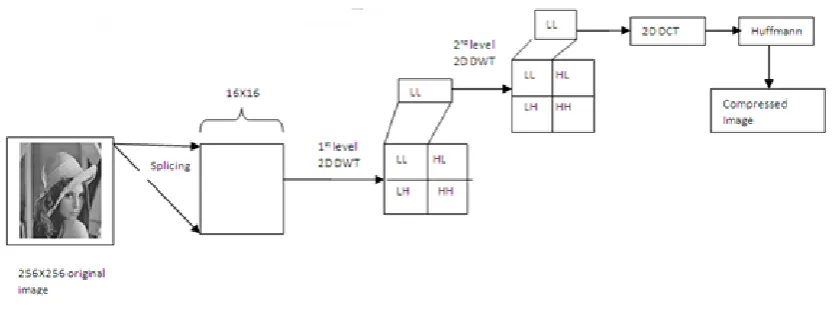
The presented hybrid DWT-DCT algorithm for image compression is to exploit the properties of both the DWT and the DCT (as illustratedin Fig. 1):-
Take the Lena/Barbra image. The original
image/frame of size 256x256. Firstly original
image/frame divided into blocks of 16x16. By using the 2-D DWT decomposed the each 16x16 blocks. The low-frequency coefficients are LL and high-low-frequency coefficients are HL, LH and HH.
When LL passed to the next stage where the high-frequency coefficients (HL, LH and HH) are discarded. The passed LL components are further decomposed using another 2-D DWT and the detail coefficients (HL, LH and HH) are discarded. . 4x4 DCT has been applied to the reaming approximate DWT coefficients (LL) and can be achieved high CR. Then Huffman codes are performed on 4x4 and assign the codes to low-frequency coefficients and high-frequency coefficients. . In this lossless compression shorter codes are assigned to the most frequently used symbols, and longer codes to the symbols which appear less frequently in the string.
[image:2.595.68.488.341.500.2]Then the images are compressed and finally, the image is reconstructed followed by inverse procedure. During the inverse DWT, zero values are padded in place of the detail coefficients.
Figure 1. Block diagram of the proposed hybrid DWT-DCT,huffman algorithm
III. PERFORMANCE
Error Metrics: - Two error metrics are used to compare the various image compression techniques are:- 1.The Mean Square Error (MSE) and 2.The probalistic Signal to Noise Ratio (PSNR). The MSE is the cumulative squared error between the compressed and the original image, whereas PSNR is a measure of the peak error. The mathematical formulae for the two are
M N
MSE=1/NM=
∑ ∑[I(x,y)-I’(x,y)²]
V=1 X=1
PSNR = 20 * log10 (255 / sqrt (MSE))
Where I (x,y) is the original image, I'(x,y) is the
approximated version (which is actually the
decompressed image) and M, N are the dimensions of the images.
A lower value for MSE means lesser error, and as seen from the inverse relation between the MSE and PSNR, this translates to a high value of PSNR. Logically, a higher value of PSNR is good because it means that the ratio of Signal to Noise is higher. Here, the 'signal' is the original image, and the 'noise' is the error in reconstruction. So, if you find a compression scheme having a lower MSE (and a high PSNR), you can recognise that it is a better one.
IV. RESULT ANALYSIS
We have applied the hybrid image compression algorithm on several images and the results are shown in this section. Several images are used e.g endoscopic image, X-ray, Lena, Barbra, CT scan. The results are also compared with the standalone DCT and DWT
International Journal of Emerging Technology and Advanced Engineering
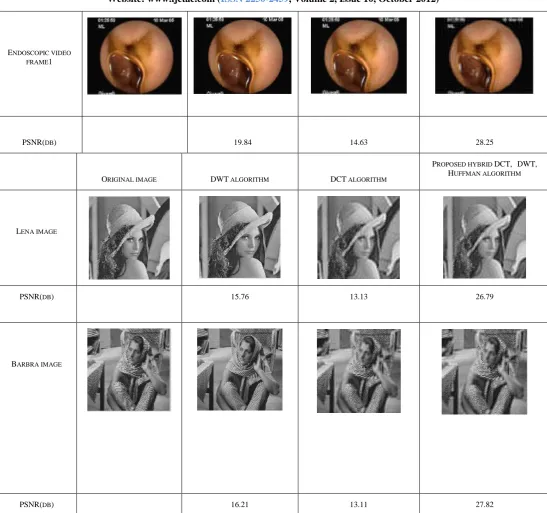
Website: www.ijetae.com (ISSN 2250-2459, Volume 2, Issue 10, October 2012)302 Take an image of size 256x256 pixels. The original image is resized to 16x16 pixels. Then hybrid image compression algorithm is applied. The following graphs depict the results in terms of PSNR for a constant CR of 97%. If we change our CR to 93%, still our hybrid image compressed performance much better than DWT, DCT standalone techniques.
Figure2:- graph shows the DCT,DWT and Huffman results at CR=97%
Figure3:- graph shows the DCT,DWT and Huffman results at CR=93%
V. CONCLUSION
In this paper we present a hybrid DWT, DCT and Huffman algorithm for image compression. The proposed scheme helps in many areas like telemedicine, wireless capsule endoscopies where the degree of compression is important.
The performance analysis on several images shows that the hybrid algorithm achieves the higher compression ratio and better PSNR
REFRENCES
[1 ] K. Rao, P. Yip, "Discrete Cosine Transform: Algorithms, Advantages, and Applications", NY Academic, 1990
[2 ] c.P. Lui, and A. D. Poularikas, "A new sub band coding compression," in Proc., IEEE Southeastern symposium on system theory, Baton Rouge, LA, pp. 317-321, Mar. 1996.
[3 ] M.Rabbani and P. Jones, “Digital image compression techniques,”SPIE Opt. Eng. Press,, Bellingham, Washington, Tech. Rep., 1991
[4 ] G. Kuduvalli and R. Rangayyan, “Performance analysis of reversible Image compression techniques for high resolution digitalTeleradiology,” in IEEE Trans. Med. Imaging, vol. 11, Sept. 1992
[5 ] J.M.Shapiro, “Embedded image coding using zerotrees of wavelet Coefficients,” in Special Issue on Wavelet And Signal Processing,vol. 41, no. 12. IEEE Trans. Signal Processing, Dec 1993.
[6 ] Said and W. A. Pearlman, “An image multiresolution representation for lossless and lossy compression,” in IEEE TransactionsOn Image Processing, vol. 5, no. 9, September 1996 [7 ] X. Li, Y. Shen, and J. Ma, “An efficient medical image
compression,,”in Engineering In Medicine And Biology 27th Annual Conference, Shangai, China, September 1-4 2005 IEEE [8 ] Ali Fayadh, Abir Jaafar Hussain, Paulo Lisboa, and Dhiya
Al-Jumeily “An Adaptive Hybrid Classified Vector Quantisation and Its Application to Image Compression” 2008 IEEE
[9 ] Zhang Shi-qiang,Zhang Shu-fang, Wang Xin-nian, Wang Yan “ The Image Compression Method Based on Adaptive Segment and Adaptive Quantified” 2008 IEEE
[10 ]Suchitra Shrestha and Khan Wahid,”Hybrid DWT-DCT algorithem for biomedical image and video compression application.” 2010 10th International conference.
[11 ]Ayan Banerjee, Amiya Halder,”An Efficient Image Compression Algorithm for almost Dual-Color Image Based on K-Means Clustering, Bit-Map Generation and RLE”.
[12 ]Sunil Bhooshan , Shipra Sharma “ An Efficient and Selective Image Compression Scheme using Huffman and Adaptive Interpolation” 2009 IEEE
[13 ]Ying Xie , Xiaojun Jing ,Songlin Sun ,Linbi Hong “ A Fast And Low Complicated Image Compression Algorithm For Predictor For JPEG-LS” 2009 IEEE
[14 ]Fawad Ahmed and M Y Siyal, Vali Uddin Abbas,” A Perceptually Scalable and JPEG Compression Tolerant Image Encryption Scheme”.
[15 ]Chong Fu ,Zhi-Liang Zhu “ A DCT-Based Fractal Image Compression Method” 2009 IEEE
[16 ]Chunlei Jiang, Shuxin Yin “A Hybrid Image Compression Based on Human Visual System” 2010 IEEE
[17 ]F.M. Bayer and R J Cintra “ Image Compression Via a Fast DCT Approximation” 2010 IEEE
[18 ]LIU Wei “ Research on Image Compression Algorithm Based on SPHIT” 2010 IEEE
[19 ]Mamta Sharma, S.L. Bawa D.A.V. college, “Compression Using Huffman Coding” may 2010 IJCSNS
International Journal of Emerging Technology and Advanced Engineering
Website: www.ijetae.com (ISSN 2250-2459, Volume 2, Issue 10, October 2012)303 [21 ]T. Goto and Y. Kato “ Compression Artifect Reduction based on
Total Variation Regularization Method for MPEG-2” 2011 IEEE [22 ]Amar Agoun “ Compression of 3D Intergral Images using 3D
wavelet Transform” 2011 IEEE.
[23 ]XiHong ZHOU “ Research on DCT Based Image Compression Quality”2011 IEEE.
SAMPLERECONSTRUCTEDIMAGEATCOMPREESION RATIOOF 97%
ORIGINAL IMAGE RECONSTRUCTED IMAGES
DWT ALGORITHM DCT ALGORITHM PROPOSED HYBRID DWT, DCT,HUFFMAN ALGORITHM
ENDOSCOPIC IMAGE(LARYNX)
PSNR(DB) 27.50 9.13 31.37
X-RAY
(CHEST)
PSNR(DB) 28.85 7.76 34.69
CT SCAN IMAGE
International Journal of Emerging Technology and Advanced Engineering
Website: www.ijetae.com (ISSN 2250-2459, Volume 2, Issue 10, October 2012) [image:5.595.24.572.126.639.2]304
Table 1:- shows the sample reconstructed image compression at ratio97% ENDOSCOPIC VIDEO
FRAME1
PSNR(DB) 19.84 14.63 28.25
ORIGINAL IMAGE DWT ALGORITHM DCT ALGORITHM
PROPOSED HYBRID DCT, DWT, HUFFMAN ALGORITHM
LENA IMAGE
PSNR(DB) 15.76 13.13 26.79
BARBRA IMAGE
International Journal of Emerging Technology and Advanced Engineering
Website: www.ijetae.com (ISSN 2250-2459, Volume 2, Issue 10, October 2012)305
SAMPLERECONSTRUCTEDIMAGEATCOMPREESION RATIOOF93%
ORIGINAL IMAGE RECONSTRUCTED IMAGES
DWT ALGORITHM DCT ALGORITHM PROPOSED HYBRID DWT,DCT, HUFFMAN ALGORITHM
ENDOSCOPIC IMAGE(LARYNX)
PSNR(DB) 22.00 12.57 30.77
X-RAY
(CHEST)
PSNR(DB) 20.50 11.78 34.00
CT SCAN IMAGE
International Journal of Emerging Technology and Advanced Engineering
Website: www.ijetae.com (ISSN 2250-2459, Volume 2, Issue 10, October 2012)306 ENDOSCOPIC VIDEO
FRAME1
PSNR(DB) 29.88 10.55 30.55
LENA IMAGE
PSNR(DB) 15.15 13.17 26.32
BARBRA IMAGE