61
Fired Heater Design
Mahesh N. Jethva
1, C. G. Bhagchandani
2 1M.E., 2Associate Professor, Chemical Engineering Department, L.D. College of Engineering, Ahmedabad-380 015
Abstract- In fired heaters, heat is released by combustion of fuels into an open space and transferred to process fluids inside tubes. The tubes are ranged along the walls and roof of the combustion chamber. The heat is transferred by direct radiation and convection and also by reflection from refractory walls lining the chamber. The design and rating of a fired heater is a moderately complex operation. Here forced draft fired heater, which is fired by fuel gas, has been treated. For that all required equations and generalizations are listed from different fired heater design methods as per requirement. A fired heater design calculations are performed using Microsoft Excel Programming software.
Keywords- Convective heat transfer, Heat balance, Radiant heat transfer, Shield section.
I. INTRODUCTION
A fired heater is a direct-fired heat exchanger that uses the hot gases of combustion to raise the temperature of a feed flowing through coils of tubes aligned throughout the heater. Depending on the use, these are also called furnaces or process heaters. Some heaters simply deliver the feed at a predetermined temperature to the next stage of the reaction process; others perform reactions on the feed while it travels through the tubes.
Fired heaters are used throughout hydrocarbon and chemical processing industries such as refineries, gas plants, petrochemicals, chemicals and synthetics, olefins, ammonia and fertilizer plants. Most of the unit operations require one or more fired heaters as start-up heater, fired reboiler, cracking furnace, process heater, process heater vaporizer, crude oil heater or reformer furnace.
Heater fuels include light ends (e.g. refinery gas) from the crude units and reformers as well as waste gases blended with natural gas. Residual fuels such as tar, pitch, and Bunker C (heavy oil) are also used. Combustion air flow is regulated by positioning the stack damper. Fuel to the burners is regulated from exit feed temperature and firing rate is determined by the level of production desired.
A typical fired heater will have following four sections: (1) Radiant section, (2) Shield section, (3) Convection section, and (4) Breeching and stack. A fired heater may be a box (rectangular c/s) or vertical (cylindrical c/s) in shape. Same way, a fired heater may be classified depending on location of the burners and type of the draft.
II. RADIANT SECTION DESIGN
A. Radiant Heat Transfer in Radiant Section:
Applying basic radiation concepts to process-type heater design, Lobo & Evans developed a generally applicable rating method that is followed with various modifications, by many heater designers. Direct radiation in the radiant section of a direct fired heater can be described by the equation shown below.
Where,
= Radiant heat transfer, Btu/hr = Stefan-Boltzmann constant,
0.173E-8 Btu/ft2-hr-R4
= Relative effectiveness factor of the tube bank
= Cold plane area of the tube bank, ft2
= Exchange factor
= Effective gas temperature in firebox, °R = Average tube wall temperature, °R
B. Heat Balance In The Radiant Section:
There are four primary sources of heat input as well as four sources of heat output to the radiant section. We can now set up the heat balance equation as follows:
Where,
= heat liberated by fuel, Btu/hr (LHV) = sensible heat of combustion air, Btu/hr
= sensible heat of steam used for oil
atomization, Btu/hr
= sensible heat of recirculated flue gases,
Btu/hr
= heat absorbed by radiant tubes, Btu/hr = Radiant heat to shield tubes, Btu/hr
= heat loss in firebox through furnace walls,
bridgewall, casing, etc., Btu/hr
= heat of flue gases leaving the radiant
section, Btu/hr
C. Total Heat Transfer in Radiant Section (if Shield Section is present):
The total heat transfer in firebox when shield section is present will be as follows:
( ) ( )
62
Where,
= Convective heat transfer to radiant tubes,
Btu/hr
= Convective heat transfer to shield tubes,
Btu/hr
III. CONVECTION SECTION DESIGN
A.Overall Heat Transfer Coefficient, :
Where,
= Overall heat transfer coefficient, Btu/hr-ft2-F
= Total outside thermal resistance, hr-ft2-F/Btu
And,
Where,
= Outside thermal resistance, hr-ft2-F/Btu
= Tube wall thermal resistance, hr-ft2-F/Btu = Inside thermal resistance, hr-ft2-F/Btu
And the resistances are computed as,
( )
Where,
= Effective outside heat transfer coefficient, Btu/hr-ft2-F
= Inside film heat transfer coefficient, Btu/hr-ft2 -F
= Tube-wall thickness, ft
= Tube wall thermal conductivity, Btu/hr-ft-F = Outside tube surface area, ft2/ft
= Mean area of tube wall, ft2/ft = Inside tube surface area, ft2/ft
= Inside fouling resistance, hr-ft2-F/Btu
B.Inside film heat transfer coefficient, :
The inside film coefficient needed for the thermal calculations may be estimated by several different methods. The API RP530, Appendix C provides the following methods,
For liquid flow with ≥10,000,
And for vapor flow with ≥15,000,
Where the Reynolds number is,
And the Prandtl number is,
Where,
= Heat transfer coefficient, liquid phase, Btu/hr-ft2-°F
= Thermal conductivity, Btu/hr-ft-°F = Inside diameter of tube, ft
= Absolute viscosity at bulk temperature, lb/ft-hr = Absolute viscosity at wall temperature, lb/ft-hr = Heat transfer coefficient, vapor phase,
Btu/hr-ft2-°F
= Bulk temperature of vapor, °R = Wall Temperature of vapor, °R
= Mass flow of fluid, lb/hr-ft2
= Heat capacity of fluid at bulk temperature, Btu/lb-°F
For two-phase flow,
Where,
= Heat transfer coefficient, two-phase, Btu/hr-ft2
-°F
= Weight fraction of liquid = Weight fraction of vapor
C. Effective outside heat transfer coefficient ( for Fin tubes:
Where,
= Average outside heat transfer coefficient, Btu/hr-ft2-F
= Fin efficiency
= Total outside surface area, ft2/ft
= Fin outside surface area, ft2/ft = Outside tube surface area, ft2/ft
i. Average outside heat transfer coefficient, :
Where,
= Outside heat transfer coefficient, Btu/hr-ft2-F = Outside radiation heat transfer coefficient,
Btu/hr-ft2-F
63
ii. Outside film heat transfer coefficient, :
Where,
= Colburn heat transfer factor
= Mass velocity based on net free area, lb/hr-ft2 = Heat capacity, Btu/lb-F
= Gas thermal conductivity, Btu/hr-ft-F = Gas dynamic viscosity, lb/hr-ft
iii. Colburn heat transfer factor, :
( )
Where,
= Reynolds number correction = Geometry correction
= Non-equilateral & row correction = Outside diameter of fin, in = Outside diameter of tube, in = Average gas temperature, F
= Average fin temperature, F
Reynolds number correction, :
Where,
= Reynolds number =
Geometry correction, :
For segmented fin tubes arranged in, a staggered pattern,
an inline pattern,
For solid fin tubes arranged in, a staggered pattern,
an inline pattern,
Where,
= Fin height, in = Fin spacing, in
Non-equilateral & row correction, : For fin tubes arranged in, Staggered pattern,
( )
Inline pattern,
( )
Where,
= Number of tube rows = Longitudinal tube pitch, in = Transverse tube pitch, in
iv. Mass Velocity, :
Where,
= Mass flow rate of gas, lb/hr = Net free area, ft2
And,
Net Free Area, :
Where,
= Cross sectional area of box, ft2 = Fin tube cross sectional area/ft, ft2/ft
= Effective tube length, ft = Number tubes wide
= Fin height, ft
= Outside diameter of tube, ft = Transverse tube pitch, ft = fin thickness, ft
= number of fins, fins/ft
v. Surface Area Calculations:
For the prime tube,
And for solid fins,
( ) ( )
And for segmented fins,
( )
(( )( ) ( ))
Where,
= Outside diameter of tube, ft = number of fins, fins/ft
= fin thickness, ft = Fin height, ft
64
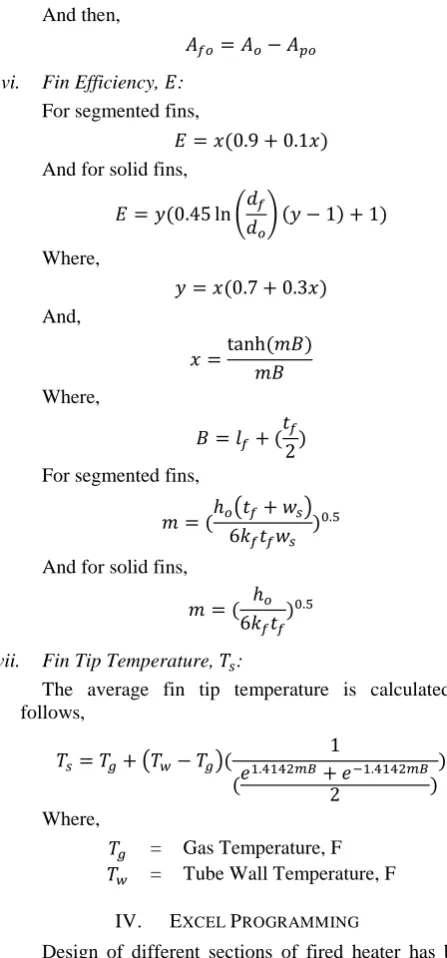
And then,
vi. Fin Efficiency, :
For segmented fins,
And for solid fins,
( )
Where,
And,
Where,
For segmented fins,
( )
And for solid fins,
vii. Fin Tip Temperature, :
The average fin tip temperature is calculated as follows,
( )
Where,
= Gas Temperature, F = Tube Wall Temperature, F
IV. EXCEL PROGRAMMING
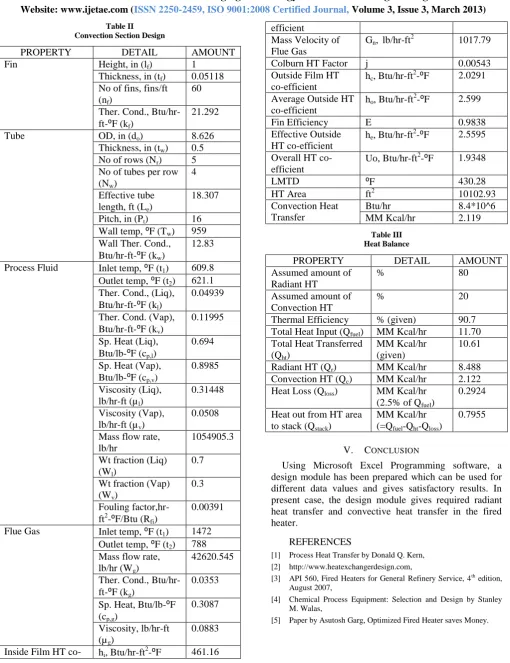
[image:4.595.38.262.136.616.2]Design of different sections of fired heater has been performed using Microsoft Excel Programming. For the calculation purpose, different calculation methods and equations are used in the programming.
Table I Radiant Section Design
PROPERTY DETAIL AMOUNT
Tube OD, in (do) 8.626
thickness, in (tw) 0.05118 No of tubes (Nt)
(Radiant)
40
No of tubes (Nt) (Shield)
12
Effective length, ft (Le) (Radiant)
35.07
Effective length, ft (Le) (Shield)
18.31
Tube spacing, in (CC) (Radiant)
16
No of tubes per row (Nt/r) (Shield)
4
Transverse pitch, in (Pt) (Shield)
16
Combustion Fraction excess air 0.15
Firebox Diameter, ft (D) 19.98
Process fluid Mean wall
temperature, (Tt), ⁰R
1097.95
Flue gas Flue gas
temperature (Tg), ⁰R
2077.1
α (Radiant) (-) 0.9086
α (Shield) Assumed (-) 1
Acp (Radiant) ft2 1870.52
Acp (Shield) ft2 97.64
αAcp (Radiant) ft2 1699.51
αAcp (Shield) ft2 97.64
(αAcp)r+(αAcp)s ft2 1797.15 AR/
((αAcp)r+(αAcp)s)
AT, ft2 2103.81
Area of Shield Section, ft2 (As)
97.64
AR, ft 2
306.66 AR/
((αAcp)r+(αAcp)s)
0.17
Partial pressure atm (P) 0.256
Mean beam length ft 13.32
P*l atm-ft 3.406
Emissivity E 0.5087
Exchange factor F 0.5129
Radiantion Heat Transfer
Btu/hr 3.37*10^7
65
Table II Convection Section Design
PROPERTY DETAIL AMOUNT
Fin Height, in (lf) 1
Thickness, in (tf) 0.05118 No of fins, fins/ft
(nf)
60
Ther. Cond., Btu/hr-ft-⁰F (kf)
21.292
Tube OD, in (do) 8.626
Thickness, in (tw) 0.5 No of rows (Nr) 5 No of tubes per row (Nw)
4
Effective tube length, ft (Le)
18.307
Pitch, in (Pt) 16 Wall temp, ⁰F (Tw) 959 Wall Ther. Cond.,
Btu/hr-ft-⁰F (kw)
12.83
Process Fluid Inlet temp, ⁰F (t1) 609.8 Outlet temp, ⁰F (t2) 621.1 Ther. Cond., (Liq),
Btu/hr-ft-⁰F (kl)
0.04939
Ther. Cond. (Vap), Btu/hr-ft-⁰F (kv)
0.11995
Sp. Heat (Liq), Btu/lb-⁰F (cp,l)
0.694
Sp. Heat (Vap), Btu/lb-⁰F (cp,v)
0.8985
Viscosity (Liq), lb/hr-ft (µl)
0.31448
Viscosity (Vap), lb/hr-ft (µv)
0.0508
Mass flow rate, lb/hr
1054905.3
Wt fraction (Liq) (Wl)
0.7
Wt fraction (Vap) (Wv)
0.3
Fouling factor,hr-ft2-⁰F/Btu (Rfi)
0.00391
Flue Gas Inlet temp, ⁰F (t1) 1472 Outlet temp, ⁰F (t2) 788 Mass flow rate,
lb/hr (Wg)
42620.545
Ther. Cond., Btu/hr-ft-⁰F (kg)
0.0353
Sp. Heat, Btu/lb-⁰F (cp,g)
0.3087
Viscosity, lb/hr-ft (µg)
0.0883
Inside Film HT co- hi, Btu/hr-ft2-⁰F 461.16
efficient
Mass Velocity of Flue Gas
Gn, lb/hr-ft2 1017.79
Colburn HT Factor j 0.00543
Outside Film HT co-efficient
hc, Btu/hr-ft2-⁰F 2.0291
Average Outside HT co-efficient
ho, Btu/hr-ft 2
-⁰F 2.599
Fin Efficiency E 0.9838
Effective Outside HT co-efficient
he, Btu/hr-ft2-⁰F 2.5595
Overall HT co-efficient
Uo, Btu/hr-ft2-⁰F 1.9348
LMTD ⁰F 430.28
HT Area ft2 10102.93
Convection Heat Transfer
Btu/hr 8.4*10^6
[image:5.595.45.290.144.784.2]MM Kcal/hr 2.119
Table III Heat Balance
PROPERTY DETAIL AMOUNT
Assumed amount of Radiant HT
% 80
Assumed amount of Convection HT
% 20
Thermal Efficiency % (given) 90.7 Total Heat Input (Qfuel) MM Kcal/hr 11.70 Total Heat Transferred
(Qht)
MM Kcal/hr (given)
10.61
Radiant HT (Qr) MM Kcal/hr 8.488 Convection HT (Qc) MM Kcal/hr 2.122 Heat Loss (Qloss) MM Kcal/hr
(2.5% of Qfuel)
0.2924
Heat out from HT area to stack (Qstack)
MM Kcal/hr (=Qfuel-Qht-Qloss)
0.7955
V. CONCLUSION
Using Microsoft Excel Programming software, a design module has been prepared which can be used for different data values and gives satisfactory results. In present case, the design module gives required radiant heat transfer and convective heat transfer in the fired heater.
REFERENCES
[1] Process Heat Transfer by Donald Q. Kern, [2] http://www.heatexchangerdesign.com,
[3] API 560, Fired Heaters for General Refinery Service, 4th edition,
August 2007,
[4] Chemical Process Equipment: Selection and Design by Stanley M. Walas,