
© 2015, IRJET ISO 9001:2008 Certified Journal
Page 1035
The Importance of Patent Protection in Combating Climate Change:
Development and Diffusion of Environmentally Sound Technologies.
Madiha Khan
Lecturer,Dept. of Economics, Southeast University,Dhaka, Bangladesh
---
---Introduction:
The issue of climate change has become one of the burning-questions among world leaders of both developed and developing countries. The growing global demand for energy and the agreement on reducing greenhouse gas (GHG) emissions are the two foremost parallel leanings in designing energy and environmental policies. In addition, the acceleration of economic growth in developing countries without efficient energy and environment friendly innovation result in adverse consequences due to global climate change. There is now a worldwide concurrence that the development and diffusion of a wide range of new technologies is the most important mechanism to confront global climate change and a growing energy demand. In this line, developed and developing countries should work jointly in order to foster the development, transfer and adaptation of technologies for climate change mitigation. However, the universal public good feature of environment is the source of debate regarding the role of intellectual property rights (IPRs) in the transfer of climate-friendly technologies. The relationship between innovations and IPRs, particularlypatenting, is a controversial issue and there are strong arguments on both sides of thedebate. Hence, the general purpose of this discussion paper is to provide a broad overview about the importance of patent protection in developing and dissemination of environmentally sound technologies (ESTs) in the context of current policy environment to avoid significant climate risks.
© 2015, IRJET ISO 9001:2008 Certified Journal
Page 1036
1. Background:
Climate change is now regarded as one of the most serious threats to the worldwide environment and to sustainable development. It is now one of the most important influential factors to shape the way of living on Earth. The Intergovernmental Panel on Climate Change (IPCC) has defined climate change as: “a change of climate which is attributed directly or indirectly to human activity that alters the composition of the global atmosphere and which is in addition to natural climate variability observed over comparable time periods.”1Most of the scientists argued that
increasing accumulation (concentration) of greenhouse gases (GHGs) in the globe’s atmosphere emitted as a consequence of diverse human activities is the principal reason of global warming and worldwide climate change. According to the IPCC report (2007) it is likely that GHGs emissions as result of economic development lead to an increase in the average global temperature, increased frequency and intensity of extreme weather-related events, greater variation in temperatures across time and average sea-level rise. These effects represent an undesirable impact on all inhabitants of the globe as it is rapidly affecting basic and necessary things such as water supply, food production, economic activity, population health, biological diversity, natural resources and so on.
The response to climate change problems is closely related to the crucial apprehensions of sustainable development and poverty eradication. Since climate change is inevitable to a great extent, it is imperative to undertake necessary measures to adapt and mitigate it. In this connection, government representatives, environmentalists, lawyers, industry groups, development lobbyists, human rights activists and carbon traders all agree on one thing: Innovation, development and transfer of technologies will play a vital role in the global initiatives to effectively deal with the undesirable impacts of climate change. Therefore, it is essential to boost the effort for technology development and transfer, particularly to developing countries, in support of climate change mitigation.
Environmentally sound technologies (ESTs) and technology transfer are key the concepts to understand better our analysis. In a broad sense, ESTs can be defined as technologieswhich reduce emissions of greenhouse gases and increase the energy efficiency. Examples of ESTs include carbon-free renewable energy sources such as hydro and wind power, photovoltaics and solar thermal power plants, re-combustion technology, combined heat and power , hydrogen cells , etc.
The term ‘technology transfer’ refers to an extensive set of systems covering the streams of know-how, experience and equipment for mitigating and adapting to climate change amongst different stakeholders.2The role of transfer of
environmentally sound technology is particularly important because of the great interest of developing countries in
1
United Nations Framework Convention on Climate Change
© 2015, IRJET ISO 9001:2008 Certified Journal
Page 1037
adaption and mitigation of climate change. This interest comes from the fact that many developing countries are on the stage of substantial infrastructure build up.
Innovation is then substantially needed to progress the future performance of current and proposed environmentally sound technologies. Clean technology innovation must increase by a factor of between two and ten to meet global climate change goals. The needed investments are estimated to be USD 1.1 trillion per year (in real terms) through 2050, or around 1.1 percent of global GDP.3
In general, patents play an important role in promoting innovation in environmentally sound technology by providing incentives to technology developers, particularly in sectors where major investments in R&D are required, such as wind, solar, carbon capture and storage, and biofuels. Thus, it is essential to highlight the role of the patent system in a practical and balanced approach; otherwise the potential to achieve positive and sustainable outcomes for global climate change problem could be compromised. The increase in patent applications and the concentration of patent ownership in this sector should not be surprising at all, since they mirror overall worldwide trends in a variety of technology sectors. Then, combating climate change effects is one of the most relevant challenges of this century. The development of alternative sources of energies seems to be one of the main targets to achieve this objective. In this context, strong incentives for faster and larger improvements through innovation processes should be provided to the firms. Patents are, in our opinion, an adequate way to generate these incentives.
2. Importance of patents for innovation and transfer of ESTs:
Developing new technologies has always been, in a way or another, tied to risk. There is uncertainty about the final product of a research process and uncertainty on how the market will receive it. The high costs that innovators face are an additional constraint in the innovation process. In addition, the ability to appropriate the returns to research while competitors are trying to produce similar results lacks of full certainty. Also, this condition is shared by the pricing of competing goods.
Under these circumstances, why would anybody invest time, knowledge, money and technology if guaranteed benefits are inexistent? In order to promote innovation and ensure a remuneration of the effort exerted by inventors, patent system represents a powerful tool to be used.
In short, a patent is a form of intellectual property. It consists of a set of exclusive rights granted by a competent authority to an inventor or their assignee for a limited period of time in exchange for the public disclosure of
3
© 2015, IRJET ISO 9001:2008 Certified Journal
Page 1038
an invention. Therefore, patent system works as an incentive forinnovation, since it provides the possibility of generating benefits after a successful research (invention) process.
According with Gallini and Scotchmer (2001), to justify intellectual property in economic terms, there must be some type of asymmetric information about the costs and benefits of research programs. This condition arises; actually this asymmetric information about research programs is the entire reason to bestow Intellectual Property Rights (IPRs) on firms in exchange for public revelation of their research insights. It is this trade, of profits in return for information, which constitutes the heart of any IPR system.
Numerous studies have documented the need of encouraging a strong patent law; since it represents an essential prerequisite to the development of new technologies. Going further, many firms indicate that Intellectual Property Rights are essential to the profitability of commercial research. In their absence, they will not commit research and development (R&D) funding.
Branstetteret. Al [2005], have examined how the scope of technology transfer within US multinationals changes when a series of IPR reforms in a country are implemented. It was also found that royalty payments for the use or sale of intangible assets made by affiliates to parent firms increase when IPR legislation is strengthened. This evidence suggeststhat asound and enforcedIPR system may be a prerequisite for technology transfer.Accordingly, it could prove beneficial for some developing countries to improve their IPR system. As we have said, risk is inherent to the development of any new technology; therefore, the environmental field is not an exception.
One of the agreements of the Rio Declaration on Environment and Development4 states that nations should cooperate
in creating new technologies. This document also mentions that environmental technologies should be made available to developing countries on terms which would encourage their wide dissemination without constituting an economic burden on them.
The aspect regarding the economic burden for developing countries has been the source of many discussions about the patent system and its role in climate change combat. Voices from these nations usually complain about the patent system and the way it hinders their efforts in climate change abatement.
A study made in 2009 by Copenhagen Economics shows that intellectual property rights do not constitute a significant barrier as claimed, since a variety of technologies exist for reducing emissions. In many cases, IPR-protected technologies are not necessarily more costly than those not covered. Also, given that patents are virtually non-existent
© 2015, IRJET ISO 9001:2008 Certified Journal
Page 1039
for these technologies in most developing countries, it is difficult to argue that IPR protection is a significant barrier to technology transfer.
In the case of renewable energy generation, Barton [2007] examined four technologies; finding that the holders of patents could not overprice their products because of international competition and the existence of substitutes.
It is important to mention the fact that in eco-innovation, the most fundamental technologies have been long ago absorbed by popular technical knowledge, having been-off patent for many years already. Thus, current patents mainly protect improvements to basic inventions. This encourages competition among alternatives with the same general objective.
Park and Lippoldt [2008] empirically analyzed how the IPR strengthening impacts local innovation and technology transfer in developing countries. The result, strong IPRs are significantly and positively associated with: developing country patent applications and expenditure on R&D as a share of GDP, inward Foreign Direct Investment (FDI), merchandise imports, service imports and the inflow of high-tech products.
As an evidence of these spill-over benefits, we find that for the period 2004-2007, compared
the growth rate of patent registration in emerging market economies increased by a 545%. (vs&120% in developed countries). In 2008, emerging markets registered patents already accounted for 20% of worldwide patenting in these climate change technologies, compared to less than 5% in the late 1990s.
With this arguments and data we can asseverate that climate change market technologies are not monopolistic. This makes it unlikely that patent holders can price their inventions above normal competitive levels. Therefore patent pricing cannot be considered as a major barrier for technological transfer in this field.
Another aspect in which IPR system has been “attacked” is licensing. India and China proposed that the flexibilities in trade-related aspects of intellectual property rights (TRIPS) for the compulsory licensing of medicines should be extended to carbon abatement technology. Their argument: Climate is a public good (as health), and the international community should allow compulsory licensing to secure welfare in less developed countries.
© 2015, IRJET ISO 9001:2008 Certified Journal
Page 1040
There is evidence that compulsory licensing reduces the incentives to innovate in pharmaceutical, therefore reduces the level of innovation in the field. (Danzon and Towse, 2003; Bate and Boateng, [2007]. Those arguments apply in part to eco-innovation as well. Copenhagen [2009] finds no argument in favor of extending the TRIPS flexibilities due to the number of substitute technologies available, many of which are not protected by IPRs.
Many diseases are (initially) only treatable with one specific drug, in the case of climate change combat, there are many technologies available to combat climate change. Going further, this study considers compulsory licensing as a disincentive to investment in environmental technologies.
Through this section, we have emphasized the main arguments in favor of patents in the ESTs field. Costs, risks and competition generate uncertainty about the revenues of investment in research and innovation (R&D) and then constitute a constraint in developing new technologies. Patents are incentive mechanisms to overcome these barriers. Arguments against patents have been refuted supporting the defense on the literature: Currently, a variety of green energy alternatives is available in the market and the competition between these alternatives results in non monopolistic prices. Evidence suggests that, even when patents are motivating innovation processes, green energies prices are not high enough to constitute a general constraint in the acquisition of these technologies.
3. Evidences in support of patent to fight climate change:
The main objective of this section is to provide empirical evidence of the growing relevance of patents. Growth is not only the consequence of innovation stimulated by patents, and economic issues are difficult to isolate and to replicate to obtain accurate comparison, but these data give an intuition about what is happening in the real world; this statistics review is coherent with our hypothesis about the incentives for innovation that patents generate and its positive effects in general and in the particular case of ESTs.
Intellectual property (IP) filings worldwide rebounded in 2010 after experiencing a considerable drop in 2009. Patent and trademark filings worldwide grew by 7.2% and 11.8%, respectively.In the case of China, IP growth rates were more than double its GDP.
We name green patents to those that protect environmental energies (ESTs). This subsection is dedicated to this specific field. We have mentioned that development of energy-related technologies, such as those related to renewable energy, plays an important role in tackling climate change. This is reflected in the growth rate of filings 2005-2009 in environmental energies is 3.7% (11st position in the total in the 35 fields’ classification)5.
5
© 2015, IRJET ISO 9001:2008 Certified Journal
Page 1041
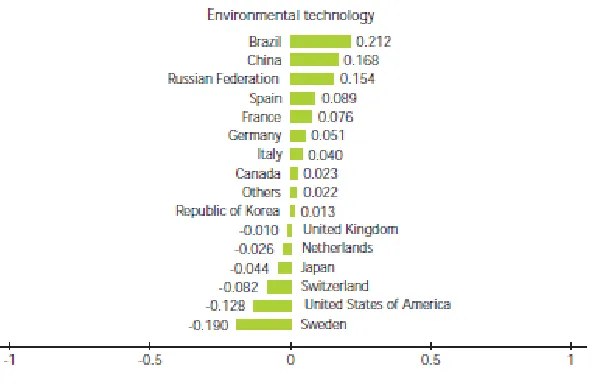
[image:7.612.152.448.295.489.2]Another way to measure innovative strength is to calculate a country’s Relative Specialization Index (RSI). It seeks to capture whether a given country tends to have a lower or higher propensity to file in certain technology fields. A positive RSI value for a technology indicates that a particular country has a relatively high share of patent filings related to that field of technology. As it can be seen in figure 1, the nations with the highest RSI for environmental technology are nor precisely in the group of developed countries.
Figure 1: RSI in top countries
Source: 2011 Worldwide Intellectual Property Indicators WIPO, Economics and Statistics series
The total number of patent applications in the four energy- related fields reached 28,560 in 2009, almost nine times as much as in 1990 (Figure 2). Solar energy-related patent applications account for 50.3% of the total in 2009. There was a substantial increase in solar and wind energy patent applications, while those in the field of fuel cell technology show a small drop in the last two years.
© 2015, IRJET ISO 9001:2008 Certified Journal
Page 1042
Source: 2011 Worldwide Intellectual Property Indicators WIPO, Economics and Statistics series
Japan (34.1%), the Republic of Korea (18.7%) and the US (14%) accounted for more than two-thirds of total solar energy patent applications. However, only the Republic of Korea (1.6%) and China (1.1%) have more than one percent of their total PCT patent applications published in this field. For fuel cell technology, Japan accounted for more than half of all patent applications in this field. For Japan (1.3%) and Canada (1.0%), more than one percent of their total patent applications are in this field.
Through the data study we can say that patents in general, and green patents as the specific case, have experienced a relevant growth in the last years. As we mentioned in section 2, the growth of green patents and the variety of options avoid the reasons to consider IP system as a barrier, since this framework allows more competitive prices.
Real cases where patents have played a crucial role:
In this section we describe two real-world cases where patents seem to have a relevant role in innovation.
Case 1: Patent 039 (from General Electric, (GE)
:
“The 039 patent. Without this patent, a seminal one on variable speed wind technology, probably a lot of big players would not have entered the wind industry in the 1990s”. The ’039 Patent, which issued back in 1992, is directed to a variable speed wind turbine that provides responsive control of generator torque, and it is the origin of other innovating devices (Green Patents Blog).© 2015, IRJET ISO 9001:2008 Certified Journal
Page 1043
team. In 2010, GE invested 5% of its industrial revenue on R&D. They filed 20.000 patents the last decade, and they have nearly 40.000 engineers and scientists around the world. They have developed more than 150 cores technologies that create leadership across the company (GE 2009 report, web, greenpatentindex). In 2011, GE and its venture capital partners will invest $63 million in 10 home energy technology companies as part of GE´s $200 million ecomagination challenge.
Case 2:eSolar
.
This firm is a Pasadena, California solar thermal startup. It makes solar power plants using flat mirrors that are a part of a structure called “power tower” architecture. It was founded in 2007 and it is getting important business deals to implement and deploy its technology. One of the most important is a master licensing agreement with Chinese electrical power equipment manufactures Penglai electric (Penglai). Penglai will develop at least 2 gigawatts of solar thermal power plants in China over the next 10 years.eSolar owns at least four published U.S. patent applications and at least half a dozen international applications. These patented innovations contribute to the efficiency of power tower plants, getting eSolar’s success in deploying its solar thermal technology in emerging markets such as India and China belies claims by those countries and other developing nations that IP rights are acting as a barrier to transfer of clean technologies.
However, eSolar’s success in finding willing partners in India and China may actually be driven, at least in part, by intellectual property protection: it’s hard to imagine Penglai or ACME investing in such large scale projects without the exclusivity in their home markets guaranteed by the master license agreements (Green Patents Blog, eSolar web).
4. Conclusion:
© 2015, IRJET ISO 9001:2008 Certified Journal
Page 1044
inflow of high-tech products. Therefore, patents are the adequate support to innovation and diffusion of technology to meet the global climate change.
References:
J. Barton,“Intellectual Property and Access to Clean Energy Technologies in Developing Countries: An Analysis of Solar
Photovoltaic, Biofuel and Wind Technologies”. Geneva: ICTSD, 2007.
R.Bate, and K. Boateng “Drug Pricing and Its Discontents: At Home and Abroad,” Health Policy Outlook #9, American Enterprise Institute for Public Policy Research.2007.
Branstetter, Lee et al. “Do Stronger Intellectual Property Rights Increase International Technology Transfer? Empirical
Evidence from US Firm-level Data”, NBER Working Paper 11516, NBER, Cambridge. 2005.
Clean Energy Patent Growth index: http://cepgi.typepad.com/. Last day consulted: 6th March 2012.
Copenhagen Economics, “Are IPR a Barrier to the Transfer of Climate Change Technology?”
Available online at: http://trade.ec.europa.eu/doclib/docs/2009/february/tradoc_142371.pdf, 2009.
P.M. Danzon, and A. Towse, “Differential Pricing for Pharmaceuticals: ReconcilingAccess, R&D and Patents,”
International Journal of Health Care Finance and Economics 3:183– 205, 2003.
eSolar: http://www.esolar.com/ Last day consulted: 7th March 2012.
N.T.Gallini, and S. Scotchmer, “Intellectual Property: When is it the Best Incentive System?”Institute of Business and Economic Research, Department of Economics, University of California, Berkeley, Paper E01’303. (2001)
General Electric: http://www.ge.com/ Last day consulted: 27th February 2012.
IEA.“Energy Technology Perspectives 2008 Executive Summary”. International Energy Agency. Available online at:
http://www.iea.org, 2008.
IPCC. “IPCC Special Report: Methodological and Technological Issues in Technology Transfer—Summary for
© 2015, IRJET ISO 9001:2008 Certified Journal
Page 1045
IPCC. “Climate Change: Synthesis Report”. Intergovernmental Panel on Climate Change. Available online at: http://www.ipcc.ch, 2007.
Maskus, Keith, Kamal Saggi and ThitimaPuttitanun, 2004.“Patent Rights and International Technology Transfer through Direct Investment and Licensing.” Paper prepared for the conference. InternationalPublic Goods and the Transfer of Technology after TRIPS, Duke University Law School, April 4–6, 2003. Revised June 2004
OECD: Environmental Outlook to 2030. OECD, Paris. Available online at:
http://www.oecd.org/document/20/0,3746,en_2649_37465_39676628_1_1_1_37465,00.html,2008.
G. Park, Walter, and C. Lippoldt, Douglas,“Technology Transfer and the Economic Implications of the Strengthening of
Intellectual Property Rights in Developing Countries”,OECD Trade Policy Working Paper No. 62, OECD, Paris, 2008.
The UNFCCC: “Application of environmentally sound technologies for adaption to climate”
Available online at: http://unfccc.int/resource/docs/2006/tp/tp02.pdf
![SW-PBIS Implementation Blueprint Part 1 [10-18-2015 Final].docx](data:image/gif;base64,R0lGODlhAQABAIAAAP///wAAACH5BAEAAAAALAAAAAABAAEAAAICRAEAOw==)