© 2016, IRJET | Impact Factor value: 4.45 | ISO 9001:2008 Certified Journal | Page 1369
MQTT – Messaging Queue Telemetry Transport
IOT based Messaging Protocol
Suvam Mohanty
1, Sagar Sharma
2, Vaibhav Vishal
3123
B.Tech CSE, School of Computer Science & Engineering, VIT University Vellore
Prof. Naresh K, Assistant Professor, Dept. of Computer Science & Engineering, VIT University, Tamil Nadu, India
---***---
Abstract -
Wireless sensor network pose a novel challenge in comparison to the traditional networks. To answer such challenges, there is a new emergence of a communication paradigm. The basic idea of the Internet of Things is physical devices can exchange data between each other or being controlled by others. The aim is to use a messaging protocol like MQTT, which is a light weight protocol and has capabilities to send data between devices and other systems. The communication between the huge amounts of devices is enabled by IPv6 and light weight communication protocols such as MQTT. The goal was to develop a protocol which is bandwidth-efficient and uses little battery power.Key Words: Broker, IOT services, MQTT, Publish, Subscribe, and Server.
I. I
NTRODUCTIONIn the past few years, Wireless Sensor Networks (WSNs) have been gaining increasing attention, both from commercial and technical point of views, because of their potential of enabling of novel and attractive solutions in areas such as industrial automation, asset management, environmental monitoring, transportation business, etc. [5]. This paper describes the pub/sub protocol MQTT [9].MQTT is an extension of the open publish/subscribe protocol Message Queuing Telemetry Transport [7]. Designed by IBM, it is originally intended for unreliable networks with restricted resources such as low bandwidth and high-latency. It consists of one broker server and two kinds of clients called as Publisher (Publish client) and Subscriber (Subscribe client). Broker server acts as an intermediary for messages sent between Publish client and Subscribe client for the interesting topic. When the Publish client issues a topic and sends a message to the Broker server, the Subscribe client selects the topics which it finds interesting.
To ensure the reliability of messaging, MQTT supports 3 Levels of Quality of Services (QoS) [8]. Figure 1 shows packet exchange measure according to 3 different QoS levels. (1)QoS Level 0 sends message only once following the message distribution flow, and does not check whether the message arrived to its destination, (2) QoS Level 1 sends the message at least once, and checks the delivery status of the message by using the status check message, and (3) QoS Level 2 passes the message through exactly once utilizing the 4-way handshake. MQTT transmits messages through Broker server to form a connection between Publish and Subscribe clients. Figure 2 shows the process of how each Clienttransmits and receives the message via Broker server according to different Topics.
Architecture- (i) Sensor is a client, connects to server/broker over TCP. (ii) It is message-oriented. Every message is a discrete junk of data which is opaque to the broker. (iii) Message is published to an address is called as a topic. Clients may subscribe or unsubscribe to multiple topics based on its needs. Messages in MQTT are published on topics. These topics are treated as a hierarchy using slash (/) operator, for example, a/b/c/d. MQTT is a wire protocol focused on the vital exchange of messages and is designed in such a way such that it remains simple, open, lightweight and a lot easy to implement. These characteristics make it ideal for this messaging queue service to use them in any constrained environments. An example that suggests it where the network is expensive, MQTT has a very low rate of bandwidth or is highly unreliable to run on any embedded systems or device with the least processor capability. Although publishers and subscribers have a habit of exchanging messages of mobile applications, it must agree on serialization schemes otherwise
© 2016, IRJET | Impact Factor value: 4.45 | ISO 9001:2008 Certified Journal | Page 1370
II. R
ELATEDWORK
Urs Hunkeler: This paper addresses a new communication paradigm, data-centric communication. The paper extends the open publish/subscribe protocol Message Queuing Telemetry Transport to Wireless Sensor Nets by designing in such a way that it can be run on low-end and battery-operated sensor/actuator devices and operate over bandwidth-constraint. [5]
Meena Singh: The paper addresses the concerns in the deployment of IoT to ensure the security of devices and D2D communications. The paper proposes a secure version of MQTT and MQTT-SN protocols in which security feature is augmented to the existing MQTT protocol based on Key/Ciphertext Policy-Attribute Based Encryption using lightweight Elliptic Curve Cryptography. The paper also demonstrates how feasible SMQTT and SMQTT-SN are for various IoT. The implementations show that th paper still has issues related to security aspects of SMQTT such as key revocation, group publish/subscribe for distributed SMQTT. [2]
Shinho Lee: This paper analyzes MQTT message transmission process which consists of real wired/wireless publish client, broker server and Subscribe client. By the methodology, MQTT transmits messages through 3 levels of QoS with various sizes of payloads, it then captures packets to analyze end-to-end delays and message loss. Although the results suggested that end-to-end delay is significantly associated with message loss under different payloads, the behavior under various wQoS levels and payloads is still unclear. [3]
Dinesh Thangavel: The aims to design and implement a common middleware that supports MQTT and CoAP and provides a common programming interface. For wireless sensor networks to transfer data from a gateway to clients the paper uses the “publish-subscribe” architecture where a client needing data registers its interests with a server.The methodology isn’t effective in the detection of network conditions at the gateway and then switching to the protocol that gives maximum performance for the network conditions.[4]
Michael Hofmann: This paper proposes to use an exemplary automotive use case with an AVL Particle Counter (APC) as device. The APC transmits its status information by means of a fingerprint via the publish-subscribe protocol Message Queue Telemetry Transport (MQTT) to an MQTT Information Broker in the remotely located AVL back-end.The paper specifically address the data security aspects of the data acquisition process from an AVL Particle Counter. The model works well on securing the server, but the client-side verification of the server authentication inside the security controller is still not
in effect. [11]
Seong-Min Kim: This paper proposes the IoT Home Gateway that supports abstracted device data to remove heterogeneity, device discovery by DPWS, auto configuration for constrained devices such as arduino. Also, the IoT Home Gateway provides lightweight information delivery using MQTT protocol. The proposed architecture consists of the IoT Home Gateway for aggregating data from devices, the Web Based Service Definition Engine for defining the user's required services and the IoT Service Platform for executing the service via the aggregated data and the user's defined services. [12]
Aleksandar Antonic: This paper compares MQTT and CUPUS in the context of smart city application scenarios. Smart city services pose different key-requirements on IoT publish/subscribe solutions and thus we propose a taxonomy to identify vital features of IoT publish/subscribe middleware. The comparison shows that CUPUS is more appropriate for mobile environments with frequent context changes, while it can filter out unrequired data on devices prior to being reported to backend cloud servers. The MQTT protocol proves to be suitable for Wireless Sensor Networks (WSNs) and heterogeneous environments due to its small code footprint, low bandwidth usage and standardized interfaces.[13]
Yuri F. Gomes: This paper explores the use of the MQTT (Message Queue Telemetry Transport) lightweight protocol together with the ISO/IEEE 11073 standard bringing the IoT paradigm to the healthcare area where users are able to share Personal Health Information (PHI) with their doctors and be able to use healthcare services using Personal Health Devices (PHD), CE devices and the Internet. The paper present new ways of connecting PHDs in home networks and the Internet by the use of MQTT Brokers, which will reduce the amount of data traffic. The paper doesn’t consider the security features of MQTT in a health context. [14]
© 2016, IRJET | Impact Factor value: 4.45 | ISO 9001:2008 Certified Journal | Page 1371
integrated solution should emerge, if we want to bring the IoT to the 50 billion network that is predicted to become in the next years. These requirements cannot be met by the same communication protocol, and so we propose a new kind of broker, named QEST that can bridge the two worlds, represented by their state-of-the-art protocols: MQTT and REST. In this paper, they demonstrate that the approach allows rapid development of user-facing IoT systems, while grating machines all the performance they need. [19]
Ramon Alcarria: The paper highlights about the loose-coupled object interconnection demands improvements in the control plane for an optimum coordination between distributed services in mobile devices. There are several coordination challenges in these environments, related to the interaction between services, the communication channels establishment across service fragments and the transmission of events at runtime. This paper defines a coordination model and proposes solutions to these challenges by developing a cooperative service execution model for mobile environments, using the publish-subscribe paradigm for communicating control events. Subsequently, we evaluate this model and analyse the improvements of the designed optimization mechanisms over the MQTT protocol and the NS-3 simulator. [17]
Bin Xiao : This paper analyzes MQTT message transmission process with a propose of a novel mobile system named “Canderoid” to monitor independent outdoor travel of the elderly individuals remotely, with aid from the caretaker. The system is composed mainly of an android terminal (Wanderoid), an MQTT broker, and a platform on caretaker side. In the system, an android terminal named “Wanderoid” is implemented on a smartphone to capture the travelling status, using built-in smartphone sensors.The terminal device is a normal smartphone, with a fish-eye lens attached on the camera. The sensor data are transferred to the platform of caretaker after capturing. The data transmission work relies on a message pushing architecture, which deals with mobile IP
address changing and enables remote manipulation of the smartphone terminal, by introducing the MQTT broker. [16]
Stephen Wilson: The aims to a suite of software applications was developed in order to provide functionality to monitor and record environmental and experimental data and the associated metadata. A piece of software developed by IBM called the Micro broker was used as middleware to handle the flow of messages containing the monitored data using the MQ telemetry transport (MQTT) format. Methods to send control commands were also employed where allowed by the experimental set up. The software was used to monitor a range of laboratories within the School of Chemistry at the University of Southampton. A number of repository solutions were implemented to build an understanding of what is required for a scalable and interoperable system. [15]
Niccolò De Caro: This proposes to overcome IOT services by using lightweight application protocols which improve the smartphone performance in terms of bandwidth consumption, battery lifetime and communication latency. The work focuses on two emerging application protocols: the Message Queuing Telemetry Transport (MQTT) and the Constrained Application Protocol (CoAP). Although both protocols have been designed
for highly constrained environments such as sensors, they are also appropriate to be adopted in smartphone applications. We provide a qualitative and quantitative comparison between MQTT and CoAP when used as smartphone application protocols and we give preliminary indications on the application scenarios in which either protocol should be adopted. While MQTT has already been adopted in smartphone applications, CoAP is relatively new and has up to now mainly been considered for sensors and actuators. [18]
Hsiang Wen Chen: This paper proposes a method to integrate Message Queuing Telemetry Transport (MQTT) protocol with the ETSI M2M architecture via a new network function called MQTT proxy. The MQTT proxy, on the one side, acts as an MQTT broker to the MQTT clients. While on the other side, it serves as a Gateway Application (GA) for interfacing with the ETSI M2M-compliant architecture, specifically Open MTC developed by Fraunhofer FOKUS. By the MQTT Proxy, MQTT resources can be converged in the ETSI M2M architecture. Although the comparison between the MQTT Proxy and the HTTP Proxy shows that the MQTT Proxy has lower latency, better power-saving and more support feature than the HTTP Proxy, the implementation of model on real M2M applications is still to be analyzed. [20]
Zhiqiang Wei: This paper proposes to use a Smartphones have been widely integrated with GPS receiver, which may provide accurate location information of vehicles without cost increase. Traditionally, LBS applications obtain vehicle locations then using the Hypertext Transfer Protocol (HTTP) protocol uploaded to central servers with a fixed frequency. In this paper, we exploit an intelligent strategy of GPS sensing
and transmitting. Explicitly, we implemented a platform to collect real-time GPS data from vehicles. A common Android Smartphone serves as a GPS sensor in a vehicle. Client Application software is designed to generate GPS location updates with adaptive time stamps once it executed. In the final comparison, MQTT push technology is introduced into GPS transmission in order to effectively reduce mobile traffic. [23]
Kannan Govindan:In this paper we analyze in detail about the end-to-end service assurance parameters such as content delivery delay and probability of content delivery for a MQTT-SN to be used in health care Internet of Things (IoT). To model the end-to-end delay, various entities of the MQTT-SN including handshake messages in MQTT-SN Pub/sub architecture over TCP, over UDP and then the queuing delay involved in server have been considered.[25]
Meena Singh: Rapid innovations in the area of digital things and Information Communication Technology are driving rapid deployment of Internet of Things (IoT) around the globe. Device to Device communications (D2D) in IoT are envisaged through various protocols such as Constrained Access Protocol (CoAP), Message Queue Telemetry Transport (MQTT) and MQTT-SN (for sensor networks). [26]
© 2016, IRJET | Impact Factor value: 4.45 | ISO 9001:2008 Certified Journal | Page 1372
maintenance services. An overall goal is to proactively predict and optimize the Maintenance, Repair and Operations (MRO) processes carried out by a device maintainer, for industrial devices deployed at the customer. [27]
Mohsen Hallaj Asghar: Internet of Things defined a global environment where objects are able uniquely identifiable and allowing systems to manage, track and monitor them. Things have capability with self-configuring based on standard communication protocol. [28]
Yiming Xu: Performance of data analytics in Internet of Things (IoTs) depends on effective transport services offered by the underlying network. Fog computing enables independent data-plane computational features at the edge-switches, which serves as a platform for performing certain critical analytics required at the IoT source. [30]
Aleksandar Antonić
:
Publish/subscribe messaging pattern is often used as a communication mechanism in data-oriented applications and is becoming wide-spread, specially due to the expansion of the Internet of Things (IoT) services and applications. In addition to MQTT, which is one of the commonly used publish/subscribe protocols in the context of IoT, there are a number of other message queuing solutions, either open or proprietary. [25]Jorge E. Luzuriaga: Connectivity clearly plays an important role in Internet of Things (IoT) solutions, and the efficient handling of mobility is crucial for the overall performance of IoT applications. Currently, the
most widely adopted protocols for IoT and Machine to Machine (M2M) environments, namely MQTT, CoAP or LWM2M, are directly dependent on the TCP/IP protocol suite. [29]
Hyun-Chul Jo:
The periodic data acquisition is essential© 2016, IRJET | Impact Factor value: 4.45 | ISO 9001:2008 Certified Journal | Page 1373
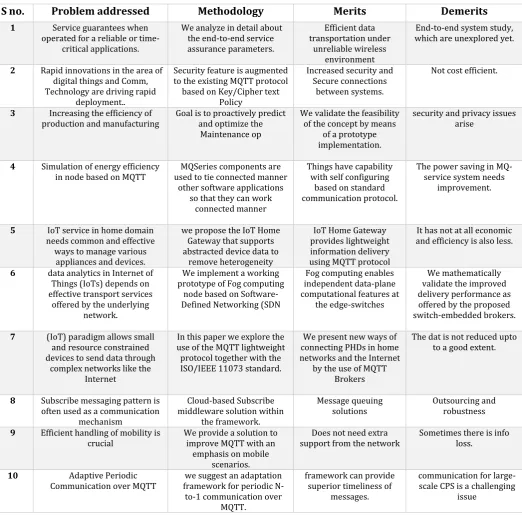
TABLE I.
COMPARATIVE
ANALYSIS
S
no.
Problem addressed
Methodology
Merits
Demerits
1 Service guarantees when operated for a reliable or
time-critical applications.
We analyze in detail about the end-to-end service assurance parameters.
Efficient data transportation under
unreliable wireless environment
End-to-end system study, which are unexplored yet.
2 Rapid innovations in the area of digital things and Comm, Technology are driving rapid
deployment..
Security feature is augmented to the existing MQTT protocol
based on Key/Cipher text Policy
Increased security and Secure connections
between systems.
Not cost efficient.
3 Increasing the efficiency of
production and manufacturing Goal is to proactively predict and optimize the Maintenance op
We validate the feasibility of the concept by means
of a prototype implementation.
security and privacy issues arise
4 Simulation of energy efficiency
in node based on MQTT used to tie connected manner MQSeries components are other software applications
so that they can work connected manner
Things have capability with self configuring
based on standard communication protocol.
The power saving in MQ-service system needs
improvement.
5 IoT service in home domain needs common and effective ways to manage various
appliances and devices.
we propose the IoT Home Gateway that supports abstracted device data to
remove heterogeneity
IoT Home Gateway provides lightweight information delivery using MQTT protocol
It has not at all economic and efficiency is also less.
6 data analytics in Internet of Things (IoTs) depends on effective transport services
offered by the underlying network.
We implement a working prototype of Fog computing
node based on Software-Defined Networking (SDN
Fog computing enables independent data-plane computational features at
the edge-switches
We mathematically validate the improved delivery performance as offered by the proposed switch-embedded brokers.
7 (IoT) paradigm allows small and resource constrained devices to send data through
complex networks like the Internet
In this paper we explore the use of the MQTT lightweight protocol together with the ISO/IEEE 11073 standard.
We present new ways of connecting PHDs in home networks and the Internet
by the use of MQTT Brokers
The dat is not reduced upto to a good extent.
8 Subscribe messaging pattern is often used as a communication
mechanism
Cloud-based Subscribe middleware solution within
the framework.
Message queuing
solutions Outsourcing and robustness
9 Efficient handling of mobility is
crucial We provide a solution to improve MQTT with an emphasis on mobile
scenarios.
Does not need extra
support from the network Sometimes there is info loss.
10 Adaptive Periodic
Communication over MQTT framework for periodic N-we suggest an adaptation to-1 communication over
MQTT.
framework can provide superior timeliness of
messages.
communication for large-scale CPS is a challenging
© 2016, IRJET | Impact Factor value: 4.45 | ISO 9001:2008 Certified Journal | Page 1374
S
no.
Problem addressed
Methodology
Merits
Demerits
11 Traditional Wireless Networks are address based i.e. they
require addresses for communication. But due to dynamically changing addresses of new WSN the communication
can halt.
A data-centric communication approach can be used, in
which information is delivered to the consumers not based on their network addresses, but rather as a function of their contents and
interests.
Publish/Subscribe messaging systems are scalable and support dynamic application
topology.
The current implementation of the MQTT-S gateway has two open problems: in the case
of node failure it is not possible to trigger the will
message and it is not possible to send message
with QoS 1 or 2 from the broker to the clients.
12 One of the major concerns in the deployment of IoT is to ensure
the security of devices and Device to Device communications. Besides,
existing communication protocols for IoT are devoid of
security features.
A lightweight Attribute Based Encryption, over elliptic curves is used to secure the
MQTT messages, where payload is encrypted using
symmetric Advance Encryption System cryptography and AES key is encrypted using ABE scheme.
The scheme consumes less time for encryption and decryption when compared with the other schemes. Also the proposed security feature is efficient, robust and scalable.
The performance is not improved wherein the access policies are fixed and known a priori. Also key revocation, group publish/subscribe for distributed SMQTT
supported.
13 Currently, the most widely adopted protocols for loT environment, namely MQTT, CoAP or LWM2M, are directly
dependent on the TCP/IP protocol suite.
The solution is to maintain the publish/subscribe approach but decouple the pure data generation process
by the data sending process.
Makes the system more immune to changes in the point of attachment of mobile
devices which avoids loT service developers having to explicitly consider this issue.
In case of large disruption period the messages may
still be lost. Also may create congestion in network due to sudden
release of the buffered messages in the queue.
14 Wireless sensor networks typically consist of sensor nodes
and gateways that operate on devices with limited resources.
As a result, WSNs require bandwidth-efficient and
energy-efficient application protocols.
A common middleware is deployed and executed in the
BeagleBoardxM which is connected to a layer-2 switch
through Ethernet. This middleware plays role of a publisher and the messages
The middleware efficiently calculates the Bandwidth utilization of the Network.
The middleware can be used only with one publisher, one server and
one broker.
15 The impact of various network parameters on the MQTT-SN service assurance requires an end-to-end system study, which
are unexplored yet.
Detailed analysis about the end-to-end service assurance
parameters such as content delivery delay and probability
of content delivery for a MQTT-SN to be used in health
care Internet of Things.
This modeling facilitates the system designer on designing the server to meet the service
assurances. The model efficiently analyzes the service
performances;
The model does not analyze a real time implementation for which
one can use already available open source MQTT-SN over UDP, and
then MQTT over TCP.
16 The integration of heterogeneous technologies and
communications solutions. Ex. Integration of mqtt
This can be achieved by a new network function called MQTT proxy. The MQTT proxy, on the one side, acts as an MQTT broker to the MQTT
clients.
This method allows M2M applications on OpenMTC to
access and deliver data to MQTT devices
Most of the devices do not support ETSI M2M, so
these devices should communicate with the platform through the inter
proxy.
17 IoT Home Gateway for Auto-Configuration and Management
of MQTT Devices.
The architecture consists of the IoT Home Gateway for
aggregating data from devices, the WBSDE for defining the user's required services and the IoT Service.
Satisfies the requirements of the user about convenience and energy management in
home.
Not all devices support DPWS.
18 Integrating MQTT and ISO/IEEE 11073 for Health Information
Sharing in the Internet of Things.
A broker-based architecture is used to establish a connection between ISO/IEEE
11073 Agents and Managers, and creates an automatic discovery mechanism of new
PHDs in home networks.
Useful in constrained resources devices. Automatic discovery of devices
by the use of Brokers.
Security features of MQTT in a health context not
incorporated.
19 A messages sent periodically by a publisher can arrive irregularly at the subscriber, some of which arrive after the
deadline due to network propagation delay, queuing delay, or application overruns.
The subscriber monitors the processor utilization and SRTT between the broker and
the subscriber. The publisher monitors the task’s execution time and SRTT between the
publisher and the broker.
It is not required to store neither per-client information
nor per topic information.
Large number of control messages resulting in poor
bandwidth utilization. Not suitable for N-to-M periodic communication.
20 Subscribe messaging pattern is often used as a communication
mechanism
Cloud-based Subscribe middleware solution within
the framework.
© 2016, IRJET | Impact Factor value: 4.45 | ISO 9001:2008 Certified Journal | Page 1375
III.APPLICATIONSOFMQTT
1. It is used in Facebook messenger app. The company used MQTT because of its specific design for applications like sending telemetry data to and from space probes, and hence uses less bandwidth and battery. By maintaining MQTT, the company was able to achieve phone-to-phone delivery in the hundreds of milliseconds.
2. Location Aware Messaging for Accessibility (LAMA) is a system for making information available to people relevant to their interests and location. The system uses Smart Phones, MQTT and WebSphere Message Broker and some clever application software.
3. GAIAN Database- A distributed federated database using a biologically inspired self-organization principle to minimize management and it was written in Java. GaianDB has already been used in complex, distributed, semantic join queries for text analytics applications and has drawn the attention of significant customers in the military.
IV.CONCLUSION
MQTT (Message Queue Telemetry Transport) is a lightweight publish/subscribe messaging protocol. It is standard protocol for small devices. It is open standard and better suited for constrained environment than HTTP. The principle is publishing messages and subscribing to topics. Multiple clients/processes connect to a broker/monitor and subscribe to topics that they are interested in. The broker and MQTT act as a simple, common interface for connecting everything. It is a message-centric wire protocol designed for M2M communications that enables the transfer of telemetry-style data in the form of messages from devices, along high latency or constrained networks, to a server or small message broker. Devices may range from sensors and actuators, to mobile phones, embedded systems on vehicles, or laptops and full scale computers. It supports publish-and-subscribe style communications and is extremely simple. MQTT (Message Queuing Telemetry Transport) targets device data collection. Its purpose is to collect data from many devices and transport that data to a Data Centre.
REFERENCES
List and number of all bibliographical references in 9-point Times, single-spaced, at the end of your paper. All the 30 papers are referenced here . The citations number of each is as mentioned:
[1] Shinho Lee, Hyeonwoo Kim, Dong-kweon Hong, Hongtaek Ju: Correlation Analysis of MQTT Loss and Delay According to QoS Level
[2] Meena Singh, Rajan MA, Shivraj VL, and Balamuralidhar P : Secure MQTT for Internet of Things (IoT)
[3] Shinho Lee, Hyeonwoo Kim, Dong-kweon Hong, Hongtaek Ju :Correlation Analysis of MQTT Loss and Delay According to QoS Level
[4] Dinesh Thangavel, Xiaoping Ma, Alvin Valera and Hwee-Xian Tan, Colin Keng-Yan TAN : Performance Evaluation of MQTT and CoAP via a Common Middleware
[5] Urs Hunkeler & Hong Linh Truong: MQTT-S – A Publish/Subscribe Protocol For Wireless Sensor Networks [6] Dinesh Thangavel, Xiaoping Ma, Alvin Valera and Hwee-Xian Tan, Colin Keng-Yan TAN :End-to-end service assurance in IoT MQTT-SN
[7] Power Profiling: HTTPS Long Polling vs. MQTT with SSL, on Android,
[8] S. Behnel, L. Fiege, G. Muehl, “On Quality of Service and Publish Subscribe,” Proceedings of the 26th IEEE International Conference on Distributed Computing Systems Workshops, July, 2006.
[9] K. M. Bell, D. N. Bleau, J. T. Davey, “Push notification service,” U.S. Patent 8 064 896, November, 2011.
[10] Hsiang Wen Chen, Fuchun Joseph Lin : Converging MQTT resources in ETSI standards based M2M platform
[11]Christian Lesjak, Daniel Hein, Michael Hofmann, Martin Maritsch, Andreas Aldrian, Peter Priller, Thomas Ebner, Thomas Ruprechter and Gunther Pregartner : Securing Smart Maintenance Services: Hardware-Security and TLS for MQTT
[12]Aleksandar Antonic, Martina Marjanovi c, Pavle Sko cir and Ivana Podnar Zarko :Comparison of the CUPUS Middleware and MQTT Protocol for Smart City Services [13]Yuri F. Gomes, Danilo F. S. Santos, Hyggo O. Almeida and
Angelo Perkusich : Integrating MQTT and ISO/IEEE 11073 for Health Information Sharing in the Internet of Things [14]Stephen Wilson & Professor Jeremy Frey : The SmartLab:
Experimental and Environmental Control and Monitoring of the Chemistry Laboratory
[15]Bin Xiao & Muhammad Zeeshan Asghar : “Canderoid”: A mobile system to remotely monitor travelling status of the elderly with dementia
[16]Ramon Alcarria & Tomas Robles : Resolving Coordination Challenges in Cooperative Mobile Services
© 2016, IRJET | Impact Factor value: 4.45 | ISO 9001:2008 Certified Journal | Page 1376
[18] Matteo Collina & Giovanni Emanuele Corazza :
Introducing the QEST broker: Scaling the IoT by bridging MQTT and REST
[19] Hsiang Wen Chen, Fuchun Joseph Lin : Converging
MQTT resources in ETSI standards based M2M platform [20]Soma Bandyopadhyay & Abhijan Bhattacharyya
:Lightweight Internet Protocols for Web Enablement of Sensors using Constrained Gateway devices
[21]Zhiqiang Wei & Yaqing Song : The Research and Implementation of GPS Intelligent Transmission Strategy Based on on-board Android Smartphones
[22]Seong-Min Kim, Hoan-Suk Choi, Woo-Seop Rhee : IoT Home Gateway for Auto-Configuration and Management of MQTT Devices
[23]Kannan Govindan : End-to-end service assurance in IoT MQTT-SN
[24]Christian Lesjak , Design Center Graz : Hardware-security and TLS for MQTT
[25]Mohsen Hallaj Asghar : Design and simulation of energy efficiency in node based on MQTT protocol in Internet of Thing
[26]Seong-Min Kim : IoT home gateway for auto-configuration and management of MQTT devices
[27]Yiming Xu : Towards SDN-based fog computing: MQTT broker virtualization for effective and reliable delivery [28]Jorge E. Luzuriaga: Handling mobility in IoT applications
using the MQTT protocol
[29]Aleksandar Antonić :Comparison of the CUPUS middleware and MQTT protocol for smart city services [30]Hyun-Chul Jo : Adaptive Periodic Communication over