Citation:
White, SL and Spencer, S (2018) A school-commissioned model of speech and lan-guage therapy. Child Language Teaching and Therapy, 34 (2). ISSN 1477-0865 DOI: https://doi.org/10.1177/0265659018780961
Link to Leeds Beckett Repository record: http://eprints.leedsbeckett.ac.uk/4906/
Document Version: Article
The aim of the Leeds Beckett Repository is to provide open access to our research, as required by funder policies and permitted by publishers and copyright law.
The Leeds Beckett repository holds a wide range of publications, each of which has been checked for copyright and the relevant embargo period has been applied by the Research Services team.
We operate on a standard take-down policy. If you are the author or publisher of an output and you would like it removed from the repository, please contact us and we will investigate on a case-by-case basis.
A school-commissioned model of
speech and language therapy
Sarah White, Leeds Beckett University and Leeds Community Healthcare NHS Trust
Dr Sarah Spencer, University of Sheffield
Abstract
Many Speech and Language Therapy (SLT) services have limited capacity for providing school-based input. Some offer commissioned SLT input, to enhance the service provided by the UK National Health Service (NHS), giving schools the option to increase the amount and scope of SLT intervention. This two-tiered model of service provision is relatively new and has not been researched.
This study investigated the experiences of schools who had commissioned input from the local SLT service, in terms of a) describing how this was utilised and b) exploring perceptions of its value. Semi-structured interviews were carried out with Special Educational Needs
Co-ordinators (SENCos) from 11 schools and were thematically analysed using Framework Analysis (Ritchie and Spencer 1994). SENCos reported many positive aspects of the commissioned model, including better communication with Speech and Language Therapists (SLTs) and improved outcomes for children. SENCos felt that the numbers of children with Speech, Language and Communication Needs (SLCN) had reduced following commissioned input. Very few disadvantages of the model were identified. SLTs delivered a range of activities, including training staff and providing direct input for children. SENCos would recommend the service, and perceived the cost to be moderate. These data suggest that SENCos place a high value on SLT in schools, and welcome the opportunity to purchase additional input.
Keywords
Funding, commissioned, school, intervention, consultative
I Background
1 The Consultative Model
that they were delegating therapy programmes that they had no personal experience of delivering (Pring et al 2012).
2 Effectiveness of Consultative Models
Clinical gains have been shown to be significant for children receiving input via experienced SLTAs (e.g. Boyle et al 2009). To investigate whether these results could be replicated by Teaching Assistants (TAs), McCartney et al (2011) evaluated the effectiveness of therapy delivered by a TA, compared to a control group with no input. A therapy manual was provided to TAs, with instructions for delivering therapy for vocabulary, grammar and narrative targets. Results showed no significant difference in progress between the two groups, suggesting that therapy delivered by a TA is less likely to be effective than therapy delivered by a SLTA.
Mecrow, Beckwith and Klee (2010:2) evaluated an ‘enhanced consultative approach’, whereby intensive therapy was delivered by specialist TAs working under the guidance of SLTs. Using within-subject comparison for 35 children, results demonstrated that statistically significant gains were made and sustained for a number of language targets (such as use of auxiliary ‘is’) which were individually selected for children, although this was not replicated for speech targets (e.g. use of word-initial /g/).
Baker and McLeod (2004) conclude that for children with speech sound disorders, the SLT’s direct involvement plays a vital role in the effectiveness of therapy: they describe two children whose targets were identical, but one did not respond to the therapy so the approach was
adapted. Their study, although limited in scale so not necessarily representative, demonstrates the specialist role of the therapist in evaluating and managing therapy approaches when delivering therapy directly. Similarly, in interviews with 33 SLTs from 14 services, Roulstone et al
(2012:330) identified a role for ‘external involvement at a specialist level rather than just advisory or modelling’.
3 Collaboration
Lack of collaboration between SLTs and school staff is often perceived as a barrier to successful outcomes for children: SLTs and teachers report that they value regular liaison, but lack of time often prevents this (Law et al 2002, Baxter et al 2009:221). In a small-scale study consisting of interviews with four primary-school headteachers, Leyden, Stackhouse and Szczerbinski (2011) suggest that best practice in implementing SLT strategies typically consists of a top-down model overseen by the leadership team within school, with regular dedicated time available for
collaboration between SLTs and teaching staff.
4 Pupil Premium funding
Schools in the UK receive ‘Pupil Premium’ funding, which in 2014-15 paid between £1,300 and £1,900 for each pupil receiving free school meals, with the aim of improving academic outcomes for the most socially disadvantaged children (Department for Education 2014). Pupil Premium is spent according to schools’ own priorities; however, schools are expected to justify expenditure to the Department for Education in order to demonstrate that it is being used to effectively close the gap for the lowest-achieving pupils (Carpenter et al 2013).
5 School-commissioned SLT input
Purchasing SLT input may appeal to schools with high levels of Pupil Premium, as there is a clear evidence-base for links between SLCN and low educational attainment (e.g. Spencer et al 2017), and therefore potential to demonstrate improved outcomes for children who receive additional SLT input. In a survey of 1240 schools, Carpenter et al (2013) found that some were planning to introduce or enhance support from specialist services. There is a lack of research into commissioned SLT; however such models do exist, as referenced by Lindsey et al (2010).
This study describes a commissioned model of SLT input in schools within a single service: the NHS provides a core offer in this area, and local schools can commission additional SLT input from the NHS service, to enhance this provision. The aims of this study are to:
Investigate schools’ motivations for purchasing additional SLT input.
Explore the scope of the work undertaken by SLTs during commissioned time.
Elicit feedback from schools about their experiences of purchasing additional SLT input.
II Method
Ethical approval to undertake this study was obtained from the University of Sheffield, and local permission was granted by the NHS Trust.
1 Design
The study was carried out in an NHS (government-funded) SLT service. Within the Local Educational Authority (LEA – a governing body for a group of schools within one geographical area), 147 schools (50.5%) commissioned input from the SLT service, either individually or as clusters of schools. Seven schools in neighbouring authorities also commissioned input from the service. The majority of contracts (65%) were for at least half a day per week of SLT time.
2 Participants
and were invited to ask questions about the study. Most SENCos represented primary schools within the LEA; one represented schools from a neighbouring authority.
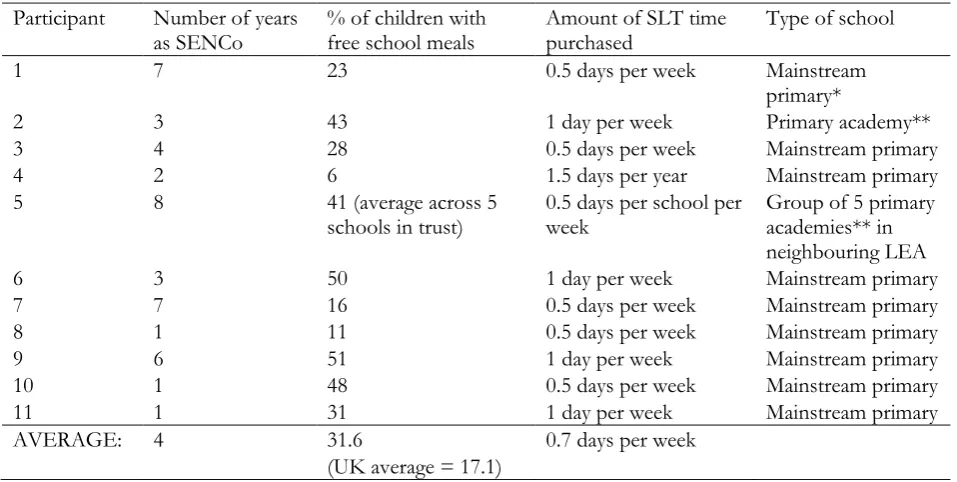
Table 1. Participant and school information
*government-funded school under the control of the Local Education Authority (follows the National Curriculum) **government-funded school outside the control of the Local Education Authority (may not follow the National Curriculum)
3 Procedure
An interview was designed and piloted. Semi-structured interviews were conducted by two SLTs, one of whom is the first author of this paper. Two SENCos worked in schools whose named SLT was the first author: their interviews were conducted by another SLT in order to reduce bias. Interviews were conducted face-to-face in schools, and audio-recorded.
4 Analysis
Interviews were transcribed verbatim and analysed using Framework Analysis (Ritchie and Spencer 1994). Interviews were imported into NVivo10 (QSR International 2012) and coded: codes were assigned to each new topic which emerged, such as “better liaison”, or “children’s progress”. Codes were re-used for similar data, and new codes created as necessary. As further data were imported, codes were re-worded to take account of similar but new data (e.g. “children’s progress” was widened to “impact of SLT input”).
As more interviews were imported and analysed, fewer new codes were added, as the data reached a natural saturation point. When all interviews had been coded, they were re-analysed and data was re-coded if a more appropriate code had since been created. Codes were combined into themes: e.g. “availability of SLT” and “SLT being seen as member of staff” became
“communication and relationships”. Some themes were combined to become broader still: Participant Number of years
as SENCo % of children with free school meals Amount of SLT time purchased Type of school
1 7 23 0.5 days per week Mainstream
primary*
2 3 43 1 day per week Primary academy**
3 4 28 0.5 days per week Mainstream primary
4 2 6 1.5 days per year Mainstream primary
5 8 41 (average across 5
schools in trust) 0.5 days per school per week Group of 5 primary academies** in neighbouring LEA
6 3 50 1 day per week Mainstream primary
7 7 16 0.5 days per week Mainstream primary
8 1 11 0.5 days per week Mainstream primary
9 6 51 1 day per week Mainstream primary
10 1 48 0.5 days per week Mainstream primary
11 1 31 1 day per week Mainstream primary
AVERAGE: 4 31.6
(UK average = 17.1)
“communication and relationships” and “impact of SLT” became “positive aspects”. When themes had been identified, data was charted onto matrices: each matrix represented one theme.
III Results and Discussion
Six main themes emerged from the interviews. These are presented below, along with illustrative comments from participants:
1 Motivations for commissioning SLT
The most common motivation for commissioning SLT input was to meet the needs of high numbers of children with delayed language, particularly in nursery and reception years:
We’ve got what I would consider to be quite a language-poor school, so we’ve got lots of children who come to school with very low levels of language in reception and nursery.
Three SENCos commented on links between SLCN and educational and social outcomes for children:
We’d identified lots of speech, language and communication needs, and we’re very well aware that unless you get those things in place from an early age, and you’re pro-active about working with them, the knock-on effect socially and academically is massive.
It is unclear whether this SENCo was aware of any empirical evidence for a “knock-on effect” (e.g. Clegg et al 2005) or whether she perceived there to be a causal link between SLCN and academic outcomes based on her experiences of working with children with SLCN.
SENCos were motivated to develop capacity within schools to meet the needs of children with SLCN:
We wanted to focus a lot of attention on doing programmes, training staff to be able to deliver interventions, so we have less children coming into Key Stage 1 and 2 [Key Stage 1 describes
educational provision for children aged 5-7 years; Key Stage 2 is 8-11 years] with speech and language difficulties.
The above quote demonstrates a clear motivation for the prevention of SLCN, rather than therapy input as a treatment for existing SLCN. This type of intervention, sometimes described as ‘universal’ (e.g. Gasgoine 2008) is unlikely to be delivered by SLT services in the NHS, but may be valuable to schools in raising educational attainment (Carpenter et al 2013).
Another motivation for purchasing commissioned input was to provide more direct input for children. Five SENCos felt that the NHS-funded input was inadequate (quotes from three SENCos are provided):
[The SLT] would just be in to see those children who’d been referred, assess them, and leave programmes for staff, and then she’d be gone. And that package wasn’t enough.
We felt the caseload was sort of lagging behind… we had a couple of children with some quite complex needs.
We wanted her to work more with the children
These statements support the view that a basic consultative model (e.g. Law et al 2002) may be perceived by schools as inadequate, particularly where SLT input is limited to a single instance of delegating a therapy programme.
2 SLT Activity
Table 2. SLT Activity
Type of activity Number of schools
Direct intervention 8
Training school staff 11
Parent liaison 2
Assessment/identification of SLCN 3
Other 3
SLT activity (Table 2) was the most varied of the themes. In all schools, some time was spent training staff in delivering SLT interventions:
Working with some identified TAs, training them up so they can deliver programmes.
The fact that these schools allocate time for staff to work with the SLT demonstrates that they place a high value on working together to ensure effective delegation. This type of collaboration is advocated by Law et al (2002) who reported that commitment and availability of staff, and a high level of joint work, were needed to ensure the success of a consultative model. This extract also indicates a possible move towards an ‘enhanced consultative approach’ (e.g. Mecrow et al 2010:2), whereby TAs might develop more specialist skills in order to deliver SLT interventions effectively.
Two SENCos described more formal training which the SLT had delivered to school staff:
When we had OFSTED a few years ago, one of the issues was around modelling the language for younger children, so [the SLT] did some twilight sessions with our foundation staff, on how to do that.
All SENCos identified that SLTs delivered interventions directly, either to groups or individuals:
This describes a different practice to that identified by Pring et al (2012), who reported that SLTs were increasingly delegating therapy programmes and therefore lacking in opportunities to develop or maintain their clinical expertise. Commissioned SLT input may therefore represent a more attractive option for SLTs themselves, who carry out more direct work under this model. There was some degree of overlap with the training role identified above, as TAs often worked alongside SLTs.
Individual work with the children, where a couple of them needed that specialist therapy.
This SENCo’s perception that some children require direct input from an SLT is consistent with the literature which identifies a specialist, non-advisory role for SLTs (e.g. Roulstone et al 2006, Baker and McLeod 2004). Leyden et al (2011) also identified that school staff welcomed direct SLT input where they felt that they themselves lacked the necessary technical SLT knowledge.
3 Positive Aspects
All SENCos reported that they would continue to commission additional SLT input if budgets allowed, and would recommend the model to others. SENCos placed a high value on having regular contact with their SLT – this was identified as a positive aspect of the commissioned model by all schools with at least fortnightly input:
You get to know [the SLT], schools get to know them, children get to know them, and families get to know them. Relationships are built.
These views support the findings of Baxter et al (2009:221), who reported that 62% of school staff perceived liaison to be ‘very important’. SENCos felt that increased contact time had facilitated better communication and working relationships between school staff and the SLT, similar to the feedback given by school staff in McKean et al’s interviews (2016).
Increased contact time was perceived as beneficial even when small amounts of SLT input were commissioned (this SENCo’s school purchased only half a day per term, which doubled their NHS input at that time):
It just means that we feel more supported, because once a term I think would just not feel enough.
SENCos particularly valued the reassurance of knowing that they or other staff could speak to their SLT at any time:
Having somebody that I can easily ask questions of instantly is very beneficial.
This may have been particularly pertinent for this SENCo, who was new to the role, although the availability of SLTs for support and advice on an as-needed basis was explicitly
recommended by headteachers in Leyden et al’s (2011) study.
Four SENCos felt that more frequent visits, and a long-standing relationship with the school, had enabled the SLT to better understand the needs of the school and the individual children:
These responses suggest that as the SLT spent more time in school, the input became more effective. This type of virtuous circle effect supports Baker and McLeod’s (2004) view that ongoing assessment during SLT intervention plays a vital role in the success of the therapy input.
Five SENCos felt the commissioned input had a direct impact on outcomes for the children, either in terms of speech, language and communication or academic attainment:
The cohort who have had [SLT intervention] this year, their language scores are so much higher and with the test that we did before the interventions, we’ve tested them again after and they’ve made loads of progress. They’re just more vocal and more confident with their speech.
Two SENCos noted that the commissioned input had been effective at meeting the needs of children with SLCN in the foundation stage, to the point where this group was significantly reduced, or no longer existed, in older classes:
It raises attainment… by the time they go into year 1, those booster sessions have brought them up to where they should be. So the only ones that you have that are on speech and language [programmes] in KS1 are the children that have specific speech and language problems, and not just the lack of vocabulary and stimulation.
The two quotations above demonstrate the potential value of SLT in raising educational attainment through early intervention. They also describe a process of examining the children’s responses to universal intervention and support as part of the process of identifying those who have more severe difficulties warrenting further intervention. This has parallels with the
Response to Intervention (RTI) model used in the United States of America to support children with literacy and other learning needs, whereby children at risk of persisting educational
difficulties are identified and targeted early through accessing universal and targeted levels of support in school (Fuchs and Fuchs 2006). These extracts also support the data reported by Boyle et al (2009), who found that children with regular SLT input in school were able to make significant clinical progress.
Another virtuous circle effect is possible in terms of staff training:
Once [the SLT has] trained up the staff… her time can then be devoted more to those children with specific communication difficulties.
This SENCo predicted that as the SLT and school staff become more efficient at providing early interventions for children with language delay, less input would be needed for children in KS1 and KS2, because this group would cease to exist. More SLT time could then be spent providing specialist input to children. These outcomes again have similarities with the ‘Response to
Intervention’ (RTI) model.
Increased staff knowledge and experience was another common positive aspect for the SENCos. One felt that “staff confidence is the biggest thing”, while five others reported that some staff were developing more specialist skills:
This demonstrates the impact of a dedicated TA who can become more specialised in SLT interventions as a result of working with the SLT – similar, perhaps, to the ‘specialist teaching assistants’ described by Mecrow et al (2010), who worked closely with SLTs in schools and were able to provide effective SLT input. This supports the existing evidence that a consultative model may be particularly effective when it is closely managed by the SLT and involves staff who have more specialist skills and experience (e.g. McCartney et al 2011).
In two schools, the SENCos felt that staff were more able to identify children with SLCN:
We’re getting better at noticing children that might have speech and language problems. All staff are a bit more aware; they understand language a bit more.
Five SENCos valued the opportunity to tailor their SLT input to suit the needs of their school:
Rather than an SLT coming in and saying “this is what I can offer”, she very much works around the needs of the school.
These SENCos drew a comparison with the NHS-funded service, reporting a clear preference for being able to decide on their own level and type of SLT input, rather than being passive recipients of a consultative model. SENCos welcomed the opportunity to take a pro-active role in improving SLT provision, similar to a school described by Carpenter et al (2013:73) who had invested funding into SLT-specific training due to the “erosion” of the local SLT service.
4 Negative Aspects
Six SENCos had no negative feedback. Where negative feedback was given, it was often specific to the school’s individual circumstances, with no common themes or overall trends.
One SENCo felt that her school was disadvantaged by having commissioned input on a Monday, but acknowledged that the SLT had been able to resolve this issue:
Sometimes we’ve felt we’ve lost out if it’s been a bank holiday or a training day, because our day falls on a Monday. It’s been accommodated by [the SLT] coming in on a different day or swapping days around.
The SENCo who represented schools from a neighbouring authority reported difficulties in working with two separate SLT providers (the commissioned provider and the local SLT service for their school). The local service reportedly felt that the commissioned service was “stepping on [their] toes”. However, the two providers had been able to establish a positive working relationship and could complement each other:
[The local service is] contacting me and saying, ‘we’ve got this child, and we can’t meet their needs in clinic, can your therapist pick them up and work with them now, so their needs can be better met in school?’ Now for us, that’s brilliant.
I’m never quite sure what the therapist expects of me … she turns up and we have a bit of a chat and say what’s your plan for the day, and possibly I’d like a bit more of a regimented, this is what’s happening over the next few weeks – a bit more formalised.
This supports Baxter et al’s findings (2009) that school staff, particularly SENCos, value the opportunity to liaise regularly with SLTs in order to discuss aims and objectives.
One SENCo reported that staff had been unprepared for the SLT to delegate programmes of work to them:
I think many of the teachers were under the impression that the SLT would actually work with the children.
This again highlights the need for the SLT and SENCo to explicitly clarify their joint aims and expectations for commissioned input. This is consistent with the findings of Law et al (2002) who identified that schools needed SLTs to set clear expectations about roles. This extract might also be an indication that some school staff prefer a more traditional model of SLT input over a consultative model: this is contrary to existing research which shows that schools are in favour of consultation providing that it is managed closely (e.g. Law et al 2002).
One SENCo reported difficulties with implementing whole-school approaches, particularly in engaging class teachers. However, she felt that the SLT had had a positive impact on this:
Getting staff on board to make changes in the classroom, that was my agenda, and actually having someone else to verify that from a different specialist area, that’s really benefitted me – so it was a problem, but she’s helped with it.
She went on to say that she “knew” the commissioned input had had a positive impact but found it difficult to evidence this:
The assessments that are used by speech therapy aren’t entirely compatible with what we use in school, so you can prove the impact in speech therapy through your assessments, but that has to translate, because of OFSTED, into levels at school.
This echoes the findings of Lindsay et al (2010), who recognised that the systematic use of data to evaluate SLT provision in schools was a consistent area of difficulty. However, while Lindsay et al hypothesised that this reflected a difficulty in managing joint data collection, this SENCo felt that the difficulty lay in the difference in assessment methods used by schools and SLTs.
5 Suggestions
There were no common sub-themes amongst SENCos’ suggestions for improving the commissioned service, with each offering different suggestions.
One identified the need to maintain the same SLT for the commissioned input:
This is consistent with earlier comments regarding the perceived impact of the relationship between the SLT and school staff, and the potential for SLTs to work more effectively with children and schools as they develop a greater understanding of individual needs and working practices.
Another suggestion was that the commissioned contract could include the option to purchase additional components:
It was quite good when we had [an SLTA] who could speak Urdu, and could communicate with the parents. Our SLT doesn’t have that skill, but that would be good in a school like ours… like an add-on to our normal cadd-ontract.
Where SLTs or SLTAs speak additional languages, especially where these are common amongst parents and/or children, this may represent an opportunity to generate further income for the SLT service and to meet an identified need within schools. Additional packages could include specific interventions for children, or training sessions for parents delivered in other languages.
One SENCo wanted to know how other schools were choosing to use their commissioned SLT time:
It would be nice to see how other schools are using the commissioned time, and maybe some case studies of the successful things.
This demonstrates the potential for SENCos to share information and influence each others’ decisions about Pupil Premium expenditure: 74% of schools are influenced by “word of mouth” recommendations (Carpenter et al 2013) when deciding how to spend their funding.
Two SENCos provided general recommendations for managing the commissioned input, as advice to other SENCos:
You really need to manage it very carefully to get the best out of it. I think people may have this concept that you’re just going to come in and sort everything out, but actually… it’s a two-way thing, get all your staff on board, you need to treat [the SLT] like a member of staff.
Both SENCos felt that their own role was crucial to the success of the commissioned input, supporting the view that a successful consultative model should consist of regular and close liaison, and a commitment from school staff with strong top-down leadership (Baxter et al 2009, Leyden et al 2011).
6 Cost
Common feedback was that the cost was “fair”, “moderate” or “reasonable”, with the service being seen as “cost-effective”. One SENCo felt that the cost put a strain on the school’s budget, and that her school was disadvantaged due to a lack of funding:
As there is a lack of research into school-commissioned models of SLT, it is difficult to compare the views of SENCos in this study to any wider evidence regarding perceptions of cost.
Carpenter et al (2013) found that 45% of primary schools felt that support from specialist
services was “very effective”, but this did not refer specifically to a commissioned model of SLT.
IV Limitations
The study represented a small proportion of the overall number of schools with commissioned input within the LEA. There were no participants from schools who purchased more than one day per week, and only one from a school with less than half a day per week. SENCos with more positive perspectives may be over-represented in this study due to a recruitment bias, as SENCos with less positive experiences may be less likely to agree to participate when invited by their collaborating SLT. The fact that the SENCos in this study placed a high value on the face-to-face communication with their SLT is perhaps also indicative of the fact that these SENCos
represented schools that do purchase weekly input. The reasons for schools choosing not to commission additional SLT input was beyond the scope of the project and could be considered in future research.
V Implications and Conclusions
There are few - if any - studies on commissioned models of SLT, yet such models may increase in prevalence as services continue to face funding difficulties (e.g. Pring et al 2012). This study will therefore be of interest to SLT managers and to schools, who may consider adopting a similar model or already use one.
Schools are motivated by the prospect of increased academic attainment for children, particularly where this can be evidenced, therefore commissioned models could be actively marketed
towards schools with low academic attainment in areas of social deprivation, as a means of improving academic outcomes. School staff value the opportunity to work more closely with, and to form ongoing relationships with, a consistent SLT working within school. They use commissioned SLT time in a variety of ways but usually to provide direct input for children and training for school staff as a minimum. Evidencing children’s progress, particularly in terms of reporting this in terms of academic levels, is an area of difficulty, and SLTs and SENCos would benefit from working jointly to identify meaningful ways of demonstrating progress.
Future research could aim to identify the long-term impact of commissioned SLT input, through comparing the clinical progress made by children with SLCN within commissioned schools and within the basic consultative model, or through investigating longitudinal effects of whole-school approaches to improving speech, language and communication. Further studies could investigate alternative commissioned providers, such as independent SLTs, and could aim to gather the views of SLTs themselves, in order to provide a more thorough analysis of this model of provision.
Funding
References
Baker, E. and McLeod, S. (2004) Evidence-based management of phonological impairment in children. Child Language Teaching and Therapy 20 (3), 261-285
Baxter, S., Brookes, C., Bianchi, K., Rashid, K. and Hay, F. (2009) Speech and language
therapists and teachers working together: exploring the issues. Child Language Teaching and Therapy 25 (2), 215-234
Blatchford, P., Russell, A., Bassett, P., Brown, P., & Martin, C. (2004) The role and effects of teaching assistants in English primary schools (Years 4–6) 2000–2003; results from the class size and pupil action rations (CSPAR) KS2 project. Report to the DFES. London: HMSO
Boyle, J.M., McCartney, E., O’Hare, A. and Forbes, J. (2009) Direct versus indirect and individual versus group modes of language therapy for children with primary language impairment: principal outcomes from a randomised controlled trial and economic evaluation. International Journal of Language and Communication Disorders 44 (6), 826-846 Carpenter, H., Papps, I., Bragg, J., Dyson, A., Harris, D., Kerr, K., Todd, L. and Laing, K. (2013)
Evaluation of Pupil Premium: Research Report. London: Department for Education.
Clegg, J., Hollis, C., Mawhood, L., & Rutter, M. (2005). Developmental language disorders –a follow‐up in later adult life. Cognitive, language and psychosocial outcomes. Journal of Child Psychology and Psychiatry 46(2), 128-149
Department for Education (2014) Pupil Premium: funding for schools and alternative provision. Accessed online at:
http://www.education.gov.uk/schools/pupilsupport/premium/b00231348/pupil-premium-information-for-schools-and-ap-settings/online-reporting (accessed on 3rd March 2014)
Fuchs, D. & Fuchs, L.S. (2006). Introduction to Response to Intervention: What, why, and how valid is it? Reading Research Quarterly 41 (1), 93-99
Gale, N., Heath, G., Cameron, E., Rashid, S. and Redwood, S. (2013) Using the framework method for the analysis of qualitative data in multidisciplinary health research. BMC Medical Research Methodology 13:117.
Gasgoine, M. (2008) Change for children with language and communication needs: creating
sustainable integrated services. Child Language Teaching and Therapy 24 (2), 133–154 Law, J., Lindsay, G., Peacey, N., Gasgoigne, M., Soloff, N., Radford, J. and Band, S. (2002)
Consultation as a model for providing speech and language therapy in schools: a panacea or one step too far? Child Language Teaching and Therapy 18 (2), 145-164
Leyden, J., Stackhouse, J. and Szczerbinski, M. (2011) Implementing a whole school approach to support speech, language and communication: perceptions of key staff. Child Language Teaching and Therapy 27 (2), 203-222
Lindsay, G., Soloff, N., Law, J., Band, S., Peacey, N., Gasgoine, M. and Radford, J. (2002) Speech and language therapy services to education in England and Wales. International Journal of Language and Communication Disorders 37 (3), 273-288.
McCartney, E., Boyle, J., Ellis, S., Bannatyne, S. and Turnbull, M. (2011) Indirect language therapy for children with persistent language impairment in mainstream primary schools: outcomes from a cohort intervention. International Journal of Language and
Communication Disorders 46 (1), 74-82
McKean, C., Law, J., Laing, K., Cockerill, M., Allon‐Smith, J., McCartney, E., & Forbes, J. (2016). A qualitative case study in the social capital of co‐professional collaborative co‐
Mecrow, C., Beckwith, J. and Klee, T. (2010) An exploratory trial of the effectiveness of an enhanced consultative approach to delivering speech and language intervention in schools. International Journal of Language and Communication Disorders 45 (3), 354-367
QSR International (2012) NVivo version 10
Office for Standards in Education, Children’s Services and Skills (OFSTED) (2012) Outstanding achievement for pupils learning English as an additional language: Greet Primary School. Accessed online at: http://www.ofsted.gov.uk/resources/good-practice-resource-outstanding-achievement-for-pupils-learning-english-additional-language-greet (accessed on 3rd March 2014)
Pring, T., Flood, E., Dodd, B. and Joffe, V. (2012) The working practices and clinical experiences of paediatric speech and language therapists: a national UK survey.
International Journal of Language and Communication Disorders 47 (6), 696-708 Ritchie, J., Spencer, L. and O’Connor, W. (2003) Carrying out qualitative analysis. In Ritchie, J.
and Lewis, J. (eds) Qualitative Research Practice. London: Sage Publications.
Roultstone, S., Wren, Y., Bakopoulou, I. and Lindsay, G. (2012) Interventions for children with speech, language and communication needs: an exploration of current practice. Child Language Teaching and Therapy 28 (3), 325-341