SRJIS/BIMONTHLY/ MS ANUPAMA (680-686)
JULY-AUG, 2015, VOL-3/19 www.srjis.com Page 680 A STUDY OF PERSONALITY OF ADOLESCENTS IN RELATION TO
COMMITMENT
Ms. Anupama
Alumnus (M.Ed. Student), University School of Open Learning (USOL), Panjab University,
Chandigarh (UT)
The present study examines the personality of adolescents in relation to commitment. The sample of the study comprised of 200 eleventh class students (100 boys and 100 girls) studying in government and private schools of Chandigarh. Descriptive survey method was employed to collect the data. The major findings of the study revealed a significant difference in the personality of male and female adolescents. Further, adolescents with high level of commitment have better personality as compared to their counterparts. But, there was no significant difference in the personality and commitment level with regard to type of school. Keywords: Personality, Psychological Hardiness, adolescence, Commitment
INTRODUCTION
A man is born just like any other animal being but he gradually transforms into a
human being by acquiring knowledge and thus by being educated. With the progress of time
one learns how to interact with one‟s own surroundings. This aim can be fulfilled only by
proper understanding of the individual and his abilities and aptitudes.Personality is all that a
person is. It is totally of his being and includes his physical, mental, imaginations, instincts; Scholarly Research Journal's is licensed Based on a work at www.srjis.com
SRJIS/BIMONTHLY/ MS ANUPAMA (680-686)
JULY-AUG, 2015, VOL-3/19 www.srjis.com Page 681 thoughts and sentiments constitute his personality. Psychologists are different from each
other in terms of the meaning of personality. Most of them agree that the term personality is a
relatively stable trait, tendencies or features that perpetuate individual's behaviour to some
extent; or more specialized, personality is made up of traits and tendencies which is led to
individual differences in behaviour, behaviour stability over time and behaviour continuity in various situations (Feist & Feist, 2002).
Personalities are formed in the early years, before the age of eleven, some say before
the age of seven. During the formative years, one of the major factors influencing the formation of the children‟s personalities is parenting. The foundation of personality of the
children lies in the womb of family. Family is regarded as nursery of socialization. Parenting
style is one of the important component of the family system. Parenting is the greatest
responsibility. It involves careful attention to the need of the child in order to ensure that he
has a complete and all round development. Edmund and Gerard (2015) conducted a study
entitled the influence of trait affect and the five-factor personality model on impulse
buying, Additionally, studies on how the five-factor personality model‟s dimensions
influence impulse buying have also produced contradictory results and found that trait
affect does have a significant influence on impulse buying controlling for state affect,
but that this influence is fully accounted for by the five-factor personality model, the
extraversion, conscientiousness and neuroticism dimensions of which are found
consistently to predict impulse buying.
Geetanjali (2011) conducted a study on academic achievement of 200 stud ents of
11th class in relation to their personality and emotional intelligence and found that there
exists significant relationship between academic achievement and emotional intelligence
and partial relationship between academic achievement and personalit y.Commitment is
one of the major factors affecting gross psychological hardiness which represents a tendency
to involve oneself in whatever one is doing or encounters. In gross psychological hardiness
variable, there exist two more sub variables, viz. control and challenge. Control is described as a “Tendency to feel and act as if one is influential in the face of the varied contingencies of life”. Challenge is described as a “Belief that changes rather than stability is normal in life
and that the anticipation of changes is interesting incentives to growth rather than threats to security.” Hardiness operates as a stress buffer as well as has direct influence on health, so
SRJIS/BIMONTHLY/ MS ANUPAMA (680-686)
JULY-AUG, 2015, VOL-3/19 www.srjis.com Page 682 of commitment, control and challenge (Westman, 1990).Kobasa (1979) defined hardiness as
a personality trait having the components of commitment, challenge, and control and is found
to be associated with strong resistance to negative feelings induced by adverse circumstances.
Jagpreet (2010) conducted a study to find the influence of gender and school climate on
psychological hardiness among Indian adolescents. The results of the study revealed that the significant main effects of gender and school climate are dependent on each other to explain
control, challenge and psychological hardiness among adolescents
OBJECTIVES
1. To compare the personality of adolescents studying in government and private
schools.
2. To compare the commitment of adolescents studying in government and private
schools.
3. To compare the personality of adolescents with regard to gender.
4. To compare the commitment of adolescents with regard to gender.
5. To compare the personality of adolescents in relation to commitment.
HYPOTHESES
1. There will be no significant difference in the personality of adolescents studying in
Government and Private schools.
2. There will be no significant difference in the commitment of adolescents studying in
Government and Private schools.
3. There will be no significant difference in the personality of adolescents with regard to
gender.
4. There will be no significant difference in the commitment of adolescents with regard
to gender.
5. There will be no significant difference in the personality of adolescents in relation to
commitment.
DESIGN OF THE STUDY
In the present study, descriptive survey method was employed to collect the data.
SRJIS/BIMONTHLY/ MS ANUPAMA (680-686)
JULY-AUG, 2015, VOL-3/19 www.srjis.com Page 683 SAMPLE OF THE STUDY
Stratified random sampling technique was employed in the present study. The sample
comprised of 200 students of class 11th of two senior secondary schools of Chandigarh. Out
of these, 100 students were selected randomly from each government and private schools.
Further 50 male and 50 female students were taken from each type of school i.e. government
and private.
TOOLS OF THE STUDY
1. Eysenck‟s Personality Questionaire-revised (E.P.Q.-R) by H.J. Eysenck and S.B.G.
Eysenck (1980) for calculating personality score.
2. Scale of Psychological Hardiness by K.M. Nowack, (1990) for calculating
commitment score.
STATISTICAL TECHNIQUE
The obtained data was analysed by employing t-test.
RESULTS AND DISCUSSION
Table-1: Mean Differentials with regard to the personality and commitment of
adolescents studying in Government and Private schools.
Variable
Mean S.D
t-value
Level of
Significance Govt.
School
Pvt. School
Govt. School
Pvt. School
Psychoticism 9.87 9.14 2.01 1.89 0.78 Not Significant
Extrovert 10.84 11.02 2.14 2.83 1.08 Not Significant
Neuroticism 13.11 12.94 2.68 3.21 1.57 Not Significant
Personality
(Total) 39.48 37.10 5.84 5.56 1.24 Not Significant
[image:4.595.66.535.471.586.2]Commitment 35.65 31.58 8.21 7.36 1.72 Not Significant
Table 1. shows that the „t‟ values between Government and Private schools was not
significant in all the dimensions of personality viz. Psychoticism (t=0.78). Extrovert (t=1.08)
and Neuroticism (t=1.57). It indicates that there was no significant difference in the
Personality of adolescents studying in Government (M1=39.48) and Private (M2=37.10)
schools. Similar type of results has been witnessed for the variable commitment also. „t‟
value for commitment between Government and Private schools was not significant (t=1.72).
It shows that commitment level of government and private school adolescents is almost same.
SRJIS/BIMONTHLY/ MS ANUPAMA (680-686)
JULY-AUG, 2015, VOL-3/19 www.srjis.com Page 684 Table-2: Mean Differentials with regard to the personality and commitment of male and
female students studying in Government and Private schools.
Variable Mean S.D t-value Level of Significance
Male Female Male Female
Psychoticism 10.77 6.26 2.59 1.25 3.49 0.01
Extrovert 14.28 9.84 3.62 2.02 4.17 0.01
Neuroticism 13.47 13.01 3.47 3.54 0.68 Not Significant
Personality (Total) 49.81 37.64 6.51 5.94 3.86 0.01
Commitment 36.12 24.91 8.21 7.35 2.99 0.01
Table 2. shows that „t‟ values between male and female adolescents studying in
Government and Private schools were found highly significant in the areas of Psychoticism
(t=3.49) and Extrovert (t=4.17) while it was found to be non-significant in the area of
Neuroticism (t=0.68). It indicates that there was significant difference in the Personality of
male and female adolescents. Further, the higher mean scores of male adolescents with
respect to personality indicate that they are more open about their personality as compared to
female adolescents. The mean differential with regard to commitment level of male and
female adolescents was significant at .01 level (t=2.99). It further indicates that the male adolescents (M=36.12) have higher level of commitment as compared to female adolescents
(M=241.91). Thus, hypotheses 3 and 4 stands rejected.
Table-3: Mean Differentials with regard to the personality of adolescents in relation to
commitment
Dependent Variable
Sub-Independent Variables
Mean Mean SD SD
t-value
Level of
Significance
High C Low C High
C
Low C
Personality
Psychoticism 6.12 3.78 3.50 2.48 3.05 0.01
Extrovert 10.25 6.52 3.02 2.89 3.81 0.01
Neuroticism 5.62 9.82 2.27 3.43 2.94 0.01
Personality
(Total) 23.10 18.32 4.21 3.94 3.10
[image:5.595.64.533.548.664.2]0.01
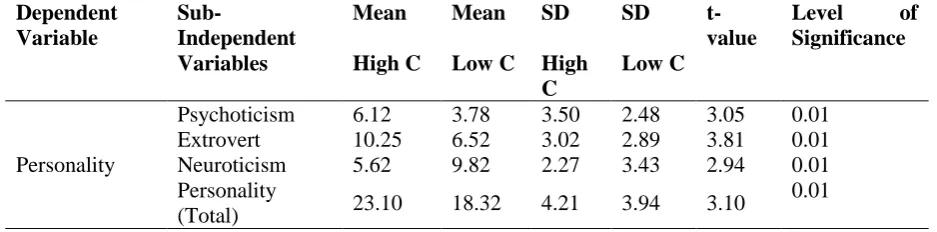
Table 3. shows that the „t‟ values between the personality of adolescents in relation to
high and low score of commitment was found to be statistically significant in all the areas of
Personality viz. Psychoticism (t=3.05), Extrovert (t=3.81), Neuroticism(t=2.94). It shows that
there was significant difference in the personality of adolescents in relation to high
SRJIS/BIMONTHLY/ MS ANUPAMA (680-686)
JULY-AUG, 2015, VOL-3/19 www.srjis.com Page 685 personality of adolescents with high and low level of commitment is differing significantly
with respect to various dimension of personality viz. Psychoticism, Extrovert and
neuroticism. Thus, hypotheses 5 also stands rejected.
EDUCATIONAL IMPLICATIONS
The study revealed that there is a significant difference in the personality of
adolescents with regard to their gender and level of commitment. So, it is very important for
parents and teachers to know the importance of psychological hardiness and its role in
increasing the commitment level of the students. Psychological hardiness among adolescents
in the age group of 17-18 years plays a very important role in their life and careers. It not
only helps them cope with the unnecessary stress and anxiety, but also help in making them
aware of their responsibility. So, efforts should be made by the teachers and the parents of the students to increase their emotional maturity. They may channelize an adolescent‟s energy
into constructive dimension, so they should act as the facilitators for them in helping them in
handling such situations by providing them appropriate atmosphere. It is useful for providing
guidance to the students to increase their level of hardiness in order to deal with stress
efficiently. The appropriate curriculum activities should be introduced in schools by
educational administrators and planners to enhance the level of hardiness in order to decrease
the stress among students. Group activities and team work should be organised among
students which develop the feeling of co-operation, social attitude, independence, tolerance,
acceptance of others, self-confidence and responsibilities.
REFERENCES
Edmund, R. T. and Gerard, P. P. (2015). The influence of trait affect and the five-factor
personality model on impulse buying. Personality and Individual Differences, 76,
216–221. Retrevied from http://www.sciencedirect.com/science/article /pii/S0191886
914007533
Eysenck, H.J. and Eysenck, S.B.G. (1980). Mannual of Eyseck‟s Personality Questionnaire-
Revised (EPQ-R). London: Hodder and Stoughton.
Feist, J. and Feist, G.J. (2002). Theories of personality. Translated by E. Sayed Muhammadi
SRJIS/BIMONTHLY/ MS ANUPAMA (680-686)
JULY-AUG, 2015, VOL-3/19 www.srjis.com Page 686 Geetanjali (2011). Academic achievement of eleventh class students in relation to their
personality and emotional intelligence. Unpublished M.Ed. dissertation, Punjab
University, Chandigarh.
Jagpreet (2010). Influence of gender and school climate on psychological hardiness among
Indian adolescents. Unpublished M.Ed. dissertation, Punjabi University, Patiala.
Kobasa, S. C. (1984). Personality and social resources in stress resistance. Journal of Personality and Social Psychology, 45(4), 839-850.
Mangal, S.K. (2005). Advanced Education Psychology. New Delhi: Prentice Hall of India
Pvt. Ltd. P 126.
Nowack, K. M. (1990). Initial development and validation of psychological hardiness scale.
American Journal of Health Promotion, 4(3):173-180
Westman, M. (1990). The relationship between stress and performance: The moderating