800
IMPLEMENTATION OF PANORAMA 360
OFOR VIRTUAL
TOURING AT TUGU PAHLAWAN MUSEUM SURABAYA
1MUHTADIN, 2I KETUT EDDY PURNAMA, 3AHMAD ZAINI, 4SURYA SUMPENO, 4DYAH
KARTIKAWATI
1,2,3,4
Researcher, Department of Networking & Multimeda, Institut Teknologi Sepuluh Nopember
2
Assoc. Prof., Department of Networking & Multimeda, Institut Teknologi Sepuluh Nopember E-mail: [email protected], [email protected], [email protected], [email protected]
ABSTRACT
Introduction to historical sites is one of education subject that less interested by the student and the public. One of historical sites is museum. Based on the data from Indonesian Tourism found that the number of visitors has decreased. It has been made several efforts to increase the number of visitors by displaying information such as text and image of the museum, but it cannot increase the number of visitors because of the image do not show the whole museum. In this research proposed one of the way to solve the problem by making virtual touring of Tugu Pahlawan Surabaya museum by using the 360o panorama. The making of panoramic image by combining 2D image by determining control point which connected each other. In this research obtained the result that more complex the existing object on the panoramic location the control point which is used more complex too. For running the virtual touring application, the size panoramic image which is used between 2700x1350 to 5927x2964 pixels because if we used panoramic’s image that has high resolution it will make the virtual touring application hard to run.
Keywords: Virtual Touring, Panoramic 360o, Image Panoramic.
1. INTRODUCTION
Introduction to historical sites is one of education subject that less interested by the student and the public. One of historical sites is museum. Museum is one of sites to increase the understanding and cultivation of the historical value to the public. However, the number of visitors has decreased until now. Based on the data from directorate of culture, tourism, youth, and sport, Depbudpar 2009, the number of visitors in 2006 is 4 milions of visitors, in 2007 decreased to 4.20 millions of visitors and in 2008 has decreased again to 4.17 millions of visitors.[1] This is because the ways to introduce the museum that is too monotonous and less interesting (usually form of a poster) that only use text or images that are difficult to be understood by the students and the community. However, there are people who have high interesting with the museum, but it has limitedness on distance, time, and cost.
It has been made several efforts to introduce the museum to the public among which the seminar about the importance to know the museum, create a poster, the form of website just text and images, make a motion that invites the public to introduce and to attract people to know the museum. Some of
the ways has done but still less to interesting the public and the students to know the museum.
Thus, to solve this problem, we need need some method that to increase interest the students and the public by way visualize the museum in 3D and virtual museum will be expected to introduce more interesting to the public.
2. VIRTUAL TOURING
A. Museum Tugu Pahlawan
Tugu Pahlawan (Heroes Monument) is a monument built to commemorate and remember the events of November 10 battle 1945, where
arek-arek Suroboyo (people of Surabaya) fighting
801 significance for the city of Surabaya as a symbol of courage in the fight against the invaders.
B. System Design
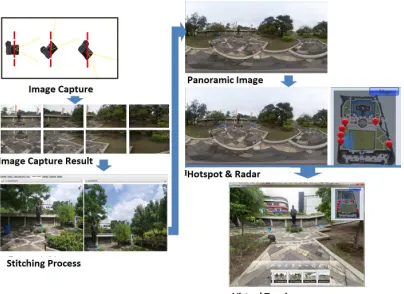
[image:2.595.306.522.332.427.2]Virtual touring is made with the panorama touring models of the museum and was given a description of museum objects that exist in the panorama.The making of virtual touring is done by capture image in the museum then performed the images stitching process for the combine into panoramic images museum. The Making of virtual touring have used of multiple panoramic image and linking the panoramic image to form a touring route. the result of Virtual touring then published in the website so that it can be used as an alternative media promotion for museum. System design flow of virtual touring shown in figure 1.
Figure 1 System Design
C. System Implementation
The implementation of system is be divided into three steps. The following steps are made on the implementation of the system:
1) Image Capture Process
Image capture is done using a digital SLR camera. The camera can be used in manual focusing so visibility unlimited. Before the image capture process first conducted studies museum floor plan. It is done to ease when the image capture process in determining the spot (location). Spot must have historical value and has a large area so that when the image capture did not have trouble. With the determination of the spot will be formed on the virtual touring.
Therefore, in this research has determined several spots that will be the image capture process. To the outside of the museum has been determined the ten spots and to the inside of the museum has
been determined that the eight spots will be the image capture process for the three spots in the museum parts on the first floor and five spots for the museum on the second floor of the inside
The capture of panoramic image from a spot, the camera position at the center spots so the spot must have a large area. Figure 2 is an image capture technique in this research. To obtain the 360 panoramic image , image capture is done 360° in the horizontal plane and 180° in the vertical plane. In Figure 2a shows the image capture technique using overlapping. It is done in order to easier in the merge image process.
The capture image is done by changing the position of the camera and the camera will be rotated 360° in the horizontal plane. For the vertical plane, the position angles of the camera be in the position 90°,45°,0°,-45°,-90°. The position angle of camera in the capture image to shown in figure2b. On the time the position angles of the camera be in a position 0° in the vertical plane was also the image capture by rotating the camera 360° in the horizontal plane. Similarly, to the image capture with another the position angles of camera it will be also the image capture of 360° in the horizontal plane.[2] This is done in order to obtain the images needed to form a panorama that has the spherical shape of a spot.
1) Stitching process
Stitching process is a process to combine 2D image capture of by determining the points (control points) are the same between one image capture of with another image, so as to result a panoramic image capture. Stitching process is divided into three stages. The following stages in the process of stitching:
[image:2.595.90.292.337.484.2]a) b)
802
A) Detection and Matching
In the detection and matching process image capture to be sought control point which connected each other. In determining control points must be precise because if the control point between continuous image does not match, then the results obtained will be a problem after the next process. The more control points are determined properly then the better the results generated panorama image.
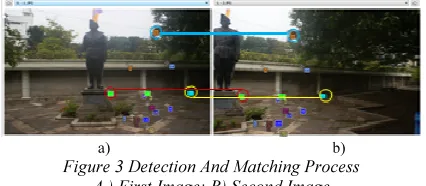
Figure 3 shows the process of determining control points in the two images are continuous with each other. The red line in Figure 3a shows the control points in the first image is placed at the end of the existing objects in panoramic location. Because the control point is a pair of points so that in Figure 3b for both images there are also a couple
a) b)
of the existing control points in Figure 3a are shown in the red line. Blue and yellow lines show the existing control point pair in Figure 3a and Figure 3b. Determination of control points between two images must have the closest match rate.
B) Warping
This process is done to transform the images into a panoramic images which spherical shape. In the warping process, the determination of control points at the previous stage is very influential when image is transformed. If it is less precise determination of control point there will be a shift in the position of images and errors in the transformation of images. So it is necessary to determine the control points back. Shift in position is often the case when deciding on a control point on a moving object and detail.
Elipse in Figure 4a shows that a shift in the position of image during the stitching process so that the image needs to be improved by changing the position of the control point. When changing the position of the control point is positioned on the right control point panorama image will not shift
position and there are no errors in the transformation of image. Existing red line in Figure 4b shows that after the warping process, not a shift in the position of the image.
a) b)
C) Fade,Blend
In the fade process, blend the color image will be aligned to related image due when image capture usually found differences in the brightness of the color on the object at a point about control point. In the fade, blend panoramic image projection can be selected as desired. In this study, using a projection to form spherical panoramic image. This is because using a form of spherical panoramic image can be viewed in 360 ° in the horizontal plane and 180 ° in the vertical plane.
In the fade process, blend to form a related image a mutually panoramic image that have spherical shape this takes quite a long time. To do fade process, blend and produce a panoramic image around 30-45 minutes. Panorama image results at this stage has a large size usually ranges 19564x 9782 pixels up to 20420x10210 pixels.
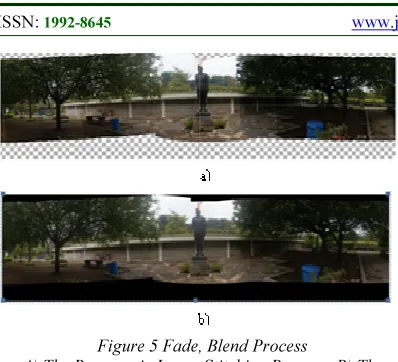
[image:3.595.306.506.193.277.2]Figure 5a shows the result of the panoramic image process. In Figure 5a shows that the panoramic image has a different color when combining 2D image fade process so it is necessary to process, blend the colors on which combined 2D image have the same color and no visible differences in color. Panorama image in Figure 5b does not look striking color differences between the 2D image it merging image. This is because in Figure 5b has done the panoramic image fade process, blend
Figure 3 Detection And Matching Process A ) First Image; B) Second Image
Figure 4 Warping Process
[image:3.595.87.300.342.435.2]803
3. VIRTUAL TOURING RESULT
[image:4.595.90.289.104.285.2]In the system that have been created, performed a 2D image process for producing a panoramic image of a spot. The resulting panoramic image is a panoramic image projected into spherical shapes. In fact the number of images required to form a 2D panorama image for each different spot. This is because each spot has a level of complexity, complexity, and intensity of light on objects that exist in different spots. Here the number of images used to create a panoramic image for each spot on the hero monument museum shown in Table1.
Table 1The Number Of Panoramic Image
No Panoramic Name Number of
Image
1. Patung Proklamator 48
2. Patung Jenderal Sudirman 49
3. Patung Mayjend Sungkono 54
4. Patung HR. Muhammad 57
5. Patung Gubernur Suryo 53
6. Patung Doel Arnowo 51
7. Patung Bung Tomo 52
8. Mobil Bung Tomo 44
9. Lapangan Upacara Tugu Pahlawan 46
10. Identitas Tugu Pahlawan 46
11. Sosiodrama Pidato Bung Tomo 43
12. Koleksi HR. Muhammad 47
13. Koleksi Foto dan Lukisan 41
14. Koleksi Pribadi Bung Tomo 55
15. Koleksi Senjata 45
16. Koleksi Replika Ultimatum Sekutu 55
17. Diorama Statis I 40
18. Diorama Statis II 40
From the Table 1 shows that for a spot that has a complexity, complexity, and intensity of light on an object that requires an average height between 50-60 so that the formation of a 2D image a panoramic image. While the spot that has a level of complexity, complexity, and intensity of light on objects that are on average takes between 40-50 2D image to form a panoramic image. Figure shows a screenshot of the application that we have made.
We have conducted a survey as a result of the implementation of this research. We had interviewed the management of the museum tugu pahlawan on the implementation of our virtual museum. Base on the interview, it can be concluded that overall Virtual touring is good but needs to be improved in terms of navigation and virtual tour guide. Respondents still find it difficult in running the existing navigation in the virtual touring and for a virtual tour guide needs to be added to the other spots, narrative to explain the history of the objects that are still lacking and sound for a virtual tour guide needs to be clarified.
To determine the success rate of virtual touring, we conducted a survey to visitors who will expected after touring a virtual community can try visiting museum Tugu Pahlawan.
[image:4.595.306.537.231.395.2]From the survey results, it can be concluded that overall virtual touring has been very good but needs to be improved in terms of navigation. Respondents still feel difficulties in running the existing navigation in the virtual touring. The map of museum on the virtual touring also need to be repaired. On the results of the questionnaire the majority of people assess the museum floor plan has been very good will but from the results of the questionnaire are also pretty much the judge that the plan museum still needs to be improved.
Figure 5 Fade, Blend Process
A) The Panoramic Image Stitching Process; B) The Panoramic Image Fade, Blend Process
Figure 6 Panoramic image in virtual touring application
a)Panoramic image of the original; b) panoramic image has been compressed
[image:4.595.83.295.480.711.2]804
4. CONCLUSION
This research has successfully implemented a virtual touring on the museum Tugu Pahlawan that can be used as an alternative promotion heroes memorial museum to attract the public to visit the museum. From the implementation, we get the following conclusion:
1. Image capture process should be done before at 11.00 o’clockBecause of at the time after 11:00 hours the sunlight will affect the intensity of light on objects that exist on the location of the image, so the image the results obtained less than the maximum. 2. Image capture can made with a 50% overlap
or more than 50% overlap to obtain maximum results.
3. The results of the survey showed that the manager of the virtual touring can be used as an alternative media campaign
4. The results of the community survey found that the image quality panoramic assessment is good and people are overall for virtual touring has been very good.
REFRENCES:
[1] Direktorat Kebudayaan, Pariwisata, Pemuda, dan Olahraga, 2009. Jumlah Pengunjung
Museum di Indonesia.
(http://kppo.bappenas.go.id/preview/225.html). Diakses 28 Mei 2013.
[2] Baki Koyuncu, Pınar Kocabaşoğlu, “Virtual Campus”, International Journal of Computers, Issue 4, Vol.1,2007. Issue 4, Volume 1, 2007 [3] Aznoora Osman, Nadia Abdul Wahab,
Mohammad Hafiz Ismail, “Development and Evaluation of an Interactive 360° Virtual Tour
for Tourist Destinations”, Journal of