
ISSN: 1992-8645 www.jatit.org E-ISSN: 1817-3195
1157
RESEARCH ON THE COMBINING OF COMPRESSED
SENSING AND NETWORK CODING IN WIRELESS SENSOR
NETWORK
JIPING XIONG1, JIAN ZHAO2 AND LIFENG XUAN3
College of Mathematics, Physics and Information Engineering, Zhejiang Normal University
Jinhua, Zhejiang Province, China
Email: [email protected] , [email protected] , [email protected], [email protected]
ABSTRACT
Wireless sensor networks (WSN) are faced with the problem that network size is inversely proportional to network lifetime because the number of data packets transmitted is equal to the number of communication nodes for recovering original signal. Compressed sensing(CS) compresses and samples in sparse domain of network source to reduce the amount of transmitted data to accurately reconstruct original signal which is far less than the number of network nodes, and thereby reducing total energy consumption of network. Network coding (NC) is applied to intermediate node to encode data before forwarding it rather than simply store and forward it, achieving balance of network load. This paper introduces research status of two emerging technologies, proposing combined method by researching their inner contact and applying them to WSN to expand network size while reducing energy consumption to prolong life of network. Furthermore, we conclude our work and point out future research directions.
Keywords: Compressed Sensing (CS), Network Coding (NC), Wireless Sensor Network (WSN).
1. INTRODUCTION
Wireless Sensor Networks (WSN)[1] consists of massive tiny sensor nodes which cooperate with each other to perceive information in target region firstly. Then gather and process them before transmitted to the sink node through the mode of self-organization and multi-hop. At last the information of sink node will be sent to the user by other network. With the development of the semiconductor technology and embedded system, WSN have emerged as a low-cost and large scale platform to capture the physical world for many applications such as military surveillance, infrastructure maintenance[2], infrastructure maintenance[3],animal monitoring[4], internet of things[5] and scientific inquiry[6]. Usually wireless sensor networks will inevitably increase the number of desired node in the network with the network size increases, and generally the sink node requires the number of data packets transmitted to accurately reconstruct the original signal is greater than the number of network codes. Since it consumes the energy of the nodes to transmit data packets, indicating that it will lead to the increase in the total energy consumption of the entire network if the network nodes increase, further emerge the problem
that the network size is inversely proportional to the network lifetime. The key to solve the problem is to reduce the number of the data packets required but still be able to accurately recover the original signal, and thereby reducing the energy consumption of the whole network. Furthermore, substantially balancing the energy consumption of each node can appropriately improve the life of the entire network. These are research hot spot.
1158 nodes codes the transmitted data firstly and then store and forward them, which improve network throughput while balancing the network load by taking full advantage of the network link to prolong the life of the entire network. According to the contact between compressed sensing and network coding, collecting and compressing data by compressed sensing in the source firstly, then coding and forwarding them through network coding at the intermediate nodes, at last recovering original information by reconstruction algorithm at the sink node. Combining the two applications to reduce the overall energy consumption of the network in order to extend the wireless sensor network lifetime while expanding its scale.
The paper is organized as follows. In section 2, we describe the research status of compressed sensing and network coding. Method of combining compressed sensing and network proposed in section 3. Finally, we draw some conclusions and sketch future work.
2. COMPRESSED SENSING AND
NETWORK CODING
2.1 Compressed Sensing
Compressed sensing is a new technology formally proposed in 2006 by Candes[7] and
Donoho[8] in signal processing domain and
developed rapidly recent years from theory to practical applications, which is widely applied to the field of signal and image processing, pattern recognition, and wireless communication.
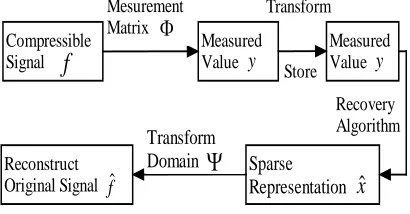
The core idea of compressed sensing is to sample and compress the signal simultaneously. When the signal is sparse or can be sparse in a transform domain, handle it with non-adaptive liner projection to acquire fewer measurement values, then store and transfer the values to the sink node in order to recover original information through recovery algorithm. Figure. 1 shows the theoretical framework of compressed sensing.
Compressible Signal
Measured Value Measured
Value
Sparse Representation
Transform
Store
y
f
Mesurement Matrix
y
Recovery Algorithm
x
ˆ
Reconstruct Original Signal fˆ
Transform Domain
Ψ
[image:2.612.92.297.593.700.2]Φ
Figure. 1 Theoretical Framework Of Compressed Sensing.
f
is the original signal,y
is the measured value, Ψis a sparse matrix,Φ
is the measurement matrix, the sparsity of the transmitted sparse matrixx
isK, andx
is the sparse representation of signalf
in transform domain Ψ.ΨΦ can be represented by sensing matrixA.Measurement matrix Φ∈RM×N
(
M <<N)
and signalf
are known, and measuring process is as follows:1 n n n n m 1 n n m 1
m
f
y
×=
Φ
× ×=
Φ
×Ψ
×x
× (1) As can be seen from the above formula, the amount of the measured value is far less than the original image signal and therefore greatly reducing the number of packets required for transmission.x
ˆ
can be reconstructed by solving the following formula in CS:xˆ=min ||x|| , s.t. y=Ax
0 (2)
Measured value
y
is known and A is sensing matrix in the formula, but the above formula is non-deterministic polynomial problem, when the projection matrix meets certain conditions, the problem ||x ||0 can be obtained by solving ||x||1 [9]:xˆ=min ||x||1, s.t. y=Ax (3) It can be seen from the framework of compressed sensing that research focus of CS primarily concentrates on the selection of sensing matrix and recovery algorithms.
Sensing matrix must satisfy restricted isometry property (RIP)[10]. Sensing matrix with a specific structure can improve the speed of the reconstruction algorithm. The practical sensing matrix is the matrix with special structure[11-14] including deterministic sensing matrices as well as matrices whose entries are random variables which are coupled across rows and columns in a peculiar way rather than Gaussian matrix considering the physical nature of the transmission process and the actual executable constraint. But it is still a problem to apply deterministic sensing matrices satisfying RIP features in range of optimal parameter to actual[15].
In addition to the
0
l and
1
ISSN: 1992-8645 www.jatit.org E-ISSN: 1817-3195
1159 for the reconstruction through convex optimization, and analog compressed sensing in Shannon Information Theory[19-20] is proposed to try to solve this problem. In addition, the iterative threshold algorithm is also proposed as an efficient computing way to solve large-scale convex programming problems[21-22] except its imbalance.
Applying compressed sensing to the wireless sensor network in the literature[23], it points out that distributed compressed sensing is only for the signal correlated in the time domain and introduces analog modulation and synchronous communication applied to the wireless sensor network. It puts forward the concept of local compressed sensing, considering the balance between reconstruction quality and transmission cost and analyzing the relationship between choice of routing scheme with design of sensing matrix, all these provide ideas and methods for how to apply compressed sensing to the wireless sensing network.
2.2 Network Coding
Network coding technology was proposed in year 2000 by R.Ahlswede[24], and it is an information exchange technology which combines coding and routing. The message sent from the source through the intermediate nodes does not perform any processing just simply be stored and then forwarded to the sink node in conventional computer communication network, but network coding technology encodes the transmitted message by using the intermediate nodes rather than only at the store-and-forward, which can realize maximum transmission capacity in theory and improve the utilization of the link bandwidth.
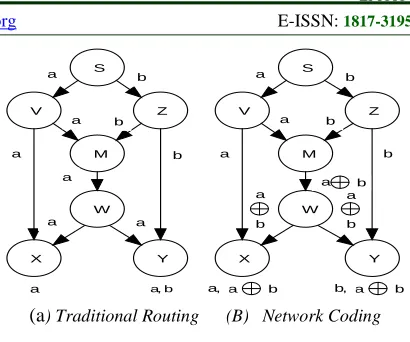
Figure. 2 shows the butterfly network model as an example of network coding, the capacity of each link is 1, S is the source node, X and Y are the sink nodes, V,M,W and Z are the intermediate nodes. According to the Max-Flow Min-Cut bound, X and Y can receive information a and b sent from S at the same time in theory. The traditional routing method is on the left image, which needs to use the link between M and V twice if X and Y all both receive information a and b. X and Y receive a total of three bits of information, so the rate is 1.5 bit/unit time. M perform XOR operation to the information on the right image, X can achieve b through
) (a b
a⊕ ⊕ , let the rate reaches to 2 bit/unit time, so the broadband utilization increased by 33%.
S
V
X M
Y Z
a b
a b
a b
a a
S
V
X M
Y Z
a b
a b
a b
a
a
a a, b b
a
b b
a, b,a b
W a
W
a b
[image:3.612.315.520.71.242.2](a) Traditional Routing (B) Network Coding
Figure. 2 Butterfly Network Model
Network coding can make use of other network links except the multi-cast tree to disperse network flow and balance network load to extend network lifetime. Simultaneously network coding can ensure the security of the data from a certain extent, since people can only achieve original data by knowing how to decode.
Applying network coding to the wireless sensor network, the liner network encoding is sufficient to acquire network capacity[25], but liner network coding can be applied to the actual when it only uses random coefficients[26]. Chou[27] proposes a coding scheme which uses random coefficients generated by the intermediate nodes to multiplies the same number of packets and form a new packet, but it will bring heavy burden since the nodes will consume too much power for transmitting data which is equivalent to the number of nodes. From another perspective, this in turn provides an opportunity for the combination of network coding and compressed sensing. In addition, network coding have the probability of decoding failure [28].
3. COMBINATION RESEARCH
3.1 Research Purposes and Practical Significance
1160 effectively reduce the number of packets transmitted and accurately reconstruct original data.
The advantages of CS technology mainly include less sampling, simple encoding and complex decoding, so computational capabilities at encoding end is relatively weak and is strong at decoding end because the decoding end is usually the base station or computer[29]. CS technology is applicable to WSN with limited power and computational capabilities and it generates a small number of linear projection values far less than the number of nodes will be able to accurately reconstruct the original signal at sink node, which can overcome the limitation of network coding as information exchange technology in wireless sensor
network. Combining these two emerging
technologies can extend network scale without affecting its lifetime which has strong research significance and application value.
3.2 Research Survey
In this paper, methods of combining compressed sensing and network coding are proposed by making use of the connection of each matrix in compressed sensing and network coding. It mainly researches combination of two technologies through these two aspects of encoding and decoding to improve transmission efficiency of the whole WSN by using CS to match NC at encoding end or decoding end.
Network coding technology should collect packets at least equal to the number of nodes will be able to recover original signal, otherwise achieve nothing. Considering that adjacent nodes will observe similar phenomena at the same time or the same node will observe similar phenomena in a certain period of time, which illustrates a certain correlation of data the nodes measured in the time domain or spatial domain, so every node produces a sparse random coefficient vector and nonzero coefficients in the vector match to the measured data of the nodes[30], in order to reduce the number of the packets need to be transmitted, illustrating correlated data is compressible. Compressed network coding is put forward to solve the problem of network utility maximization by exploiting the time-domain correlation of the data[31]. The concept of combination of CS and NC is proposed in [32] but ignores the data header overflow problem in practical applications and need to be further improved.
Liner network coding is used for transferring information and forming random projection values to display net-compression of the related measured
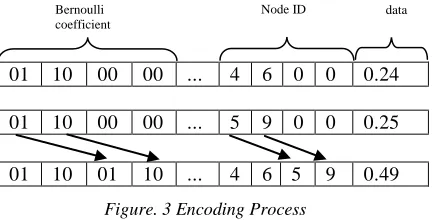
data in a practical scheme[33]. This scheme increase diversity to developing the characteristics of broadcast of wireless network, adapting the dynamic transmission characteristic of the wireless network, developing relevance of sensing measured data to reduce the amount of packet the sink node needed to reduce the communication overhead. It considers the relationship of the network coding matrix and compressed sensing matrix, and needs to let the transmission matrix satisfy RIP property as well as solve the header overflow problem, so Bernoulli matrix is used as sensing matrix. This matrix can simply realize the increase or decrease in the data packet and solve the header overflow problem. Figure. 3 shows the encoding process, i.e. Process of merging packets. The active node receives data packets with different node ID the adjacent nodes broadcast and emerges these packets until the length of the packet exceeds the set. The saturated packets are stored and then forwarded while the unsaturated packets continue to be broadcast and merged until it becomes saturated. At last the sink node collects a certain number of saturated packets and then recovers the original signal by solving the optimization problem.
01 10 00 00 ... 4 6 0 0 0.24
01 10 00 00 ... 5 9 0 0 0.25
[image:4.612.315.531.390.500.2]01 10 01 10 ... 4 6 5 9 0.49
Figure. 3 Encoding Process
But it ignores the specific routing scheme, just schedules data transmission lines to avoid conflict. There will be data loss when the scheduled link does not work. The detail routing method is put forward in the system model while combining CS with NC[34]. It prescribes that adjacent nodes within a fixed distance from each other can transmit data rather than transmit them in a predetermined link.
The link between transmission matrix of Random network coding and sensing matrix of compressed sensing is also discussed in [28], and compressed sensing is applied to the decoding end of network coding. It point out that random network coding can be decoded with a high probability, but still existing probability of decoding failure and resulting in transmission delay. It proves the transmission matrix of random network coding has the nature of sensing matrix of compressed sending and provides a network coding scheme based on random
Bernoulli coefficient
ISSN: 1992-8645 www.jatit.org E-ISSN: 1817-3195
1161 encoding and compressed sensing. The transmission matrix can be regarded as coefficient matrix of an indefinite equation when decoding is failed. Compressed sensing can be exploited to solve indefinite equation to continue decoding, which reduces the error rate of random network coding to some extent. This scheme realizes combination of CS and NC at sink node, but it needs to resend the packets when compressed sensing decoding is also failed.
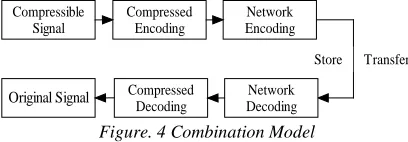
The study shows that there are a certain number of effects about combination of compressed sensing and network coding applied to wireless sensor network abroad. The combination is primarily used for reducing the number of data transmitted to lower power consumption of the nodes while balancing the load of each node in WSN in order to achieve more long-term life cycle of the overall network. It includes problems of signal or data acquisition, data transmission and routing, data fusion and signal reconstruction etc. Figure. 4 shows the general model of the combination according to the above studies:
Compressed Encoding
Network Encoding
Network Decoding Compressible
Signal
Compressed Decoding
Store Transfer
[image:5.612.91.295.372.443.2]Original Signal
Figure. 4 Combination Model
The above research of data transmission is based on the ideal case of no external influence, so it’s a challenge to data security when data loss and alteration appears because of the malicious attackers. Therefore, the researchers should not only solve the problem of transmitting large-capacity data but also consider data security. Of course, all of these should not have an influence on the lifetime of the network.
4. CONCLUSIONS AND FUTURE WORKS
Applying the combination of compressed sensing and network coding to wireless sensor network, which can effectively reduce the transmitted data and ensure the accurate reconstruction of the original signal in large capacity data transmitted network to reduce the power consumption, it can also balance network load through network coding to extend the lifetime of the whole network rather than change routing ways of the entire network on a large scale when some nodes stop working due to out of power.
Besides the research of connection of their matrix and the combination model for the combination of CS and NC, routing methods should also be considered. Applying efficient routing methods to match CS and NC can reduce power consumption of the network to a large extent. In addition, the research and selection of sensing matrix as well as reconstruction algorithm can ensure the correct and efficient combination of CS and NC. Moreover, the combination technology can be applied to other wireless networks with large capacity data transmission in addition to the wireless sensor network. These are all research hot-spot in future.
5. ACKNOWLEDGMENTS
This work is partially supported by the Opening Fund of Top Key Discipline of Computer Software and Theory in Zhejiang Provincial Colleges at Zhejiang Normal University.
REFERENCES
[1] Akyildiz L F, Su W L, “A Survey on Sensor Networks”, IEEE communications Magazine, 2002, 40(8), pp. 102 -114.
[2] T. He, S. Krishnamurthy, L. Luo, T. Yan, L. Gu, R. Stoleru, G. Zhou, Q. Cao, P. Vicaire, J.A. Stankovic, et al, “VigilNet: An integrated sensor network system for energy-efficient surveillance,” ACM Transactions on Sensor Networks (TOSN), vol. 2, no. 1, pp. 38, 2006.
[3] N. Xu, S. Rangwala, K.K. Chintalapudi, D.
Ganesan, A. Broad, R. Govindan, and D. Estrin, “A wireless sensor network for structural monitoring,” in SenSys 04, pp. 13– 24.
[4] A.Mainwaring, D. Culler, J. Polastre, R.
Szewczyk, and J. Anderson, “Wireless sensor networks for habitat monitoring,” in Proceedings of the 1st ACM International Workshop on Wireless Sensor Networks and Applications, 2002, pp. 88–97.
[5] Luigi Atzoria, Antonio Ierab, “The Internet of Things: A survey”, Computer Networks, Vol. 54, 2010, pp. 2787-2805.
1162
[7] Donoho D L, “Compressed sensing”, IEEE
Transactions on Information Theory, 2006, 52(4), pp. 1289-1306.
[8] E. Candès, “Compressive sampling”, In:
Proceedings of International Congress of
Mathematicians, Mathematical Society
Publishing House, 2006, pp. 1433-1452.
[9] E. Candès, T. Tao, “Robust uncertainty
principles: exact signal reconstruction from highly incomplete frequency information”, IEEE Transactions on Information Theory, 52(2), 2006, pp. 489-509.
[10] E. Candès, Romberg J, “Sparsity and
incoherence in compressive sampling. Inverse Problems”, 23(3), 2007, pp. 969-985.
[11] M. Lustig, D. Donoho, J.Santos, “Compressed sensing MRI”, IEEE Signal Processing Magazine, vol. 27, 2008, pp. 72-82.
[12] M. Herman, T. Strohmer, “High-resolution radar via compressed sensing”, IEEE Trans. on Signal Processing, vol. 57, no. 6, 2009, pp. 2275-2284.
[13] J. Haupt, “Toeplitz compressed sensing
matrices with applications to sparse channel estimation”, IEEE Trans. Inform. Theory, vol. 56, no. 11, 2010, pp. 5862-5875.
[14] G. Pfander, H. Rauhut, “The restricted
isometry property for time-frequency structured random matrices”, Preprint, 2011.
[15] J. Bourgain, S. Dilworth, K. Ford, S.
Konyagin, and D. Kutzarova, “Explicit constructions of RIP matrices and related problems”, Duke Math. J., vol. 159, no. 1, 2011, pp. 145-185.
[16] M. Burger, M. Moeller, M. Benning, and S. Osher, “An adaptive inverse scale space method for compressed sensing,” Technical Report 11-08, UCLA, 2011.
[17] S. Ma, “Fixed point and bregman iterative methods for matrix rank minimization”, Math. Program., vol. 128, no. 1, 2011, pp. 321-353. [18] R.G.Baraniuk, “Compressive sensing”, IEEE
Signal Processing Magazine, 24(4), 2007, pp. 118-121.
[19] D. Donoho, A. Javanmard,
“Information-theoretically optimal compressed sensing via spatial coupling and approximate message passing”, Preprint, [arXiv:1112.0708], 2011.
[20] Y. Wu, “Optimal phase transitions in
compressed sensing”, Preprint, [arXiv:1111.6822], 2012.
[21] M. Fornasier, “Iterative thresholding
algorithms”, Appl. Comput. Harmon, Anal, vol. 25, no. 2, 2008, pp. 187-208.
[22] A.Beck, “A fast iterative
shrinkage-thresholding algorithm for linear inverse problems”, SIAM J. Imaging Sci., vol. 2, no. 1, 2009, pp. 183-202.
[23] Marco F. Duarte, Godwin Shen, Antonio
Ortega and Richard G. Baraniuk, “Signal compression in wireless sensor networks”, Phil. Trans. R. Soc. A, 370, 2012, pp. 118-135.
[24] RAhlswede, NCai, “Network information
flow”, IEEE Trans on Information Theory, 46(4), 2000, pp. 1204-1216.
[25] S.Y.R. Li, R.W.N. Cai, “Linear network
coding”, IEEE Trans actions on Information Theory, vol. 49, no. 2, 2003, pp. 371-381.
[26] T. Ho, M. Medard, R. Koetter, “A random
linear network coding approach to multicast”, IEEE Transactions on Information Theory, vol. 52, no. 10, 2006, pp. 4413-4430.
[27] P.A. Chou, Y. Wu,“Practical network coding”, Allerton Conference on Communication, Control and Computing, 2003.
[28] GAO Chao, LI Sheng-hong, “Network Coding with Compressed Sensing Decoding”, Communications Technology, Vol.45, 2012.
[29] Angshul Majumdar, “Compressed sensing of
color images”, Signal Processing, 2010, pp. 3122-3127.
[30] W. Wang, M. Garofalakis, “Distributed sparse random projections for refinable approximation”, IPSN 07, 2007, pp. 331-339. [31] Chong Luo, Jun Sun, “Compressive Network
Coding for Approximate Sensor Data
Gathering”, Global Telecommunications
Conference, Dec, 2011.
[32] S. Katti, “Real Network Codes”, Allerton Conference on Communication, Control and Computing, 2007.
[33] N. Nguyen, Krishnamurthy, “Netcompress:
Coupling Network Coding and Compressed Sensing for Efficient Data Communication in Wireless Sensor Networks”, in IEEE SIPS, Urbana, IL, October, 2010.
[34] Megumi Kaneko, Khaldoun. Al. Agha,
“Compressed Sensing based Protocol for EfficientReconstruction of Sparse Superimposed Data in a Multi-Hop Wireless
![Assessment of Physiological Health Status in Relations to Different Anthropometric and Cardio respiratory Measures of Head Supported Load Carrying Male Porters of Sikkim, India [Article Retracted]](data:image/gif;base64,R0lGODlhAQABAIAAAP///wAAACH5BAEAAAAALAAAAAABAAEAAAICRAEAOw==)