
HARMONIC RESPONSE ANALYSIS AND OPTIMIZATION
OF HZS150 CONCRETE MIXING STATION
1HU GAO, 1HUI LI, 2*RUILIAN HOU
1
Department of mechanical engineering, Zaozhuang Vocational College of Science & Technology Tengzhou 277500, Shandong , China
2 Information School,
Shandong Polytechnic University, Jinan 250353, Shandong, China
*Corresponding author
ABSTRACT
Through the research, design datas are provided for the enhancing product performance and competitiveness. In the paper, based on problems that exist in the construction of concrete mixing station, actual conditions of Tengzhou city and research results in China United cement plant, concrete mixing station’s overall structure is designed. And the structure’s harmonic response and dynamic properties are analyzed based on its characteristics with HZS150 mixing station of steel structure as the carrier; the overall structure is also optimized.
Keywords: HZS150, Mixing Station, Harmonic, Power performance
1.
INTRODUCTIONAlong with increasing urbanization in China, as a developing city, Tengzhou’s basic construction is booming, which causes the great development of concrete machinery [1]. Tengzhou is a third-tier city which is rapidly developing, the demand for concrete increases, and concrete mixing station and concrete mixing building is becoming more and more important. However, the city's concrete mixing stations still face the issues of low technical content, large regional difference and low quality. Some products even have low production capacity, low automation degree, low weighing precision and poor environmental performance. On the other hand, Tengzhou has a small economic scale; most of manufacturers need equipments which feature less investment, high degree of automation, high mixing quality, high production capacity, high weighing precision and continuous production[2,3].
2.
ARCHITECTURE DESIGN OF HZS150CONCRETE MIXING STATION
(1) Structure of main body
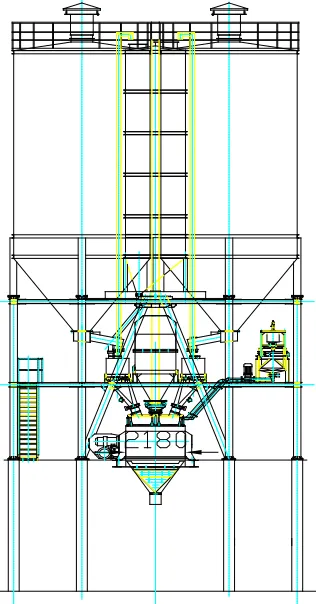
In this paper, HZS150 is the research object, it is 25.4 m high, symmetrical appearance is emphasized, roof, upper bracket, batching, mixing layer, middle layer and lower upright post are main parts, the platform’s primary and secondary beams
are formed by welding. The main structure is composed of upper frame, bent frame, " door"-shape frame, belt conveyor, aggregate batching device, mixing platform and ingredients platform, its whole structure is shown in figure1[4,5].
Ingredient layer platform, belt conveyor and bracket are in furnish layer platform, unloading device collect aggregate, water, liquid admixture, cement, coal according to certain proportion, and then feed them into the mixer.
(3) Mixing layer platform
Concrete hopper is installed under mixing layer platform, and a mixer (2000L) is installed in the platform, the mixer has an unloading device, the system’s main function is mixing concrete evenly.
3.
ANALYSES3.1 Harmonic response analysis
Harmonic response is continuous periodic response in the whole system caused by mechanical load. In this paper, the ANSYS method is used for harmonic response analysis, namely, the responses in the structure are determined in different frequencies, responses are found in corresponding frequency curve, peak values in the curves are observed[6,11]. Harmonic loads in three directions are respectively
: x 2000 sin(2 )
X F = π f t (1)
: 3375sin(2 )
Y Fy= − πf t (2)
: 150 sin(2 )
The values for the three directions are different, but their frequencies are the same.
(1) In X direction, with harmonic load, the displacement of column vertex and central node of edge beam of mixing layer in X direction is the research subject, the displacement of the nodes under various frequencies is analyzed, as shown in Figure2 and Figure 3 ( From figure 2- figure 8, X axis represents frequency, y axis represents axial displacement ).
Figure 1: Design Of Overall Structure
[image:2.612.319.519.81.222.2]Figure 2: The Displacement Of Central Node Of Edge Beam Of Mixing Layer In X Direction
Figure 3: The Displacement Of Column Vertex In X Direction
(2) In Y direction, with harmonic load, the displacement of support node of mixer and central node of mixing layer’s edge beam is the research subject, and the displacement of the nodes under various frequencies is also analyzed, as shown in figure 4 and figure 5.
(3)In Z direction, with harmonic load, the displacement of upper column top and central node of mixing layer’s edge beam is studied, as shown in figure 5 and figure 6.
[image:2.612.107.265.227.529.2]Based on the analysis from figure 2 to figure 7, it is found that: (1) Mixer’s vibration frequency is proportional to response value, response curve rise with large frequency, and response curve decrease with small frequency, and the three kinds of loads cause the same response. (2) The structure’s vibration frequency shall be between 0.75 and 1.25, when excitation frequency =2.1HZ, peak will appear.
[image:2.612.332.505.486.609.2]Figure 5: The Displacement Of Support Node Of Mixer
[image:3.612.327.510.155.335.2]Figure 6: The Displacement Of Central Node Of Mixing Layer’s Edge Beam
Figure 7: The Displacement Of Upper
3.2 Dynamic Performance Analysis
When there are harmonic load in all of the three directions, no phase difference exist; when there is harmonic load in one of the directions, the structure has the same response. So the analysis of internal force and deformation in peak should be conducted when harmonic load exists in all of the three directions.
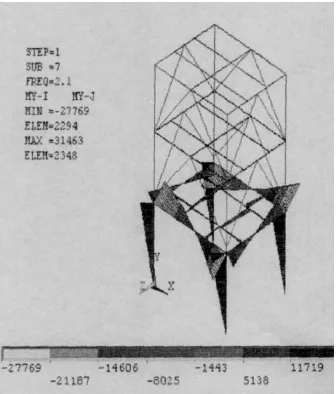
(1)Characteristics of the distribution of internal force: (see figure 8- figure 11)
In this paper the mixer’s harmonic load is considered, the purpose of doing so is to reflect the influence of dynamic load on components; the features of internal force distribution are shown from figure 8 to figure 11.
[image:3.612.113.289.256.387.2]Figure 8: Axial Force
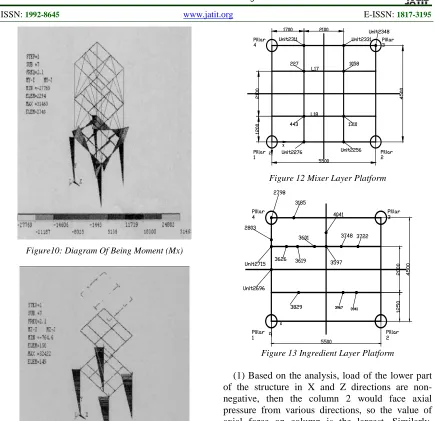
[image:3.612.313.481.366.563.2]Figure10: Diagram Of Being Moment (Mx)
Figure11: Diagram Of Being Moment (Mz)
[image:4.612.90.525.67.488.2]Through the above analysis, it is found that lower part of the structure is exposed to large impact; it is due to force from mixing platform on dynamic load. In Figure 12 and figure 13, positions of column 1, column 2, column 3, and column 4 are shown.
[image:4.612.279.517.69.429.2]Figure 12 Mixer Layer Platform
Figure 13 Ingredient Layer Platform
(1) Based on the analysis, load of the lower part of the structure in X and Z directions are non-negative, then the column 2 would face axial pressure from various directions, so the value of axial force on column is the largest. Similarly, various forces on the point will mutate.
(2) According to the above analysis, because checkered plates are densely laid on the platform, its overall rigidity is improved, so MHz can be ignored. The maximum value of positive M appear in main edge beam of anterior root, and the maximum value of negative M appear in main edge beam of posterior root; The maximum value of positive bending moment appear in beam end near column 2 and column 3, the maximum value of negative bending moment appear in beam end near column 1 and column 4, there is a inflection point in the middle. The maximum positive axial force appears in beam end near column near column 1 and column 4, the maximum negative axial force appear in beam end between column 2 and column 3, there is inflection point in the middle[12]. In this paper, only strength and stiffness are considered.
column’ oblique palm bear pressure, so behind pressure is larger than the side pressure.
3.3 Optimization
According to the current situation of concrete mixing stations in Tengzhou cit and the above analysis, the optimization scheme is as follows.
(1) Structure model
Space tower structure is used as reference, considering wind loads impact on space, in the plane model, the upper part and the middle beams are considered as a beam.
(2) Selection of section
When mixer is working, forces from X and Y directions are not balanced, to ensure balance of “door "-shape frame, inner forces are calculated according to “well"-type beam, and section of main beam within the platform is selected.
(3) Overall structure
In order to avoid the risk of resonance, dragon door-shape frame is used to replace door-shape frame, as long as concrete transport vehicles can enter and leave smoothly.
4.
CONCLUSIONThrough the research, design data are provided for the enhancement product performance and competitiveness. In the paper, based on problems exist in the construction of concrete mixing station, actual conditions of Tengzhou city and research results in China United cement plant, mixing station’s overall structure is designed. And the structure’s harmonic response and dynamic properties are analyzed based on its characteristics with HZS150 mixing station of steel structure as the carrier; the overall structure is also optimized. It is found that the structure has great application and promotion value.
ACKNOWLEDGEMENTS
This work was supported by the natural science fundation Project of Shandong Province, China (No. ZR2011FM028).And it was supported by Shandong Province college science and technology plan project (No.J12LN10).
REFERENCES:
[1] Al Qadi, A., Bin Mustapha, N. K., AL-Mattarneh, H., and AL-Kadi, Q., “Statistical models for hardened properties of
self-compacting concrete”, American Journal of
Engineering and Applied Sciences, Vol. 2, No.
4, 2009, pp. 764–770
[2] Al Qadi, A., Bin Mustapha, N. K., AL-Mattarneh, H., and AL-Kadi, Q., “Central composite design models for workability and
strength of self-compacting concrete”, Journal
of Engineering and Applied Science, Vol. 4,
No. 3, 2009, pp. 177–183.
[3] Ferraris, C. F., Brower, L., Daczko, J., and Ozylidirim, C., “Workability of self-compacting
concrete.” Journal of Research National
Institute of Standards and Technology (NIST),
Vol. 104, No. 5, 1999, pp. 461–478
[4] Khatib, J. M., “Performance of self-compacting
concrete containing fly ash”, Construction and
Building Materials, Vol. 22, No. 9, 2008, pp.
1963–1971.
[5] Phan, T. H., Chaouche, M., and Moranville, M., “Influence of organic admixtures on the
rheological behavior of cement pastes.” Cement
& Concrete Research, Vol. 36, No. 10, 2006,
pp. 1800–1806
[6] Richart F E, Brandtzaeg A, Brown R L, “A study of failure of concrete under combined
compressive stresses”, Engineering Experiment
Station Bulletin, No. 185, University of Illinois,
Urbana.
[7] Yong Y K, Nour M G, Nawy E G, “Behaviour of laterally confined high-strength concrete under
axial loads”, J. Struct. Eng., 114, 1998, pp.
333–351
[8] Ahmad S H, Shah S P, “Stress-strain curves of
concrete confined by spiral reinforcement”, J.
Am. Concret. Inst., 79, 1982, pp. 478–484
[9] Vaidyanathan, P. P., & Weng C., “Active beamforming with interpolated FIR filtering”,
"In Proceedings of International Symposium on
Circuits System ISCAS, 2010, pp. 173–176.
[10] Liu Y., Lin Z., “On the applications of the frequency-response masking technique in
array beamforming”, Circuits, Systems and
Signal Processing, Vol. 25, No. 2, 2006, pp.
201–224
[11] Abraham T, Carthy J, McManus B, “Collagen matrix remodeling in 3-dimensional cellular space resolved using second harmonic generation and multiphoton excitation
fluorescence”, J Struct Biol, Vol. 169, 2010,
pp. 36–44.
[12] Linkens, D.A., “Analytical solutions of large number of mutually coupled nearly sinusoidal
oscillators”, IEEE Trans. Circuits Syst., Vol.
[13] Brown MD, Smith CA, Sellers JG, Folliard KJ, Breen JE, “Use of alternative materials to reduce shrinkage cracking in bridge decks”,
ACI Mater J 104, 2007, pp. 629–637
[14] Hadidi R, Saadeghvaziri M, “Transverse cracking of concrete bridge decks: state of the
art”, ASCE J Bridge Eng, Vol. 10, No. 5, 2005,
pp. 503–510
[15] Khayat KH, Yahia A, “Effect of Welan gum-high range water reducer combinations on
rheology of cement grout”, ACI Mater J , Vol.
94, No. 5, 2005, pp. 365–372
[16] Saak AW, Jennings HM, Shah SP, “New methodology for designing self compacting
concrete”, ACI Mater J, Vol. 96, No. 6, 2001,
![Assessment of Physiological Health Status in Relations to Different Anthropometric and Cardio respiratory Measures of Head Supported Load Carrying Male Porters of Sikkim, India [Article Retracted]](data:image/gif;base64,R0lGODlhAQABAIAAAP///wAAACH5BAEAAAAALAAAAAABAAEAAAICRAEAOw==)