A U G U S T 1 9 9 8
WRL
Research Report 98/5
Efficient
Dynamic
Procedure Placement
Daniel J. Scales
The Western Research Laboratory (WRL) is a computer systems research group that was founded by Digital Equipment Corporation in 1982. Our focus is computer science research relevant to the design and application of high performance scientific computers. We test our ideas by designing, building, and using real systems. The systems we build are research prototypes; they are not intended to become products.
There are two other research laboratories located in Palo Alto, the Network Systems Lab (NSL) and the Systems Research Center (SRC). Another Digital research group is located in Cambridge, Massachusetts (CRL).
Our research is directed towards mainstream high-performance computer systems. Our prototypes are intended to foreshadow the future computing environments used by many Digital customers. The long-term goal of WRL is to aid and accelerate the development of high-performance uni- and multi-processors. The research projects within WRL will address various aspects of high-performance computing.
We believe that significant advances in computer systems do not come from any single technological advance. Technologies, both hardware and software, do not all advance at the same pace. System design is the art of composing systems which use each level of technology in an appropriate balance. A major advance in overall system performance will require reexamination of all aspects of the system.
We do work in the design, fabrication and packaging of hardware; language processing and scaling issues in system software design; and the exploration of new applications areas that are opening up with the advent of higher performance systems. Researchers at WRL cooperate closely and move freely among the various levels of system design. This allows us to explore a wide range of tradeoffs to meet system goals.
We publish the results of our work in a variety of journals, conferences, research reports, and technical notes. This document is a research report. Research reports are normally accounts of completed research and may include material from earlier technical notes. We use technical notes for rapid distribution of technical material; usually this represents research in progress.
Research reports and technical notes may be ordered from us. You may mail your order to:
Technical Report Distribution
DEC Western Research Laboratory, WRL-2 250 University Avenue
Palo Alto, California 94301 USA
Reports and technical notes may also be ordered by electronic mail. Use one of the fol-lowing addresses:
Digital E-net: JOVE::WRL-TECHREPORTS
Internet: [email protected]
UUCP: decpa!wrl-techreports
To obtain more details on ordering by electronic mail, send a message to one of these addresses with the word ‘‘help’’ in the Subject line; you will receive detailed instruc-tions.
Efficient Dynamic Procedure Placement
Daniel J. Scales
August 1998
i
Abstract
Efficient Dynamic Procedure Placement
Daniel J. Scales
Western Research Laboratory
Compaq Computer Corporation
[email protected]
Abstract
Commercial applications such as database servers often have very large instruction foot-prints and consequently are frequently stalled due to instruction cache misses. A large fraction of the i-cache misses are typically due to conflicts in the relatively small direct-mapped on-chip instruction caches. A variety of tools have been developed to try to order the procedures of an application to minimize these conflicts. Such tools often make use of profile informa-tion to place procedures so that procedures that frequently call each other do not conflict in the i-cache. However, users often avoid using any kind of tool that requires them to do extra profil-ing and linkprofil-ing steps to optimize their application. In addition, any tool that does a static layout of procedures (whether using profiling information or not) cannot adapt to varying application workloads that cause very different application behavior.
We have developed a method called DPP (dynamic procedure placement) for placing pro-cedures at run time for good i-cache performance and have implemented it for Digital Unix on Alpha servers. Our system uses a run-time loader similar to a shared-library loader and is completely transparent. Our method efficiently invokes the loader at procedures calls and also correctly handles indirect procedure calls. We have developed a variety of extensions, in-cluding run-time code optimizations and a way of restarting the procedure placement while an application is running. In this paper, we describe our method, explain the difficult implement-ation issues, discuss our extensions, and give performance results for a variety of benchmarks and the Oracle database server. We also provide detailed simulation results using the SimOS-Alpha full-machine simulator.
1
Introduction
The code sizes of commercial applications are often extremely large, because they provide a large
number of features and extensive safeguards for security and reliability. These applications include
personal productivity software, such as word processors and spreadsheets, workflow applications,
such as SAP R/3, and database servers. On any given run, these applications will likely execute
only a fraction of their code, but the instruction footprint is often still very large. Because of
their large footprints, such applications incur frequent instruction cache misses. While some of the
cache misses are unavoidable capacity misses, many of the misses are due to conflicts in relatively
small on-chip instruction caches which are direct-mapped or have small set associativity.
For example, the Alpha version of the Oracle 7.3 database includes 9 megabytes of
instruc-tions. When Oracle runs an on-line transaction processing (OLTP) application similar to the TPC-B
benchmark or a decision support (DSS) application similar to the TPC-D benchmark, the
instruc-tion footprint is about 1 megabyte. During these runs, instrucinstruc-tion stalls can account for 25-30% of
the execution time of the Oracle database server on an AlphaServer 4100 multiprocessor [1].
A variety of tools have been developed to try to order the procedures of an application to
min-imize these i-cache conflicts and reduce stalls. Some tools simply make use of static information
such as the structure of the call graph, while other tools use profile information from a previous
run that contains the calling frequency between each pair of procedures or even full traces.
Vari-ous algorithms have been developed to use these types of information to place procedures so as to
reduce conflicts [4, 5, 8]. However, users often avoid using profiling tools that require them to do
an extra profiling run and re-linking step in order to optimize their application. More importantly,
any tool that does a static layout at compile or link time (whether using profiling information or
not) cannot adapt to varying application behavior caused by differing inputs. This limitation is
especially problematic for applications such as databases which have so many distinct components
and features. For example, the code exercised in the Oracle server is quite different when executing
an on-line transaction processing (OLTP) application versus a decision support (DSS) application.
A fixed procedure layout cannot possibly be optimal for these different workloads.
We have instead developed a method for doing placement of procedures at run time. Our
method, which we call DPP (for dynamic procedure placement), is completely transparent. The
user does not have to do any extra profiling or relinking steps, and the image of the application on
disk is left unchanged. In addition, because the layout occurs at run time, DPP produces different
layouts for each individual run that are tailored to that run. In the default setup, DPP places
procedures consecutively in a text segment (i.e. code segment) as they are called. Therefore,
any procedure that is not called in a particular run is never placed in the text segment. In addition,
procedures that call each other are likely to be placed near each other. However, we have developed
a number of extensions to the default arrangement. We have designed a way of restarting the
procedure layout in the middle of a run, so that the procedures used in the core part of the run can
be placed together. In addition, we have developed a method of doing automatic profiling at run
procedures are placed so as to reduce conflicts.
We have implemented DPP for Digital Unix on Alpha workstations and servers using a
run-time loader similar to a shared-library loader. The basic method initially maps the application code
in its normal location in the address space, and creates a new empty text segment. The loader then
copies the starting procedure of the application to the new segment, but changes all procedure calls
to call back to the loader instead. As the application runs, the loader will be invoked whenever
a procedure attempts to call another procedure at a new call site. The loader then determines
what procedure is being called, and copies that procedure to the new text segment, if not already
there, again replacing procedure calls. Complexities such as indirect procedure calls and branches
outside of a procedure are also handled. Our method is fully implemented, and we have used it for
a variety of complex applications, including an Oracle database.
Chen and Leupen [2] have previously proposed a method for doing procedure placement at run
time called “Just-In-Time Code Layout” (JITCL). We have adopted their activation-order heuristic
of placing procedures consecutively as they are called as our default, but use a fundamentally
different approach to catch calls to unplaced procedures. In addition, they did not develop an actual
implementation of JITCL, but instead relied on simulation to determine potential performance
benefits. Because they only simulated their method, they apparently did not solve several important
problems for real applications, such as catching the use of indirect procedure calls. As described
above, we have also developed a number of extensions to the basic layout heuristic.
In the following section, we describe our basic method for dynamic procedure placement and
our solutions for some difficult problems encountered in real applications. We also describe the
limitations of our approach. Next, we describe a number of extensions to our basic method. We
then give performance results when using DPP, both on SimOS-Alpha, a complete machine
simu-lator, and on actual machines, for a number of standard benchmarks and for a database application.
Finally, we describe related work and conclude.
2
Design and Implementation
In this section, we describe the design and implementation of DPP (dynamic procedure placement).
In the first section, we describe the basic method. We then describe the additional problems that
must be handled to run complete applications. Finally, we discuss some of the limitations of our
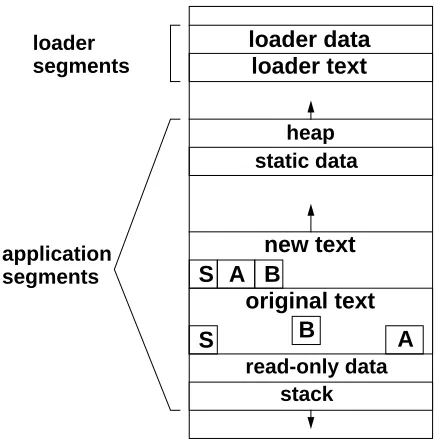
stack read-only data
original text new text
static data heap
loader text loader data
S B A S A B
application segments
[image:8.612.153.373.77.297.2]loader segments
Figure 1: Memory layout for DPP
2.1
Basic Method
Our method makes use of a dynamic loader that is similar to the shared-library loader that is used
in most current UNIX systems to link applications with shared libraries at run time. This dynamic
loader gains control when an application marked for dynamic procedure placement is invoked.
The loader maps in all the appropriate segments of the application, but creates an empty text
(code) segment immediately following the original application text segment. Figure 1 illustrates
the layout of the application and loader segments. The loader then copies the starting procedure S
of the application from the original text segment into the start of the empty text segment. While
copying, the loader replaces all procedure call instructions by calls back to itself, and also does all
necessary relocations, as indicated by relocation entries in the application executable. The loader
then calls the starting procedure at its new location. As the application runs, the loader will be
invoked when a procedure A attempts to call another procedure B at a new call site. If B has not
been yet been placed, then the loader copies B to the end of the new text segment, again replacing
procedure call instructions and doing relocations. In either case, the procedure call instruction at
the call site in A is updated to call B directly, if it was originally a direct procedure call. The loader
than allows execution to continue. Eventually, the application reaches a steady state in which there
is no loader overhead, because all the procedures it is using have been placed and all the call sites
have been patched.
The main difficulty with this approach is dealing with indirect procedure calls. Most RISC
specific to the Alpha, we will reference these instructions via their name on the Alpha processor:
BSR (direct) and JSR (indirect). BSR instructions call a specific procedure, usually specified
by a relative offset from the current program counter. JSR instructions call a procedure whose
absolute address is specified by the contents of a register. JSRs are frequently used to call specific
procedures when the distance between the calling and called procedures is too large or unknown
until link time. However, JSRs also provide the flexibility to call many different procedures at a
single call site based on the current value of a register. We will refer to a data value that contains
the starting address of a procedure and can be used as the argument of a JSR as a procedure pointer.
Procedure pointers are used in implementing a similar concept in higher-level languages, known
as function pointers in C and other languages.
Our problem is that any memory location or register can contain a procedure pointer. Therefore,
the loader cannot possibly correctly update all procedure pointers that contain the old address of
a procedure A so that they now point to the new address of procedure A in a new text segment.
Depending on the relocation or type information available in the executable, the loader may know
the location of all procedure pointers at the start of the program, but it does not yet know the
new locations of procedures, so it cannot update the procedure pointers. The procedure pointers
may then be copied arbitrarily into newly allocated data structures before the procedures that they
reference are placed in the new text segment.
Our solution is to catch indirect procedure calls to “old addresses” via virtual memory
protec-tion. We map the original text into the address space at its default location, but we protect it as
non-executable (using the Unix mmap system call). We use this mapped region as the source for
procedure instructions when copying procedures to the new text region. However, if an indirect
procedure call is made using a procedure pointer that references an “old address” in the original
text region, then a memory protection fault will occur. Under Digital Unix, the loader can obtain
control via a signal handler and then take the appropriate steps to copy the destination procedure,
if necessary, and update the procedure pointer. Note that we don' t use this method to trap direct
procedure calls, because we wish to avoid the faulting overhead in the common case.
We may now give our method in detail as shown in Figure 2. In step 2, the calls to the loader
use the same return register as the original call, so no register contents are lost. Different entry
points to the loader are used for different return registers. Note also in step 4 that the dynamic
loader returns to the call site and executes the newly replaced call instruction, rather than calling
procedure B directly. The reason is that the dynamic loader would have to use a JSR to call B,
and therefore a register would have to hold B' s address. Therefore, that register' s contents would
1. Map all of the text and data segments of the application in their standard locations in the address
space, but protect the text segment so that it is not executable.
2. Create a new, empty text segment and copy the starting procedure of the application from the
original text segment to the start of the new segment. Replace all procedure call instruc-tions by calls to the loader and do any other necessary relocation changes based on the new location of the procedure.
3. Begin execution of the copied procedure.
4. Whenever the dynamic loader is called from the application, do the following:
based on the return address, original call instruction, and current register contents,
de-termine the call site A that invoked the loader and the procedure B that the application would have called at that site.
if B is not already placed in the new text segment, copy B to the current end of the new
text segment, again replacing all procedure call instructions and doing all relocations. Also update any statically-known procedure pointers to B in the read-only data segment so that they point to the new address of B. If the original call was a JSR, then also update the contents of the register that will be used by the JSR to be the new address of B.
replace the instruction at the call site with the instruction of the original application, if
it was a JSR, or by a direct call to the new address of B, if it was a BSR.
return to the original call site and execute the newly replaced call instruction.
5. Whenever the dynamic loader is invoked by a signal handler because of a JSR to an address in
the original text segment, do the following:
based on the PC, original call instruction, and current register contents, determine the
call site A that caused the fault and the procedure B being called.
as above, if B is not already placed in the new text segment, copy B to the current end
of the new text segment, making the usual changes.
update the contents of the register that will be used by the JSR to the new address of B. return from the signal handler (which will cause the original call instruction to be
re-executed)
or zero, zero, r18 L: ldq r27, 48(r14)
ldq r19, 848(sp) ldq r16, 56(r14) jsr r26, (r27)
Figure 3: Sample Code for Indirect Call
returns to the call site via the same return register as the original call instruction. Since that register
is immediately used as the return register on the call to B, all register contents will be correct on
entry to B.
2.2
Complexities
In this section, we discuss a few more implementation complexities that must be resolved to run
complete applications.
First, some applications have code (in just a few places) that actually branches to another
procedure without saving any return address. Since the destination procedure may not be placed
yet, we must call the loader in this case, but there is no obvious register to use for saving the return
address. One solution is to do some dataflow analysis when placing procedures containing such
code to determine which registers are not being used. This option can potentially add a fair bit
of computational overhead and extra code to the loader. Our approach is to modify the branch to
jump to new code added at the end of the procedure that explicitly saves a register before calling
the loader. By placing the new code at the end of the procedure, we avoid having to update relative
branches within the procedure and we also avoid having the added code interfere with the execution
of the procedure after the branch is restored to call the new location of the destination procedure.
We also encountered some applications which has a large number of virtual memory faults
because of the repeated use of procedure pointers that the loader had not updated with a new
address. This problem typically occurs when the procedure pointer is copied from its original
static location to one or more locations in data structures. When the procedure referenced by the
procedure pointer is finally placed, the loader cannot update all instances that refer to the procedure.
Although the number of such traps still did not cause significant overhead, we were interested in
reducing the number of traps where possible. Fortunately, it is usually easy to do simple analysis
of the code at a call site to determine where the procedure pointer that is being used is located.
Whenever a trap occurs, the loader therefore inspects the instructions preceding the call site. The
load instruction L used to load the procedure pointer can almost always be identified. Figure 3
loaded with values that are arguments to the called procedure. r27 is loaded with a procedure pointer that contains the address of the called procedure. r26 is the return register for the call. Once it has identified the proper load instruction, the loader can calculate the memory location
of the procedure pointer and update it with the new address of the procedure, as long as a few
conditions hold. First, the registers used in calculating the effective address in instruction L cannot
have been modified between L and the JSR instruction. Similarly, no stores can occur between L
and the JSR. Finally, there cannot be any branches to instructions between L and the JSR. This
method of updating procedure pointers is highly effective in eliminating almost all virtual memory
faults once the application has reached a steady state.
Another implementation problem that we encountered was determining the call site when the
loader was invoked by a signal. The signal results because a particular call site used a JSR to call
an address in the original text segment. However, in Digital Unix, the information provided to the
signal handler does not include a direct indication of the call site address. In most RISC systems,
a standard register is used to store the return address of the call. Therefore, the signal handler can
typically determine the call site based on the contents of the standard return register. We ensure
that this method always works by modifying the very few procedures that do not use the standard
return register when doing a JSR as the loader copies them to the new text segment.
2.3
Limitations of our Approach
While the large majority of all applications can be handled transparently by our method, there are
some restrictions on the applications that can be executed. First, applications that do arithmetic
calculations on procedure pointers (or function pointers in C) may not work correctly, since the
offsets between various procedure pointers will be different in the original static layout and the
dynamic layout. Arithmetic on function pointers is, of course, not a good programming practice,
and is allowed only in a few higher-level languages like C that do not have strict type systems.
Second, applications that do comparisons between procedure pointers may not work correctly.
Certain procedure pointers may be updated when the referenced procedure is first placed, while
other procedure pointers are never updated or only updated later (because they can' t immediately
be located by the loader). Therefore, a comparison of procedure pointers that really reference the
same procedure may fail incorrectly, because one pointer contains the old address of the
proced-ure and the other pointer contains the new address. Again, applications are very unlikely to do
comparisons of procedure pointers, since comparison of associated explicit tags would be clearer.
Third, applications that make use of a signal handler to detect memory protection faults may
loader' s handler calls any handler installed by the application if the fault does not appear to happen
because of non-executable text. Therefore, the likelihood of a problem is minimal.
2.4
Comparison with Alternate Approaches
Chen and Leupen [2] propose a different approach to placing procedures dynamically that they
call Just-In-Time Code Layout (JITCL). In their approach, each procedure call is replaced as it is
copied with a call to a “thunk routine” that corresponds to the procedure being called. A thunk
for a particular procedure is a piece of code that copies the procedure into the new text segment
if the procedure has not been placed yet, patches the call site to call the procedure at the new
address, and then jumps to the new procedure. The use of customized thunk code for each different
procedure may potentially reduce some of the overhead of our approach, in which all procedure
calls initially enter the loader and then the loader determines which procedure was called based on
register contents. On the other hand, the thunk approach has extra overhead in creating the thunks
and a bigger instruction footprint because of all the different thunks (which may each be 20-30
instructions) that are executed.
More importantly, this approach does not work at all in the presence of indirect procedure calls,
where the procedure being called cannot be determined statically. The procedure call cannot be
directed to call a particular thunk, and, just as importantly, the call site cannot be patched to call the
destination procedure directly. Since most current systems (such as Digital Unix) use procedure
pointers both for initialization and some standard library routines, this approach would not work
for any applications, even applications that did not explicitly use procedure pointers.
However, one way of modifying the thunk approach to deal with indirect procedure calls is
as follows. We place the thunks at the original address of the procedures that they represent.
Therefore, we do not have to change procedure calls at all when procedures are copied to their
new location (except for appropriately updating relative offsets in BSRs). When first encountered,
procedure calls still call procedures at their original address and therefore invoke the appropriate
thunk. The thunk executes as described above, except that it only patches the call site to call
the procedure at its new location for direct procedure calls. Indirect procedure calls are handled
correctly, since they will always call the thunk at the original procedure address, and the thunk
will jump to the procedure at its new location. The disadvantage is that indirect procedure calls
will always incur the overhead of the thunk code, both in terms of executing extra instructions and
extra occupancy of the cache and TLB.
In addition, there is extra overhead in creating the thunks. A naive approach would create a
initializa-tion overhead, as a large number of virtual memory pages were touched to create thunks for many
procedures that were never used. A more sophisticated approach would use virtual memory
pro-tection to allow thunks on a particular virtual memory page to be created only when a procedure on
that page was first called. For most processors (including Alpha), it may also be necessary to add
additional bridge code so BSR calls in the new text segment, with their limited range, can actually
reach the thunks in the original segment.
Note that the first two limitations described in the Section 2.3 are avoided with this modified
approach. These limitations arise because we modify procedure pointers to point to the new
loc-ation of a procedure when possible. In this approach, we never modify procedure pointers, so
arithmetic and comparisons on procedure pointers operate as expected. However, we decided that
the added overhead of the thunk approach was likely to be much too high to justify using it to
eliminate these two minor restrictions.
3
Extensions
In this section, we describe a number of extensions to the basic DPP system that we have
imple-mented.
3.1
Code Optimizations
Given that we are already copying code at run time, it is fairly easy for us to do a number of
run-time code optimizations to further improve the performance of the application. One optimization
is to replace JSR instructions by BSR instructions when possible, because procedures that call each
other are now closer together. JSR instructions are not only used for indirect procedure calls, but
also for direct calls that cannot use BSR instructions because the two procedures are too far apart
in the virtual address space. When we use DPP, most procedures that call each other are typically
placed much closer, and therefore may be able to use a BSR call, even though they required a
JSR call in the original application. The main difficulty with this optimization is determining if a
JSR call is a simply a direct call between two far-apart procedures, or really an indirect procedure
call. Under Digital Unix, the loader is usually able to distinguish these two cases by trying to
determine from what location the procedure address used by the JSR is loaded. If the loader can
determine the location, and that location is in a read-only segment of address constants, then the
call is really a direct call to a fixed procedure. Otherwise, the loader does not do the optimization.
with no-ops) some instructions, such as the instruction that loads the procedure address used by
the JSR.
When we cannot eliminate the JSR, we can still try to improve its behavior on some processors.
On the Alpha, the JSR instruction includes a field which gives a “hint” of the low-order bits of the
destination address, in order to avoid delays in fetching the next i-cache line. For an indirect
procedure call, the compiler cannot fill in this hint, since it has no idea what procedure might be
called. However, when the loader is invoked for a call site that is doing an indirect procedure call
in the original application, the loader can fill in the hint with a value corresponding to the actual
target procedure on this call. In the cases where an indirect call actually calls the same procedure
over and over, filling in the hint will speed up later calls at the same call site.
3.2
Restarting Procedure Placement
Although DPP readily adapts to different uses of an application, we have developed a method
of restarting procedure placement that allows DPP to adapt better to changing behavior of an
application during a run. This technique can be useful for almost any application, since most
applications include an initialization phase. The initialization phase will often execute procedures
that are only used during initialization and may cause some procedures that will no longer be used
to be placed among procedures that will often be used. It is therefore useful to restart the procedure
placement after initialization. This technique is also useful for applications which may have long
phases of very distinct behavior. In this case, it may be beneficial to restart the placement whenever
a new phase starts.
The method for doing a restart is as follows:
1. Change the protection of the current text segment so it is non-executable and create another
empty text segment that is executable.
2. Reset the loader' s table of procedure mappings, so that all procedures will be placed again in
the new text segment.
3. Copy the current procedure to the new text segment, again replacing all procedure calls to
invoke the loader and doing the necessary relocations.
4. Restart execution at the appropriate spot in the new copy of the current procedure.
When the loader is invoked by a call or a signal, it handles these events as in steps 4 and 5 in
Figure 2, with some extensions. First, it is now possible that a signal will occur because of call
through a procedure pointer that references the previous text segment (not the original application
must maintain information so it can determine which procedure was being called. In addition,
there must be some method of handling procedure returns, since the return addresses on the stack
refer to the previous text segment. The simplest method is to again use virtual memory protection.
When a procedure return attempts to jump to an address in the previous text segment, the loader
will be invoked via the signal handler. The loader must then distinguish the case of a return from
the case of an indirect procedure call, both of which can cause a signal. If the signal was caused by
a return, then the loader copies the returned-to procedure to the latest text segment, as necessary,
and then returns to the appropriate location in the new copy of the procedure. Unfortunately, under
Digital Unix, it is impossible to distinguish the two reasons for a signal in all cases. Therefore, our
implementation actually replaces all return instructions of the current procedure with extra code
that invokes the loader at a special entry point. When this entry point is called, the loader copies
the returned-to procedure to the latest text segment, again replacing its return instructions. In this
way, only returns by procedures on the stack at the time of the restart are trapped.
We currently allow the user to specify when a restart should occur in two different ways. First,
if procedure names are available in the application, the user can specify the name of a procedure
which should cause a restart when it is called for the first time. Second, the user can specify
that a restart should occur when a particular signal (the UNIX “hangup” signal in our current
implementation) is sent to the application.
Our loader also provides a useful option in which the original unmodified application code is
executed until the hangup signal is sent to the application. At that point, the application code is
protected as non-executable and the procedure placement proceeds as described in Section 2.1. In
this way, the overhead of the procedure placement can be completely avoided during the
initial-ization and early phases of an application, when many procedures that are called only once are
executed and DPP is likely to be least effective. DPP can then be started and the minimal number
of procedures placed once the application is in its “main loop”.
3.3
Run-time Profiling
We have also developed an extension of DPP that records profiling information dynamically during
an application run and uses that information to produce a better procedure layout during the same
run. We simply start the loader in a mode where it leaves unchanged the call to the loader at
the application call site whenever it is invoked. The loader is therefore invoked on every single
procedure call, and it records a profile of the procedure calls. After the certain amount of time or a
signal from the user, the loader uses the profile information to place the most important procedures
as those described in [4, 5, 8]. It then continues in a normal way, so that any other procedures
that are called are placed as usual in a dynamic way. Because of the profiling information, the
static algorithm can do a better job than the simple dynamic algorithm in ensuring that the most
important procedures are placed so that they do not conflict.
During the profiling process, execution speed can be slowed down by a factor of ten or more,
but the profiling is clearly worthwhile if it is used only during a small warmup period and improves
the performance of a production application that will run continuously for a much longer time.
We can potentially control these restarts or profiling periods using an adaptive timing method.
For example, we can periodically do restarts on a long-running production application (say, once
an hour). If the set of procedures that are placed in the current restart period is similar to the set
of procedure placed in the preceding period, then the application has been executing similar code,
so we increase the time between restart periods. If the sets are very different, then the application
has been doing different kinds of computations (perhaps of different phase of a workload), so we
should either decrease the restart period or keep it the same.
4
Performance Results
In this section, we provide performance results for applications using DPP. We first describe some
of the expected performance effects and our experimental setup, and then give both simulated
results obtained using SimOS-Alpha, a full machine simulator, and actual results for runs on an
AlphaServer.
4.1
Expected Effects
Although we expect performance benefits from the use of DPP, there are many conflicting effects
that are involved. The main expected performance benefit is a reduction in first-level i-cache
misses. We would also expect a decrease in iTLB faults, since the procedures actually used by the
applications are packed together on fewer code pages than in the original executable. The resident
set of the application should also decrease, thereby likely improving performance when it executes
in a heavy timesharing mix of applications.
However, DPP has a large initialization cost, when it reads in and sorts symbol and relocation
information from the application executable. The loader also introduces instruction overhead and
pollutes the caches with its instructions and data each time it is invoked at a new call site. DPP will
therefore provide a performance benefit only if the application executes for a long time in a steady
page that the original application touches, since it must copy each active procedure from its original
code page to the new segment. In fact, it may touch more of the application code pages, since it
copies whole procedures, and it additionally must touch the code pages of the new text segment.
Again, a decrease in iTLB faults will only occur if the application executes for a long time with
good instruction locality. Since DPP cannot control any misses caused by kernel code, TLB fault
handlers, etc., DPP may also not help applications which have a significant amount of system time.
An interesting effect of DPP is that there may be more conflicts between instructions and data
in the combined second-level cache, because the instructions are making more effective use of
that cache. Because of DPP, there may be fewer conflicts between instructions in the
second-level cache. There will then tend to be more instructions resident in the second-second-level cache and
therefore potentially more conflicts with data. This effect may be especially pronounced for the
Alpha 21164, which has an on-chip combined 96 Kbyte second-level cache.
Finally, unfortunately, DPP can have negative effects on performance because of chance
place-ment decisions. For example, two crucial procedures that were not conflicting in the original static
layout may happen to conflict in the dynamic layout, even though the rest of the dynamic layout is
better for i-cache behavior. As another example, the consecutive layout of procedures in the new
text segment may happen to conflict badly in the second-level cache with a particular application
data structure.
4.2
Experimental Setup
Our application set includes three applications from the SPLASH-2 parallel application suite [11]
(but always run on one processor), four applications from the SpecInt95 collection, and the Oracle
7.3 database server running a decision support (DSS) query. The applications are listed in Table 1,
along with the number of procedures and code length in the second and third columns. For RT
(RayTrace), we use two input sets (teapot and balls4), because the cache behavior for the two
inputs is quite different. For the first four applications and Oracle, we isolated the initialization
and finalization phases and therefore can give statistics on just the main part of the application.
The Oracle execution is for a particular decision support query, which is repeated several times
after database initialization. We measure the query after it has already been executed once, so the
software database cache is fully warmed up and no disk operations are required after the restart.
We have implemented the DPP method and extensions described in the previous section for
Alpha servers running Digital Unix. However, our implementation does not correctly handle
ap-plications with kernel threads and does not currently work with shared libraries. All of the
available under the Digital Unix compiler, excluding profiling optimizations.
We do our simulated runs using SimOS-Alpha, a port of SimOS to the Alpha. SimOS [9] is a
full machine simulator that completely simulates the available hardware and can run complete
op-erating systems and application workloads without any changes (except possibly for minor changes
to device drivers). SimOS fully simulates all activity on the machine, including user processes,
ker-nel activity, TLB fault handling, etc. In our runs, we simulate a 200 MHz Alpha processor with
separate 8 Kbyte direct-mapped first-level instruction and data caches and a 2-way associative 1
Mbyte board cache. The processor has a 48-entry instruction TLB and a 64-entry data TLB.
We are able to run our DPP loader on SimOS without any changes to the loader or to SimOS.
Most other user-level simulators would require extensive changes to simulate dynamic procedure
placement, since they assume a fixed layout of procedures as indicated by the executable and they
do not typically allow an extra executable (the loader) to be mapped into the application' s address
space. In addition, SimOS correctly handles many events, such as signals, memory mapping, cache
flushes, etc., that are often not allowed or fully simulated by other simulators.
We do real performance runs on an AlphaServer 4100. The AlphaServer has four 300 MHz
21164 processors, which each have 8 Kbyte direct-mapped on-chip instruction and data caches, a
96 Kbyte 3-way associative on-chip combined second-level cache, and a 2 Mbyte direct-mapped
board-level cache. Like the simulated processor above, the Alpha 21164 has a 48-entry instruction
TLB and a 64-entry data TLB. The individual processors are rated at 8.1 SpecInt95 and 12.7
SpecFP95, and the system bus has a bandwidth of 1 Gbyte/s.
4.3
Application Results
In Table 1, we list the applications and give statistics for static and dynamic placement of
pro-cedures. The second and third columns give the number of procedures and code length (in bytes)
of the statically linked executable. The fourth column gives the number of 8 Kbyte code pages
in the static executable that are touched during execution. The fifth and sixth columns give the
number of procedures actually placed by standard DPP during a full run and the total length of
these procedures. For most applications, less than 50% of the procedures and 50% of the code in
the executable are actually used, while in the Oracle run, less than 20% of the procedures and code
are used. The seventh column gives the number of code pages in the new segment touched with
dynamic placement (i.e. roughly the sixth column divided by 8192). In comparison with the fourth
column, the “page footprint” is much smaller for all applications when DPP is used. Many pages
in the original code segment are also touched during layout as procedures are copied to the new
Static Dynamic Restart
no. of code pages no. of code pages no. of no. of no. of code
procs length touched procs length touched traps faults procs length
LU 379 163840 16 93 45836 6 166 4 10 4428
water 408 221184 20 131 87396 11 354 6 36 39916
RT/teapot 524 262144 25 203 108604 14 476 113 42 21180
RT/balls4 524 262144 25 203 105796 13 464 7394 42 19964
m88ksim 607 278528 29 204 108852 14 485 17 90 62428
perl 674 532480 49 175 244148 30 550 4 NA NA
gcc 2282 1630208 175 1080 1078260 132 6544 70 NA NA
go 654 360448 41 409 265348 33 1826 5 NA NA
[image:20.612.71.545.73.270.2]Oracle/DSS 12670 10330112 635 2479 2231204 273 8235 470 465 503812
Table 1: Applications and Placement Statistics
The eighth and ninth columns give the number of traps (normal calls to the loader) and faults
(calls to the loader via the signal handler). The number of traps is essentially the number of call
sites that are encountered, since a trap can only happen once at each call site. The number of faults
is quite low for all applications except RT (RayTrace). RayTrace makes extensive use of function
pointers for manipulating various kinds of geometric objects, and the function pointers used at one
particular call site cannot be patched, as described in Section 2.2, because of a modification to
the register used to load the function pointer. With some additional analysis, the code at this call
site could potentially be modified so that the address of the function pointers could be determined
properly at run time.
The last two columns of Table 1 give the number of procedures placed (and their total length)
in the main part of the application when the loader does a restart after application initialization.
Clearly, a large number of procedures are only used for initialization and finalization, and the code
being used in the main part of the application is often quite small. Hence, restarting the placement
after initialization should improve the effectiveness of DPP by ensuring that the procedures used
by the main computation are placed near each other.
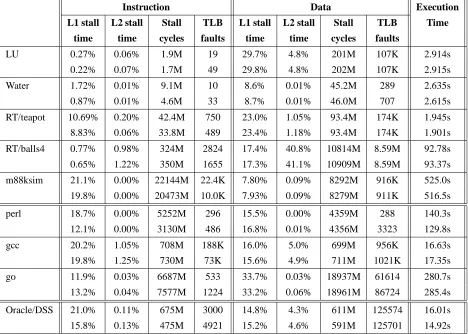
Table 2 gives the results of simulating the applications on SimOS. The first row for each
ap-plication is for a normal run and the second row is for a run using DPP. As mentioned above, the
statistics for perl, gcc, and go are for entire runs, while the statistics for the remaining
applica-tions exclude initialization and finalization phases (which often include I/O and other interaction
with the operating system.) All statistics include all activity on the machine, including TLB faults,
kernel activity, clock interrupts, etc. The statistics for the normal runs show that LU, Water, and
Instruction Data Execution
L1 stall L2 stall Stall TLB L1 stall L2 stall Stall TLB Time
time time cycles faults time time cycles faults
LU 0.27% 0.06% 1.9M 19 29.7% 4.8% 201M 107K 2.914s
0.22% 0.07% 1.7M 49 29.8% 4.8% 202M 107K 2.915s
Water 1.72% 0.01% 9.1M 10 8.6% 0.01% 45.2M 289 2.635s
0.87% 0.01% 4.6M 33 8.7% 0.01% 46.0M 707 2.615s
RT/teapot 10.69% 0.20% 42.4M 750 23.0% 1.05% 93.4M 174K 1.945s 8.83% 0.06% 33.8M 489 23.4% 1.18% 93.4M 174K 1.901s RT/balls4 0.77% 0.98% 324M 2824 17.4% 40.8% 10814M 8.59M 92.78s 0.65% 1.22% 350M 1655 17.3% 41.1% 10909M 8.59M 93.37s m88ksim 21.1% 0.00% 22144M 22.4K 7.80% 0.09% 8292M 916K 525.0s 19.8% 0.00% 20473M 10.0K 7.93% 0.09% 8279M 911K 516.5s
perl 18.7% 0.00% 5252M 296 15.5% 0.00% 4359M 288 140.3s
12.1% 0.00% 3130M 486 16.8% 0.01% 4356M 3323 129.8s
gcc 20.2% 1.05% 708M 188K 16.0% 5.0% 699M 956K 16.63s
19.8% 1.25% 730M 73K 15.6% 4.9% 711M 1021K 17.35s
go 11.9% 0.03% 6687M 533 33.7% 0.03% 18937M 61614 280.7s
[image:21.612.73.541.75.409.2]13.2% 0.04% 7577M 1224 33.2% 0.06% 18961M 86724 285.4s Oracle/DSS 21.0% 0.11% 675M 3000 14.8% 4.3% 611M 125574 16.01s 15.8% 0.13% 475M 4921 15.2% 4.6% 591M 125701 14.92s
Table 2: Simulated Application Performance (normal vs. with DPP)
misses in the first-level i-cache.
The stall cycles due to i-cache misses go down by 8-50% when using DPP for all applications
except RT/balls4, gcc, and go. The overall execution time also goes down for these same
applica-tions, but mostly by only 2-3%. (For LU, the execution time essentially stays the same.) However,
the execution time does go down significantly (7-8%) for perl and Oracle.
For RT/balls4, the increased instruction stall cycles seem to be due to a conflict with the
ap-plication data in the second-level cache, since the time due to L2 instruction misses increase. The
application accesses a huge amount of data, as indicated by the large number of data TLB faults.
This result is confirmed by an additional simulation of RT/balls4 in which the second-level cache
has 4-way associativity. In this run, the instruction stall cycles go down from 179M to 164M. In
gcc, the increased instruction stall cycles is probably due to the execution of the loader itself. The
loader time is less that 0.1% of the total run time for all applications except RT/teapot, where it is
0.26%, and gcc, where it is 1.39%. The high loader time in gcc is due to the large number of traps
to the loader, which in turn is due to the large number of distinct call sites that are executed during
is likely to cause cache pollution that affects the performance of the application. It is not obvious
why the instruction stall cycles and run time increase for go; these effects may be due to some
conflict between crucial procedures that happens to be introduced by the dynamic placement.
Although largely insignificant to the execution time, the stall cycles go down dramatically
for water. A large part of this effect is due to removing a conflict between a crucial application
routine and a library routine, fabs(), that computes the absolute value of a floating-point value.
This routine is placed far away from the application routines that use it by the linker, because it is
a library routine, but is automatically placed near these routines by DPP.
The number of iTLB faults goes down dramatically for m88ksim and gcc, both applications
that have large numbers of iTLB faults. The dramatic decreases in iTLB faults are likely due to the
fact that the active procedures of these applications are spread out over a large number of pages
in the static executable, while DPP places all active procedures together on a much smaller set of
pages. The iTLB faults increase somewhat for perl, go, and Oracle (but hardly affect the execution
time), possibly because of execution of the loader itself.
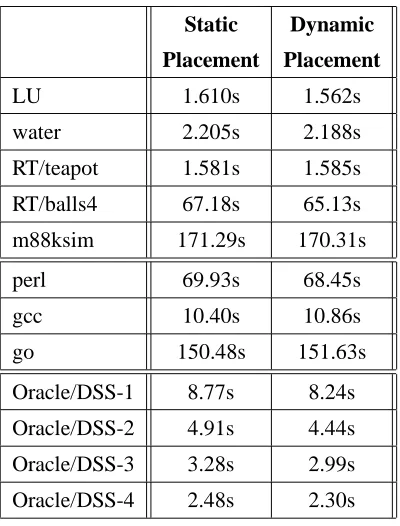
In Table 3, we give the actual run times for the applications on our AlphaServer when using
static and dynamic placement. For Oracle, we give results when using one, two, three, and four
server processes, respectively, to do the decision support query in parallel. As before, the results
for perl, gcc, and go are for the entire application run, while the results for the other applications
are only for the main part of the application. The obvious result is that times go down or stay
roughly the same in almost all cases, and the Oracle runs have quite significant decreases (6-10%)
in execution time. However, the changes are rather small for the other applications. On the real
machine, there may be more adverse effects due to data and instruction conflicts in the second-level
on-chip 96 Kbyte cache.
m88ksim provides one example of the usefulness of the facility for restarting procedure
place-ment. This benchmark simulates the execution of two different programs, and we consider the
second program, the Dhrystone benchmark, to be the main computation. When we restart the
pro-cedure placement just before simulating the Dhrystone benchmark, the run time goes down from
170.31 seconds to 156.36 seconds. The restart is improving performance because the mix of
pro-cedures used in simulating the first program is quite different from the mix used in simulating the
Dhrystone benchmark. As we said above, a restart is likely to be beneficial when an application
Static Dynamic Placement Placement
LU 1.610s 1.562s
water 2.205s 2.188s
RT/teapot 1.581s 1.585s
RT/balls4 67.18s 65.13s
m88ksim 171.29s 170.31s
perl 69.93s 68.45s
gcc 10.40s 10.86s
go 150.48s 151.63s
Oracle/DSS-1 8.77s 8.24s
Oracle/DSS-2 4.91s 4.44s
Oracle/DSS-3 3.28s 2.99s
[image:23.612.207.407.71.334.2]Oracle/DSS-4 2.48s 2.30s
Table 3: Application Run Times
5
Related Work
There has been a variety of work [2, 3, 4, 5, 6, 7, 8, 10, 12] in improving the instruction cache
behavior of user applications, with most of it focusing on statically laying out the instructions of
an application using profile information from a previous run. Samples and Hilfinger [10] did early
work in using edge frequencies between basic blocks to lay out basic blocks, while McFarling [7]
used basic block frequency counts. Pettis and Hansen [8] developed a simple algorithm for placing
procedures based on procedure frequency counts that is frequently used. Several more complex
but potentially more effective algorithms [4, 5, 6] have been developed recently, including some
that make use of a full trace of procedure calls. Most of these systems have been run only on
user-level simulators, and the authors report the changes in instruction miss rates, but not changes
in execution time. Several systems [3, 12] have recently been developed to manage automatically
the collection of profiles and the re-optimization of user executables.
Our system is most similar to the Just-In-Time Code Layout of Chen and Leupen [2]. However,
as we describe in Section 2.4, their approach does not work for indirect procedure calls, which are
used in almost all applications, at least in initialization and library code. Because they did not do
an actual implementation, they did not necessarily address the detailed implementation issues that
arise. In addition, their simulation results were obtained by instrumenting the user applications,
code in the i-caches. It is not clear if they modeled the behavior of the TLBs. Our simulations using
SimOS-Alpha model the entire system, including the execution of the unmodified loader code, and
we have reported performance results for real systems as well.
6
Conclusions
We have described a method called DPP (dynamic procedure placement) for laying out the
pro-cedures of an application at run time for better instruction cache behavior. Our method is fully
implemented and transparently runs on a variety of applications, including the Oracle 7.3 database
server. It handles a number of difficult problems that arise with real applications, including the use
of indirect procedure calls. We have simulated the effects of DPP on a number of applications using
SimOS-Alpha, a complete machine simulator, and have also measured actual performance results.
Our method usually reduces instruction stall cycles significantly (by 8-50%) for the applications
we have simulated, and typically reduces the execution time as well, but to a lesser degree. We also
achieved notable improvements (6-10%) in the actual run time for the Oracle database executing
a decision support workload. Most other recent work in this area has only reported simulation
results, rather than changes in application run times on real systems.
By default, our system simply places procedures consecutively in a new text segment in the
order in which they are called. However, we have developed an extension in which the layout is
restarted during an application run, so that the procedures that are used in the main part of the
application are more likely to be placed closed together. This extension significantly improved the
performance of one of our applications that had two distinct phases of computation. We have also
implemented a mode in which procedure calls are transparently monitored for a period of time,
and then, during the same run, the profiling information is used to layout the most important
pro-cedures. In the future, we intend to investigate additional run-time layout heuristics. For instance,
we could make use of cache size information to reduce conflicts even when important procedures
cannot be placed near each other. Also, we may want to place very large procedures in a separate
segment, since they are guaranteed to conflict with other procedures in the first-level caches.
Fi-nally, it may be useful to dynamically clone some small but important procedures at run time if it
is otherwise not possible to place the procedures so as to avoid conflicts with some of their callers.
References
Ar-chitecture, June 1998.
[2] J. B. Chen and B. D. D. Leupen. Improving Instruction Locality with Just-In-Time Code Layout. In The 1997 USENIX Windows NT Workshop, Aug. 1997.
[3] R. Cohn, D. Goodwin, P. G. Lowney, and N. Rubin. Spike: An Optimizer for Alpha/NT Executables. In The 1997 USENIX Windows NT Workshop, Aug. 1997.
[4] N. Gloy, T. Blackwell, M. D. Smith, and B. Calder. Procedure Placement Using Temporal Ordering Information. In 30th International Symposium on Microarchitecture, pages 303– 313, Dec. 1997.
[5] A. Hashemi, D. Kaeli, and B. Calder. Efficient Procedure Mapping Using Cache Line Color-ing. In Proceedings of the ACM SIGPLAN' 97 Conference on Programming Language Design
and Implementation, pages 171–182, June 1997.
[6] J. Kalamatianos and D. Kaeli. Temporal-Based Procedure Reordering for Improved Instruc-tion Cache Performance. In Proceedings of the Fourth InternaInstruc-tional Symposium on
High-Performance Computer Architecture, pages 244–253, Feb. 1998.
[7] S. McFarling. Program Optimization for Instruction Caches. In Proceedings of the Third
In-ternational Conference on Architectural Support for Programming Languages and Operating Systems, pages 183–191, 1989.
[8] K. Pettis and R. Hansen. Profile Guided Code Positioning. In Proceedings of the ACM
SIGPLAN' 90 Conference on Programming Language Design and Implementation, pages 16–
27, June 1990.
[9] M. Rosenblum, E. Bugnion, S. A. Herrod, and S. Devine. Using the SimOS Machine Simu-lator to Study Complex Computer Systems. ACM Transactions on Modeling and Computer
Simulation, 7(1):78–103, Jan. 1997.
[10] A. D. Samples and P. N. Hilfinger. Code Reorganization for Instruction Caches. Technical Report UCB/CSD 88/447, University of California, Berkeley, Oct. 1988.
[11] S. C. Woo, M. Ohara, E. Torrie, J. P. Singh, and A. Gupta. The SPLASH-2 Programs: Char-acterization and Methodological Considerations. In Proceedings of the 22nd International
Symposium on Computer Architecture, pages 24–36, June 1995.
[12] X. Zhang, Z. Wang, N. Gloy, J. B. Chen, and M. D. Smith. System Support for Automatic Profiling and Optimization. In Proceedings of the 16th ACM Symposium on Operating
23
WRL Research Reports
‘‘Titan System Manual.’’ Michael J. K. Nielsen.
WRL Research Report 86/1, September 1986. ‘‘Global Register Allocation at Link Time.’’ David
W. Wall. WRL Research Report 86/3, October
1986.
‘‘Optimal Finned Heat Sinks.’’ William R. Hamburgen. WRL Research Report 86/4, October 1986.
‘‘The Mahler Experience: Using an Intermediate Language as the Machine Description.’’ David
W. Wall and Michael L. Powell. WRL
Research Report 87/1, August 1987.
‘‘The Packet Filter: An Efficient Mechanism for User-level Network Code.’’ Jeffrey C. Mogul,
Richard F. Rashid, Michael J. Accetta. WRL
Research Report 87/2, November 1987.
‘‘Fragmentation Considered Harmful.’’ Christopher
A. Kent, Jeffrey C. Mogul. WRL Research Report 87/3, December 1987.
‘‘Cache Coherence in Distributed Systems.’’
Christopher A. Kent. WRL Research Report 87/4, December 1987.
‘‘Register Windows vs. Register Allocation.’’ David
W. Wall. WRL Research Report 87/5, December
1987.
‘‘Editing Graphical Objects Using Procedural Representations.’’ Paul J. Asente. WRL Research Report 87/6, November 1987.
‘‘The USENET Cookbook: an Experiment in Electronic Publication.’’ Brian K. Reid. WRL Research Report 87/7, December 1987.
‘‘MultiTitan: Four Architecture Papers.’’ Norman
P. Jouppi, Jeremy Dion, David Boggs, Michael J. K. Nielsen. WRL Research Report 87/8, April
1988.
‘‘Fast Printed Circuit Board Routing.’’ Jeremy Dion. WRL Research Report 88/1, March 1988.
‘‘Compacting Garbage Collection with Ambiguous Roots.’’ Joel F. Bartlett. WRL Research Report 88/2, February 1988.
‘‘The Experimental Literature of The Internet: An Annotated Bibliography.’’ Jeffrey C. Mogul.
WRL Research Report 88/3, August 1988. ‘‘Measured Capacity of an Ethernet: Myths and
Reality.’’ David R. Boggs, Jeffrey C. Mogul,
Christopher A. Kent. WRL Research Report 88/4, September 1988.
‘‘Visa Protocols for Controlling Inter-Organizational Datagram Flow: Extended Description.’’
Deborah Estrin, Jeffrey C. Mogul, Gene
Tsudik, Kamaljit Anand. WRL Research
Report 88/5, December 1988.
‘‘SCHEME->C A Portable Scheme-to-C Compiler.’’
Joel F. Bartlett. WRL Research Report 89/1, January 1989.
‘‘Optimal Group Distribution in Carry-Skip Ad-ders.’’ Silvio Turrini. WRL Research Report 89/2, February 1989.
‘‘Precise Robotic Paste Dot Dispensing.’’ William
R. Hamburgen. WRL Research Report 89/3, February 1989.
‘‘Simple and Flexible Datagram Access Controls for Unix-based Gateways.’’ Jeffrey C. Mogul.
WRL Research Report 89/4, March 1989.
‘‘Spritely NFS: Implementation and Performance of Cache-Consistency Protocols.’’ V. Srinivasan and Jeffrey C. Mogul. WRL Research Report
89/5, May 1989.
‘‘Available Instruction-Level Parallelism for Super-scalar and Superpipelined Machines.’’ Norman
P. Jouppi and David W. Wall. WRL Research
Report 89/7, July 1989.
‘‘A Unified Vector/Scalar Floating-Point Architec-ture.’’ Norman P. Jouppi, Jonathan Bertoni,
and David W. Wall. WRL Research Report
24 ‘‘Architectural and Organizational Tradeoffs in the
Design of the MultiTitan CPU.’’ Norman P. Jouppi. WRL Research Report 89/9, July 1989.
‘‘Integration and Packaging Plateaus of Processor Performance.’’ Norman P. Jouppi. WRL Research Report 89/10, July 1989.
‘‘A 20-MIPS Sustained 32-bit CMOS Microproces-sor with High Ratio of Sustained to Peak Perfor-mance.’’ Norman P. Jouppi and Jeffrey Y. F. Tang. WRL Research Report 89/11, July
1989.
‘‘The Distribution of Instruction-Level and Machine Parallelism and Its Effect on Performance.’’
Norman P. Jouppi. WRL Research Report
89/13, July 1989.
‘‘Long Address Traces from RISC Machines: Generation and Analysis.’’ Anita Borg, R.E.Kessler, Georgia Lazana, and David W. Wall. WRL Research Report 89/14,
Septem-ber 1989.
‘‘Link-Time Code Modification.’’ David W. Wall. WRL Research Report 89/17, September 1989. ‘‘Noise Issues in the ECL Circuit Family.’’ Jeffrey
Y.F. Tang and J. Leon Yang. WRL Research
Report 90/1, January 1990.
‘‘Efficient Generation of Test Patterns Using Boolean Satisfiablilty.’’ Tracy Larrabee. WRL Research Report 90/2, February 1990.
‘‘Two Papers on Test Pattern Generation.’’ Tracy
Larrabee. WRL Research Report 90/3, March 1990.
‘‘Virtual Memory vs. The File System.’’ Michael
N. Nelson. WRL Research Report 90/4, March
1990.
‘‘Efficient Use of Workstations for Passive Monitor-ing of Local Area Networks.’’ Jeffrey C. Mogul. WRL Research Report 90/5, July 1990.
‘‘A One-Dimensional Thermal Model for the VAX 9000 Multi Chip Units.’’ John S. Fitch. WRL Research Report 90/6, July 1990.
‘‘1990 DECWRL/Livermore Magic Release.’’
Robert N. Mayo, Michael H. Arnold, Walter S. Scott, Don Stark, Gordon T. Hamachi.
WRL Research Report 90/7, September 1990. ‘‘Pool Boiling Enhancement Techniques for Water at
Low Pressure.’’ Wade R. McGillis, John S. Fitch, William R. Hamburgen, Van P. Carey. WRL Research Report 90/9, December
1990.
‘‘Writing Fast X Servers for Dumb Color Frame Buf-fers.’’ Joel McCormack. WRL Research Report 91/1, February 1991.
‘‘A Simulation Based Study of TLB Performance.’’
J. Bradley Chen, Anita Borg, Norman P. Jouppi. WRL Research Report 91/2,
Novem-ber 1991.
‘‘Analysis of Power Supply Networks in VLSI Cir-cuits.’’ Don Stark. WRL Research Report 91/3, April 1991.
‘‘TurboChannel T1 Adapter.’’ David Boggs. WRL Research Report 91/4, April 1991.
‘‘Procedure Merging with Instruction Caches.’’
Scott McFarling. WRL Research Report 91/5,
March 1991.
‘‘Don’t Fidget with Widgets, Draw!.’’ Joel Bartlett. WRL Research Report 91/6, May 1991.
‘‘Pool Boiling on Small Heat Dissipating Elements in Water at Subatmospheric Pressure.’’ Wade R. McGillis, John S. Fitch, William R. Hamburgen, Van P. Carey. WRL Research
Report 91/7, June 1991.
‘‘Incremental, Generational Mostly-Copying Gar-bage Collection in Uncooperative Environ-ments.’’ G. May Yip. WRL Research Report 91/8, June 1991.
‘‘Interleaved Fin Thermal Connectors for Multichip Modules.’’ William R. Hamburgen. WRL Research Report 91/9, August 1991.
25 ‘‘Network Locality at the Scale of Processes.’’
Jeffrey C. Mogul. WRL Research Report 91/11,
November 1991.
‘‘Cache Write Policies and Performance.’’ Norman
P. Jouppi. WRL Research Report 91/12,
Decem-ber 1991.
‘‘Packaging a 150 W Bipolar ECL Microprocessor.’’
William R. Hamburgen, John S. Fitch. WRL
Research Report 92/1, March 1992.
‘‘Observing TCP Dynamics in Real Networks.’’
Jeffrey C. Mogul. WRL Research Report 92/2,
April 1992.
‘‘Systems for Late Code Modification.’’ David
W. Wall. WRL Research Report 92/3, May
1992.
‘‘Piecewise Linear Models for Switch-Level Simula-tion.’’ Russell Kao. WRL Research Report 92/5, September 1992.
‘‘A Practical System for Intermodule Code Optimiza-tion at Link-Time.’’ Amitabh Srivastava and David W. Wall. WRL Research Report 92/6, December 1992.
‘‘A Smart Frame Buffer.’’ Joel McCormack & Bob
McNamara. WRL Research Report 93/1,
January 1993.
‘‘Recovery in Spritely NFS.’’ Jeffrey C. Mogul.
WRL Research Report 93/2, June 1993.
‘‘Tradeoffs in Two-Level On-Chip Caching.’’
Norman P. Jouppi & Steven J.E. Wilton. WRL
Research Report 93/3, October 1993.
‘‘Unreachable Procedures in Object-oriented Programing.’’ Amitabh Srivastava. WRL Research Report 93/4, August 1993.
‘‘An Enhanced Access and Cycle Time Model for On-Chip Caches.’’ Steven J.E. Wilton and
Nor-man P. Jouppi. WRL Research Report 93/5, July 1994.
‘‘Limits of Instruction-Level Parallelism.’’ David W. Wall. WRL Research Report 93/6, November
1993.
‘‘Fluoroelastomer Pressure Pad Design for Microelectronic Applications.’’ Alberto Makino, William R. Hamburgen, John S. Fitch. WRL Research Report 93/7, November
1993.
‘‘A 300MHz 115W 32b Bipolar ECL Microproces-sor.’’ Norman P. Jouppi, Patrick Boyle, Jeremy Dion, Mary Jo Doherty, Alan Eustace, Ramsey Haddad, Robert Mayo, Suresh Menon, Louis Monier, Don Stark, Silvio Turrini, Leon Yang, John Fitch, William Hamburgen, Rus-sell Kao, and Richard Swan. WRL Research Report 93/8, December 1993.
‘‘Link-Time Optimization of Address Calculation on a 64-bit Architecture.’’ Amitabh Srivastava, David W. Wall. WRL Research Report 94/1, February 1994.
‘‘ATOM: A System for Building Customized Program Analysis Tools.’’ Amitabh Srivastava,
Alan Eustace. WRL Research Report 94/2, March 1994.
‘‘Complexity/Performance Tradeoffs with Non-Blocking Loads.’’ Keith I. Farkas, Norman P. Jouppi. WRL Research Report 94/3, March
1994.
‘‘A Better Update Policy.’’ Jeffrey C. Mogul.
WRL Research Report 94/4, April 1994.
‘‘Boolean Matching for Full-Custom ECL Gates.’’
Robert N. Mayo, Herve Touati. WRL Research
Report 94/5, April 1994.
‘‘Software Methods for System Address Tracing: Implementation and Validation.’’ J. Bradley Chen, David W. Wall, and Anita Borg. WRL
Research Report 94/6, September 1994.
‘‘Performance Implications of Multiple Pointer Sizes.’’ Jeffrey C. Mogul, Joel F. Bartlett, Robert N. Mayo, and Amitabh Srivastava.