ORIGINAL RESEARCH ARTICLE
THE CULTURE OF INNOVATION AND SUSTAINABLE DEVELOPMENT:
CHALLENGES FOR ENGINEERING
*
Enrique Posada
Advisor and innovation coordinator, HATCH INDISA S.A.S., Colombia
ARTICLE INFO ABSTRACT
The challenges that sustainable development offers, involve important revisions of cultural models, not only social, but also in the very practice of engineering. To assume change, it is important to understand the connections between ideas, belief systems and reality itself. Change is possible when the system of ideas and beliefs of people, organizations and society becomes more flexible. Change is facilitated by understanding the dynamic processes that connect ideas with experiences. The starting point of change has a lot to do with assuming states of creative functioning, associated with imagination, intuition, the ability to compromise and to undertake projects and the creation of spaces for appreciation and observation. This is where innovation is useful, as that capacity to discover and assume the new possibilities that allow technological, social and human functioning within acceptable parameters in relationship to sustainability. Here, some mechanisms to unlock the creative and innovative forces in engineering practice are discussed, and the possibilities and advantages of having a creative and innovative ideas system as a basis for achieving sustainability are considered. Ten operating schemes are proposed, associated with the laws of modern physics, which contribute to the development of creativity, innovation and sustainability in engineering work.
Copyright ©2017,Enrique Posada. This is an open access article distributed under the Creative Commons Attribution License, which permits unrestricted use, distribution, and reproduction in any medium, provided the original work is properly cited.
INTRODUCTION
There are important challenges for the practice of engineering today. Global warming, the ever-menacing scarcity of materials and non-renewable resources, the dark aspects of technology, the digitalization of process, the enormous amount of data and information that has to be understood and made good use of, pollution and its effects on health, are some of the things that have to be taken into account. It is expected from engineers that they contribute with high quality, non-harmful and sustainable technology to solve all challenges. This requires new approaches to the practice of engineering in order to consider sustainability a as key parameter in all engineering work. Given the power of technology which has lasting, deep (and sometimes unexpected) effects on everything (human beings, resources, environment and the economy); the engineer has to be, at the same time, careful, effective and quick acting.
*Corresponding author:Enrique Posada,
Advisor and innovation coordinator, HATCH INDISA S.A.S., Colombia.
This demands a new approach full of awareness, creativity and capacity for compromise and holistic considerations. The traditional objective approach to the world should be complemented with a more comprehensive, balanced, sensible and intimate view. For this, new creative considerations are in order, such as the ones proposed here.
Culture, Creativity and Sustainability
One might think that when talking about engineering and sustainable development, emphasis should be placed, above all, on technology. However, the achievement of sustainability hast to do with ideas, education, policy, objectives, teamwork, commitment and responsibility, which involves various elements related to culture and human behavior (Posada, 2014; Posada, 1995; Posada, 2002; Conservation Biology, editors, 2002; McDaniel, 2002; Thomas, 2003). For example, organizations of all types must have management policies, with principles that guide action and with a certain methodological and conceptual clarity, that is, with an aligned and operative belief system, that generates coherent and effective actions.
ISSN: 2230-9926
International Journal of Development Research
Vol. 07, Issue, 12, pp.17655-17660, December,2017
Article History:
Received 29th September, 2017
Received in revised form 04th October, 2017
Accepted 29th November, 2017
Published online 29th December, 2017
Key Words: Creativity,
Engineering Practice, Sustainability, Innovation, Change, Imagination, Intuition.
Citation: Enrique Posada, 2017. “The culture of innovation and sustainable development: challenges for engineering”, International Journal of
Development Research, 7, (12), 17655-17660.
Therefore, knowing the technical aspects is not enough to advance decisively on sustainability issues, even if one looks at them from the engineering side. Everything that has to do with the motivation of people is essential. The most profound motivation that people and organizations could be one that includes balances between the environment, society and economy in their work and in their vision, all of that relating to ethics. Ethics is coherence between ideas, words and actions. This raises key questions about the effects of actions of people and organizations, about the future and about what it will bring, about the evil that could happen and the good that was
not done. Ethics is fundamentally associated with
consciousness and therefore the ethical performance of organizations and companies depends on the state of consciousness they have.
Sustainability implies complex and interconnected cycles and feedback loops. To be successful, it is necessary that people and organizations possess advanced creative states of consciousness (Ronald Glasberg, 2013; John, 2001). These creative attitudes have to do with the awakening of the capacities to imagine, establishing visions, to generate declarations, to assume commitments and policies, which result in conservation of the earth and its resources, with actions that avoid waste and show respect for the rational and the correct ways. Likewise, creativity helps generating important questions, substantial interrogations, which give rise to research attitudes, to novel approaches to the problems and to the generation of alternatives. It is here where appropriate engineering practice intervenes, highly motivated, highly ethical and full of creativity, to make essential contributions to sustainability.
Beliefs, level of consciousness and sustainability
Beliefs are thoughts, ideas, mental schemes through which people create and interpret reality and interact with it. They appear in the open in the form of statements by organizations or individuals. Beliefs interpret and contribute to creating experiences that confirm the truth of what people or organizations believe. Beliefs give rise to cause-effect and effect-cause relationships between people and environmental, social and economic elements. When people and organizations realize this and deliberately manage their beliefs and culture, they acquire the power to restructure their consciousness (their belief system) and to attune their culture to the new circumstances and realities, which facilitates the change (Posada, 1995; Posada, 2017).Culture and beliefs have to do with the way in which the consciousness of people (and therefore of organizations) is structured. In this sense, it is worth noting that beliefs come or exist in the form of clusters or sets, more or less confusing or clear, associated with levels or states. The states or modes of working consciousness belong to three categories: reactive states, mental and emotional states and creative states. Reactive states can be associated with the concepts of fear, discomfort and pain, aggression and paying too much attention to the past. When people and organizations function in a reactive state, they tend to move away from social and personal responsibility, as they perceive in the situations elements of fear, pain, defense and attack, repetition of failures or guilt, before which they feel weak and dependent. The mental, rational and well-oriented emotional states are of great importance in the methodologies of the work of engineers and tend to dominate their actions (especially in what has to do with the logical and rational mind). These states
can be associated with the concepts of organized management of data and historical records, the use of logic, analysis and methodology, motivation based on positive emotions and experimental and predictive work. These are the main bases of the rational way of doing things and, in these ways, the current social and economic structure and the proper functioning of organizations have been built. With these structures, the reactive modes are overcome. All this works at its best, when it is complemented by emotional intelligence, which could be defined as the ability to be motivated, committed, cheerful and with a good attitude towards situations, that is, to complement rationality with a responsible and positive attitude. However, the problems of sustainability faced by humanity (which generate enormous risks, fears, mistakes, conflicts, and losses) are so challenging and enormous, that, to solve them, rational work is not enough, even supported by high doses of emotional intelligence and the best logical engineering practice. This has a lot to do with the complexity, the high speed of the interactions, and the inherent interconnections that generates non-linear and secondary reactions everywhere. Connecting the living (environment), with the human (society) and with the productive (economy and work), necessarily gives rise to such complexities. In the past, due to relatively minor element sizes, and the relatively slow speed of interactions, the sustainability crisis was not as evident, even during wars, scarcity and diseases. However, given the technological advances and the enormous social and economic growth, the natural element is being subject to situations that threaten the integrity of the whole.
When considering this, it is fortunate that people and organizations also exhibit creative states in which they are able to face successfully the challenges. These creative states are associated with concepts such as imagination, innovation, research, development, evolution, creativity and creation, intuition and observation. These states allow for the superior nature of people to shine and stimulate personal and social responsibilities. It might seem that these concepts are too ideal in the real world, subject to competition, to the demands of the market, to the demands of time and to economic shortcomings. However, organizations, the productive system and people are no really alien to these idealized realities, given that human beings are integral entities. Therefore, it is convenient to establish personal and social realities that are creative and have idealized aspects.
Creativity, Innovation and Sustainability
both in engineering and in human sciences. In 1972, Gregory Bateson brought to light a theory according to which the desirable change (for example the search for sustainability), should not refer only to our actions, but more to our thoughts. That is, we have to think about how we think. Bateson called this the "ecology of the mind." For Carl Rogers, organisms have an innate tendency to actualization, which governs all functions, both physical and of experience. This force constantly tends to develop the potentialities of individuals to ensure their conservation and prosperity, within the limits of the environment. However, the success of these actions does not only depend on the real or objective situation, but also on the situations such as the subject perceives them. The subject perceives the situations in terms of the notion he has of his self. The world is perceived through the prism of the self. In this way, anything related to the self tends to be perceived in closer fashion and it is more susceptible of being modified, depending on the desires of the subject. On the other hand, that which does not have a perceived relationship with the self, tends to be considered more vaguely or even, it is totally overlooked. Given that, ultimately it is the notion of the self what determines the effectiveness, or the failure of the tendency to actualize and integrate relationships and things within the attention span and bounders of the observer. Collectively, this concept can be extended to the idea of a group ego that should be consciously updated to the realities of sustainability. This closer employment of attention should result in more sustainable modes of operation. It seems evident that such achievements are essentially the result of attitudes, perceptions and mental works, results of the ecology of the mind.
Rogers is the father of the humanistic school in relationship to the study and care of the human mind. This school develops the concept of empathy, which consists in assuming the position of the other as a working method for the achievement of good human relations and therapy. Humanistic psychology highlights non-verbal experience and the total exploration of states of consciousness as a means of realizing people´s full human potential. Based on these approaches, the best points of human behavior are achieved when there is a delicate,
empathetic, well-intentioned, free, ample, integral,
comprehensive, tranquil, evolutionary and equilibrated handling of the human nervous system, in a healthy balance with the natural reality. In this way, it is easier for people to find unsuspected capacities within their own ordinary capacities, in their own nervous systems.
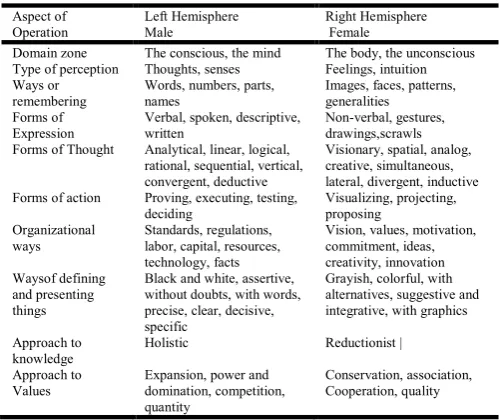
By extension, organizations also have their own nervous system, with principles similar to those applied to people. From a conceptual and symbolic point of view, there are two modes of operation of the nervous system, which have been associated with the existence of two hemispheres in the brain: left hemisphere and right hemisphere. When considering these two modes of functioning, the idea is that it is possible to enrich the brain and the nervous functioning when one is aware of the ranges of possibilities that exist. The two modes of operation are not totally independent nor do they correspond to clear separations of physical type. Rather, they are options for the contemplation and experimentation of reality. Table 1 contrasts the two modes of operation of the nervous and cerebral processes (Posada, 2016 and Posada, 2006). One of the modes, the one the left hemisphere, is associated with the conscious aspect of functioning and with the mind; the other one, with the body and with the unconscious aspects.
They are not radically separate modes, but denote possibilities that complement each other. The idea of establishing these two categories is to challenge people and organizations to seek deliberate and innovative ways of functioning. By genetics, by education, by environmental influence, by indoctrination, by choice, or for many other reasons, there is a tendency to prefer certain modes of operation. The customs or routines that are adopted by people or organizations, can condition and cause limitations. With this, options are lost and this is reflected in the ways we relate with the environment. This limited functioning is one of the causes of disordered behaviors, little evolved and not very sensitive in relation to nature and others, which cause threats to sustainability. How can the categories in Table 1 be taken into account? Determining this is an intelligent and creative task that should always be part of the management programs in any organization.
[image:3.595.308.558.303.513.2]The following are some examples applicable to sustainability, on the use of two of the categories in the table.
Table 1. Opposite and complementary modes of operation
Aspect of Operation Left Hemisphere Male Right Hemisphere Female
Domain zone The conscious, the mind The body, the unconscious Type of perception Thoughts, senses Feelings, intuition Ways or
remembering
Words, numbers, parts, names
Images, faces, patterns, generalities Forms of
Expression
Verbal, spoken, descriptive, written
Non-verbal, gestures, drawings,scrawls Forms of Thought Analytical, linear, logical,
rational, sequential, vertical, convergent, deductive
Visionary, spatial, analog, creative, simultaneous, lateral, divergent, inductive Forms of action Proving, executing, testing,
deciding Visualizing, projecting, proposing Organizational ways Standards, regulations, labor, capital, resources, technology, facts
Vision, values, motivation, commitment, ideas, creativity, innovation Waysof defining
and presenting things
Black and white, assertive, without doubts, with words, precise, clear, decisive, specific
Grayish, colorful, with alternatives, suggestive and integrative, with graphics
Approach to knowledge
Holistic Reductionist |
Approach to Values
Expansion, power and domination, competition, quantity
Conservation, association, Cooperation, quality
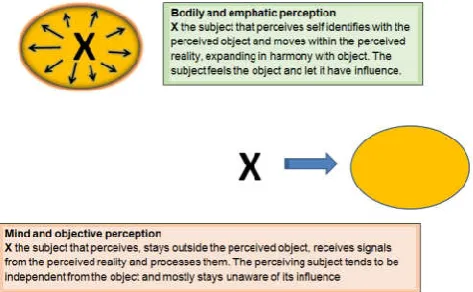
In this way organization functions as a body, each of its parts committed, almost automatically doing its job. The perception zone corresponds to the mechanisms that the organization has to realize and to be aware, to measure, to gather information, to know in which states it is. It is the area where states of being are identified and evaluations are made. It is the area of audits, of revisions. From the mental point of view, the organization perceives ideas, thoughts, ideological and mental structures. For this purpose, similar to people, it is endowed with senses, the mechanisms of communication and sensory perception. By using the organizational eyes, observations are made, situations are looked at, opportunities are admired and appreciated, laws and regulations are read and understood, images and symbols are treasured. With the organizational ear, attention is paid to surging events and to alarms, communities and customers are listened to, staff and personnel concerns and ideas are heard and taken into account, there are options for people to talk and express their ideas. With the organizational sense of taste, pleasure and organizational gusto are available, achievements are enjoyed and celebrated, people are careful and orderly, maintenance works and things are done with affection, refinement and elegance. With the organizational sense of smell, problems are detected, dangerous or harmful situations are smelled, communications are sensitized, small hidden and subtle details are captured, so that they do not become catastrophic, so that they become useful; commitments and small actions are stimulated and considered important. With the organizational tact the situations are handled in appropriate way, strength and force are applied where it corresponds, without hurting; the problems are touched and the variables are measured, to have them at hand. From the bodily point of view, the mechanisms of perception have to do with feelings and intuition. These are perceptions related to identification mechanisms, of empathic nature. Figure 1 compares the two ways of perceiving, bodily and mental. In them X is the subject that perceives and the oval shape is the object that is perceived.
Figure 1. The two ways of perceiving, bodily and mental
Body and emphatic perception has to do with greater involvement of those responsible for the issues, for example, in productive, social, environmental or economic matters, in the teams, in the systems, seeing them from within. In this way, people can see various details that give rise to divergences, deviations, alternatives and creativity. The identification also has to do with an affectionate approach to the systems, with the creation of spaces for motivation and care. When good identification and closeness are achieved, natural systems and resources feel intimate and information and data are experienced and received intuitively, as if they were obtained by a sixth sense.
When organizations work with experts, for example, they have the feeling that the expert is close to the team, to the process, and knows everything there is to know. Developing close and intimate relationships and expertise in organizations, increases empathic perception.
Ten operating schemes (principles) for sustainability
In order to facilitate practical and constructive engineering work, ten principles that facilitate a creative approach and the development of personal and business ethics are here presented (Bruce Hannon, 1993).
The Principle of Universal Potentiality: Refers to the internal, often hidden, potential that resides in both people and
objects (Boström et al., 2012). If this potential is taken into
account, people can observe the entire universe surrounding them beyond the usual classifications of bad, good, problematic, operative, executive, loser, winner, qualitative, numeric; and start focusing also on the possibilities and in the responsibility they have of locating and finding opportunities,
the underlying values behind these classifications.
Opportunities are those hidden potentials. With this principle in mind, teamwork, connections, relationships and people are stimulated and valued. Sustainability is the result of finding potentialities.
The Principle of Participatory Observation: examines the fact that reality has subjective aspects that depend, largely, on the participation of people. With this principle, it is easier to take steps after detecting the opportunities, to make them real, to take advantage of them. In the construction of sustainable development, everyone should be an observer that participates
(Carol, 2007; Margareta Norberg et al., 2012). Sustainability is
the result of participation and collaboration.
The Principle of Uncertainty: refers to the fact that any process is susceptible to improvements and to examination, since its operation occurs in a wide spectrum of possibilities, some of which contribute to uncertainty, some of which are
conditioned (Brian Wynne, 1992; Stephen et al., 1992).
Behind the variations and uncertainties, there are potential for savings and for new interpretation possibilities. Sustainability is hidden behind uncertainty.
The Principle of Association and Complementarity: refers to the importance of having a complete perspective when examining and interpreting realities, so that opposing sides and complementary views are taken into account. This principle makes it easier to accept that there are several possibilities to solve a problem and that arbitrary limitations should not be fixed or imposed peremptorily. In terms of teamwork, this principle facilitates appreciating the other's space and practicing active listening. With this principle in the minds of organizations, the benefits of being part of working groups, of joining with other companies, of working with universities, with authorities, with clients and suppliers are dully considered. Sustainability is the balance of opposing and complementary ways.
This results in synergistic associations that optimize business work. This gives strength and shared knowledge. The united way is the way to sustainability.
The Principle of the Varied Alternatives and Levels of Existence: refers to the fact that there are several levels of reality, just as there are several levels of consciousness and an interesting spectrum of alternatives and levels of functioning. This principle makes it easier for people and organizations to accept the existence of improvement models applicable to themselves and to the different processes. With this, standards are set, goals are set, the mind is opened up to concepts and visits of advisors, courses are attended with pleasure, training is sought, conversations are held with clients and suppliers, fairs are attended, environmental regulations are known and explored as sources of action and improvement. Sustainability will be reached by many paths.
The Principle of the Management of Time: facilitates the observation of events with a broader perspective and achieves a greater focus and effectiveness to realize the importance of the instant that is lived, the importance of the opportunity that appears when entirely appreciating the present reality. This enlivens awareness and the problems appear and are solved in harmony with: the capabilities to see them, the availability of attention and time to experience them and the energy to solve them. If organizations and people turn their backs on them and do not fully experience them, risks, menaces, tensions and non-compliances appear and time becomes a traps. Management and managers must have time to listen to the signals that come from everywhere and to propose a participatory vision in whose achievements all become managers. That will create time. Paying attention creates the necessary time to attaining sustainability.
The Principle of Prevalent Energy: recognizes that people, organizations, life and nature all have potentials that manifests energetically. This principle facilitates that people and
organizations understand the many connections and
implications that agitate and stimulate them and see themselves as energy sources that generate harmonious and responsible behavior (Georgescu-Roegen, 1976). Ultimately, with the search for a healthier world and sustainability, it will enrich community work; stimulate employment and prosperity, creating spaces for individual and collective happiness. Energy is the magic tool for balanced sustainability.
The Principle of Entropy: refers to the elements of order and disorder involved in the processes, reflected in the fact that there are tendencies to disintegrate, to create disorder and disorient things, being necessary to intervene actively so that there is integration and order (Georgescu-Roegen, 1971). Operating crises provide clues to improvement and development, and agitation and turbulence provide useful signals to change the level of functioning. Order shows the way to sustainability.
The Principle of the Chaotic Aspects of the Transformations: refers to the effects hidden in the small variations of the parameters that influence reality and that can be very determinant. These effects of chaotic type and are a natural part of existence, related to the phenomena and can generate high instabilities and complexity. In this sense, it is convenient to realize that there are catalysts, which are elements that facilitate change. An advisor, a standard, a
course, the idea of a given person, an exchange with a client, attending a fair. All those are events of unsuspected scope, capable of catalyzing transformations. Sustainability is the result of catalysis.
Conclusion
Engineering work schemes have been presented in order to have a comprehensive vision of reality, to approach more effectively the complexity underlying the problems of sustainability. Several practical tools have been presented that facilitate this approach. Complementary visions of reality and the use of ten principles here expounded, based on modern physics, to solve situations in a sustainable manner are very important. Emphatic perception and paying attention are clues to sustainability.
REFERENCES
Boström, Magnus. 2012. A missing pillar? Challenges in theorizing and practicing social sustainability: introduction to the special issue. Sustainability: Science, Practice, and Policy; Bethesda Vol. 8, Iss. 1, (Winter).
Brian Wynne, Uncertainty and environmental learning: Reconceiving science and policy in the preventive paradigm. Global Environmental Change, Volume 2, Issue 2, June 1992, Pages 111-127. https://doi.org/10.101 6/0959-3780(92)90017-2
Bruce Hannon, Matthias Ruth, Evan Delucia. 1993. A physical view of sustainability. Ecological Economics, Volume 8, Issue 3, December, Pages 253-268. https://doi.org/ 10.1016/0921-8009(93)90061-A
Carol A. Adams, Patty McNicholas, 2007. "Making a difference: Sustainability reporting, accountability and organisational change", Accounting, Auditing and
Accountability Journal, 20, 3, pp.382-402,
https://doi.org/10.1108/09513570710748553
Four Challenges of Sustainability. Conservation Biology, Volume 16, Issue 6, pages 1457–1460, December 2002. doi: 10.1046/j.1523-1739.2002.01668.x
Georgescu-Roegen, N. 1971. The Entropy Law and the Economic Process. Harvard University Press: Cambridge, Massachusetts.
Georgescu-Roegen, N. 1976. Energy and Economic Myths: Institutional and Analytical Economic Essays. Pergamon Press: New York.
John E. Carroll. Sustainability and Spirituality. SUNY Press, Aug 6, 2004 - 191 pages
Margareta Norberg, Yulia Blomstedt, Göran Lönnberg, Lennarth Nyström, Hans Stenlund, Stig Wall and Lars Weinehall. Community participation and sustainability – evidence over 25 years in the Västerbotten Intervention Programme. JournalGlobal Health Action, Volume 5, 2012 - Issue s6: Special Issue: The Västerbotten Intervention Programme
McDaniel, J. 2002. Spirituality and Sustainability.
Conservation Biology, 16: 1461–1464, December.
doi:10.1046/j.1523-1739.2002.01669.x
Posada E, Valencia G, Robledo D. 2016. Towards Sustainable Cities trough a Decrease in CO2 Emissions Based on Creating Consciousness on Human Habits and Its Relations
to Body CO2 Emissions and Associated Impacts. Int J
Earth Environ Sci.,1: 116. doi: http://dx.doi.org/1
Posada E. 2010. Strategic Analysis of alternatives for Waste Management, Chapter published in Waste Managemente, Subil Kumar, editor, Intech, Croatia, 2010
Posada E. 2017. The Ayurveda Natural Medicine System and
Its Environmental Implications. Environ Sci Ind J.,
13(4):144.
Posada, E. 1995. En busca del conocimiento creativo,
Medellín, 220 p, https://www.amazon.com/dp/
B00FHD1TKA/ref =rdr_kindle_ext_tmb.
Posada, E. 2002. Guía de buenas prácticas de manejo energético en las pequeñas y medianas empresas, Ministerio del Medio Ambiente de Colombia y CNPML, Medellín, 86 pg.
Posada, E. 2006. La enseñanza y el aprendizaje de la
creatividad, Medellín, 142 pg., 2006.https://www.
amazon.es/ense%C3%B1anza-aprendizaje-creatividad-Enrique-Restrepo-ebook/dp/B00FFLBM9C
Posada, E. 2014. Hacia una cultura de la gestión energética empresarial, ISBN: 978-958-46-4746-7, Medellín, 690 pp.https://www.autoreseditores.com/libro/2527/enrique- posada-restrepo-indisa-sa/hacia-una-cultura-de-la-gestion-energetica-empresarial.html
Ronald Glasberg, 2003. Mathematics and Spiritual
Interpretation: A Bridge to Genuine Interdisciplinarity. Journal of religion and science, Zygon, Volume 38, Issue 2, June. Pages 277–294. DOI: 10.1111/1467-9744.00500 Stephen R. Dovers, John W. Handmer. 1992. Uncertainty,
sustainability and change. Global Environmental Change,
Volume 2, Issue 4, December Pages 262-276.
https://doi.org/10.1016/0959-3780(92)90044-8
Thomas P. 2003. Maxwell. Integral Spirituality, Deep Science, and Ecological Awareness, Journal of religion and science, Zygon, vol. 38, no. 2, June. DOI: 10.1111/1467-9744.00499