5215
A HEURISTIC METHOD FOR IMPROVING TCP
PERFORMANCE BY A GREEDY ROUTING ALGORITHM
1S.P. VALLI, 2Dr.SHARMILA SANKAR, 3Dr.K.M MEHATA
1, Assistant Professor (Sel.Grade) Department of Computer Science and Engineering, B.S.Abdur Rahman
Crescent University, INDIA
2Professor , Department of Computer Science and Engineering, B.S.Abdur Rahman Crescent University,
INDIA
3Senior Professor, School of Computing Sciences, Hindustan University, INDIA
E-mail: 1[email protected], 2[email protected], 3[email protected]
ABSTRACT
Transmission Control Protocol (TCP) is a reliable transport layer protocol that works well in a wired network. TCP achieves this reliability by sending an acknowledgment for the data packets transmitted. During data transmission packets might be dropped. In wired networks packet loss is a rare event and the reasons for loss in most cases is attributed to buffer overflow. In such cases this is handled by TCP by reducing the transmission rate. However the same might not be the scenario in a wireless network. In wireless network packet loss may be due to various reasons such as node failure, link failure of an intermediate node, signal loss, network partitions, hidden and exposed terminals. Thus TCP performance degrades in a wireless network and TCP for wireless adhoc networks has to withstand these challenges. Route instability is another major challenge in Mobile Adhoc network and the role of a routing protocol has a significant impact on the performance of TCP throughput. This paper improves the performance of TCP in mobile Adhoc networks by using a Greedy cross layer routing algorithm which reduces the route instability problem in TCP for Adhoc networks. The simulations were done using Qualnet 5.0. The simulation results show a significant improvement in the throughput, reduction in the number of packets lost and the number of retransmissions.
Keywords: Transmission Control Protocol (Tcp), Throughput, Hidden And Exposed Terminal, Routing
Instability, Retransmissions, Routing Algorithm
1. INTRODUCTION
A Mobile Adhoc network includes a set of
nodes that are either mobile or static. The node communications takes place via wireless links
without any infrastructure or centralized
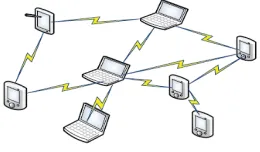
information. Each node has the ability to communicate with all other nodes in the transmission range. Figure 1 shows a Mobile Adhoc network where every node acts as a router and forwards packets to the neighboring nodes within the range.
[image:1.612.348.478.514.590.2]TCP is a reliable transport layer protocol that has been well designed for wired networks. The reliability of transmission is achieved by way of acknowledgments of packets sent.
Figure 1: Mobile Adhoc Network
5216 occurred and the second when more than three duplicate acknowledgments are received by the sender. While retransmission time out may happen due to congestion in the network, three duplicate acknowledgements may be due to out of order of sequence of packets received. When the retransmission timer expires TCP retransmits the packets and in the later case TCP fast retransmits the packets. This is the scenario in wired networks wherein most packet losses are due to buffer overflow.
When used in the wireless adhoc networks TCP faces many challenges such as mobility, network partitions, route and link failures. The problem of hidden and exposed terminals at the lower layers also has an impact on TCP performance. The reasons for TCP performance degradation in wireless adhoc networks is the huge number of packet losses that take place in the mobile networks. While the reasons for packet loss may be due to various events such as a node failure, mobility, link failure, channel contention and so on TCP assumes all packet losses as congestion and resets its congestion window thus reducing the transmission rate. Thus improving performance of TCP in mobile Adhoc networks is a major challenge and this paper focuses on improving the performance of TCP for Adhoc networks.
One of the key challenges of TCP in adhoc networks is to identify the reasons and consequences of a packet loss. In adhoc networks due to excessive contention for the shared medium the probability of packet loss is increased. Such contention for the channel and loss due to this is misinterpreted as packet loss due to congestion in the network and TCP reduces its transmission rate. This problem is worsened with the hidden and exposed terminals and TCP performance is degraded . Hence this paper focuses on reducing the number of retransmissions that happen at the MAC layer and reducing the channel contentions by selecting an appropriate routing protocol.
The rest of this paper is organized as follows: in Section 2 provides an overview of TCP congestion control algorithms and insight into the routing instability problem. In Section 3 related work on improving TCP performance in wireless ad hoc networks is discussed. Section 4 provides the proposed method for improvement . Section 5 presents the simulation environment discussion of the simulation results. Section 6 provides the
conclusions and future directions of this work. Section 7 provides the acknowledgments.
2. TCP CONGESTION CONTROL
ALGORITHMS
This section deals with the congestion control algorithms widely used in TCP. The TCP sender maintains a buffer called as the congestion window which is used to record the packets which have been sent but not acknowledged by the receiver. The idea of additive increase (AI) is that when the network is not congested, the congestion window of a TCP source is increased by one packet per round trip time (RTT). The idea of multiplicative decrease (MD) is, when the network is congested, the congestion window of a TCP source is decreased to‘d’ times of the current congestion window size, where d is a constant coefficient less than 1. Slow Start is a congestion control algorithm ,it is called as slow start because the congestion window is increased from one. In the Congestion Avoidance algorithm a retransmission timer expiring or the reception of duplicate ACKs can implicitly signal the sender that a network congestion situation is occurring. The sender immediately sets its transmission window to one half of the current window size (the minimum of the congestion window and the receiver’s advertised window size), but to at least two segments. If congestion was indicated by a timeout, the congestion window is reset to one segment, which automatically puts the sender into Slow Start mode. If congestion was indicated by duplicate ACKs, the Fast Retransmit and Fast Recovery algorithms are invoked. Fast retransmit means that a TCP source retransmits the lost packets without waiting for its retransmission timer to expire. Fast Recovery takes place after Fast Retransmit.
2.1 Hidden And Exposed Terminal
5217 transmission to a node that is within the range of each of them. This leads to collision and loss of data at the receiver end.
Figure 2: Hidden Terminal
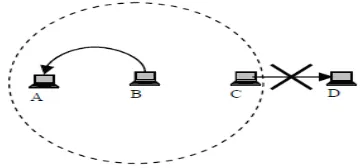
Figure 3 shows how an exposed terminal problem emanates. As seen from Figure 3, A and C are within B’s transmission range however A is outside C’s transmission range. Assume B is transmitting to A and if C has to transmit to D, it could not do so because C senses a busy channel due to the ongoing B’s transmission. Therefore, station C will refrain from transmitting to D. The problem of hidden and exposed terminal is predominant in multi-hop wireless networks. This paper aims at reducing the impact of contentions that happen at the MAC layer and how this can be effectively handled using a greedy routing algorithm,.
Figure 3: Exposed Terminal
2.2 Routing Instability
This section deals with the routing instability problem and its impact on the TCP performance. The cause of route instability and its impact is analyzed considering as a sample, a 7 node chain topology as shown in Figure 4. Let us assume that a data transmission takes place from node 1 to node 7 through the intermediate nodes 2-6. Data packets are in queue waiting for transmission from node 1. When node 1 is transmitting to node 2, node 4 which is not in the interference range of node 1 is unaware of these transmissions. Hence when it sends a request to send (RTS) to node 3 it may not respond as it is sensing the transmission between
[image:3.612.329.504.258.348.2]nodes 1 and 2. Thus transmissions between nodes 1,2 and 3 leads to channel contention at 4 and causes a link failure leading to the route instability problem. Thus the traffic at other nodes depends on the source node 1 which injects packets into the network causing a contention for the channel at the later nodes. This channel contention leads to drop of packets in the intermediate nodes. This eventually causes degradation in the throughput. Though the packet drops is a event at the transport layer, the hidden and exposed terminal problems at the MAC layer increases the chances of link failures thereby leading to route rediscovery.
Figure 4. Routing Instability in Chain Topology
This is mainly because in 802.11, the number of packets in flight is limited by the per-hop
acknowledgements at the MAC layer.
3. RELATED WORK
There has been a significant amount of research in the context of the IEEE 802.11 protocol and the impact of other layers on the TCP performance. In [1], the authors investigate the performance of the IEEE 802.11 MAC protocol over multi-hop wireless networks. The study focuses on the performance of TCP as the transport protocol. In the paper [2] Li et al. examine the performance of chains as the number of hops are increased and study the effect of cross-interference between chains. They analyze the effect of MAC 802.11 behavior on the performance of multi-hop chains. However, they do not categorize interference patterns that govern network performance.
[image:3.612.112.293.438.522.2]5218 parameter settings to improve the performance of TCP over multi-hop networks.
In [5] the authors have proposed a new a new Greedy Routing Protocol (GRD) that reduces the control overheads during route discovery and improves the network performance compared to AODV in high dense scenarios. The authors of [6] have examined how the transport layer affects the routing and MAC layers. Based on their study they have proposed two solutions named TCP-FeW and ROBUST . The authors of [7] have examined the effect of multi-hop wireless link on TCP throughput and loss behavior for several simple network configurations and flow patterns.
4. PROPOSED METHOD
A sequence of nodes that participates in communication between a source and a destination by forwarding messages is called a chain. The source and destination nodes may not be within the transmission range of each other and two adjacent nodes in the chain can exchange packets bidirectional. The channel used for such communications is called a link and the communication between source and destination is called a flow. Multi-hop wireless networks exhibit characteristics different from wired networks. In a typical wireless network that uses IEEE 802.11 packets are dropped at MAC either due to link contention or buffer overflow and such losses have an impact on the TCP transmission. Spatial channel reuse improves the channel utilization and hence it is highly desirable to have multiple nodes that do not interfere with other and can transmit simultaneously.
In a chain topology as shown in Figure 5 let us assume that data transmission takes place from source node 1 to destination node 8 via the intermediate nodes 2-7. During such a transmission when node 1 forwards data to 3 through intermediate node 2, node 3 and 4 though not in the transmission range of 1 cannot transmit data owing to the exposed terminal problem. However due to channel spatial reuse data transmission can happen simultaneously from node 6 to node 8 through node 7. Thus depending on the number of hops in data transmission, TCP throughput may vary due to hidden and exposed terminal problems. It is understood that this problem is predominant when the number of one hop nodes are cluttered together creating route instability. Hence as proposed by [5] a greedy routing algorithm is used wherein the route is selected based on the farthest node rather than the nearest neighbor as in AODV. The
proposed method is called as TCP-GRD (TCP using Greedy Routing Algorithm) .
The following are the assumptions made in the implementation. It is assumed that every node in the network is willing to forward the packets and all nodes use 802.11. Since forwarding of the packets is done by the farthest node in the transmission range it is assumed that the nodes are
moving with moderate mobility. For
implementation purposes chain topology is considered in the discussions. However this method shows improvement in TCP throughput when the payload size is less. Hence it works for short flows.
By selecting the farthest nodes the intermediate nodes do not participate in the transmission of data and hence the problem of hidden and exposed terminal is minimized. Thus this method which uses the Greedy Routing Algorithm (TCP-GRD) shows significant improvement in TCP throughput compared to using TCP with AODV. The advantage of using such a routing algorithm is the route instability and hidden and exposed terminal problems are minimized by reducing the number of adjacent nodes that take part in the transmission. This reduction in the number of nodes that participate in the transmission reduce the excessive contentions of the nodes for the shared medium. Thus this selection of a suitable routing protocol to address the issue of hidden and exposed terminal problem shows significant improvement in the throughput . However this method works well for lighter payloads. Hence when the payload size increases though the contention is reduced the actual congestion in the network due to the increased payload is unavoidable.
Under circumstances when the payload size increases beyond a threshold value we propose the use of Explicit Congestion Notification (ECN) to notify the sender about the congestion in the route selected with the farthest node as the next hop. The threshold value is calculated based on the average queue size at the point of time when congestion occurs. The occurrence of congestion can be known
from the receipt of three duplicate
acknowledgements or the timeout event.
5219 The method is called as greedy because it selects the node closer to the destination rather than to itself. Hence a route is established with farthest nodes strategy from every node which avoids the exposed terminal problem to a certain extent. In a mobile environment where the chance of farthest node moving out of the transmission range is possible a route recovery algorithm that is supported by the Greedy Routing Discovery (GRD) [5] is used.
4.1 Greedy Route Discovery
The Greedy route discovery method is an on demand routing algorithm. The main advantage of using the Greedy Route Discovery algorithm is it reduces the network congestion by reducing the number of nodes that participate in route discovery. By selecting the farthest neighbor to rebroadcast it the reduces the number of hops and thereby the hidden and exposed terminal problems that occur when nodes are placed in the transmission and interference range of other nodes. A unique identifier is assigned to each Route Request packet (RREQ) so as to enable detection and dropping of
duplicate packets. Selective border node
transmission technique is used when a source imitates a data transmission to a destination for which prior route information is not available. An intermediate node on receiving a RREQ packet makes an entry of the previous hop and the source node information in its routing table. This packet is then multicast or a Route Reply (RREP) is sent to the source if it has found a route. Before data transmission when no route information is available a route request packet is initiated at the network layer and the RREP from the farthest node is selected. In a mobile Adhoc network where chances of farthest node moving, is high the route rediscovery which is part of the Greedy routing algorithm is initiated. The Greedy route discovery works by constructing a neighbor table and using a random variable called the reachability parameter that determines the number of nodes that can rebroadcast the route request message. The route maintenance is also taken care by the Greedy route discovery algorithm. A part of the route discovery of GRD proposed by [5] is shown in Figure. 6.
Protocol PathDiscovery() {
while(1)
{
for (each chosen neighbor)
if (path to destination exists) {
unicast RREQ to destination node; unicast RREP to sender node; exit ();
}
FIGURE 6:PATH DISCOVERY
The algorithm uses a reachability parameter ‘K’ to achieve the reachability of the broadcast. The value of K is between 3 and 7.
5. RESULTS AND DISCUSSIONS
The performance metrics that are analyzed for evaluation include throughput, number of retransmissions, fast retransmissions and the time when the first packet is received. After extensive simulations the inferences from the simulations depict the main reasons for TCP performance degradation and how it has been overcome using
the proposed method
.
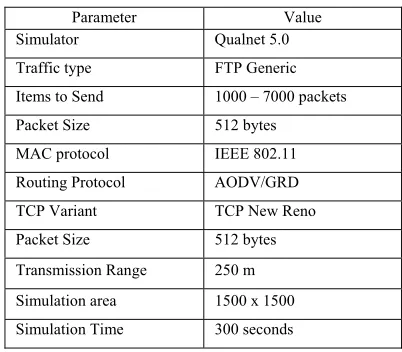
Simulations were done usingQualnet 5.0 simulator. The simulation parameters are as shown in Table 1.
[image:5.612.316.517.511.687.2]The simulations were done by varying the number of hops, the number of flows and packet sizes. In cases of one hop flow from a source to a destination the following values were obtained for data transmission starting from 1000 packets using FTP generic and the packet size as 512 bytes.
Table 1: Simulation Parameters
Parameter Value
Simulator Qualnet 5.0
Traffic type FTP Generic Items to Send 1000 – 7000 packets
Packet Size 512 bytes
MAC protocol IEEE 802.11 Routing Protocol AODV/GRD
TCP Variant TCP New Reno
5220 In the Table 2 S1 indicates the source node 1 and D3 indicates a destination node numbered 3 in the chain topology shown in Figure 5.
Table 2: Simulation results of chaintopology
Source -Destination
Number of hops
Throughput (bps)
First Packet Received
at (s)
Last Packet Received
at (s)
S1-D3 2 15806 1.18 27.09
S1-D4 3 9824 1.3 42.9
S1-D5 4 17726 1.3 24.4
S1-D6 5 11000 1.4 35.7
S1-D7 6 7059 4.3 59.9
S1-D8 7 7256 5.1 60.1
S1-D9 8 7453 6.2 64.3
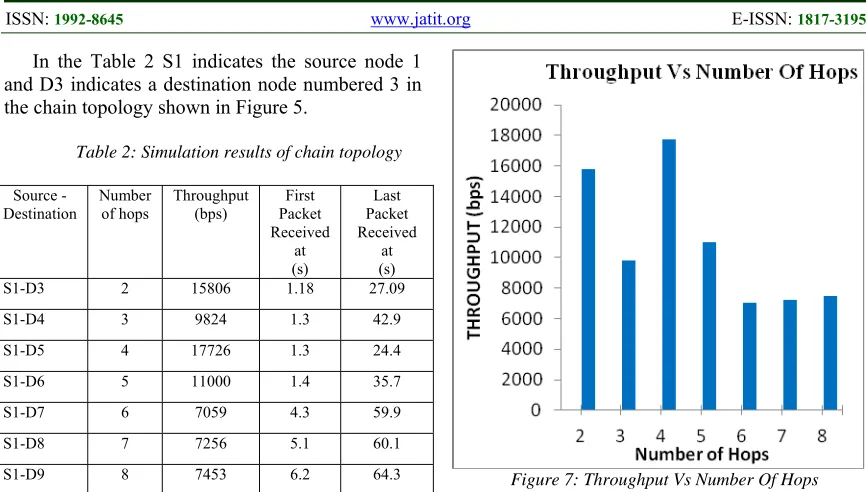
It is seen from the simulation results that maximum throughput varies depending on the number of hops from source to destination. In the first case in data transmission from source S1 to destination node D3 the number of hops between the source and destination is 2. In the second case data transmission takes place from source node S1 to destination node D4 where the number of hops is 3. In this case while data is transmitted from node 1 to node 4 , node 3 cannot transmit to node 4 due to exposed terminal problem Hence the throughput has reduced . In the transmission from source node 1 to destination node 5, the number of hops is 4 and in this case the throughput has increased due to channel spatial reuse.
It can also be observed from the table the first and last packets received at the destinations vary as the number of hops increases. The last packet received when data transmission from S1-D5 is 24.4 seconds. The reason for this is due to channel spatial reuse, simultaneous transmissions take place between the source node and destination. However this is not the case when the number of hops increases because the nodes are again susceptible to hidden and exposed terminal problems.
The graph in Figure 7 shows the throughput when data transmission takes place between nodes 1 and other nodes in a single flow. It can be observed from the graph that throughput is at its maximum when the number of hops is 4. The reason for the increase is as discussed above. However throughput stabilizes after a specific number of hops and in this case it stabilizes after 6.
Figure 7: Throughput Vs Number Of Hops
The simulation results shows the degradation in throughput when the nodes are in close proximity. The hidden and exposed terminal problems exhibited by the adjacent nodes make the degradation worse. Hence the proposed method makes the transmissions optimal by selecting the farthest node to transmit thus reducing the hidden
terminal and exposed terminal problem
considerably.
The simulations were done for different flows and different sets of source and destinations. The following table shows the different scenarios of simulations using the conventional and proposed method.
The graph depicts the throughput measured in bits per second (bps) and extensive simulations were done and the impact of the different parameters on the throughput was analyzed.
5221
Table 3: Throughput of Traditional TCP Vs TCP_GRA
S.No Number of data items
Throughput -Conventional TCP with AODV (bps)
Throughput -TCP-GRD (bps)
1 1000 126662 150542
2 2000 139054 160909
3 3000 151851 167473
4 4000 153820 163906
5 5000 154034 160298
6 6000 149579 163039
7 7000 145738 161643
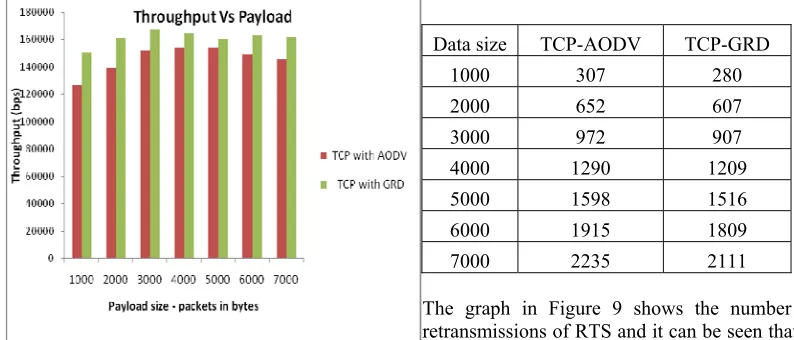
It is obvious that the throughput increases as the number of data items increase. But it can be observed from the table that the throughput for the same number of data items differs for the proposed TCP-GRD and conventional TCP. This increase in throughput for TCP-GRD is due to the reduction in the number of nodes in the transmission that face the hidden and exposed terminal problem. The graph in Figure 8 shows the comparison of the proposed TCP-GRD and conventional TCP.
Figure 8: Throughput Comparison
From the simulation results it was observed that the time when the first packet was sent using conventional TCP was 31.26 second and using TCP-GRD it was 37.04. This delay in the first packet sent is due to the time taken by TCP-GRD for the greedy route discovery. However the time when the last packet was sent and the time when the last packet was received at the destination does
not show any delay and is better compared to the conventional TCP. The time when the last packet was sent is as shown in Table 4.
Table 4: Time of Last Packet sent
S.No Number of data items
Last packet sent at - TCP using AODV
(s)
Last packet sent at TCP –GRD
(s)
1 1000 63 61.8
2 2000 89.6 84.9
3 3000 112 109
4 4000 114 101
5 5000 121 106
6 6000 132 112
[image:7.612.102.499.410.580.2]Table 5 shows the RTS retransmissions due to time out at the MAC layer. It can be observed from the simulations that the number of retransmissions is significantly reduced in using GRD with TCP than with AODV. Due to this reduction in the number of retransmissions the congestion is reduced and hence the TCP throughput shows improvement in TCP with GRD.
Table 5: RTS Retransmissions Due To Timeout
Data size TCP-AODV TCP-GRD
1000 307 280
2000 652 607
3000 972 907
4000 1290 1209
5000 1598 1516
6000 1915 1809
7000 2235 2111
5222
Figure 9: RTS retransmissions due to timeout
Hence from the results and discussion it is seen that the proposed method which uses the Greedy Routing Algorithm with TCP outperforms the conventional TCP. Though the problem of route instability, hidden and exposed terminals problems prevails in all topologies, it becomes worse in chain topology especially when the number of one hop nodes in the path is high; hence the problem has been addressed on a chain topology.
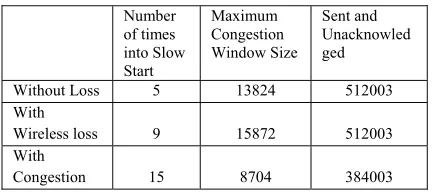
From the simulation results the following parameters were also analyzed by varying the number of packets sent and the data load. Three different scenarios such as without any loss, with loss due to congestion and with loss due to wireless and other failures were simulated.
Losses due to congestion were simulated by creating a bottleneck at a specific node and by increasing the number of flows that go through a particular intermediate node. In a similar manner wireless loss was induced by creating a link failure at the interfaces. In Qualnet link failure can be created by using Qualnet’s fault interface option at the incoming and outgoing link of any node.
Table 6: Parameters analyzed in multi-hop networks
Number of times into Slow Start
Maximum Congestion Window Size
Sent and Unacknowled ged
Without Loss 5 13824 512003
With
Wireless loss 9 15872 512003
With
Congestion 15 8704 384003
The Table 6 shown above is a summary table from the various data obtained from the above
scenarios. The trace files of Qualnet was analyzed and the parameters such as the number of times the congestion window enters into the slow start is measured. This value indicates how performance has degraded. Every time when TCP enters into the slow start state it restarts the congestion window from one segment which leads to severe degradation.
It can be seen from the results that the number of times TCP enters into slow start is more during loss during congestion. Hence loss due to congestion has a severe impact on TCP compared to other losses. In TCP all MAC retransmissions and hidden terminal problem, exposed terminal problem delay the data transmission which is assumed to be as congestion and retransmission time out occurs. Hence TCP enters into slow start and starts with Congestion window size as 512 which was the initial value.
The second parameter shows the maximum congestion window value during a transmission and how it is significantly reduced during congestion. A smaller congestion window indicates a less number of transmission units at one time from the sender. The last column specifies the sent and unacknowledged which is the highest sequence number of packet that has been sent but not yet acknowledged.
6. CONCLUSION
The problem of hidden and exposed terminal and routing instability and the impact it has on the TCP throughput has been addressed This paper attempts to find a solution from the perspective of the routing protocol used in a chain topology. The Greedy routing algorithm proposed by Sharmila Sankar et.al is used and simulation results have been shown. The routing algorithm which is a modification of AODV is capable of reducing the number of hops and thereby the exposed terminal problem is minimized. Also the congestion window and other parameters such as number of retransmissions and fast retransmissions have been analyzed. The routing overhead and the mobility of the farthest node has been analyzed with a specific mobility model which can further be extended to other mobility models also.
Moreover since the hidden terminal and exposed terminal problem has a major impact on the chain topology it was considered for simulation scenarios.
[image:8.612.89.305.597.693.2]5223 is reduced and hence the TCP throughput performance is improved by reducing the unnecessary retransmissions. There is a marginal delay in the time when the first packet reaches the destination when compared to the conventional TCP however the time when the last packet reaches the destination is less compared to conventional TCP.
The same can be further applied to other topology and mobility models to study the impact . Since this paper focuses on flows when the payload size is lesser, it can be further extended to analyze flows with varying payloads.
The impact of the hidden and exposed problems which leads to routing instability has been addressed by using a Greedy Routing Protocol.
7. ACKNOWLEDGMENT
We gratefully acknowledge the authors of the Greedy Routing Protocol [5] for sharing their knowledge and providing technical aspects of the protocol.
.REFERENCES
:
[1] S. Xu and T. Saadawi, “Does the IEEE 802.11
MAC protocol work well in multihop wireless ad hoc networks,” IEEE Communications Magazine, June 2001, pp. 130—137.
[2] J. Li, C. Blake, D. DeCouto, H. Lee, R.
Morris, “Capacity of ad hoc wireless networks”, in: MobiCom, 2001, pp. 61–69.
[3] Ng, S. Liew, “Throughput analysis of 802.11
multi-hop ad hoc networks, IEEE/ACM Transactions on Networking” 15 (2),2007, 309–322.
[4] H. Khalife, N. Malouch,” Interaction between
hidden node collisions and congestions in multihop wireless ad-hoc networks”, in: ICC ’06: IEEE International Conference on Communications, vol. 9, 2006.
[5] Sharmila Sankar and V.Sankaranarayanan, “A
Cross Layer Design for route maintenance in dense Manets”, International Journal of Information Technology and Knowledge Management, July-December 2011, Vol.4, No.2, pp. 539-543.
[6] K. Nahm, A. Helmy, C. J. Kuo, "Cross-layer
interaction of TCP and ad hoc routing
protocols in multihop IEEE 802.11
networks", IEEE Trans. Mobile Compute.,
vol. 7, no. 4, pp. 458-469, Apr. 2008.
[7] Kaixin Xu, Sang Bae, Sungwook Lee, Mario
Gerla - “TCP behavior across multihop wireless networks and the wired internet” International Workshop on Wireless Mobile Multimedia. Proceedings of the 5th ACM international workshop on Wireless mobile multimedia,Pg 41-48 , 2002
[8] G. G Holland, N Vaidya. “Analysis of TCP
Performance over Mobile Ad Hoc Networks”. Wireless Networks, Springer.pp 275-288, Volume 8, Numbers 2-3 / March, 2002.
[9] N. Parvez, A. Mahanti, and C. Williamson,
“An analytic throughput model for TCP New
Reno,” IEEE/ACM Transactions on
Networking, vol. 18, no. 2, pp. 448-461, April 2010.
[10] F. Ye, S. Yi, and B. Sikdar, “Improving
Spatial Reuse of IEEE 802.11 Based Ad Hoc Networks,” Proc. IEEE Global Telecomm. Conf. (GLOBECOM '03), Dec. 2003.
[11] Pham Thanh Giang, Pham Minh Vi, "Cross
layer design to enhance TCP performance in multi-hop ad hoc networks", Advanced Technologies for Communications (ATC) 2013 International Conference on, pp. 642-647, 2013, ISSN 2162-1020.
[12] Siva Ram Murthy C, and Manoj B.S. “ Ad hoc
Wireless Networks: Architecture and Protocol “, Prentice Hall, 2004.