• No results found

Design modification and field performance of two row maize planter

N/A
N/A
Protected

Academic year: 2020

Share "Design modification and field performance of two row maize planter"

Copied!
5
0
0

Loading.... (view fulltext now)

Full text

(1)

Full Length Research Article

DESIGN MODIFICATION AND FIELD PERFORMANCE OF TWO ROW MAIZE PLANTER

*

Ahmad Nawaz Gill, Abdul Ghafoor, Anjum Munir and Muhammad Iqbal

Department of Farm Machinery and Power, Faculty of Agricultural Engineering & Technology,

University of Agriculture, Faisalabad

ARTICLE INFO ABSTRACT

Mechanization in maize crop is increasing in Pakistan day by day due to its good cooking oil and flour quality. The aim of this study was to modify and develop two row maize planter with locally available materials which ultimately decreased its cost. After modification, a field experiment was conducted at Crop Physiology Research Area of the University of Agriculture, Faisalabad to evaluate the efficiency of two row maize planter. The effect of three levels of seed rates S1 (25

kg/ha), S2 (30 kg/ha) and S3 (35 kg/ha), three levels of row to row distance RR1 (50 cm), RR2 (65

cm) and RR3 (80 cm), three levels of machine forward speed V1 (3 km/h), V2 (6 km/h) and V3 (9

km/h) and three levels of fertilizer rate F1 (20 kg/ha), F2 (40 kg/ha) and F3 (60 kg/ha) were investigated on maize dry biomass and emergence rate index using maize variety Montgomery. The experiment was laid out in Randomized Complete Block Design (RCBD) with three replications. The data regarding row to row distance, fertilizer rate, seed rate, machine forward speed, maize dry biomass and emergence rate index was analyzed at 5 % level of significance. Maize dry biomass and emergence rate index (ERI) were not affected significantly by machine forward speed. Best results regarding dry biomass and emergence rate index (ERI) were recorded when seed rate was 35 kg/ha, row to row distance was 80 cm and fertilizer rate was 60 kg/ha. Average field efficiency of two row maize planter was calculated to be 73.8 %.

Copyright © 2014 Ahmad Nawaz Gill et al. This is an open access article distributed under the Creative Commons Attribution License, which permits unrestricted use, distribution, and reproduction in any medium, provided the original work is properly cited.

INTRODUCTION

Maize is much important crop for Pakistan because it provides good quality oil and other useful products for human beings and animals. Pakistan is one of the developing countries of South Asia. The area of Pakistan is about 79.61 million hectares. Cropped area of Pakistan either by irrigation or rain dependent is nearly 23.04 million hectares (Anonymous, 2010-11). Pakistan’s economy depends upon agriculture. The third most significant crop of the world is maize after wheat and rice with reference to area and production. In Pakistan maize is cultivated on an area of near about 1.02 million hectares with an annual production of 3.56 million tons. Average yield of this important crop in Pakistan is only 3.4 tons per hectare which is remarkably low as compared with other developed countries (GOP, 2009). In Pakistan, traditional seeding methods are still in practices. Manual broadcasting and rough seed metering through a funnel behind a plough are still very common in irrigated and Barani areas of Pakistan.

*Corresponding author: Ahmad Nawaz Gill

Department of Farm Machinery and Power, Faculty of Agricultural Engineering & Technology, University of Agriculture, Faisalabad

These conventional sowing practices may be the reasons for low crop yield in the country. These sowing practices also hinder mechanized inter-culture and harvesting operations (Khan et al., 1990). In different areas of the world, maize crop is used as food grain for human consumption. It is being used in manufacturing industries and corn refineries for producing products such as, gluten (used in animal feed), syrup, corn starch, alcohol for use in beverages industries, ethanol, fructose corn syrup, biodegradable chemicals and plastics, rubber, paper, textiles, ready-to-eat snack foods and breakfast cereals, cornmeal, flour and additives in paint and explosives. In addition, it is also used as an important feed and fodder for animals. It is calculated that four thousand industrial products can be made with maize crop. There are more than one thousand items in USA supermarkets that contain maize (Prabhu and Shivaji, 2000). Usually effect of space between plants refers to number of plants per unit area but spatial arrangement of plants should also be taken in account (Ogbaji, 2003). Non-conventional and improved methods of sowing can increase yield of maize by increasing weight of grain and height of plant stalk. That is the only reason why farmers use extra amount of chemical fertilizers to overcome their negligence in planting methods which increase cost of

ISSN: 2230-9926

International Journal of Development Research

Vol. 4, Issue, 7, pp. 1336-1340, July,2014

International Journal of

DEVELOPMENT RESEARCH

Article History:

Received 10th April, 2014

Received in revised form 05th May, 2014

Accepted 10th June, 2014

Published online 20th July, 2014

Key words:

Biomass;

Emergence rate index; Seed rate;

(2)

production (Mohsan et al., 1998). By using hybrid seed and keeping optimum plant density grain yield of maize crop can be increased remarkably. Instead of all these factors, there will remain a significant gap between actual and potential yield of different farmers because they use different agro-management practices. Among all agro-management practices planting methods are of great importance (Cardwell, 1982). Sunlight or radiation use efficiency of maize plant depends upon plant sowing methods (Tollenaar and Aguilera, 1992). Level of irrigation and row to row distance affected growth rate and yield of maize when maize crop was grown maintaining 30 cm, 45 cm and 60 cm row to row distance. Highest yield of maize crop was observed when there was 60 cm row spacing (Lambe et al., 1998).

In Pakistan average yield of maize crop is low because farmers are not using good quality seed and improved sowing techniques. Pakistani cultivars are using those planting methods which can never achieve optimum plant density hence adversely results low gain yield. It is found that if maize is sown on ridges it can maximize crop yield because it makes reasonable amount of nitrogen available to plants (Amin et al., 2006). Problems related to non-conventional sowing methods open the way for introduction of drill and planter. There are several advantages of seed planter cum fertilizer applicator over the traditional maize planting methods in the field. Those advantages included uniform seed and fertilizer distribution. Calculated quantities of seed and fertilizer can be placed at the required depth with fertilizer below and besides the seed. Mechanical (wheel hoe) and chemical weeding are also possible. Maize planter available at University of Agriculture, Faisalabad had some drive problems related to its chain and sprockets mechanism. Therefore, keeping in view the above factors this study had been focused to modify and fabricate two row maize planter as well as to evaluate field performance of the modified machine.

MATERIALS AND METHODS

This study was carried out at Agricultural Farms of the University of Agriculture, Faisalabad (UAF) with an aim to modify, fabricate and test the performance of tractor driven two row maize planter. Planter was modified using locally available materials. The maize planter was modified in the Workshop of the Department of Farm Machinery and Power, UAF. After modification and fabrication, the machine was tested in the fields. Keeping in view the aims to meet the required standards related to maize planting, the study was carried out in two phases.

 Modification and fabrication of two row maize planter.

 Testing and field evaluation of modified two row maize planter.

Phase -I Modification and fabrication of two row maize planter

The machine has been modified and fabricated using locally available materials to overcome the problems of unavailability of spare parts. Following modifications were made in two row maize planter. High cost and unavailable imported chains used in power transmission were replaced by locally available low cost chains of same standards and requirements. Roller chain

[image:2.595.314.552.248.371.2]

is the type of chain drive most commonly used for transmission of mechanical power on many kinds of domestic, industrial and agricultural machinery. It consists of a series of short cylindrical rollers held together by side links. It is driven by a toothed wheel called a sprocket. It is a simple, reliable, and efficient means of power transmission. The roller chain design reduces friction, resulting in higher efficiency and less wear. There is even very low friction, as long as the chain is sufficiently lubricated. Continuous lubrication of roller chains is of prime importance for efficient operation as well as correct tensioning. Locally available 2050 No. roller chain was used for two row maize planter to transmit power from rear wheel to seed and fertilizer metering disk with the help of sprockets. The layout of roller chain assembled on sprockets is shown in Figure 1.

Fig. 1. Roller chain assembled on sprocket

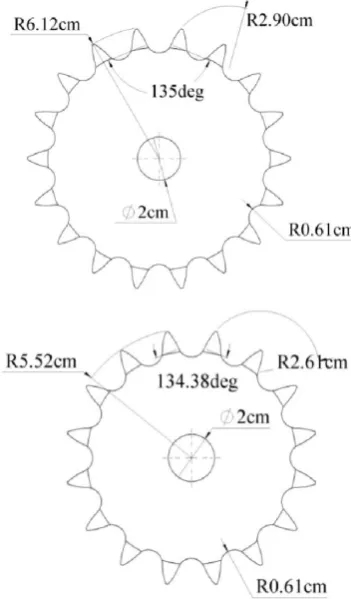
Sprockets used for metering of seed and fertilizer as well as power transmission were replaced by locally available sprockets. Modified sprockets have been shown in Figure 2.

[image:2.595.343.519.455.755.2]
(3)
[image:3.595.51.273.193.348.2]

A sprocket is a profiled wheel with teeth that meshes with a chain or track. The chain and sprocket system was selected to transmit power from ground wheel to seed and fertilizer metering disk. A wheel having 56.76 cm diameter was provided to drive metering devices. Small but necessary modifications in metering devices and the machine were taken into account according to new chains and sprockets like decreasing thickness of bushes related to sprockets and introducing rubber join between seed box and seed metering disk for smooth and uniform distribution of seeds. Final form of modified two row maize planter is shown in Figure 3.

Fig. 3. Isometric view of modified two row maize planter

1. Main frame, 2. Sliding frame, 3. Front wheel, 4. Rear wheel, 5. Chain and sprockets, 6. Furrow opener, 7.Seed metering plate, 8. Fertilizer box, 9. Seed box, 10. Soil remover

Phase - II Field performance evaluation

A field experiment for the performance evaluation of two row maize planter was conducted at Crop Physiology Research Area, University of Agriculture, Faisalabad under irrigated conditions of Faisalabad. Maize variety “Montgomery” was planted on an area of 2 acres. The experiment was laid out in Randomized Complete Block Design (RCBD) to evaluate the field performance of two row maize planter. Effect of treatments was observed on maize emergence rate index (ERI) and maize dry biomass. Treatments were replicated three times. Details of treatments are given in Table 1. The data collected was subjected to statistical analysis by ANOVA technique following four factorial randomize complete block design. The treatment means were differentiated by least significant different (LSD) test at 5 % level of significance.

The soil type of the farm was determined by hydrometer method. Before starting the experiment soil samples were collected randomly from six places by a sampling tube up to a depth of 25 cm. An area of one square meter each was selected in every experimental plot for the determination of emergence rate index. The emergence rate index was calculated using following equation:

= % − %( − 1)

Where; ERI is emergence rate index, n is number of days since planting, % n is plants emerged on day ‘n’ as a percent of total seed emergence, % (n-1) is plants emerged on day ‘n-1’ as a percent of total seeds planted. Maize dry biomass was determined soon after 25 days of seed emergence. Samples collected were weighed to determine fresh weight. Each sample was chopped thoroughly. Samples were placed in oven at 70°C until constant weight was obtained and dry matter weight was recorded.

RESULTS AND DISCUSSION

[image:3.595.307.559.343.581.2]

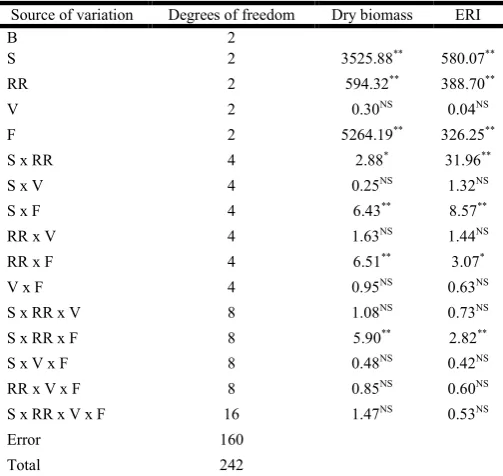
Particle size analysis of soil was performed prior to sowing of crop by taking sample to a 25 cm depth. Soil of experimental area was found sandy clay loam in texture having 13.37 % moisture content. ANOVA for the effect of seed rate, row to row distance, machine forward speed and fertilizer rate on emergence rate index and maize dry biomass is shown in Table 2.

Table 2. ANOVA of dry biomass and ERI as affected by seed rate, row to row distance, machine forward speed and fertilizer

rate

Source of variation Degrees of freedom Dry biomass ERI

B 2

S 2 3525.88** 580.07**

RR 2 594.32** 388.70**

V 2 0.30NS 0.04NS

F 2 5264.19** 326.25**

S x RR 4 2.88* 31.96**

S x V 4 0.25NS 1.32NS

S x F 4 6.43** 8.57**

RR x V 4 1.63NS 1.44NS

RR x F 4 6.51** 3.07*

V x F 4 0.95NS 0.63NS

S x RR x V 8 1.08NS 0.73NS

S x RR x F 8 5.90** 2.82**

S x V x F 8 0.48NS 0.42NS

RR x V x F 8 0.85NS 0.60NS

S x RR x V x F 16 1.47NS 0.53NS

Error 160

Total 242

ward speed (km/h) and F is fertilizer rate (kg/ha).

[image:3.595.114.480.620.682.2]

Effect of seed rate, row to row distance and fertilizer rate on emergence rate index and maize dry biomass was highly significant while effect of machine forward speed was non-significant. All interactions except seed rate and row to row distance, seed rate and fertilizer rate, row to row distance and fertilizer rate as well as seed rate, row to row distance and fertilizer rate were non-significant in both cases of emergence rate index and maize dry biomass. Interaction of seed rate and

Table 1. Treatments and their levels

Parameters Row to row

distance, (RR) Seed rate, (S)

Fertilizer rate, (F)

Machine speed,

(V) Block, (B) Levels 3 levels

RR1 = 50cm RR2 = 65cm RR3 = 80cm

3 levels S1 = 25 kg/ha S2 = 30 kg/ha S3 = 35 kg/ha

3 levels F1 = 20 kg/ha F2 = 40 kg/ha F3 = 60 kg/ha

3 levels V1 = 3 km/h V2 = 6 km/h V3 = 9 km/h

(4)
[image:4.595.40.286.208.364.2]

row to row distance was significant in case of dry biomass and highly significant in case of emergence rate index, interactions of seed rate and fertilizer rate as well as seed rate, row to row distance and fertilizer rate were highly significant both for maize dry biomass and emergence rate index whereas interaction between row to row distance and fertilizer rate was highly significant for maize dry biomass and significant for emergence rate index. Effect of different treatment levels of seed rate, row tow distance, fertilizer rate and machine forward speed is shown in Table 3.

Table 3. Effect of different levels of treatments on maize dry biomass and emergence rate index

Treatments Levels

Mean Dry biomass

(g m-2)

Mean Emergence

rate index (ERI) Seed rate (S) S1 = 25 kg/ha 360.49c* 13.13c

S2 = 30 kg/ha 418.19b 15.16b

S3 = 35 kg/ha 518.22a 17.03a

Row to row distance (RR)

RR1 = 50cm 400.75c 13.51c

RR2 = 65cm 429.99b 15.11b

RR3 = 80cm 466.16a 16.70a

Machine speed (V) V1 = 3 km/h 431.68a 15.12a

V2 = 6 km/h 433.11a 15.09a V3 = 9 km/h 432.11a 15.11a

Fertilizer rate (F) F1 = 20 kg/ha 348.37c 13.65c

F2 = 40 kg/ha 409.26b 15.10b

F3 = 60 kg/ha 539.27a 16.57a *

Means sharing similar letters are statistically non-significant (P>0.05).

Statistically analyzed result for calculating the effect of seed rate on dry biomass showed that increasing the levels of seed rate from 25 to 35 kg/ha statistically increased the maize dry biomass. The reason of increase in dry biomass with increase in seed rate could be that at seed rate 25 kg/ha, number of plants were less than that of seed rate 30 kg/ha and maximum number of plants were obtained when seed rate was 35 kg/ha. Increasing the levels of row to row distance from 50 to 80 cm statistically increased the maize dry biomass. The reason of increment in the dry biomass with increase in row to row distance could be that higher the distance between rows, higher would be availability of nutrients, air, moisture contents and sunshine for the plants and ultimately plants would emerge and grow better. The reason of non-significant effect of machine speed (V) on maize dry biomass could be that higher the speed of machine higher would be seed and fertilizer scattering but ultimately machine would pass through more quickly and maize dry biomass would not be affected significantly because of no change in seed or fertilizer application.

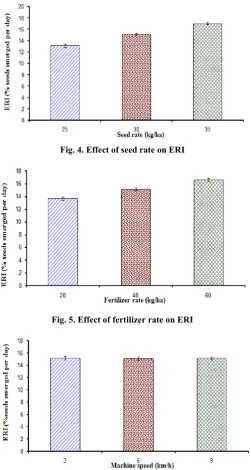
Maize dry biomass increased by increasing fertilizer rate from 20 to 60 kg/ha. Reason of increase in biomass by increase in fertilizer rate could be that fertilizers provide essential nutrients to plants, which ultimately enhance the growth rate of plants. Emergence rate index also showed increasing trend due to increase in seed rate. Reason of greater ERI with greater seed rate could be that it is hard for a single seed to tear the upper surface of soil for emergence but it is quite easy for cluster of seeds to emerge. Greater number of seeds could increase chances of seeds to emerge. Figure 4 shows effect of seed rate on ERI. The statistically analyzed results showed that the minimum ERI was produced by F1 that was 13.65 and maximum with the F3 that was 16.57 it was followed by the F2 where the ERI was 15.10. Fertilizers are always used to

[image:4.595.310.562.295.766.2]

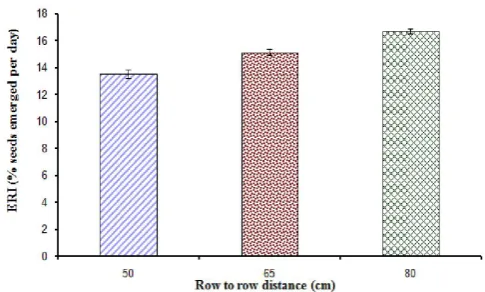
maximize availability of nutrients required by any seed for its growth. So, reason of increase in ERI by increasing fertilizer rate could be that at higher fertilizer rate seeds gained more nutrients and more chances to emerge. Graphical affect of fertilizer rate on maize ERI is shown in Figure 5. Machine forward speed has non-significant effect on ERI. The reason of non-significant effect of machine speed (V) on maize ERI could be that more the speed of machine greater would be seed and fertilizer scattering but ultimately machine would pass through more quickly and ERI would not affected significantly because of no change in seed or fertilizer application. However, effect of machine forward speed on maize ERI is also shown in Figure 6. Increasing the levels of row to row distance from 50 to 80 cm statistically increased the maize ERI. The reason of increment in the ERI with increase in row to row distance could be that higher the distance between rows, higher would be availability of nutrients, air, moisture contents and sunshine for the plants and ultimately plants would emerge and grow better. The effect of row to row distance on maize ERI is shown in Figure 7.

Fig. 4. Effect of seed rate on ERI

Fig. 5. Effect of fertilizer rate on ERI

(5)
[image:5.595.41.284.56.202.2]

Fig. 7. Effect of row to row distance on ERI

Conclusions

Pakistan is a developing country. The economy of Pakistan basically depends upon agriculture. Usually in Pakistan farmers practice broadcast sowing of cereals and pulses which costs less, but ultimate income is also less due to higher intercultural operation costs and lower grain yields. Improved implements like seed drills and planters are useful additions to mechanized equipment for ensuring timely sowing and placement of seed and fertilizer at appropriate depths for better germination. Keeping in view the above information a two row maize planter was tested for its field performance by the Engineers of University of Agriculture Faisalabad (UAF). The modification of roller chains and sprockets were suggested to improve its field performance. These modifications were carried out at the Workshop of Department of Farm Machinery and Power, University of Agriculture, Faisalabad. Locally available 2050 No. roller chain used instead of imported unavailable roller chain. Sprockets also altered with locally available sprockets. After modifications, machine was tested for its field performance in research fields of Depart of Crop Physiology, University of Agriculture Faisalabad (UAF). The efficiency of two row maize planter was determined in the field by sowing maize with three levels of seed rate (25, 30 and 35 kg/ha), row to row distance (50, 65 and 80 cm), machine speed (3, 6 and 9 km/h) and fertilizer rate (20, 40 and

60 kg/ha). Machine speed (V) has not significant effect on maize dry biomass and emergence rate index (ERI). Maximum maize dry biomass and ERI were recorded when seed rate was 35 kg/ha, row to row distance was 80cm and fertilizer rate was 60 kg/ha. The field performance of machine after modifications remains good.

REFERENCES

Amin, M., Razzaq, A., Rehmatullah and Ramzan, M. 2006. Effect of planting methods, seed density and nitrogen, phosphorus fertilizer level on sweet corn (Zea mays L.) J.

Res. Sci. 17(2): 83-89.

Anonymous, 2010-2011. Economic Survey of Pakistan. Government of Pakistan, Finance Division, Economic Advisor Wing, Islamabad.

Cardwell, V. B. 1982. Fifty years of Minnesota: Corn production source of yield increase. J. Agron., 74(6): 984-990.

GOP. 2009. Economic survey of Pakistan 2008-09. Ministry of food, agriculture and live stock, Federal Bureau of statistics, Islamabad.

Khan, AS., Tabassum, MA., Khan, J. 1990. Selection of seed cum fertilizer drill. Atechnical consideration. AMA. 27(4). Lambe , L., Patil, SM., Jiotode, DJ., Drainage, SO. 1998.

Effect of irrigation level and row spacing on yield of rabi maize (Zea mays L). J. Soil and Crops, 8(1): 95-99. Mohsan, J M., Ebling, TL., Taylor, CC., Lynch, MP., Reddish,

MA., Endres, MI., Kung, L. 1998. The effects of height of cutting, hybrid, and storage of maturity at harvest on the nutritive value of corn silage for lactating dairy cows. J.

Dairy Sci., 85(1): 383

Ogbaji, MI. 2003. Effects of nitrogen rates and intra row spacing on local maize (Zea mays L.) in the southern Guinea Savannah zone of Nigeria. J. of sustainable Agri.

And Environ., 5(1): 147-152.

Prabhu, LP., Shivaji, P. 2000. Meeting world maize needs: Technological opportunities and priorities for the public sector. CIMMYT World Maize Facts and Trends.

Tollenaar, M., Aguilera, A. 1992. Radiation use efficiency of old and new maize hybrids. Agron. J., 84: 536-541. USA: 498.

Figure

Fig. 1. Roller chain assembled on sprocket
Table 2. ANOVA of dry biomass and ERI as affected by seed
Fig. 4. Effect of seed rate on ERI
Fig. 7. Effect of row to row distance on ERI

References

Related documents

Following a series of interventions aimed at supporting patients having these measures and increasing effective leadership, collaborative team work, and routine recording of

Drawing from the nomadic v/s sedentary debate throughout human history, this paper attempts to point out to an inherently present hostility in civilizational discourses towards the

Screening of cytotoxic activities using WiDr and Vero cell lines of ethyl acetate extracts of fungi-derived from the marine sponge

To our knowledge, there are relatively few examples in the literature of studies that investigate effort prediction models generated using data from Web hypermedia

The results of the analysis in Figure 4 show a fairly significant positive correlation between IgE anti-HDM levels in the serum of patients with the mite density in

Herein, the interest is to study the aerodynamic of the flow of fuel and air entering the furnace via swirl burners, the subsequent combustion processes and effects on the

When a tuple space has to store tuples of many different types, partitioning decreases the search time that is especially important for the tuple spaces based on data structures,

Assessment indicators of single contributions were proposed and a global index was defined to classify new and existing buildings, referring to total performance: the model