ISSN: 1992-8645 www.jatit.org E-ISSN: 1817-3195
428
CURRENT CHALLENGES AND CONCEPTUAL MODEL OF
GREEN AND SUSTAINABLE SOFTWARE ENGINEERING
KOMEIL RAISIAN 1, JAMAIAH YAHAYA 2, AZIZ DERAMAN 3
1, 2
Faculty of Information Science and Technology, the National University of Malaysia 43600 UKM Bangi Selangor, Malaysia
3 School of Informatics & Applied Mathematics, Universiti Malaysia Terengganu, Kuala Terengganu,
MALAYSIA
1
2
*Corresponding author: komeil Raisian
ABSTRACT
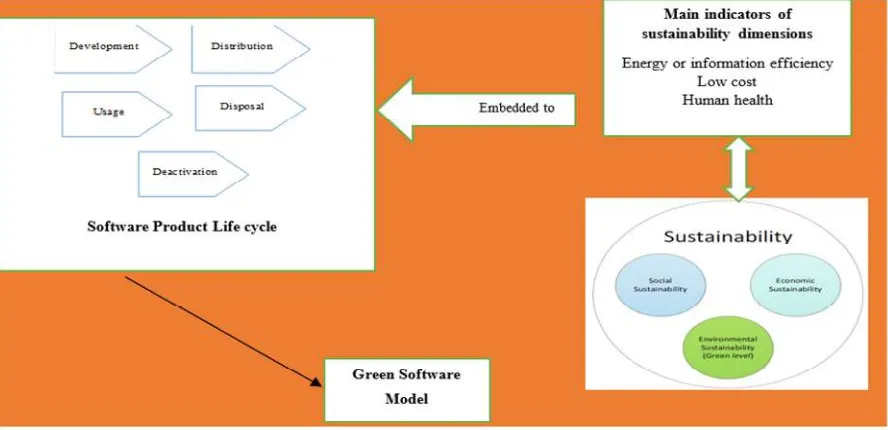
Software is a fundamental component in a rapidly advancing technological society. The science of software engineering is the utilization of a systematic, disciplined, quantifiable methodologies to deal with the development, operation, and maintenance of software and also the investigation of these methodologies which practically means how to apply engineering science to the application of software. Sustainability is turning into an essential point in information technology as commitment of information technology to uphold our Future, and as advancing business sector fragment. The issue of sustainability was not duly accounted for in the conventional and older software engineering field. Software engineers deal with particular themes that need to take into account sustainability, for instance, green IT, efficient algorithms, smart grids, agile practices and knowledge management, yet there does not exist a thorough comprehension of the idea of sustainability and if it can be incorporated to software engineering. Information communication technology hugely affects sustainable improvements because of its rising popularity for vitality and resource management required when producing hardware and software units. The ranking technique made 374 papers out of 11 different databases. In the wake of performing the exclusion measures, the set was diminished to 97 papers that were clearly identified with the models characterized for performing a composed survey. The purpose of current study is to recognize recent issues in green software engineering and examine the aspect of sustainable and create green software product to render a conceptual model of sustainable software engineering product to wind up even greener. Consequently, we recommend a technique to incorporate sustainability in product life cycle. Then, a conceptual model is rendered demonstrating the consolidated life cycles of sustainable product and principle sustainable measurement dimensions, such as energy or information efficiency, low cost and human health.
Keywords: Green Software Engineering; Sustainability And Sustainability Dimensions Software Product
Life Cycle, Hardware, Conceptual Model
1. INTRODUCTION
Nowadays apart from cost, factors such as environment, social, and human sustainability are required to be considered in any planning program, implementation and running software system. Sustainability, normally known as addressing "the requirements of the present without trading off the capacity of future eras to fulfil their own particular needs", is a critical segment of society, government and finance [1]. In the current world, organizations have perceived that there are environmental implications of asset utilization and social cost brought about by their operations and software
systems. Besides, Organizations have begun to understand that not just cost efficiency can be achieved with sustainability however even perpetual prosperity can be gained. In this manner, beside factors like cost, time, and quality, likewise sustainability is an objective to achieve when planning, developing, configuring and operating and working software systems. Additionally, when creating software systems we need to investigate software engineering completely from an engineering perspective.
ISSN: 1992-8645 www.jatit.org E-ISSN: 1817-3195
429 indicated by Gartner. Actually, this 2% incorporates just the being used period of hardware: in the staying 98% software both incorporates the individual business and also the public sector, and conveying end-client applications that pervade [2, 3]. Software can add to diminishing power consumption (i.e. ended up greener) by being more energy efficient, consequently utilizing lesser power or by making more sustainable for supported processes, henceforth diminishing the environmental effect of governments, organizations and people utilizing software. While experts' opinions in gauging and organizing the level of greenness of hardware segments still is there, significant examination is required to associate make greener of hardware to its executing software [4, 5, 6, and 7].
The software engineering study area has as of late been considering sustainability, as the expanded number of papers, observational studies, and gatherings on the point exhibits that Greening in software plans to lessen the natural effect brought on by the software [8, 9, 10]. Penzenstadler [11] in comprehensive seminar address survey showing that software engineering is principle confinement of research which there is one technique in software engineering that expressly addresses sustainability. It is a reference system with particular application in web engineering [12]. So far, not many studies have been led on the make greener of software itself. Hence, it is critical to examine the significance of sustainable software product and green software engineering and applied model.
This research novelty is needs to be elaborated what measurements can and need to be added to be able to capture all sustainability aspects in software product. So, based to the different dimension of sustainability that needs to be taken into account when conducting research on sustainability during software product life cycle to evaluated current model and challenge of green software and sustainable software engineering. There are three questions depend on these objectives:
i. What is the current model and challenge of green software and sustainable software engineering?
ii. What are the dimensions of sustainability in green software product?
iii. What are main measurements of sustainability dimensions in software
engineering product and conceptual model?
The remaining sections of this paper are organized as follows: Section two presents the theoretical basis for green software, sustainability and sustainability dimensions. Section three describes the research method. The results are presented in Section four. Section five stated about discussion and Section six conclusion of this paper.
2. RELATED WORK
This part delivers a theoretical background regarding the most important notions that are relates to the scope of the current study. The first subcategory associates with the main notions associated to Definition and benefits of Green Software. The second subcategory defines notions associated with Sustainability and sustainability dimensions.
2.1 Definition And Benefits Of Green
Software
It is important to clear up our comprehension by "Green and Sustainable Software" and "Green and Sustainable Software Engineering". Thus, we provide two clarifications in this part. These definitions depend on the foundation of comprehensive product life cycles in the matter of Life-cycle Assessment (LCA) or a "cradle to-grave" approach, the discoveries on the three unique levels of effects of Information and communication technology (ICT) on Software Development (SD), and effects of administrations offered by ICTs on the life cycles of different product and administrations.
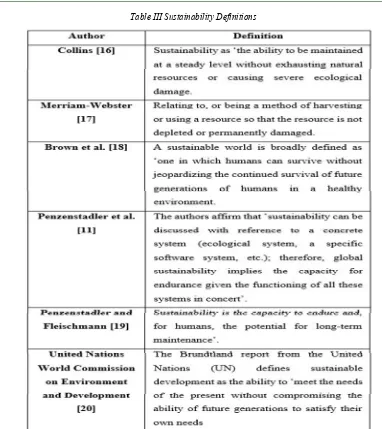
To start with, a definition displayed as Green and Sustainable Software is software, whose immediate and backhanded negative effects on economy, society, individuals, and environment that come from advancement, organization, and use of the software are negligible and/or which positively affects sustainable improvement [13].
ISSN: 1992-8645 www.jatit.org E-ISSN: 1817-3195
430 architects, and designers in a circumstance to advance their product as needed. Furthermore, it is essential that the improvement procedure itself is considering environmental issues.
Second definition exhibited as Green and Sustainable Software Engineering is the specialty of creating green and sustainable software with a green and sustainable designing procedure. Consequently, it is the specialty of characterizing and creating software product as it were, so that the negative and positive effects on practical improvement that outcome and/or are relied upon to come about because of the software product over its entire life cycle are ceaselessly evaluated, reported, and utilized for a further advancement of the software product [14].
The overall discernment around a software is that it is naturally green and software scarcely has an environmental effect. That may not be valid by any stretch of the imagination. So the imperative inquiry is - Can software be any more green than it as of now is? As more examination is being completed on the subject of green software, it is revealed that there is a difference in software greenness and the green software whose fundamental point has been to build up a "simple" software.
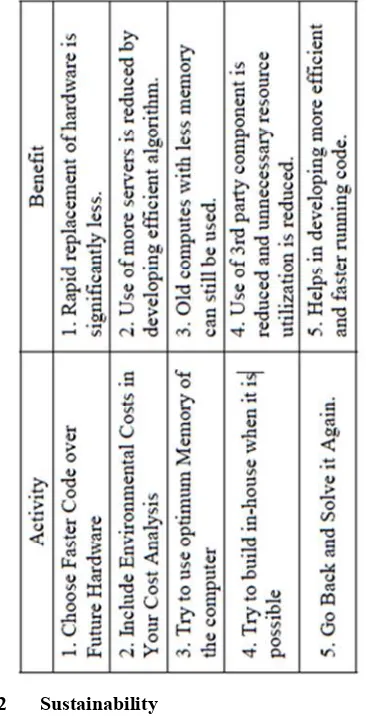
[image:3.612.324.507.111.471.2]A "simple" is the greenest software available and probably the most effective software ever has been the greenest arrangements. Although, software designers don't consider this issue while developing software. There exist some normal procedures in software development which are certainly not green. For instance, propelled PC hardware and most recent innovation adjusts for the weaknesses in the product and henceforth slower, wasteful and more costly software has been there for quite a while without a lot of execution debasement. Software engineers perform cost investigation in a manner that the worker hours are thought to be the most valuable ware and henceforth accentuation is to decrease the advancement time. But very little consideration is paid to the advancement of a more efficient algorithm which is less time consuming. Because the software should be executed a huge number of times, sparing time in the execution might be a superior arrangement both regarding cost and sustainability. As individuals, software engineers despise tackling the same issue over and over again. Table 1 demonstrates a few advantages of green software engineering.
Table I Some Benefits Of Green Software Engineering
2.2 Sustainability
To clarify this research target, this study defined understanding of sustainability and what we mean by sustainability and how researcher would like to apply it to software engineering.
ISSN: 1992-8645 www.jatit.org E-ISSN: 1817-3195
[image:4.612.113.495.87.516.2]431
Table III Sustainability Definitions
2.3 Sustainability Dimensions
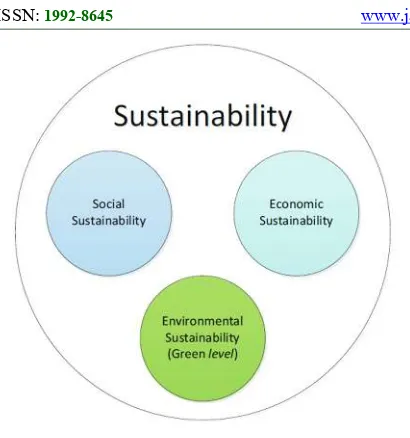
Modeling sustainability in three measurements is by all accounts generally acknowledged. It permits a simple perception of the reconciliation of financial, natural and social issues [21]. As all studies are taken from administration related field, the financial aspect shapes a necessary part and was in this manner not taken as a different segment. However, the studies demonstrate an exceptionally solid predominance of tending to environmental issues. There are no studies that only concentrate on social issues, furthermore incorporating every one of the three measurements of maintainability is just present in two of them [22]. Seuring [23] underline the requirement for expanding collaboration with supply chain, if sustainability objectives wanted to be achieved [24]. Henceforth,
ISSN: 1992-8645 www.jatit.org E-ISSN: 1817-3195
[image:5.612.93.298.74.293.2]432 Figure I Sustainability Dimensions
2.3.1 Economic dimension
Financial investments ought to be kept up. The meaning of profit as the sum a person can spend amid a period and still be doing well toward the end of the period can characterize economic sustainability, as it decays on expending interest, as opposed to capital. In various cases, the current monetary circumstance is viewed as a sort of benchmark for assessing choices on their environmental effect. This holds especially for the LCA related studies (e.g. 25, 26] or those incorporating AHP [27, 28].
2.3.2 Environmental dimension
Environmental sustainability is required by people, it tries to enhance human well-being by securing common resources. Water, land, air, minerals and biological community administrations are these resources; henceforth much is changed over to manufactured or monetary capital. Environment incorporates the wellsprings of crude materials utilized for human needs, and guaranteeing that sink limits reusing human squanders are not surpassed. Most studies spend a great deal on clarifying related environmental issues. Most of the time, life-cycle appraisal information shapes the beginning stage for the investigation. Consequently, vitality interest and CO2-emanations [e.g. 25, 29] are among the every now and again specified points. However, in various cases, rather thorough arrangements of environmental effect criteria are taken up, for example, alluding to a wide range of regular capital [29, 30] or assets, for example, water or vitality and
also squander [e.g., 31] .Overall an extensive variety of natural viewpoints is considered. A more profound look gives some scrutinize to the common methodology picked. The relationship between the LCA-based environmental effects and their administration in the inventory network frequently indicates supplier determination [e.g. 25] and improvement issues, for example, transport to end-clients [25]. Thus, LCA based methodologies appear to rule here as they permit fathoming and demonstrating product related impact [32].
2.3.3 Social dimension
Social Sustainability implies keeping up social capital and saving the societal groups in their completeness. Social capital is speculations and administrations that make the essential structure for society: trust brings down transaction costs.
As per [33], "Social sustainability implies keeping up social capital and protecting the societal groups in their completeness". Willis et al. [34] characterized social sustainability as "a positive and long haul condition inside groups and a procedure inside groups that can accomplish and keep up that condition".
3. METHODS
Kitchenham [36] and presented that the research method used is a systematic revision, through which it is intended to identify, evaluate and interpret the possible and relevant researches for a given issue .The subsequent stages were followed for the conduction of this review: revision planning, research recognition, Selection of primary studies and categorization [35].
3.1 Revision Planning
In this step with the processes and ways to the application belonging to a systematic survey, Specifies the protocol. Extra to, the alteration objective, research asks principal primary research resorts and criteria to incorporation and prevention belonging to papers defines in this protocol [35].
In the next subsection, the principal primary research resorts and criteria for the incorporation and prevention belonging to different articles will be discussed.
ISSN: 1992-8645 www.jatit.org E-ISSN: 1817-3195
433 from theatrical finding and also embedded sustainable dimensions. So, the aims of this study are as follow:
i. To evaluated the current model and challenge of green software and sustainable software engineering.
ii. To identify the dimensions of sustainability in green software product?
iii. To identify the main measurements of sustainability dimensions in software engineering product and conceptual model.
The principal primary research resorts and criterion to the incorporation and prevention of distinctive papers are discussed in following subsection. Table 3 is shown the main key words of this research.
Table III Research Keywords
Sustainability Software Engineering
Sustainability Dimensions
Green software
3.2 Research Recognition
[image:6.612.92.294.342.406.2]Kitchenham [36] presented that finding the largest number belonging to fundamental inquiries as possible (connected to the inquiry topic), to use an unbiased strategic inquiry that is the main purpose of a systematic review. In accord with this proposition, keywords used (Table 3) and united: ‘‘Sustainability’’, ‘‘Software Engineering’’. Throughout the paper, these keywords are searched [37]. The foundations, in which the research is accomplished, are showed in Table 4.
Table IV Bases Researched In The Systematic Review
The research is accomplished in April of 2016, in other words, by the databases the publications of the first trimester of 2016 may not have been categorized. Just journal publications since 2006 forward have searched. . This process finished into 370 papers that shaped the foundation the basic studies choice.
3.3 Selection Of Primary Studies
The omission of copy titles, that decreased the collection to 390 papers, is the first stage after research identification. The summaries are comprehended and appraised, to use the following prevention criterion after this step: Articles of literature review; Articles were not connected to sustainability, sustainability dimensions, software engineering and green software. The collection was decreased in 90 papers, which were read completely, surveyed and analysed, after the execution of this process.
3.4 CATEGORIZATION
According to impact of sustainability and defined by Penzenstadler [12] and Sustainability dimensions described by Naumann [12] the chosen articles were read and categorized. The kind of factors used was recognized along with sustainability and how they cooperate with software engineering and green software as well.
4. RESULTS
After the papers categorization the section shows the outcomes obtained. To sum up the categorization, according to sustainability in software engineering and green software.
4.1 Current Challenges Of Software
Engineering
Numerous advancements on software engineering are developed [38]; along these lines, here spotlight on those articles that spread green and sustainable software engineering. An incredible survey can be acquired from Penzenstadler et al. [11] proposed a broadened assortment of information for sustainable software engineering that incorporates related application areas and sustainability ideas from related controls that scientists can gain from when further exploring Sustainability in software engineering.
Lately numerous endeavors have been done in getting green software. A few endeavors are centered on building green and sustainable software, some outline software procedures to help all partners in building green software products. Other endeavors are centered around building software tools that measure the impact of software Researched Databases
ScienceDirect SpringerLink Springer e-books IEEE Xplore Digital Library Australian Journal of Basic and Applied
Sciences Scientific.Net
Scopus ACM-Digital Library
Wiley InterScience
ISSN: 1992-8645 www.jatit.org E-ISSN: 1817-3195
434 on the earth and the impact of application improvement situations on the product as for productivity. There are endeavors that underline the working framework to control the energy utilization of applications. General software solutions found in [39, 40] incorporate virtualization, shutting applications which are no more being used, effective calculations by composing a minimal outline of codes and information structures, diminishment of parallelism overhead by creating proficient burden adjusting calculations, fine grained green figuring, and making vitality assignment calculations for steering information. Naumann et al. [12] concocted a conceptual reference model named GREENSOFT model for sustainable software. Their four section model backings software engineers, managers, and clients in making, keeping up, and utilizing software in a green way. The four sections cover a life cycle model, measurements, system models, and suggestions and devices for various partners. Shenoy [41] talked about that the adjustments in the current SDLC and proposes proper strides which can prompt lower carbon discharges, power and paper use, therefore helping Organizations to move towards greener and sustainable software development. Mahaux [42] contend that requirements engineering is basic to the entire software life cycle principally in the application stage where clients are conveyed the framework and anticipate that it will adjust to their prerequisites. They guarantee that proper requirement engineering can help software last more along these lines diminishing the power utilization. Capra et al. (2010) concentrate on building up a measure of resource efficiency for software applications and outline how application advancement situations can have a hindering impact because of the extra lines of code they include. Gupta [43] present a structure for making a smart force profile that execute three techniques at the moment of login into the system. These techniques consistently measure the energy utilization of running software in a given timeframe and can be consolidated in operating systems. Oliveira et al. [44] exhibited a methodology taking into account periodic measurement of GPIs and QoS and reception of Service Oriented design is utilized to streamline vitality productivity at the Software-as-Service layer. Endeavors on incorporating sustainability in Service-Oriented software are observed in [45, 9]. Sissa [46] and Agarwal [15] tried to characterize general good practices in green software, for example, gathering prerequisites through electronic means and sending
the idea of virtualization. Studies that spotlights on the configuration of code and how it might bring about bloating are discovered in [47]. An experiment on energy efficiency through including more cores on a CPU can be discovered in [48]. Works that emphasis on the significance of requirements engineering for sustainable software are discovered in [11, 42, 50, 51, and 52] .In [52] it is contended that green ICT ideas identified with software requirement engineering ought to be added to bachelor’s degree software courses. In [51] a requirement engineering methodology is created that permits engineer to deal with sustainability as a top notch quality goal. Presenting sustainability of software process is observed in [53]. In [54] endeavors are centered on having clear measurements for measuring the carbon impression of software development, the measure of assets utilized by programming, and the amount of harm it does to environment. Work discovered [33, 11] spotlight on quality designing taking into account the estimations of software as far as quality measurements. Works that are committed for practical improvement in software engineering are observed in [55, 56] .Mahmoud et al. [4] planned a product model that covers all parts of software identified with green processing. The model is a two level model in which the principal level is a half breed software engineering process between consecutive, iterative, and dexterous software development forms that means to make a green and supportable programming process. Having an environmentally maintainable programming building procedure will diminish their negative effects of ICT on environment. The second level characterizes how software can be utilized as means to advance green ICT by recognizing all the methodologies that have been taken.
ISSN: 1992-8645 www.jatit.org E-ISSN: 1817-3195
435
4.2 Software Sustainability
There exist a few fields in which software sustainability should be connected: software systems, software products, Web applications, data centers and so forth. Different attempts are being made, however the greater part of this deals with data systems, which use fundamentally higher power than business office areas [57]. As noted in [58], the best approach to accomplish sustainable software is primarily by enhancing power utilization. Though hardware has been always enhanced in order to be efficient, software has not. The software advancement life cycle and related improvement devices and techniques seldom, if at any point, take into account energy efficiency as a goal [59]. Energy efficiency has never been a key necessity in the advancement of software oriented advances, thus there is an extensive potential for enhancing efficiency.
As commented by [60], software assumes a noteworthy part, both as a feature of the issue and as a major aspect of the arrangement. The conduct of the software has critical impact on whether the energy saving components incorporated with the platform are powerful [61]. In [51], it is said that 'the term Sustainable Software can be translated in two ways: [62] the software code being sustainable, rationalist of reason, or [4] the software intention being to bolster sustainability objectives.
As per [19], sustainable software is 'software, whose effects on economy, society, people, and environment that outcome from improvement, sending, and use of the software are insignificant and/or which positively affect sustainable advancement'.
The researchers utilize the same identification for the idea of green and sustainable software. In this way they characterize green and sustainable software as 'software, whose immediate and circuitous negative effects on economy, society, people, and environment that outcome from advancement, organization, and use of the software are insignificant and/or which positively affects sustainable development [12]. They consider that immediate effects are identified with assets and power utilization amid the creation and utilization of software, when marginal effects will impacts the software product use, together with different procedures and long haul systemic impacts.
A thorough definition is provided by [56] that implies that green and sustainable software is software:
• Direct and circuitous utilization of environmental energies, that emerge from arrangement and use, are observed, consistently measured, assessed and enhanced as of now in the improvement procedure
• Acquisition and use fallout can be persistently assessed and advanced
• Development and generation forms consistently assess and minimize their immediate and backhanded utilization of regular power and resources
One more relevant definition is sustainable computing processing. It is utilized to exchange the political idea of sustainability to computers, including material segments (hardware) and also instructive ones (software); it incorporates advancement and in addition utilization forms [63].
This concept is particularly essential on account of software, in light of the fact that different researchers, for example, [12, and 56] use both terms equally. Taking into account [7], this methodology is flawed and that it should be dodged, since we are discussing two unique ideas, as will be seen at the appropriate time. What seems genuine, notwithstanding, is that software sustainability, albeit still in its initial stages, is a critical exploration subject that will be of incredible significance in the following couple of years. All things considered, general work on its centrality is required.
4.3 Main Measurements Of Sustainability
Dimensions In Software Engineering An aspect of the software sustainability is the software engineering sustainability. In the area of software engineering, very few recommendations have handled the idea of sustainability [9]. In a late overhaul of this work, the researchers monitored that the quantity of proposition has expanded impressively throughout the most recent 2 years [64]. This serves to show that there is a steadily developing worry to handle sustainability with regards to software engineering.
ISSN: 1992-8645 www.jatit.org E-ISSN: 1817-3195
436 • Social sustainability: This implies keeping up social capital and saving the solidarity of societal groups. Social capital is speculations and administrations that make the fundamental structure for society [65]. For SE, there is a question that: 'What impacts do software systems have on society (e.g. correspondence, cooperation, government)?' so as to create socially sustainable software, the product engineers require a method for surveying, all through the improvement procedure, the impacts that the developed software will have on social sustainability of its planned clients.
People’s wellbeing is principle perspective from society circle of triple base of Sustainability. Social circle has an extensive variety of variables. People’s wellbeing and security covers the vast majority of the components from social circle. The effect of People’s wellbeing and security can consider social joy, better way of life, appropriate working environment, and upgraded moral qualities among society. Along these lines, the organization can add to the general public emphatically and accomplish better sustainability
• Economic sustainability: This expects to look after resources. Resources incorporate capital as well as included quality. This requires a meaning of wage as the "sum one can expend amid a period and still be well off toward the end of the period, as it declines on using included worth (interest), as opposed to capital" [65]. For SE, there is a question that: 'In what capacity can software systems be made so that the partners' long haul speculations are as protected as could be expected under the circumstances from financial dangers?'
Cost is principle aspect from monetary circle of triple base of Sustainability. As indicated by the investigation by Corbett [66], the most ordinarily refered to driver for reusing Green IT practices is sparing cost. Particularly in times of monetary emergency, cost lessening turns into the most essential financial goal [67] of numerous organizations. On the off chance that green practices don't prompt an express (and critical) diminishment of costs, natural objectives are regularly viewed as a pleasant discretionary reward as opposed to an unquestionable target [68].
• Environmental sustainability: tries to enhance people’s welfare by ensuring maintenance environmental resources, for example, water, land, air, minerals and biological system administrations; consequently, much is changed over to fabricated or financial capital. Environment incorporates the wellsprings of crude materials utilized for human needs, and in addition guaranteeing that sink limits reusing human squanders are not surpassed [17].For SE, we suggest the conversation starter: 'How does programming influence the earth amid, inter alia, improvement and support?'
For SE: How can software be made with the goal that it can without much of a stretch adjust to future change?
Data accessible and power usage are primary perspective from environment circle of triple base of Sustainability within [69].
This implies any investigation of the issue, power or data required in a software engineering environment ought to be aware of the potential effect on different parties.
As commented in the Intel specialized article Impact of Software on Energy Consumption, a great part of the PC power utilized (and spared) depends on the adequacy of settlement too, somehow: while performing a "workload" (is the measure of handling that the computer has been given to do at a specific period
Figure 3. illustrates that when energy input and wastages between the source, network layers and even down to the hardware are known, there is constrained power information amid calculation, related code and in the long run the operation the software does.
ISSN: 1992-8645 www.jatit.org E-ISSN: 1817-3195
[image:10.612.91.521.68.223.2]437
Figure.II Power Consumption Breakdown In A Data Center (Adapted From [70]
[image:10.612.132.483.301.679.2]ISSN: 1992-8645 www.jatit.org E-ISSN: 1817-3195
[image:11.612.94.302.130.281.2]438 And also Figure 4 summarizes the different levels of sustainability that relate organization to information systems and to software engineering.
Figure III Sustainability Levels
4.4 Aspects Of Sustainability In Software
Engineering
Penzenstadler [11] for lack of normal comprehension about sustainability exhibited a meaning of the dimensions of sustainability in and for software designing. The dimensions are outlined with extracts from praiseworthy portrayals on the most proficient method to bolster these angles in software improvement procedures and software framework examination for the creation and use periods of the lifecycle.
ICT systems are one of the best tools to enhance the way we deal with our surroundings. These progressions happen at a high rate and in shortening advancement cycles. This accentuation on fleeting effects draws the center for some people and foundations far from long haul environmental prosperity. Hence, ICT frameworks as they are at present conveyed in the public eye frequently serve as diversions from more critical yet less earnest long haul issues.
Thus, to use the capability of ICT to change human communication with the world towards more sustainable conduct, sustainability ought to be made a top of the line quality interest in software engineering. "Greening through IT" includes utilizing what we have realized as a part of IT and related orders to make our life "greener" (in the feeling of all the more naturally reasonable) by giving sufficient backing to the activities of our day by day life [74].
Conversely, keeping in mind the end goal to delimit our exploration and make the wording unambiguous, Green IT or "greening of IT" is making hardware and software of ICT frameworks
more energy efficient and utilizing renewable power sources.
The test is to investigate how to diminish man's effect on environment by finding new methodologies in ICT that unequivocally consider sustainability. A hefty portion of these arrangements imply a change towards higher productivity, however higher effectiveness is not as a matter of course the key for making the world all the more environmentally sustainable. A major a portion of moving our life on this planet toward a more sustainable one is about advancing asset use and sparing energy. In the meantime, there is the contradiction that in the long run enhancing their utilization does not spare assets rather, for some difficulties it will be more sustainable to pick an alternate arrangement as opposed to streamlining the current one [74]; for instance, setting up a videoconference as opposed to venturing out to week after week conferences, or auto sharing as opposed to making fuel use more effective little improvement exertion with high fuel reserve funds contrasted with high exertion for little fuel investment funds.
Sustainability angles can be conveyed to endure both amid the advancement and amid utilization of programming frameworks. The advancement procedure perspective incorporates [33]:
Advancement process viewpoint: Sustainability in the underlying software improvement process (with capable utilization of natural, human, and money related assets).
Upkeep process viewpoint: Sustainability of the product framework amid its support period until substitution by another framework (with nonstop checking of value, information administration).
The product perspective includes the parts of sustainability amid generation and utilization: System creation viewpoint: Sustainability of the software framework as product concerning its utilization of assets for generation (utilizing green IT standards and economically delivered hardware segments).
Software utilization perspective: Sustainability in the use forms in the application area activated by the product framework as product (mindful in effect on environment, utilizing green business forms.
4.5 RESEARCH CONCEPTUAL MODEL
ISSN: 1992-8645 www.jatit.org E-ISSN: 1817-3195
439 different issues and materials, which are not directly related to study, and using this way you can make research questions clear and you can provide a map for research [75]. Different studies, which have been reviewed in the previous sections, supported the researcher to make proposed model of the current study. Figure 1 shows research
[image:12.612.96.540.177.392.2]proposed model of this study. To obtain a sustainable software product any processes contributing to its life cycle should sustainable themselves. Figure 5 presents conceptual model of this study.
Figure IV Conceptual Model Of The Research
5. DISCUSSION
Software engineering should be sustainability mindful. Additionally, for an all-encompassing methodology for sustainability mindful software system engineering all parts of sustainability should be coordinated into all life cycle periods of software. In conventional software system advancement approaches sustainability is not adequately coordinated [5]. Sustainability is generally not unequivocally portrayed in software and necessities determination basic leadership, it is not adequately considered in arranging, creating, designing, and working software frameworks [5, 75]. With a specific end goal to acknowledge sustainability mindfulness in software, one must have the sustainability measurements Conceptualized and coordinated into the complete software product life cycle. Likewise, the improvement idea, strategies, and devices should be altogether assessed. The absences of Current Model are in including and saying the part of software itself in keeping up and make greener use in ICTs. how software influences the earth, we ought to consider alongside how the life cycle of a product impacts environment through ICT, how software itself can help in keeping the earth green
ISSN: 1992-8645 www.jatit.org E-ISSN: 1817-3195
440
6. CONCLUSION AND FUTURE WORK
The goal of this study was to answer the accompanying inquiries: (1)What is the current model and challenge of green software and sustainable software engineering? (2)What are the dimensions of sustainability in green software product? (3)What are main measurements of sustainability dimensions in software engineering product and conceptual model? To accomplish this objective, research question established and gathered from a few IS papers, MIS journals and articles, and IT papers are introduced in the Table 4. However, it is expected to specify that there are a little number of papers accessible on this subject. Out of the 374 papers came about by the hunt in 11 experimental important databases, just 97 scientific papers were straightforwardly identified to be relevant. The majority of the endeavors spent on Green ICT/IT have been committed to tending to the impacts of hardware on environment ,yet little have been thinking about the impacts of building software products also. In this way, the arrangement was to recognize current challenge in software engineering and explore the measurements of sustainable and create green software product to presents a calculated model of sustainable software engineering product to end up greener of software itself. Subsequently, we proposed a strategy to coordinate sustainability in product life cycle. At last, a theoretical model is introduced demonstrating the consolidated life cycles of maintainable product and fundamental sustainable measurements dimensions, for example, energy or information efficiency, low cost and human health. Currently, we are still in the early phase of the study. This didn’t succeed to determine the dimensions of sustainability in software engineering product however the future research can look into this filed with analyzing the conceptual model and appropriate techniques to enhance it.
ACKNOWLEDGMENT
First and foremost praise be to Almighty Allah for all his blessings for giving me patience and good health throughout the duration of this research. I wish to thank my supervisor, Co-SUPERVISOR and my family for their love, support, encouragement and sacrifice throughout the course of this study. Next many thanks to Malaysian Ministry of Higher Education.This research is funded by Malaysia Ministry of Higher Education under the Fundamental Research Grant Scheme (FRGS/1/2015/ICT04/UKM/02/1) and DPP-2015-FTSM. Last, but not least, I would like
to thank my beloved wife for standing by me no matter how rough the sea and the journey has been. She is the only one that can attest to all sacrifices we both had to make, so that this manuscript can become a reality.
REFERENCES
[1] Brundtland GH. Report of the World Commission on Environment and Development:“our common future”. United Nations, New York., 2014.
[2] Pettey C. Gartner estimates ICT industry accounts for 2 percent of global CO2 emissions. Dostupno na: https://www. gartner. com/newsroom/id/503867. 2007 Apr 26;14:2013.
[3] Bozzelli P, Gu Q, Lago P. A systematic literature review on green software metrics. VU University, Amsterdam. 2013.
[4] Mahmoud SS, Ahmad I. A green model for sustainable software engineering. International Journal of Software Engineering and Its Applications. 2013 Jul;7(4):55-74.
[5] Betz S, Caporale T. Sustainable Software System Engineering. InBig Data and Cloud Computing (BdCloud), 2014 IEEE Fourth International Conference on 2014 Dec 3 (pp. 612-619). IEEE.
[6] Kern E, Dick M, Naumann S, Filler A. Labelling Sustainable Software Products and Websites: Ideas, Approaches, and Challenges.2015.
[7] Calero C, Piattini M. Green in Software Engineering. Springer; 2015 Apr 3.
[8] Bener AB, Morisio M, Miranskyy A. Green software. Ieee Software. 2014 May;31(3):36-9. [9] Penzenstadler B, Bauer V. Jumpstart
sustainability in seminars: hands-on experiences in class. InProceedings of Second Computer Science Education Research Conference 2012 Sep 9 (pp. 37-44). ACM. [10]Dustdar S, Li F, Truong HL, Sehic S, Nastic S,
Qanbari S, Vögler M, Claeßens M. Green software services: from requirements to business models. InProceedings of the 2nd International Workshop on Green and Sustainable Software 2013 May 20 (pp. 1-7). IEEE Press.
ISSN: 1992-8645 www.jatit.org E-ISSN: 1817-3195
441 [12]Naumann S, Dick M, Kern E, Johann T. The
greensoft model: A reference model for green and sustainable software and its engineering. Sustainable Computing: Informatics and Systems. 2011 Dec 31;1(4):294-304.
[13]Dick M, Naumann S, Kuhn N. A model and selected instances of green and sustainable software. InWhat Kind of Information Society? Governance, Virtuality, Surveillance, Sustainability, Resilience 2010 (pp. 248-259). Springer Berlin Heidelberg.
[14]Dick M, Naumann S. Enhancing Software Engineering Processes towards Sustainable Software Product Design. InEnviroInfo 2010 (pp. 706-715).
[15]Agarwal S, Nath A, Chowdhury D. Sustainable approaches and good practices in green software engineering. International Journal of Research and Reviews in Computer Science (IJRRCS). 2012 Feb;3(1).
[16]Collins dictionary.
http://www.collinsdictionary.com/, 2013. [17]Merriam-Webster
http://www.merriam-webster.com/, 2013.
[18]Brown BJ, Hanson ME, Liverman DM, Merideth Jr RW. Global sustainability: Toward definition. Environmental management. 1987 Nov 1;11(6):713-9.
[19]Penzenstadler, B, and Andreas F. "Teach sustainability in software engineering?." In Software Engineering Education and Training (CSEE&T), 2011 24th IEEE-CS Conference on, pp. 454-458. IEEE, 2011.
[20]United Nations World Commission on Environment and Development Report of the World Commission on Environment and Development: our common future. In: United Nations conference on environment and development.,1987.
[21]Carter CR, Liane Easton P. Sustainable supply chain management: evolution and future directions. International journal of physical distribution & logistics management. 2011 Feb 1;41(1):46-62.
[22]Clift, R. "Metrics for supply chain sustainability." In Technological Choices for Sustainability, pp. 239-253. Springer Berlin Heidelberg, 2004.
[23]Seuring S, Müller M. From a literature review to a conceptual framework for sustainable supply chain management. Journal of cleaner production. 2008 Oct 31;16(15):1699-710.
[24]Gold, S., Seuring, S. and Beske, P., 2010. The constructs of sustainable supply chain management-a content analysis based on published case studies. Progress in Industrial Ecology, an International Journal, 7(2), pp.114-137.
[25]Edwards JB, McKinnon AC, Cullinane SL. Comparative analysis of the carbon footprints of conventional and online retailing: A “last mile” perspective. International Journal of Physical Distribution & Logistics Management. 2010 Feb 2;40(1/2):103-23.
[26]Sonesson U, Berlin J. Environmental impact of future milk supply chains in Sweden: a scenario study. Journal of Cleaner Production. 2003 May 31;11(3):253-66.
[27]Srivastava SK. Green supply‐chain management: a state‐of‐the‐art literature review. International journal of management reviews. 2007 Mar 1;9(1):53-80.
[28]Lin SS, Juang YS. Selecting green suppliers with analytic hierarchy process for biotechnology industry. Operations and supply chain management. 2008 Sep;1(2):115-29. [29]Cholette S, Venkat K. The energy and carbon
intensity of wine distribution: A study of logistical options for delivering wine to consumers. Journal of Cleaner Production. 2009 Nov 30;17(16):1401-13.
[30]Ukidwe NU, Bakshi BR. Flow of natural versus economic capital in industrial supply networks and its implications to sustainability. Environmental science & technology. 2005 Dec 15;39(24):9759-69.
[31]Lu LY, Wu CH, Kuo TC. Environmental principles applicable to green supplier evaluation by using multi-objective decision analysis. International Journal of Production Research. 2007 Sep 15;45(18-19):4317-31. [32]Van Bommel HW. A conceptual framework for
analyzing sustainability strategies in industrial supply networks from an innovation perspective. Journal of Cleaner Production. 2011 May 31;19(8):895-904.
[33]Penzenstadler B. Towards a Definition of Sustainability in and for Software Engineering. InProceedings of the 28th Annual ACM Symposium on Applied Computing 2013 Mar 18 (pp. 1183-1185). ACM.
ISSN: 1992-8645 www.jatit.org E-ISSN: 1817-3195
442 [35]Raisian K, Yahaya J, Deraman A, Hamdan AR,
Rais IA, Yahaya NZ. A model for environmental quarry system based on particles, vibration and noise components. Journal of Environmental Management & Tourism. 2016 Jul 1;7(2 (14)):185.
[36]Kitchenham B. Procedures for performing systematic reviews. Keele, UK, Keele University. 2004 Jul;33(2004):1-26.
[37]Raisian, K. and Yahaya, J, 2016. “Security Issues Model on Cloud Computing: A Case of Malaysia” International Journal of Advanced Computer Science and Applications(IJACSA), 6(8),
2015.http://dx.doi.org/10.14569/IJACSA.2015. 060829.
[38]Da Silva FQ, Santos AL, Soares S, França AC, Monteiro CV, Maciel FF. Six years of systematic literature reviews in software engineering: An updated tertiary study. Information and Software Technology. 2011 Sep 30;53(9):899-913.
[39]Govindasamy A. Optimization of operating systems towards green computing. International Journal of Combinatorial Optimization Problems and Informatics. 2011 Sep 1;2(3):39. [40]Lo CT, Qian K. Green computing methodology
for next generation computing scientists. In2010 IEEE 34th Annual Computer Software and Applications Conference 2010 Jul 19 (pp. 250-251). IEEE.
[41]Shenoy SS, Eeratta R. Green software development model: An approach towards sustainable software development. In2011 Annual IEEE India Conference 2011 Dec 16 (pp. 1-6). IEEE.
[42]Mahaux M, Canon C. Integrating the complexity of sustainability in requirements engineering. InFirst international workshop on Requirements for Sustainable Systems 2012. [43]Gupta PK, Singh G. A Framework of Creating
Intelligent Power Profiles in Operating Systems to Minimize Power Consumption and Greenhouse Effect Caused by Computer Systems. Journal of Green Engineering. 2011 Jan 31;1(02):145-63.
[44]de Oliveira Jr FG, Ledoux T. Self-optimisation of the energy footprint in service-oriented architectures. InProceedings of the 1st Workshop on Green Computing 2010 Nov 29 (pp. 4-9).
[45]Razavian M, Tamburri DA, Gu Q, Lago P. Modeling to support communication and engineering of service-oriented software.
InProceedings of the First International Workshop on European Software Services and Systems Research: Results and Challenges 2012 Jun 5 (pp. 8-9). IEEE Press.
[46]Sissa G. Green software. UPGRADE: The European Journal for the Informatics Professional. 2010 Jun;11:53-63.
[47]Bhattacharya S. A Systems Perspective of Software Runtime Bloat-Origin, Mitigation and Power-Performance Implications (Doctoral dissertation, Indian Institute of Science BANGALORE).
[48]Marowka A, Gan R. Back to thin-core massively parallel processors. Computer. 2011 Dec 1;44(12):49-54.
[49]Deprez JC, Ramdoyal R, Ponsard C. Integrating energy and eco-aware requirements engineering in the development of services-based applications on virtual clouds. InFirst International Workshop on Requirements Engineering for Sustainable Systems 2012 Mar 19.
[50]Raisian, K., & Yahaya, J., 2015. A Research Framework for Environmental Quarry System. " 2nd International Research Management & Innovation Conference (IRMIC 2015) LANGKAWI, 26 – 27 AUGUST 2015
rmc.kuis.edu.my/irmic/e-proceedings/e-proceeding-irmic-2015/.
[51]Penzenstadler B, Tomlinson B, Richardson D. Re4es: Support environmental sustainability by requirements engineering. InInternational Workshop on Requirements Engineering for Sustainable Systems 2012.
[52]Ahmed F, Capretz LF, Campbell P. Evaluating the demand for soft skills in software development. IT Professional. 2012 Jan;14(1):44-9.
[53]Lami, G., Fabbrini, F. and Fusani, M., 2012, June. Software sustainability from a process-centric perspective. In European Conference on Software Process Improvement (pp. 97-108). Springer Berlin Heidelberg.
[54]Taina J. Good, bad, and beautiful software-In search of green software quality factors. Cepis Upgrade. 2011 Oct;12(4):22-7.
ISSN: 1992-8645 www.jatit.org E-ISSN: 1817-3195
443 [56]Johann T, Dick M, Kern E, Naumann S.
Sustainable development, sustainable software, and sustainable software engineering: an integrated approach. In2011 International Symposium on Humanities, Science and Engineering Research 2011 Jun 6 (pp. 34-39). IEEE.
[57]Koomey J. Growth in data center electricity use 2005 to 2010. A report by Analytical Press, completed at the request of The New York Times. 2011 Aug 1;9.
[58]Calero C, Bertoa MF, Moraga MÁ. A systematic literature review for software sustainability measures. InGreen and Sustainable Software (GREENS), 2013 2nd International Workshop on 2013 May 20 (pp. 46-53). IEEE.
[59]Capra E, Francalanci C, Slaughter SA. Is software “green”? Application development environments and energy efficiency in open source applications. Information and Software Technology. 2012 Jan 31;54(1):60-71.
[60]Easterbrook SM. Climate change: a grand software challenge. InProceedings of the FSE/SDP workshop on Future of software engineering research 2010 Nov 7 (pp. 99-104). ACM.
[61]Steigerwald B, Agrawal A. Developing green software. Intel White Paper. 2011.
[62]Murugesan S et al Fostering green IT – guest editors’ introduction. IT Prof 15(1):2013. [63]Mocigemba D. Sustainable computing. Poiesis
& Praxis. 2006 Sep 1;4(3):163-84.
[64]Penzenstadler B, Raturi A, Richardson D, Calero C, Femmer H, Franch X. Systematic mapping study on software engineering for sustainability (SE4S). InProceedings of the 18th International Conference on Evaluation and Assessment in Software Engineering 2014 May 13 (p. 14). ACM.
[65]Goodland R. Sustainability: human, social, economic and environmental. Encyclopedia of global environmental change. 2002;5:481-91. [66]Corbett J. Unearthing the Value of Green IT.
InICIS 2010 (Vol. 198)..
[67]Sarkar P, Young L. Managerial attitudes towards Green IT: An explorative study of policy drivers. PACIS 2009 Proceedings. 2009 Jul 19:95.
[68]Fernández H, Procaccianti G, Lago P. Economic aspects of green ICT. InGreen in Software Engineering 2015 (pp. 107-127). Springer International Publishing.
[69]Raturi A, Tomlinson B, Richardson D. Green Software Engineering Environments. InGreen in Software Engineering 2015 (pp. 31-59). Springer International Publishing.
[70]Capra E, Formenti G, Francalanci C, Gallazzi S (2010) The impact of MIS software on it energy consumption. In: European conference of information science 2010.
[71]Amsel N, Ibrahim Z, Malik A et al (2011) Toward sustainable software engineering: NIER track. In: 2011 33rd international conference on software engineering (ICSE), pp 976–979.
[72]Manteuffel C, Ioakeimidis S. A systematic mapping study on sustainable software engineering: A research preview. 9th SC@ RUG 2011-2012. 2012:35.
[73]Tate K. Sustainable software development: an agile perspective. Addison-Wesley Professional; 2005 Oct 1.
[74]Tomlinson B. Greening through IT: information technology for environmental sustainability. Cambridge, MA: MIT Press; 2010 May 3.
[75]Raisian, K., Ibrahim, O. and Nilashi, M., 2013. Customer Trust Model for Malaysian Internet Banking.
![Figure.II Power Consumption Breakdown In A Data Center (Adapted From [70]](https://thumb-us.123doks.com/thumbv2/123dok_us/8907847.957691/10.612.132.483.301.679/figure-ii-power-consumption-breakdown-data-center-adapted.webp)
![Figure III Sustainability Levels the current one [74]; for instance, setting up a](https://thumb-us.123doks.com/thumbv2/123dok_us/8907847.957691/11.612.94.302.130.281/figure-iii-sustainability-levels-current-instance-setting.webp)