ISSN: 1992-8645 www.jatit.org E-ISSN: 1817-3195
BIG DATA FOR ACCREDITATION: A CASE STUDY OF
SAUDI UNIVERSITIES
ARWA IBRAHIM AHMED
APRINCESS NOURAH BINT ABDULRAHMAN UNIVERSITY, Department of Information system,
Riyadh, KSA
E-mail: [email protected]
ABSTRACT
Big data and its analysis are one of the most prominent technological trends amongst academia and business as it allows treat massive, varied and complex structure of data sets from numerous sources to gain deeper insights and greater values from these data analytics. This study explore the factors necessary for Big Data implementation and provide understanding how enhance these factors in higher education accreditation using qualitative case study of Saudi universities. This found six key factors are essential for big data implementation in higher education accreditation in Saudi universities, are security issues, preserving privacy, analytical skills, IT infrastructure, top management support and collaborative information-sharing projects.
Keywords: Big Data, Higher Education, Accreditation, Analytics and Key Factors
1. INTRODUCTION
Recently, the fast pace of technological developments along with emergence of new web-based learning modes resulting from the information and communication technology revolution, as well as the rising competition among higher education institutions have led to emerge a new technological solutions to improve the quality of higher education from different IT solution providers such as SAP, Cisco, Microsoft and others which have provided a parallel universe of IT standards and qualifications with global coverage [1].
For accreditation purposes, the higher education institutions such as universities need to deal with massive volume of data from different sources such as data are generated from online transactions, videos, audios, images, emails, social media, click streams, logs, posts, search queries, social networking interactions, science data, mobile phones applications, and data stored in several operating systems. This data is usually stored, sort, retrieve, and analysis in traditional format to satisfy the accreditation requirements. However, these traditional database methods and tools cannot efficiently process the big volume of data [2]. Driven by mandatory requirements and the potential to improve the quality of higher education meanwhile reducing the costs, these massive quantities of data which known as ‘big data’ needs
to analyze effectively in real time in order to extract maximum values for higher education. Big Data can be defined as a massive volume, complex, velocity, and variable of data which need to more advanced analytical technologies and tools in order to manage, and analyze the information [3]. Big data hold the promise of supporting a wide range of higher education institutions functions, including among others accreditation decision support, quality assurance of higher education, and develop educational benchmarks [1].
ISSN: 1992-8645 www.jatit.org E-ISSN: 1817-3195 accreditation using case of Saudi universities. More
specifically, this study attempts to explore the key factors that need to take into consideration during Big Data implementation in higher education accreditation in Saudi universities, and provide further insight about what should be done to enhance these factors in order to ensure proper implementation of Big Data for higher education accreditation. This study seeks to answer two research questions are: what are factors required to Big Data implementation in higher education accreditation? And how do these factors are enhanced in higher education accreditation?
Saudi universities are an appropriate context to conduct this study on big data implementation for higher education accreditation since Saudi universities are witnessing a major change in information systems and traditional methods used for data analytics using technology-based tools and yet to be considered and enhanced. Thus, this study is essential particularly in Saudi context as the big data still new concept, and there is a lack of experiences to deal with this new technology. Thus, the results of this study will enable decision makers in Saudi universities to better use their resources using big data by taking into consideration those aspects that are most likely to have a greater impact on accreditation process and quality assurance of higher education.
2. HIGHER EDUCATION ACCREDITATION
The higher education accreditation is a kind of quality assurance process for operations, services and programs provided by educational institutions which being carried out by external bodies such as a ministry of education, regional and international accrediting agencies to develop educational applicable standards, assess the extent to which educational institutions meet these standards, and grant the accreditation [8].
Recently, the rapid changes in the higher education environment and emergence of new technologies led to increase the interest in education quality and assessment of universities outcomes [9]. The establishment of an appropriate strategies and development of measurements, practices, and systems for accreditation of higher education have become top priority for policymakers, heads of colleges and universities, and accrediting agencies worldwide [10]. Therefore, the demand for developing good policies, strategies and systems has increased in order to develop assessment practices for accreditation and quality assurance in
higher education [9]. Despite most countries have increasingly developed national quality assurance systems, many higher education institutions around the world are facing challenges in accreditation [9-11].
The challenges facing education institutions for accreditation include [12-14]: meeting the actual needs expectations of labor market with well-qualified skills in the knowledge society, satisfying the rising demands of many stakeholders in terms of improve information about programs, institutions, curriculum in order to increase the skills, aptitudes and competencies of universities' outputs. As well as, contribute to the achievement of national goals such eliminate unemployment, inclusion, equity, and develop a knowledge-based society [15]. In addition, the need to ensure quality and standards under the increasing expansion in higher education for the majority of citizens, since many countries are seeking to improve the quality of higher education as much as possible for all population rather than focusing on a small elite as kind of development of its economic and social future, however, the expansion hasn't always been controlled or well planned. Such expansion has led to inefficient use of available resources such as under-utilized facilities, overly high ratios of staff and student, programme duplication with high costs [12]. Moreover, the increased deregulation, delegation, and granting of further autonomy for higher education institutions in regard to select the students, staff appointment, and design the curriculum have increased the need to enhance accountability in higher education institutions, nevertheless, the increased deregulation has not always been followed by improve the management, strategic planning capabilities, or financial authority [15].
3. BIG DATA
ISSN: 1992-8645 www.jatit.org E-ISSN: 1817-3195 BD, namely Volume, Velocity, and Variety which
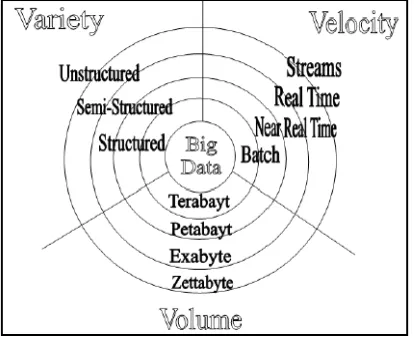
known as 'the 3 Vs of big data' as illustrated in Figure 1 [2, 4, 5, 16].
[image:3.612.91.298.360.530.2]Variety means the diverse types of data coming from numerous and varied sources which can be classified as unstructured, semi structured, and structured [2]. As an example: text, images, webpage, social media, video, audio, and traditional structured data. The increase of inconsistent data formats and incompatible data structures lead to increase the complexity of data analysis. While, data velocity indicates the timeliness of data collection, streaming, and analysis in order to extract maximum value from data [5].The data volume refers to the quantum of data generated and collected from masses of data which becomes increasingly big than terabytes and petabytes, and thus outstrips the traditional databases analytical software [4].However, some scholars have added that the ‘Value of Data’ is another characteristic of BD which emphasizes usefulness of data in getting to know and the predictive power of data in decision making process [2, 17].
Figure 1: The Three Vs of Big Data
2.1 Big Data Technologies
The BD analytics process is not easy task which is impossible performed using traditional database management software, which thereby resulted in emergence of new technologies to support BD analytics such as MapReduce, High Performance Computing Cluster (HPCC) systems, and Hadoop which are which are most widely-used in data analytics [5]. These technologies have been described as a new generation of BD technologies and architectures which designed in order to extract value from massive volumes of data from numerous sources in real time by an effective analytical capabilities [2].
MapReduce is a programming model that breaks down big and complex mass of data sets into small fragments in distributed computing environment with a parallel processing and generating on a cluster [18]. Hadoop is Java-based programming framework and miscellaneous open source platform which is Google’s data storage system and based on MapReduce. It was created by the Apache Software Foundation along with several contributors of Hadoop project such as Google, HP, IBM, Yahoo, Microsoft, Facebook and many others [18]. Hadoop comprises a distributed file system, analytics and data storage platforms, configuration and workflow administration [19]. Hadoop Distributed File System (HDFS) is nodes-structured file system designed to run across nodes in Hadoop data cluster to hold big amounts of data by integrating the file systems with each other and combine them within one big file system [20]. While HPCC systems is an open source, data-intensive computing system platform which allows the users to define data model. It does not require third party tools such as Cassandra or Oozie [18].
2.2 Importance of Big Data
Under the increasing growth of data globally, big data analytics become an imperative to gain values from these data. The International Data Corporation (IDC), argues that in 2011, the overall volume of data that created is 1.8ZB (≈ 1021B), which indicates that it has multiplied nine-fold within five years [4]. The IDC expected also this volume of data will increase twice every two years at least. Figure 2 shows the increasing massive volume of data globally.
ISSN: 1992-8645 www.jatit.org E-ISSN: 1817-3195 innovation in generating valuable information [17].
Moreover, the BD analytics have ability to develop benchmarks and criteria that needed by organizations to carry out its functions and tasks effectively [21].
Figure 1: Increasing Growth in Big Data Globally
Despite the vibrant BD market and the complexities surrounding its implementation, the factors that required to ensure proper implementation of BD initiatives remain poorly understood [2, 9]. A typical BD implementation is multidimensional which involves organizational and technological aspects, sharing similar characteristics with other entities [22]. Yet, most existing BD literature lacks to investigate the factors that assist in success BD implementation and little understanding is given to guide BD projects with implementing a BD successfully [9, 19, 22]. This is particularly true in the higher education accreditation literature. Therefore, this paper aims to move towards a clearer understanding of the key factors that need to take into consideration during Big Data implementation in higher education accreditation using the case of Saudi universities.
3. METHODOLOGY
This study used a qualitative case study method [23] using the case of Saudi universities to provide in-depth empirical inquiry to investigate a contemporary BD phenomenon in a holistic manner within its real life context.
The rationale for selecting case study design is that the fact of BD is a contemporary topic, particularly in the context of higher education accreditation in Saudi universities. Therefore, case study provides holistic investigation approach to
understand different aspects would be necessary to take into consideration to implement BD from different perspectives through numerous source of data [23].
2.3 Data and Analysis
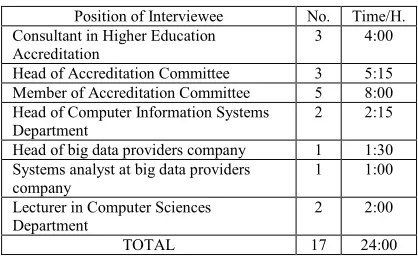
[image:4.612.94.300.155.325.2]The source of data was from the Saudi government universities using semi structured interviews which enable deeper understanding to explore the underlying aspects that require for implementation of BG in higher education accreditation in Saudi universities. Interviews involved 17 respondents with 18 hours interviews. The respondents of interviews were from five Saudi universities are University of Dammam, King Saud University, Princess Nora bint Abdul Rahman University, Imam Muhammad ibn Saud Islamic University, and Umm al-Qura University and with big data solution providers in Saudi. The respondents are involved in the implementation and development of higher education accreditation, have well technical knowledge with big data, and most of them are IT experts as shown in table 1. Face to face interviews were carried out with all respondents, recorded with recording device, and then they transcribed. The transcripts were analyzed using content analysis and word-frequency count approach [24].
Table 1:Interviewees Profile
Position of Interviewee No. Time/H.
Consultant in Higher Education Accreditation
3 4:00
Head of Accreditation Committee 3 5:15
Member of Accreditation Committee 5 8:00
Head of Computer Information Systems Department
2 2:15
Head of big data providers company 1 1:30
Systems analyst at big data providers company
1 1:00
Lecturer in Computer Sciences Department
2 2:00
TOTAL 17 24:00
4. RESEARCH FINDINGS
The main findings can be characterized by the six categories of factors that should be considered when introduce the big data concept for higher education accreditation in Saudi government universities. These are discussed below.
4.1 Security Issues
[image:4.612.313.522.439.570.2]ISSN: 1992-8645 www.jatit.org E-ISSN: 1817-3195 concerns. These concerns are related to storage,
management, and processing issues. The inflow of big amount of data from numerous sources increases an extra burden on storing, processing, and communication. As one interviewee said:
“We can't imagine the increasing massive volume of data from diverse sources. So this will increase a burden on our shoulders to deal with this issue in terms of how to store and process and manage this data in secure manner”.
These security concerns stemmed from the external data sources such as social media which represents an unregulated accumulation of data and biggest threat source to data security in terms of accessibility, accuracy, dissemination of data. Thus, traditional security solutions not useful to use in diverse and big data sets which requires adoption of more advanced security models. This point was confirmed by one interviewee when he stated:
“I think that the biggest concern in big data is social media such as Twitter and Facebook which yields unregulated and increasing volume of data set. It appears as a severe security threat such as accessibility, accuracy, and dissemination which need to handle properly using more advanced
security solutions”.
This finding is in line with [6, 7] who noted that the security is a key concern of big data.
4.2 Preserving Privacy
Privacy is another key concern about implementation of big data in higher education accreditation in Saudi universities that need to be considered. Almost all interviewees stressed that the big data need to consider privacy for analytics. This finding consistent with [3, 25] who affirmed that the Privacy is among key issues should be considered in big data analytics.
The findings show that the privacy in big data for higher education accreditation in Saudi universities involves many concerns such as protection of personal data of users, intellectual property rights, and government documents that may be leaked during data acquisition and storage. For example, one interviewee acknowledged:
“Accreditation process usually requires to access many data sources like universities' websites to conduct comparison and develop benchmarks. So when talk about big data, we worry about whether we are violate property rights or attacked personal privacy which may hold us accountable for use or leakage of data”.
An IT expert from big data providers stated to address the privacy concerns, big data must be governed by laws and regulations that protect data
privacy and enhance the compliance with confidentiality and intellectual property rights. He also suggested that this issue can overcome using anonymization applications prior to data analytics, and preserving privacy encryption protocols that provide encrypted data while protecting the privacy.
4.3 Analytical Skills
Having analytical skills among users of big data analytics is an important aspect for higher education accreditation in Saudi universities. These skills include knowledge and competence in handling big amount of data, which would resulting in an effective data analytics and extract maximum value from big data. This result supported one interviewee:
“In fact, big data is a new topic in Saudi, it is still lack of user awareness and experiences and knowledge to deal with this new trend of data. Thus, I believe that the development of analytical skills will enhance the benefit from the advantages of big data and improve values from its analytics”.
The Big data provider added to promote analytical skills among users can be carried out through holding training coursework, when he said:
“We believe that the knowledge is basis for any innovation, this particularly true when it came big data. Therefore, we strive to improve analytical skills of big data by holding workshops and advertising campaigns to educate users”.
4.4 IT Infrastructure
The big data creates a new challenges for IT infrastructure for both of hardware and software in the universities necessary to generate, collect, store and analyze data. The analysis of interviews shows that the BD deals with thousands clusters and nodes of data which require high storage capacity, HPC systems, high internet speeds and computing power necessary to manage the data, analysis and user queries. This may increase the spending universities on further IT investment to be compatible with BD requirements. However, some interviewees indicate that cloud computing provides an ideal solution to avoid such challenges of IT infrastructure and reduce the costs of the long-established infrastructure. This finding confirmed by [16, 20] who indicate that cloud computing offers a unique solutions to success big data.
4.5 Top management Support
ISSN: 1992-8645 www.jatit.org E-ISSN: 1817-3195 management support is an imperative aspect which
plays a critical role in adoption and implementation of big data in higher education accreditation in Saudi universities. Senior management support was detected in the form of financial resource allocation, awareness and serious desire to adopt big data, giving administrative approvals, encourage collaborative information-sharing projects with other universities. This point confirmed by several interviewees, for instance, confirmed that:
“Honestly, if Head of university not willing or intend to adopt big data in our university we can't going forward”.
Likewise, another interviewee commented:
“As you know, big data is novel concept requires senior management support before and after the adoption of big data in terms provide the necessary financial and nonfinancial assistance, encourage the improvements, eliminate obstacles”
Awareness of senior management creates a positive environment for big data in in Saudi universities. As one said:
“Actually, big data is still vague for many, the awareness of management in universities about the potentials of big data will enhance this trend”.
4.6 Collaborative Information-Sharing Projects
The Collaborative Information-sharing projects (CISP) is one of an important aspects for big data in higher education accreditation in Saudi universities. It refers to exchange information amongst universities at national, regional and international levels. The interviews indicate that the (CISP) offers an opportunity for data integration, generate massive data sets that may be useful to big data analytics to develop benchmarks for higher education accreditation. Moreover, the findings revealed that the (CISP) improve the collaboration at national and international level to standardization the accreditation criteria, aligning the objectives, increase accessibility to more relevant information in timely manner which provide wide platform of information that can be analyzed using big data analytics to improve higher education quality.
Some mentioned that to enhance (CISP), universities should signing a Memorandum of Understanding (MoU) in order to organize the sharing data process. These MoU serve as a legal framework which promotes accessibility to more relevant and valuable data while protect the privacy and intellectual property rights.
5. CONCLUSION
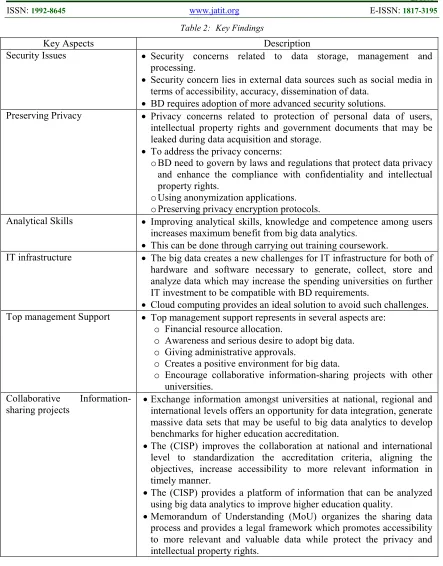
This study aims to identify the factors that required to take into consideration for Big Data implementation, and provide understanding how enhance these factors in higher education accreditation using case of Saudi universities. The findings of this study found six key factors are essential that should be taken into consideration for Big Data implementation in higher education accreditation in Saudi universities, namely security issues, preserving privacy, analytical skills, IT infrastructure, top management support and collaborative information-sharing projects. Table 2 describes these factors and the issues required to enhance these factors.
ISSN: 1992-8645 www.jatit.org E-ISSN: 1817-3195
Table 2: Key Findings
Key Aspects Description
Security Issues • Security concerns related to data storage, management and processing.
• Security concern lies in external data sources such as social media in terms of accessibility, accuracy, dissemination of data.
• BD requires adoption of more advanced security solutions.
Preserving Privacy • Privacy concerns related to protection of personal data of users, intellectual property rights and government documents that may be leaked during data acquisition and storage.
• To address the privacy concerns:
oBD need to govern by laws and regulations that protect data privacy and enhance the compliance with confidentiality and intellectual property rights.
oUsing anonymization applications.
oPreserving privacy encryption protocols.
Analytical Skills • Improving analytical skills, knowledge and competence among users increases maximum benefit from big data analytics.
• This can be done through carrying out training coursework.
IT infrastructure • The big data creates a new challenges for IT infrastructure for both of hardware and software necessary to generate, collect, store and analyze data which may increase the spending universities on further IT investment to be compatible with BD requirements.
• Cloud computing provides an ideal solution to avoid such challenges. Top management Support • Top management support represents in several aspects are:
o Financial resource allocation.
o Awareness and serious desire to adopt big data.
o Giving administrative approvals.
o Creates a positive environment for big data.
o Encourage collaborative information-sharing projects with other universities.
Collaborative
Information-sharing projects •
Exchange information amongst universities at national, regional and international levels offers an opportunity for data integration, generate massive data sets that may be useful to big data analytics to develop benchmarks for higher education accreditation.
•The (CISP) improves the collaboration at national and international level to standardization the accreditation criteria, aligning the objectives, increase accessibility to more relevant information in timely manner.
•The (CISP) provides a platform of information that can be analyzed using big data analytics to improve higher education quality.
•Memorandum of Understanding (MoU) organizes the sharing data process and provides a legal framework which promotes accessibility to more relevant and valuable data while protect the privacy and intellectual property rights.
This study based on the analysis of a case study of Saudi universities and therefore not free of limitations. To get a deeper insight and generalize the results, a further research needs to be conducted using quantitative methods. Moreover, further research is required to clearly define the privacy and security issues in big data for higher education accreditation. For future research and based on the
ISSN: 1992-8645 www.jatit.org E-ISSN: 1817-3195
REFRENCES:
[1] F. Saeed And A. Dixit, "A Decision Support System Approach For Accreditation & Quality Assurance Council At Higher Education Institutions In Yemen," In Moocs, Innovation And Technology In Education (Mite), 2015 Ieee
3rd International Conference On, 2015,
Pp. 163-168.
[2] S. Kaisler, F. Armour, J. A. Espinosa, And W. Money, "Big Data: Issues And Challenges Moving Forward," In System Sciences (Hicss), 2013 46th Hawaii
International Conference On, 2013, Pp.
995-1004.
[3] W. Raghupathi And V. Raghupathi, "Big Data Analytics In Healthcare: Promise And Potential," Health Information
Science And Systems, Vol. 2, P. 3, 2014.
[4] M. Chen, S. Mao, And Y. Liu, "Big Data: A Survey," Mobile Networks And
Applications, Vol. 19, Pp. 171-209, 2014.
[5] S. Sagiroglu And D. Sinanc, "Big Data: A Review," In Collaboration Technologies And Systems (Cts), 2013 International
Conference On, 2013, Pp. 42-47.
[6] M.-H. Kuo, T. Sahama, A. W. Kushniruk, E. M. Borycki, And D. K. Grunwell, "Health Big Data Analytics: Current Perspectives, Challenges And Potential Solutions," International Journal Of Big
Data Intelligence, Vol. 1, Pp. 114-126,
2014.
[7] H. Kupwade Patil And R. Seshadri, "Big Data Security And Privacy Issues In Healthcare," In Big Data (Bigdata
Congress), 2014 Ieee International
Congress On, 2014, Pp. 762-765.
[8] P. G. Altbach And J. Knight, "The Internationalization Of Higher Education: Motivations And Realities," Journal Of
Studies In International Education, Vol.
11, Pp. 290-305, 2007.
[9] I. Jung And C. Latchem, Quality Assurance And Accreditation In Distance
Education: Models, Policies And
Research: Routledge, 2012.
[10] Ó. Espinoza And L. Eduardo González, "Accreditation In Higher Education In Chile: Results And Consequences,"
Quality Assurance In Education, Vol. 21,
Pp. 20-38, 2013.
[11] A. Y.-C. Hou, "Quality In Cross-Border Higher Education And Challenges For The
Internationalization Of National Quality Assurance Agencies In The Asia-Pacific Region: The Taiwanese Experience,"
Studies In Higher Education, Vol. 39, Pp.
135-152, 2014.
[12] J. S. Eaton, Distance Learning: Academic And Political Challenges For Higher
Education Accreditation: Council For
Higher Education Accreditation Washington, Dc, 2001.
[13] J. Knight, "Cross-Border Higher Education: Issues And Implications For Quality Assurance And Accreditation,"
Report: Higher Education In The World
2007: Accreditation For Quality
Assurance: What Is At Stake?, 2007.
[14] D. Teferra And P. G. Altbachl, "African Higher Education: Challenges For The 21st Century," Higher Education, Vol. 47, Pp. 21-50, 2004.
[15] O. L. Liu, "Outcomes Assessment In Higher Education: Challenges And Future Research In The Context Of Voluntary System Of Accountability," Educational
Measurement: Issues And Practice, Vol.
30, Pp. 2-9, 2011.
[16] D. Garlasu, V. Sandulescu, I. Halcu, G. Neculoiu, O. Grigoriu, M. Marinescu, Et Al., "A Big Data Implementation Based On Grid Computing," In Roedunet
International Conference (Roedunet),
2013 11th, 2013, Pp. 1-4.
[17] J. Moorthy, R. Lahiri, N. Biswas, D. Sanyal, J. Ranjan, K. Nanath, Et Al., "Big Data: Prospects And Challenges," J.
Decis. Makers, Vol. 40, Pp. 74-96, 2015.
[18] J. Dittrich And J.-A. Quiané-Ruiz, "Efficient Big Data Processing In Hadoop Mapreduce," Proceedings Of The Vldb
Endowment, Vol. 5, Pp. 2014-2015, 2012.
[19] P. Zikopoulos And C. Eaton,
Understanding Big Data: Analytics For Enterprise Class Hadoop And Streaming Data: Mcgraw-Hill Osborne Media, 2011. [20] I. A. T. Hashem, I. Yaqoob, N. B. Anuar,
S. Mokhtar, A. Gani, And S. U. Khan, "The Rise Of “Big Data” On Cloud Computing: Review And Open Research Issues," Information Systems, Vol. 47, Pp. 98-115, 2015.
ISSN: 1992-8645 www.jatit.org E-ISSN: 1817-3195
International Symposium On, 2014, Pp.
488-499.
[22] J. Gao, A. Koronios, And S. Selle, "Towards A Process View On Critical Success Factors In Big Data Analytics Projects," 2015.
[23] R. K. Yin, Case Study Research: Design
And Methods: Sage Publications, 2009.
[24] S. Stemler, "An Overview Of Content Analysis," Practical Assessment, Research
& Evaluation, Vol. 7, Pp. 137-146, 2001.
[25] B. Thuraisingham, "Big Data Security And Privacy," In Proceedings Of The 5th Acm Conference On Data And Application
Security And Privacy, 2015, Pp. 279-280.
[26] C. M. Olszak And E. Ziemba, "Critical Success Factors For Implementing Business Intelligence Systems In Small And Medium Enterprises On The Example Of Upper Silesia, Poland,"
Interdisciplinary Journal Of Information,
Knowledge, And Management, Vol. 7, Pp.
129-150, 2012.
[27] A. B. Sangar And N. B. A. Iahad, "Critical Factors That Affect The Success Of Business Intelligence Systems (Bis) Implementation In An Organization,"
Intelligence, Vol. 12, Pp. 14-16, 2013.
[28] W. Yeoh And A. Popovič, "Extending The Understanding Of Critical Success Factors For Implementing Business Intelligence Systems," Journal Of The Association For
Information Science And Technology, Vol.