IJPSR (2018), Volume 9, Issue 12 (Research Article)
Received on 17 April, 2018; received in revised form, 05 July, 2018; accepted, 13 July, 2018; published 01 December, 2018
PHYSICOCHEMICAL CHARACTERISATION AND DISSOLUTION PROPERTIES OF EFAVIRENZ- β CYCLODEXTRIN SOLID BINARY SYSTEMS
Bharati Arali * 1, Anand Y. Kumar 2 and Mallikarjuna C. Setty 3
Department of Pharmaceutics 1, East West College of Pharmacy, Bengaluru -560091, Karnataka, India. Departments of Pharmaceutics 2, V. L. College of Pharmacy, Raichur -584103, Karnataka, India. Department of Pharmaceutics 3, Oxford College of Pharmacy, Bengaluru-560068, Karnataka, India.
ABSTRACT: Efavirenz (EFA) solid binary systems were prepared with β-CD by co-grinding and microwave irradiation methods. Detection of inclusion complexation was done in solution state by means of phase solubility analysis and in solid state by FTIR, DSC and in-vitro Dissolution studies. Apparent stability constant revealed EFA with β-CD at 1:1 M produces stiochometric complex with AL type phase solubility profile. A true inclusion of EFA with β-CD at 1:2 M in solid state was confirmed by FTIR and DSC. Dissolution properties of EFA- β-CD binary systems were superior when compared to physical mixture and pure drug. Overall the rank order of improvement in dissolution properties of Efavirenz with ratios is 1:2M > 1:1M and methods MW > CG > PM > pure drug. One way ANOVA suggest the DP60 and DE60 values were significantly higher (P<0.01) in solid binary systems prepared by microwave irradiation method when compared to co-grinding and its corresponding physical mixtures and pure drug.
INTRODUCTION: In recent years due to application of combinational chemistry and high-throughput screening during drug discovery, a majority of new drug candidates exhibits poor aqueous solubility, which makes compounds to be very challenging for formulation scientists in developing bioavailable dosage forms. An important tool in this regard is the use of cyclo-dextrins (CDs), especially chemically modified cyclodextrins. CDs are cyclic (α-1, 4)-linked oligosaccharides of α-D-glucopyranose, containing a relatively hydrophobic central cavity and hydrophilic outer surface as shown in Fig. 1.
QUICK RESPONSE CODE
DOI:
10.13040/IJPSR.0975-8232.9(12).5350-56
Article can be accessed online on:
www.ijpsr.com
DOI link: http://dx.doi.org/10.13040/IJPSR.0975-8232.9(12).5350-56
These starch derivatives interact via dynamic complex formation and other mechanisms in a way that camouflages undesirable physicochemical properties, including low aqueous solubility, poor dissolution rate and limited drug stability. Through these effects cyclodextrins and their derivatives have became popular modalities for increasing oral bioavailability and absorption rate 1, 2.
The improvement in hydrophilcity is obtained through the formation of inclusion complexes where the host/guest interaction is dependent on the dimension of the oligosaccharide ring, and/or by means of highly homogeneous assembly between the CDs and the drug in the solid state. In most cases these associations provide amenable solution behaviour of poorly soluble drugs 3. CDs improve the apparent drug solubility and / or dissolution of poorly water soluble drugs through inclusion complexes with their polar molecules or functional groups.
Keywords:
Efavirenz, β-CD, Solid binary systems, Dissolution properties
Correspondence to Author: Bharati Arali
Assistant Professor,
Department of Pharmaceutics, East West College of Pharmacy, #63, I Phase Bharatnagar, BEL Layout, Vishwaneedam Post, Off Magadi Road, Bengaluru - 560091, Karnataka, India.
The net effect is that water soluble cyclodextrins drug complex is formed 4, 5, 6, 7, 8, 9, 10.
FIG. 1: THE CHEMICAL STRUCTURE AND 3D STRUCTURE OF CYCLODEXTRIN
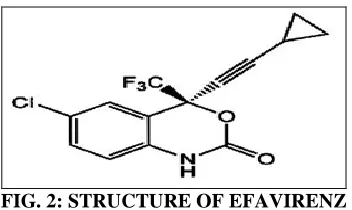
Efavirenz, chemically 2H-3, l-benzoxazin-2-one, 6-chloro - 4- (cyclopropylethnyl) -l, 4-dihydro-4-(tri-fluoromethyl)-(4S) is a non-nucleoside reverse transcriptase inhibitor with activity against HIV Fig. 2. It has no inhibitory effect on HIV-2 RT or human cellular DNA polymerases alpha, beta, gamma, or delta. Efavirenz binds directly to RT and inhibits viral RNA and DNA-dependent DNA polymerase activities by disrupting the catalytic site. Although the drug RT template complex may continue to bind deoxynucleoside triphosphate and to catalyze its incorporation into the newly forming viral DNA, it does so at a slower rate 11.
FIG. 2: STRUCTURE OF EFAVIRENZ
Efavirenz is practically insoluble in water having lowest solubility of about 0.01 mg/ml 12. Efavirenz pKa value is 10.2, cLogP value is 4.666 and logP value is 3.68 13. This drug has been classified as class II drugs of BCS systems i.e. high permeability and low solubility 14, 15. The poor aqueous solubility and wettability of EFA gives rise to difficulties in pharmaceutical formulations for oral delivery, which may lead to variable bio-availability. To over come these drawbacks, increasing the aqueous solubility of EFA are an important goal. Hence, in this investigation, solid binary systems of EFA were tried with β-CD with the aim to improve its solubility and dissolution properties.
MATERIALS AND METHODS:
Materials: Efavirenz (EFA) was a gift sample from Strides Pharma Ltd., Bangalore, India. β -cyclodextrin (βCD) was obtained from Glenmark Pharma Ltd., Nasik, India. All other reagents and solvents used were of analytical grade.
Methods:
Preparation of Solid Binary Systems: The following binary systems of EFA and β-CD were prepared at 1:1 and 1:2 molar ratios.
Physical Mixtures: The physical mixtures of EFA and β-CD in 1:1 and 1:2 M were obtained by mixing individual components that had previously been sieved (75-150 µm) together with a spatula.
Co-grinded Systems: Efavirenz was triturated with β-CD in a glass mortar, the resulting grinded powder was passed through sieve no 80.
Microwave Irradiated Systems: The aqueous solution of cyclodextrin was added slowly into a solution of EFA dissolved in methanol with constant stirring. The mixture was subjected for irradiation in microwave oven for 90 sec at 60 ºC, after reaction completes add adequate amount of methanol to remove the residual β-CD. The resulting mixture was stirred for 1h and evaporated under vacuum until dry. The resulting powder was pulverized and passed through sieve no 80.
Detection of Solid Binary Systems in Solution State:
[image:2.612.63.297.91.231.2] [image:2.612.86.262.430.535.2]be exhibited by the CD molecules. The apparent stability constants were calculated from the solubility diagrams.
Detection of Solid Binary Systems in Solid State: FTIR Studies: Fourier transform IR spectra were recorded on a Shimadzu FTIR-281-spectro-photometer.The spectra were recorded for Efavirenz, β-CD and solid binary systems. Samples were prepared in KBr disks prepared with a hydrostatic press at a force of 5.2T cm-2 for 3 min. The scanning range was 450-4000 cm-1 and the resolution was 1 cm-1.
Differential Scanning Calorimetry: Thermo-grams of Efavirenz, β-CD and solid binary systems were recorded on a Sieko, DSC 22 ºC model differential scanning calorimeter (Tokyo, Japan). About 10 mg of samples were sealed in aluminium pans and heated at a rate of 10 ºC/min from 30 ºC-300 ºC.
Dissolution Studies:In-vitro dissolution studies of Efavirenz, physical mixture and solid binary systems prepared were carried out in 900 ml of 1.5% w/v sodium lauryl sulfate (SLS) solution using a USPXXI type 2-dissolution rate test apparatus by powder dispersed amount method (powder samples were spread over the dissolution medium). Sample equivalent to 100 mg of Efavirenz, speed of 75 rpm and a temperature of 37ºC were used in each test.
A 5 ml aliquot was withdrawn at different time intervals, filtered using a 0.45 µm nylon disc filter and replaced with 5 ml of fresh dissolution medium. The filtered samples were suitably diluted, if necessary and assayed for Efavirenz by measuring the absorbance at 247 nm. The dissolution experiments were conducted in triplicate. The results were computed by using dissolution software PCP DISSO V3.0.
RESULTS AND DISCUSSION:
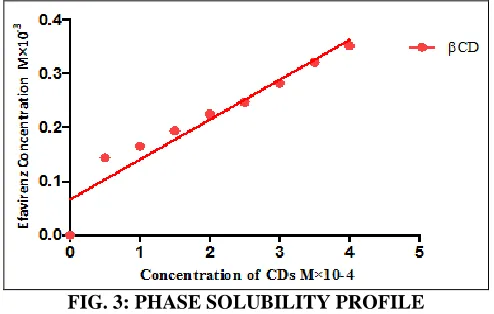
Phase Solubility Studies: The solubility of Efavirenz increases linearly with an increase in the concentration of CDs giving AL type solubility diagrams Fig. 3. The increase in solubility in the systems is due to one or more molecular interactions between Efavirenz and CD form distinct species or complexes. The cavity size of β -CD seems to be optimal for entrapment of
Efavirenz molecule and consequently provides the greatest solubilisation effect. The apparent stability constants (K1:1) were calculated from phase solubility diagrams by using following equation 16.
K1:1 = Slope / So (1-Slope)
[image:3.612.316.563.230.387.2]Where, So is intercept. The apparent stability constant value was 0.6221M-1 ± 0.01389 for β-CD and increase in solubility was 2.711. The stability constant value that was observed with β-CD indicates Efavirenz interacts strongly with β-CD and produce 1:1M stoichiometric complex.
FIG. 3: PHASE SOLUBILITY PROFILE
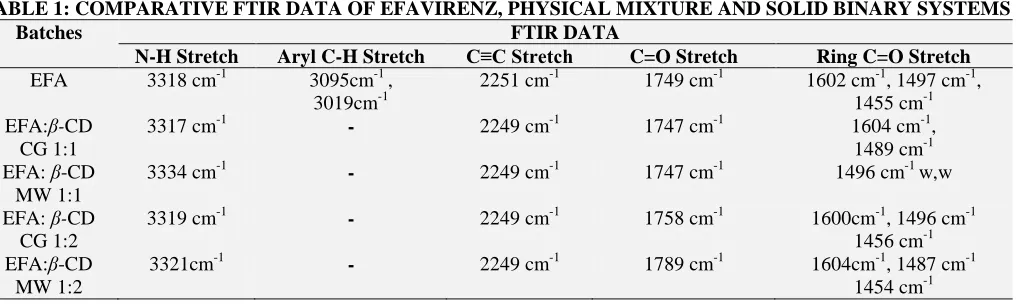
FTIR Studies: The FTIR spectrum of pure Efavirenz, physical mixture and its solid binary systems prepared by all methods are shown in Fig. 4 and Table 1. The FTIR characteristic Efavirenz bands are -NH stretching at 3318 cm-1, Aryl-CH stretching at 3095 and 3018 cm-1, C≡C stretching at 2251 cm-1, C=O stretching at 1747cm-1, Ring C=C stretching at 1602, 1497, 1456cm-1, C-F stretching at 1186 cm-1 and out of plane =C-H band at 743 cm-1. Efavirenz has strong absorption peak at 1747 cm-1 which was assigned to drug carbonyl stretching vibration. The characteristic carbonyl stretching (CO) vibration of Efavirenz appeared at 1747 cm-1 (Efavirenz) in the physical mixtures, co-grinded and microwave irradiated products with β -CD.
Efavirenz and the hydroxyl groups of the host cavities during complexation processes. FTIR spectrum β-CD is characterized by intense bands at 3300 to 3500 cm-1 associated with the absorption of the hydrogen bonded OH groups of β-CD. The vibration of the aryl-CH and CH2 groups appear in
the 2800 to 3000 cm-1 region. The observed changes in the FTIR spectra of the solid binary systems may be explained by the different preparation methods. From the FTIR spectra the patterns of the physical mixtures correspond to superimposing of FTIR spectra of the two components.
FIG. 4: FTIR SPECTRA OF EFAVIRENZ, ΒCD AND ITS SOLID BINARY SYSTEMS
However, in the co-grinded and microwave irradiated methods near smoothening of the band situated at 3200 to 3700 cm-1 was observed. Moreover the vibrations of Efavirenz are shifted towards higher frequencies, suggesting the breakage of existing bonds as a result of inclusion complex formation with reduced intensities. Spectral changes always concern C-OH, -CH2 and
[image:4.612.50.299.243.419.2]CH groups of the β-CD suggesting, the host-guest interactions being dominated by hydrogen bonds among the above mentioned groups. Analysis of FTIR spectra of the inclusion complexes and physical mixtures of the components revealed the most frequent changes to be in the range of 2950 to 3050 cm-1, which were interpreted as the valency bonds of the C-H in plane vibrations of the aromatic range. Differences were also found in the 1480 to 1600 cm-1 regions, attributed to the C=C bonds in the aromatic range. The intensity and shape of these bonds changed dramatically for the inclusion complexes as compared to those of pure Efavirenz and the physical mixture. These indicate the vibrating and bending of the Efavirenz molecule were restricted, due to the formation of an inclusion complex. These suggest the aromatic rings in Efavirenz being inserted into the cavity of cyclodextrin.
TABLE 1: COMPARATIVE FTIR DATA OF EFAVIRENZ, PHYSICAL MIXTURE AND SOLID BINARY SYSTEMS
Batches FTIR DATA
N-H Stretch Aryl C-H Stretch C≡C Stretch C=O Stretch Ring C=O Stretch
EFA 3318 cm-1 3095cm-1 ,
3019cm-1
2251 cm-1 1749 cm-1 1602 cm-1, 1497 cm-1, 1455 cm-1 EFA:β-CD
CG 1:1
3317 cm-1 - 2249 cm-1 1747 cm-1 1604 cm-1, 1489 cm-1 EFA: β-CD
MW 1:1
3334 cm-1 - 2249 cm-1 1747 cm-1 1496 cm-1 w,w
EFA: β-CD CG 1:2
3319 cm-1 - 2249 cm-1 1758 cm-1 1600cm-1, 1496 cm-1 1456 cm-1 EFA:β-CD
MW 1:2
3321cm-1 - 2249 cm-1 1789 cm-1 1604cm-1, 1487 cm-1 1454 cm-1
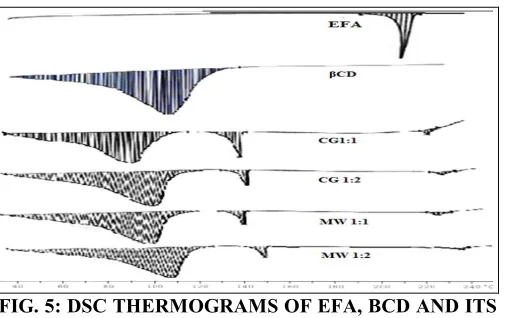
DSC Studies: The DSC curves of the Efavirenz and β-CD compared with its solid binary systems prepared by all methods confirm not only an interaction between the drugs and β-CD but also a real inclusion. DSC thermograms of Efavirenz and its solid binary systems were shown in Fig. 5. The DSC thermogram of Efavirenz exhibited an endothermic peak at 136.87 ºC corresponding to its melting point and DSC thermogram of β-CD showed broad endothermal peak at 96.99. Lowering of the endothemic peaks in cyclodextrin
[image:4.612.58.566.439.592.2]co-grinding and 1:1M microwave irradiation method. These point to partial interaction between Efavirenz and β-CD, but in case of EFA-β-CD 1:2M microwave irradiated inclusion complex more reduction in Efavirenz endothermal peak indicates strong interaction between Efavirenz and β-CD.
FIG. 5: DSC THERMOGRAMS OF EFA, ΒCD AND ITS SOLID BINARY SYSTEMS
Dissolution Studies: When an assumed drug-CD inclusion complex is dispersed in a dissolution medium, a very rapid dissolution is often observed. Dissolution rate tests are based on this observation in order to characterize the inclusion complexation between drug and cyclodextrin. The most often used dissolution rate tests are the rotating disk method and dispersed amount method.
In the present investigation, dispersed amount method is used to investigate the various dissolution parameters of Efavirenz and its solid binary systems. The dissolution data of Efavirenz and its inclusion complexes were studied by using dissolution software PCP DISS0 V.3.0. DP30, DP60,
DE30, DE60, MDT30, MDT60, RDR30, RDR60, T50
values were calculated from the dissolution software and are given in Table 2 and the dissolution profiles are shown in Fig. 6.
TABLE 2: DISSOLUTION PARAMETER DATA OF EFA, EFA: ΒCD PHYSICAL MIXTURES AND ITS SOLID BINARY SYSTEMS
Batches DP30 DP60 DE30 DE60 MDT30 MDT60 RDR30 RDR60 T50
EFA 8.3 16.0 4.69 8.55 14.56 28.62 1.0 1.0 239.1 PM 1:1M 9.4 17.9 7.32 8.80 14.25 27.36 1.28 1.26 211.3 PM 1:2M 14.6 27.0 7.53 13.87 14.14 26.32 1.57 1.56 132.2 CG 1:1M 25.4 44.3 14.17 24.87 13.49 25.92 2.82 2.76 71.0 CG 1:2M 33.2 55.4 21.97 33.64 10.84 25.28 3.77 3.55 51.4 MW 1:1M 44.1 68.8 22.27 40.13 14.56 25.09 4.65 4.34 35.7 MW 1:2M 48.5 78.0 22.90 43.80 13.91 24.30 4.96 4.78 31.2
FIG. 6: COMPARATIVE RELEASE PROFILES OF EFA, EFA: ΒCD PHYSICAL MIXTURES AND ITS SOLID BINARY SYSTEMS
TABLE 3: MODEL FITTING VALUES OF EFAVIRENZ, PHYSICAL MIXTURE AND ITS SOLID BINARY SYSTEMS
Batches K1×10
2
(min)- 1 KH×10
2
(mg1/3.min-1)
R K R K
EFA 0.9951 -0.0029 0.9936 -0.0009 PM 1:1M 0.9944 -0.0033 0.9942 -0.0010 PM 1:2M 0.9952 -0.0052 0.9948 -0.0016 CG 1:1M 0.9975 -0.0098 0.9926 -0.0028 CG 1:2M 0.9901 -0.0135 0.9778 -0.0037 MW 1:1M 0.9979 -0.0194 0.9864 -0.0049 MW 1:2M 0.9722 -0.0320 0.9958 -0.0066
The dissolution data obtained were subjected to model fitting and the model which fits the observed dissolution data was evaluated by correlation coefficient (r) between the variables involved. The calculated `r’ values in various models for all complexes are summarized in Table 3.
The results of the dissolution rate studies indicated higher dissolution rate of Efavirenz from solid binary systems when compared to Efavirenz itself and the corresponding physical mixtures. The slight increase in dissolution rate and efficiency values recorded for the physical mixture may be explained on the basis of the solubility of the drug in aqueous CDs solutions.
[image:5.612.57.383.350.586.2]The DE30 and DE60 values of the binary systems
that were prepared by the co-grinded and microwave irradiated methods were relatively high when compared with the values from the physical mixtures, and Efavirenz alone. Overall, the rank order of improvement in dissolution properties of Efavirenz with methods is MW > CG > PM. The DE30 and DE60 values of the Efavirenz- βCD
microwave irradiated complexes were higher than those of the complexes prepared by co-grinding method. One-way ANOVA was used to test the
statistical significant difference between pure and prepared solid binary systems. Significant differences in the means of DP60 and DE60 were
tested at 95% confidence. The DP60 and DE60
values of solid binary systems prepared by microwave irradiation and co-grinding method are significantly higher (P<0.01) when compared to DP60 and DE60 values of pure Efavirenz, physical
mixture and its corresponding solid binary systems as shown in Table 4 and Table 5.
TABLE 4: ANOVA DATA OBTAINED FOR DP60 BY USING DUNNETT MULTIPLE COMPARISON TESTS FOR
EFA: ΒCD PHYSICAL MIXTURES AND SOLID BINARY SYSTEMS AT 1:1 AND 1:2 RATIOS
Batches Comparison Number of points Mean SD SEM Mean difference Q P value
EFA --- 3 15.079 0.99 0.5747 --- --- ---
PM 1:1M EFA vs. PM 1:1M 3 17.922 0.08 0.0469 -2.843 6.107 **P<0.01
CG 1:1M EFA vs. CG 1:1M 3 27.19 0.75 0.4365 -12.111 26.014 **P<0.01
MW 1:1M EFA vs. MW 1:1M 3 44.258 0.04 0.0245 -29.179 62.675 **P<0.01
PM 1:2M EFA vs. PM 1:2M 3 55.422 0.11 0.0662 -40.344 86.657 **P<0.01
CG 1:2M EFA vs. CG 1:2M 3 68.729 0.07 0.0445 -53.650 115.24 **P<0.01
MW 1:2M EFA vs. MW 1:2M 3 78.119 0.82 0.4781 -63.041 135.41 **P<0.01
[image:6.612.48.566.234.323.2]Where, ns* not significant, P< 0.05*(significant), P< 0.01** (very significant) and P< 0.001*** (highly significant)
TABLE 5: ANOVA DATA OBTAINED FOR DE60 BY USING DUNNETT MULTIPLE COMPARISON TESTS FOR
EFA: ΒCD PHYSICAL MIXTURES AND SOLID BINARY SYSTEMS AT 1:1 AND 1:2 RATIOS
Batches Comparison Number of points Mean SD SEM Mean difference q P value
EFA --- 3 8.55 0.08 0.0049 --- --- ---
PM 1:1M EFA vs. PM 1:1M 3 8.853 0.09 0.0557 -0.3001 4.299 **P<0.01
CG 1:1M EFA vs. CG 1:1M 3 13.87 0.01 0.0077 -5.320 76.195 **P<0.01
MW 1:1M EFA vs. MW 1:1M 3 24.86 0.16 0.0614 -16.316 233.70 **P<0.01
PM 1:2M EFA vs. PM 1:2M 3 33.65 0.10 0.0631 -25.097 359.49 **P<0.01
CG 1:2M EFA vs.CG 1:2M 3 40.11 0.10 0.0586 -31.566 452.13 **P<0.01
MW 1:2M EFA vs. MW 1:2M 3 43.82 0.08 0.0516 -35.272 505.22 **P<0.01
Where, ns* not significant, P< 0.05*(significant), P< 0.01** (very significant) and P< 0.001*** (highly significant)
CONCLUSION: Physicochemical characterization of EFA-cyclodextrin binary systems in solution state by phase solubility revealed 1:1 M complexation of EFA with β-CD. A true inclusion of EFA with β-CD at 1:2 M in the solid state was confirmed by FTIR, DSC studies. Dissolution properties of EFA- βCD binary systems were superior when compared to pure EFA.
Overall, microwave irradiated systems showed superior dissolution properties when compared to co-grinded systems and physical mixtures.
ACKNOWLEDGEMENT: The authors gratefully acknowledge the staff of V. L. College of Pharmacy, Raichur and Dr. Sridhar Katta, Principal, East West College of Pharmacy, Bengaluru for their constant support and cooperation during research work.
CONFLICT OF INTEREST: Nil
REFERENCES:
1. Sunil S, Jambhekar and Philip B: Cyclodextrins in pharmaceutical formulations I: structure and physicochemical properties, formation of complexes and types of complex. Drug Discovery Today 2016; 21(2): 356-362.
2. Nair AB, Attimarad M, Al-Dhubiab BE, Wadhwa J, Harsha S and Ahmed M: Enhanced oral bioavailability of acyclovir by inclusion complex using hydroxypropyl-β -cyclodextrin. Drug Delivery 2014; 21(7): 540-547. 3. Fasinu P, Pillay V and Ndesendo VM: Diverse approaches
for the enhancement of oral drug bioavailability. Biopharmaeutis and Drug Disposition 2013; 32: 185-209. 4. Jingna X, Yimin Z, Xiayang L and Yan Z: Inclusion
complex of nateglinide with sulfobutyl ether β -cyclodextrin: Preparation, characterization and water solubility. Jou of Mole Structure 2017; 1141: 328-334. 5. Lanxiang L, Juan X, Hua Z, Kun L, Wenwen Z, Kai L and
Hong Z: Inclusion complexes of laccaic acid A with β-cyclodextrin or its derivatives: Phase solubility, solubilization, inclusion mode, and characterization. Dyes and Pigments 2017; 139: 737-746.
[image:6.612.48.563.353.450.2]and bioactivity evaluation. Journal of Moleular Liquids 2016; 219: 592-598.
7. Apichart A and Somchai S: Inclusion complexes between sildenafil citrate and cyclodextrins enhance drug solubility. Asian Journal of Pharmaceutical Sciences 2016; 11(1): 104-105.
8. Gabriel OKL, Yvonne TFT and Kok-Khiang P: Enhancement of Norfloxacin solubility via inclusion complexation with β-cyclodextrin and its derivative hydroxypropyl-β-cyclodextrin. Asian Journal of Pharma-ceutical Sciences 2016; 11(4): 536-546.
9. Jian-Qiang Z, Di W and Kun-Ming J: Preparation, spectroscopy and molecular modelling studies of the inclusion complex of cordycepin with cyclodextrins. Carbohydrate Research 2015; 406: 55-64.
10. Liandi C, Ruihao L and Tao G: Dramatic improvement of the solubility of pseudolaric acid B by cyclodextrin complexation: Preparation, characterization and validation. International J of Pharmaceutics 2015; 479(2): 349-356. 11. Chien-Ching H, Sui-Yuan C and Shu-Wen L:
Effectiveness of a reduced dose of Efavirenz plus 2 NRTIs as maintenance antiretroviral therapy with the guidance of
therapeutic drug monitoring. Journal of Microbiology, Immunology and Infection 2015; 48(2-1): S34-S35. 12. Lariza DSA, Monica FLRS and Camila TA: Solid
dispersion of efavirenz in PVP K-30 by conventional solvent and kneading methods. Carbohydrate Polymers 2014; 104: 166-174.
13. Benjamin JE and Roy MG: Drugs for HIV Infection- Infectious Diseases. Elsevier Limited, Edition 4th, Vol. 2, 2017: 1293-1308.
14. Rodrigo C, Anita N, Bertil A, Groot DW and Jennifer BD: Biowaiver monographs for immediate release solid oral dosage forms: Efavirenz. Journal of Pharmaceutical Sciences 2013; 102(2): 318-329.
15. Leslie ZB: The role of BCS (Biopharmaceutics Classification System) and BDDCS (Biopharmaceutics Drug Disposition Classification System) in drug develop-ment. Journal of Pharmaceutical Sci 2013; 102(1): 34-42. 16. Aiju C, Min L, Lina D and Dezhi S: Study on the effect of
solvent on the inclusion interaction of hydroxypropyl-β -cyclodextrin with three kinds of coumarins by phase solubility method. Fluid Phase Equilibria 2013; 341: 42-47.
All © 2013 are reserved by International Journal of Pharmaceutical Sciences and Research. This Journal licensed under a Creative Commons Attribution-NonCommercial-ShareAlike 3.0 Unported License.
This article can be downloaded to ANDROID OS based mobile. Scan QR Code using Code/Bar Scanner from your mobile. (Scanners are available on Google Playstore)
How to cite this article: