
Towards many-body based nuclear reaction modelling
Stéphane HILAIRE1a and Stéphane Goriely2 1
CEA, DAM, DIF, F-91297 Arpajon, France 2
Institut d'Astronomie et d'Astrophysique, Université Libre de Bruxelles, CP-226, 1050 Brussels, Belgium
Abstract. The increasing need for cross sections far from the valley of stability poses a challenge for nuclear reaction models. So far, predictions of cross sections have relied on more or less phenomenological approaches, depending on parameters adjusted to available experimental data or deduced from systematic expressions. While such predictions are expected to be reliable for nuclei not too far from the experimentally known regions, it is clearly preferable to use more fundamental approaches, based on sound physical principles, when dealing with very exotic nuclei. Thanks to the high computer power available today, all the ingredients required to model a nuclear reaction can now be (and have been) microscopically (or semi-microscopically) determined starting from the information provided by a nucleon-nucleon effective interaction. This concerns nuclear masses, optical model potential, nuclear level densities, photon strength functions, as well as fission barriers. All these nuclear model ingredients, traditionally given by phenomenological expressions, now have a microscopic counterpart implemented in the TALYS nuclear reaction code. We are thus now able to perform fully microscopic cross section calculations. The quality of these ingredients and the impact of using them instead of the usually adopted phenomenological parameters will be discussed. Perspectives for the coming years will be drawn on the improvements one can expect.
1 Introduction
To model a nuclear reaction, two complementary paths can be considered. On the one hand, one can use empirical approaches, and on the other hand, many-body based approaches can be chosen. In the first case, nuclear reaction inputs are usually obtained from phenomenological expressions whose parameters are fine-tuned to fit experimental data. This enables generally to produce accurate cross sections which are however only reliable close to the mass or energy range in which the adjustments have been performed. On the contrary, more fundamental approaches, based on sound physical principles, do not provide the same fitting flexibility but presumably have a higher predictive power when dealing with exotic nuclei far from the experimentally known regions. With the development of high performance computers, systematic studies and the calculation of all nuclear reaction inputs required to model a nuclear reaction have become more and more feasible. During the last two decades, significant efforts have been engaged towards this aim, and all the traditional
phenomenological ingredients now have a microscopic counterpart which can be used to perform nuclear reaction predictions.
We first discuss in Section 2, the iterative process required to improve the quality of these ingredients and illustrate some of the evolutions the various iterations have made possible. We then review in Section 3, the main inputs currently available online. We finally conclude on what is planned in a close future, in particular in reducing the still present sources of uncertainties.
2 A step by step process
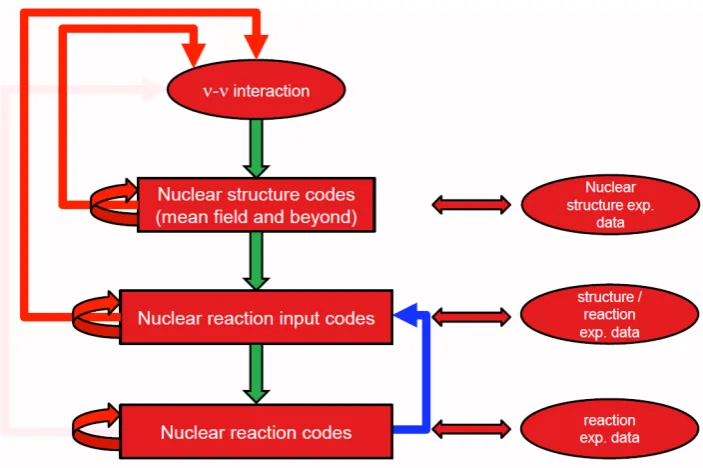
Except for light nuclei, there is nowadays no direct link between the nucleon-nucleon interaction and the prediction of a nuclear reaction without any severe restriction on the target mass. Therefore, several intermediate steps are required, as illustrated in Figure 1, to establish a connection between a nucleon-nucleon interaction and a nuclear reaction code.
Figure 1. Schematic view of the connections required to link a nucleon-nucleon (ν-ν) effective interaction with a nuclear reaction code. The green arrows indicate a transmission of input to modelling codes whose results are then compared with relevant experimental data (double red arrow). At each step, one can either loop back to fine-tune the parameters of the nucleon-nucleon effective interaction (red solid arrows) or improve the modelling under consideration (curved arrow) in order to improve the agreement with experiment. At each step of this process, different experimental data are considered as constraints. Up to now, the results produced by nuclear reaction codes are not used to fine-tune the ν-ν effective interaction parameters (light grey arrow) but have led to modification in the nuclear reaction input codes as illustrated by the blue arrow.
effective forces have been extensively used [1-16] reproducing a wide set of observables, either experimentally determined or based on realistic ab-initio-type calculations.
The second step of this iterative sequential process consists in using the nuclear structure results to estimate nuclear reaction ingredients, such as nuclear level densities [17-18], optical potentials [19-21], gamma-ray strength functions [22-23] and fission paths [8,24]. This second step also requires the use of specific approaches implemented in what we call “nuclear reaction input codes” (NRIC). When the result obtained with one of this NRIC does not agree sufficiently with experimental data, as in the first step, one can either modify the nucleon-nucleon effective interaction or add new features to the modelling in the nuclear reaction input codes to correct approximations. A typical example of the first type of situation, where the interaction turns out to be responsible for a deviation of the theory from experiment is shown in Figure 2. In this figure, one can observe the impact of the effective interaction on the nuclear level densities. The BSk13 interaction has been in this case parameterized to suppress the drift observed with the BSk9 parametrization when comparing the theoretical level densities prediction of s-wave neutron mean spacing at the neutron binding energy with experimental data. Another example of such an adjustment of the interaction parameters has also been performed using fission barriers as constraints [8]. Fission barriers are not strictly speaking experimental data but rather “reaction input data” (see Figure 1) derived from nuclear reaction analysis. Extracting them from nuclear structure predictions is not at all trivial and requires specific methods [8,24]. Of course, when the interaction is modified, one has to try to keep, at the same time, all the properties already obtained with previous parameterizations at the same level of quality.
Figure 2. Ratio of the theoretical s-wave neutron resonances mean spacing (Dth) to the experimental data compiled in [25] using the combinatorial level density method [17] with the BSk9 [6] and BSk13 [7] interactions.
the number of approximations, the model uncertainties and the computing time are still too large to link directly the nucleon-nucleon effective interaction and the reaction codes outputs, so that it remains impossible to adjust the interaction parameters directly on reaction cross sections, even if recent developments might change this restriction in the future [27]. An example of a result obtained at this third step which has implied a modification of the nuclear reaction code producing nuclear level densities is illustrated in Figure 3 and discussed in details in [28].
Figure 3. 233
U(n,f) cross sections computed using microscopic nuclear level densities [17] and fission paths [8]. The dashed and full curves correspond to the predictions obtained with the EMPIRE nuclear reaction code [29] considering or not left-right asymmetry of the outer barrier.
This figure shows that the combinatorial nuclear level density performed in [17] used too crude an approximation to account for the impact of collective vibrational levels, which turned out to have a significant impact when applied to determined fission transition states [28]. This deficiency was then solved by improving the method used to perform combinatorial level density calculation with a more rigorous treatment of vibrational levels [18].
3 Current status within the Skyrme-HFB approach
Tables of nuclear level densities, E1 gamma-ray strengths, nuclear matter densities, fission paths have all been determined from the sole BSk14 interaction and are available either in the RIPL-3 [25] library, in the TALYS code [29] or the BRUSLIB nuclear data library [30]. In the latest TALYS version, however, the theoretical nuclear masses are those obtained with BSk17 [11], the first interaction providing a root mean square deviation with experimental masses lower than 600 keV. Using such ingredients has already shown interesting features which can clearly not be addressed with traditional phenomenological approaches. An example, illustrated in Figure 4, concerns the possibility offered to study continuum spin and parity distribution deviating from the statistical hypothesis with a significant impact on isomer production [30].
.
Figure 4. Comparison between experimental and theoretical cross section. Solid lines and squares [31,32] correspond to the total photoreaction cross section. Dashed lines and stars [31] correspond to the isomeric state production. Red (resp. black) curves have been obtained using the combinatorial (resp. statistical) model for nuclear level densities.
As can be observed, a significantly larger isomer production is obtained when non-statistical nuclear level densities are used in the theoretical calculation. This is directly related to the spin distribution with spin higher than 5 h in 180
Ta which is bigger with a combinatorial model than with the traditional Fermi Gas type formula assuming a Wigner law for the spin distribution [31]. The predictive power of microscopic nuclear reaction inputs has also been investigated in fission cross section calculation either to provide one with the possibility to perform systematic fission cross section predictions [33] or following a consistent methodology [34] used to produce high quality evaluated files [35] for applications. In the first case [33], it has been shown that the quality of the prediction is not at the level required for practical applications, mainly because the microscopic fission barrier heights still suffer from a lack of accuracy, but provided a global deformation-independent normalization is applied, a satisfactory estimate of the fission cross section for non-energy applications can be reached.
4 Conclusions and perspectives
nuclear structure observables [38]. Work along this path has already been engaged starting by improving the accuracy of the Gogny force with respect to nuclear masses [37] as well as computing level density tables [39] and nuclear matter densities required for optical model calculation. The next step, presently underway, consists in computing gamma-ray strength functions and fission barriers. We believe that such a project is a way to progress and be able in the future to obtain satisfactory nuclear reaction predictions on the bases of reliable and accurate microscopic inputs only.
References
1. M. Samyn, S. Goriely, P.-H Heenen, J.M. Pearson, F. Tondeur, Nucl. Phys. A 700, 142 (2002) 2. S. Goriely, M. Samyn, P.-H Heenen, J.M. Pearson, F. Tondeur, Phys. Rev. C 66, 024326 (2002) 3. M. Samyn, S. Goriely, J.M. Pearson, Nucl. Phys. A 725, 69 (2003)
4. S. Goriely, M. Samyn, M. Bender, J. M. Pearson, Phys. Rev. C 68, 054325 (2003) 5. M. Samyn, S. Goriely, M. Bender, J.M. Pearson, Phys. Rev. C 70, 044309 (2004) 6. S. Goriely, M. Samyn, J.M. Pearson, M. Onsi, Nucl. Phys. A 750, 425 (2005) 7. S. Goriely, M. Samyn, J.M. Pearson, Nucl. Phys. A 773, 279 (2006)
8. S. Goriely, M. Samyn, J.M. Pearson, Phys. Rev. C 75, 064312 (2007) 9. S. Goriely, J.M. Pearson, Phys. Rev. C 77, 031301 (2008)
10. N. Chamel, S. Goriely, J.M. Pearson, Nucl. Phys. A 812, 72 (2008) 11. S. Goriely, N. Chamel, J.M. Pearson, Phys. Rev. Lett. 102, 152503 (2009) 12. S. Goriely, J.M. Pearson, Phys. Rev. C 80, 065804 (2009)
13. S. Goriely, N. Chamel, J. M. Pearson, Phys. Rev. C 82, 035804 (2010) 14. S. Goriely , N. Chamel, J. M. Pearson, Phys. Rev. C 88, 024308 (2013) 15. S. Goriely , N. Chamel, J. M. Pearson, Phys. Rev. C 88, 061302 (2013) 16. S. Goriely, Nucl. Phys. A 933, 68 (2015)
17. S. Hilaire, S. Goriely, Nucl. Phys. A 779, 63 (2006) 18. S. Goriely, S. Hilaire, Phys. Rev. C 78, 064307 (2008)
19. E. Bauge, J.P. Delaroche, M. Girod, Phys. Rev. C 58, 1118 (1998) 20. E. Bauge, J.P. Delaroche, M. Girod, Phys. Rev. C 63, 024607 (2001) 21. S. Goriely, J.P. Delaroche, Phys. Lett. B 653, 178 (2007)
22. S. Goriely, E. Khan, Nucl. Phys. A 706, 217 (2002)
23. S. Goriely, E. Khan, M. Samyn, Nucl. Phys. A 739, 331 (2004) 24. M. Samyn, S. Goriely, J.M. Pearson, Phys. Rev. C 72, 044316 (2005) 25. R. Capote et al, Nucl. Data Sheets 110, 3107 (2009)
26. J.F. Lemaitre, S. Panebianco, J.L. Sida, S. Hilaire, Phys. Rev. C 92, 034617 (2015) 27. G. Blanchon, M. Dupuis, H.F. Arellano, N. Vinh Mau, Phys. Rev. C 91, 014612 (2015)
28. M. Sin et al., Proceedings if the International Conference on Nuclear Data for Science and Technology- ND 2007, (EDP Science Volume 1, eds. O. Bersillon, F. Gunsing, E. Bauge, R. Jacqmin, S. Leray, Apr. 22-27, 2007, Nice, France, 2008) p. 313
29. A.J. Koning, S. Hilaire, M. Duijvestijn, Proceedings if the International Conference on Nuclear Data for Science and Technology- ND 2007, (EDP Science Volume 1, eds. O. Bersillon, F. Gunsing, E. Bauge, R. Jacqmin, S. Leray, Apr. 22-27, 2007, Nice, France, 2008) p. 211, see also
http://www.talys.eu
30. Y. Xu, S. Goriely, A. Jorissen, G.L. Chen, M. Arnould, Astronomy & Astrophysics 549, A106 (2013), see also http://www.astro.ulb.ac.be/bruslib
31. S. Goko et al., Phys. Rev. Lett. 96, 192501 (2006) 32. H. Utsunomiya et al., Phys. Rev. C 67, 015807 (2003) 33. S. Goriely et al. Phys. Rev. C 79, 024612 (2009) 34. S. Goriely et al., Phys. Rev. C 83, 034601 (2011)
38. S. Goriely, S. Hilaire, M. Girod, S. Peru, Phys. Rev. Lett. 102, 242501 (2009) 39. J.P. Delaroche et al., Phys. Rev. C 81, 014303 (2010)
![Figure 2. Ratio of the theoretical s-wave neutron resonances mean spacing (Dth) to the experimental data compiled in [25] using the combinatorial level density method [17] with the BSk9 [6] and BSk13 [7] interactions](https://thumb-us.123doks.com/thumbv2/123dok_us/8157607.1360803/3.595.114.473.332.571/figure-theoretical-resonances-experimental-compiled-combinatorial-density-interactions.webp)
![Figure 3. The dashed and full curves correspond to the predictions obtained with the EMPIRE nuclear reaction code [29] 233U(n,f) cross sections computed using microscopic nuclear level densities [17] and fission paths [8]](https://thumb-us.123doks.com/thumbv2/123dok_us/8157607.1360803/4.595.119.478.165.410/correspond-predictions-obtained-reaction-sections-computed-microscopic-densities.webp)
