Constraints on Physics Beyond the Standard
Model and Its Observable Effects
Thesis by
Jennifer Kile
In Partial Fulfillment of the Requirements
for the Degree of
Doctor of Philosophy
California Institute of Technology
Pasadena, California
2007
c
2007
Jennifer Kile
For Max and Werner, who were always there, and for Dave, Martin, and Fletch,
Acknowledgements
First, I would like to thank Profs. Mark Wise and Michael Ramsey-Musolf for their
extensive guidance, many helpful comments, insight, and support during the last six
years. I would also like to thank the other members of my thesis committee, Profs.
John Schwarz and Robert McKeown, for their willingness to examine this thesis.
Next, I would like to thank Dr. Michael Graesser, who was certainly the brains
and main driving force behind the first project that I worked on here at Caltech,
which here is described in Chapter 4.
I would also like to thank Peng Wang, my officemate and collaborator, who put
up with a huge number of dumb questions from me throughout the last several years,
and to Rebecca Erwin, who endured fewer, but nonetheless equally dumb, questions.
Next, I thank Julian von Wimmersperg for keeping me sane during the production
of this thesis, frequent technical advice, and being willing to critique my writings and
talks at length (and I mean at length). Also, I would like to thank my housemate,
Hareem Maune, for occasionally making sure that I remembered to eat, and Lotty
Ackerman, for the substantial amount of chocolate that she provided.
Also thanks to the other graduate students on the fourth floor of Lauritsen Lab,
who didn’t seem to mind my walking into their offices and talking about completely
random things: Mike Salem, Moira Gresham, Donal O’Connell, Ketan Vyas,
Alejan-dro Jenkins, Paul Cook, and Jie Yang.
I would also like to thank the many people, in addition to those already named
above, who contributed helpful comments about the works described in this thesis.
They include N. Bell, V. Cirigliano, M. Gorshteyn, P. Langacker, B. Nelson, P. Vogel,
Luty, M. Perelstein, and J. Vinet. Also I would like to thank J. Erler for his helpful
information on using the GAPP code.
And, finally, the works in this thesis were supported by U.S. Department of
En-ergy contracts FG02-05ER41361, ER40701, FG02-05ER41361,
DE-FG03-ER40701, and DE-FG-0392-DE-FG03-ER40701, as well as National Science Foundation awards
Abstract
In this work, we describe three analyses, all of which involve physics beyond the
Standard Model. The first two discussed here are closely related; they use
effec-tive operator analyses to constrain the contributions of physics beyond the SM to
observable processes. The third project involves the investigations of a particular
extra-dimensions model which addresses the cosmological constant problem.
The first project which we will discuss uses the scale of neutrino mass to place
model-independent constraints on the coefficients of the chirality-changing terms in
the muon decay Lagrangian. We list all of the dimension-six effective operators which
contribute to muon decay and Dirac mass for the neutrino. We then calculate the
one-loop contributions that each of these operators makes to neutrino mass. Taking
a generic element of the neutrino mass matrix to be of order∼1 eV, we derive limits
on the contributions of these operators to the muon Michel parameters which are
approximately four orders of magnitude more stringent than the current experimental
results, and well below near-future experimental sensitivity. We also find two
chirality-changing operators, which, due to their flavor structure, are unconstrained by neutrino
mass yet contribute to muon decay. However, as these two operators differ from
those constrained by neutrino mass only by their flavor indices, we naively expect
their contributions to also be small; if their effects instead turn out to be observable,
this may be an indication of beyond-the-Standard-Model physics with an interesting
flavor structure.
In the second analysis, we again perform an effective operator analysis, this time
applied to Higgs production at a linear collider. Here we include all
include operators that contain right-handed Dirac neutrinos. We obtain limits on
these operators from electroweak precision observables, the scale of neutrino mass,
and limits on neutrino magnetic moments, and use these limits to constrain the
contributions of these operators to the Higgs production cross-section. Although
we find that all operators containing right-handed neutrinos contribute negligibly to
Higgs production, we do find three operators containing only SM fields which could
have observable contributions at an e+e− linear collider.
Lastly, we discuss the characteristics of a particular extra-dimensions model
orig-inally proposed by Carroll and Guica [54]. This model has two extra dimensions
compactified into a sphere, a bulk magnetic field, and a bulk cosmological constant.
In this model, the cosmological constant seen by a four-dimensional observer can
be set to zero by fine-tuning the bulk magnetic field against the bulk cosmological
constant. If branes with a tension are added at each of the poles of the two-sphere,
solutions with zero four-dimensional cosmological constant are still possible, but the
compactified dimensions must acquire a deficit angle which depends on the brane
tension. However, the brane tension does not affect the fine-tuning relationship
between the bulk cosmological constant and the bulk magnetic field. This feature
led to the hope that, after this fine-tuning, the model might self-tune, keeping the
four-dimensional cosmological constant zero regardless of what happens to the brane
tension by adjusting the deficit angle. We speculated that this self-tuning property
would imply a massless scalar mode in the perturbed Einstein’s equations; as there
exist very stringent limits on scalar-tensor theories of gravity, a massless scalar mode
would make this model incompatible with observation. We conducted a search for
such modes, and found none which satisfied the boundary conditions. This finding
Contents
Acknowledgements v
Abstract vii
1 Introduction 1
1.1 Neutrino Mass and Muon Decay . . . 2
1.2 Fermionic Operators and Higgs Production . . . 8
1.3 Extra Dimensions and the Cosmological Constant . . . 10
2 Muon Decay Parameters From Neutrino Mass 12 2.1 Introduction . . . 12
2.2 Operator Basis . . . 18
2.3 Operator Renormalization: Mixing and Matching Considerations . . . 22
2.3.1 Matching with OM, AD(4) . . . 23
2.3.2 Mixing among n = 6 operators . . . 27
2.4 Neutrino Mass Constraints . . . 33
2.5 Conclusions . . . 37
3 Fermionic Effective Operators and Higgs Production at a Linear Collider 40 3.1 Introduction . . . 41
3.2 Higgs Production in the Standard Model . . . 46
3.3 Operator Basis . . . 47
3.4.1 General Considerations . . . 51
3.4.2 Class B Operators . . . 52
3.4.3 Class C Operators . . . 62
3.4.4 Flavor Nonconserving Operators . . . 65
3.5 Limits on Operator Coefficients . . . 65
3.6 Discussion and Conclusions . . . 71
4 Gravitational Perturbations of a Six-Dimensional Self-Tuning Model 74 4.1 Introduction . . . 75
4.2 The Unperturbed Model . . . 78
4.3 Linear Analysis . . . 80
4.3.1 Gauge Fixing and Perturbed Equations . . . 80
4.3.2 Boundary Conditions . . . 85
4.4 Fine-tuning or Self-tuning? . . . 88
4.5 Conclusions . . . 89
List of Figures
1.1 The current experimental status ofν oscillation parameters, taken from [1]. . . 3
1.2 χ2 plotted as a function ofM
H, taken from [42]. The yellow band shows
the region excluded by the direct searches at 95% CL. . . 8
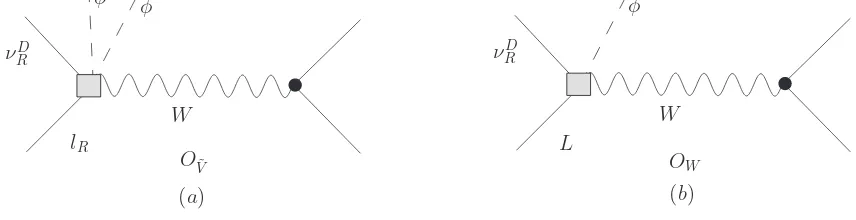
2.1 Contributions from the operators (a)OV , AD(6)˜ and (b)OW, AD(6) (denoted by the shaded box) to the amplitude for µ-decay. Solid, dashed, and wavy lines denote fermions, Higgs scalars, and gauge bosons, respectively.
After SSB, the neutral Higgs field is replaced by its vev, yielding a
four-fermion µ-decay amplitude. . . 23 2.2 One-loop graphs for the matching contributions of the n= 6 operators
(denoted by the shaded box) to then= 4 mass operatorO(4)M, AD. Solid, dashed, and wavy lines denote fermions, Higgs scalars, and gauge bosons,
respectively. Panels (a, b, c) illustrate contributions from O(6)B,W, O(6)V˜ , and O(6)F , respectively, to O(4)M, AD. . . 24 2.3 One-loop graphs for the mixing amongn= 6 operators. Notation is as in
previous figures. Various types of mixing (a–g) and self-renormalization
(h–j) are as discussed in the text. . . 30
2.4 Two-loop graphs for the mixing of the n= 6 operators. Only represen-tive graphs for the mixing of the four-fermion operators O(6)F, ABCD into
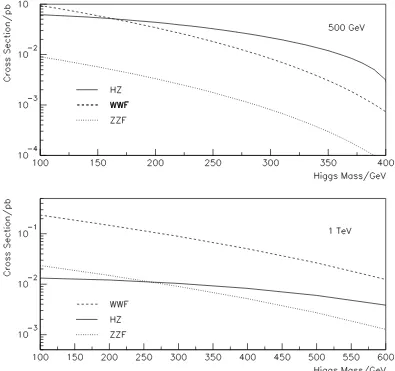
3.2 Contribution of Class A operators (a) O`
M, AB and (b) OM, ABν to Higgs production . . . 49
3.3 Contribution of Class B operators to Higgs production . . . 52
3.4 Contribution of Class C operators to Higgs production . . . 53
3.5 Ratio of contribution ofOV R,ee to SM Higgs production cross-section for
(top) √s = 500 GeV and (bottom) 1 TeV for CV R,eev2/Λ2 = 10−2. For
√
s= 1 TeV, the line for the Hqq¯,Hµ+µ−, andHτ+τ− channels is not
shown; it has the value of −2.2, independent of Higgs mass. . . 56 3.6 Ratio of contribution of OV R,µµ to SM Higgs production cross-section
for (top) √s = 500 GeV and (bottom) 1 TeV for CV R,µµv2/Λ2 = 10−2. Curves for OV R,τ τ are identical. . . 57
3.7 Ratio of contribution ofOV L,eeto SM Higgs production cross-section for
(top)√s= 500 GeV and (bottom)√s= 1 TeV forCV L,eev2/Λ2 = 10−2. For√s = 1 TeV, the line for theHqq¯,Hµ+µ−, andHτ+τ− channels is
not shown; it has the value of 2.6, independent of Higgs mass. . . 59 3.8 Ratio of contribution of OV Lτ,ee to SM Higgs production cross-section
for (top) √s = 500 GeV and (bottom) 1 TeV for CV Lτ,eev2/Λ2 = 10−2. For√s = 1 TeV, the line for theHqq¯,Hµ+µ−, andHτ+τ− channels is
not shown; it has the value of 2.6, independent of Higgs mass. . . 61 3.9 Contributions of operators containing νR to Higgs missing energy final
Chapter 1
Introduction
The Standard Model (SM) has demonstrated remarkable success in explaining particle
interactions at energies up to a few hundred GeV. The experimental value for the
anomalous magnetic moment of the muon agrees with the SM prediction to seven
significant figures [1]. Fits to the LEP and SLDZ pole data [2] show that the current experimental data is well-described by the the Minimal Standard Model. And, of
course, no non-SM particles have yet been discovered.
However, despite this success, few physicists believe that the SM is valid up to
arbitrarily high energies; the SM contains 19 free parameters (not including neutrino
masses and mixing angles!) which currently must be put in by hand, does not explain
why fermions seem to come in three flavors or predict their masses, and requires the
existence of a Higgs boson with a mass not too far from the weak scale, even though
radiative corrections would be expected to push its mass up to the Planck scale.
Additionally, as the SM does not address the issue of neutrino mass at all, does
not explain the matter-antimatter asymmetry in the universe, and fails miserably to
explain the cosmological constant, we now have conclusive evidence of physics beyond
the SM.
To address some of these issues which the SM leaves unresolved, many ideas
have been proposed for physics beyond the SM. These include supersymmetry (for an
introductory review, see [3]), models of extra dimensions (see reviews [4, 5, 6]), models
with with extra gauge bosons [7], technicolor [8], and many other ideas. Currently, the
and the cosmological constant problem is a subject of intense study. (For some very
recent reviews on the cosmological constant, see [13, 14, 15].)
While the value of studying particular new physics scenarios is evident, the
rich-ness of possibilities for physics beyond the Standard Model indicates that
model-independent analyses are also worthwhile. In this work, we will use both approaches.
First, in Chapters 2 and 3 we will use general operator analyses to obtain
model-independent constraints on the contributions of new physics to two processes—muon
decay and Higgs production. (Interestingly, both of these processes can, in
prin-ciple, receive contributions from new physics which also gives rise to the
(not-yet-understood) phenomenon of neutrino mass.) Then, in Chapter 4, we will study a
particular extra-dimensions model which attempts to address the cosmological
con-stant problem. We discuss the motivation for each of these analyses below.
1.1
Neutrino Mass and Muon Decay
Although the first direct evidence for neutrino mass came in the 1960s [16] with the
observation of an unexpectedly low νe flux coming from the sun, it wasn’t until the last two decades that the case for nonzero ν mass became compelling. For recent reviews, see [1], [17], and [18]. Fig. 1.1 (taken from [1]) gives a visual summary of
the current knowledge of neutrino oscillation parameters taken from experiments.
Two mass regions in Fig. 1.1 are of particular interest. These roughly correspond
to the regions explored by the “solar” (oscillations ofνe or ¯νeintoν’s of other flavors) and “atmospheric” (oscillations ofνµ) experiments. The former is dominated by the most recent results of Super-Kamiokande (Super-K) [19] and the Sudbury Neutrino
Observatory (SNO) [20], which look for disappearance of solar νe, and KamLAND [21], a reactor experiment which looks for disappearance of ¯νe. Combining the results of the three experiments [19] gives the region marked “Super-K+SNO+KamLAND
95%” in Fig. 1.1, which indicates ∆m2 close to 8×10⁻⁵eV2 and the Large Mixing
Angle solution for tan2θ
. Observations of neutral-currentν interactions by SNO [22]
ν
µ↔ν
τν
e↔ν
X10
0
10
–3
∆
m
2
[eV
2
]
10
–12
10
–9
10
–6
10
2
10
0
10
–2
10
–4
tan
2
θ
CHOOZ Bugey CHORUS NOMAD CHORUS KARMEN2 PaloV erdeν
e↔ν
τ
NOMAD
ν
e↔ν
µCDHSW NOMAD BNL E776 K2K http://hitoshi.berkeley.edu/neutrino Cl 95% Ga 95%
KamLAND
95%
SNO
95%
Super-K
95%
Super-K+SNO +KamLAND 95%LSND
90
/
99
%
SuperK
90
/
99
%
[image:15.612.116.461.36.592.2]All limits are at 90%CL unless otherwise noted
Tha atmospheric neutrino data, however, are dominated by Super-K. They report
in [23] a deficit ofνµ events dependent upon zenith angle and energy, with no corre-sponding deficit in νe events. They thus report sin22θatm > 0.92 and 1.5×10⁻³ < ∆m2 < 3.4×10⁻³eV2 at 90% CL. They also report [24] a dependence upon L/E
(where L is the ν flight distance and E is its energy) in their muon disappearance results, which yields similar results. Finally, they see [25] aντ appearance at the 2.4σ level and find that their results are completely compatible with full νµ−ντ mixing.
Also shown in Fig. 1.1 is the region favored by the LSND experiment [26, 27, 28,
29], whose results favored ¯νµ to ¯νe oscillations with ∆m2 ∼ 1 eV2. Assuming three neutrino flavors, neutrino mass results must satisfy the simple relation
∆m212+ ∆m223 = ∆m213 (1.1)
where ∆m2
ij =m2i−m2j. This relation cannot be satisfied by the ∆m2ijs implied by the solar, atmospheric, and LSND experiments. Thus, the LSND results were considered
possible evidence for a sterile neutrino νs. However, the very recent results of Mini-BooNE [30] do not support the LSND results and there is currently no compelling
evidence for a sterile ν.
While constraints from neutrino oscillations give us information about the squared
mass differences ∆m2
ij between different mass eigenstates, they tell us nothing about
the overall scale of neutrino mass. Results from tritium β decay [31, 32] give a limit of <2 eV [1] on the sum
X
i
|Uei|2m2νi (1.2)
where U is the neutrino mixing matrix.
Limits also exist on the sum of the neutrino masses from cosmology. Constraints
from WMAP and the Sloan Digital Sky Survey [33] give a limit of
X
mν < .42 eV at 95%, CL (1.3)
It is these last two results which will be the most relevant to our work in Chapters 2
and 3. However, the presence of neutrino oscillations (and therefore nonzero neutrino
mass) imply that the SM Lagrangian is not complete. If neutrinos are purely Dirac
particles, the Lagrangian will receive terms of the form
δL =−mijνν¯RiνLj +h.c. (1.4)
where i and j are flavor indices. Thus, we must necessarily add a right-handed neutrino νR to the SM. However, if neutrinos are instead purely Majorana particles and receive a mass term of the form
δL =−1 2m
ij
νν¯RiνRcj+h.c. (1.5)
then we find that nature allows lepton number violation. Therefore, when considering
extensions to the SM, we should allow the Lagrangian to contain terms which contain
right-handed Dirac neutrinos or to contain terms which violate lepton number, or
both. In this work, for simplicity, we will assume that neutrinos are purely Dirac
particles.
Given that neutrino mass is a window onto physics beyond the SM, it makes
sense to consider the possibility that the current knowledge of neutrino mass could
already be used to place constraints on new physics and its possible manifestations
in observable processes. The first such process which we consider is muon decay. One
can write the effective muon decay Lagrangian in the form
Lµ−decay =
−4√Gµ
2 X
γ, , µ
gµγ ¯eΓγνν¯Γγµµ (1.6)
where Γγ runs over all possible Lorentz structures (1, γµ and σµν/√2) and and
µ are the electron and muon chiralities. In the SM, gV
LL = 1 and all others are
zero. It is easy to see from Eq. 1.6, however, that the sum also includes terms that
terms which contain right-handed neutrinos, such as the case γ = V, or µ = R. Thus, it is not hard to imagine that if neutrino mass compels us to include in the
Lagrangian effective operators which contain right-handed neutrinos, that some of
these operators could contribute to Lµ−decay. A key point of the analysis which we
present in Chapter 2 is that some of these operators will contribute to neutrino mass,
and, thus, can be constrained by current limits on mν. (More specifically, one can note that dimension-six operators that contribute to mν without insertions of tiny neutrino Yukawa couplings will contain a single νR field. This implies that the terms in Lµ−decay which can be constrained by limits on m
ν will contain one right-handed
ν and one left-handedν, and, thus, 6=µ.) These coefficients gγ
µ can be translated into effects on the muon decay spectrum,
which can be written as
d2Γ
dx dcosθ = mµ 4π2W
4
eµG2µ q
x2−x2 0
×[FIS(x)±Pµcosθ FAS(x)] (1.7)
×h1 +~ζ·P~e(x, θ)i
where Weµ = (m2µ+m2e)/2mµ is the maximum e energy, x=Ee/Weµ, x0 =me/Weµ, andP~µandP~eare theµandepolarizations. ~ζis a vector dependent on the experimen-tal configuration. The isotropic and anisotropic components of the decay spectrum,
FIS(x) and FAS(x), can be written in terms of four of the Michel parameters (MPs)
ρ, η, ξ, and δ [34, 35]:
FIS = x(1−x) + 2 9ρ(4x
2
−3x−x20) +ηx0(1−x) (1.8)
FAS = 1 3ξ
q
x2−x2 0
1−x+ 2 3δ
4x−3 + q
1−x2 0−1
. (1.9)
In the SM these parameters take the values ρ=δ = 34, η= 0, and ξ= 1.
gγ µs as
ρ= 3 4 −
3 4 gLRV
2+3
2 gLRT
2+ 3
4Re g S LRgLRT∗
+ (L↔R)
. (1.10)
It should be noted that the gS,V,TLR,RL all correspond to terms in Eq. 1.6 which contain right-handed neutrinos. Recently, ρ (and δ) has been measured by the TWIST Col-laboration [36, 37], who hope to eventually improve their precision to the few×10−4
level.
In Chapter 2, we set out investigate whether the scale of neutrino mass can be
used to place limits on some of the gγ
µ. We enumerate the dimension-six operators
which can contribute to a Dirac mass of the neutrino or to muon decay, and then use
current upper bounds on neutrino mass to derive constraints on contributions of these
operators to chirality-changing (i.e, 6=µ) terms in the muon decay Lagrangian. We obtain model-independent constraints considerably stronger than the current
experi-mental bounds and, finally, discuss the implications for currently ongoing experiments
to measure the muon decay parameters. The content of Chapter 2 is largely borrowed
from the work of Erwin et al. [38].
In the analysis of Chapter 2 (and later in Chapter 3), we will assume a scale of 1 eV
for an upper limit on a generic entry of the neutrino mass matrix, and, for simplicity,
we will assume that neutrinos are purely Dirac particles. For a similar study of muon
decay where neutrinos are allowed to have Majorana mass terms, see [39]. It should
be noted that our limits from neutrino mass on the effects of physics beyond the SM
given in those chapters will improve if the upper bounds on the neutrino mass scale
become more stringent in future measurements.
One can also ask what ramifications our results can have for certain models. A
class of models for which the Michel parameters have particular relevance is
Left-Right-Symmetric Models (LRSM). For a treatment of the interplay of muon decay
1.2
Fermionic Operators and Higgs Production
Continuing with our work with effective operators, we move from muon decay to Higgs
production at ane+e−Linear Collider. Unlike muon decay, all that is known about the
properties of the Higgs boson is theoretical or through indirect experimental evidence.
Direct searches [41] have ruled out the ranges of the Higgs boson massmH <114.4 at the 95% confidence level. Fits to mH by the LEP Electroweak Working Group have yielded the range shown in Fig. 1.2 (from [42]); they obtain a 95% CL upper limit of
186 GeV, which rises to 219 GeV when the direct search results are included.
0
1
2
3
4
5
6
100
30
300
m
H[
GeV
]
∆χ
2
Excluded
∆αhad =
∆α(5)
0.02758±0.00035
0.02749±0.00012
incl. low Q2 data
[image:20.612.119.392.240.515.2]Theory uncertainty
Figure 1.2: χ2 plotted as a function of M
H, taken from [42]. The yellow band shows the region excluded by the direct searches at 95% CL.
Given the range ofmH compatible with the SM, it (or something like it) is expected to be discovered at the LHC. Assuming that such a Higgslike particle is, in fact,
discovered, a linear collider will be necessary to measure its properties to determine
particle’s mass, spin, and couplings to other particles. (For a short review, see [43].)
Is the new particle a scalar? Are its couplings to the W± andZ particles compatible
with it being the source of electroweak symmetry breaking? Are its couplings to
fermions proportional to their masses? For an excellent discussion of Higgs physics
at a future LC, we direct the reader to [44].
Here, we will concentrate on the observable most relevant to our work in Chapter
3, the Higgs Boson production cross-section. As the production cross-section is also
important for measurements of the Higgs branching fractions [45], we will discuss
their relevance as well.
A precise measurement of the Higgs production cross-section is critical for
distin-guishing an SM Higgs boson from scalars predicted by other models, such as
super-symmetry. For example, the production cross-section for the lightest MSSM Higgs
will differ from that of the SM Higgs. (For a calculation of the cross-sections for
the MSSM Higgses with radiative corrections included, see [46].) In addition, [47]
describes in detail how partial width and branching ratio measurements at a linear
collider could be used to distinguish an SM Higgs boson from an MSSM Higgs. This
would be particularly important for values of tanβ and MA where it is possible that only one of the MSSM scalars would be observable at the LHC.
The branching fractions of a Higgslike scalar can also be useful in
distinguish-ing the SM from extra-dimensions scenarios. The authors of [48] find that an SM
Higgs boson can be distinguished from the Randall-Sundrum scalar radion by precise
measurements of its branching fractions, particularly to gg; for a particularly light radion,ggcan actually be the primary decay mode, whereas a Higgs of the same mass would decay primarily to b¯b. The authors of [49] and [50] consider how Higgs-radion mixing could affect the properties of a Higgs boson; they find that the branching
ratios, particularlyH →gg, could differ substantially from the SM expectation. [50] additionally find that the HZZ coupling would differ from the SM scenario, leading to changes in the overall Higgs production cross-section.
There are multiple reasons why it is important to understand how much physics
First and foremost, if it turns out that the possible effects of new physics are large
enough to substantially change either the expected Higgs mass range or its production
or decay mechanisms, search strategies may have to be changed accordingly. Secondly,
given the importance of determining the Higgs production cross-section, we would like
to know whether an observed deviation from the SM expectation favors particular
models, or if unknown new physics at energy scale Λ could make the interpretation
of such a deviation ambiguous.
In Chapter 3, we describe the use of a general operator analysis to constrain the
effects of physics beyond the SM on Higgs production at a linear collider. We restrict
ourselves to dimension-six operators which contain fermions and Higgs fields (for
similar analyses considering other operators, see [51, 52]), including three operators
which we borrow from the muon decay analysis. We then use precision electroweak
data and limits on neutrino mass to place limits on the contributions of these operators
to Higgs production at a linear collider, and find operators that could have observable
effects on the Higgs production cross-section. Chapter 3 borrows heavily from the
work of Kile and Ramsey-Musolf [53].
1.3
Extra Dimensions and the Cosmological
Con-stant
After the discussion of these two model-independent analyses, in Chapter 4 we
inves-tigate the characteristics of a specific model of extra dimensions which was originally
proposed in [54]. This model was proposed to possibly shed new light on the
cosmo-logical constant problem, the observation of a cosmocosmo-logical constant more than 120
orders of magnitude smaller than the naive SM expectation ofM4
P.
Other models of extra dimensions have been proposed to address the cosmological
constant problem [55, 56, 57, 58, 59]. In models with extra dimensions, the
cosmolog-ical constant seen by a four-dimensional observer can receive contributions from both
models introduce an unpleasant fine-tuning between different terms which contribute
to the cosmological constant. The model presented in [54] also required such a
fine-tuning; however, it appeared possible in this model that, once this fine-tuning took
place, the volume of the extra dimensions would adjust itself so that the cosmological
constant would remain zero, independent of the brane tension.
We expected that this self-tuning property would imply a massless mode in the
perturbed Einstein’s equations, and searched for such modes. The presence of such
a mode would cause this model to be strongly disfavored, as tests of the equivalence
principle [60, 61] place tight constraints on scalar-tensor theories of gravity. We found
no such modes and speculated that this model did not, in fact, have a self-tuning
Chapter 2
Muon Decay Parameters From
Neutrino Mass
In this chapter, we discuss the first of our two model-independent analyses: using
current limits on the scale of neutrino mass (∼1 eV) to constrain the effects of new
physics on muon decay. We specifically consider operators which can contribute to
the chirality-changing terms in the muon decay Lagrangian, and we only consider the
case of Dirac neutrinos. The contents of this chapter are, aside from small cosmetic
changes, taken from [38].
2.1
Introduction
Precision studies of muon decay continue to play an important role in testing the
Standard Model (SM) and searching for physics beyond it. In the gauge sector of
the SM, the Fermi constant Gµ that characterizes the strength of the low-energy, four-lepton µ-decay operator is determined from the µ lifetime and gives one of the three most precisely known inputs into the theory. Analyses of the spectral shape,
angular distribution, and polarization of the decay electrons (or positrons) probe for
contributions from operators that deviate from the (V −A)⊗(V −A) structure of the SM decay operator. In the absence of time-reversal (T) violating interactions, there
exist seven independent parameters—the so-called Michel parameters [34, 35, 63]—
anisotropic distribution; and three additional quantities (ξ0, ξ00, η00) that are needed
to describe the lepton’s transverse and longitudinal polarization1. Two additional
parameters (α0/A, β0/A) characterize a T-odd correlation between the final state
lepton spin and momenta with the muon polarization: ˆSe·kˆe×Sˆµ.
Recently, new experimental efforts have been devoted to more precise
determi-nations of these parameters. The TWIST Collaboration has measured ρ and δ at TRIUMF [36, 37], improving the uncertainty over previously reported values by
fac-tors of∼2.5 and∼3, respectively. An experiment to measure the transverse positron polarization has been carried out at the Paul Scherrer Institute (PSI), leading to
sim-ilar improvements in sensitivity over the results of earlier measurements [64]. A new
determination ofPµξwith a similar degree of improved precision is expected from the TWIST Collaboration, and one anticipates additional reductions in the uncertainties
in ρand δ [65].
At present, there exists no evidence for deviations from SM predictions for the
Michel parameters (MPs). It is interesting, nevertheless, to ask what constraints
these new measurements can provide on possible contributions from physics beyond
the SM. It has been conventional to characterize these contributions in terms of a set
of ten four-fermion operators
Lµ−decay =
−4√Gµ
2 X
γ, , µ
gµγ ¯eΓγνν¯Γγµµ (2.1)
where the sum runs over Dirac matrices Γγ = 1 (S), γα (V), and σαβ/√2 (T), and the subscripts µand denote the chirality (R, L) of the muon and final state lepton, respectively2. In the SM, one has gV
LL = 1 and all other gµγ = 0. A recent, global analysis by Gagliardi, Tribble, and Williams [67] give the present experimental bounds
on the gγ
µ that include the impact of the latest TRIUMF and PSI measurements.
Theoretically, thegγ
µcan be generated in different scenarios for physics beyond the
1The parametersη and η00 are alternately written in terms of the independent parametersα/A
andβ/A.
2The normalization of the tensor terms corresponds to the convention adopted in [66]. We do
SM. The most commonly cited illustration is the minimal left-right symmetric model
that gives rise to non-zerogV
RR,gRLV , andgVLR. From a model-independent standpoint, the authors of [68] recently observed that the operators in Eq. (2.1), having different
chiralities for the muon and final state charged lepton, will also contribute to the
neutrino mass matrix mAB
ν through radiative corrections. Consequently, one expects
that the present upper bounds on mν should imply bounds on the magnitudes of the
gγ
µ. The authors of [68] argued that the most stringent limits arise from two-loop
contributions because the one-loop contributions are suppressed by three powers of
the tiny, charged lepton Yukawa couplings. The two-loop constraints are nonetheless
stronger than the present bounds given in [67] and could become even more so with
the advent of future terrestrial and cosmological probes of the neutrino mass scale.
In this chapter, we present the results of a follow-up analysis of mν constraints on the µ-decay parameters, motivated by the observations of [68] and the new exper-imental developments in the field. Our study follows the approach of [69],[70], and
[71], used recently in deriving model-independent naturalness bounds on neutrino
magnetic moments implied by the scale of mν. We concentrate on the case of Dirac neutrinos, deferring a detailed consideration of Majorana neutrinos to a separate
anal-ysis. Although there exists a long-standing theoretical prejudice favoring the see-saw
mechanism with light, Majorana neutrinos as an explanation of the small scale ofmν, we see several reasons for studying the Dirac and Majorana cases separately:
(i) From the standpoint of string phenomenology, obtaining models with neutrino
self-couplings and a type I see-saw mechanism appears to be quite difficult.
Re-cently, the authors of [72] performed a systematic study of 175 viable ways of
embedding the Standard Model gauge group in theE8×E8 heterotic string with
Z3 orbifold compactification and found that only two of the twenty classes of such inequivalent models admitted neutrino self-couplings. The natural scale of
mν in these two classes lies many orders of magnitude below the scale implied by neutrino oscillation data. Interactions leading to Dirac masses occur more
Z3×Z3 orbifold string construction [73] indicated the plausibility of obtaining a type II see-saw mechanism, wherein left-handed lepton-number-violating
neu-trino self-couplings arise from interactions with scalar SU(2)L triplet fields.
Ei-ther way, however, the appearance of Majorana mass terms is not at all a generic
feature of string constructions, leaving the Dirac case as a logical possibility.
(ii) Experimentally, there exists no conclusive evidence for or against the presence of
light Majorana neutrinos. New searches for neutrinoless doubleβ-decay (0νββ) could provide conclusive proof that the light neutrinos are Majorana, provided
the neutrino mass spectrum has the “inverted” rather than “normal”
hierar-chy (for recent reviews, see, e.g., [74] and [75]). If, on the other hand, future
long-baseline oscillation experiments establish the existence of the inverted
hi-erarchy and/or ordinaryβ-decay measurements indicate a mass consistent with the inverted hierarchy, a null result from the 0νββ searches would imply that neutrinos are Dirac particles3. Either way, the investment of substantial
ex-perimental resources in these difficult measurements indicates that determining
the charge conjugation properties of the neutrino is both a central question for
neutrino physics as well as one that is not settled. Until it is, considering the
implications of Dirac neutrinos remains a valid enterprise.
(iii) The phenomenological analyses of Dirac and Majorana masses for other
neu-trino properties and interactions are quite distinct. As illustrated by the recent
analyses of neutrino magnetic moments in [69], [70], and [71], the characteristics
of the operator basis and renormalization can be sufficiently different and
com-plex for the two cases that separate studies of each are warranted. Moreover, the
parameterization of the µ-decay Michel spectrum in the presence of Majorana neutrinos may require modification from the standard form, as indicated by the
recent work of [76]. Rather than lose the reader in the details of differences in
both the Michel parameterization and operator renormalization for Dirac and
Majorana neutrinos, we prefer to concentrate on the Dirac case in the present
study and consider the Majorana case in a separate paper.
Having this focus in mind, we work with an effective theory that is valid below a
scale Λ lying above the weak scale v ≈ 246 GeV and that contains SU(2)L×U(1)Y -invariant operators built from Standard Model fields plus right-handed (RH) Dirac
neutrinos. We consider all relevant operators up to dimension n = 6 that could be generated by physics above the scale Λ. For simplicity, we restrict our attention
to two generations of lepton doublets and RH neutrinos. Extending the analysis to
include a third generation increases the number of relevant operators but does not
change the substantive conclusions. While the spirit of our work is similar to that of
[68], the specifics of our analysis and conclusions differ in several respects:
i) The effective theory that we adopt allows us to compute contributions to mν from scales lying between the weak scale v and the scale of new physics Λ. In contrast, the authors of [68] used a Fierz transformed version ofLµ−decay in Eq.
(2.1), which is not invariant under the SM gauge group and, therefore, should
be used to analyze only contributions below the weak scale.
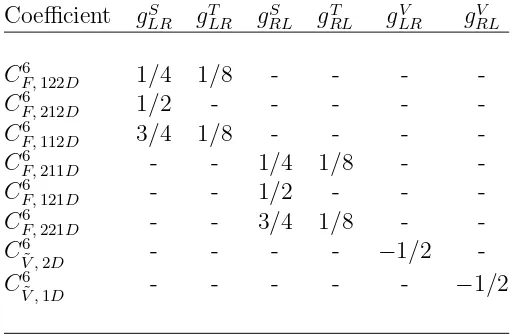
ii) We show that for the two-flavor case the operators in Lµ−decay proportional to gLRS,T and gS,TRL arise from twelve independent dimension n = 6 gauge-invariant four-fermion operators, while those containing gV
LR and gRLV are generated by four independent n = 6 operators that contain two fermions and two Higgs scalars.
iii) While the operators that contribute toµ-decay have dimensionn = 6 or higher, the lowest dimension neutrino mass operator occurs at n = 4. The authors of [68] used dimensional regularization (DR) to estimate the mixing between the
n = 6 µ-decay and neutrino mass operators4 but did not consider matching
with the n = 4 operator at the scale Λ that cannot be determined with DR. We derive order-of-magnitude expectations for the n = 6 operator coefficients 4Since the computation of [68] did not employ gauge invariant operators, we consider the results
implied by this matching, which depends only linearly on the lepton Yukawa
couplings and which gives the dominant constraints for Λv.
iv) For Λ not too different from v, constraints associated with mixing among the
n = 6 operators can, in principle, be comparable to expectations arising from contributions to the n = 4 mass operator. We carry out a complete, one-loop analysis of this mixing and show that only the neutrino magnetic moment and
two-fermion/two-Higgs operators mix with the n = 6 neutrino mass operator to linear order in the lepton Yukawa couplings. We derive the resulting bounds
on the gV
LR,RL that follow from this mixing and find that they are comparable
to expectations based on one-loop matching with the n = 4 mass operator for Λ∼> v.
v) From the mixing with then= 6 mass operator, we find that the bounds on the
|gV
LR,RL| are two or more orders of magnitude stronger than those obtained in [68] and at least three orders of magnitude below the experimental limits given
in [67].
vi) The neutrino mass implications for the couplingsgLR,RLS,T are more subtle. Of the twelve independent four-fermion operators that contribute to these couplings,
only eight are directly constrained by the scale of neutrino mass and naturalness
considerations. Based on one-loop matching, we expect that their contributions
to the gLR,RLS,T are generally ∼104 times smaller than the present experimental
bounds, and∼103 times smaller than obtained in the analysis of [68]. We show,
however, that the flavor structure of the remaining four operators allows them
to evade constraints implied by either one-loop matching or two-loop mixing.
While from a theoretical perspective one might not expect their contributions to
be substantially larger than those from the constrained operators, experimental
efforts to determine the gLR,RLS,T remain a worthwhile endeavor.
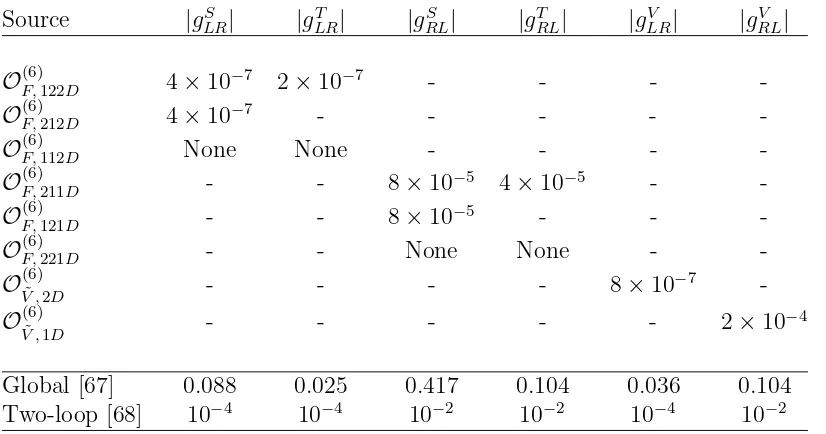
A summary of our results is given in Table 2.1. In the remainder of the paper
Table 2.1: Constraints onµ-decay couplingsgγ
µ. The first eight rows give naturalness expectations in units of (v/Λ)2×(m
ν/1 eV) on contributions fromn = 6 muon decay operators (defined in Section 3.3 below) based on one-loop matching with the n= 4 neutrino mass operators. For Λ ∼ v, the bounds on gV
LR,RL obtained from one-loop mixing are similar to those listed. The ninth row gives upper bounds derived from a recent global analysis of [67], while the last row gives estimated bounds from [68] derived from two-loop mixing of n = 6 muon decay and mass operators. A “-” indicates that the operator does not contribute to the given gγ
µ, while “None” indicates that the operator gives a contribution unconstrained by neutrino mass. The subscript D runs over the two generations of RH Dirac neutrinos.
Source |gSLR| |gLRT | |gRLS | |gRLT | |gLRV | |gRLV |
OF,(6)122D 4×10⁻⁷ 2×10⁻⁷ - - -
-OF,(6)212D 4×10⁻⁷ - - - -
-OF,(6)112D None None - - -
-OF,(6)211D - - 8×10⁻⁵ 4×10⁻⁵ -
-OF,(6)121D - - 8×10⁻⁵ - -
-OF,(6)221D - - None None -
-OV ,(6)˜ 2D - - - - 8×10⁻⁷
-OV ,(6)˜ 1D - - - 2×10⁻⁴
Global [67] 0.088 0.025 0.417 0.104 0.036 0.104
Two-loop [68] 10−4 10−4 10−2 10−2 10−4 10−2
of independent operators through n = 6 that contribute to mAB
ν and/or µ-decay. Section 2.3 gives our analysis of operator mixing and matching considerations, while
in Section 2.4 we discuss the resulting constraints on thegLR,RLγ that follow from this analysis and the present upper bounds on the neutrino mass scale. We summarize in
Section 3.6.
2.2
Operator Basis
To set notation, we follow [69] and consider the effective Lagrangian
Leff =
X
n,j
Cn j(µ) Λn−4 O
(n)
where µ is the renormalization scale, n ≥ 4 is the operator dimension, and j is an index running over all independent operators of a given dimension. The lowest
dimension neutrino mass operator is
O(4)M, AD = ¯LAφν˜ RD (2.3)
where LA is the left-handed (LH) lepton doublet for generation A, νD
R is a RH
neu-trino for generation D, and ˜φ = iτ2φ∗, with φ being the Higgs doublet field. After
spontaneous symmetry breaking, one has
φ→
0
v/√2
(2.4)
so that
CM, AD4 O(4)M, AD → −mADν ν¯LAνRD
mADν = −CM, AD4 v/√2 . (2.5)
The other n = 4 operators are those of the SM and we do not write them down explicitly here.
For the case of Dirac neutrinos that we consider here, there exist no
gauge-invariant n = 5 operators. In considering those with dimension six, it is useful to group them according to the number of fermion, Higgs, and gauge boson fields
that enter:
¯
LγµLLγ¯ µL ¯
`Rγµ`R`¯Rγµ`R ¯
`Rγµ`Rν¯RγµνR ¯
νRγµνRν¯RγµνR ¯
L`R`¯RL ¯
LνRν¯RL
ijL¯i`RL¯jνR
Here `R is the right-handed charged lepton field. Several of the operators appearing in this list can contribute to µ-decay, but only the last one can also contribute to
mAD
ν through radiative corrections. Including flavor indices, we refer to this operator
as
OF, ABCD(6) =ijL¯Ai `CRL¯Bj νRD (2.6) where the indices i, j refer to the weak isospin components of the LH doublet fields and 12 =−21 = 1.
Fermion-Higgs:
i( ¯LAγµLB)(φ+Dµφ)
i( ¯LAγµτaLB)(φ+τaDµφ)
i(¯`ARγµ`RB)(φ+Dµφ) (2.7)
i(¯νRAγµνRB)(φ+Dµφ)
i(¯`ARγµνRB)(φ+Dµφe)
mAD
ν since they contain no RH neutrino fields. Any loop graph through which they
radiatively induce mAD
ν would have to contain operators that contain both LH and
RH fields, such as OM, AB(4) or other n = 6 operators. In either case, the resulting constraints on the operator coefficients will be weak. For similar reasons, the third
and fourth operators cannot contribute substantially because they contain an even
number of neutrino fields having the same chirality and since the neutrino mass
operator contains one LH and one RH neutrino field. Only the last operator
OV , AD(6)˜ ≡i(¯`ARγµνRD)(φ+Dµφe) (2.8)
can contribute signficantly to mν since it contains a single RH neutrino. It also contributes to the µ-decay amplitude after SSB via the graph of Fig. 2.1a since the covariant derivative Dµ contains charged W-boson fields. We also write down the
n= 6 neutrino mass operators
OM, AD(6) = ( ¯LAφνe RD)(φ+φ) (2.9)
as well as the charged lepton mass operator ( ¯Lφ`R)(φ+φ) that we do not use in the
present analysis.
Fermion-Higgs-Gauge:
¯
LτaγµDνLWµνa
¯
LγµDνLBµν ¯
`RγµDν`RBµν ¯
νRγµDννRBµν (2.10)
g2( ¯Lσµντaφ)`RWµνa
g1( ¯Lσµνφ)`RBµν
g2( ¯Lσµντaφe)νRWµνa
As for the fermion-Higgs operators, the operators in (2.10) that contain an even
number of νR fields will not contribute significantly to mABν , so only the last two in the list are relevant:
O(6)B, AD = g1( ¯LAσµνφe)νRDBµν (2.11)
OW, AD(6) = g2( ¯LAσµντaφe)νRDWµνa (2.12)
In addition to these operators, there exist additional n= 6 operators that contain two derivatives. However, as discussed in [69], they can either be related to OB, AD(6) and O(6)W, AD through the equations of motion or contain derivatives acting on the νR fields so that they do not contribute to the neutrino mass operator. Consequently,
we need not consider them here. We also observe that the operator O(6)W, AD will also contribute to the µ-decay amplitude via graphs as in Fig. 2.1b. We have com-puted its contributions to the Michel parameters and find that they are suppressed
by ∼(mµ/Λ)2 ∼<1.7×10⁻⁷ relative to the effects of the other n= 6 operators. This suppression arises from the presence of the derivative acting on the gauge field and the
absence of an interference between the corresponding amplitude and that of the SM.
Finally, we note that the operators whose chiral structure suppresses their
contribu-tions to the neutrino mass operator (as discussed above) may, in general, contribute
to muon decay via the terms in Eq. (2.1) having = µ. We do not consider these terms in this study.
2.3
Operator Renormalization: Mixing and
Match-ing Considerations
In analyzing the renormalization of operators that contribute to both µ-decay and
mAD
ν it is useful to consider separately two cases: (i) one-loop matching conditions
W φ
νD
R
lR
φ
W φ
νD
R
L
(a) (b)
[image:35.612.111.539.34.144.2]OV˜ OW
Figure 2.1: Contributions from the operators (a) O(6)V , AD˜ and (b) OW, AD(6) (denoted by the shaded box) to the amplitude for µ-decay. Solid, dashed, and wavy lines denote fermions, Higgs scalars, and gauge bosons, respectively. After SSB, the neutral Higgs field is replaced by its vev, yielding a four-fermionµ-decay amplitude.
contributions to mAD
ν involving the second case will be smaller than those implied
by matching with O(4)M, AD by ∼ (v/Λ)2, since O(6)
M, AD contains an additional factor
of (φ†φ)/Λ2. We first consider this case and employ dimensional analysis to derive
neutrino mass naturalness expectations for the n= 6 operator coefficients. Forv not too different from Λ, the impact of the n = 6 mixing can also be important, and in this case we can employ a full renormalization group (RG) analysis to derive robust
naturalness bounds.
2.3.1
Matching with
O
M, AD(4)The analysis of [68] employed dimensional regularization (DR) to regularize the
one-and two-loop graphs through which four-fermion operators containing a singleνRfield contribute to the n= 6 mass operator. Mixing with lower-dimension operators does not arise in DR since the relevant graphs are quadratically divergent and must be
proportional to the square of a mass scale. For µ > v, all fields are massless, and µ
itself appears only logarithmically. Since the mass operator exists for zero external
momentum, all quadratically-divergent graphs vanish in this case.
The n = 4 mass operator will nevertheless receive contributions at the scale Λ associated with loop graphs containing the n = 6 operators. Simple power counting shows that these contributions go as∼Λ2/(4π)2 times a productn= 6 operator
of the effective theory with the full theory (unspecified) at the scale Λ implies the
presence of a contribution to C4
M of order ∼ αC6/4π. As emphasized in [77], the precise numerical coefficient that enters this matching contribution cannot be
com-puted without knowing the theory above the scale Λ. One may, however, estimate
the size of these contributions either using a gauge-invariant regulator, such as the
generalized Pauli-Villars regulator of [78], or using naive dimensional analysis. Since
we are interested in order-of-magnitude expectations, use of the latter is sufficient.
We emphasize that these expectations can only be relaxed in specific models that
suppress the matching conditions.
L
νR
L
φ
OB,W
(
a
)
L
lR
νR
φ
φ
O
V˜(
b
)
νR
L
φ
L
lR
O
F [image:36.612.118.282.226.515.2](
c
)
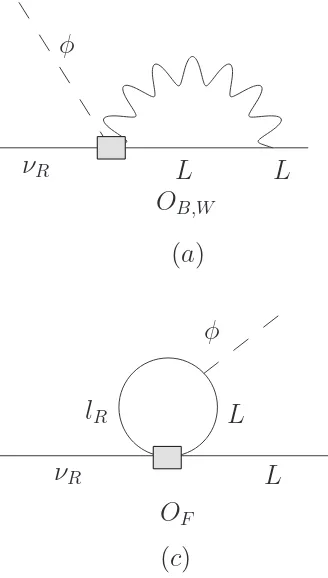
Figure 2.2: One-loop graphs for the matching contributions of the n = 6 operators (denoted by the shaded box) to then = 4 mass operatorOM, AD(4) . Solid, dashed, and wavy lines denote fermions, Higgs scalars, and gauge bosons, respectively. Panels (a, b, c) illustrate contributions from O(6)B,W, OV(6)˜ , and O(6)F , respectively, to O(4)M, AD.
The relevant one-loop graphs are shown in Fig. 2.2. For the matching of the
four-fermion operatorsOF, ABCD(6) ontoO(4)M, AD, two topologies are possible, associated with either the fields ( ¯LA, νD
of O(6)F, ABCD as well as ofO(6)˜
V , AB into O
(4)
M, AD, one insertion of the Yukawa interaction
f∗
AC¯lCRLA is needed to convert the internal, RH lepton into a LH one. In contrast, no Yukawa insertion is required for the matching ofO(6)B, AD and O(6)W, AD ontoO(4)M, AD.
To simplify the analysis of matching involving theOF, ABCD(6) we note that one may always redefine the fields LA and `D
R so that the charged lepton Yukawa matrix fAD is diagonal. Specifically, we take
LA → LA0 =S
ABLB (2.13)
`CR → `C0 =T
CD`D
with SAB and TCD chosen so that
¯
Lf `˜ = ¯L0fdiag˜ `0 (2.14)
whereL,L0 denote vectors in flavor space, ˜f denotes the Yukawa matrix in the original
basis, and ˜fdiag = ˜S†f˜T˜. We note that the field redefinition (2.13) differs from
the conventional flavor rotation used for quarks, since we have performed identical
rotations on both isospin components of the left-handed doublet. Consequently, gauge
interactions in the new basis entail no transitions between generations. We also note
that Eqs. (2.13) also imply a redefinition of the operator coefficientsC4
M, AD,CF, ABCD6 , etc.. For example, one has
CM, A4,6 0D = C 4,6
M, ADSM, A0A (2.15)
C60
F, A0B0C0D = CF, ABCD6 SA0ASB0BTC∗0C
where a sum over repeated indices is implied. Diagonalization of the neutrino mass
matrix requires additional, independent rotations of the νD
L,R fields after inclusion of
radiative contributions to the coefficientsCM, AD4,6 generated by physics above the weak scale. Since we are concerned only with contributions generated above the scale of
the L0, `0
R basis5.
In this case, the only four fermion operators OF, ABCD(6) that can contribute sub-stantially to mAD
ν are those having either A = C or B = C. Thus, we obtain the following estimates of the contributions from the n= 6 operators to the coefficient of the n = 4 mass operator:
OB, AD(6) → CM, AD4 (Λ)∼
α
4πcos2θ
W
CB, AD6 (Λ)
O(6)W, AD → C
4
M, AD(Λ)∼
3α
4πsin2θW
CW, AD6 (Λ)
OV , AD(6)˜ → CM, AD4 (Λ)∼
fAA 16π2C
6 ˜
V , AD(Λ) (2.16)
OF, ABAD(6) → C
4
M, BD(Λ)∼
fAA 8π2C
6
F, ABAD(Λ)
O(6)F, ABBD → CM, AD4 (Λ)∼
fBB 16π2C
6
F, ABBD(Λ)
where θW is the weak mixing angle and where we have made the dependence on the matching scale Λ explicit6.
The relative factor of 3 cot2θ
W for the mixing of OW, AD(6) compared to the mixing of OB, AD(6) arises from the ratio of gauge couplings (g/g0)2 and the presence of a ~τ·~τ
appearing in Fig. 2.2a. The factor of two that enters the mixing ofOF, ABAD(6) compared to that of O(6)F, ABBD arises from the trace associated with the closed chiral fermion loop that does not arise forOF, ABBD(6) .
We observe that there exist two four-fermion operators that contribute to µ-decay that do not contribute to C4
M, AD in the basis giving a diagonal fAB: O(6)F, AABD with either A= 1, B = 2 or A= 2, B = 1. It is similarly straightforward to see that these operators do not mix with C6
M, AD, since in the basis of charged lepton mass
eigen-states, there exist no Yukawa interactions that couple lepton doublet and charged
lepton singlet fields of different generations. As we discuss in Section 2.4, the
oper-ators O(6)F, AABD with either A = 1, B = 2 or A = 2, B = 1 contribute to gS,TLR and 5For notational simplicity, we henceforth omit the prime superscripts.
6In relating the coefficients C(Λ) to those at the weak scale as needed for the analysis of both
µ-decay andmν, we will neglect corrections to the relations in Eqs. (2.16) generated by running, as
gRLS,T, respectively. Consequently, the magnitudes of these couplings are not directly bounded by mν and naturalness considerations, as indicated in Table 2.1.
These conclusions differ from those in [68], which did not take into account
oper-ators that contribute to µ-decay but do not mix with the neutrino mass operators. The corresponding bounds ongS,TLR andgRLS,T obtained in that work are, thus, not gen-eral and would apply only in scenarios for which C6
F,112D and CF,6 221D vanish. From a theoretical standpoint, one might expect the magnitudes ofC6
F,112D and CF,6 221D to be comparable to those of the other four-fermion operator coefficients in models that
are consistent with the scale of neutrino mass. Nevertheless, we cannot a priori rule
out order of magnitude or more differences between operator coefficients.
2.3.2
Mixing among
n
= 6
operators
Because O(6)M, AD contains one power of (φ†φ)/Λ2 compared to O(4)
M, AD, the constraints
obtained from mixing with the former will generally be weaker than the one-loop
n = 4 matching contributions by ∼ (v/Λ)2 . However, for Λ not too different from
the weak scale, the n = 6 mixing can be of comparable importance to the n = 4 matching. Here, we study the mixing among n= 6 operators by computing all one-loop graphs that contribute using DR and performing a renormalization group (RG)
analysis. Doing so provides the exact result for contributions to the one-loop mixing
from scales between Λ andv, summed to all orders in fAAln(v/Λ) andαln(v/Λ). In carrying out this analysis, it is necessary to identify a basis of operators that
close under renormalization. We find that the minimal set consists of seven operators
that contribute to µ-decay and mAD ν :
OB, AD(6) , O
(6)
W, AD, O
(6)
M, AD, O
(6) ˜
V , AD, O
(6)
F, AAAD, O
(6)
F, ABBD, O
(6)
F, BABD . (2.17)
For simplicity, we have included a single RH neutrino fieldνD
R in all seven operators.
While one could, in principle, allow for different νR generation indices, the essential physics can be extracted from an analysis of this minimal basis.
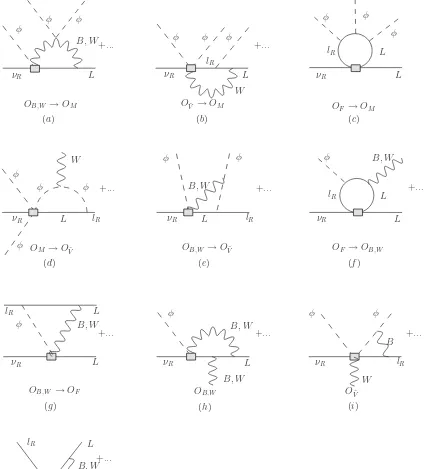
Fig. 2.3, where we show representative contributions to operator self-renormalization
and mixing among the various operators. The latter include mixing of all operators
into OM, AD(6) (a–c); mixing of OM, AD(6) , OB, AD(6) , and OW, AD(6) into O(6)V , AD˜ (d, e); and mixing between the four-fermion operators and the magnetic moment operators (f,
g). Representative self-renormalization graphs are given in Fig. 2.3(h–j). As noted in
[68], the mixing of the the four-fermion operators into OM, AD(6) contains three powers of the lepton Yukawa couplings and is highly suppressed. In contrast, all other mixing
contains at most one Yukawa insertion.
Working to first order in the fAA we find a total of 59 graphs that must be computed, not including wavefunction renormalization graphs that are not shown.
Twenty-two of these graphs were computed by the authors of [69] in their
analy-sis of the mixing between OM, AD(6) and the magnetic moment operators. Here, we compute the remaining 37. As in [69], we work with the background field gauge
[79] in d = 4−2 spacetime dimensions. We renormalize the operators using mini-mal subtraction, wherein counterterms simply remove the divergent 1/ terms from the one-loop amplitudes. The resulting renormalized operators OjR(6) are expressed in terms of the unrenormalized operators O(6)j as
OjR(6) = X
k
Zjk−1ZnL/2
L Z nφ/2
φ O
(6)
k = X
k
Zjk−1Ok(6)0 , (2.18)
where
Oj(6)0 =Z
nL/2
L Z nφ/2
φ O
(6)
j (2.19)
are theµ-independent bare operators; ZL1/2 and Zφ1/2 are the wavefunction renormal-ization constants for the fields LA and φ, respectively; nL and nφ are the number of LH lepton and Higgs fields appearing in a given operator; andZ−1
jkZ nL/2
L Z nφ/2
φ are the
counterterms that remove the 1/ divergences.
Since the bare operatorsO(6)j0 do not depend on the renormalization scale, whereas the Zjk−1 and the O(6)jR do, the operator coefficients C6
RG equation for the operator coefficients: µ d dµC 6 j + X k
Ck6 γkj = 0 (2.20)
where
γkj = X ` µ d dµZ −1 k`
Z`j . (2.21)
is the anomalous dimension matrix. We obtain7 γ
jk=
−3(α1−3α2) 16π
3α1
8π −6α1(α1+α2) −
9α1f∗
AA
8π −
9α1fAA
4π −
9α1fBB
2π
9α1fBB
4π
9α2
8π
3(α1−3α2)
16π 6α2(α1+ 3α2)
27α2f∗
AA
8π −
9α2fAA
4π −
9α2fBB
2π
9α2fBB
4π
0 0 9(α1+3α2)
16π −
3λ
2π2 0 0 0 0
0 0 9α2fAA
8π −
3fAAλ
8π2
3α1
4π 0 0 0
−3fAA∗
128π2 −
f∗
AA
128π2 0 0
3(3α1−α2)
8π 0 0
−3fBB∗
128π2 −
f∗
BB
128π2 0 0 0
3(α1+α2) 8π
3(α1−α2) 4π
0 0 0 0 0 3(α1−α2)
4π
3(α1+α2) 8π (2.22)
where the αi = gi2/(4π) and λ is the Higgs self coupling defined by the potential
V(φ) =λ[(φ†φ)−v2/2]2.
Using this result for γij and the one-loop β functions for α1, α2, and the lepton Yukawa couplings, we solve the RG equations to determine the operator coefficients
C6
k(µ) as a function of their values at the scale Λ. As in [69] we find that the the running of the gauge and Yukawa couplings has a negligible impact on the evolution
of the C6
k(µ). It is instructive to consider the results obtained by retaining only the leading logarithms ln(µ/Λ) and terms at most first order in the Yukawa couplings.
7The term inγ
33 proportional toλdiffers from that of [69], which contains an error. However,
+... φ φ φ φ φ φ (b)
OV˜ →OM OF→OM
OF +... φ φ +... φ +... φ φ φ φ +... φ φ +... φ +... (d)
(g) (e) (h) (c) (f) (i) OB,W
OB,W →OF
OB,W →OV˜
OM →OV˜
OV˜
OF →OB,W νR
νR L L
lR
W
lR L
νR L νR L lR νR L
L lR
W
lR
νR L νR νR
+... B, W
L
B, W W
B
lR
νR L
L lR
B, W
(j)
lR L
B, W φ
+... φ
φ φ
OB,W →OM (a)
νR L
B, W
B, W
[image:42.612.112.536.56.525.2]B, W
φ φ φ φ φ φ φ B, W B, W B, W (c) (b) (a) L
lR lR L lR L
L
νR νR L νR L
[image:43.612.118.531.204.642.2]+...
Figure 2.4: Two-loop graphs for the mixing of then = 6 operators. Only representive graphs for the mixing of the four-fermion operatorsO(6)F, ABCD into O(6)M, AD are shown.
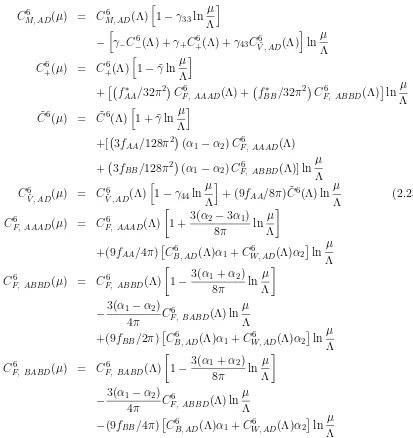
We find
CM, AD6 (µ) = CM, AD6 (Λ)h1−γ33lnµ Λ i
−hγ−C−6(Λ) +γ+C
6
+(Λ) +γ43CV , AD6˜ (Λ)
i lnµ
Λ
C+6(µ) = C+6(Λ)h1−˜γlnµ Λ i
+ f∗
AA/32π2
CF, AAAD6 (Λ) + f∗
BB/32π2
CF, ABBD6 (Λ)lnµ Λ ˜
C6(µ) = C˜6(Λ)h1 + ˜γln µ Λ i
+[ 3fAA/128π2
(α1 −α2)CF, AAAD6 (Λ) + 3fBB/128π2
(α1−α2)CF, ABBD6 (Λ)] ln µ Λ
CV , AD6˜ (µ) = CV , AD6˜ (Λ)
h
1−γ44lnµ Λ i
+ (9fAA/8π) ˜C6(Λ) ln
µ
Λ (2.23)
CF, AAAD6 (µ) = CF, AAAD6 (Λ)
1 + 3(α2−3α1)
8π ln
µ
Λ
+(9fAA/4π)
CB, AD6 (Λ)α1+CW, AD6 (Λ)α2lnµ Λ
CF, ABBD6 (µ) = CF, ABBD6 (Λ)
1− 3(α1+α2) 8π ln
µ
Λ
−3(α14−π α2)CF, BABD6 (Λ) lnµ Λ +(9fBB/2π)
CB, AD6 (Λ)α1+CW, AD6 (Λ)α2lnµ Λ
CF, BABD6 (µ) = CF, BABD6 (Λ)
1− 3(α1+α2) 8π ln
µ
Λ
−3(α1−α2)
4π C
6
F, ABBD(Λ) ln
µ
Λ
−(9fBB/4π)
where
C±6(µ) ≡ CB, AD6 (µ)±CW, AD6 (µ) ˜
C6(µ) ≡ α1CB, AD6 (µ)−3α2CW, AD6 (µ) (2.24)
γ± ≡ (γ13±γ23)/2
˜
γ ≡ 3(α1+ 3α2)/16π .
We note that the combination of coefficients C6
+(v) enters the neutrino magnetic
moment. Its RG evolution was obtained in [69] to zeroth order in the Yukawa
cou-plings; here we obtain the corrections that are linear infAAandfBB. The correspond-ing contributions to the neutrino mass matrix δmAD
ν and magnetic moment matrix
µAD
ν are then given by
δmADν = −
v3
2√2Λ2
CM, AD6 (v) (2.25)
µAD ν
µB
= −4√2mev Λ2
ReC+6(v) . (2.26)
From Eqs. (2.23), (2.25), and (2.26) we observe that to linear order in the lepton
Yukawa couplings, C6
M, AD(µ) receives contributions from the two magnetic moment operators and O(6)V˜ but not from the four fermion operators. This result is consis-tent with the result obtained by the authors of [68], who computed one-loop graphs
containing the four-fermion operators of Eq. (2.1) using massive charged leptons and
found that contributions to mν ∝ m3`. In the effective theory used here, the latter result corresponds to a one-loop computation with three insertions of the Yukawa
in-teraction. However, mixing with O(6)V˜ was not considered in [68], and our result that this operator mixes with OM, AD(6) to linear order in the Yukawa couplings represents an important difference with the former analysis.
We agree with the observation of [68] that the four fermion operators can mix
[image:44.612.219.426.61.157.2]and Z0 bosons that correspond in our framework to the diagrams of Fig. 2.4a. We
observe, however, that the two-loop constraints will be we
![Figure 1.1: The current experimental status of ν oscillation parameters, taken from[1].](https://thumb-us.123doks.com/thumbv2/123dok_us/312031.1032359/15.612.116.461.36.592/figure-current-experimental-status-n-oscillation-parameters-taken.webp)
![Figure 1.2: χ2 plotted as a function of MH, taken from [42]. The yellow band showsthe region excluded by the direct searches at 95% CL.](https://thumb-us.123doks.com/thumbv2/123dok_us/312031.1032359/20.612.119.392.240.515/figure-plotted-function-yellow-showsthe-region-excluded-searches.webp)
![Fig. 2.4. These graphs were estimated in [68] by considering loops with massive W ±](https://thumb-us.123doks.com/thumbv2/123dok_us/312031.1032359/44.612.219.426.61.157/fig-graphs-estimated-considering-loops-massive-w.webp)