2016 International Conference on Manufacturing Science and Information Engineering (ICMSIE 2016) ISBN: 978-1-60595-325-0
Harmonic Analysis Algorithm Based On SVD
Filter
CHONG WANG, PENG WU, JUNFENG ZHAO and LI ZHANG
ABSTRACT
SVD (singular value decomposition) has been applied to design a FIR band-pass filter for both narrow and steep transitional bands, so as to simplify the complex execution on hardware when the harmonic algorithm that is based on FIR (finite impulse response) digital filter is used. First of all, a conventional method is used to obtain the coefficients of the band-pass filter (prototype), and some of the coefficients are arranged in a matrix. Then, the coefficient matrix is used to calculate SVD, based on which, a low dimensional and approximate expression of the matrix is accordingly obtained. Finally, according to the approximate expression of the matrix, the execution structure of the extrapolation filter is employed to design, approximately, the prototype of the band-pass filter. Simulation results show that the complex hardware execution of the harmonic algorithm can be simplified by using the proposed method to extract and analyze the harmonic waves.1
INTRODUCTION
With the rapid development of power electronic technologies, the quality of electric energy has now been highly underlined because of the severe harmonic pollution in power system. Therefore, it is necessary to extract harmonic components from the power system to make follow-up analysis [1]. On the one hand, the measurement of high-voltage power is required to be more accurate, as it is related to the interests of three parties: power plant, power transporter and power consumer. On the other hand, online monitoring on both the quality and the usage of electric energy is of great significance to maintain a safe and reliable power grid as
Chong Wang, Junfeng Zhao, Li Zhang, Jiangsu Electric Power Information & Telecommunication Company, Jiangsu, P. R. China.
well as to ensure that the electric energy is reasonably tolled, and a great deal of on-site checking works can be saved thanks to the online monitoring results [2].
It is convenient to use Parks-McClellan optimal digital filter an applicable narrow and steep transitional band-pass filter [3]. The filter designed by this algorithm, however, has a higher order, implying that the execution on hardware is complex, which, as a result, will lead to a higher power consumption of the hardware system. To simplify the complex execution on hardware, SVD (singular value decomposition) has then been applied to design the band-pass filter for narrow and steep transitional bands.
HARMONIC ANALYSIS ALGORITHM BASED ON SVD FILTER
The SVD-based algorithm to design the narrow and steep transitional band-pass filter is constructed according to following steps:
Step 1: Continuous electric power signals are collected at the sampling
frequency of fsample and converted into digital signalsx n
.Step 2: Based on the sampling frequency fsample and the harmonic component
1
f
as well as on actual conditions, the pass-band rangefp1 fp2, the stop-band
ranges
0 fs1
andfs1 0.5 fsample, the maximum pass-band ripple rp and themaximum stop-band attenuation rs of the narrow and steep transitional band-pass
filter are determined.
Step 3: According to the sampling frequency fsample, the pass-band range and the
stop-band range, as stated in Step 2, the normalized pass-band range
1 sample
2 sample
2 fp f 2 fp f
and the normalized stop-band ranges
1 sample
0 2 fs f
and 2
fs2 fsample
are obtained.
Step 4: According to the normalized pass-band range, the normalized stop-band
range, the maximum pass-band ripple rp and the maximum stop-band attenuation
s
r
, the narrow and steep transitional band-pass filter h n
is designed by using aconventional method, where, n NF and NF can be any positive integer. The
length of this FIR filter is
2NF1
.Step 5: Decompose singular values of the matrix H:
1
r
i i i
i
H μ υ (1)
where, 1, 2,…, r are singular values of the matrix.
Step 6: Given that the rest singular values can be ignored if compared to the l maximum singular values, the matrix Hcan be approximately expressed as:
0 l
i i i i
H μ υ (2)
H
μ0 μ2 ... μl
s0 s2 ... sR
(3)According to (3), the harmonic components for analysis can be extracted. The SVD-based algorithm to design the narrow and steep transitional band-pass filter is similar to the technique that is based on the periodicity of filter coefficients to design the low-pass FIR filter (extrapolation) [4-5]. Both have the same filtering execution structure. But, parameters in our algorithm are obtained by decomposing singular values as well as by searching on computer.
SIMULATION
To prove that the SVD-based narrow and steep transitional band-pass filter designed by using our algorithm is accurate to extract harmonic components from signals, the following simulation is conducted. The signals to be analyzed is expressed as:
5 sin 2
0 0
2 sin 2
1 1
3 sin 2
2 2
x t f t f t f t
(4)
0 50Hz
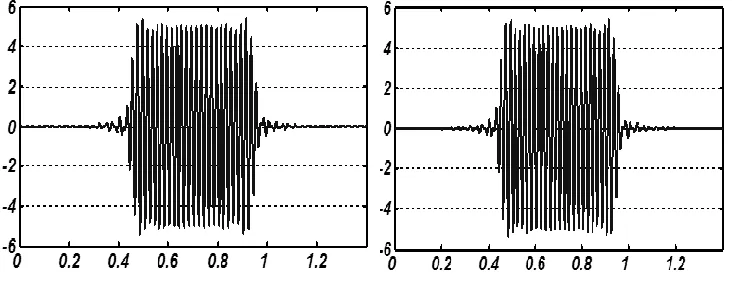
Figure 1. The 50Hz harmonic component extracted by the Parks-McClellan algorithm (left) and our algorithm (right).
Figure 2. The 75Hz harmonic component extracted by the Parks-McClellan algorithm (left) and our algorithm (right).
Figure 1 shows the 50Hz harmonic components of band-pass filter 2 designed by our algorithm and the Parks-McClellan algorithm, respectively. Figure 2 shows the 75Hz harmonic components of band-pass filter 4 designed by our algorithm and the Parks-McClellan algorithm, respectively. It can be seen that both algorithms can achieve a basically same effect.
CONCLUSION
In this study, SVD has been applied to the conventional algorithm (namely, the Parks-McClellan optimization FIR filter designing method) to design the band-pass filter for both narrow and steep transitional bands. The SVD-based algorithm has simplified the complex execution on hardware and, therefore, lowered the complexity of the hardware execution of the harmonic algorithm that is based on FIR digital filter.
REFERENCES
1. M. Elad, M.A.T. Fiueiredo, and Yi Ma. 2010. “On the Role of Sparse and Redundant
Representations in Image Processing,”Proceedings of the IEEE, 98(6):972-982.
2. Yonina C. Eldar and Gitta Kutyniok. 2012. “Compressed Sensing: Theory and Applications,”
Cambridge University Press.
3. H. Qi and S. Hughes. 2012. “Invariance of Principal Components under Low-dimensional Random Projection of the Data,” IEEE International Conference on Image Processing, pp. 113-116.
4. T. Wimalajeewa, Hao Chen, and P.K. Varshney. 2012. “Performance Limits of Compressive Sensing-based Signal Classification,” IEEE Transactions on Signal Processing, 60( 6): 2758 –2770.