http://dx.doi.org/10.4236/ojs.2015.51002
Comparison of the Sampling Efficiency in
Spatial Autoregressive Model
Yoshihiro Ohtsuka
1, Kazuhiko Kakamu
21Department of Economics, University of Nagasaki, Nagasaki, Japan 2Faculty of Law, Politics and Economics, Chiba University, Chiba, Japan
Email: [email protected], [email protected]
Received 29 December 2014; accepted 18 January 2015; published 22 January 2015
Copyright © 2015 by authors and Scientific Research Publishing Inc.
This work is licensed under the Creative Commons Attribution International License (CC BY). http://creativecommons.org/licenses/by/4.0/
Abstract
A random walk Metropolis-Hastings algorithm has been widely used in sampling the parameter of spatial interaction in spatial autoregressive model from a Bayesian point of view. In addition, as an alternative approach, the griddy Gibbs sampler is proposed by [1] and utilized by [2]. This pa-per proposes an acceptance-rejection Metropolis-Hastings algorithm as a third approach, and com-pares these three algorithms through Monte Carlo experiments. The experimental results show that the griddy Gibbs sampler is the most efficient algorithm among the algorithms whether the number of observations is small or not in terms of the computation time and the inefficiency fac-tors. Moreover, it seems to work well when the size of grid is 100.
Keywords
Acceptance-Rejection Metropolis-Hastings Algorithm, Griddy Gibbs Sampler, Markov Chain Monte Carlo (MCMC), Random Walk Metropolis-Hastings Algorithm, Spatial Autoregressive Model
1. Introduction
model. We have to mention that in economic analysis typically the sample size is small, for instance, areal data such as state-level data is widely used. The maximum likelihood methods depend on their asymptotic properties while the Bayesian method does not, because the latter evaluates the posterior distributions of the parameters conditioned on the data. Therefore, it is reasonable to examine the properties of Bayesian estimators (see [12]).
Although there are a lot of works using spatial models in a Bayesian framework, previous literature has rarely examined sampling methods for the parameter of spatial correlation. [13] proposed a random walk Metropolis- Hastings (hereafter RMH) algorithm. This method is widely used (e.g., [11] [12] [14] and so on). On the other hand, [2] applied a griddy Gibbs sampler (hereafter GGS) proposed by [1] and showed the GGS got an advan-tage over the RMH method from a simulated data and estimated the regional electricity demand in Japan. How-ever, [2] has examined only one case. In this paper, we compare the properties of the GGS in the case that the number of observation is small (or large) through the Monte Carlo experiments. Desirable properties for sam-pling methods in the Bayesian inference are efficiency and well mixing, which yield fast convergence. In addi-tion to these properties, computaaddi-tional requirements and model flexibility are important for applied econome-trics. Therefore, the purpose of this paper is to investigate the properties of some sampling algorithms given several parameters of a model.
In this paper, we examine the efficiency of the existing Markov chain Monte Carlo methods for the spatial autoregressive (hereafter SAR) model which is the simplest and most commonly used model in the spatial mod-els. Moreover, we propose an acceptance-rejection Metropolis-Hastings (hereafter ARMH) algorithm as an al-ternative MH algorithm, which is proposed by [15] because it is well known that the RMH is inefficient. This algorithm is widely used for the acceleration of MCMC convergence, for example, in the time series models (see [16]-[18] and so on). The advantage of this method is that the computational requirement is very small since it is irrelevant to the shape of the full conditional density. Therefore, we apply the algorithm to the SAR model.
We illustrate the properties of these algorithms using simulated data set given the three number of observa-tions and the seven values of spatial correlation. From the results, we find that the GGS is the most efficient method whether the number of observations is small or not in terms of both the computation time and the ineffi-ciency factors. Furthermore, we show that it is efficient when the number of grid in the GGS sampler is one hundred. These results give a benchmark of sampling the spatial correlation parameter of the models.
The rest of this paper is organized as follows. Section 2 summarizes the SAR model. Section 3 discusses the computational strategies of the MCMC methods, and reviews three sampling methods for spatial correlation pa-rameter. Section 4 gives the Monte Carlo experiments using simulated data set and discusses the results. Finally, we summarize the results and provide concluding remarks.
2. Spatial Autoregressive (SAR) Model
Spatial autoregressive model explains the spatial spillover using a weight matrix (see [19]). There are numerous approaches to construct the weight matrix, which plays an important role in the model. For example, those are a first order contiguity matrix, inverse distance one and so on. Among the approaches, [20] recommended the first order contiguity dummies, because they showed that the first order contiguity weight matrix identifies the true model more frequently than the other matrices through the Monte Carlo simulations. Thus, we also utilize the first order contiguity dummies as the weight matrix.
Let C be an n n× matrix of contiguity dummies, with cij =1 if areas i and j are adjacent and 0
ij
c = otherwise (with cii =0). We standardized the weight matrix as follows
1
ij ij n
ij j c w
c = =
∑
and we define W =
{ }
wij , where wij denotes the spatial weight on the j-th unit with respect to the i-th unit. Note that we have∑
nj=1wij =1 for all i.Next, let yi and xi be a dependent variable and a 1×k vector of covariates on the ith unit for 1, ,
(
2)
1, 0, , 1
n
i ij j i i i
j
y ρ w y σ ρ
=
=
∑
+xβ+ < (1)where ρ and σ2 indicates the spatial correlation, and the variance of the disturbance term, respectively. As is shown in [21], we know that
λ
min−1 = −1 amdλ
max−1 =1, where λmin and λmax denote the minimum and maximum eigenvalue of W , since we standardize the weight matrix like W . Thus, we restrict ρ to(
1,1)
ρ
∈ − .Then the likelihood function of the model (1) is given as follows:
(
2) (
2)
22
, , , , 2π exp
2 n
n
L σ ρ σ ρ
σ
− ′
= − −
e e
yβ X W I W (2)
where y=
(
yi,,yn)
′,(
1, , n)
′ ′ ′=
X x x , e=
(
ei,,en)
′, 1 ni i j ij j i
e =y −
∑
=ρw y −xβ , and In is an n n× unit matrix.3. Posterior Analysis and Simulation
3.1. Joint Posterior Distribution
Since we adopt the Bayesian approach, we complete the model by specifying the prior distribution over the parameters. We use the following independent prior distribution:
(
2)
( )
( )
2( )
, ,
π β σ ρ =π β π σ π ρ
Given a prior density π
(
β,σ ρ2,)
and the likelihood function given in (2), the joint posterior distributioncan be expressed as
(
2)
(
2) (
2)
, , , , , , L , , , ,
π β σ ρ y X W ∝π β σ ρ yβ σ ρ X W (3)
Finally, we assume the following prior distributions:
(
)
2(
)
(
)
0, 0 , 0 2 , 0 2 , 1,1
N µ σ IG ν λ ρ U −
Σ
β
where IG a b
( )
, denotes an inverse gamma distribution with scale and shape parameters a and b.Since the joint posterior distribution is given by (3), we can now adopt the MCMC method. The Markov chain sampling scheme can be constructed from the full conditional distributions of ρ,
β
and σ2.3.2. Sampling
ρ
From (3), the full conditional distribution of ρ is written as
(
2)
2 '
, , , , , exp
2 n
p ρ σ ρ ρ
σ
∝ − −
e e
y X W I W
β (4)
As it is difficult to sample from the standard distribution, we examine three approaches for sampling ρ. First, we introduce the GGS, which is applied by [2]. Second, we overview the RMH algorithm, which is extended by [13]. Finally, we propose an ARMH algorithm. These sampling methods are summarized in the following. 3.2.1. Griddy Gibbs Sampler
The GGS was proposed by [1]. This sampling algorithm approximates a cumulative distribution function of the full conditional distribution by each kernel function over a grid of points and uses a numerical integration method, and is sampling method from the full conditional distribution by using the inverse transform method. Let the grid be as follows
1 2 1
1 a a am am+ 1
− = < << < =
and ρi
(
i∈{
1,,m}
)
, which is centered in the interval[
]
1 , i ia a+ . Then, the full conditional distribution in the
(
)
(
)
2 2 1 , , , , , , , , ii m h
h p
p
ρ β σ
ω
ρ β σ
=
=
∑
y X W
y X W
Thus, we select the grid ai∗ with probabilities,
( )
(
(
1)
)
1 1i i i
i m
j j j
j a a h a a ω ρ ω + + = − = −
∑
Finally, we sample ρ from the uniform(
a ai, i 1)
∗ ∗
+ . [22] stated that the choice of the grid of points has to be made carefully and constitute the main difficulty in applying GGS. In this paper, we select the equal interval among am+1−am as in [1]. Then, our numerical experiments examines to choice the size of grid for estimating the spatial correlation.
3.2.2. Random Walk Metropolis-Hastings Algorithm
The RMH method is a simple algorithm because it needs the previous value and a random walk process such as
(
)
new N old, 2
φ φ τ , where
φ
old is the parameter of the previous sampling, andτ
denotes the tuning para- meter, respectively. Therefore, the following Metropolis step is used: Sampleρ
new from(
)
new old 2
,
N s
ρ ρ
where s is the tuning parameter. In the numerical example below, we select the tuning parameter such that the acceptance rate lies between 0.4 and 0.6 (see [13]). Next, we evaluate the acceptance probability
(
old new)
(
(
new 2)
)
old 2
, , , , ,
, min ,1
, , , , , p
p
ρ σ ρ α ρ ρ
ρ σ ρ
=
y X W y X W
β β
And finally set
ρ ρ
= new with probability α ρ(
old,ρnew)
, otherwiseρ ρ
= old. The proposal value of ρ is not truncated to the interval(
−1,1)
because the constraint is part of the target density. Thus, if the proposed value of ρ is not within the interval, the conditional posterior is zero, and the proposal value is rejected with probability one (see [23]). It is well known that the method is not efficient because the convergence is slow for using the previous sampled parameter.3.2.3. Acceptance-Rejection Metropolis-Hastings Algorithm
An acceptance-rejection Metropolis-Hastings (ARMH) algorithm method was proposed by [15]. This algorithm samples the parameter using the AR and MH steps. Suppose that there is a candidate function g
( )
ρ
such that it is possible to sample directly from g( )
ρ
by some known method. Then, the AR step proceeds as follows. We sampling the parameter from the candidate function g( )
ρ
, and accepts the candidate draw with probability( ) ( )
p
ρ
cgρ
. This step is iterated until the candidate draw is accepted.Next, suppose the candidate
ρ
new is produced from above AR step. The MH part proceeds as follows. We calculate the acceptance probability, q as following:( )
( )
( ) ( )
(
)
(
)
( )
( )
( ) ( )
(
) (
)
(
( ) (
) ( )
)
old old
old
old old new new
old
new old
old old new new
old new
If , then 1;
If and , then ;
If and , then min ,1 .
p cg q
cg
p cg p cg q
p
p g
p cg p cg q
p g
ρ ρ
ρ
ρ ρ ρ ρ
ρ
ρ ρ
ρ ρ ρ ρ
ρ ρ < = < = =
should also make q as close to one as possible.
The advantage of this method is that it is free to functional form which differs from the GGS and RMH. In this paper, in order to construct the candidate function, we utilize the result of [7], which showed the consistency and asymptotic normality of quasi-ML estimators of model parameters, to the candidate density. Then, we construct the candidate density g
( )
ρ
as an approximation to the the conditional posterior density by omitting the determinant I−ρ
W as follows:( )
(
ˆ ,ˆ2)
g ρ N µ σρ ρ (5) where µˆρ =
(
y W Wy′ ′) (
−1{
y−Xβ)
′Wy}
and ˆ2 2(
)
1ρ
σ σ ′ ′ −
= y W Wy . Thus we sample
ρ
new from the distribu-tion, and apply the ARMH algorithm.3.3. Sampling Other Parameters
The full conditional distributions of
β
and σ2 are( )
ˆ ˆ 2(
ˆ)
ˆ
, , and 2 , 2
N σ IG ν λ
Σ
β β
where
{
2(
)
1}
0 0
ˆ ˆ
β =Σ σ− ′ −ρ +Σ−
X y Wy β ,
(
2 1)
1 0ˆ = σ− ′ + − −
Σ X X Σ , νˆ= +n ν0, and
λ
ˆ=e e′ +λ
0. These para-meters are easily sampled from the Gibbs sampler (see [25]).4. Comparison of MCMC Methods
4.1. Measures of Efficiency for Comparison
In this section, we examine the properties of three MCMC methods by simulated data sets. Desirable properties for sampling methods in MCMC are efficiency and well mixing, which yield fast convergence. [17] compared from the view point of acceptance rate in the AR and MH step. [26] [27] evaluated the efficiency of sampling methods, comparing the inefficiency factor and time of MCMC simulation. Following previous literatures, we also compare inefficiency factor and computational time.
The inefficiency factor is defined as
1
1 2 s
s r ∞
=
+
∑
where rs is the sample autocorrelation at lag s calcu- lated from the sampled values. It is used to measure how well the chain mixes and is the ratio of the numerical variance of the sample posterior mean to the variance of the sample mean from the hypothetical uncorrelated draws (see [28]).4.2. Data Generating Process and Estimation Procedures
We now explain the simulated data for an experiment. First, we give the weight matrix as an exogenous variable. We construct the spatial weight matrix W as follows: 1) generate cij for i> j from Bernoulli distribution with a probability of success 0.3, 2) set cij =cji for i=/ j and cij =0 for i= j , and 3) compute
1 n ij ij j ij
w =c
∑
=c for all i, j. Next, for the independent variables xi=(
1,x x1i, 2i,x3i)
, we take the standard normal variates and set the X , which are n×4 covariate matrices.Given W , X ,
ρ
= −0.9,−0.6,−0.3, 0, 0.3, 0.6, 0.9 , and n=50, 100, 200, the true data generating process is as follows:1 n
i ij j i i
j
y ρ w y
=
=
∑
+xβ+ (6) where the i is normally and independently distributed with E u( )
i =0 and( )
2 2
i
E u =σ . The parameter is set to be
β
′ =(
β β β β
0, 1, 2, 3) (
= 1,1,1,1)
and2 0.1
σ = , respectively. The parameters of ρ for simulated data reflect the values obtained in [12]. All the results in this paper were calculated using the Ox version 5.1 (see [29]).
(
)
2(
)
(
)
4
,100 , 1.0 2 , 0.01 2 , and 1,1
N ×I σ IG ρ U −
0
β
We perform the MCMC procedure by generating 35,000 draws in a single sample path and discard the first 20,000 draws as the initial burn-in. For the GGS, we consider the number of grid, m=50, 100, 300 for estimating the parameters.
[image:6.595.91.540.304.723.2]4.3. Results of Comparison
Table 1 reports inefficiency factors by using three methods. Although there are some differences, the perfor-mances of the GGS are almost equivalent to those of the ARMH. In addition, these algorithms are more efficient than RMH. For example, from the table in n=50, the inefficiency factors calculated by the ARMH are smaller than the other methods. However, if spatial correlation is positive strong such as
ρ
=0.9, the value by the GGS(
m=100)
has the smallest inefficiency factor. Next, we focus on the results in n=100. In this case, the GGS(
m=50,100)
perform the best forρ
=0.6, 0.9, respectively. In the case of n=200, the values of the GGS(
m=100)
and the ARMH are similar in each parameter. We can also find such similarity in sample paths and autocorrelation functions. Figure 1 shows the results of MCMC simulation in each method in the cases of0.3
ρ
= , n=50 and m=100. The figure shows that the marginal posterior densities (middle of the figure) Table 1. Inefficiency factor of models.Observation: n=50
Parameter RMH GGS ARMH
ρ m=50 m=100 m=300
−0.9 7.2 3.2 3.4 3.4 2.8
−0.6 27.6 4.4 4.4 4.7 3.7
−0.3 15.4 23.7 6.6 6.9 4.3
0 41.6 9.0 10.1 11.5 6.6
0.3 79.8 24.6 19.6 20.9 13.1
0.6 117.0 46.3 45.2 52.3 44.6
0.9 806.1 312.9 223.1 327.2 324.9
Observation: n=100
Parameter RMH GGS ARMH
ρ m=50 m=100 m=300
−0.9 10.7 4.8 5.0 5.3 4.7
−0.6 17.0 6.7 7.3 7.5 4.6
−0.3 34.7 9.0 10.2 10.9 5.0
0 72.4 15.4 16.2 17.8 9.5
0.3 85.1 24.5 25.5 32.6 19.9
0.6 202.3 36.1 56.6 65.8 51.3
0.9 609.1 379.3 338.0 342.1 338.9
Observation: n=200
Parameter RMH GGS ARMH
ρ m=50 m=100 m=300
−0.9 22.2 7.1 8.3 5.7 7.8
−0.6 31.0 11.5 12.4 13.5 9.0 −0.3 64.8 17.6 17.6 19.1 13.8
0 75.7 23.5 26.4 33.6 23.7
0.3 163.6 57.4 67.3 65.6 50.5
0.6 697.3 164.2 117.5 163.3 159.3
Figure 1. Sample paths, sample autocorrelation and posterior density of ρ=0.3, n=50.
have similar shapes but that the sample paths (top of the figure) and autocorrelation functions (bottom of the figure) are different. From the sample paths, we can find that the ARMH and GGS mix better than the RMH. As same as the sample paths, autocorrelation functions shows the same tendency. The figure of autocorrelation in-dicates that both GGS and ARMH perform similarly in the autocorrelation disappear. On the contrary, the result for the RMH indicates that serious autocorrelation for parameter at large lag length.
Table 2shows CPU time on a Pentium Core2 Duo 2.4GHz including discarded and rejected draws. For the GGS, the computation time depends on the number of grid because the increase of grid number causes the cost of computation time. In all cases, the GGS
(
m=50)
overwhelms the others. If we focus on the case of n=50, the computational time of the GGS(
m=100)
are as same as those of the RMH and ARMH methods. Futher-more, if n=200, the GGS needs much shorter time than the RMH and ARMH methods. Summarizing the re-sults of inefficiency factors and computational time, if the number of observation is not only small (like n=50) but also large, then it is suitable to use the GGS. In addition, the choice of grid number affects to the computa-tional time. In this numerical experiments, the results of selecting m=100 seem to work well in terms of inef-ficiency factors and computational time.Table 3shows the results with acceptance probabilities in both AR and MH parts in the ARMH. From the ta-ble, the acceptance probabilities in those part are exceed 89%. This result shows that our candidate function seems to work well, and the probabilities of sampling the same value consecutively are low. However, our ARMH algorithm does not improve the values of inefficiency factor. Thus, we think that the SAR model has the problem of identification.
Figure 2andTable 4 depict the sample path and the correlation among the parameters in the case of n=100, 0.9
ρ
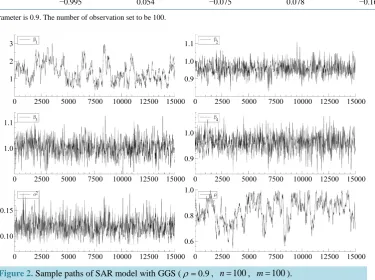
= , m=100 using the GGS. From β2 to β4 and σ2 in the figure, the MCMC draws seem to be well mixing. In addition, correlations among these parameters are very small. On the other hand, strong correlation between β0 and ρ can be found from the figure. Moreover, the correlation between β0 and ρ is −0.995 from the table. Therefore, we assume that the spatial correlation and constant term is weakly identified.5. Concluding Remarks
Table 2. Time of convergence.
Observation: n=50
Parameter RMH GGS ARMH
ρ m=50 m=100 m=300
−0.9 22.17 11.12 22.68 1:05.96 24.24 −0.6 23.22 11.57 23.06 1:05.99 23.95 −0.3 23.31 11.71 23.21 1:07.18 23.99 0 23.27 11.83 23.27 1:07.87 24.01
0.3 23.20 12.26 23.10 1:09.49 23.99
0.6 24.16 12.07 22.70 1:08.36 24
0.9 23.17 12.06 23.64 1:08.66 24.02
Observation: n=100
Parameter RMH GGS ARMH
ρ m=50 m=100 m=300
−0.9 1:31.73 18.67 35.49 1:37.61 1:44.90 −0.6 1:41.36 17.25 35.75 1:37.83 1:42.99 −0.3 1:43.81 19.93 36.64 1:39.25 1:43.22 0 1:40.10 18.30 40.15 1:38.47 1:43.53
0.3 1:40.90 19.90 40.04 1:41.40 1:43.55
0.6 1:41.73 18.91 37.35 1:43.97 1:43.13
0.9 1:43.36 17.93 37.89 1:40.33 1:42.27
Observation: n=200
Parameter RMH GGS ARMH
ρ m=50 m=100 m=300
−0.9 8:40.79 26.88 56.62 2:43.63 9:05.58 −0.6 8:43.81 26.66 56.76 2:45.73 9:07.63 −0.3 8:59.71 26.74 58.84 2:44.22 9:08.03 0 8:57.87 26.92 57.48 2:46.64 8:56.41
0.3 9:03.95 27.02 58.49 2:45.99 8:51.45
0.6 9:12.82 28.24 58.13 2:48.13 9:01.35
0.9 9:22.86 27.10 57.84 2:48.15 8:59.61
Note: Time denotes CPU time on a Pentium Core2 Duo, including discarded and rejected draws.
Table 3. Acceptance probability of the ARMH methods.
Parameter n=50 n=100 n=200
ρ AR step MH step AR step MH step AR step MH step
−0.9 0.9866 0.9116 0.9578 0.8975 0.9881 0.9505 −0.6 0.9999 0.9500 0.9999 0.9438 1.0000 0.9724 −0.3 1.0000 0.9848 1.0000 0.9805 1.0000 0.9906 0 1.0000 0.9849 1.0000 0.9787 1.0000 0.9949
0.3 1.0000 0.9670 1.0000 0.9544 1.0000 0.9861
0.6 0.9991 0.9553 0.9958 0.9375 1.0000 0.9802
[image:8.595.89.541.580.721.2]Table 4. Correlation of parameters.
1
β β2 β3 β4
2
σ
2
β −0.050
3
β 0.087 0.106
4
β −0.059 0.205 0.183
2
σ 0.161 −0.007 0.002 −0.025
ρ −0.995 0.054 −0.075 0.078 −0.160
Note: True parameter is 0.9. The number of observation set to be 100.
Figure 2. Sample paths of SAR model with GGS (ρ=0.9, n=100, m=100).
the results of selecting m=100 seem to work well in terms of inefficiency factors and computational time. Therefore, the GGS is beneficial algorithm for estimating the spatial parameter as same as the result of [22].
Finally, we will state our remaining issues. In this paper, we found that the GGS was the most efficient algo-rithm in sampling the intensity of spatial interaction. On the other hand, we showed the problem of the SAR model such that the spatial correlation and constant term was weakly identified. Thus, we have to construct the model which is identified, or appropriate algorithm to sample the intensity of spatial interaction. Furthermore, we found that the number of grids is appropriate when m=100. In this paper, we could not derive the theoreti-cal reason why m=100 was appropriate number of grids, that was, we only showed the results of Monte Carlo experiments. However, it is important to know the properties of the existing sampling methods, though research on the convergence of the GGS algorithm has never been examined. We think that, in this respect, our experi-ment gives the benchmark in applied econometrics.
Acknowledgements
We gratefully acknowledge helpful discussions and suggestions with Toshiaki Watanabe on several points in the paper. Mototsugu Fukushige gave insightful comments and suggestions when we made a presentation at Japan Association for Applied Economics in June, 2009. This research was partially supported by KAKENHI # 25245035 for K. Kakamu.
References
Journal of the American Statistical Association, 87, 861-868. http://dx.doi.org/10.1080/01621459.1992.10475289 [2] Ohtsuka, Y. and Kakamu, K. (2009) Estimation of Electric Demand in Japan: A Bayesian Spatial Autoregressive AR(p)
Approach. In: Schwartz, L.V., Ed., Inflation: Causes and Effects, Nova Science Publisher, New York, 156-178.
[3] Anselin, L. (2003) Spatial Externalities, Spatial Multipliers, and Spatial Econometrics. International Regional Science Review, 26, 153-166. http://dx.doi.org/10.1177/0160017602250972
[4] Gelfand, A.E., Banerjee, S., Sirmans, C.F., Tu, Y. and Ong, S.E. (2007) Multilevel Modeling Using Spatial Processes: Application to the Singapore Housing Market. Computational Statistics and Data Analysis, 51, 3567-3579.
http://dx.doi.org/10.1080/01621459.1990.10476213
[5] Anselin, L. (2010) Thirty Years of Spatial Econometrics. Papers in Regional Science, 89, 3-25.
http://dx.doi.org/10.1111/j.1435-5957.2010.00279.x
[6] Ord, K. (1975) Estimation Methods for Models for Spatial Interaction. Journal of the American Statistical Association,
70, 120-126. http://dx.doi.org/10.1080/01621459.1975.10480272
[7] Lee, L.F. (2004) Asymptotic Distributions of Quasi-Maximum Likelihood Estimators for Spatial Autoregressive Mod-els. Econometrica, 72, 1899-1925. http://dx.doi.org/10.1111/j.1468-0262.2004.00558.x
[8] Conley, T.G. (1999) GMM Estimation with Cross Sectional Dependence. Journal of Econometrics, 92, 1-45.
http://dx.doi.org/0.1016/S0304-4076(98)00084-0
[9] Kelejian, H.H. and Prucha, I.R. (1999) A Generalized Moments Estimator for the Autoregressive Parameter in a Spa-tial Model. International Economic Review, 40, 509-533. http://dx.doi.org/10.1111/1468-2354.00027
[10] Anselin, L. (1980) A Note on Small Sample Properties of Estimators in A First-order Spatial Autoregressive Model. Environment and Planning A, 14, 1023-1030. http://dx.doi.org/10.1068/a141023
[11] LeSage, J.P. (1997) Regression Analysis of Spatial Data. The Journal of Regional Analysis and Policy, 27, 83-94. [12] Kakamu, K. and Wago, H. (2008) Small-Sample Properties of Panel Spatial Autoregressive Models: Comparison of
the Bayesian and Maximum Likelihood Methods. Spatial Economic Analysis, 3, 305-319.
http://dx.doi.org/10.1080/17421770802353725
[13] Holloway, G., Shankar, B. and Rahman, S. (2002) Bayesian Spatial Probit Estimation: A Primer and an Application to HYV Rice Adoption. Agricultural Economics, 27, 383-402. http://dx.doi.org/10.1111/j.1574-0862.2002.tb00127.x
[14] Ohtsuka, Y., Oga, T. and Kakamu, K. (2010) Forecasting Electricity Demand in Japan: A Bayesian Spatial Autore-gressive ARMA Approach. Computational Statistics & Data Analysis, 54, 2721-2735.
http://dx.doi.org/10.1016/j.csda.2009.06.002
[15] Tierney, L. (1994) Markov Chains for Exploring Posterior Distributions (with Discussion). Annals of Statistics, 22, 1701-1728. http://dx.doi.org/10.1214/aos/1176325750
[16] Chib, S. and Greenberg, E. (1994) Bayes Inference in Regression Models with ARMA(p,q) Errors. Journal of Eco-nometrics, 64, 183-206. http://dx.doi.org/10.1016/0304-4076(94)90063-9
[17] Watanabe, T. (2001) On Sampling the Degree-of-Freedom of Student’s-t Disturbances. Statistics & Probability Letters,
52, 177-181. http://dx.doi.org/10.1016/S0167-7152(00)00221-2
[18] Mitsui, H. and Watanabe, T. (2003) Bayesian Analysis of GARCH Option Pricing Models. Journal of the Japan Sta-tistical Society (Japanese Issue), 33, 307-324.
[19] LeSage, J.P. and Pace, R.K. (2008) Introduction to Spatial Econometrics (Statistics: A Series of Textbooks and Mono-graphs). Chapman and Hall/CRC,London.
[20] Stakhovych, S. and Bijmolt, T.H.A. (2009) Specification of Spatial Models: A Simulation Study on Weights Matrices. Papers in Regional Science, 88, 389-408. http://dx.doi.org/10.1111/j.1435-5957.2008.00213.x
[21] Sun, D., Tsutakawa, R.K. and Speckman, P.L. (1999) Posterior Distribution of Hierarchical Models Using CAR(1) Distributions. Biometrika, 86, 341-350. http://dx.doi.org/10.1093/biomet/86.2.341
[22] Bauwens, L. and Lubrano, M. (1998) Bayesian Inference on GARCH Models Using the Gibbs Sampler. The Econo-metrics Journal, 1, 23-46. http://dx.doi.org/10.1111/1368-423X.11003
[23] Chib, S. and Greenberg, E. (1998) Analysis of Multivariate Probit Models. Biometrika, 85, 347-361.
http://dx.doi.org/10.1093/biomet/85.2.347
[24] Chib, S. and Greenberg, E. (1995) Understanding the Metropolis-Hastings Algorithm. The American Statistician, 49, 327-335.
[25] Gelfand, A.E. and Smith, A.F.M. (1990) Sampling-Based Approaches to Calculating Marginal Densities. Journal of the American Statistical Association, 85, 398-409. http://dx.doi.org/10.1080/01621459.1990.10476213
Eco-nomics, 25, 281-301. http://dx.doi.org/10.1007/s10614-005-2974-4
[27] Asai, M. (2006) Comparison of MCMC Methods for Estimating GARCH Models. Journal of the Japan Statistical So-ciety, 36, 199-212. http://dx.doi.org/10.14490/jjss.36.199
[28] Chib, S. (2001) Markov Chain Monte Carlo Methods: Computation and Inference. In: Heckman, J.J. and Leamer, E., Eds., Handbook of Econometrics, Elsevier,Amsterdam, 3569-3649.