© 2017, IRJET | Impact Factor value: 5.181 | ISO 9001:2008 Certified Journal | Page 580
Performance Analysis of Optimization Techniques for OLSR Routing
Protocol for VANET
Suhaib sheikh
1, Bhawna Sharma
2, Sunil Panjeta
31,2
Mtech scholar in electronics and communication engineering, YIET, Haryana, India
3
Assistant professor, Dept. of electronics and communication engineering, YIET, Haryana, India
---***---Abstract
-
Vehicular ad hoc network is an infrastructure lessnetwork where each network node not only acts as a host but also acts as a router. The environment is highly dynamic due to mobile nature of nodes. upon a routing protocol of these networks, The accurate functioning depends that can respond to the rapid changes in the topology. Our interest is focused on the OLSR routing protocol, which uses hello and topology control (TC) messages to discover and then disseminate link state information throughout the mobile ad hoc network. The impact of Hello messages on the performance of OLSR in term of packet delivery ratio, delay and throughput we discuss. The objective of this thesis is to study the impact of tuning on the performance of mobile routing Protocol, OLSR, which is proactive routing protocol. Since not many VANETs have been deployed, most of the studies are based on simulation. Also for this thesis, experiments are conducted by network simulator2.34 by using tool command language. To analyze the performance of routing protocol OLSR by tuning its parameters a basic framework is employed. by applying an optimization approach We initially evaluated the performance in terms of QOS that obtains automatically efficient OLSR parameter configurations by coupling two different stages: an optimization procedure and a simulation stage. It is observed that tuned-OLSR outperformed OLSR. The three basic parameters are tuned by applying genetic (GA), simulate annealing (SA) and particle swarm (PSO) algorithms. As compared to the respective performance of OLSR It shows considerable increase in throughput, packet delivery ratio and a substantial decrease in delay. The possibility of automatically and efficiently customizing any protocol for any VANET scenario the optimization methodology presented in this work (coupling meta heuristics and a simulator) offers.
Key Words
: Android app, Application PacKage File, APK
files structure, Android’s four-layer model
1. INTRODUCTION
1.1
Vehicular Adhoc Networks (VANET)
Vehicular ad hoc network is a unique form of MANET which is a vehicle to vehicle & vehicle roadside wireless communication network. It is autonomous & self-organizing wireless communication network, where nodes in VANET involve themselves as servers and/or clients for exchanging & sharing information [1]. VANET has set of distinctive
property, A unique case of Manet. Highways, junctions, traffic lights, avenues confine movements of nodes. It generates specific mobility patterns opposed to MANET. Vehicles move very faster than nodes in MANET gives shorter connection time between nodes. So network disconnection taken place frequently and route maintenance is harder compared to MANET [2].
1.2 Routing in VANETs
Routing in VANET can be classified under transmission strategies or routing information. Unicast, broadcast, multicast are various transmission strategies. Generally numerous routing information used Topology based and position based routing protocols, like position based mostly routing needed preinstalled map or route information [2].
1.2.1 Transmission strategies based classification
According to transmission strategies routing can be classified under Unicast, broadcast and multicast. Multicast further partitioned into geocast and cluster based routing protocols.
Unicast routing
-
one to one communication take placeUsing multihop method; where intermediate nodes are used to forward data. This is the widely used class in ad hoc network. Many Unicast routing protocols are planned For VANET; most of the topology based routings are Unicast such as AODV, DSR, and GPSR etc.
Broadcast routing
-
one to all communication takes place.Flooding, BROADCOMM, DV-CAST etc. are broadcast protocols. In VANET this is most frequently used routing protocol especially to communicate the safety related message. Simplest of broadcast method is carried by flooding in which each node rebroadcast the message to other nodes. But with larger density of nodes, this causes exponential increase in bandwidth.
Multicast routing
-
one to many communication take© 2017, IRJET | Impact Factor value: 5.181 | ISO 9001:2008 Certified Journal | Page 581
through it. COIN and CBDRP are cluster based routing. Ingeocast routing, message delivery to other nodes lie within a specific geographic area, like area where accident taken place. Example, ZOR (Zone of Relevance).
1.2.2 Routing Information based classification
This class used link or position information for routing. used link’s information stored in routing tables for forwarding packet to destination and position based routing used node’s position for forwarding packets Topology relayed routing. This position information obtains from GPS.
1.2.3 Topology based routing protocols
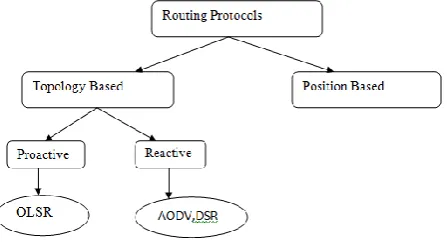
[image:2.595.59.283.418.541.2]Topology based routing protocols use links information that exists in the network to achieve packet forwarding. Routing table, maintained at each node, are used to store the link information of all others node in given topology. As the nodes in VANETs are constantly moving, routing table must be maintained frequently [2].These routing protocols use the link information which exists in the network to send the data packets from source to destination. They can also be classified as active (table-driven) and reactive (on demand) routing [3].
Figure 1: Taxonomy of routing protocols
1.2.3.1 Proactive (table-driven)
Proactive protocols are used to establish the routes in advance on the basis of the periodic exchange of routing tables.
a) The protocol Optimized Link State Routing
Protocol (OLSR)
The protocol Optimized Link State Routing Protocol (OLSR) OLSR is a link-state protocol, which optimizes the way of broadcast of control messages to save bandwidth consumption through the use of the concept of "multipoint relays".
b)Fisheye State Routing (FSR)
FSR is a proactive protocol link state. on the calculation of the route locally A faraway topology change has not a significant influence It suppose that. Therefore, the exchange of routing table updates is a function of the distance. More a node is faraway less it receives local topology updates. With updates FSR does not deluge the network, but all nodes periodically exchange with its neighbors partial routing update information. Indeed, all links propagates hop by hop in each sends. FSR has a inclusive map of the network but cannot guarantee accuracy of all connections between farther nodes.
1.2.3.2 Reactive (On Demand)
Reactive protocols, only keep the roads in use for routing. On demand at the time of packet routing, the protocol will search through the network a route to the destination. to flood the network with a query The predictable method of route lookup is, in order to find the target station, which responds with the reverse path.
a) Dynamic Source Routing (DSR)
Based on the "source routing" The DSR protocol is, which means that the path travelled by the packet is included in the header of the data packet from the source to be read by routers. the first is used to find routes on require, and the second is responsible for the maintenance of the communication route in progress: Two distinct mechanisms, The DSR protocol is composed of. the path preservation process does not nearby repair a broken link and the performance of the protocol decreases with increasing mobility The limitation of this protocol is that.
b) Ad Hoc on Demand Distance Vector (AODV)
AODV is a reactive protocol based on the principles of distance vector routing protocols. in DSR discovery and maintenance of routes It borrows its mechanisms and uses a hop by hop routing, and sequence numbers. AODV builds routes by using a series of queries "route request / route reply"[4, 5].
RELATED WORK
The research work performed in this field by diverse researchers is presented as follows:
Mr. Bhagirath Patel et al. [1]
a subclass of mobile ad hoc© 2017, IRJET | Impact Factor value: 5.181 | ISO 9001:2008 Certified Journal | Page 582
rising road safety, real time traffic update and differenttravel comforts, it turns attention of the research worker. like self-organized network, dynamic topology, unintended nature etc. however several common individuality VANET and Manet shares, VANET differs from Manet by challenges, application, design, power constraint and quality patterns, thus routing protocols utilized in Manet don't seem to be applicable with VANET. New routing strategy for VANET has been planned by several researchers in recent year. In VANET like design, characteristic, challenges, glimpse of routing protocols, the diverse aspects of, and simulation models used for VANET This paper provides specialize.
ManpreetKauret. al. [2]The paper proposes that the
performance of VANET remains optimum within thousand meters and after that due to high packet loss rate communication among vehicles is not feasible. for dynamic protocols Finding optimal path is a typical task. The paper focuses on some of the important QOS metrics in VANET & vehicular traffic management solutions to improve overall safety of trafficJamal Toutouh et al. [3] This paper discusses a series of
representative meta heuristic algorithms (PSO,DE,GA, and SA) in order to find automatically optimal configurations of OLSR routing protocol. Adding up, a rest of realistic VANET scenarios (based in the city of M´alaga) has been defined to accurately evaluate the performance of the network under the automatically optimized OLSR. lead to higher QoS than the quality (RFC 3626) and then many human consultants, The tuned OLSR configurations creating it amenable for utilization in VANETs configurations, Experiments depict that.Jatingupta et al. [4] OLSR routing protocol is one of the
foremost used proactive routing protocol used in MANETS. Consisting of many sensor nodes, which are mobile in nature, The MANETS is an autonomous network. in MANETS The routing is the most type issue, as the nodes are mobile in nature, so there is no fixed topology. In this paper, to discover and then disseminate link state information throughout the mobile ad hoc network, the prime focus is on the OLSR routing protocol, which uses hello and topology control (TC) messages. The paper discusses the impact of Hello messages on the performance of OLSR in term of load, delay and throughput using OPNET.M. Gunasekar et al. [5]
Vehicular adhoc network(VANET) provides wireless communication among vehicles without any underlying network infrastructure. In such Network, Quality-of-service (QoS) is complex because the network topology may change constantly and the available state information for routing is inherently imprecise. However, restricted wireless resources and the lossy characteristics of a wireless channel, providing a reliable multihop communication in VANETs is particularly
challenging, due to the vehicle movement. Therefore, to the deployment of VANETs offering an efficient routing strategy is crucial. To optimize the parameter setting in optimized link state routing protocol (OLSR) The paper proposes an Intelligent Water Drops (IWD) algorithm. For better Qos, IWD Algorithm harmonizes the parameters in OLSR. The QoS versions of the IWD tuned OLSR routing protocol do improve the Packet Delivery Ratio, reduce the communication cost and network traffic load in the high speed movement scenarios.
Venkatesh et al. [6]
for VANETs the offered routingprotocols reviewed and categorize them into a taxonomy based on key attributes such as network architecture, applications supported, routing strategies, forwarding strategies, mobility models and quality of service metrics. like as mobility of nodes On diverse internal factors and external factors such as road topology and obstacles that block the signal, The performance of routing protocols depends. to pact with the forceful scenarios by selecting the best routing and forwarding strategies This demands a highly adaptive approach and by using appropriate mobility and propagation models. The paper important protocols happiness to unicast, multicast, geocast and broadcast classes delivers. Strengths and weaknesses of various protocols using topology based, position based and cluster based approaches are analyzed. on the adaptive and context-aware routing protocols attention is given. Simulation of broadcast and unicast protocols is carried out and the results are presented
.
Padmavathi. K et al. [7] that forces the inaccuracies in
the power level in sequence of neighboring nodes a few parameters of olsr and prove the comparison between ideal and realistic version of olsr addresses. Qos routing in mobile ad-hoc networks is difficult because of speedy amendment in topology. The paper aims at given that a better value of the package delivery rate and the throughput, that is in need of powerful routing protocol standards, which can agreement to destinations delivering of the packages, and the throughput on a network. It principally focuses on the imprecision of state information, more specifically the residual energy level of nodes that is collected by the control messages of olsr. Inaccurate information affects the efficiency of olsr protocol. Tuning of olsr is done which in turn improves the residual energy information of nodes.© 2017, IRJET | Impact Factor value: 5.181 | ISO 9001:2008 Certified Journal | Page 583
3. PROPOSED WORK
3.1
Problem Statement
The exchange of up-to-date information among vehicles is the most salient feature of VANETS. For this, packets travel from one node to another. But in a network with high mobility and no central authority, travelling becomes a complex task. The routing protocol operates in the core of VANETs, finding updated paths among the nodes to allow the effective exchange of data packets. For this reason this paper deals with the optimization of a routing protocol, specifically the Optimized Link State Routing (OLRS) protocol.
3.2 Proposed Work
[1] Simulation of OLSR protocol with standard values. [2] Optimization framework to automatically tune the OLSR configuration by various optimizations like SA, GA and PSO [3] Performance evaluation of optimized OLSR Protocol.
4. RESULTS AND ANALYSIS
An effort is made to examine the impact of “Hello packets” on the packet delivery ratio, delay and throughput. An effort is made to recover the performance of algorithm by varying time interval of “Hello” packets and discussing the variation shown by the results. general or default value of OLSR is set at 2.0 Hello interval.
[image:4.595.305.563.59.240.2]4.1 Result and Discussion
Table -4.1:
Analysis for total packet received in various optimization techniques
PROTOCOL
USED OLSR GA PSO SA
SR NO. SCENARIO USED
1 1
6090 6974 7391 6774
2 2 5837 6974 7510 6839
3 3 6205 6974 6745 6908
4 4 5759 6974 7436 6392
5 5
5956 6974 7945 6539
Chart -4.1: Comparisons of various optimization techniques on the basis of total packet received
[image:4.595.30.562.346.681.2]From the figure above, we can wrap up that PSO has highest packet received and OLSR has lowest packet received.
Table-4.2:
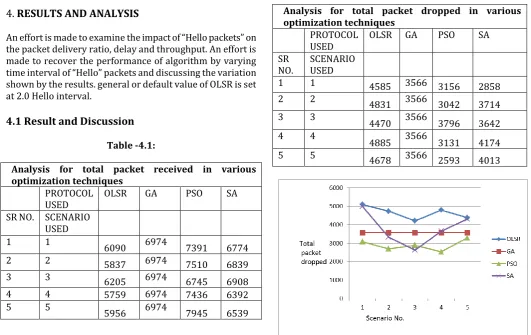
Analysis for total packet dropped in various optimization techniques
PROTOCOL
USED OLSR GA PSO SA SR
NO. SCENARIO USED
1 1 4585 3566 3156 2858 2 2 4831 3566 3042 3714 3 3
4470 3566 3796 3642 4 4
4885 3566 3131 4174 5 5 4678 3566 2593 4013
Chart -4.2: Comparisons of various optimization
techniques on the basis of total packet dropped© 2017, IRJET | Impact Factor value: 5.181 | ISO 9001:2008 Certified Journal | Page 584
Table-4.3:
Analysis for packet delay ratio (PDR) in various optimization techniques
PROTOCOL
USED OLSR GA PSO SA
SR
NO. SCENARIO USED
1 1 57.93% 66.34% 70.31% 63.77% 2 2 55.53% 66.34% 71.44% 65.06% 3 3 59.03% 66.34% 64.16% 65.72% 4 4 54.79% 66.34% 70.74% 60.81% 5 5 56.66% 66.34% 75.58% 62.21%
Chart-4.3: Comparisons of various optimization
techniques on the basis of packet delay ratio (PDR)From the above figure, we can conclude that PSO has highest packet delay ratio and OLSR has lowest packet delay ratio.
Table-4.4:
Chart-4.4: comparisons of various optimization techniques on the basis of throughputs(in Kbps)
From the above figure, we can conclude that PSO has highest throughput and OLSR has lowest throughput.
Table-4.5:
Chart-4.5: Comparisons of various optimization
techniques on the basis of end to end delayFrom the above figure, we can conclude that OLSR has highest end to end delay and PSO has lowest end to end delay.
Analysis for throughput (in Kbps) in various optimization techniques PROTO
COL USED
OLSR GA PSO SA
SR N O.
SCENA RIO NO.
1 1 3.0450 3.487 3.6955 3.3520 2 2 2.9185 3.487 3.7550 3.4195 3 3 3.1025 3.487 3.3725 3.4540 4 4 2.8795 3.487 3.7180 3.1960 5 5 2.9780 3.487 3.9720 3.2695
Analysis for end to end delay in various optimization techniques
PROTOCOL USED SR
© 2017, IRJET | Impact Factor value: 5.181 | ISO 9001:2008 Certified Journal | Page 585
Table-4.6:
Analysis for Consumed Energy in various optimization techniques
Optimization Consumed Energy (j)
Hop Count
Average Hope Count OLSR-PSO 900.71 22143 2 OLSR-SA 900.522 53670 10 OLSR-GA 900.348 16785 2
OLSR 900.174 18570 3
Chart-4.6: comparisons of various optimization
techniques on the basis of Consumed EnergyFrom the above figure, we can conclude that OLSR-PSO has highest Consumed Energy and OLSR has lowest Consumed Energy.
Chart-4.7: comparisons of various optimization
techniques on the basis of Hop CountFrom the above figure, we can conclude that OLSR-SA has highest Hop Count and OLSR-GA has lowest Hop Count
Chart-4.8: comparisons of various optimization
techniques on the basis of Average Hop CountFrom the above figure, we can conclude that OLSR-PSO & OLSR-GA has lowest Average Hop Count and OLSR-SA has highest Average Hop Count.
5. CONCLUSIONS
We have addressed the possible parameter tuning of the OLSR routing protocol to be used in VANETs by using an automatic optimization tool, in this thesis. For this purpose, we have defined an optimization strategy based on coupling optimization algorithms (GA) and the ns-2 network simulator. Moreover, differentiation among the optimized OLSR configurations and standard one are done. The validation of the optimized configurations that are found by comparing with each other and with the standard tuning, studying their performance in terms of QoS over VANET scenarios is done. We can summarize that in PSO, we obtained highest packet received, throughput and PDR and lowest packet drop and end to end delay. PSO gives the best results among PSO, GA and SA for tuning of OLSR. SA gives better results than GA but lesser than PSO. Energy Consumption in PSO is high compared to other optimizations. Optimizations provide better performance in terms of throughput and PDR compared to default OLSR but decreases the network life time .
REFERENCES
[1] Mr. Bhagirath Patel, Ms. KhushbuShah, ”A Survey on
Vehicular Ad hoc Networks” IOSR Journal of Computer Engineering (IOSR-JCE), Volume 15, Issue 4,Dec 2013.
[2] Manpreet Kaur, Kunwarpal, “Optimize OLSR with
Cognitive in Wireless Mesh Network”, International Journal of Engineering and Advanced Technology (IJEAT), Volume-2, Issue-3, February 2013.
[3] Jamal Toutouh, Jos´eGarc´ıa-Nieto, and Enrique Alba,
© 2017, IRJET | Impact Factor value: 5.181 | ISO 9001:2008 Certified Journal | Page 586
VANETs”, IEEE TRANSACTIONS ON VEHICULARTECHNOLOGY, IN PRESS, 2012 IEEE.
[4] Jatin Gupta, AmandeepVerma, “Exhaustive Study on the
Influence of Hello Packets in OLSR Routing Protocol” International Journal of Information and Computation Technology, Volume 3, Number 5 (2013), pp. 399-404
[5] M.Gunasekar, S.J.Hinduja, “Automatic Tuning Of OLSR
Routing Protocol Using IWD in VANET,”International Journal of Innovative Research in Computer and Communication Engineering., Vol.2, Special Issue 1, March 2014.
[6] Venkatesh, A Indra, RMurali ,”Routing Protocols for
Vehicular Adhoc Networks (VANETs): A Review” Journal of Emerging Trends in Computing and Information Sciences, Vol. 5, Issue 1, January 2014.
[7] Padmavathi.K, Thivaharan.S, ”An Improved OLSR
Protocol for Reducing the Routing Overhead in MANETs”, International Journal of Innovative Research in Computer and Communication Engineering, Volume 2,Issue 4,April 2014.
[8] P.Jacquet,P.Muhlethaler,T.Clausen,A.Laouiti, .Qayyum,L.