© 2016, IRJET | Impact Factor value: 4.45 | ISO 9001:2008 Certified Journal | Page 1008
Project Management – The Challenges & Their Resolutions
Anurag Sachan
1, Aditya Raj
2, Manjula R.
31Student, Dept. of Computer Science and Engineering, VIT University, Tamil Nadu, India 2Student, Dept. of Computer Science and Engineering, VIT University, Tamil Nadu, India
3 Professor, Dept. of Computer Science and Engineering, VIT University, Tamil Nadu, India
---***---Abstract -
This paper helps in understanding and reviewing
the different types of risks and challenges that are encountered with respect to project management and how various methods can be used to resolve those risks. The main interest of this paper is to analyze the influence of the dynamic and ever-changing environment of projects nowadays. Corporate projects undergo lots of real time changes and these need to be thought of and understood before starting the project so as to avoid any delays or obstruction in the completion of the project. The following are some of the topics that have been analyzed in this paper: What is project management? What are the challenges faced? How can those issues be resolved?
Key Words: Project management, risk factors, challenges, issues, resolution
1. INTRODUCTION
Project management deals with understanding and managing how a particular project works and the different stages that are undergone before the final completion of the project. It is vital in making sure that any project that is taken on by teams or corporates ensures its feasibility and outcome favored towards the needs of the customer without facing any challenges in between that might cause chaos and havoc in the project. Management deals with understanding these challenges beforehand and being ready to take them on as and when they appear with forethought given to how to resolve these challenges in the most effective and time optimized manner so that it may not interfere with the project deadlines and timeline.
The concepts and the theories that are dealt with in this study originate from the notions of project management of software development, risk management etc. The important factor that is stated in
this study is that every project has risks and is sure to encounter various kinds of issues and the ability to forecast those risks and issues and manage them is a key predictor is=n project success. Risk and Issue management is theoretically very simple, but practically becomes extremely difficult.
2. PROJECT MANAGEMENT RISKS & ISSUES
A risk is an uncertain event or consequence that may occur during the time of a project. It may or may not have a measurable impact on the project. This impact may either be positive or negative. Risk identification is a critical and iterative process and it is imperative to include this step in each project. Risks and issues can come internally or externally and can be both predictable and unpredictable in nature. Rigorous risk management can ensure the success of a project.
© 2016, IRJET | Impact Factor value: 4.45 | ISO 9001:2008 Certified Journal | Page 1009 Stated below are some of the challenges that may be
faced during the project and some methods as to how to avoid them or work through them and ensure the efficient continuation of the project:
2.1 Geographically distant project teams
Very often, project teams comprise of multiple project members from different regions, multiple organizations or people who are giving a collaborative sense to the effort into the project. Many times, the project team may belong to the same corporation but work out of offices based in different locations, thus the need synchronization for their work. Companies that can manage to get help in collaborating all the people to work in synchronous time have an advantage in the market.
2.2 Usage of the wrong tool
The attempt to manage projects using desktop software applications can lead to failure as these software were not made for cooperation among several parties, such as the various project teams, the manager, the client etc. For example, file version control cannot be properly used by common software which may lead to confusion between which is the latest updated format of the project files and which is not. Specialized software should be used for instances such as this.
2.3 Mismanagement of resources
A lot of the times, the requirements or demands for the project resources is higher than the team members available for the execution. Without the help of centralized project management software, proper resource management becomes a burdensome exercise. Managers should choose a web-based project management software that can take care of some features such as:
Cross project resource allocation.
Take care of over or under allocation of
resources.
Assignment of team members to required
resources or jobs.
Scheduling of resources.
Thus, resource allocation for projects is of extreme importance and for it to be accurate and precise, it should be accountable for team members’ default work schedule, off time, resources available etc. This point is one of the most important in project management and if overlooked, or taken lightly can act as a high risk situation in the future timeline of the project.
2.4 Status meetings
Project status update meeting mean the team members meeting the project leader to update him on their tasks. Time, a critical resource, is often wasted in these meetings where different sub-teams go around updating the manager on their tasks. A web based project management software is viable in place of project meetings as it can help the teams to keep updating their completed tasks, remaining tasks etc. on a regular basis and the manager gets real time updated on any issues or requirements that might arise with respect to the teams.
A project management software should be chosen according to the needs of the manager in such a way that it may help them to view various statistics and make informed decisions, such as:
Project Reports.
Project Revenues.
Project Resources.
Cross Project Resource Allocation.
Team Portfolio.
© 2016, IRJET | Impact Factor value: 4.45 | ISO 9001:2008 Certified Journal | Page 1010 2.5 Undefined goals
If the team is not certain about what they want to achieve during the start of the project, this can lead to distress later on and the whole project suffers. The project manager should be able to set the right goals, in a precise manner before the start of the project so that the management, client etc. all know what the final product will be and what is going to be done to achieve it.
2.6 Changes in the scope
Project scope can be simply defined as the parameters upon which the project is based. It is a detailed description identifying and describing all major deliverables and any project boundaries that need to be adhered to. Project scope should have all the necessary information required by the project team the produced the result in the estimated time and within budget. Scope creep is the phenomena that occurs when new features are added to the list of product designs that have already been approved, without the addition of the required increase in budget, time and resources. Some reasons why scope creep occurs are:
Poor requirements analysis.
Customer integration is not proper.
Complexity of the project is underestimated.
Lack of change control.
Certain ways to ensure that scope creep does not occur and thus hinder the progress of the project include thoroughly understanding the project vision and ambition, understanding the priorities of the project and its deliverables, breaking the deliverables into actual work requirements(as detailed as necessary), confirming the major and minor milestones, proper assignment of resources and expectation of the fact that scope creep is inevitable and implementing the required actions to make sure that it does not have a great impact on the project as a whole.
2.7 Inadequate skills
A project requirements sometimes specific particular knowledge of special skills for its completion. It may so happen that the contributors to the project lack these skills, thus putting the project’s authenticity in jeopardy. Proper project management can help the project manager evaluate the available skills and competencies, and help him/her make decisions as to hire additional help, outsource certain parts of the project or train the already available staff.
2.8 Risk management
Improper risk management can many times lead to the failure of the project. A manager should have the ability to tolerate risk as projects rarely go as planned. Understanding the project thoroughly, assessing the risks that might occur, taking special help from experienced personnel and making sure to have back-up plans ready to deploy as and when required are some of the core competencies that a project manager should possess. Contingency plans are the need of the hour and managers should have pre-planned plans of action ready for ‘what-if’ situations that may arise. All these qualities are entirely dependent on the manager.
2.9 Inaccurate Deadlines
© 2016, IRJET | Impact Factor value: 4.45 | ISO 9001:2008 Certified Journal | Page 1011 require a bit of a setback can still be handled
effectively.
3.0 Stakeholder engagement
According to Project Management Institute (PMI), the term project stakeholder refers to – ‘an individual, group or organization who may affect, be affected by or perceive itself to be affected by a decision, activity or outcome of a project.’ A client, CEO, team member or any such person who does not show interest in the project can lead to its downfall. Steps should be taken by the project manager to keep all stakeholders engrossed in the project by having meetings, encouraging feedback etc. at every step of the way. Engagement of the stakeholder is of utmost importance to ensure the completion of the project.
3. AGILE SOFTWARE PROJECT & DEVELOPMENT
Agile software development is defined as – ‘A set of principles for software development under which the requirements and solutions evolve through the collaborative effort of self-organizing cross-functional teams.’
The concept of agile software and project development promotes evolutionary development, adaptive planning, continuous improvement and possibly early delivery. The main importance of agile development is the ability for rapid and flexible response to change.
The Agile Manifesto is based on twelve principles, namely:
Customer satisfaction by early and continuous
delivery of valuable software.
Welcome changing requirements, even in late
development.
Working software is delivered frequently
(weeks rather than months).
Close, daily cooperation between business
people and developers.
Projects are built around motivated individuals,
who should be trusted.
Face-to-face conversation is the best form of
communication (co-location).
Working software is the principal measure of
progress.
Sustainable development, able to maintain a
constant pace.
Continuous attention to technical excellence
and good design.
Best architectures, requirements, and designs
emerge from self-organizing teams.
Regularly, the team reflects on how to become
more effective, and adjusts accordingly.
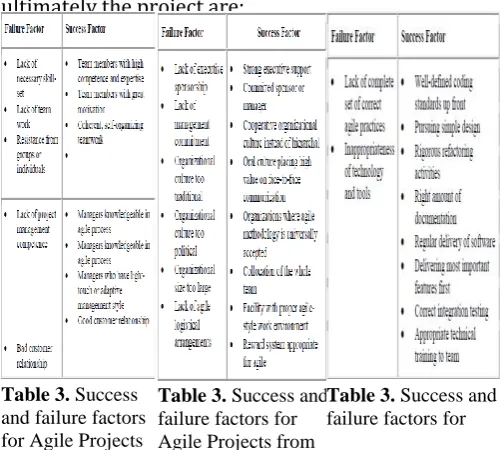
Some of the success and failure factors that determine the success of the agile development process and ultimately the project are:
[image:4.595.308.560.377.602.2]Thus, from the above information we can see that standard projects can be converted into the format of agile development projects in order to ensure better project management and handle the risks and issues involved in the process much more successfully.
Table 3. Success and failure factors for Agile Projects from the People Dimension
Table 3. Success and failure factors for Agile Projects from the Organizational Dimension
© 2016, IRJET | Impact Factor value: 4.45 | ISO 9001:2008 Certified Journal | Page 1012 4. CONCLUSIONS
There are a lot more different challenges that are faced during project undertakings and proper management is the key to success of a project. The above stated issues of project management and their resolutions are some of the commonly faced ones in the corporate industry and general projects. A lot of them can be solved through the use of a good and centralized project management system, as well as there being several other ways to handle various issues that may arise.
ACKNOWLEDGEMENT
We are thankful to our guide Prof. Manjula R (Associate Professor, School of Computer Engineering), VIT University, Vellore Tamil Nadu for her valuable guidance, encouragement and cooperation during the course of this study and its presentations. A study such as this owes its success from its commencement to its completion to the people involved. We avail this opportunity to convey our sincere thanks to everyone who helped and assisted us in successfully completing this study.
REFERENCES
[1] Five Common Project Management Challenges by
Cynthia K. West, Ph.D., Vice President, Project Insight
[2] Project Management: Challenges & Lessons Learned by
Joseph Amalraj, Christine Hernani, Kelly Ladouceur, Aparna Verma, BUEC 663 Dr. Joseph Doucet Friday February 9, 2007
[3] A Review on Project Management and Issues