© 2018, IRJET | Impact Factor value: 6.171 | ISO 9001:2008 Certified Journal | Page 850
AN EXPERIMENTAL STUDY ON WASTE GLASS AS PARTIAL
REPLACEMENT FOR FINE AGGREGATE IN CONCRETE
Pratheba.S
1, Gowsalya.M
2, Ishwariya.A.M
3, Jayasri.A
4, Kalaiyarasi.R
51 Assistant Professor, Civil Department, V.R.S college of Engineering and Technology, Tamilnadu, India.
2,3,4,5 Undergraduate Students, Civil Department, V.R.S College of Engineering and Technology,Tamilnadu, India.
---***---
Abstract
- Glass has been indispensible to man’s life to suchproperty as pliability to take any shape with ease, bright surface resistance to abrasion, safety and durability. United nation estimates the volume of early solids to be 200 million tonnes, 7% of which is made up of waste glass. Furthermore unlike other waste product glass is impermissible and thus detrimental to the environment. Using waste glass in concrete has gained far more importance in parallel to environmental consciousness. In this project an attempt has been made to use the waste glass as partial replacement for both fine aggregate and coarse aggregate separately. For this M20 grade of
concrete was used with a mix proportion of 1:1.5:3 and with water cement ratio as 0.5 concrete specimens were moulded with 0%,10%,20%,30%,40% of waste glass replacing fine aggregate. The tests for hardened concrete such as axial compressive strength, split tensile and flexural were conducted for 7, 14, 28 days respectively and comparisons were made. The obtained results confirm the viability of replacing waste glass for fine aggregate.
Keywords: Compressive strength, Durability, split tensile strength, Waste Glass Concrete, Workability.
1. INTRODUCTION
The concrete constitutes cement, coarse aggregate and fine aggregate. About 90% of the volume of concrete is aggregate. Hence quality of aggregate is one of the factors which decide the quality of concrete. Its physical and chemical properties influence the performance of concrete. The aggregate used in concrete shall be hard, strong, dense, durable, clean and free from other deleterious substance. With increased construction activities, especially in developing countries, the natural resources such as crushed stone and sand are rapidly depleting. The concepts for alternative material such as recycled aggregate are popular in developed countries like USA, UK, Japan, Germany and Denmark etc, but in India, it is yet to find wide use due to its limited availability, practical difficulties in breaking the concrete. Civil construction is responsible for 15% to 20% consumption of natural resources. In developed countries like U.K., this consumption is 6 tonnes per year per inhabitant. For sustainable development of concrete technology we need, the conservations of primary materials, enhancement of the durability of concrete structure and a holistic approach to the technology. While considering a waste material as concrete ingredient, the following three major considerations are relevant. Economy Compatibility with other constituent’s materials Concrete properties.
1.1 Waste Glasses
Quantities of waste glass have been on the rise in recent years due to an increase in industrialization and the rapid improvement in the standard of living. Over the next few years the targets for waste glass recovery will significantly Increases in line with the packaging waste, End-of life vehicle (ELV) and waste Electrical and Electronic Equipment (WEEE) Directives. Whilst this recovered waste glass could theoretically be reused as 100%Feedstock for new glass manufacture, due to contamination tolerances and the Imbalance between production and arising of specific waste glass streams in the World, there is a practical limit. Unfortunately, the majority of waste glass is not being recycled but rather abandoned, and is therefore the cause of certain serious Problems such as the waste of natural resources and environmental pollution. The use of waste glass as an aggregate and pozzolana in concrete Manufacture has a huge potential that is not being currently exploited due to a Lack of standards and 3rd – party certification as well as
uncertainly about Consistency of supply and price of these emerging new materials. For these reasons, this project has been conducted through basic experimental research in order to analyze the possibilities of recycling waste glasses as fine aggregates for concrete. Utilization of glass wastes in concrete production will preserve the clean environment and natural resources.
1.2 Bottom ash
Bottom ash is the residue or non-combustible substance formed after the combustion of lignite or coal in the furnace at a temperature of 1300 degree Celsius. It is removed as slag from the bottom of the furnace. The total amount of bottom ash produced in Neyveli Lignite Corporation is 2.75 lakhs per annum .Nevertheless the bottom ash is being merely deposited in piles which is becoming hazardous to the environment. Sand is one of the major constituent of concrete is diminishing in its quality around the world. This creates a need for finding an alternative. Bottom ash has particle size similar to sand. Bottom ash was used as additive agent to fine aggregate replacement.
1.3 Objectives of the project
© 2018, IRJET | Impact Factor value: 6.171 | ISO 9001:2008 Certified Journal | Page 851
To attain more strength while comparing to the normal concrete.
2. PREVIOUS STUDY
Caijun shi and Keren zheng in their paper titled “A review on the use of waste glasses in the production of cement and concrete” has reviewed the threepossible uses of waste glasses in production of cement and concrete. The use ofwaste glasses as concrete aggregates has a slight negative effect on theworkability, strength and freezing-thawing resistance of cement concrete.However, the main concern is expansion and cracking of the concrete containing glass aggregates. It needs to control the pH of the system below 12 in order to prevent potential corrosion of glass aggregates and expansion of the concrete, which may be achieved by the replacement of Portland cement with pozzolanic Materials such as fly ash, silica fume and metakaolin. Ground glass powders Exhibit very good pozzolanic reactivity and can be used as cement replacement. As expected, its pozzolanic reactivity increases as its finesses increases. Alkalis in The glass powder can cause alkali-aggregate reaction and expansion if alkali-aggregates Are alkali-reaction. Results from ASTM C 1260 testing indicate that the alkali- Aggregate reaction expansion decreases as glass replacement increases, and will be under the deleterious limit if the glass replacement is 50% or more. TheCombined use of other supplementary cementing materials such as coal fly ash,Ground blast furnace slag and metakaolin can also decrease the expansion from Alkali-aggregate reaction. Lithium salt can be a very effective additive to preventthe alkali-aggregate reaction expansion of concrete containing glass powders.
Mukesh C. Limbachiya in this paper titled “bulk engineering and Durability Properties of washed glass sand concrete” reports the results of an Experimental programme aimed at examining the performance of Portland- Cement concrete produced with washed glass sand (WGS), as natural sand Substitute- by mass. The effects of up to 50% WGS on fresh, engineering and Durability related properties have been established and its suitability for use in a Range of normal-grade concrete production assessed. WGS characteristics results showed that the post-container glass waste can be crushed to provide WGS of Physical properties that satisfy the current requirements set in appropriate Standards for natural sand for concrete. The density and waste absorption of WGS Was found to be lower than natural sand. The results for fresh concrete showed a Reduction in workability of concrete with increases WGS proportion beyond 20% in the mix, although slump measurements remained within the allowable margin of +25 mm. the mixes with high proportions of WGS were found to be less cohesive. Studies of hardened concrete properties, comprising bulk engineering properties ( compressive cube and cylinder strength, flexural, modulus of elasticity, Drying shrinkage) and durability ( near surface absorption, alkali silica reaction) Showed similar performance for concrete produced with natural aggregates and Up to 15% WGS.
Iker bekir topc and mehmet canbaz in the paper titled “ properties of Concrete containing waste glass “ studied that the waste glass (WG) can be Considered as coarse aggregates in the concretes, WG was used reduced to 4-16mm in proportions of 0-60% in the production of PKC/ B 32.5/R type cement.The effects of WG on workability and strength of the concrete with fresh andhardened concrete tests were analyzed. As a result of study conducted, WGWas determined not to have a significant effect upon the workability of theConcrete and only slightly in the reduction of its strength. Waste glass cannot be used as aggregate without taking into account its alkali silica reaction (ASR) Properties. As for cost analysis, it was determined to lower the cost of concrete Productions. Their study was an environmental one in consideration to the fact That WG could be used in the concrete as coarse aggregates without the need fora high cost or rigorous energy.
Seung Bum park, bong Chun Lee and Jeong Hwan Kim in their paper titled “studies on mechanical properties of concrete containing waste glass aggregate” Suggest that the quantities of waste glass have been on the rice in recent years dueTo an increase in industrialization and the rapid improvement in the standard of living. Unfortunately, the majority of waste glass is not being recycled but rather abandoned, and is therefore the cause of certain serious problems such as the Waste of natural resources and environmental pollution. For these reasons, thisStudy has been conducted through basic experimental research in order to analyzethe possibilities of recycling waste glasses (crushed waste glasses from Korea Such as amber, emerald green, flint, and mixed glass) as fine aggregates for concrete. Test results of fresh concrete show that both slump and compactingFactors are decreased due to angular grain shape and that air content is increasedDue to the involvement of numerous small-sized particles that are found in waste Glasses. In addition the compressive, tensile and flexural strengths of concretehave been show to decrease when the content of waste glass is increased.In conclusion, the results of this study indicate that emerald green waste glasswhen used below 30% in mixing concrete is practical along with usage of 10% SBR latex. In addition, the content of waste glasses below 30% is practical along with usage of a pertinent admixture that is necessary to obtain work ability andAir content.
3. MATERIALS USED
Cement Fine aggregate Coarse aggregate Waste glass Water Bottom ash
3.1 Cement
© 2018, IRJET | Impact Factor value: 6.171 | ISO 9001:2008 Certified Journal | Page 852 basic ingredient of concrete, mortar, and Plaster. It consists
of mixture of oxides of calcium, silicon and aluminum. Cements of various strengths are available. Depends on the requirement concrete it is to be chosen.
3.2Fine aggregate
Aggregate characteristics such as specific gravity, bulk density, and particle Size distribution and moisture content is essential prior to proportioning of mixtures. Shape and surface texture have a major role in affecting the rheological Properties of concrete, these characteristic may also be considered while proportioning. The particle shape should ideally be equi-dimensional i.e. not Elongated or flaky. Aggregates should be relatively free of flat and elongated Particles. Compared to rough textured angular and elongated particles smooth and rounded aggregates require less of cement paste to produce flowing Concretes.
Fine aggregate shall consist of natural sand or manufactured sand or a Combination. Fine aggregates should be selected so as to reduced the water demand hence rounded particles are thus preferred to crushed rock fines where Possible. The finest fractions of fine aggregate are helpful to prevent segregation.
The river sand conforming to III zone as per IS 383-1987 was used. For the Fine aggregate river sand conforming to IS 383-1987 was used. It passes through 2.36mm IS sieve with a specific gravity of 2.701 and this was come under III zone.
3.3 Coarse aggregate
A maximum size of 20mm is usually selected as coarse aggregates up to 20mm may be used in concrete. Aggregates should be strong and free of internal flaws or fracture. Aggregates should be strong and free of internal flaws or fractures. Aggregates of high intrinsic strength are generally preferred. Granites, Basalt, lime stones and sandstones are being successfully used in concrete.
3.4 Waste Glass
Glass forms as a result of solutions containing alkali and soil alkali metal Oxides in addition to some other metal oxides. It’s essential material is (sio2) silica. WG used in the
experiments was that of windscreen glass. Following the gathering Process, these bottles were kept in water so that the labels on them would be Removed, and were then reduced to as fine as 4-20mm. unit weight and specific Gravity of the WG used in place of natural aggregates as fine as 4-20mm were 1493kg/m3 and 2400kg/m3 according to
ISO 6782:1982 and ISO 6783:1982,respectively.
Table – 1: Chemical combination of the glass
Sio2 69.50%
Na2o 14.58%
K2o 0.41%
Cao 8.75%
Al2o3 1.10%
Fe2o3 0.22%
Mgo 3.97%.
3.5 Water
Water is an important ingredient of concrete as it actively participates in chemical reaction with cement. Clean potable water conforming to IS 456-2000 was used, the water used in the preparation of mortar should not necessary be distilled water, but must be free of all acids, based and others dissolved salts.
4. METHODOLOGY
Collection of Materials Properties of Materials
Casting of specimens with replacement of 0%,10,20%,30% & 40%
Curing of specimens Testing of specimens Analysis of result.
5. RESULTS AND DISCUSSIONS
5.1 WORKABILITY
Workability value for concrete is obtained by carrying out slump cone test. The variation in the slump value arises due to the replacements of waste glass. The table 2 shows the slump value with respect to the replacement of waste glass. For conventional concrete, the slump value is higher workability value gets reduced when the percentage of replacement of waste glass content with coarse aggregate.
Table-2: Workability of concrete
5.2 Compressive Strength
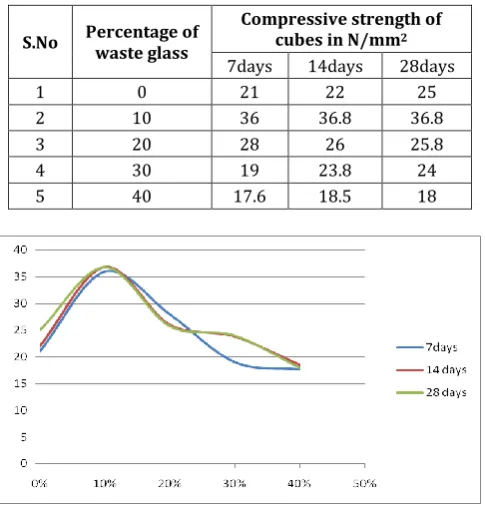
The mean compressive strength of 100mm concrete cubes, using waste glass as replacements for fine aggregate were determined at the age of 7days, 14 days, and 28 days in the mix proportion of 1:1.5:3.33 were reported in the table 3.The compressive strength of concrete with waste glass is considerably higher than that of the conventional concrete. The compressive strength increases greatly with 10% replacement of waste glass as fine aggregate gradually decreases as the glass quantity increases in 7days and 14 days. In 28 days, 10% replacement gives an increased compressive strength and for more replacement show ups and downs.
WORKABILITY
Slump Replacement of glass in concrete as fine aggregate
0 %
10 %
20 %
30 %
40 %
52 mm
38 mm
43 mm
48 mm
© 2018, IRJET | Impact Factor value: 6.171 | ISO 9001:2008 Certified Journal | Page 853
Table - 3 : Compressive strength of cubes replacement of fine aggregate
S.No Percentage of waste glass
Compressive strength of
cubes in N/mm2
7days 14days 28days
1 0 21 22 25
2 10 36 36.8 36.8
3 20 28 26 25.8
4 30 19 23.8 24
5 40 17.6 18.5 18
Chart – 1: Comparison graph for compressive strength
5.3 Split Tensile Strength
[image:4.595.313.559.49.218.2]
The mean split tensile strength of concrete cylinder, using waste glass as replacement for fine aggregate were determined at the age of 28days in the mix proportion of 1:1.5:3 were reported in the table 4.4, 4.5 and fig 4.3. The split tensile strength of concrete with waste glass is considerable higher than the conversional concrete. The tensile strength increases greatly with 10% replacement of waste glass as fine aggregate and gradually decreases as the glass quantity increases in 7days and 14 days. In 28days, 10% replacement of both fine aggregate and coarse aggregate gives an increased split tensile strength and more replacement shows ups and downs.
Table - 4 : Split Tensile strength of cylinders (fine aggregate)
S.No Percentage of waste glass
Tensile strength of cubes in
N/mm2
7days 14days 28days
1 0 2.8 2.9 2.9
2 10 3.6 3.7 3.83
3 20 3.59 3.7 3.8
4 30 3.05 3.24 3.24
5 40 2.82 2.9 3.05
Chart – 2: Comparison graph for split Tensile strength
5.4 FLEXURAL STRENGTH
The mean flexural strength of concrete beams, using waste glass as replacements for coarse aggregate and fine aggregate were determined at the age of 28days in the mix proportion of 1:1.5:3 were reported. The flexural strength of concrete with waste glass in considerable higher than the conventional concrete. In 28days, the optimum percentage i.e.10% replacement, gives an increased flexural strength.
Table - 4 : Flexural strength of beams by replacement of fine aggregate
S.No Percentage of
waste glass Flexural strength of beams at 28 days in N/mm2
1 0 % 10.73
2 10 % 14.4
6. CONCLUSION
Waste glass can be transformed into useful of fine aggregate separately. The compressive strength of conglasscrete is more than the twice of the compressive strength of the conventional concrete. Conglasscrete possesses higher tensile strength than the conventional concrete. The 10% replacement of fine aggregate by waste glass was found to be optimum for cement concrete. In M20 grade of concrete with
10% replacement gives 80% more in compressive strength. In M20 grade of concrete with 10% replacement 32%gives
more in tensile strength. In M20 grade of concrete with 10%
replacement gives 34% more in flexural strength. So, we can use these concrete in massive structure like bridges, dams and also used in foundation.
REFERENCES
[1] Mukesh C. limbachiya (2009) “ bulk engineering and durability properties of washed glass sand concrete’’ construction and building materials vol 23 pp 1078-1083.
[image:4.595.42.285.114.367.2]© 2018, IRJET | Impact Factor value: 6.171 | ISO 9001:2008 Certified Journal | Page 854
[3] John butler and Paul Hooper (2005) “ dilemmas in optimizing the environmental benefit from recycling” resources conservation and recycling, vol 45 pp 331-355
[4] Seung bum park, bong chun lee and Jeong hwan kim(2004) “ studies on mechanical properties of concrete containing waste glass aggregate” cement and concrete research, vol 34 pp 2181-2189
[5] Iker bekir tope and Mehmet canbaz(2004) “ properties of concrete containing waste glass” cement and concrete research, volume 34 pp 267-274
[6] Seung-bum park and bong-chun lee (2004) “ studies on expansion properties in mortar containing waste glass and fibers” cement concrete research, vol 34 pp 1145-1152
[7] Dr EA Byars, HY zhu and Dr B morales (2002) “conglasscrete project” the university of Sheffield.
[8] Shetty M.S “concrete technology” S.chand & company ltd… New Delhi
[9] IS: 456:2000 “code of practice for plain & reinforced concrete” bureau of Indian standards, New Delhi.
[10] IS: 10262:1982 “methods of tests for strength of concrete “bureau of Indian standards, new Delhi.
[11] IS: 383:1970 “specifications for coarse & fine aggregate from natural sources for concrete “bureau of Indian standards, new Delhi.
BIOGRAHIES:
Ms.S.PRATHEBA is working as Assistant Professor at V.R.S College of Engg & Tech, Arasur Villupuram. Her qualification is M.E (Environmental Engg)
Ms.M.GOWSALYA is a final year student at V.R.S college of Engineering and Technology, Villupuram.
Ms.A.M.ISHWARIYA is a final year student at V.R.S college of Engineering and Technology, Villupuram.
Ms.A.JAYASRI is a final year student at V.R.S college of Engineering and Technology, Villupuram.