© 2017, IRJET | Impact Factor value: 6.171 | ISO 9001:2008 Certified Journal | Page 1731
Soil Strengthening Using Waste Materials
Navdeep Singh Sodhi
1, Shish Pal
2, Vinod Kumar Sonthwal
31P.G. Student, Department of Civil Engineering, NITTTR, Sector 26, Chandigarh, India 2Lecturer, Department of Civil Engineering, Government Polytechnic, Ambala City, Haryana, India
3Associate Professor, Department of Civil Engineering, NITTTR, Chandigarh, India
---***--- Abstract: India has been coming into view as one of the world’s fastest growing economies, which has brought it with a significant jump in construction activities. Hence, Structural Concrete Waste is increasing with the rapid growth in construction activities during construction process at construction sites and in plants, for the production of construction materials.
In addition to this, with the rapid increase in generation of waste from plastics industry all around the world due to Changing Consumption, Production Patterns and Economic Growth. The world's annual consumption of plastic materials has increased from around 5 million tonnes in the 1950s to nearly 100 million tonnes. Thus, presently 20 times more plastic is produced as compared to 50 years ago. After food waste and paper waste, plastic waste is the third major constitute at municipal and industrial waste in cities. This situation gets worsened due to the fact that they are not even aware of the ill-effects of plastic waste to environment.
Due to the large quantities of structural concrete waste and extremely long periods required for natural decomposition of waste plastic, they are often the most visible component in waste dumps and open landfills resulting in serious environmental problems. So depending on this, the object of this thesis was chosen as “Soil Strengthening Using Waste Materials (Structural Concrete Waste and Polypropylene)”.
In this research work, an extensive laboratory work have been carried out for utilization of fines obtained from structural concrete waste and waste fibres of polypropylene in the improvement of the various properties of the Clayey (CI) type of soil obtained from Chandigarh College of Engineering and Technology (CCET), Sector – 26, Chandigarh.
KEYWORDS: Soil Stabilisation, Structural Concrete Waste (Fines), Fibres of Waste Plastics, Plain Soil, Mixed Soil, Reinforcement, Reinforced soil, Polypropylene, Maximum Dry Density, Optimum Moisture Content, Direct Shear Strength Parameters, Unconfined Compressive Strength.
I. INTRODUCTION
For any structure, the foundation is most crucial and has to be strong to prop the entire structure. Soil near by the foundation plays very crucial part in foundation’s strength. We need to have proper view about their properties and factors act on their behavior. The process of soil stabilization or improvement of properties helps us to achieve the required properties in a soil needed for the construction work. In recent life span, with the increase in the need for infrastructure, ungraded materials and fuel, soil stabilization has started to take a new shape. With the availability of better research, materials and equipment, it is emerging as a popular and cost-effective method for soil improvement to improve soil other than replacing the poor soil at the building site.
Here, in this project, soil stabilization has been done with the help of using the fines obtained from demolished concrete structures and randomly distributed polypropylene fibers obtained from waste materials. To upgrade soil in the shear strength parameters has been lay emphasis on and number of comparative studies has been carried out by using different methods of shear resistance measurements.
© 2017, IRJET | Impact Factor value: 6.171 | ISO 9001:2008 Certified Journal | Page 1732 II. MATERIALS USED
2.1 SOIL
In the present study the soil procured from Chandigarh College of Engineering and Technology (CCET), Sector – 26, Chandigarh, (India) had been investigated and depending on the properties given below in Table-1 the soil had been classified as CI (Clayey Soil with Intermediate Compressibility).
Table 1: Determination of Classification of Soil Depending on the Index Properties
Properties of the Soil Sample Values of the Different Properties
Colour Brown
Liquid Limit 36.23%
Plastic Limit 21.30%
Plasticity Index (IP) 14.93% Type of Soil as per IS: 1498 CI Specific Gravity (G) 2.60
The various engineering properties of the plain soil have been determined and are tabulated as given below:
Table 2: Values of Engineering Properties of the Plain Soil
Properties of the Soil Sample Values of the Different Properties Compressibility (MDD)
Maximum Dry Density, (ϒd(max))
Optimum Water Content, (w) 10.95 1.99
Direct Shear Strength (DSS)
a) Angle of Internal Friction (Φ) b) Cohesion (C)
24.22º 0.30 kg/cm2
2.2 STABILISING MATERIAL
In this research work, improvements of soil properties have been carried out with help of the following waste materials.
a) Structural concrete Waste (Fines)
b) Polypropylene (Waste Fibres of Plastic)
2.2.1 Structural concrete Waste (Fines)
The fines obtained from the demolished concrete structure from NITTTR, Chandigarh.
2.2.2 Polypropylene (Waste Fibres of Plastic)
The waste fibre material –polypropylene obtained from the Supreme Industries, Village – Serseni (Lalru), Ambala – Chandigarh Highway, Distt.- S.A.S.Nagar, Punjab; producing a number of plastic items which are globally used for the different works, have been used.
III. METHODOLOGY ADOPTED
Laboratory investigations were conducted on the “Plain Soil”, “Mixed soil” (Mixed Soil means the plain soil admixed with the optimum percentage of fines (10%)) and “Reinforced Soil” (Polypropylene is added in the mixed soil in variation of length of 10mm, 20mm & 30mm at different percentage 0 %, 0.15%, 0.25% & 0.35% of waste fibre material by weight of the dry soil sample) sample for the improvement of the following engineering properties of the soil:
i) Maximum Dry Density at Optimum Moisture Content, and
© 2017, IRJET | Impact Factor value: 6.171 | ISO 9001:2008 Certified Journal | Page 1733 4.1 Compaction Test
The Modified Proctor’s Test have been conducted for the determination of the Optimum Moisture Content (w) and Maximum Dry Density (ϒd(max)) of the Plain Soil (Table-3), Mixed Soil (Table-4) and Reinforced Soil (Table-5) by
compacting the soil samples manually.
[image:3.595.98.498.226.500.2]4.1.1 Determination of OMC-MDD of Plain Soil Samples
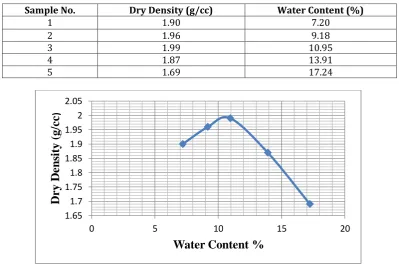
Table 3: Data for OMC-MDD of Plain Soil Samples
Sample No. Dry Density (g/cc) Water Content (%)
1 1.90 7.20
2 1.96 9.18
3 1.99 10.95
4 1.87 13.91
5 1.69 17.24
Fig. 1: OMC – MDD Curve for Plain Soil Sample
The maximum dry density of the plain soil has been found as 1.99 g/cc at 10.95% of optimum moisture content from the curve drawn in fig.1
4.1.2 Determination of the Optimum Quantity of the Fines to be added to the Plain Soil:
[image:3.595.53.546.641.779.2]The fines have been added to the plain soil with the various percentages as detailed in the table-4, for the Optimization of the fines to be added.
Table 4: Various Percentages of the Fines added to the Plain Soil for OMC – MDD
Sample
No. 4% 7% Percentage of Fines 10% 12% 14%
Dry Density
(g/cc)
Water Content
(%)
Dry Density
(g/cc)
Water Content
(%)
Dry Density
(g/cc)
Water Content
(%)
Dry Density
(g/cc)
Water Content
(%)
Dry Density
(g/cc)
Water Content
(%)
1. 1.93 7.54 1.95 6.54 1.96 6.57 1.87 7.16 1.96 6.69
2. 1.99 9.16 2.03 7.94 2.05 7.96 2.02 8.83 1.99 10.36
3. 2.04 10.65 2.06 9.23 2.07 9.21 2.07 10.88 2.02 13.31
1.65 1.7 1.75 1.8 1.85 1.9 1.95 2 2.05
0 5 10 15 20
D
ry
D
en
si
ty
(g/
cc
)
© 2017, IRJET | Impact Factor value: 6.171 | ISO 9001:2008 Certified Journal | Page 1734
4. 1.95 11.66 2.08 10.50 2.09 10.37 2.01 12.92 1.99 14.58
[image:4.595.54.550.69.317.2]5. 1.92 13.98 2.02 11.24 2.03 12.78 1.98 14.79 1.95 16.21
Fig. 2: Graphical Representation of OMC – MDD at Various Percentages of the Fines added to the Plain Soil
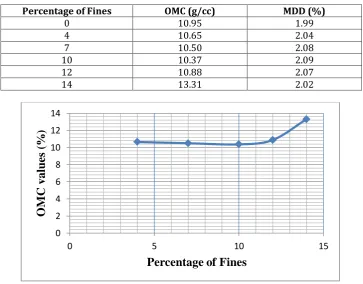
Table 5: Consolidated Result of OMC-MDD of Plain Soil admixed with varying Percentage of Fines.
Percentage of Fines OMC (g/cc) MDD (%)
0 10.95 1.99
4 10.65 2.04
7 10.50 2.08
10 10.37 2.09
12 10.88 2.07
14 13.31 2.02
Fig. 3 Graphical Representation of OMC Values Corresponding to Different Percentages of Fines
The optimum quantity of the fines has been obtained from the fig. 3, as 10% by weight of the dry soil sample, to be called as “Mixed Soil” in this research work.
4.1.3 Determination of the OMC-MDD of the Reinforced Soil:
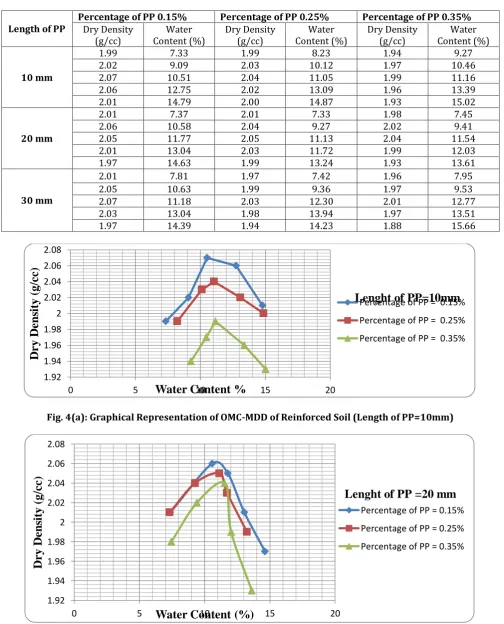
Polypropylene (waste fibres of plastics) has been added to the mixed soil by 10mm, 20mm and 30mm in length at 0.15%, 0.25% and 0.35% by weight of dry soil sample, to be called as Reinforced Soil” in this research work.
1.85
1.9
1.95
2
2.05
2.1
2.15
0
5
10
15
20
D
ry
D
en
si
ty
(g/
cc
)
Water Content (%)
Percentage of Fines 4%
Percentage of Fines 7%
Percentage of Fines 10%
Percentage of Fines 12%
Percentage of Fines 14%
0 2 4 6 8 10 12 14
0 5 10 15
O
M
C
val
u
es
(%
)
[image:4.595.116.480.368.652.2]© 2017, IRJET | Impact Factor value: 6.171 | ISO 9001:2008 Certified Journal | Page 1735
and 0.35% of Polypropylene by Weight of Dry Soil Sample.
Length of PP Percentage of PP 0.15% Dry Density Percentage of PP 0.25% Percentage of PP 0.35% (g/cc) Content (%) Water Dry Density (g/cc) Content (%) Water Dry Density (g/cc) Content (%) Water
10 mm
1.99 7.33 1.99 8.23 1.94 9.27 2.02 9.09 2.03 10.12 1.97 10.46 2.07 10.51 2.04 11.05 1.99 11.16 2.06 12.75 2.02 13.09 1.96 13.39 2.01 14.79 2.00 14.87 1.93 15.02
20 mm
2.01 7.37 2.01 7.33 1.98 7.45 2.06 10.58 2.04 9.27 2.02 9.41 2.05 11.77 2.05 11.13 2.04 11.54 2.01 13.04 2.03 11.72 1.99 12.03 1.97 14.63 1.99 13.24 1.93 13.61
30 mm
2.01 7.81 1.97 7.42 1.96 7.95 2.05 10.63 1.99 9.36 1.97 9.53 2.07 11.18 2.03 12.30 2.01 12.77 2.03 13.04 1.98 13.94 1.97 13.51 1.97 14.39 1.94 14.23 1.88 15.66
Fig. 4(a): Graphical Representation of OMC-MDD of Reinforced Soil (Length of PP=10mm)
Fig. 4(b): Graphical Representation of OMC-MDD of Reinforced Soil (Length of PP=20mm) 1.92
1.94 1.96 1.98 2 2.02 2.04 2.06 2.08
0 5 10 15 20
D
ry
D
en
si
ty
(g/
cc
)
Water Content %
Percentage of PP = 0.15%
Percentage of PP = 0.25%
Percentage of PP = 0.35%
Lenght of PP=10mm
1.92 1.94 1.96 1.98 2 2.02 2.04 2.06 2.08
0 5 10 15 20
D
ry
D
en
si
ty
(g/
cc
)
Water Content (%)
Percentage of PP = 0.15%
Percentage of PP = 0.25%
Percentage of PP = 0.35%
[image:5.595.47.552.109.734.2] [image:5.595.72.526.537.731.2]© 2017, IRJET | Impact Factor value: 6.171 | ISO 9001:2008 Certified Journal | Page 1736
[image:6.595.72.524.49.244.2]Fig. 4(c): Graphical Representation of OMC-MDD of Reinforced Soil (Length of PP=30mm)
Table 7: Consolidated Result of OMC-MDD Reinforced Soil
Length
of PP Percentage of PP 0% Percentage of PP 0.15% Percentage of PP 0.25% Percentage of PP 0.35%
Dry Density
(g/cc)
Water Content
(%)
Dry Density
(g/cc)
Water Content
(%)
Dry Density
(g/cc)
Water Content
(%)
Dry Density
(g/cc)
Water Content
(%)
10 mm
1.99 10.95 2.07 10.51 2.04 11.05 1.99 11.16
20 mm 2.06 10.58 2.05 11.13 2.04 11.54
30 mm 2.07 11.18 2.03 12.30 2.01 12.77
4.2 Direct Shear Strength (DSS) Parameters of the Soil
The mixed soil samples reinforced with the fibres of waste polypropylene had been tested by using the direct shear test apparatus at the maximum dry density (ϒd(max)), and optimum moisture content (w), for the analysis of the direct shear
[image:6.595.60.541.302.399.2]strength parameters and the results for the same has been tabulated as given below in Table-8.
Table 8: Values of DSS Parameters for Mixed Soil
Percentage of PP
Length of PP
10mm 20mm 30mm 10mm 20mm 30mm
Angle of Internal Friction, Φ Cohesion, c (kg/cm2)
0% 24.77º 0.32
0.15% 25.32º 26.55º 28.20º 0.36 0.39 0.41
0.25% 26.86º 28.79º 29.79º 0.47 0.43 0.45
0.35% 29.09º 30.66º 29.78º 0.47 0.49 0.45
The comparisons of the direct shear strength parameters of the mixed soil with the direct shear strength parameters of the reinforced soil are as follows:
Table 9: Comparisons of Increase in DSS of Mixed Soil with Reinforced Soil
Percentage of PP
Length of PP
10mm 20mm 30mm 10mm 20mm 30mm
Increase in Angle of Internal
Friction (Φ) Increase in Cohesion (c)
0% 24.77º 0.32 kg/cm2
0.15% 2.22% 7.18% 13.84% 12.50% 21.87% 28.12%
0.25% 8.43% 16.22% 20.26% 46.87% 34.37% 40.62%
0.35% 17.44% 23.77% 20.22% 46.87% 53.12% 40.62%
1.85 1.9 1.95 2 2.05 2.1
0 5 10 15 20
D
ry
D
en
si
ty
(g/
cc
)
Water Content (%)
Percentage of pp = 0.15%
Percentage of PP = 0.25%
[image:6.595.80.518.505.602.2]© 2017, IRJET | Impact Factor value: 6.171 | ISO 9001:2008 Certified Journal | Page 1737
Fig. 5: Increase in Angle of Internal Friction with the Increase in Waste Fibres of PP
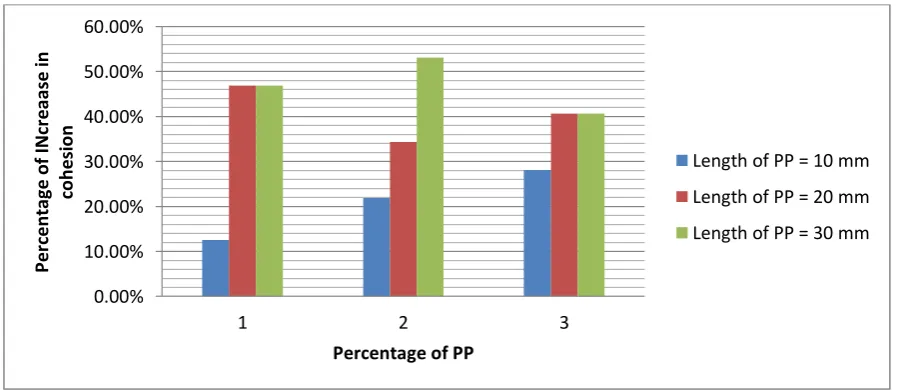
[image:7.595.82.512.105.303.2]The increase in cohesion with the addition of waste fibres of PP has been graphically shown in fig.6
Fig. 6: Increase in Cohesion with the Increase in Waste Fibres of PP
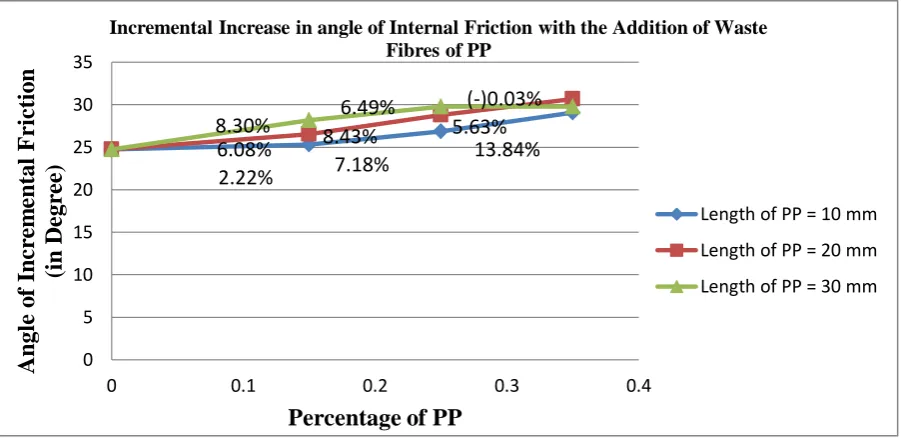
It has been observed from the experimental investigations that the direct shear strength parameters has been increased with the addition of the waste fibres of PP, depending on which the incremental increase in DSS parameters has been tabulated as given below in Table-10.
Table 10: Incremental Increase in DSS of Reinforced Soil
Percentage of PP
Length of PP
10mm 20mm 30mm 10mm 20mm 30mm
Incremental Increase in Angle of
Internal Friction, Φ Incremental Increase in Cohesion, c
0% 24.77º 0.32 kg/cm2
0.15% 2.22% 7.18% 13.84% 12.5% 21.87% 28.12%
0.25% 6.08% 8.43% 5.63% 30.55% 10.25% 9.75%
0.35% 8.30% 6.49% (-) 0.03% 0.00% 13.95% 0.00%
0.00% 5.00% 10.00% 15.00% 20.00% 25.00%
1 2 3
P
er
ce
n
tage
o
f
In
cr
eas
e i
n
A
n
gl
e o
f
In
te
rn
al
F
ri
cti
o
n
Percentage of PP
Length of PP = 10 mm
Length of PP = 20 mm
Length of PP = 30 mm
0.00% 10.00% 20.00% 30.00% 40.00% 50.00% 60.00%
1 2 3
P
e
rcent
ag
e
of
INcr
e
aa
se
in
co
h
e
si
on
Percentage of PP
Length of PP = 10 mm
Length of PP = 20 mm
[image:7.595.73.522.359.554.2]© 2017, IRJET | Impact Factor value: 6.171 | ISO 9001:2008 Certified Journal | Page 1738
The incremental increase in angle of internal friction with the addition of waste fibres of PP has been graphically shown in fig.7
Fig. 7: Incremental Increase in Angle of Internal Friction with the Increase in Waste Fibres of PP
[image:8.595.73.524.119.339.2]The incremental increase in cohesion with the addition of waste fibres of PP has been graphically shown in fig.8
Fig. 8: Incremental Increase in Cohesion with the Increase in Waste Fibres of PP
V. CONCLUSIONS OF THE STUDY
On the basis of the analysis and interpretations of the results obtained from the experimental investigations carried out in the present research work, the following conclusions are drawn:
5.1 Compressibility of the Soil
In case of the compressibility, it is concluded that, there is 5.03% increase in the Maximum Dry Density of plain soil when the fines added at 10% by weight of soil at 10.37% moisture content and marginal decrease in the Maximum Dry Density of the mixed soil with the increase in the fibre contents i.e. waste fibres of the polypropylene.
0 5 10 15 20 25 30 35
0 0.1 0.2 0.3 0.4
A
n
gl
e o
f
In
cr
em
en
tal
F
ri
cti
o
n
(i
n
D
egr
ee
)
Percentage of PP
Incremental Increase in angle of Internal Friction with the Addition of Waste Fibres of PP
Length of PP = 10 mm
Length of PP = 20 mm
Length of PP = 30 mm 2.22% 7.18%
13.84% 6.08% 8.43% 5.63% 8.30% 6.49%
(-)0.03%
0 0.1 0.2 0.3 0.4 0.5 0.6
0 0.1 0.2 0.3 0.4
C
o
h
es
io
n
(i
n
k
g/
cm
2
)
Percentage of PP
Incremental Increase in angle of Cohesion with the Addition of Waste Fibres of PP
Length of PP = 10 mm
Length of PP = 20 mm
Length of PP = 30 mm 30.55% 10.25%
9.75% 0.00% 13.95%
28.12%
12.50%
21.87%
[image:8.595.72.526.400.587.2]© 2017, IRJET | Impact Factor value: 6.171 | ISO 9001:2008 Certified Journal | Page 1739
The direct shear strength parameters of the soil reinforced with waste fibres of polypropylene used for the improvement of the engineering properties of the soil with 20 mm length and 0.35% weight of polypropylene by weight of dry soil sample is found as 23.77% increase in the angle of internal friction (Φ) and 53.12% increase in cohesion (c).
VI.RECOMMENDATIONS
On the basis of the experimental investigations in this study, it is recommended that:
i) The engineering properties of the soil collected from C.C.E.T. Chandigarh. (India) can be improved by using the fines and fibres of waste polypropylene as reinforcement.
ii) The optimum quantity of fibres of waste polypropylene as reinforcement that can be used to improve the engineering properties of clayey soil (CI) is found to be 20mm in length at 0.35% of polypropylene by weight of dry soil sample for DST.
REFERENCES
1. Akinmushuru,J.O. and Akinbolade, “Stability of loaded footings on reinforced soil” Journal, Geo Tech Engg. Div., ASCE, Vol. 107, No– 6, pp819-827, 1981.
2. Ayyar T.S.R., Joseph J., and Beena K. S., “Bearing Capacity of Sand Reinforced with Coir Rope”, First Indian Geotextile Conference on Reinforced soils and Geotextiles, Bombay, All - Al6, 1988.
3. Banerjee, P.K., “Development of new geo-synthetic products through blends of natural fibers,” Proceedings of the International Seminar and Techno-meet on Environment Geo-technology with geo-synthetics, New Delhi, 1966.
4. Cammack, “A role for coir fiber geo-fabrics in soil stabilization and erosion control”, Proceedings of the 11th workshop on coir geo-grids and geo-fabrics in Civil Engineering Practice, Coimbatore, India, pp 28 -31, 1988.
5. Central Pollution Control Board, “Assessment of plastic waste and its management at airport and railway stations in Delhi” Parivesh Bhawan, CBD-cum-Office Complex, East Arjun Nagar, Delhi-110032, India, 2009.
6. Chaosheng Tang, Bin Shi, Wei Gao, Fengjun Chen, Yi Cai, “Strength and mechanical behaviour of short polypropylene fibre reinforced and cement stabilized clayey soil” Geotextiles and Geo-membranes, pp 194 – 202, 2006.
7. Consoli, N.C., Prietto, P.D.M. and Ulbrich, L.A., “The behaviour of fibre- renforced cemented soil” Ground Improvement, London, 3(1), pp 21-30, 1999.
8. Giroud, J.P. and Noiray, L., “Geotextile reinforced unpaved road design”, Journal of Geotechnical Engineering Division, ASCE: 107, pp 1233 - 1254, 1981.
9. International Journal on Theoretical and Applied Research in Mechanical Engineering ISSN (Print): 2319-3182, Volume-3, Issue-1, “Study on heave characteristics of black cotton soils using copper slag with cement as admixture” pp 1-70, 2014.
10. Kumar, A. Wallia, B.S., and Bajaj, A., “Influence of fly ash, lime and polyester fibers on compaction and strength properties of expansive soil,” Journal of Materials in Civil Engineering, ASCE, Vol.19, No.3, pp 242-248, 2007.
11. Miss Apurva J Chavan, “Use of plastic waste in Flexible pavements” International Journal of Application or Innovation in Engineering & Management (IJAIEM.) Volume 2, Issue 4, ISSN 2319 – 4847, pp 540-552, 2013.
© 2017, IRJET | Impact Factor value: 6.171 | ISO 9001:2008 Certified Journal | Page 1740
13. Science for environment policy, DG Environment news alert services (in-depth report), “Plastic Waste: Ecological and Human Health Impacts”, pp 1-41, 2011
14. Shish Pal, Vinod Kumar, Jasvir Rattan, “Stabilisation of soil using Polypropylene as Waste Fibre Material” International Journal of Innovative Research in Science, Engineering and Technology, Volume-4, Issue-11, November-2015.
15. Vaishali Sahu, “Sustainable reuse of stabilized and fiber reinforced fly ash-lime sludge (FALS) as pavement sub-base material,” Proceeding of Indian Geotechnical Conference, Roorkee, pp 1-8, 2013.
16. Venkata Koteswara Rao Pasupuleti, Satish Kumar Kolluru, Blessing stone T., “Effect of Fiber on Fly-Ash Stabilized Sub Grade Layer Thickness” ISSN 0975-4024, Vol-4 No-3, pp140-147, 2012.
17. Vipul Kerni, Vinod Kumar, “Review on Stabilization of Clayey Soil Using Fines Obtained from Demolished Concrete Structures” in IJIRSET, Volume 4, Issue 5, May 2015.
18. Yetimoglu, T., Inanir, M., O.E., “ A study on bearing capacity of randomly distributed fiber-reinforced sand fills overlying soft clay” Geotextiles and Geo-membrane 23(2), pp174-183, 2005.
BIOGRAPHY
Navdeep Singh Sodhi – The author has completed his B.Tech. from Indo Global Institute of Engineering and Technology, Mohali, Punjab (India) and pursuing M.E. in Construction Technology and Management (Civil Engineering), from NITTTR, Chandigarh.
Shish Pal – The author is currently working as Lecturer in the Department of Civil Engineering, under State Board of Technical Education, Haryana at Government Polytechnic, Ambala City. He has completed his M.E. in Construction Technology and Management (Civil Engineering), from NITTTR, Chandigarh and pursuing Ph.D. (Civil Engineering) from Punjab Engineering College (Deemed to be University) , Chandigarh (India).