© 2018, IRJET | Impact Factor value: 6.171 | ISO 9001:2008 Certified Journal
| Page 3980
An Invisible, Reversible, Robust and Efficient Image Watermarking
Algorithm Based on Adaptive Prediction Method
Chetna Sharma
1, Abhinandan Singh
2, Mohan Singh Kachera
31
M
.Tech. Scholar, Department of Electronics and Communication, Rajasthan Technical University, India
2
Assistant Professor,
Department of Electronics and Communication, Rajasthan Technical University, India
3M.Tech. Scholar, Department of Electronics and Communication, Rajasthan Technical University, India
---***---Abstract -
Watermarking is a recognizable imagepattern that may be lighter or darker in tone. It shows the copy rights of particular documents. Usually watermarking has been used in currency notes, government documents, passport for security features and stamp papers for legal purpose. Watermarking is very beneficial for identifying the document of any authorized person. If copyrights have been reserved than nobody can produce the copy of legal documents. Digital watermarking emerged as a solution for copyrights detection, protection and maintenance of important data. A new reversible watermarking algorithm based on adaptive prediction-error expansion, is proposed, which can recover original image after extracting the hidden data. Embedding capacity of such algorithms depend on the prediction accuracy of the predictor. The method can embed secret data into 3×3 image block order by exploiting the pixel redundancy within each block. An interesting feature of randomization is that it provides improved image parameters i.e. Peak Signal to Noise Ratio (PSNR) and Mean Square Error (MSE). In this proposed method of reversible watermarking the proposed method gives much better results in terms of PSNR, MSE and Embedding Capacity.
Key Words: Peak Signal to Noise Ratio (PSNR), Mean Square Error (MSE).
1. Introduction
Watermarks can be embedded into images through the spatial domain or the frequency domain. The spatial domain usually uses simple algorithms to embed the watermark by modifying the pixel values of the original image. In the frequency domain, pixel values are transformed to the coefficients. These coefficients are modified to embed watermarks in the original images. Hence, watermarks embedded by the technique of the transform domain are more robust than water- marks which are embedded by spatial domain. Applications of Digital Watermarking – security, robustness, ease of embedding & retrieval, interoperability, effect on band-width, transparency.
2. Literature Review
Shuang Yi, Yicong Zhou & Zhongyun Hua [1]proposed a reversible data hiding method for natural images using the
© 2018, IRJET | Impact Factor value: 6.171 | ISO 9001:2008 Certified Journal
| Page 3981
[5] proposed a method for watermarking. This methodused conditional local prediction and give better results. General idea of the digital watermarking is to insert the data into media cover to allow security to the data. The technique of watermarking that is fulfilling these needs known as the Reversible watermarking. K. Hung [6] proposed a watermarking algorithm based on 4x4 Integer DCT and AC prediction technique. The tamper localization is done using AC prediction i.e. AC (1, 1) coefficient is modified in each 4x4 pixel block of 3x3 neighborhood. The formula for quantization of AC (1, 1) is modified. 4x4 Integer DCT reduces the blocking artifacts which are caused by 8x8 DCT. The PSNR for Lena image is found to be 42.98dB. AC prediction value is used as an error checking code. Jinal H. Mehta & Vishakha Kelkar[7] presents a comparison between classical Prediction error expansion based reversible watermarking and proposed prediction error expansion scheme considering region of interest for gray scale medical images. In classical prediction error expansion the augmentation of the predicted error values is used for data embedding. In the proposed scheme, prediction error expansion by preserving the Region of Interest is used. Both the schemes focus on Reversible data hiding where the original primary image can be remodeled listlessly after extracting the payload. A performance evaluation based on Peak Signal to Noise ratio (PSNR), total payload capacity is carried out. Additional capacity and less distortion of the primary image in comparison to the basic method is obtained through the results.
3. Adaptive Prediction Error Expansion
Watermarked information bit (0 or 1) is embedded into original image using additive predictor error expansion method as discussed below. First predicted value p(n) of original pixel a(n) is estimated by a prediction technique and then prediction error c(n) is obtained as, c(n)=a(n)-p(n).The watermark is then embedded into the residual/error pixel (c(n) by traditional additive Predictor Error Expansion method as given by equation (1),
( ) {
( ) ( ( ) ( ) ( ) ( ) ( ) ( ( )
(1)
Here b is to be embedded bit (0 or 1), sign(c(n)) implies +1 if c(n) is positive and -1 if negative. Q is embedding rate i.e. Q=1 implies single layer embedding and multi –layer embedding means for Q>1. Thus, after predictor error expansion, watermarked pixels can be given by below equation: aw(n) = cw(n) + p(n) (2)
At the retrieval side, the original image and the watermarked can be restored. First, prediction value is estimated (similar to what is done at embedding side) and thus cw(n) can be calculated as:
cw(n) = aw(n) – p(n) (3)
Once, cw is obtained, the residual image (c) and hidden bit
(b) can be obtained using the equation given below:
( )
{
( )
( )
( ) ( ( ))
( )
( )
( ) ( ( ))
(4)
The original pixel is estimated by:
a(n) = p(n) + c(n) (5) Thus, original image and watermark information can be recovered completely using adaptive Predictor Error Expansion.
4. Proposed Method
Aim of the proposed watermarking scheme is to increase the prediction accuracy so as to achieve higher embedding capacity. For this, a symmetrical predictor structure is proposed which is adopted from [8]. Based on the coordinate position of the pixels of given image (IM), label its pixels by four symbols position. Let A(n), B(n), C(n) and D(n) are symbols representing pixels of IM at even-even positions, even-odd positions, odd-even positions and odd-odd positions respectively with the first pixel of the image considered to be at (1,1) i.e. odd-odd. Motivation behind classifying the pixels into four parts as per the coordinate positions is to make use of a symmetrical predictor structure.
Fig.1 Labeling of Image (IM) based on spatial co-ordinates.
4.1 Prediction and Watermarking of even-even
positioned pixel
In first phase, only pixels denoted by A shown in figure 1 are predicted (i.e. pixels at even-even positions) and then watermarked by Predictor Error Expansion method. Prediction method proposed by [8] is 4th order predictor and is given as:
 (n) = (C(n-3) + C(n+3) + B(n-1)B(n+1))/4 (6) D C D C D C D C
[image:2.595.306.552.98.260.2]© 2018, IRJET | Impact Factor value: 6.171 | ISO 9001:2008 Certified Journal
| Page 3982
Here, Â is the predicted value of A(n) shown in figure 2.D(n-4) C(n-3) D(n-2)
B(n-1) A(n) B(n+1)
D(n+2) C(n+3) D(n+4)
Fig. 2 Prediction analysis of A(n)
In an image, generally a pixel has a value close to its neighbors and it depends on the local structure (edge direction etc.) of the image. Thus, we propose an adaptive prediction method of 8th order predictor. Initially, neighboring pixels of all A are divided into four sets, denoted by set1, set2, set3, set4. These sets are describes
below:
Set1 (n) = {B (n-1), B (n+1), m1},
Set2 (n) = {D (n-2), D (n+2), m2},
Set3 (n) = {C (n-3), C (n+3), m3},
Set4 (n) = {D (n-4), D (n+4), m4} (7)
Here,
m1 = (B (n-1) + B (n+1))/2, m2 = (D (n-2) + D (n+2))/2,
m3 = (C(n-3) + C(n+3))/2, m4 = (D(n-4) + D(n+4))/2 (8)
In order to estimate the strength of edges at A(n), we estimate four parameters that give intensity variations of pixels in four directions. These parameters are proposed to be estimated as given below:
∑( ( ) )
∑( ( ) )
∑(
( ) )
∑ ( ( ) ) (9)
Where, m is given by the relation given below:
m = (m1 + m2 + m3 + m4)/4 (10)
Here, equation 8 gives estimate of edges of A(n) at horizontal (00), vertical (900), in 450 and 1350 directions
respectively. Then predicted value of A(n) is considered to be the estimated sum of m1, m2, m3, m4, Where, m is given
by the relation given below:
( ) (11)
Where, w1, w2, w3 and w4 are the prediction coefficients
used with m1, m2, m3 and m4 respectively. Normalizing it
to find prediction coefficients as given by equation (12).
(( ) )
(( ) )
(( ) )
(( ) ) (12) Where N is the normalization factor given by equation (13),
( ) ( ) ( ) ( ) (13)
In case, if any of the parameter is zero, that means there is no intensity variation of pixels in that direction, then corresponding prediction coefficient is made 1 and the rest are made 0. If more than one parameter is zero, the weights are equally divided among the corresponding coefficients. Thus combining (11) and (12), A(n) can be predicted efficiently. Hence, the proposed Adaptive Prediction Error Expansion method is adaptive to edge characteristics of neighboring pixels. After predicting each pixel of A and finding corresponding c(n), we can apply Adaptive Prediction Error Expansion method to get watermarked pixels of A and is denoted by Aw.
4.2 Prediction and Watermarking of Remaining
Pixels
In second phase, pixels denoted by B are predicted and undergoes watermarking process. Same procedure is followed to predict the values of B as explained in section 4.1. However, pixels available for proposed method are 6 original and 2 watermarked pixels shown in figure 3. Once predicted value of B is obtained, adaptive Predictor Error Expansion method is used to get watermarked pixels Bw.
Similarly, in the third phase, the prediction of C type pixel is done in the same way as done for type A and B pixels with the only difference that pixels available for prediction are 2 original and 6 watermarked pixels shown in figure 4. Similarly, in the fourth phase, the prediction of D type pixel is done in the same way as done for type A, B and C pixels with the only difference that pixels available for prediction are 8 watermarked pixels.
C(n-4) D(n-3) C(n-2) Aw(n-1) B(n) Aw(n+1)
C(n+2) D(n+3) C(n+4) Fig. 3 Neighborhood of B type pixels
Bw(n-4) Aw(n-3) Bw(n-2)
D(n-1) C(n) D(n+1) Bw(n+2) Aw(n+3) Bw(n+4)
[image:3.595.97.229.120.199.2] [image:3.595.96.245.487.619.2] [image:3.595.354.509.621.764.2]© 2018, IRJET | Impact Factor value: 6.171 | ISO 9001:2008 Certified Journal
| Page 3983
Aw(n-4) Bw(n-3) Aw(n-2)Cw(n-1) D(n) Cw(n+1)
Aw(n+2) Bw(n+3) Aw(n+4)
Fig. 5 Neighborhood of D type pixels
Thus, proposed Adaptive Prediction Error Expansion method exploits neighborhood pixels efficiently and estimates the prediction coefficients adaptively based on the similarity of pixels in different directions.
4.3 Watermark Embedding and Extraction
Process
The input image, which is typically of 8 bit resolution, is modified in such a way that the pixel values of the modified image will be in the range [Q, 255 - Q], where Q is the embedding rate. The modification is given in [8] and the truncation information is send as an overhead to decoder.
( ) {
( ) ( ) ( )
(14)
Once we get the preprocessed image (Im), classify its pixels
into four groups based on their coordinate positions. Then the proposed algorithm, as discussed in previous sub-sections, can be used to get watermarked image (Iw). At
the decoder side, we have watermarked image (Iw). In a
reverse order of watermark embedding, we can recover the preprocessed image (Im) and watermark data easily. Embedding Algorithm
Step1- Apply proposed Prediction Error Expansion algorithm for pixels of type A using 8 neighborhood original pixels as shown in figure 2 as it is done at the encoder & hide bits. Apply Prediction Error Expansion using equation (2) to get watermarked pixels.
Step2-Apply proposed algorithm for pixels of type B using 6 original pixels and 2 watermarked pixels to get watermarked pixels of type B and hide bits.
Step3- Repeat the same process for pixels of type C to get the watermarked pixels of type c and hide bits.
Step4-Repeat the same process for pixels of type D to get the watermarked pixels of type D and hide bits.
Retrieval Algorithm
Step1-Apply proposed Prediction Error Expansion algorithm for pixels of type D using 8 neighborhood watermarked pixels as shown in figure 5 as it is done at the encoder. Recover the original pixels of type D and hidden bits. Apply inverse Prediction Error Expansion using equation (4) to get secret bits and original pixels.
Step2- Apply proposed algorithm for pixels of type C using 2 original pixels and 6 watermarked pixels.Recover the original pixels of type C and hidden bits.
Step3-Repeat the same process for pixels of type B. Recover the original pixels of type B and hidden bits. Step4- Repeat the same process for pixels of type A. Recover the original pixels of type A and hidden bits.
5. Simulation Results
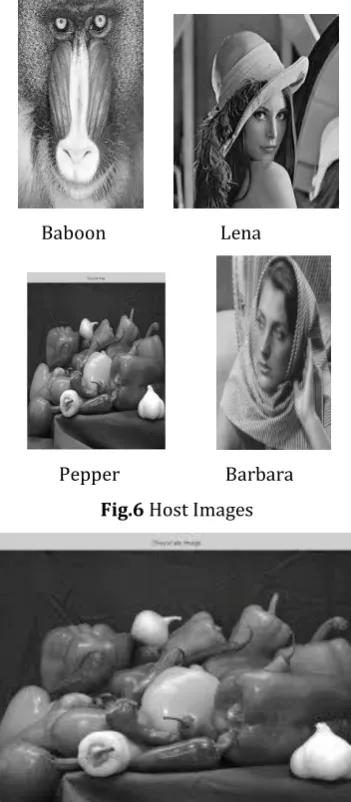
In this section we demonstrate simulation results for propose method. For testing the algorithm, images of Lena, Baboon, Peppers and Barbara are used. Figure 6 shows the host images. The host images are used to embed the watermark bits into its pixels. The size of each of the host image is 512x512 i.e. each of the host image has 262144 number of pixels. Each of the host images is a gray scale 8-bit image. The experiment was conducted in MATLAB 2014 to test the validity of the proposed algorithm.
Baboon Lena
Pepper Barbara Fig.6 Host Images
[image:4.595.91.236.97.160.2] [image:4.595.345.521.331.733.2]© 2018, IRJET | Impact Factor value: 6.171 | ISO 9001:2008 Certified Journal
| Page 3984
The value of PSNR is satisfactorily good (above 40 dB) inall cases which implies the validity of the proposed algorithm. The value of PSNR demonstrates the ability of the watermarking algorithm to efficiently embed more number of watermarking bits efficiently into the host image. Higher the PSNR better will be the quality of the Watermarked image. Lesser PSNR indicates a more distorted watermarked image .It is observed from table 1, that the proposed method provides better results as compared to the results of Shuang Et Al.[1]. Thus the proposed method is providing better improvement in PSNR over the results of Shuang Et Al[1]. Table 1 shows the comparative study of the simulation results of the proposed algorithm with Shuang et al. It is clear from the table given below that the proposed algorithm works better that Shuang et al. in terms of PSNR for a given embedding rate of Q = 0.2.
Table 1- Comparison of the proposed method with Shuang Et Al. [1]
S.No. Image Shuang Et
Al[1] PSNR Proposed Method PSNR
1. Baboon 38.75 dB 78.54 dB
2. Lena 48.45 dB 79.89 dB
3. Pepper 46.26 dB 78.38 dB
4. Barbara 46.32 dB 79.83 dB
The proposed method is providing MSE = 0.0302, PSNR = 78.5446, Embedding Capacity = 127965, when Cover image of Baboon is used. For Lena image MSE=0.0258, PSNR=79.8915, Embedding Capacity = 184550 and Pepper image MSE=0.0307, PSNR=78.3883, Embedding Capacity = 121201 and Barbara image MSE=0.0260, PSNR=79.8356, Embedding Capacity = 182340.
6. CONCLUSION
In this paper, Adaptive Prediction Error Expansion based watermarking is proposed which focus on hiding and extracting the data inside a cover image. Prediction Error Expansion is used for detecting the edge pixels of cover image. Experimental study points out that the proposed method gives better result as compared to the results of Shuang Et. Al. [1] in terms of higher visual quality, high PSNR values of hiding secret data in the image thus reduces the chance of the confidential message being detected and enables secret communication. It is also found that the hidden message can be extracted perfectly.
ACKNOWLEDGEMENT
I would like to express my sincere thanks to Mr. Abhinandan Singh for giving me the opportunity to explore this field of image Watermarking. He has always motivated and supported me at all stages of the project work. Also I would like to thank our Department of Electronics & Communication Engineering for providing me all the help as and when required.
REFERENCES
[1] Shuang Yi, Yicong Zhou and Zhongyun Hua, “Reversible Data Hiding in Encrypted Images using Adaptive Block-Level Prediction-Error Expansion”, Journal of Signal Processing: Image Communication, pp. 1-26, 2018.
[2] Yan Qi & Liping Liu, “Reversible Watermarking Algorithm based on Prediction Error Expansion for Color Image”, Proceedings of International Conference on Image Processing, pp. 102-106, 2017.
[3] J. Feng, I. Lin, C. Tsai, Y. Chu, “Reversible watermarking: current status and key issues”, Int. Journal, Vol. 2, No. 3, pp. 161–170, 2006.
[4] Qing Liu & Jun Ying, “Gray scale Image Digital Watermarking Technology Based on Wavelet Analysis”, IEEE Symposium on Electrical & Electronics Engineering, pp. 618-621, 2012.
[5]Khushboo Pawar, Bhawana Pillai, Dr. Sadhna K Mishra, “Conditional Local Prediction Based Image Watermarking”, International Journal of Engineering Technology and Applied Science, Vol. 2 , No.3, March-2016. [6] Kuo-Ming Hung, “A Novel Robust Watermarking Technique Using IntDCT Based AC Prediction”, WSEAS Transactions on Computers, Vol. 7, No. 1, pp. 16-24, 2008. [7] Jinal H. Mehta & Vishakha Kelkar, “Comparison of Reversible Watermarking using Prediction Error Expansion and Prediction Error Expansion Considering Region of Interest for Medical images”, IEEE 2nd
International Conference for Convergence in Technology,2017.
[8] M. Chen, Z. Chen, X. Zeng, and Z. Xiong “Reversible image watermarking based on full context prediction,” in International conference on Image Processing (ICIP), page 4253-4256, IEEE (2009).
[9] Patrick Bas and Teddy Furon, “A New Measure of Watermarking Security: The Effective Key Length”, IEEE Transactions on Information Forensics and Security, Vol. 8, No. 8, 1306-1317, 2013.
[10] Huawei Tian, Yao Zhao, Rongrong Ni, Lunming Qin and Xuelong Li, “LDFT-Based Watermarking Resilient to Local Desynchronization Attacks”, IEEE Transactions on Cybernetics, Vol. 43, No. 7, pp. 2190-2211, 2013.
[11]Zahra Pakdaman, Saeid Saryazdi & Hossein Nezamabadi-Pour, “A prediction based reversible image
watermarking in Hadamard domain”, Multimedia Tools
Application, Springer Journal, pp. 1-29, 2016.
[12] E. P. Kumar, R. E. Philip, P. S. Kumar & M. G. Sumithra, “DWT-SVD based reversible watermarking algorithm for embedding the secret data in medical images”, Proc. of 4th