Munich Personal RePEc Archive
An Algorithm for payoff space in C1
parametric games
Carfì, David and Ricciardello, Angela and Agreste, Santa
University of California at Riverside
2011
Online at
https://mpra.ub.uni-muenchen.de/32099/
An Algorithm for payoff space in
C
1
parametric
games
S. Agreste, D. Carf`ı, A. Ricciardello
July 8, 2011
Abstract
We present a novel algorithm to determine the payoff-space of certain normal-formC1 parametric games, and - more generally - of continuous
families of normal-formC1 games. The algorithm has been implemented
by using MATLAB, and it has been applied to several examples. The implementation of the algorithm gives the parametric expressions of the critical zone of any game in the family under consideration both in the bistrategy space and in the payoff space and the graphical representations of the disjoint union (with respect to the parameter set of the paramet-ric game) of the family of all payoff spaces. We have so the parametparamet-ric representation of the union of all the critical zones. One of the main moti-vations of our paper is that, in the applications, many normal-form games appear naturally in a parametric fashion; moreover, some efficient models of coopetition are parametric games of the considered type. Specifically, we have realized an algorithm that provides the parametric and graphical representation of the payoff space and of the critical zone of a parametric game in normal-form, supported by a finite family of compact intervals of the real line. Our final goal is to provide a valuable tool to study simply (but completely) normal-formC1-parametric games in two dimensions.
1
Introduction and motivations
Our study is based on a method able to determine the payoff space of normal-formC1-games inndimensions, that is forn-players normal-form games whose
applied by D. Carf`ı and others. The model is given by a particular kind of parametric game, in which the parameter set is the cooperative strategy set of the game (see [8, 9, 10, 11, 12, 13]). That is the basic object which allows to pass from the standard normal-form definition of game([1, 2, 3, 14]) to their coopetitive extension. Our algorithm permits a general vision of the payoff space of a parametric game and of the Nash paths, knowledge of fundamental importance in the applications.
2
Preliminaries on normal-form
C
1games
We shall considern-person games in normal-form. We give the definitions used in this work in order to ease the reader. The form of following definitions is particularly useful for our purpose.
Definition 1 (of game in normal-form). Let E= (Ei)ni=1 be an ordered
family of non-empty sets. We call n-person game in normal-form upon the support E each function
f : ×
E→Rn,
where ×E denotes the Cartesian product ×n
i=1Ei of the family E. The set Ei
is called thestrategy set of player i, for every index i of the family E, and the product ×
E is called the strategy profile space, or the n-strategy space, of the game.
Terminology. Together with the previous definition of game in normal form, we have to introduce some terminologies:
• the set {i}ni=1 of the firstn positive integers is saidthe set of the players
of the game;
• each element of the Cartesian product×
Eis said a strategy profile of the game;
• the image of the functionf, i.e., the setf(×E) of all realn-vectors of type f(x), withxin the strategy profile space×
E, is called then-payoff space, or simply thepayoff space, of the gamef.
We recall, further, for completeness and, to ease the reader, the definition of Pareto boundary we shall use in the paper.
to the usual order of the euclidean n-space Rn. If S denote the strategy space
×E, we shall denote the maximal boundary of the n-payoff space by ∂f(S) and
the maximal boundary of the game by ∂f(S) or by ∂(f). In other terms, the
maximal boundary ∂f(S) of the game is the reciprocal image (by the function
f) of the maximal boundary of the payoff space f(S). We shall use analogous terminologies and notations for theminimal Pareto boundary.
The fundamental properties of Pareto boundaries have been presented in [6].
3
The method for
C
1games
The method we use to study a normal-form C1 game is given and applied in [4, 5, 7].
The context. We deal with a type of normal-form gamef defined on the product ofncompact non-degenerate intervals of the real line, and such thatf
is the restriction to then-strategy space of a C1 function defined on an open set ofRn containing then-strategy space S (which, in this case, is a compact non-degeneraten-interval of then-spaceRn).
Before to give the main result of the method, we recall some basic notions.
3.1
Topological boundary
We recall that the topological boundary of a subset S of a topological space (X, τ) is the set defined by the following three equivalent propositions:
• it is the closure ofS minus the interior ofS:
∂S= cl(S)\int(S);
• it is the intersection of the closure ofSwith the closure of its complement
∂S= cl(S)∩cl(X\S);
• it is the set of those points x of X such that every neighborhood of x
The key theorem of our method is the following one.
Theorem 1. Let f be a C1 function defined upon an open set O of the
euclidean space Rn and with values in Rn. Then, for every part S of the open
O, the topological boundary of the image of S by the function f is contained in the union
f(∂S)∪f(C),
where C is the critical set of f in S, that is the set of the points xof S such that the Jacobian matrix Jf(x)is not invertible. If, more, the function f is not
continuous over a part H of Oand C1elsewhere in O, the topological boundary
of the image of S by the function f is contained in the union
f(∂S)∪f(C)∪f(H),
where C is (again) the critical set of f in S.
4
Two players parametric games
In this article we shall use the following definitions of parametric game.
Definition 3. Let E = (Et)t∈T and F = (Ft)t∈T be two families of non
empty sets and let
f = (ft)t∈T
be a family of functions
ft:Et×Ft→R2.
We define parametric game over the strategy pair (E, F) and with family of payoff functions f the pair
G= (f, >),
where >is the usual strict upper order of the Euclidean plane R2. We define payoff space of the parametric game G the union of all the payoff spaces of the game family
g= ((ft, >))t∈T,
that is the union of the payoff family
P = (ft(Et×Ft))t∈T.
We note that the familyP can be identified with the multi-valued path
p:T →R2:t7→ft(Et×Ft),
• parametric games in which the families E andF consist of only one set, respectively.
In the latter case we can identify a parametric game with a pair (f, >), where
f is a function from a Cartesian product T×E×F into the plane R2, where
T, Eand F are three non-empty sets.
Definition 4. When the triple (T, E, F) is a triple of subsets of normed spaces, we define the parametric game (f, >) of class C1 if the function f is
of class C1.
5
Numerical Results
Consider a (loss) parametric game (h, <), with strategy sets E =F = [0,1], parameter setT = [0,1]2 and biloss (disutility) function
h:×(T, E, F)→R2
whose section
h(a,b):×(E, F)→R2
is defined by
h(a,b)(x, y) = (x−(1−a)xy, y−(1−b)xy),
for all (x, y)∈E×F and (a, b)∈[0,1]2.
The above game is the von Neuman convexification of the finite game rep-resented by the following array
(a, b) (1,0) (0,1) (0,0) .
Assume, now, that the parameter points (a, b) belong also to the 1-sphere
S1
p, with respect to the p-norm, in the Euclidean plane R2, for some positive
realp; that is, let us assume
ap+bp= 1,
for some positive realp. Consider, then, the restriction
g:S×E×F→R2
of the functionhto the parameter set
S=S1p∩T.
By projecting on the first factor of the product S×E×F, we can consider, instead of the parametric game g, with parameter set S1
parametric game (f, <), with parameter set [0,1] and a-payoff functionfa
de-fined by
fa(x, y) =
x−(1−a)xy, y−(1−(1−ap)1/p)xy,
for all (x, y)∈E×F and a∈[0,1]. Here, by equivalent parametric game, we mean the existence of the bijection
j:S→[0,1] : (a, b)7→a
whose inverse is the bijection
j−1: [0,1]→S:a7→(a,(1−ap)1/p).
In the following sections we shall consider the following sub-cases: 1. p= 1:
fa(x, y) = (x−(1−a)xy, y−axy),
for allx, yandain [0,1]. 2. p= 0.1:
fa(x, y) = x−(1−a)xy, y−(1−(1−a0.1)10)xy,
for allx, yandain [0,1]. 3. p= 0.5:
fa(x, y) = x−(1−a)xy, y−(1−(1−a0.5)2)xy,
for allx, yandain [0,1]. 4. p= 2:
fa(x, y) = x−(1−a)xy, y−(1−(1−a2)0.5)xy,
for allx, yandain [0,1]. 5. p= 10:
fa(x, y) = x−(1−xy), y−(1−(1−a10)0.1)xy
,
for allx, yandain [0,1].
Moreover, we shall present the following games: 6.
fa(x, y) = x+y+a, x−y+a2
,
for allx, y∈[0,2] anda∈[0,1]. 7.
fa(x, y) = (x+y+a, x−y+|a|),
6
First game
p
= 1
LetE=F = [0,1] be the strategy sets and let abe a real number fixed in the interval [0,1]. Consider thea-biloss (disutility) function of the parametric game (f, <), defined by
fa(x, y) = (x−(1−a)xy, y−axy),
for all (x, y) in [0,1].
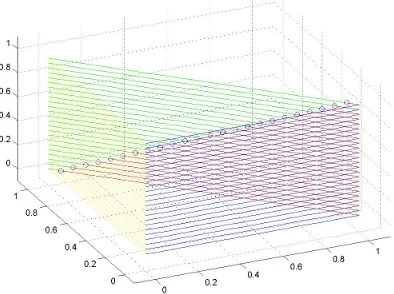
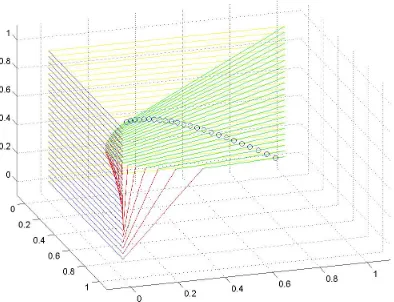
The critical zone of the functionfa (represented in Figure 1 for every a in
[0,1]) is the set
[image:8.612.206.409.308.459.2]C(fa) =(x, y)∈[0,1]2: 1−ax−(1−a)y= 0 .
Figure 1: Disjoint union of the critical zones.
The disjoint union of the family
(fa(∂(E×F)))a∈T,
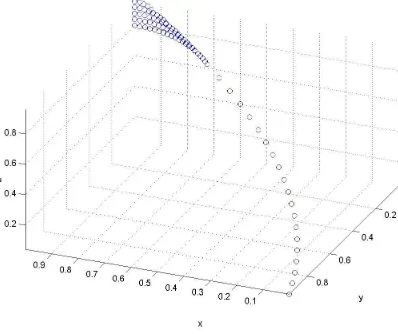
that is the disjoint union of the transformations of the topological boundaries of the bistrategy space, with respect to the parameter set, is shown in Figure 2. Recalling that the action of a family of functions (with common domain) on a subset of the common domain of the member-functions is the family of the images (transformations) of the subset, we can consider the above disjoint union as a faithful representation of the action of the entire family (fa)a∈T,on
Figure 2: First Game: Disjoint union of transformations of the topological boundaries of the bistrategy space.
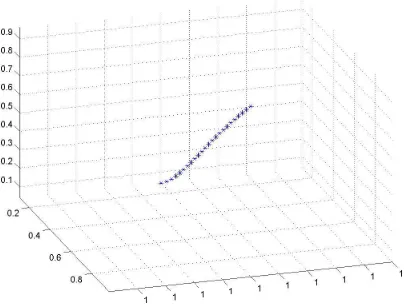
The disjoint union of transformations of the critical zones is shown in Figure 3.
Figure 3: First Game: Disjoint union of transformations of the critical zones.
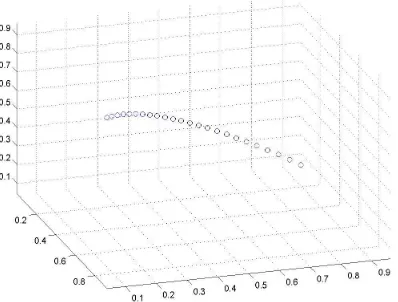
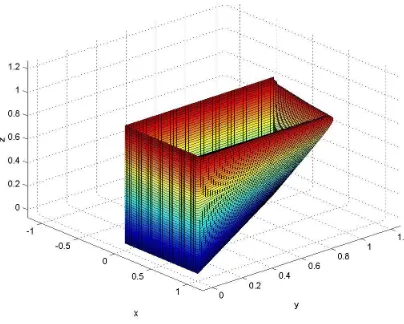
[image:9.612.205.407.420.566.2](fa(E×F))a∈T,
that is the disjoint union of the transformations of the payoff spaces, with respect to the parameter set, as shown in Figure 4. By the way, we observe that this last disjoint union is the graph of the multivalued curve
c:T →R2:a7→fa(E×F),
but an irrelevant permutation
[image:10.612.208.405.286.433.2]J :T×R2→R2×T : (a, X, Y)7→(X, Y, a).
Figure 4: First Game: Disjoint union of payoff spaces.
7
Second game:
p
= 0.1
LetE =F = [0,1] be the strategy sets and let fa be the a-biloss (disutility)
function
fa(x, y) = x−(1−a)xy, y−(1−(1−a0.1)10)xy
,
for allx, y ain [0, 1]. The critical zone of thea-biloss function is
C(fa) =(x, y)∈[0,1]2: 1−(1−(1−a0.1)10)x−(1−a)y= 0 .
Figure 5: Second Game: Disjoint union of critical zones.
Figure 6: Second Game: Disjoint union of transformation of the topological boundary of the bistrategy space.
The disjoint union of transformations of the topological boundary of the bistrategy space is presented in Figure 6.
[image:11.612.205.405.354.513.2]Figure 7: Second Game: Disjoint union of transformations of the critical zones.
The Payoff Space (represented in Figure 8 for everyain T), is obtained by the union of transformations of the critical zone and of the topological boundary of the bistrategy space.
[image:12.612.202.403.412.567.2]8
Third Game:
p
= 0.5
Let the strategy sets of the parametric gameG= (f, <) beE =F = [0,1] and let thea-biloss (disutility) function ofGbe defined by
fa(x, y) = x−(1−a)xy, y−(1−(1−a0.5)2)xy,
for allx, yandain [0,1].
The critical zones, in Figure 9, are the sets
C(fa) =
n
(x, y)∈[0,1]2: 1−(1−(1−a0.5)2)x−(1−a)y= 0o,
[image:13.612.207.411.314.466.2]withavarying inT.
Figure 9: Second Game: Critical zones.
The transformations of the topological boundary of the bistrategy space are shown in Figure 10.
The transformations of critical zones are presented in Figure 11.
Figure 10: Third Game: Transformations of the topological boundary of the bistrategy space.
Figure 11: Third Game: Transformations of critical zones.
9
Forth Game:
p
= 2
Let the strategy sets of the parametric gameG= (f, <) beE =F = [0,1] and let thea-biloss (disutility) function ofGbe defined by
fa(x, y) = x−(1−a)xy, y−(1−(1−a2)0.5)xy
,
[image:14.612.208.407.369.520.2]Figure 12: Third Game: Payoff space in form of disjoin union.
C(fa) =
n
(x, y)∈[0,1]2: 1−(1−(1−a2)0.5)x−(1−a)y= 0o.
So the Payoff Space overlap the transformation of the topological boundary, as shown in Figure 13 for everya.
[image:15.612.204.406.432.591.2]10
Fifth game: p=10
Let strategy sets beE=F= [0,1] and biloss (disutility) function be
fa(x, y) = x−(1−a)xy, y−(1−(1−a10)0.1)xy,
for all (x, y) andain [0,1].
The critical zones, in Figure 14, are
C(fa) =
n
(x, y)∈[0,1]2: 1−(1−(1−a10)0.1)x−(1−a)y= 0o,
[image:16.612.203.405.308.470.2]withavarying inT.
Figure 14: Fifth Game: Transformations of the topological boundary.
11
Sixth game
In this section we present a new game, where strategy sets areE =F = [0,2], the parameter set isT = [0,1] and the a-biloss (disutility) function is defined by
fa(x, y) = x+y+a, x−y+a2,
for allx, yin [0,2] andain [0,1].
Figure 15: Sixth Game: Transformation of the topological boundary
12
Seventh game
In this section we present a new game, where strategy sets areE =F = [0,2], the parameter set isT = [−1,1] and thea-biloss (disutility) function is
fa(x, y) = (x+y+a, x−y+|a|),
for allx, y,ain [−1,1].
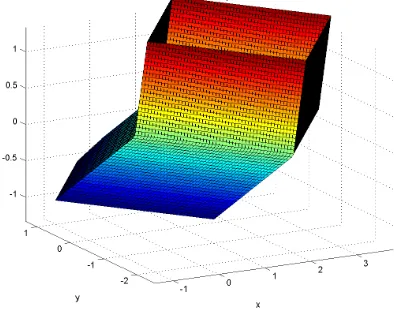
[image:17.612.205.402.467.625.2]The critical zone is empty, so the payoff spaces overlap the transformations of the topological boundary, in Figure 15.
References
[1] J. Aubin,Optima and Equilibria, second edition Springer Verlag, (1998). [2] J. Aubin, Mathematical Methods of Game and Economic Theory
North-Holland, Amsterdam, (1980).
[3] M. J. Osborne and A. Rubinstein, A Course in Game Theory Academic Press, (2001).
[4] D. Carf`ı,Payoff space of C1 Games, Applied Sciences 11, 35-47 (2009). [5] D. Carf`ı, Differentiable game complete analysis for tourism firm decisions,
in Proceedings of the 2009 International Conference on Tourism and Work-shop on Sustainable Tourism within High Risk Areas of Environmental Crisis, Messina, Italy, 2009.
[6] D. Carf`ı,Optimal boundaries for decisions,Atti Accad. Pelorit. Pericol. Cl. Sci. Fis. Mat. Nat. 86,C1A0801002 (2008).
[7] D. Carf`ı, A. RicciardelloAn Algorithm for Payoff Space in C1-Games Atti Accad. Pelorit. Pericol. Cl. Sci. Fis. Mat. Nat. Vol. 88, No. 1, C1A1001003 (2010)
[8] D. Carf`ı, G. Gambarelli, A. Uristani, Balancing interfering elements, pre-print, 2011
[9] D. Carf`ı, G. Patan`e, S. Pellegrino,A Coopetitive approach to Project financ-ing, preprint (2011)
[10] D. Carf`ı, D. Schilir`o, A model of coopetitive game and the Greek crisis, http://arxiv.org/abs/1106.3543
[11] D. Carf`ı, D. Schilir`o,Coopetitive games and transferable utility: an analyt-ical application to the Eurozone countries, pre-print, 2011
[12] D. Carf`ı, D. Schilir`o, Crisis in the Euro area: coopetitive game solutions as new policy tools, TPREF-Theoretical and Practical Re-search in Economic Fields, summer issue pp. 1-30. ISSN 2068 7710, http://www.asers.eu/journals/tpref.html, 2011
[13] D. Carf`ı, D. Schilir`o,A coopetitive model for a global green economy, sent to International Conference “Moving from crisis to sustainability: Emerging issues in the international context”, 2011
[14] G. Owen,Game Theory Academic Press, (2001).