ISSN Online: 2161-4873 ISSN Print: 2161-4865
Development of Ecologically Acceptable
Chlorpyrifos Formulation for Effective and Safe
Application
Yasser El-Nahhal
*, Bayan Wheidi, Said El-Kurdi
Department of Environment and Earth Science, Faculty of Science, The Islamic University—Gaza, Gaza, Palestine
Abstract
Application of the commercial formulation of chlorpyrifos has resulted in considera-ble environmental contamination. This study was designed to develop environmen-tally acceptable chlorpyrifos formulation for safe and effective application. This in-volved the modification of clay surfaces from hydrophilic to hydrophobic via ion- exchange reaction with organic cations. The resulting organo-clay complexes were tested for adsorption and release of chlorpyrifos. HPLC and FTIR measurements showed considerable adsorption and strong interaction between chlorpyrifos mole-cules and the organo-clay complexes. Basal spacing results emphasized the formation of suitable micro-pores for chlorpyrifos molecules. HPLC and bioassay techniques confirmed the slow release of chlorpyrifos. Leaching potential showed retention of chlorpyrifos in the top soil. Therefore application of organoclay formulation of chlorpyrifos may reduce their potential environmental contamination and produce safe applications.
Keywords
Chlorpyrifos, Adsorption, Basal Spacing, Organo-Clay, Leaching Potential
1. Introduction
Chlorpyrifos is an organophosphate insecticide widely used in agricultural and public health sectors [1]. The application of the commercial formulations of chlorpyrifos created many environmental problems. For instance, residues of chlorpyrifos have been detected in fruit, vegetables, water and soil samples in many parts of the world [2]-[7], in outdoor air samples [8], in oceanic air samples [9], in Alaskan Arctic estuaries [10], in dust [11] and in carpets [12]. Furthermore, Chlorpyrifos has been shown to cause How to cite this paper: El-Nahhal, Y.,
Wheidi, B. and El-Kurdi, S. (2016) Devel-opment of Ecologically Acceptable Chlor-pyrifos Formulation for Effective and Safe Application. Journal of Encapsulation and Ad- sorption Sciences, 6, 91-108.
http://dx.doi.org/10.4236/jeas.2016.63008
Received: August 19, 2016 Accepted: September 25, 2016 Published: September 29, 2016
Copyright © 2016 by authors and Scientific Research Publishing Inc. This work is licensed under the Creative Commons Attribution International License (CC BY 4.0).
http://creativecommons.org/licenses/by/4.0/
environmental health problems [13]-[15], ecological disturbance [16] and toxic effects to aquatic life [17]-[21]. Recent published work revealed human toxicity due to long term exposure to chlorpyrifos formulations [22]. Moreover, chlorpyrifos has been shown to: induce neurite retraction in differentiating neuronal cells, [23], cause cyto-toxicity [24] and reduce growth, enzyme activity and chlorophyll A synthesis of fresh water microalgae [25]. The annual report revealed the application of large quantities of chlorpyrifos that reached to 18,125 Liter [26].
Moreover, application of commercially available formulations of chlorpyrifos may result in subsequent leaching, movement and migration from the top soil layer to dee-per soil depths. This may also result in losing the insecticidal activity that has to be maintained in the tope soil layer where some soil insects are spending parts of their life cycle. Accordingly, the authors of this study initiated the idea of developing clay based formulation for environmentally safe and effective application of chlorpyrifos. The ra-tionale of this study is emerged from the fact that modifying the hydrophilic surfaces of clay minerals to partially or totally hydrophobic through an ion exchange reaction us-ing a suitable organic cation may enhance the adsorption of chlorpyrifos and conse-quently reduce its movement in soil and producing safe and effective application in the environment.
2. Materials and Methods
2.1. Materials
Bentonite clay was obtained from the Source Clays Repository, Clay Minerals Society, Columbia, MO, USA. Its cation exchange capacity is equal to 0.8 mmol/g [27]. Chlor-pyrifos 99.9% purity was purchased from Sigma-Aldrich, Germany. The commercial emulsion formulation of chlorpyrifos (Dursban EC20) was purchased from a certified pesticide vendor in Gaza.
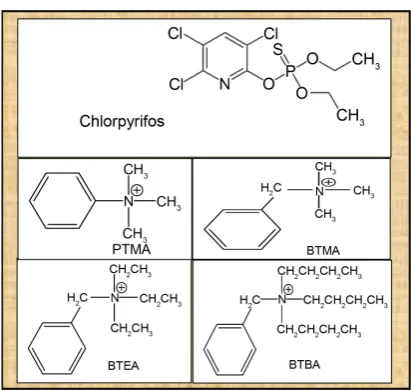
The organic cation compounds benzyltrimethyl ammonium (BTMA), benzyltriethyl ammonium (BTEA), benzyltributyl ammonium (BTBA) and phenyltrimethyl ammo-nium (PTMA) were purchased from Sigma-Aldrich, Germany and utilised without further purification. Their chemical structures are illustrated in Figure 1.
2.2. Soil Collection
Soil samples were collected from the top 20 cm of a multi-agricultural soil in Gaza which has no history of chlorpyrifos application Lewhadi Farm. The soil samples were air dried, sieved through 2 mm mesh and stored in plastic bags in the laboratory. The physicochemical properties of the soil (pH, electrical conductivity (EC), Calcium car-bonate (CaCO3) content, organic matter content (OM), organic carbon content (OC) and soil texture) were determined using standard methods.
2.3. Preparation of Organo-Clay Complexes
Figure 1. Chemical structure of the chemicals utilized.
to suspended clay (1%) under continuous magnetic stirring for 48 h at room tempera-ture [28][29]. The yielded clay complexes were separated after 30 min centrifugation (6000 g), the precipitate was washed three times with distilled water up to have free chloride ion in the washing water, lyophilized and ground to 50 µm and kept in plastic bottles at room temperature.
2.4. Adsorption of Chlorpyrifos
Adsorption of chlorpyrifos was performed at room temperature (25˚C ± 1˚C) at a fixed concentration of chlorpyrifos not too low and not too high (200 µg/g). In this proce-dure the required concentration of chlorpyrifos was prepared in 25 ml distilled water and transferred to 30 ml centrifuge tubes containing 10 mg clay or organo-clay com-plexes. The tubes were kept overnight (24 hr) for horizontal shaking at 140 rpm. The supernatants were then separated by centrifugation at 6000 g for 1 h. The remaining concentrations of chlorpyrifos in the solutions were determined by HPLC as described below.
2.5. Adsorption Isotherms
Adsorption isotherm of chlorpyrifos on each organo-clay complex was performed in distilled water by making a series of dilutions ranging from 0.0 - 1 mg/g in a total vo-lume of 25 ml. Then each vovo-lume was transferred to a 30 ml centrifuge tube containing 10 mg of clay or organo-clay complex. The tubes were sealed and kept under horizontal shaking for 48 h [30] then centrifuged at 6000 g for 1 h to separate the supernatants. The remaining concentrations of chlorpyrifos in the solutions were determined by HPLC as described below. The adsorbed amounts were calculated using Equation (1).
(
)
s i e
Q = Q −Q V M (1)
the mass of adsorbent (g).
2.6. HPLC Measurement
As described previously [30], chlorpyrifos concentrations in the supernatants were de-termined by Chromtech HPLC with Diode Array Detector (DAD) equipped with ma-nual-injection system. The column was 200 mm × 4.6 mm (i.d.) reverse-phase. Packing ODS-BP 5 µm (C18), injection volume was 50 µl and wave length of detection was 280 nm, mobile phase was water:methanol 10:90. The flow rate maintained 1.5 ml∙min−1 and retention time 8 min. External calibration and standard curve measurements were done before determination of chlorpyrifos in any supernatant.
2.7. XRD-Measurement
As previously described [31], Clay-PTMA/-BTBA complexes having different loadings (0, 0.5 mmol cationic surfactant/g clay) were measured for basal spacing using a Philips 1030 X-Ray diffractometer with CoKa radiation. These measurements were conducted at CRMD, CNRS-University, Orleans, France.
2.8. Fourier Transform Infrared (FTIR)
Following the procedure previously described [32] [33], 2 mg of chlorpyrifos, or its complexes with clay or organo-clay was crushed with 98 mg of KBr in the micro-mill. The mixture was transferred to a special cylinder with 1 cm diameter. The mixture was then compressed under vacuum and high atmospheric pressure (5 at) for 2 min. The pellets were removed and transferred to a Petri dish for protection. The FTIR spectra were obtained using KBr pellets with Agilent Technologies, Cary 640 FTIR spectrome-ter. Spectra were recorded at room temperature in the range of 1800 - 1200 cm−1.
2.9. Preparation of Organoclay Formulations of Chlorpyrifos
The organoclay formulations of chlorpyrifos were prepared by dissolving appropriate amounts (50 mg) of chlorpyrifos in 10 ml methanol and transferring 2 ml of the solu-tion to a 180 mg powdered clay, or organoclay suspended in 8 ml methanol. The system was sealed and shaken for 4 h to ensure complete interaction between chlorpyrifos and clay or organo-clay. The solvent was evaporated under reduced pressure as previously described [34].
2.10. Leaching Potential of Chlorpyrifos in Soil
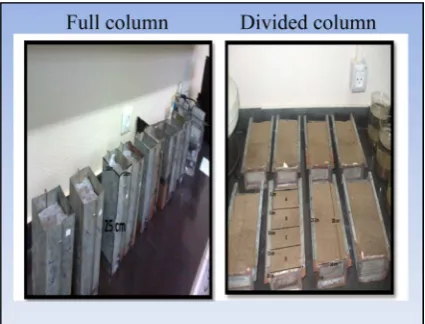
Figure 2. Column technique used for HPLC and bioassay techniques for determination of leaching potential in soil. Left photo shows full column filled with sandy soil and treated with chlorpyrifos and irrigated with water. Right photo shows the columns split lengthwise to form 2 pots.
formulation; clay, clay-PTMA; clay-BTMA; clay-BTBA. The formulation was sprayed onto the surface of the column. Each surface treated with the chlorpyrifos formulations received 1 mg chlorpyrifos. Each column was carefully irrigated with 500 ml distilled water (field capacity of water) applied in portions over 3 - 5 hours at 20 min intervals. The columns were left for 48 h in the laboratory for equilibration, then sliced leng-thwise to form two pots of 10 × 5 × 25 cm each (Figure 2). One pot was used for chem-ical determination using HPLC, and the second was used for bioassay determination using 2nd instar mosquito larvae bred in the laboratory as the test organism.
2.11. HPLC Determination of Chlorpyrifos in Soil Layers
One pot of the soil column was divided into 4 layers of 5 cm long (Figure 2). Each soil layer was transferred to a 2 L glass beaker containing 1000 ml of distilled water. The soil samples were shaken for 3 h using a magnetic stirrer. The samples were left for 2 h for precipitation and two replicates of 5 ml water were collected from each layer, centri-fuged at 20,000 rpm and used for HPLC determination as mentioned above.
2.12. Bioassay Determination of Chlorpyrifos in Soil Layers
Dose-response relationshipFollowing the procedure described in El-Nahhal et al. [37][38], series of chlorpyrifos concentrations in the range of 0.0 - 1 mg/l were prepared in 1 L distilled water. Ten mosquito larvae were added to each concentration. The number of dead larvae were recorded and taken as an indicator of chlorpyrifos concentration after 96 h. % mortality at each point was calculated according to Equation (2), El-Nahhal et al. [37]
(
)
%mortality=100∗ Lc−Lt Lc (2)
where Lc and Lt are the live cases in the control and treatment, respectively.
Y =aX (3)
where Y and X are % mortality and concentration mg/l respectively, a is the slope of the straight line and indicates the toxicity of chlorpyrifos.
Following the procedure described in the HPLC section, the soil water mixture was separated by filtration to obtain a clear solution. 10 mosquito larvae of 2nd instar age were transferred to each container of the soil layer filtrate. Dead larvae were quantified as described above. % mortality was calculated according to Equation (2) and applica-tion of Equaapplica-tion (3) enable determinaapplica-tion of chlorpyrifos concentraapplica-tion in the soil layer.
2.13. Statistical Analysis
Each experiment was repeated 2 times with 5 replicates at each point each time. Mean and standard deviations were calculated for each point. For adsorption experiments er-ror bars were presented in each isotherm, overlapping erer-ror bars indicate no statistical-ly significant difference. The capacity and intensity of adsorption on the clay or orga-no-clay complexes were obtained by fitting the adsorption results to the Freundlich
adsorption model ( 1n
f e
q=K C ). The model can be transferred to a linear mode
through log scale producing logq=logKf +1 logn Ce, where q represents the
ad-sorbed amount (mg/g), Ce is the remaining concentration in the solution, Kf and n are Freundlich constants indicating capacity and intensity of adsorption respectively. ANOVA was used to detect significant differences at the 0.05 level.
3. Results and Discussion
The organic cations used in this study (Figure 1) are surface active agents, sold at room temperature [28]. BTMA, PTMA, BTEA and BTBA contain aromatic ring and aliphatic moiety in their structures.
The aromatic ring may enhance the π-π interactions with chlorpyrifos. At low tested concentration, they do not have toxicity to different organism. Moreover, these sub-stances can be bound to clay fraction in soil or react with humic and/or fulvic acids and make larger organic molecules that interact with organic pollutants in soil or aquatic systems accordingly, they are environmentally friendly compounds. Similar observation were reported previously [39]. So far, using these organoclays as adsorbents may fur-ther enhance the adsorption of chlorpyrifos and reduce their release in the environ-ment. Moreover, analysis of carbon contents in the organoclays indicated that it con-tained organic cations below the cation exchange capacity of the clay minerals (data not shown). Detailed description of the mechanism for the formation of clay-organic cation complexes are shown in El-Nahhal and Safi [40].
In addition, the tested soil in this study had the following physicochemical proper-ties: pH value (7.0 ± 0.2), EC value (0.95 ± 0.03) ms/cm, CaCO3 value (0.05%), clay fraction (3%) and organic matter value is (1.73% ± 0.07%).
3.1. Adsorption of Chlorpyrifos
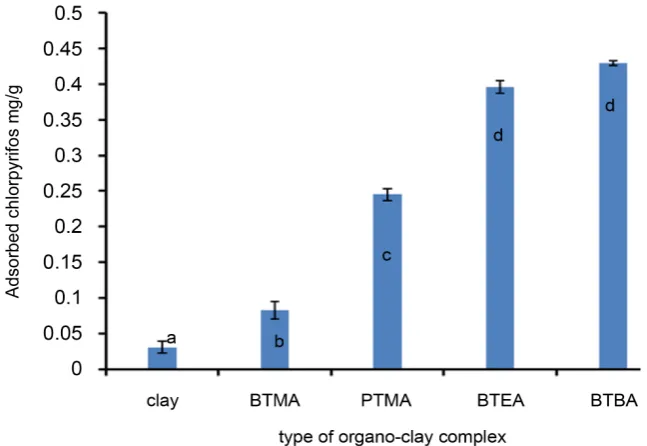
chlorpyrifos gave linear relationship. Regression analysis showed a correlation coeffi-cient (R2) of 0.998 indicating a strong positive association, validity and the suitability of the method used. Accordingly the linear equation was used to determine the concentra-tion of chlorpyrifos in the unknown samples in the supernatants by HPLC. Adsorpconcentra-tion of chlorpyrifos on the different clay and organo-clay complexes is shown in Figure 3. It demonstrates that a small amount of chlorpyrifos was adsorbed on unmodified clay similar results were previously reported [41] who revealed low adsorbed amount of chlorpyrifos on Montmorillonite.
[image:7.595.212.536.453.676.2]Modifying clay surfaces with different organic cations resulted in enhanced adsorp-tion. Moreover, modifying the clay surfaces with the largest organic cation (i.e. BTBA) resulted in further enhancement of chlorpyrifos adsorption. The explanation of these results is that the clay surface without modification has hydrophilic properties due to the presence of inorganic cations, whereas modification of the clay surfaces with or-ganic cations (e.g. PTMA) creates a micro-hydrophobic environment on the clay sur-face facilitating the adsorption of chlorpyrifos. Our results agree with Nir et al., [42] who revealed that pre adsorbing the clay minerals with aromatic organic cations en-hanced the adsorption of non ionic organic molecules from water. Further supports to our results come from the findings of Baglieri et al., [43] who reported similar pheno-mena in other cases. Moreover, modifying the clay surface with larger cations (e.g. BTBA) created a more hydrophobic environment on the clay surfaces hence more ad-sorption was observed. This suggestion is further supported by a study of Rubin et al. [44] who found that using hexadecyltrimethyl ammonium (HDTMA) created a hy-drophilic layer that allowed chlorophenols to be partitioned between water and the or-gano-clay according to log Kow value. Moreover, adsorption mechanisms of organic cations and clay surfaces are shown below.
3.2. Adsorption Mechanisms
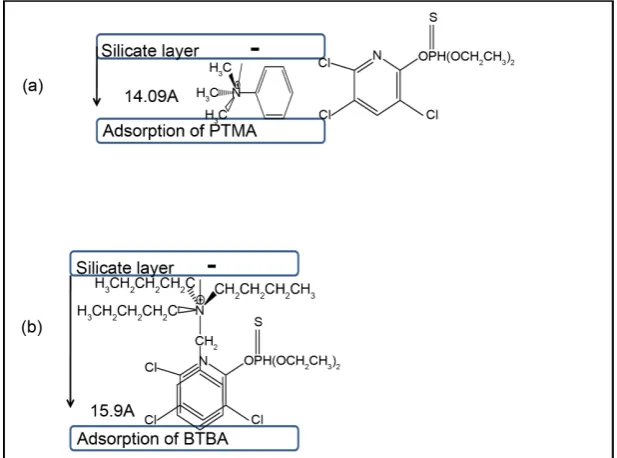
[image:8.595.219.528.444.673.2]XRD-Measurements showed that adsorption of PTMA, BTMA, BTEA and BTBA mo-lecules a loading of 0.5 mmol/g clay resulted in increasing the basal spacing of clay layers. For instance, the basal spacing is approximately 11.9 A in clay (no organic cationic ad-sorbed on clay surfaces). This result agrees with Mac Ewan and Wilson [45] who found similar basal spacing for Na+ Montmorillonite. Pre-adsorption of the clay mineral with a smaller organic cation (e.g PTMA), at 0.5 mmol/g clay increasing the basal spacing to 14.09 A, whereas using a larger organic cation BTBA, the basal spacing increased up to 15.9 A. These results agree with El-Nahhal [31] who found similar basal spacing for or-ganic cation adsorbed on Montmorillonite. These results suggest that the basal spacing is increased as the size of the aliphatic part of the organic cation increased (Figure 1). For instance, the nearly similar basal spacing of clay modified with PTMA or BTMA may due to the fact that the quaternary ammonium substituted with-CH3 in both cases. Modifying the clay surface with BTBT increased in the basal spacing, this is probably due to the fact that the quaternary ammonium saturated with three aliphatic groups (-CH2CH2CH2CH3). These groups may be oriented in different angles, accordingly tre-mendous increases in the basal spacing was observed. Consequently, modification of the clay surfaces with different organic cation may lead to the formation of micro-pores having different size according to the chemical structure and molecular size of the or-ganic cation and the degree of coverage of the surfaces. Accordingly, modifying the clay surface with a smaller size organic cation such as PTMA or BTMA, the phenyl rings and the aliphatic parts may be oriented parallel to clay layers (Figure 4) producing a smaller room (basal spacing). This position may not allow/maximize π-electrons to in-teract with chlorpyrifos through π-π interaction as obvious in Figure 4(a). Orientation
of PTMA molecules on montmorillonite surfaces was previously reported [46]. For the case of modifying the clay surfaces with BTBA a larger basal spacing was obtained due to the large size of BTBA and the orientation of aliphatic and aromatic rings. This position may allow/maximize π-electrons to interact with chlorpyrifos through π-π interaction as obvious in Figure 4(b). This situation may result in either formation of micro-pores on the clay surfaces that accommodate more molecules of chlorpyrifos or better interaction between the phenyl rings through π-π interaction and/or hydrogen bonding of pre-adsorbed organic cation and chlorpyrifos molecules. This suggestion is supported by the results of Stevens and Anderson [46] who highlighted the π-π interac-tions. Schematic diagram of Chlorpyrifos interaction with clay modified with a smaller organic cation (e.g. PTMA) and a larger organic cation (BTBA) is shown in Figure 4. It can be concluded that the interaction of chlorpyrifos with clay-PTMA seems weak due to the smaller basal spacing (Figure 4(a)) accordingly low adsorption was occur on clay-PTMA (Figure 3). At clay-BTBA (Figure 4(b)), the basal spacing is larger than the upper case accordingly the π-π interactions is freely occurred accordingly more adsorp-tion was observed (Figure 3). In addition hydrogen bonding may also influence the in-teraction between chlorpyrifos molecules and clay-PTMA due to a smaller basal spac-ing. In this case the aliphatic part of chlorpyrifos may have good position to interact with clay-PTMA accordingly high adsorption was occurred. This hypothesis was also supported by recent work of Olivella et al. [47] who emphasize the effects of π-π inte-raction, hydrogen bonding and hydrophobic effects as shown for the case of clay- PTMA (Figure 4(a)).
3.3. Adsorption Isotherms
Figure 5. Adsorption of chlorpyrifos on clay and organo-clays. Error bars represent standard deviations. Overlapping of error bars indicates no significant differences at 0.05 level.
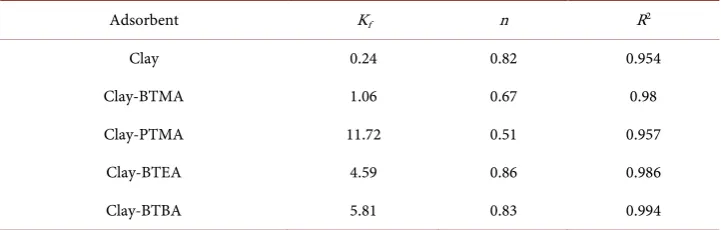
Table 1. Adsorption parameters of chlorpyrifos on clay and different organo-clays.
Adsorbent Kf n R2
Clay 0.24 0.82 0.954
Clay-BTMA 1.06 0.67 0.98
Clay-PTMA 11.72 0.51 0.957
Clay-BTEA 4.59 0.86 0.986
Clay-BTBA 5.81 0.83 0.994
clay alone to 11.72 in the clay modified with PTMA, clay modified with BTBA also showed a high value of Kf (5.81) indicating several magnitudes of adsorption capacity. The values of n are quite similar except Clay-PTMA and Clay-BTMA have lower values. The explanation for these variations is that the clay surfaces are not fully saturated with organic cation up to the cation exchange capacity. Therefore chlorpyrifos molecules tend to interact directly with clay surfaces through water bridges as demonstrated in previous studies [32] and with organic cation in the clay surface. In these cases the in-teraction tends to occur via π-π interactions with phenyl rings due to the smaller size of the cations. El-Nahhal et al., [50] demonstrated the effects of smaller molecular size of the organic cations in further enhancing the removal of organic molecules from water systems via adsorption. In addition further elaboration of the interactions on the clay surfaces are given below in the FTIR section.
[image:10.595.193.554.303.418.2]Figure 6. FTIR results. Chlorpyrifos in its free form (top left), adsorbed to clay (top right), adsorbed to clay-BTBA (bottom left) and adsorbed to clay-PTMA (bottom right). Unit of wave number is cm−1.
cm−1 (clay-PTMA); 2) the peak at 1410.152 cm−1 in the free form of chlorpyrifos disap-peared in clay, shifted to higher wave numbers at 1471.624, with an inverted peak at 1450 (clay-BTBA), and 1489.571 cm−1 with another peak at 1412 cm−1. These shifts in-dicate that pyridyl group of chlorpyrifos molecules interact more strongly with the phenyl ring of the organo-clay complex. Moreover, the hydrophobic side-chain groups (CH3-CH2-)2 of the chlorpyrifos molecule reflect with the CH3-(e.g. PTMA, BTMA); CH3-CH2-(e.g. BTEA); or CH3-CH2-CH2-CH2 (e.g BTBA). The effect is more strong in the case of Clay-BTBA due to more hydrophobic interaction. In the case of clay alone, the interaction seems to be via hydrophilic interaction through water molecule bridge (hydrogen bonding between P-O-H-O-clay). Regardless to the fact that the shift seem to be large but is is a hydrophilic interaction and immediately become very week under more hydrophilic environment (aqueous solution) accordingly more leaching was onserbed with clay formulations. Our results agree with Schmidt et al., [52] who revealed higher shifts due to the hydrophobic side-chain groups interaction with other molecules. The disappearance of the peak at 1410.152 cm−1 when chlorpyrifos interacts with the clay surface without modification indicates disappearance of the π-π interac-tion and/or hydrophobic interacinterac-tion. In accord with the data in Figure 4. Modifying the clay surface with PTMA or BTBA resulted in large shifts to higher wave numbers with appearance of other peaks indicating strong interaction. These results are sup-ported by the larger adsorbed amount of chlorpyrifos on organo-clays than clay with-out modification. More support for our results comes from the recent work of Olivella
et al. [47] who emphasized the effects of π-π interaction, hydrogen bonding and
hy-drophobic effects as shown for the case of clay-PTMA (Figure 4(a)).
[image:12.595.245.504.487.677.2]3.5. Release and Leaching Potential of Chlorpyrifos in Soil Columns
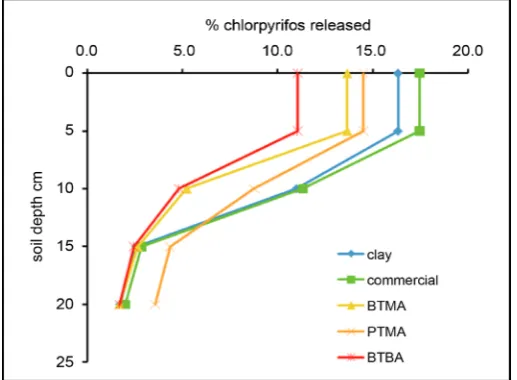
Release and leaching potential of chlorpyrifos from the different formulations in soil columns are shown in Figure 7 and Figure 8. The HPLC determination of the releaseFigure 8. Bioassay determination of released fraction of chlorpyrifos from different formulations in sandy soil in Gaza.
re-stricting chlorpyrifos release and leaching potential.
The differences between the data of HPLC determination (Figure 7) and bioassay determination (Figure 8) can be explained by the fact that HPLC can only quantify the concentration of chlorpyrifos in the soil layer, whereas bioassay detects the effect cor-responding to the concentration. Moreover, the response also depends on the sensitivi-ty of the tested organism. Concentrations determined by chemoassay usually differ from those obtained by bioassay due to variability in the sensitivity of the tested organ-isms, age of the organorgan-isms, testing conditions and precision of the methods used. However, our results agree with previous reports [31], [33] who found 10% - 15% dif-ference between bioassay and chemoassay for determination of herbicide concentra-tions in soil profiles. Leaching depth has the following order Clay-BTBA < Clay-BTMA < Clay-PTMA < Com < Clay.
Its is of great importance to mention that toxicity tests of organo-clay without chlor-pyrifos to mosquitoes showed no mortality during the experimental period.
4. Conclusions
This study presents an attempt to develop a controlled release formulation of chlorpy-rifos to reduce leaching of the compound into soil and water. Our approach involved the following aspects:
1) Modification of the clay surface from hydrophilic to hydrophobic by pre-adsorb- ing to it an organic cation whose structure would enable optimal interactions between chlorpyrifos molecules and the surface sites of the organo-clay complexes.
2) Optimizing the interaction of chlorpyrifos molecules with the organic cation on the clay surface through selection of the suitable organic cation that has chemical structure able to match the targeted molecule (chlorpyrifos) and optimize the clay sur-face coverage of organic cation.
The amounts of chlorpyrifos adsorbed on the organo-clay complexes followed the sequence BTBA = PTMA > BTEA > BTMA > clay. Basal spacing results emphasize the formation of suitable micro-porse for accommodation of chlorpyrifos molecules.
Release and leaching potential of chlorpyrifos were reduced when formulated with organo-clay complexes according to the sequence of its adsorption. Clay-BTBA showed the best advantages (large adsorption, strong interaction, and best micro-pores fit) among the tested organoclay complexes. HPLC and bioassay techniques were effective and strong tools for determination of release and leaching potential of chlorpyrifos in soil.
The results of this study confirm that organo-clay formulations of chlorpyrifos re-duce leaching of this insecticide into soil and water, and therefore have the potential to reduce its negative impacts on human health and the environment.
Acknowledgements
at Kiel University, Prof. G. Shourrmman, and Dr. U. Schocknechet at BAM, Germany. Special thanks go to Mrs. Julie Webb.
References
[1] Tomlin, C.D.S. (2006) The Pesticide Manual, A World Compendium, 14th Edition British Crop Protection Council. Alton, Hampshire, 186-187.
[2] El-Nahhal, Y. (2004) Contamination and Safety Status of Plant Food in Arab Countries.
Journal of Applied Science, 4, 411-417. http://dx.doi.org/10.3923/jas.2004.411.417
[3] Phillips, P.J. and Bode, R.W. (2004) Pesticides in Surface Water Runoff in South-East New York State, USA: Seasonal and Storm Flow Effects on Concentrations. Pest Management Science, 60, 531-543.
[4] Becker, K., Seiwert, M., Angerer, J., Kolossa-Gehring, M., Hoppe, H.W., Ball, M., Schulz, C., Thumulla, J. and Seifert, B. (2006) GerES IV Pilot Study: Assessment of the Exposure of German Children to Organophosphorus and Pyrethroid Pesticides. International Journal of Hygiene and Environmental Health, 209, 221-233.
[5] Rahmanikhah, Z., Abbas, E.S., Bahramifar, N. and Bousjien, Z.Sh. (2010) Organophos-phorous Pesticide Residues in the Surface and Ground Water in the Southern Coast Wa-tershed of Caspian Sea Iran. World Applied Sciences Journal, 9, 160-166.
[6] Angioni, A., Dedola, F., Garau, A., Sarais, G., Cabras, P. and Caboni, P. (2011) Chlorpyrifos Residues Levels in Fruits and Vegetables after Field Treatment. Journal of Environmental Science and Health. Part B, 46, 544-549.
[7] Schecter, A., Papke, O., Isaac, J., Hrimat, N., Neiroukh, F., Safi, J. and El-Nahhal, Y. (1997) 2,3,7,8 Chlorine Substituted Dioxins and Dibenzofuran Congeners in 2,4-D, 2,4,5-T and Pentachlorophenol. Organohalogen Compounds, 32, 51-55.
[8] Harnly, M., McLaughlin, R., Bradman, A., Anderson, M. and Gunier, R. (2005) Correlating Agricultural Use of Organophosphates with Outdoor Air Concentrations: A Particular Concern for Children.Environmental Health Perspectives, 113, 1184-1189.
[9] Zhong, G., Xie, Z., Cai, M., Moller, A., Sturm, R., Tang, J., Zhang, G., He, J. and Ebinghaus, R. (2012) Distribution and Air-Sea Exchange of Current-Use Pesticides (CUPs) from East Asia to the High Arctic Ocean. Environmental Science & Technology, 46, 259-267.
http://dx.doi.org/10.1021/es202655k
[10] Garbarino, J.R., Snyder-Conn, E., Lieker, T.J. and Hoffman, G.L. (2002) Contaminants in Arctic Snow Collected over Northwest Alaskan Sea Ice. Water, Air, & Soil Pollution, 139, 183-214. http://dx.doi.org/10.1023/A:1015808008298
[11] Hore, P., Robson, M., Freeman, N., Zhang, J., Wartenberg, D., Ozkayna, H., Tulve, N., Sheldon, L., Needham, L., Barr, D. and Lioy, P.J. (2005) Chlorpyrifos Accumulation Pat-terns for Child-Accessible Surfaces and Objects and Urinary Metabolite by Children for 2 Weeks after Crack-and-Crevice Application. Environmental Health Perspectives, 113, 211-219. http://dx.doi.org/10.1289/ehp.6984
[12] Morgan, M.K., Sheldon, L.S., Croghan, C.W., Jones, P.A., Robertson, G.L., Chuang, J.C., Wilson, N.K. and Lyu, C.W. (2005) Exposures of Preschool Children to Chlorpyrifos and Its Degradation Product 3,5,6-Trichloro-2-Pyridinol in Their Everyday Environments.
Journal of Exposure Analysis and Environmental Epidemiology, 15, 297-309.
http://dx.doi.org/10.1038/sj.jea.7500406
[13] Safi, J., Abu Foul, N., El-Nahhal, Y. and El-Sebae, A. (2002) Monitoring of Pesticide Resi-dues on Cucumber, Tomatoes and Strawberries in Gaza Governorates, Palestine. Nahrung/
http://dx.doi.org/10.1002/1521-3803(20020101)46:1<34::AID-FOOD34>3.0.CO;2-W
[14] Safi, J., Awad, Y. and El-Nahhal, Y. (2014) Bioremediation of Diuron in Soil and by Cya-nobacterial Mat. American Journal of Plant Sciences, 5, 1081-1089.
http://dx.doi.org/10.4236/ajps.2014.58120
[15] Schecter, A., Papke, O., Ryan, J., Furst, P., Isaac, J., Hrimat, N., Neiroukh, F., Safi, J., El-Nahhal, Y., Abu El-Haj, S., Avni, A., Richter, E., Chuwers, P. and Fischbein, A. (1997) Dioxins, Dibenzofurans and PCBs in Human Blood, Human Milk and Food from Israel, The West Bank and Gaza. Organohalogen Compounds, 33, 457-461.
[16] Anderson, T.D. and Lydy, M.J. (2002) Increased Toxicity to Invertebrates Associated with a Mixture of Atrazine and Organophosphate Insecticides. Environmental Toxicology and Chemistry, 21, 1507-1515. http://dx.doi.org/10.1002/etc.5620210724
[17] USEPA (US Environmental Protection Agency) (2011) Chlorpyrifos Facts.
http://www.epa.gov/oppsrrd1/REDs/factsheets/chlorpyrifos_fs.htm
[18] Belden J.B., Gilliom, J.R. and Lydy, J.M. (2007) How Well Can We Predict the Toxicity of Pesticide Mixtures to Aquatic Life. Integrated Environmental Assessment and Manage-ment, 3, 364-372. http://dx.doi.org/10.1002/ieam.5630030307
[19] Jin, Y., Liu, Z., Peng, T. and Fu, Z. (2015) The Toxicity of Chlorpyrifos on the Early Life Stage of Zebrafish: A Survey on Endpoints at Development, Locomotor Behavior, Oxidative Stress and Immunotoxicity. Fish & Shellfish Immunology, 43, 405-414.
http://dx.doi.org/10.1016/j.fsi.2015.01.010
[20] Kais, B., Stenel, D., Batel, A. and Braunbech, T. (2015) Acetylcholinesterase in Zebrafish Embryos as a Tool to Identify Neurotoxic Effects in Sediments. Environmental Science and Pollution Research International, 22, 16329-16339.
http://dx.doi.org/10.1007/s11356-014-4014-1
[21] EL-Nahhal, Y., EL-Najjar, Sh. and Afifi, S. (2015) Impact of Organic Contamination on Some Aquatic Organisms. Toxicology International, 22, 45-53.
http://dx.doi.org/10.4103/0971-6580.172256
[22] El-Nahhal, Y. (2016) Biochemical Changes Associated with Long Term Exposure to Pesti-cide among Farmers in the Gaza Strip. Occupational Diseases and Environmental Medi-cine, 4, 72-82. http://dx.doi.org/10.4236/odem.2016.43009
[23] Sindi, R.A., Harris, W., Arnott, G., Flaskos, J., Lloyd Mills, C. and Hargreaves, A.J. (2016) Chlorpyrifos- and Chlorpyrifos Oxon-Induced Neurite Retraction in Pre-Differentiated N2a Cells Is Associated with Transient Hyperphosphorylation of Neurofilament Heavy Chain and ERK 1/2. Toxicology and Applied Pharmacology, 308, 20-31.
http://dx.doi.org/10.1016/j.taap.2016.08.008
[24] Želježić, D., Mladinić, M., Žunec, S., LucićVrdoljak, A., Kašuba, V., Tariba, B., Živković, T., Marjanović, A.M., Pavičić, I., Milić, M., Rozgaj, R. and Kopjar, N. (2016) Cytotoxic, Geno-toxic and Biochemical Markers of Insecticide Toxicity Evaluated in Human Peripheral Blood Lymphocytes and an HepG2 Cell Line. Food and Chemical Toxicology, 96, 90-106.
http://dx.doi.org/10.1016/j.fct.2016.07.036
[25] Chen, S., Chen, M., Wang, Z., Qiu, W., Wang, J., Shen, Y., Wang, Y. and Ge, S. (2016) Tox-icological Effects of Chlorpyrifos on Growth, Enzyme Activity and Chlorophyll a Synthesis of Freshwater Microalgae. Environmental Toxicology and Pharmacology, 45, 179-186.
http://dx.doi.org/10.1016/j.etap.2016.05.032
[26] MoA (Ministry of Agriculture) (2013) Department of Plant Protection. Annual Report, Gaza.
http://dx.doi.org/10.1007/s00396-004-1244-7
[28] El-Nahhal, Y., Nir, S., Polubesova, T., Margulies, L. and Rubin, B. (1997) Organo-Clay Formulations of Alachlor: Reduced Leaching and Improved Efficacy. Proceedings of Brighton Crop Protection Conference, Brighton, November 1997, 21-26.
[29] El-Nahhal, Y. (2003) Adsorptive Behavior of Acetochlor on Organoclay Complexes. Bulle-tin of Environmental Contamination and Toxicology, 70,1104-1111.
http://dx.doi.org/10.1007/s00128-003-0096-z
[30] El-Nahhal, Y. (2002) Adsorptive of Chlorpyrifos on Organoclay Complexes: Influence of Salt Concentration. In: Ottner, F. and Gier, S., Eds., Berichte der Deutschen Ton-und To nmineralgruppe e. V, Band 9, Beitrage zur Jahrestagung, Wien, 17-30.
[31] El-Nahhal, Y. (2003) Adsorption Mechanism of Chloroacetanilide Herbicides to Modified Montmorillonite. Journal of Environmental Science and Health Part B, 38, 591-604.
http://dx.doi.org/10.1081/PFC-120023517
[32] El-Nahhal, Y., Nir, S., Polubesova, T., Margulies, L. and Rubin, B. (1998) Leaching, Photo-toxicity and Weed Control of New Formulation of Alachlor. Journal of Agricultural and Food Chemistry, 46, 3305-3313. http://dx.doi.org/10.1021/jf971062k
[33] El-Nahhal, Y., Lagaly, G. and Rabinovitz, O. (2005) Organo-Clay Formulations of Ace-tochlor: Effect of High Salt. Journal of Agricultural and Food Chemistry, 53, 1620-1624.
http://dx.doi.org/10.1021/jf040383a
[34] El-Nahhal, Y. (2003) Persistence, Mobility, Efficacy and Safety of Chloroacetanilide Herbi-cide Formulation under Field Conditions. Environmental Pollution, 124, 33-38.
http://dx.doi.org/10.1016/S0269-7491(02)00431-1
[35] El-Nahhal, Y. (2004) Leaching Behavior of Metolachlor in Soil. Journal of Environmental Engineering & Science, 3, 187-194. http://dx.doi.org/10.1139/s03-075
[36] El-Nahhal, Y., Abadsa, M. and Affifi, S. (2014) Leaching Potential of Diuron and Linuron in Gaza Soils. American Journal of Plant Sciences, 5, 4040-4049.
http://dx.doi.org/10.4236/ajps.2014.526422
[37] El-Nahhal, Y., EL-dahdouh, N., Hamdona, N. and Alshanti, A. (2016) Toxicological Data of Some Antibiotics and Pesticides to Fish, Mosquitoes, Cyanobacterial Mats and to Plants.
Data in Brief, 6, 871-880. http://dx.doi.org/10.1016/j.dib.2016.01.051
[38] EL-Nahhal, Y., Kerkez, M.F.S. and Abu Heen, Z. (2015) Toxicity of Diuron, Diquat and Terbutryn Cyanobacterial Mats. Ecotoxicology and Environmental Contamination, 10, 71- 82. http://dx.doi.org/10.5132/eec.2015.01.11
[39] Nir, S., El-Nahhal, Y., Undabeytia, T., Rytwo, G., Polubesova, T., Mishael, Y., Rabinovitz, O. and Rubin, B. (2006) Clays and Pesticides. In: Bergaya, F., Theng, B.K.G. and Lagaly, G., Eds., Handbook of Clay Science,Elsevier, Amsterdam, 677-691.
http://dx.doi.org/10.1016/S1572-4352(05)01021-4
[40] El-Nahhal, Y. and Safi, J. (2004) Adsorption Behavior of Phenanthrene on Organoclays under Different Salinity Levels. Journal of Colloid and Interface Science, 269, 265-273.
http://dx.doi.org/10.1016/S0021-9797(03)00607-6
[41] Suciu, N.A. and Capri, E. (2009) Adsorption of Chlorpyrifos, Penconazole and Metalaxyl from Aqueous Solution by Modified Clays. Journal of Environmental Science and Health Part B, 44, 525-532. http://dx.doi.org/10.1080/03601230902997543
http://dx.doi.org/10.1021/es9903781
[43] Baglieri, A., Nègre, M., Trotta, F., Bracco, P. and Gennari, M. (2013) Organo-Clays and Nanosponges for Acquifer Bioremediation: Adsorption and Degradation of Triclopyr.
Journal of Environmental Science and Health Part B, 48, 784-792.
http://dx.doi.org/10.1080/03601234.2013.780943
[44] Rubin, B., El-Nahhal, Y., Nir, S. and Margulies, L. (2000) Slow Release Formulations of Pes-ticides. US Patent No. 6,261,997.
[45] MacEwan, C. and Wilson, J. (1980) Interlayer and Intercalation Complexes of Clay Miner-als. In: Brindley, G.W. and Brown, G., Eds., Crystal Structures of Clay Minerals and Their X-Ray Identification, Mineralogical Society, London, 197-248.
[46] Stevens, J.J. and Anderson, S.J. (1996) Orientation of Trimethylphenylammonium (TMPA) on Wyoming Montmorillonite: Implications for Arene Sorption. Clays and Clay Minerals, 44, 132-141. http://dx.doi.org/10.1346/CCMN.1996.0440112
[47] Olivella, M.A., Bassicaupi, C., Bianchi, A., Fiol, N. and Villaescusa, I. (2015) New Insights into the Interactions between Cork Chemical Components and Pesticides. The Contribu-tion of π-π InteracContribu-tions, Hydrogen Bonding and Hydrophobic Effects. Chemosphere, 119, 863-870. http://dx.doi.org/10.1016/j.chemosphere.2014.08.051
[48] Jaynes, W.F. and Boyd, S.A. (1991) Clay Mineral Type and Organic Compound Sorption by hexadecyltrimethylammoium-Exchanged Clays. Soil Science Society of America Journal, 55, 43-48. http://dx.doi.org/10.2136/sssaj1991.03615995005500010007x
[49] El-Nahhal, Y. and Safi, J. (2005) Adsorption of Benzene and Naphthalene to Modified Montmorillonite. Journal of Food, Agriculture and Environment, 3, 295-298.
[50] El-Nahhal, Y., Nir, S., Serban, C., Rabinovitch, O. and Rubin, B. (2000) Montmorillo-nite-Phenyltrimethylammonium Yields Environmentally Improved Formulations of Hy-drophobic Herbicides. Journal of Agricultural and Food Chemistry, 48, 4791-4801.
http://dx.doi.org/10.1021/jf000327j
[51] Armenta, S., Quintas, G., Grrigues, S. and de la Guadia, M. (2005) A Validated and Fast Procedure for FTIR Determination of Cypermetherin and Chlorpyrifos. Talanta, 67, 634- 639. http://dx.doi.org/10.1016/j.talanta.2005.03.008
[52] Schmidt, P., Dybal, J. and Trchova, M. (2006) Investigations of the Hydrophobic and Hy-drophilic Interactions in Polymer-Water Systems by ATR FTIR and Raman Spectroscopy.
Vibrational Spectroscopy, 42, 278-283. http://dx.doi.org/10.1016/j.vibspec.2006.05.005
[53] Shah, R.M., Alam, M., Ahmad, D., Waqas, M., Ali, Q., Binyamin, M. and Shad S.A. (2016) Toxicity of 25 Synthetic Insecticides to the Field Population of Culex quinquefasciatus Say.
Submit or recommend next manuscript to SCIRP and we will provide best service for you:
Accepting pre-submission inquiries through Email, Facebook, LinkedIn, Twitter, etc. A wide selection of journals (inclusive of 9 subjects, more than 200 journals)
Providing 24-hour high-quality service User-friendly online submission system Fair and swift peer-review system
Efficient typesetting and proofreading procedure
Display of the result of downloads and visits, as well as the number of cited articles Maximum dissemination of your research work