http://dx.doi.org/10.4236/me.2016.75058
A Strategy-Oriented Enterprise Internal
Audit Organizational Structure
—Based on Case Study of CPIC
Puying Kuang
School of Management, Jinan University, Guangzhou, China
Received 11 April 2016; accepted 13 May 2016; published 16 May 2016
Copyright © 2016 by author and Scientific Research Publishing Inc.
This work is licensed under the Creative Commons Attribution International License (CC BY). http://creativecommons.org/licenses/by/4.0/
Abstract
This paper takes China Pacific Insurance (Group) Co., Ltd. (“CPIC”) as an example. According to the three turning points, from its going public at 2007 to its strategic change at 2010 and to the last whole audit organizational structure, this paper is detailed to introduce the development and ad-justment of CPIC’s internal audit organizational structure (hereinafter referred to as IAOS) as the change of corporate strategy. Moreover, it examines the advantages and disadvantages of present internal audit organizational structure both from governance layer and management layer. This paper also provides several practical advice on the problems existing in current internal audit or-ganizational structure.
Keywords
Corporate Strategy, Internal Audit, Organizational Structure
1. Introduction
said to be necessary for organizational structure to transform according to the adjustment of corporate strategy [4]. Naturally, as one part of corporate organizational structure, IAOS should continually adjust to adapt to stra-tegic change. Thus, it can make its supervision work.
This paper mainly focuses on China Pacific Insurance (Group) Co., Ltd. (here after called “CPIC”) to illu-strate the relationship between corporate illu-strategy and internal audit organizational structure. CPIC is an insur-ance group, whose major business contains property insurinsur-ance, life insurinsur-ance, asset management, endowment insurance, health insurance, and agricultural insurance. In recent years, the group has been committed to the company’s internal audit construction. With the enterprise group’s strategic transformation, audit organizational structure reforms constantly too, striving to build a professional, efficient and stimulating audit team. So the re-mainder of this paper is organized as follows. Section 2 relates the theory of IAOS. Section 3 describes the cur-rent IAOS of CPIC, analyzing the merits and demerits, and Section 4 concludes.
2. Internal Audit Organizational Structure
In 2009, China Institute of Internal Audit published a report named “The development and research report of China’s state-owned enterprise internal audit”. It released that the IAOS of Chinese enterprise group is generally becoming more diverse, dividing into centralized management mode, hierarchical management mode, vertical management mode, and vertical-hierarchical management and so on. However, which kind of mode is the best to Chinese enterprise group? Under centralized management mode and vertical management mode, audit institu-tion and auditor are in the control of head office [5]. They implement the mode “from high to low” to their sub-ordinate units. This audit organizational structure is a perfect choice because of its strong independence; while others confirm that vertical management mode is better than other modes [6].
The IAOS in enterprise group mainly involves two aspects. One is governance layer, and the other is man-agement layer. Governance layer usually means the relationship between audit institution and board of supervi-sors, board of directors, general manager, deputy manager, CFO (Chief Finance Officer), which we can call au-diting mode. There are five kinds mode in common among existing companies. First one, audit institution be-longs to general manager; second one, audit institution bebe-longs to accounting department or vice manager; third one, it belongs to board of directors; fourth, it belongs to board of supervisors; fifth, set up the audit committee under the board, leading the auditing department with board of directors together. As the first two kinds have poor independence, current enterprises in China mostly choose the third mode and the last mode.
Management layer refers to the problems of setting up the audit institution. Among enterprise groups, audit institution setup, on the one hand, involves group headquarters setup and audit institution setup of subordinate units, and relates to the relationship between these two institutions.
Different classification standards, different audit institutions setup. According to audit function, audit institu-tion includes audit division, supervision division, risk management division; depending on engagement types, such as financial audit division, infrastructure auditing division; classified by business segment, audit institution may be power division, manufacturing division, financial division.
From the relationship between the group and subordinate audit institution, groups usually choose level-to- level management, composed of two-level management and three-level management. Three-level management means group, subsidiaries, and Grandchildren Company all have audit institution; Two-level management is that Grandchildren Company doesn’t set up an audit institution. Moreover, three kinds of management types are contained. First, all levels of agency chiefs and auditors decide their own selection by themselves but they are just not independent on business, called completely hierarchical management. Second, based on hierarchical management, the selection of head officers in the subordinate audit organ is in the charge of the superior one. Another kind is appointed by audit manager. That is to say, enterprise group directly decide who is the head of subordinate audit institution.
3. Case Study
3.1. Strategic Objectives and Audit Organization Structure of CPIC
Before CPIC’s listing in 2007, the group strategically targeted “product/marketing orientation” and had a single business. That “everyone sweeps his area” is the real attributes of the group headquarter and branches. Integral consciousness and ideas of overall situation could not be found in branches. Instead, they attached much impor-tance on their sales performance. As for audit organization system, CPIC implemented the typical hierarchical management mode. Both the group and branch set up an audit institution that is responsible for auditing work and is in the charge of not only its own company but superior audit institution.
After the financial crisis of 2008, however, in order to be able to stand out in a new market environment, CPIC had to excavate new strategies to serve the customers better. After it is listed on stock exchange, taking the way of multi-region and multi-service, CPIC also put forward the “insurance focus and sustained growth of business value”. With this new development strategy, it launched the reform of organization structure and adopted centralized management mode.
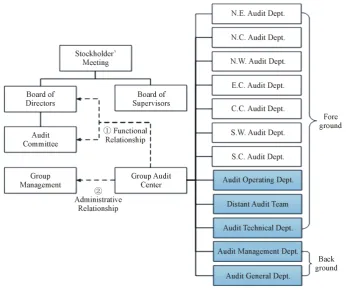
[image:3.595.140.487.418.709.2]On the aspect of audit work, the hierarchical mode can no longer bear the audit mission, such as controlling, supervision, improving the operational efficiency of the company. The audit institution in CPIC then built the group auditing center to audit Subsidiary Corporation, Branch Company and Center Support Company, and the group was audited by external auditor. In addition, different from before, setting up an audit committee (see
Figure 1) under the board of directors strengthened the independence and authority of internal audit, providing
an important safeguard for the implementation of the sustainable growth strategy.
At the end of 2010, given the rapid development of finance and insurance industry, CPIC first proposed a comprehensive transformation from “product/marketing orientation” to “customer’s demand orientation”. But this reform didn’t change the organization structure.
Since 2011, having learned from international auditing technology and auditing practice, CPIC first looked forward an independent, concentrated, and specialized internal audit management system (see Figure 1). 1) “Relatively independent” governance framework; setting up an audit committee under the board of directors leads to a dual management and responsibility system. The audit committee approves budget and staffing, while
resource allocation and audit work are in the charge of the management layer; 2) “highly centralized” internal audit management system; individual branches abolished their original internal auditing apartment, instead of which, the group established an audit center and built seven auditing apartments for audit supervision among seven central cities; 3) “process-driven and front-back stage decoupling” specialization mode; all departments were classified by business process, including front and back offices.
3.2. Analysis of the Current Audit Organization Structure’s Merits
For audit mode, audit committee under the board of directors consists of independent directors. Internal audit in-stitution reports to management and board of directors at the same time. On the relationship of the executive au-thorities, the group is the top leader who guides the management, decides internal audit work and reports to the group management administratively according to company’s needs. Furthermore, internal audit institution must receive the functional supervision of audit committee, thus it can be in touch with board of directors without limit. It is by audit committee not the group management that controls all auditors’ recruitment, appointment, compensation and other matters, both ensuring higher authority and auditing independence. Nevertheless, if in-dependent director isn’t good at auditing and is too busy to focus on audit work, audit committee cannot work anymore.
From the management level, the audit organization system eventually transformed from hierarchical man-agement mode to vertical manman-agement mode based on company’s strategic adjustment from “product and sale” to “management and service”. This vertical management mode that group leads all audit apartments has many advantages: 1) Save the audit resources and improve the audit quality. Setting up a unified audit center only greatly simplifies apartment structure, which centralizes audit resources fully and reduced the audit cost in the meantime; 2) Externalize and normalize the internal audit work, covering the whole audit work. The Pacific has implemented 100% audit coverage every year on branches and every three years on agencies with its one group audit center and 11 divisions. Both traditional audit supervision and evaluation function, and its organization management function has been fully made use of, meanwhile, the mode also strengthens the internal audit func-tion and avoids audit agencies’ substituting for internal audit; 3) Show the will of trustees or owners. The vertic-al mode is easy to form a concerted management idea, to enhance the group leadership and the cohesion of or-ganization, to sufficiently express the will to manage of trustees; 4) Systematize the internal audit institution and avoid repetitive power. Refraining from work conflict led by overlapping functions, every auditing apartment or every single auditor has their own audit objects so that internal audit institution cannot be useless.
4. Conclusion and Innovation
4.1. Conclusion
To conclude, there are two problems existing in CPIC. From foreground to background, CPIC has 13 auditing apartments in total, realizing specialty division. Its audit work spends a lot for CPIC to own 127 auditors just in foreground during this age of big data with high information technology and network. So, first of all, simplify-ing the auditsimplify-ing apartments is necessary, such as replace the humans by information system. Second, for CPIC, 2014 is the key year to implement the strategic reform of “customer’s demand orientation”. To insure the im-plement of the organizational strategy, the audit center should assess the group’s economic transition by follow-ing the strategic objective.
4.2. Cost-Utility Ratio and Decentralize the Power
Alfred D. Chandler once mentioned in his book “maybe we can define organization objects just like use the least labor to gain the best result”. That is to say, CPIC should stand at organizational goals’ height and attach more significance on reducing the audit cost and improving the audit efficiency while it is seeking standout achieve-ments on innovation.
targets by business lines. In other words, designate distinctive auditors by various types of insurance because of the same process of business disposal among the same insurance.
All in all, this innovative method that appoint special auditor under every area audit institution can extremely enhance audit quality and audit efficiency. Comparing to vertical management mode, the combination of vertical and hierarchical management mode is conducive to execute “participatory” auditing. Moreover, it provides high pertinence and professionalism, lessening excessive centralization effectively. Also, with respect to hierarchical management mode, the independence and objectivity of internal audit are guaranteed, and the management of internal audit is more centralized too.
References
[1] Chandler, A.D. (1962) Strategy and Structure: Chapters in the History of Industrial Enterprise. MIT Press, New York.
[2] Feng, M. (2012) Influence Factors of Matching Strategy and Structure. Management World, No. 2, 73-74.
[3] Feng, M. (2014) The Effects on Matching Strategy and Structure to Emerging Market Company. Nankai Business Re-view, No. 6, 63-71.
[4] Zheng, H.L. (2014) Organizational Structure Adjustment According to Enterprise’s Strategy-Based on ACase Study of Foreign Telecom Operators. Journal of Nanjing University of Posts and Telecommunications (Social Sciences), No. 4, 43-47.
[5] Zhao, Z.Y. (2013) Thinking on the Internal Audit Organization System’s Reform and Effect in Central Enterprises. Research of Finance and Accounting, No. 8, 63-64.