http://dx.doi.org/10.4236/msa.2013.412A002
Performance of Cement for Immobilizing Strontium Waste
in Saline Environment
Susetyo Hario Putero*, Widya Rosita
Department of Engineering Physics, Universitas Gadjah Mada, Yogyakarta, Indonesia. Email: *[email protected]
Received October 1st, 2013; revised November 21st, 2013; accepted December 7th, 2013
Copyright © 2013 Susetyo Hario Putero, Widya Rosita. This is an open access article distributed under the Creative Commons At- tribution License, which permits unrestricted use, distribution, and reproduction in any medium, provided the original work is prop- erly cited.
ABSTRACT
For solving the radioactive waste storage problem, there is an idea to store immobilized waste at deep sea. Solidifier material, such as cement should be resistance to saline environment for deep sea storage. So, this research objective is to study the performance of cementation method in immobilizing strontium waste in saline environment. Research was conducted by immobilizing strontium waste using Portland pozzolanic cement, white cement and composite Portland cement. Cement, 65 ppm Sr(NO3)2, sand and water were mixed and cast. Strontium waste varied in 2 v/o, 4 v/o, 6 v/o and 8 v/o. After 28 days curing, the cement block’s compressive strength and leaching rate on saline water were ana- lyzed. Determination of compressive strength was done by using Universal Wood Testing. The density of blocks was measured by picnometer at 25˚C. Compressive strength test for Portland pozzolanic cement at various w/c was conducted to confirm the effect of w/c in increasing the strength. For testing strontium leaching rate in water containing 35 ppm NaCl, cement blocks have been immersed in saline water for 21 days. 25 ml samples were taken and analyzed by Atomic Absorption Spectrophotometer. Strontium leaching rate on block containing pH 9 of waste was compared to the previous research data of strontium leaching rate on water to know the effect of saline water. To adjust the pH, 1 M NaOH was added into the waste. Effects of various cement type and filler materials (sand, zeolite and baryte) on Portland pozzolanic cement were also compared. The results show that there were almost no effects of salt on im- mobilized strontium waste, except in pH 9 waste (0.00224 over to 0.000199 g/cm2·days). Strontium leaching rates on all cemented waste still meet the IAEA’s standard, so the safety of cemented strontium waste disposal at saline environment could be ensured.
Keywords: Strontium Waste; Immobilization; Cement; Saline Environment
1. Introduction
At present, we are facing up to energy problem, espe- cially in the developing countries where many industries are developed. Industries need a stable energy supply that is generated from fossil based power plant up to now and hence, the environmental degradation is becoming the big problem. In the other hand, instability is the main problem of renewable energy. Regarding to these prob- lems, nuclear power plant becomes the only one choice in the frame of sustainable development.
A big problem in the utilization of nuclear power plant is the presence of radioactive waste that has to be stored on an ultimate disposal place for a very long time. To
finding a proper place for ultimate disposal that meets the standard is not easy, because that place has to have:
Minimum permeability;
Maximum flow dispersion;
Minimum rock gaps;
Minimum heat interference;
Maximum ion restraining capacity.
But, the main problem is the social one called NIMBY (not in my back yard) problem. To overcome this prob- lem, there is an idea to store immobilized radioactive waste into the deep sea [1]. The essence of immobili- zation is waste solidification by mixing waste with a so- lidifier material in order to protect the environment from radionuclide release. One method of immobilization is cementation.
Cement used as a solidifier is a hydraulic cement con- taining SiO2, CaO, Al2O3 and small amounts of MgO, Fe2O3, SO3. There are several types of cement, such as Portland cement, composite Portland cement, white ce- ment and pozzolanic cement. Portland cement is the most commonly used cement in many constructions, which does not need special treatment. This type contains 55% C3S (3CaO·SiO2), 19% C2S (2CaO·SiO2), 10% C3A (3CaO·Al2O3), 7% C4AF (4CaO·Al2O3·Fe2O3), 2.8% MgO, 2.9% SO3, 1% ignition loss and 1% free CaO·Ca(OH)2 and calcium silicate hydrate (CSH-tober- morite) are produced by the reaction of two calcium sili- cates compound of cement (C3S and C2S) with water. Portland cement added with some additives, gypsum for instance, is called composite Portland cement that is used in the UK for immobilized intermediate level waste (ILW) [2]. The heat of hydration in composite Portland cement is lower than Portland cement, and hence it per- mits using safely for large volume. White cement is formed from 24.2% SiO2, 4.2% Al2O3, 0.39% Fe2O3, 65.8% CaO, 1.1% MgO and 0.02% Mn2O3. Pozzolanic material is composed of SiO2, Al2O3, Fe2O3, MgO and SO3. To form pozzolanic cement, 15% - 40% of poz- zolanic materials are added into a Portland cement [3]. Reaction between pozzolanic materials and Ca(OH)2 will reduce porosity.
For storing in deep sea, solidifier material, cement in this case, should be resistance to salt. Sea water contains 3.5% salt with NaCl as major compound. Reaction be- tween NaCl with Ca(OH)2 could disrupt the structure. In addition, in some accident cases, sea water also could flood the radioactive waste temporary storage, for exam- ple in Fukushima accident. So, this research’s objective is to study the performance of cementation method in immobilizing strontium (a long lived fission product—28 years) waste in saline environment.
2. Experimental
For studying the performance of immobilized/cemented strontium waste, two tests were conducted, the compres- sive strength test and strontium leachate test. The com- pressive strength test was conducted by immobilizing strontium waste using Portland pozzolanic cement, white cement and composite Portland cement. Cements, 65 ppm Sr(NO3)2, and water (0.3 w/c) were mixed and casted into a cylinder tube having 2.81 cm of diameter and 5.62 of height. Strontium waste was varied into 2 v/o, 4 v/o, 6 v/o and 8 v/o. After 28 days curing, the com- pressive strength of cement blocks was analyzed. Deter- mination of compressive strength has been done by using Universal Wood Testing having capacity up to 200 kN. The density of blocks was measured by picnometer at 25˚C. The compressive strength test for Portland poz- zolanic cement at various w/c (0.5, 0.55, 0.6, 0.65 and
0.7) was conducted to confirm the effect of w/c in strength increasing.
For testing the strontium leaching rate on saline water (water contains 35 ppm NaCl), cement blocks were im- mersed on saline water for 21 days. 25 ml samples were taken in the 2nd, 4th, 6th, 9th, 12th, 15th, 18th, 21st days and analyzed by Atomic Absorption Spectrophotometer. The strontium leaching rate on block containing pH 9 of waste was compared to the data of strontium leaching rate on water by Nunung Prabaningrum et al. (1999) [4] to know the effect of saline water. To adjust the pH, 1 M NaOH was added into the waste. The effects of various cement type and filler materials (sand, zeolite and baryte) on Portland pozzolanic cement were also compared.
3. Results and Discussion
3.1. The Compressive Strength Test
According to the IAEA Technical Report Series No.222, the concrete resulted from the cementation process is required to meet the quality criteria [5]:
Density: 1.70 - 2.50 g/cm3;
Compressive strength: 20 - 50 N/mm2;
Compressive strength after waste loading: 2.5 N/mm2;
Leaching rate (Rn): 1.70 × 10⁻¹ - 2.50 × 10⁻⁴ g/ cm2·days;
Dose rate in contact surface: 2 mSv/hr;
Dose rate at 1 meter from contact surface: <0.10 mSv/hr;
Dose rate outside of interim storage: 0.005 mSv/hr. The Russian Federation standard requires higher com- pressive strength than IAEA standard (5 N/mm2) [2].
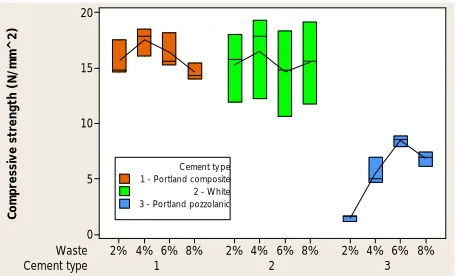
The compressive strength test result for various ce- ment type at various waste loading showed that almost of all cement types have a compressive strength over the IAEA standard (2.5 N/mm2) as shown in Figure 1, more- over the Russian Federation one. The C3S amount in composite Portland cement is higher than in white ce- ment (52 w/o:48.5 w/o), as consequently composite Portland cement has higher compressive strength as shown in Table 1. Composite Portland cement also has lower heat of hydration, and hence it results in denser cement block.
Cement type Waste 3 2 1 8% 6% 4% 2% 8% 6% 4% 2% 8% 6% 4% 2% 20 15 10 5 0 C o m p re ssi v e st re n g th ( N / m m ^ 2 )
[image:3.595.59.287.84.222.2]1 - Portland composite 2 - White 3 - Portland pozzolanic Cement type
Figure 1. Boxplot of compressive strength of all cement types. 0.70 0.65 0.60 0.55 0.50 0.30 10 9 8 7 6 5 4 3 2 1 w/c C o mp re ss iv e s tr e n g th ( N / mm^ 2 )
[image:3.595.58.288.260.396.2]Figure 2. Boxplot of compressive strength of Portland poz- zolanic cement at various w/c.
Table 1. Density of each cement type at 25˚C checked by picnometer.
Cement type Density (g/ml)
White cement 2.4563
Portland composite cement 2.631
[image:3.595.59.288.463.530.2]Portland pozzolanic cement 1.66
Table 2. Compounds composition on each cement.
Compound composite Portland White pozzolanicPortland
C3S (3CaO·SiO2) 52% 48.5% 14.55%
C2S (2CaO·SiO2) 12 % 30.5% 62.05%
C3A (3CaO·Al2O3) 8% 13.4% 13.11%
C4AF (4CaO·Al2O3·Fe2O3) 9 % 0.8% 10.32%
Mn2O3 0.02%
According to MacLaren, D.C., dan White, M.A. (2003), the increasing of w/c results in larger pores that is able to lead to the acceleration of drying process. The content of free water in large pores will evaporate quickly that can lead to generate micro cracking [6]. Therefore, it is rea-
sonable that there is a decreasing of compressive strength over 0.5 w/c. The ANOVA analysis shown in Table 3 below also confirm the argument that shows the P-values of w/c is lower than the i-value (0.05). It means that the variations of variable result in the difference responses.
3.2. The Strontium Leaching Rate Test on Saline Water
On saline water Ca(OH)2 on cement will react following reaction: 1) that destructs cement blocks following reac- tion; 2) and hence, strontium will be easier to diffuse into the water:
2
2Ca OH 2NaCl2Na OH CaCl (1)
2 3 aq 3 2aq
CaCl C A C A CaCl (2)
These reactions result in increasing of strontium leaching rate with pH 9 of waste on saline water com- pared to leaching rate in water (0.00224 over to 0.000199 g/cm2·days). However, it still meets IAEA’s standard (10−2 g/cm2·days).
But, when the Nunung’s data compared to the other blocks loading pH 6 of waste, it could be conclude that there are no effect of saline water on strontium leaching rate (0.0000049 - 0.0000068 g/cm2·days). The pH adjust- ment in this study was done by adding NaOH on the waste. NaOH will react with CaO on cement to form Ca(OH)2. The excessive Ca(OH)2 will obstructed the set- ting process of cement.
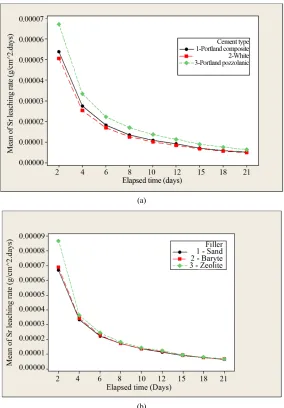
The mentioned above reactions could be avoided when there is no cracking or hole in surface, and hence NaCl could not penetrate into the gaps between pores of block. The presence of cracking or pore will reduce cement block density and as consequently increase leaching rate. Figure 3(a) shows that there is an impact of density on strontium leaching rate. A similar result was also ob- tained when we varied the filler (Figure 3(b)).
[image:3.595.58.286.551.665.2]Figure 3(b) shows that the 2nd days strontium leaching rate in zeolite filled block is the highest one. Zeolite could be used as adsorber and ion exchanger, so it should adsorb strontium well. But, on saline water, Na+ ion is easier to exchange Sr2+ and then exchanged Sr on block surface is diffused back into the water. Sand also could be used as adsorber and experiences a similar reaction
Table 3. Result of one-way ANOVA on compressive streng- th of Portland pozzolanic cement at various w/c.
Source DF SS MS F P
w/c 5 128.85 25.77 24.04 0.000
Error 12 12.86 1.07
Total 17 141.71
[image:3.595.308.538.652.725.2](a)
[image:4.595.156.440.83.491.2](b)
Figure 3. Sr leaching rate (a—upper) in various cement and (b—below) in various filler.
at saline environment could be ensured. with zeolite. But, it is believed that the smaller grain size
of zeolite (±40 mesh to ±20 mesh of sand) causes the phenomena. A smaller grain size will expand the contact surface and increase adsorb capacity, but in the other hand, exchangable Sr2+ is also much greater than in sand one. Baryte rock has no adsorb capacity, but the addition of baryte could increase the density of block (2.07 g/cm3 to 1.66 - 1.69 g/cm3 of sand and zeolite) and block the intrusion of NaCl.
5. Acknowledgements
The authors gratefully acknowledge the support of the Department of Engineering Physics, Universitas Gadjah Mada.
REFERENCES
[1] Y. S. Tang and J. H. Saling, “Radioactive Waste Manage- ment,” Hemisphere Publishing Corporation, New York, 1990.
4. CONCLUSION
The results show that there were almost no effects of saline water on immobilized strontium waste, except in pH 9 of waste (0.00224 over to 0.000199 g/cm2.days). The strontium leaching rates on all immobilized waste still meet the IAEA’s standard (10−2 g/cm2·days), and hence the safety of immobilized strontium waste disposal
[2] M. I. Ojovan and W. E. Lee, “An Introduction to Nu- clear Waste Immobilisation,” Elsevier Inc., Oxford, 2005. [3] S. H. Putero, W. Rosita, et al., “The Performance of
Various Pozzolanic Materials in Improving Quality of Strontium Liquid Waste Cementation,” Procedia Envi-
[4] A. A. Prabaningrum and W. A. W. Supardi, “The Effect of Ca-Bentonite Additive on the Cementation of Radioac- tive Concentrate Waste Containing Sodium Nitrate,”
Proceedings of the 2nd Biannual International Workshop
on High Level Radioactive Waste Management, Yogya-
karta, 10-12 August 1999, pp. 81-90.
[5] H. Poernomo and R. dan Supardi, “Pengaruh Natrium Silikat Terhadap Sementasi Limbah Uranium yang Men- gandung Ammonium Flourida,” Prosiding Pertemuan
dan Presentasi Ilmiah Penelitian Dasar Ilmu Pengeta-
huan dan Teknologi Nuklir, Yogyakarta, 25-27 April
1995, pp. 340-345.
[6] D. C. MacLaren and M. A. dan White, “Cement: Its Chemistry and Properties,” Journal of Chemical Educa- tion, Vol. 80, No. 6, 2003, pp. 623-635.