Munich Personal RePEc Archive
Choosing the scope of trade secret law
when secrets complement patents
Ottoz, Elisabetta and Cugno, Franco
University of Turin
14 February 2010
Online at
https://mpra.ub.uni-muenchen.de/27195/
Choosing the Scope of Trade Secret Law when Secrets
Complement Patents
Elisabetta Ottoz∗∗∗∗, Franco Cugno
Department of Economics, University of Turin
Abstract. We present a model where an incumbent firm has a proprietary product whose technology consists of at least two components, one of which is patented while the other is kept secret. At the patent expiration date, an entrant firm will enter the market on the same technological footing as the incumbent if it is successful in duplicating, at certain costs, the secret component of the incumbent’s technology. Otherwise, it will enter the market with a production cost disadvantage. We show that under some conditions a broad scope of trade secret law is socially beneficial.
Keywords Knowledge spillovers, Duplication costs, Covenants not to compete, Inevitable disclosure
JEL classification O31, O34
∗
1. Introduction
Since patents and trade secrets have generally been perceived as mutually exclusive, with few
exception the law and economics literature has separately concentrated on the design of optimal
patent policy and on the design of optimal trade secret policy.1 However, while the interest in
optimal patent design is long standing and has given rise to large literature in the field, whose
origins can be dated back to Nordhaus (1969),2 the issue of the optimal strength of trade secret
protection has received little attention until a short time ago. Only recently, starting from a
provocative paper by Bone (1998), some authors have widely discussed the question of whether
trade secret deserves a legal protection which goes beyond the contract law or the tort law.3 In
the words of Lemley (2008), “Trade secret law is a puzzle. Courts and scholars have struggled
for over a century to figure out why we protect trade secrets. …It seems odd, though, for the law
to encourage secrets …..I argue that, paradoxically, trade secret law actually encourages
disclosure, not secrecy. Without legal protection, companies in certain industries would invest
too much in keeping secrets.” In a similar vein Risch (2007) maintains that “trade secret are
justified by the economic benefits that flow from their existence, most notably incentives for
businesses to spend less money protecting secret information or attempting to appropriate secret
information”. According to both authors, the reduction of such costs is a sufficient reason for
the existence of a trade secret law as a separate doctrine, whereas Bone (1998) has an opposite
opinion.
The papers cited above prevalently refer to cases in which a proprietary innovation is
protected by trade secret only.4 However, in spite of the common misperception of an
alternative between patents and trade secrets, an innovator can use both intellectual property
rights to protect different aspects of the same invention, as “courts have long held that a
published patent does not invalidate those trade secrets that are not disclosed in the patent”
1
In some papers the choice between patent and trade secret protection is explicitly considered, but the strength of trade secret protection is treated as exogenous (e.g., Gallini, 1992; Denicolò and Franzoni, 2008; Cugno and Ottoz, 2006). For a discussion regarding the interplay between optimal patent and trade secret protection, see Erkal (2004). A general discussion on how innovator can prefer secret to patent protection can be found in Friedman, Landes and Posner (1991).
2
A selection of the first contributions includes Tandon (1982), Gilbert and Shapiro (1990), Klemperer (1990), Gallini (1992).
3
Previously, Friedman, Landes and Posner (1991) have yet maintained that, since the law does not protect against the loss of trade secrets by accident or by reverse engineering, there is in a sense no law of trade secret as such, concluding that there are good economic reasons for this. See also Landes and Posner (2003).
4
(Garvey and Baluch, 2007).5 Trade secrets can, in fact, “be used in lieu of patents but, more
importantly, they can be relied upon at the same time and side by side with patents to protect
any given invention…. With patents and trade secrets it is clearly possible to cover additional
subject matter, and thereby exploit the overlap and strengthen exclusivity” (Jorda, 2008).
To illustrate how patent and secret can coexist we can assume, for example, that at the time
the patent was filed the incumbent firm disclosed the best mode for carrying out the invention;
successively, the incumbent firm discovers a better best mode which it can keep secret without
bearing the risk of patent invalidation. A possible alternative hypothesis is that the proprietary
product consists of several parts, some of which are patented while others are kept secret.
However that may be, with respect to the case where patents and trade secrets are mutually
exclusive for an innovation on the whole, mixtures of the two protection tools put a specific
policy issue. To explain why, assume for simplicity a patent scope so broad as to make any
non-infringing imitation impossible. Then, if the innovator can chose to protect its proprietary
product through patent or secret but cannot combine the two form of protection, the policy
maker’s problem consists in the first place in setting the duration of patent protection and the
scope of trade secret law that induce the innovator to choose the socially preferable form of
protection, given the incentive to innovate. Thus, as Denicolò e Franzoni (2008) pointed out, it
may be the case that social efficiency requires that the duration of patent protection, relative to
the strength of secret protection, be such that the innovator’s choice falls on the patent itself. If,
instead, the innovating technology can be protected jointly by patents and secrets and expected
secrets’ duration is longer than patents’ life, policy makers have to solve a different problem.
First of all, note that if the innovator can enjoy full patent protection without disclosing all
components of its proprietary knowledge, a lengthening in patent life would not have any
effects on disclosure decision: in enlarging the disclosure of its technology, the innovator would
have nothing to gain and something to lose. Then, the relevant issue becomes: given the patent
duration, what is the socially optimal scope of trade secret law for innovations covered by a
patent-secret mix? Or, in other words, since innovations covered by a patent-secret mix enjoy
the prospect of some protection even after the patent expiration −that is, they are over protected
5
Interesting examples of patent-secret mix reported by Arora (1997) include German organic dyestuff in the nineteenth century, the Haber Bosch process for producing ammonia, the industrial diamond process technology by General Electric in the fifties. Court decisions such as C&F Packing v. IBP and Pizza Hut
with respect to comparable innovations covered only by patents− does society benefit from a
low scope of trade secret law?
In this paper we attempt to face this issue by using a model in which the social cost
associated with the mixtures of patents and trade secrets includes, besides dead-weight losses
and innovative R&D costs, the costs borne by an entrant trying to duplicate that part of the
technology protected by trade secret.Leaving aside, for sake of simplicity, costs sustained by
the two firms to protect or illicitly obtain information,6 we focus on the relations between
duplication costs (by legal means) and social welfare, along the lines of previous models present
in the literature (Gallini, 1992; Maurer and Scotchmer, 2002; Denicolò and Franzoni, 2008). A
special feature of our model is nevertheless the relation between duplication expenses, the
probability of duplication success, and the scope of trade secret law.
Considering a situation in which transaction costs of trade secret licensing are prohibitive,
we determine conditions under which a strong legal protection of trade secret is socially
beneficial even if it implies innovator’s over-rewarding. This is due to the fact that in our model
a broad scope of trade secret law has beneficial effects on the incentive to invest in R&D for the
original innovator and permits society to save on wasteful duplication costs borne by a potential
entrant. These benefits may more than compensate the reduction in the probability of
competitive entry.
The paper is organized as follows. In Section 2 the model is presented and some legal issues
are briefly discussed. Section 3 is dedicated to the design of optimal secret protection when
secrets complement patents and Section 4 concludes.
2. Employee mobility, knowledge spillover, and duplication costs
The model we will put forward in Subsection 2.2 below refers to a duopoly environment where
employee mobility is subject to some contractual and legal restrictions intended to limit
spillovers of proprietary non patented information. The scope of trade secret protection is
identified with the strength of these restrictions, which we shortly expound in the following
subsection.
6
Accurate analyses of the relation between costs incurred by rival firms in order to protect or
2.1. Labor mobility restrictions
Apart form clearly illegal means for appropriating secret information, such as industrial
espionage, employee mobility seems to be the main cause of technology spillovers between
firms.7 To the purpose of limiting harmful losses of proprietary information, in employment
contracts firms may insert post-employment clauses, known as “post-employment covenants not
to compete”. In the absence of these covenants, in some cases firms may still resort to a lawsuit
by appealing to the “inevitable disclosure doctrine” or similar arguments. The scope of trade
secret law largely depends on the degree of jurisdictions’ acceptance (and enforcement) of these
protection tools.
While post-employment covenants consist of promises by employees not to work for a
competitor for a specified period after employment ends, the inevitable disclosure doctrine
refers to cases in which such covenants are not signed in the hiring contracts or during the
employment relationships. This legal doctrine assumes that “if an employee has knowledge of
trade secrets, and accepts a similar job with a direct competitor in a highly competitive firm, he
or she will “inevitably” disclose the trade secrets in the course of performing his or her new
employment duties” (Paetkau, 2003), so that when the former employer would suffer
“irreparable harm” from disclosure this sort of employee mobility should be restricted
irrespective of the existence of post-employment covenants.Classical cases where the inevitable
disclosure doctrine has been adopted are PepsiCo., Inc. v. Redmond (7th Cir. 1995) 54 F.3d 1262
and IBM v. Papermaster, 2008 WL 4974508 (S.D.N.Y.), where the notion of “irreparable harm”
is introduced. An example of rejection is Schlage Lock Company v. Whyte (2002) 101 Cal. App.
4th 1443.
It is worth noting that while enforceability of post-employment covenants not to compete
are provided for by the law in almost all U.S. and E.U. jurisdictions, with more or less
differences and with the notable exception of California where they are banned, the adoption of
inevitable disclosure doctrine is typical of several, but not all, U.S. courts. Besides California,
where the doctrine is explicitly refused, some jurisdictions such as Michigan, Missouri,
Maryland and Minnesota expressed a few reservations about its application. Despite European
courts never refer to some form of inevitable disclosure doctrine, something similar has
nevertheless been formulated by the Court of Appeals of Paris in a case reported by Thiébart
(2003), where the employee did not signed any post-employment restrictive clause. In its
decision rendered on November 10, 1994, the court ruled that “if it is legitimate, in all cases,
7
that an employee harvest the fruit of the experience he gained with prior employers, which
constitutes for the employee a normal factor of enhanced value, this does not justify unfair
behavior which can consist in disorganizing a former employer by massive employee departure
or in disclosing manufacturing secrets and technical or commercial knowledge in order to
enable the latter to capture the clients of the former employer”.
In any case, where the inevitable disclosure doctrine −or some equivalent argument− is
adopted, the scope of trade secret law tends to be broader than elsewhere. For example, applying
the inevitable disclosure doctrine, in PepsiCo., Inc. v. Redmond the court analogized PepsiCo’s
position with respect to a former employee who was about to be hired by a competitor (Quaker)
as similar to that of “a coach who had lost a valuable player to the opposing team, playbook in
hand, on the night before a decisive game. Accordingly, it affirmed the district court order
enjoining Redmond from assuming his position at Quaker and preventing him forever from
disclosing PepsiCo trade secrets and confidential information” (Kaplan and Hanlon, 2004)
The differences in conditions for enforceability of post-employment covenants mainly
concern geographical and temporal restrictions, employees’ job positions with respect to access
to trade secrets, and employee financial compensations. For example, financial compensation to
the employee must be explicitly provided for in employment contracts (personal or collective)
in almost all E.U. states, while other jurisdictions −notably, the overwhelming majority of states in the U.S., Norway, Switzerland, Iceland and, inside E.U., Great Britain− do not require special consideration in labor contracts for worker’s agreement to a non competition covenant.8 As far
as California is concerned, Business and Professions Code section 16600 provides that “every
contract by which anyone is restrained from engaging in a lawful profession, trade, or business
of any kind is to that extent void.” Californian courts have interpreted section 16600 “as broadly
as its language reads”,9 so that they not only reject the doctrine of inevitable disclosure, but they
also refuse to enforce post-employment covenants. See Gilson (1999), where the high labor
turnover in Silicon Valley is ascribed to the weakness of trade secret protection in California, in
contrast with the low employee mobility in Route 128 district governed by Massachusetts trade
secret law.
8
Source http://www.ilo.org/public/english/dialogue/ifpdial/downloads/judges06/nc.pdf.
9
2.2. The model
First, let’s distinguish between pre- and post-innovation stages. In the post-innovation stage, a
firm, labeled I (innovator/incumbent), owns a proprietary product jointly protected by patents,
whose normalized length is T,10 and trade secrets, which have no fixed expiration date.11
Patents are assumed to be broad enough to make any non-infringing imitation impossible, so
that competitors cannot enter the market before patent’s expiration −that is, we assume that the
disclosed part of the technology is protected by ironclad patens, and no imitating product can be
obtained without it. As a consequence of this assumption the overall strength of patent
protection is fully captured by the patent’s life. At the patent expiration date a new firm, called
firm E (entrant), is founded. This new-generation firm will attempt to duplicate the secret
information by spending resources at this aim: it will enter the market bearing the same
production costs of firm I, if duplication is successful, or higher costs −those associated with the information disclosed in the patent− if the duplication attempt fails.
We assume that each employee of the incumbent firm has only a piece, more or less
important, of information on the whole set of secrets owned by his or her employer.12 To the
purpose of duplicating the secret parts of firm sI' technology, firm E may take advantage of
some knowledge spillover, whose intensity essentially depends on how easily firm sI'
employees can join the new generation firm. Employee mobility in turn depends on the scope of
trade secret law, more specifically on the enforceability of post-employment covenants not to
compete, and on the adoption or rejection by courts of the inevitable disclosure doctrine (in the
U.S.) or similar legal arguments. For example, under California law, which bans covenants not
to compete and refuses the inevitably disclosure doctrine, employee mobility practically has no
limits: in our meaning, the scope of trade secret law is at a minimum. Elsewhere, covenants non
to compete are enforceable if they respect some more or less restrictive standards, according to
which labor mobility is more or less facilitated. Note that a typical standard regards covenants’
duration (often 3 or 5 years after the employment relationship has been terminated): but even if
10
Given a patent life of t years, the normalized length is defined as T=1−e−rt, where r is the discount rate.
11
Although an innovator can often choose the extent patents and trade secrets combine with one another, in this paper we assume a given patent-secret mix. For a model where the patent-secret mix results from a maximizing choice, see Ottoz and Cugno (2008).
12
their validity is limited in time, enforcement of such agreements make up a hindrance to labor
mobility, so reducing knowledge spillover (Gilson, 1994; Hyde, 2003; see also Fudenberg and
Tirole, 1983, p. 529).
By utilizing the set of information obtained through employee mobility, whatever its
dimension, at time T firm E will spend resources to duplicate all components of firm sI'
technology protected by trade secret. Given the sum spent for duplication, called E
K , the
probability of success, γ , will increase with the dimension of the set of disposable information,
which in turn diminishes as the scope of trade secret law increases. In what follows, for sake of
simplicity we treat the scope of trade secret law as a continuous variable depending on the
conditions required by the relevant courts for enforcing post-employment covenants or applying
the inevitable disclosure doctrine.
On these bases, and adopting the usual convexity hypothesis for a cost function, we assume
that the probability of duplication success, the duplication effort, and the scope of trade secret
law, are linked by the relation
) (γ
θg
KE= , (1)
where g(0)=0, g'(γ)>0, g''(γ)>0 and the shift parameter θ is a measure of the
duplication difficulty which increases as the scope of trade secret law is broadened. Note that
this approach is very similar to the one adopted by Takalo (1998) in a model with costly patent
imitation: the only difference is that in our case the duplication difficulty depends on the
strength of trade secret protection, not on patent breadth.
If the attempt is successful, from time T firm E will compete on the same technological
footing with firm I, so that it will obtain for ever a stream of symmetric-cost duopoly profits
equal to E SD
π . If the attempt fails, firm E may enter the market with a production cost
associated with the information disclosed in the patent application, that is with higher costs than
firm I. In this case firm E will gain a stream of asymmetric-cost profits E SD E
AD π
π <
≤
0 . Given
that r represents the discount rate, firm E will then choose γ by maximizing the expected rent
) ( )
1 (
γ θ γπ π γ
g r
R
E SD E AD
E = − + −
. (2)
If an interior solution exists, the privately optimal value of
γ
will be determined byθ π π γ
r g
E AD E SD−
=
) (
' , (3)
θ γ γ θ γ π π θ γ ) ( '' ) ( ' ) ( '' 2 g g r g d d E AD E
SD− =−
−
= . (4)
So, as it was logical to expect, an increase in the scope of trade secret law reduces the
privately optimal level of γ .
Let’s now go backward to the pre-innovation stage. In analogy with the cost function (1),
suppose that the innovation effort, I
K , and the probability of success, β , are linked by the
relation KI f(β)
= , where f(0)=0, f'(β)>0, f ''(β)>0. We consider two opposite possibilities: unanticipated and anticipated concealability.
•Unanticipated concealability. Suppose that when deciding R&D expenses the innovator does not expect that some pieces of the technology to be discovered will be concealable without
incurring the risk of losing patents’ protection on the whole proprietary product. Only if and
after the innovation has been achieved, this possibility becomes clear. This means that the
innovator’s expected rent is
) ( )
1
( π β
π β f r T r T R I SD M I − − +
= , (5)
where πM and I SD
π are, respectively, the flow of monopoly profits granted by patents and the
innovator’s profit flow under symmetric-cost duopoly. Then, if I
R has an interior maximum,
the privately optimal value of β will be determined by
r T r T f I SD M π π
β) (1 )
(
' = + − , (6)
from which dβ/dθ =0.
If the inventive effort is successful and the entire technology is disclosed and patented, the
present value of innovator’s profits obviously will be T r T I r
SD
M/ (1 )π /
π + − . But if some
relevant pieces of technology can be unexpectedly not disclosed in the patent filings, with
probability 1−γ after patents’ expiration the innovator will enjoy the flow of profit I AD
π
associated with the cost asymmetry granted by trade-secrets, so that the present value of
innovator’s expected profits will be T r T I r
SD I AD
M/ (1 )((1 γ)π γπ )/
π + − − + . Since I
SD I
AD π
π > , in
this case, and in a certain sense, the innovator turns out to be over rewarded: while the
expectation of monopoly profits during the patents’ life and symmetric-duopoly profits after
patents’ expiration would be sufficient incentives to R&D effort in fact borne, with probability
γ
−
Since under the above assumptions the gains associated with concealability do not depend
on programmed R&D expenses, the pieces of technology unexpectedly concealable can be
analogized to serendipitous inventions. This implies that the incentive to innovate depends only
on patents’ duration, while the scope of trade secret law determines how much the patent-secret
holder is potentially over rewarded with respect to the remuneration that would be sufficient to
induce the R&D expenses actually incurred. So, in this case we can study the social effects of
duplication activities in a comparable way with the relevant strand of literature that justifies (or
does not justify) the existence of specific trade secrets laws on the ground of their ability to
reduce private expenses in protection costs, while creating incentives to innovate is considered a
very minor justification (Bone, 1998; Landes and Posner, 2003; Risch, 2007; Lemley, 2008).13
•Anticipated concealability. If the innovator knows in advance that some parts of the
technology to be discovered will be protectable through trade secret, its expected rent becomes
) ( )
1 ( ) 1
( γ π γπ β
π
β f
r T
r T R
I SD I AD M
I −
− +
− +
= , (7)
so that the privately optimal β will be determined by
r T
r T f
I SD I AD
M γ π γπ
π
β)= +(1− )(1− ) +
(
' , (8)
from which, by using equation (4), dβ/dθ>0.
In this case, unlike in the previous one, the scope of trade secret law affects the innovator’s
decisions −that is, the incentive to innovate depends now, besides on patents’ duration, on the
strength of trade secret protection. As we will see, this implies that the range of parameters over
which a broad scope of trade secret law is socially efficient turns out to be expanded with
respect to the case of unanticipated concealability.
3. Choosing the scope of trade secret law
In this section we first use our simple duopoly model to determine the optimal scope of trade
secret law for a given patent length. In doing this we assume that, due to high transaction costs,
trade secret licensing is not mutually convenient. Then we consider some special cases
characterized by different market behaviors.
13
3.1. Optimal scope
Let’s indicate with ∆M the stream of dead-weight loss associated with monopoly, with ∆SD the
stream associated with symmetric-cost duopoly, and with ∆AD the stream associated with
asymmetric-cost duopoly. With probability 1−γ firm E is not successful in the duplication attempt so that after patent expiration firm I will enjoy a production cost advantage. In this
case the stream of dead-weight loss will be ∆M during patent life and ∆AD≤∆M soon after the expiration date. If, on the opposite, firm E is successful in the duplication attempt, after patent
expiration the stream of deadweight loss will be ∆SD <∆AD. This event has probability γ . The
post-innovation expected social cost, SC, is the sum of the expected present value of
dead-weight losses and of the present value of the cost borne by firm E to duplicate the secret. Then,
+ ∆ − + ∆ − + ∆
= (1 ) γ (1 γ) θg(γ)
r T
r T
SC M SD AD , (9)
so that the present value of expected social welfare turns out to be
) ( )
( β
β SW SC f
SW = − − , (10)
where SW stands for the present value of social welfare that would prevail under perfect
competition.
Maximizing SW with respect to θ and T under the constraints that the innovator and the
duplicator choose R&D and duplication expenses in the privately optimal ways described
above, we in general can determine the socially optimal combination of patent length and trade
secret scope for innovations of the kind we are dealing with. As the choice of patent length is,
nevertheless, relevant also for innovations whose components are all protectable only by
patents, may be that policy makers whish to fix T in order to not penalize this second type of
innovations. If so, the problem becomes that of verifying if a reduction in the scope of trade
secret law, facilitating in prospect competitive entry, enhances social welfare. Propositions 1
and 2 below show that under certain conditions the opposite happens.
Before proceeding, it is useful to define the elasticity of probability of firm E's duplication
success with respect to the expense for duplication. As we will see, this elasticity, given by
γ γ γ γ γ
η=(d /dKE)(KE/ )=g( )/g'( )
, will turn to be crucial for our result.
Proposition 1. Unanticipated concealability. Suppose the innovator does not anticipate that
E AD E SD SD AD d d π π γ γ η η − ∆ − ∆ >
+ for all γ∈(0,1) (11)
is sufficient and necessary for social welfare to be monotonically increasing in the scope of
trade secret law .
Proof. Since in this case dβ/dθ =0 (see equation (6)), differentiating SW in equation (10) we
have dSW/dθ =−β(dSC/dθ). By using equations (3), (4) and (9) we can verify that if
E AD E SD SD AD g g g g π π γ γ γ γ − ∆ − ∆ > − 2 2 )) ( ' ( ) ( '' ) ( )) ( ' ( (12)
this derivative is positive. (See the Appendix for details.) On the other hand, differentiating
γ γ γ
η=g( )/g'( ) and rearranging terms, we have
γ γ η η γ γ γ γ d d g g g g + = − 2 2 )) ( ' ( ) ( '' ) ( )) ( ' (
. (13)
Thus, inequality (12) corresponds to inequality (11). The statement immediately follows. ■
The rationale of Proposition 1 is that when condition (11) holds a high legal protection of
trade secret allows society to save on duplication costs that would be otherwise borne by firm
E: this saving may be sufficient to more than compensate the increase of the expected present
value of dead-weight losses caused by the reduction of the probability that the duplication
attempt is successful14 Although it may seem odd that these social benefits can be more likely
obtained just for high levels of the elasticity η, that is when at the margin duplication expenses
are more likely to involve reductions in the present value of expected deadweight losses, the
reason stays on the incentive effects of high levels of this elasticity. In fact, it is precisely a high
marginal (expected) productivity of duplication expenses in terms of the probability γ that may
create incentives to invest in duplication too strong from a social point of view. In other words,
for η high and θ low private optimality implies investments in duplication too high relative to
the expected benefits on social welfare.
14 It is worthwhile noticing that the hypotheses we have formulated on the relation between γ ,
k and θ
Proposition 2. Anticipated concealability. If the innovator anticipate that some part of the
technology to be discovered will be concealable, the range of parameters over which social
welfare increases with the scope of trade secret law is broader than that identified in Proposition
1.
Proof. Some calculations involving equations (7), (8) and (10) show that in this case
) / )( )(
/ 1 ( ) / (
/dθ β dSC dθ β SW R dβ dθ
dSW =− + − I . The statement follows from the facts
that: (i) I
R
SW> (besides the expected innovator’s rent, expected social welfare comprehends the expected entrant’s rent and consumer surplus); (ii) dβ/dθ >0 (see equation (8)); and (iii) under the assumption underlying Proposition 1 dSW/dθ is positive if and only if
0 ) /
( >
−β dSC dθ . ■
Obviously, the above result is due to the effects on the incentive to innovate that a broad
scope of trade secret law has in the case of anticipated concealability but not in the opposite
case. Under anticipated concealability, a broadening in the scope of trade secret law increases
R&D expenses, but the positive effects through the probability β overweighs this increment in
costs, enhancing social welfare for any given SC. Then, condition (11) of Proposition 1 is no
longer necessary, but only sufficient, for social welfare to be increasing in the scope of trade
secret law.
3.2. Reverse engineering, protection costs, and rent dissipation
In Samuelson and Scotchmer (2002) the authors argument that “When a particular means of
reverse engineering makes competitive copying too cheap, easy, or rapid, innovators may be
unable to recoup R&D expenses. If so, it may be reasonable to regulate that means.
Anti-plug-mold laws … are an example. Using a competitor’s product as a “plug” to make a Anti-plug-mold from
which to make competing products permits competitive copying that is so cheap and fast that it
undermines the incentives to invest in designing an innovative product. Restrictions on
plug-molding may restore adequate incentives to make such investments”. Provided that the cost of
reverse engineering is high enough, according to the authors the innovator can prevent it
entirely, especially if a licensing strategy for preventing unlicensed entry is adopted. In this
case, licensing will be on terms that permit the innovator to recoup its R&D expenses, while at
the same time constraining the exercise of market power in order to dissuade other potential
Since regulation of reverse engineering can be viewed as equivalent to a broadening in the
scope of trade secret law, our result partially parallels the above arguments. We show, however,
that society can gain from making duplication more difficult even when, due to high transaction
costs, licensing is not an option. Note moreover that these social gains are independent of any
possible reduction in innovator’s expenses on protection against misappropriation caused by a
broadening of trade secret law. If we were considering the arguments in Risch (2007) and
Lemley (2008) that information-owners’ expenses to prevent illegal appropriation efforts
diminishes as the strength of legal trade-secret protection increases, our result would be
reinforced in that the range over which a broad scope of trade secret law is efficient would be
expanded.
Finally, note that in terms of the rent dissipation theory our result can be reed as follows. At
the patent expiration, duplicator’s entry implies a decrease in producer surplus (because joint
duopoly profits are less than monopoly profits) and increases consumer surplus. Moreover, the
entrant firm will spent some money in attempting duplication of trade-secrets. Thus, if the sum
of duplication expenses plus the reduction in joint profits outweighs the increase in consumer
surplus, at the social level we have a (partial) post-invention rent dissipation − the second type
of rent dissipation envisaged by Grady and Alexander (1991). Under condition (11) in
Proposition 1, this type of rent dissipation is minimized when the scope of trade secret law is at
a maximum.
3.3. Some special cases
To gain more insights into the meaning and relevance of condition (11) in Proposition 1 it is
useful to consider different market behaviors under linear output demand and constant marginal
costs. Assume therefore the inverse demand function P=a−Q, where P is market price and
Q is total output. Also assume that, with respect to the superior technology which allows to
produce at constant marginal costs equal to zero, the inferior technology implies a constant cost
disadvantage equal to ε.15 Under the above linearity assumptions and the additional hypothesis
that the function g(γ) is iso-elastic (dη/dγ =0), condition (11) can be written
E AD AD E SD SD
SD E
AD AD
AD SD
SD AD
q P q P
P q
P
) (
) )( 2 / 1 ( )
)( 2 / 1
( 2 2
ε ε π
π η
− −
− + =
− ∆ − ∆
> , (14)
15
where E i
q , i=SD,AD, stands for firm E's output.16 In what follows we will examine Cournot competition (integrated with limit pricing), Stackelberg competition with the incumbent firm
acting as the quantity leader, collusion, and incumbent’s post-patent monopoly. In this way we
can obtain approximate numeric information about the pairs (η,ε) for which, given the market
behavior, condition (11) in Proposition 1 is fulfilled.
•Cournot competition. Suppose ε<PM =a/2, where PM stands for monopoly price. Under
Cournot duopoly, where each firm chooses a quantity to produce that maximizes its profit flow
given the expectation that the rival firm maintains its output level fixed, firm E's outputs and
market prices are given by qE a/3
SD = , q =(a−2ε)/3 E
AD , PSD =a/3, PAD =(a+ε)/3. Then, condition (14) becomes
ε ε η
8 8
11 8
− − >
a a
.
Since the ratio (8a−11ε)/(8a−8ε) decreases as ε increases, approaching the value of 8
/
5 as ε tends to the point a/2, at which and above the incumbent firm enjoys full monopoly
power even after patent expiration, a necessary condition for inequality (14) to be satisfied is
8 / 5
>
η . For η>5/8 inequality (14) can be fulfilled provided that ε is sufficiently high (see
the shaded zone in Figure 1, panel i).17 In particular, this event is the more likely the more relevant is the secret part of technology in terms of production costs and the more productive is
at the margin the expense for duplication, that is for high levels of ε and η. This is due to the
fact that for any θ duplication becomes more attractive as ε and η increase, so that a strong
trade secret protection permits the society to save resources whose amount exceeds the expected
present value of dead-weight losses associated with no duplication.
16
Since Pareto-optimal output is equal to a, deadweight-loss triangles are given by
2 2 1 = − 2
1/ ) ( ) ( / )( )
( Pi a Qi Pi , i=SD,AD. When i=AD, we must add the total extra cost born by firm
E, that is E AD
q
ε .
17
•Cournot competition and limit pricing. In considering the above kind of competition we have ignored that when firm E fails in its duplication attempt the incumbent can prefer to deter entry
by resorting to a limit pricing strategy, that is by setting the price at PAD =ε. Specifically,
comparing the value of the incumbent’s profit flow under limit pricing with the corresponding
value under asymmetric-cost Cournot duopoly, we can verify that limit pricing turns out to be a
superior alternative for the incumbent if a/5<ε<a/2.18 Suppose then that the two firms compete à la Cournot when the entrant succeeds in duplicating the secret technology or, if it
does not succeed, when ε<a/5. Otherwise, the incumbent adopts a limit pricing strategy, so that if the entrant firm fails the duplication attempt and a/5<ε, its output will be zero. Then, since for a/5<ε <a/2 we have qE a/3
SD= , =0
E AD
q , PSD=a/3, PAD=ε , while for ε<a/5 the results for Cournot competition hold, condition (14) becomes
< < − < − − > . 2 5 for , 2 9 , 5 a for , 8 8 11 8 2 2 2 a a a a a a ε ε ε ε ε η
Contrary to what happens in the case illustrated in panel i of Figure 1, the right-hand part of
the inequality 2 2 2
2 ) 9
( −a a
> ε
η , starting from negative levels for ε =a/3, increases with ε
18
The incumbent’s profit flow under asymmetric-cost Cournot duopoly is given by (a+ε)2/9. Comparing this value with the profit flow under limit pricing, ε(a−ε), it follows that limit pricing turns out to be a strictly superior alternative for the incumbent if and only if 10ε2−7aε+a2<0, which
implies a/5<ε<a/2. η
1
8
5
Figure 1. Condition (14) under Cournot competition (panel i) and limit pricing (panel ii).
2
a ε
i η
[image:17.612.131.454.99.254.2]until reaching the value of 5/8 at the point ε =a/2, at which entry is no more a problem for the incumbent. This is explained by the fact that under limit pricing, while ∆AD increases with
ε as under Cournot competition, E AD
π is null for all ε. It follows that a/5<ε<a/3, or
2 / 5
/ a
a <ε< together with η>5/8, are sufficient conditions for inequality (14) to be fulfilled (see the shaded zone in Figure 1, panel ii). In these intervals, expected deadweight
losses associated with no duplication are so small, or duplication is so attractive, that a strong
trade secret protection which allows to save duplication expenses turns out to be beneficial for
society.
•Stackelberg competition. Suppose again ε<PM =a/2. Under Stackelberg competition, with
firm I being the quantity leader, firm E maximizes its profit flow treating firm sI' output as
given. In turn, firm I maximizes its profit anticipating firm E's reaction. The equilibrium firm
s '
E quantities and market prices are qSDE =a/4,q max
[
(a 3 )/a,0]
EAD = − ε , PSD =a/4,
[
( )/4, /3]
min a a
PAD= +ε . Then, condition (14) becomes
− − >
18 7 , 18 12
23 10 max
ε ε η
a a
.
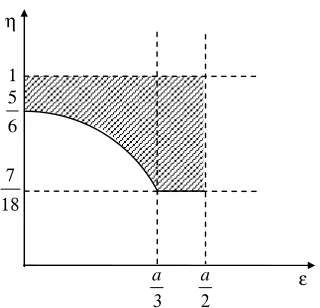
As under Cournot competition, there exists a level of η below which inequality (14) cannot
be fulfilled. Since for ε ≥a/3 firm E's output is zero, this level is now η=7/18. As ε
decreases in the interval 0<ε <a/3, the ratio (10a−23ε)/(12a−18ε) increases, until reaching
the value 5/6 at ε =0. Thus, condition (14) turns out to be more likely fulfilled under Stackelberg than under Cournot competition (see the shaded zone in Figure 2). The reason for
this is that in the ideal passage from Cournot to Stackelberg competition, for each ε <a/3 both the differences ∆AD−∆SD and E
AD E
SD π
π − decrease, but ∆AD−∆SD decreases more than
E AD E SD π
π − .19
19
Under Stackelberg competition there exists no ε<a/3 such that limit pricing is a privately superior alternative. This can be viewed by comparing the incumbent’s profit flows under asymmetric-cost Stackelberg duopoly, given by (a+ε)2/8, with the profit flow under limit pricing, that is ε(a−ε). For
2 < <
3 /
/ a
•Collusion. Antitrust notwithstanding, it may be that the two firms collude, in the sense that firm I pays firm E a fee, negatively related to the cost differential, and firm E stays out of the
market. If this is a real possibility, condition (14) is surely respected: in fact, since
M AD
SD P P
P = = and E =0
AD
q , condition (14) reduces to η >0, that is, it is fulfilled for any relevant pair (η,ε).20
•Incumbent’s post-patent monopoly. Until now we have assumed that ε<a/2. If ε ≥a/2 and firm E fails its duplication attempt, firm I continues to enjoy full monopoly power beyond the
date of patent expiration. In this case, when the two firms compete à la Cournot if the
duplication attempt succeeds, market prices and firm E's outputs in condition (14) will be
3 /
a qE
SD= , =0
E AD
q , PSD=a/3, PAD=PM =a/2. Then, condition (14) reduces to η >5/8.
When, instead, the incumbent can act as a Stackelberg quantity leader, we have qE a/4
SD= ,
0
=
E AD
q , PSD =a/4, PAD=PM =a/2, and condition (14) becomes η>3/2, which cannot hold.21 Summing up, when entry does not occur because of a cost differential greater than the
monopoly price and η is constant, condition (14) can be fulfilled under potential Cournot
competition but not if the incumbent firm is able to act as a Stackelberg leader.
20
Note that under collusion E SD
π and E AD
π are given by the fees paid by firm I in the two situations.
21
[image:19.612.215.375.95.249.2]See footnote 17 above.
Figure 2. Condition (14) under Stackelberg competition
3
a
η
1
ε
6 5
18 7
2
3.4. The elasticity of duplication probability
We have seen that under Cournot competition a necessary condition for inequality (14) to hold
is η>5/8=0.625. Likewise, under Stackelberg competition inequality (14) cannot be fulfilled if η does not exceed the value 7/18=0.388. As there is no empirical evidence on the value of
η −which measures the elasticity of individual probability of duplication success with respect
to the individual expense for duplication− the only thing we can say is that likely it varies greatly according to the innovation type, in the same way as the elasticity of the supply of
inventions −which can be viewed as the elasticity of the aggregate probability of invention success, empirically proxied by the number of patent applications, with respect to aggregate
research expenses− appears to vary greatly across sectors and over time (see Denicolò, 2007, and the literature cited therein).22 Since something similar seems to hold for the cost differential
ε, the only conclusion we can sensibly drawn is that there may exist particular market
situations where fulfillment of condition (14) cannot be excluded. Obviously, at the present no
policy implication can be deducted, either for the aggregate or for specific sectors.
4. Conclusion
We presented a simple model in which an incumbent firm owns a proprietary product protected
by a mixture of patents and trade secrets. At the patents’ expiration date an entrant tries to
duplicate the secret part of the incumbent’s technology, with a probability of success depending
on the amount of resources devoted to this aim and on the quantity of usable knowledge spilled
out of the incumbent firm, which in turn depends on the scope of trade secret law. Then, when
the patent will expire the competitor will enter the market at the same production cost as the
incumbent if duplication is successful, or higher costs if the duplication attempt fails. We
showed that in this context, under some conditions a broad scope of trade secret law may be
socially beneficial, either if the innovator, when deciding R&D expenses, anticipates that some
pieces of the technology to be discovered will be concealable, or if concealability becomes a
serendipitous opportunity after the innovation has been achieved.
22
For example, in a linear Cournot duopoly a sufficient condition for a strong trade secret
protection to be socially beneficial is that the secret part of technology is rather relevant in terms
of production costs and the probability of duplication success is sufficiently elastic with respect
to the expenses for duplication. This result holds for a wider range of parameters when the
incumbent firm can act as a Stackelberg leader or adopts a limit pricing strategy or colludes with
the entrant. In any case, independently of the innovator’s forecasting ability, a strong trade
secret protection may be collectively efficient in that it allows society to save on duplication
costs that would otherwise be borne by the entrant firm: such saving may be sufficient to more
than compensate the relatively high expected present value of dead-weight losses associated
with a low probability that the duplication attempt is successful.
Appendix
Differentiating equation (10) with dβ/dθ =0 we have
− − ∆ − ∆ − = −
= (1 ) '( ) (γ)
θ γ γ θ θ γ β θ β
θ d g
d g d d r T d dSC d
dSW AD SD
,
that is, by using equations (4) to eliminate dγ/dθ and rearranging terms,
∆ −∆ − − − = − = ( '( )) ( ) ''( ) '( ) ) ( '' 1 2 γ θ γ γ γ γ β θ β
θ g g g g r g
T d
dSC d
dSW AD SD
.
At this point it is easy to verify that dSW/d
θ
turns out to be positive if and only ifθ γ γ γ γ r g g g
g ∆AD−∆SD
> − ) ( ' ) ( '' ) ( )) ( ' ( 2 ,
that is, by using equation (3), if and only if
E AD E SD SD AD g g g g π π γ γ γ γ − ∆ − ∆ > − 2 2 )) ( ' ( ) ( '' ) ( )) ( ' ( ,
which is inequality (12) in the proof of Proposition 1.
References
Bone, R., 1998. A new look at trade secret law: doctrine in search of justification. California Law Review 86, 243-313.
Cugno, F., Ottoz, E., 2006. Trade secret vs. broad patent: the role of licensing. Review of Law and Economics 2, Article 3.
Denicolò, V., 2007. Do patents over-compensate innovators?, Economic Policy 22, 679-729. Denicolò, V., Franzoni,L., 2004. The contract theory of patents. International Review of Law and
Economics 23, 365-380.
Denicolò, V., Franzoni, L., 2008. Innovation, duplication, and the contract theory of patents. In: Cellini, R., Lambertini, L., (Eds.). The Economics of Innovation. Bingley, UK: Emerald Group, 15-32. Erkal, N., 2004. On the interaction between patent and trade secret policy. Australian Economic Review
37, 427-35.
Friedman, D., Landes, W., Posner, R., 1991. Some economics of trade secret law. Journal of Economic Perspectives 5, 61-72.
Fudenberg, D., Tirole, J., 1983. Learning by doing and market performance. Bell Journal of economics 14, 522-530.
Gallini, N., 1992. Patent policy and costly imitation. RAND Journal of Economics 23, 52-63.
Garvey, J., Baluch, A., 2007. Intellectual Property: Patent or Padlock: Patents and Trade Secrets Form the Heart of an Effective IP Strategy, http://biopharminternational.findpharma.com/biopharm/
article/articleDetail.jsp?id=400870.
Gilbert, R., Shapiro, C., 1990. Optimal patent length and breadth. RAND Journal of Economics 21, 106-112.
Gilson, R., 1999. The legal infrastructure of high technology industrial districts: Silicon Valley, Route 128, and covenants not to compete. New York University Law Review 74, 575-629.
Grady, M., Alexander, J., 1992. Patent law and rent dissipation. Virginia Law Review 78, 305-350. Hyde, A., 2003. Working in Silicon Valley: economic and legal analysis of a high-velocity labor market.
Armonk, N. Y.: M.E Sharpe.
Jorda, K., 2007. Trade secrets and trade-secret licensing. In: Krattiger, A., Mahoney, R., Nelsen, L. (Eds.). Intellectual Property Management in Health and Agricultural Innovation: A Handbook of Best Practices. Oxford, U.K: MIHR, 1042-1057.
Jorda, K., 2008. Are trade secrets nothing but “baby patents”? http://www.jordasecrets.com/2008/01/ are_trade_secrets_nothing_but.html.
Kaplan, E., Hanlon, M., 2004. The doctrine of inevitable disclosure. http://findarticles.com/p/ articles/mi_qa4023/is_200404/ai_n9367242/?tag=content;col1.
Klemperer, P., 1990. How broad should the scope of patent protection be?. RAND Journal of Economics 21, 113-130.
Lemley, M., 2008. The surprising virtues of treating trade secrets as IP rights. Stanford Law Review 61, 311-354.
Maurer, S., Scotchmer, S., 2002. The independent invention defence in intellectual property. Economica 69, 535-547.
Nordhaus, W., 1969. Invention, Growth and Welfare: A Theoretical Treatment of Technological Change. Cambridge, MA: MIT Press.
Ottoz, E., Cugno F., 2008. Patent-secret mix in complex product firms. American Law and Economics Review 10, 142-158.
Paetkau, T., 2003. California Court Rejects "Inevitable Disclosure Doctrine" But Acknowledges Availability of Injunctive Relief for the Almost Indistinguishable "Threatened" Disclosure of Trade Secrets. http://library.findlaw.com/2003/Mar/18/132641.html.
Risch, M., 2007. Why do we have trade secrets?. Marquette Intellectual Property Law Review 11, 1-76. Risch, M., 2010. Trade secret law and information development incentives. In: Dreyfuss, R., Strandburg,
K. (Eds.). The Law and Theory of Trade Secrecy: A Handbook of Contemporary Research. Northampton, MA: Edward Elgar.
Samuelson, P., Scotchmer, S., 2002. The law and economics of reverse engineering. Yale Law Journal 111, 1575-1663.
Saxenian, A., 1994. Regional Advantage: Culture and Competition in Silicon Valley and Route 128. Cambridge, MA: Harvard University Press.
Tandon, P., 1982. Optimal patents and compulsory licensing. Journal of Political Economy 90, 470–486. Takalo, T., 1998. Innovation and imitation under imperfect patent protection. Journal of Economics 67,
229-241.