Munich Personal RePEc Archive
Personal-bankruptcy cycles
Garrett, Thomas A. and Wall, Howard J.
University of Mississippi, ISEE, Lindenwood University
23 August 2010
0
Personal-Bankruptcy Cycles
*Thomas A. Garrett
University of Mississippi
and
Howard J. Wall
ISEE, Lindenwood University
November 19, 2012
Abstract
This paper estimates the dynamics of the personal-bankruptcy rate over the business cycle by exploiting large cross-state variation. We find that bankruptcy rates are significantly above trend during a recession and rise as a recession persists. After a recession ends, there is a hangover whereby bankruptcy rates begin to fall but remain above trend for several more quarters. Recovery periods see a strong bounce-back effect with bankruptcy rates significantly below trend for several quarters. Despite the
significant increases in bankruptcies during recessions, the largest contributor to rising bankruptcies during these periods has tended to be the longstanding upward trend.
JEL: K35, D14, E32
Keywords: Personal Bankruptcy, Recessions
*
We would like to thank an anonymous referee, Mike McCracken, Dan Thornton, and Yi Wen for their comments.
Thomas A. Garrett, Department of Economics, University of Mississippi, 242 Holman Hall, University, MS 38677. Phone: (662) 915-5829; E-Mail: [email protected].
1
1. Introduction
It is surprising, perhaps, that there is little consensus regarding the importance of
adverse events such as job loss for households’ personal-bankruptcy decisions. Studies
using individual-level data, for example, often find that the bankruptcy decision is
unrelated to increases in local unemployment rates or decreases in average income (Fay
et al., 2002; White, 2009; Fisher, 2005). These studies instead find support for
bankruptcy as a strategic choice, whereby households react to the financial benefits of
bankruptcy rather than a nonstrategic outcome driven by a reduced ability to repay debts.
In contrast with these empirical results, numerous surveys of bankruptcy filers suggest
that the underlying cause of most bankruptcies is an unexpected negative shock to
household income, such as a job loss(Stavins, 2000; Warren, 2003). Even so, survey
results are inconsistent: Whereas Sullivan et al. (2000) attribute two-thirds of personal
bankruptcies to job loss, Himmelstein et al. (2005) find that more than half are the result
of the lack of medical insurance following a serious injury or illness.
At the national level, data present an inconsistent picture of the link between
economic conditions and personal bankruptcy, even during recessions, when job losses
are especially prevalent. Theoretical models such as Rampini (2005) suggest that
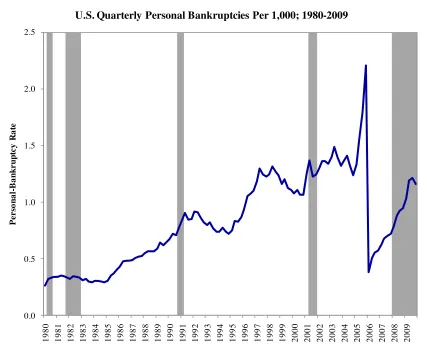
personal bankruptcies are countercyclical, but during two of the five NBER recessions
experienced in the United States between 1980 and 2009—1982-83 and 2001—the
national bankruptcy rate actually fell (Figure 1). In addition, recovery periods have been
2
recessions that preceded them. And even for those recessions during which the
bankruptcy rate rose, it is not clear that this was anything more than ongoing trends.
The purpose of this paper is to take a closer look at the link between economic
conditions and personal bankruptcy. Our approach is based on the notion that it is not the
weakness of economic activity that matters, but the persistence of the weakness. To
capture the persistence of weak labor markets, we estimate a personal-bankruptcy cycle
with three phases—trend, recession, and recovery—that align with the business cycle.
Also, rather than using official recession dates from the NBER, which are linked most
closely with national GDP growth, we use state-level recession dates that are based on
labor-market conditions. State-level data give us a better geographic match between
economic conditions and bankruptcy decisions, while labor-market recessions provide us
a better match between households and the conditions that matter for them.
We find a personal-bankruptcy cycle for which the rate of personal bankruptcy
rises above its trend rate throughout the length of a recession. After the recession ends,
there is a hangover whereby bankruptcy rates begin to fall but remain above trend for
several more quarters. Recovery periods see a strong bounce-back effect with
bankruptcy rates significantly below trend for several quarters before returning to trend.
The more severe the preceding recession, the deeper is this bounce-back.
The paper proceeds as follows: In Section 2 we review briefly the
personal-bankruptcy literature, which has focused on explaining the upward trends in bankruptcies
3
state-level labor-market recessions. We describe the cross-state differences in the levels
and trends in bankruptcy rates and outline our empirical approach in Section 4. Our
baseline estimate of the movement of bankruptcy rates during and after recessions is
presented in Section 5. Our baseline results are put into aggregate perspective in Section
6, and restricted versions of the baseline model are discussed in Section 7. Section 8
concludes.
2. The Personal-Bankruptcy Literature
The literature on U.S. personal bankruptcy has focused on the dramatic rise in
bankruptcy filings that occurred between 1985 and 2004. As illustrated by Figure 1, the
national bankruptcy rate increased from roughly 0.3 per 1,000 people in the first quarter
of 1985 to 1.2 per 1,000 people in the fourth quarter of 2004.1 National and state filing
rates declined sharply after the implementation in 2005 of the Bankruptcy Abuse
Prevention and Consumer Protection Act, which made it more difficult for consumers to
file for bankruptcy (liquidation under Chapter 7). The new rules meant an upward spike
in the national bankruptcy rate to 2.2 per 1,000 people in the fourth quarter of 2005,
before the new rules were in place, followed by a huge downward spike to 0.4 per 1,000
people in the first quarter of 2006 under the new rules. Even under the new rules the
1
This represents the sum of personal-bankruptcy filings under Chapters 7, 11, and 13. All bankruptcy data are from the Administrative Office of the U.S. Courts and are available at
4
personal-bankruptcy rate has steadily increased, hitting 1.2 per 1,000 people by the
second quarter of 2009, after a year and a half of recession.2
Numerous explanations for this rise have been offered and estimated empirically:
the increased use of credit cards and increased consumer debt (Durkin, 2000; White,
2007), the spread of casino gambling (Barron et al., 2002; Thalheimer and Ali, 2004;
Garrett and Nichols, 2008), a reduced social stigma associated with filing for bankruptcy
(Garrett, 2007), changes to state and federal bankruptcy laws (Nelson, 1999), and greater
access to secured and unsecured credit (Gropp et al., 1997).3 Most recently, Livshits et
al. (2010) model and compare the various explanations and conclude that ―a decrease in
the transactions cost of lending and in the cost of bankruptcy‖ account for the rise in
personal bankruptcy.
3. State Labor-Market Recessions
Our first step is to determine appropriate dates for recessions at the state level. As
is well known for the country as a whole, the close link between the NBER recession
dates and employment growth broke down with the 1990-91 recession when the end of
the recession was followed by a lengthy period during which aggregate employment
continued to fall. One reason that there has not been a consistent relationship between
personal-bankruptcy rates and recessions is that NBER recession dates tend to be aligned
2
See Morgan et al. (2009) for a discussion of the effects of the change in bankruptcy laws on foreclosures and the onset of recession in 2008.
3
5
with GDP growth rather than labor markets, which are more relevant for personal
bankruptcy. It is not appropriate, therefore, to use NBER recession dates because the
effects of a recession on labor markets and, therefore, personal bankruptcies, are not
limited to the NBER recession period. It is, instead, more useful to obtain dates during
which labor markets are in recession.
We also need recession dates that are better aligned geographically with the
decision to file bankruptcy, which depends on local conditions. To match our state-level
bankruptcy data, we need state-level recession dates. To obtain these dates, we follow
Owyang, Piger, and Wall (2005), who show that the depth, timing, and duration of state
labor-market recessions are quite different from national labor-market recessions and
NBER recessions. They apply the Markov-switching model of Hamilton (1989) to the
state-level coincident index of Crone and Clayton-Matthews (2005), which combines
payroll employment, wages and salaries, the unemployment rate, and hours worked into a
single index.
Although our bankruptcy data are available back to 1980 and through mid-2009,
we restrict our analysis to 1988.Q1-2004.Q4. First, we need to excise the structural break
associated with the 2005 changes in bankruptcy laws. Although this means that we are
unable to consider the 2008-2009 recession, we cannot perform a complete analysis
anyway because we need a sufficiently long post-recession period. Second, as shown by
Owyang, Piger, and Wall (2008), the so-called Great Moderation, which meant a
6
times across states, some as late as the latter part of the 1980s. Because the coincident
index begins in 1979, we do not have a long enough time series to account for the
structural break and cannot, therefore, include the recessions from the 1980s.
Despite the restrictions at both ends of our data set, our state-level analysis can be
expected to yield something like 100 labor-market recessions. Because of this, we
overcome a major obstacle to explaining bankruptcy rates during recessions because
national-level data provide only two observations of recession during the period. We
cannot, however, include all states in our analysis: The recession experiences of Alaska
and Hawaii are extremely idiosyncratic and do not match up with official national
recessions (Owyang, Piger, and Wall, 2005). We therefore exclude these states because
we need states’ recessions to have somewhat similar timing.
We apply the Markov-switching model to the remaining states and find that we
also need to exclude Arizona, New Mexico, and Wyoming because they were in
recession prior to 1988, so we don’t know when their recessions began. For the
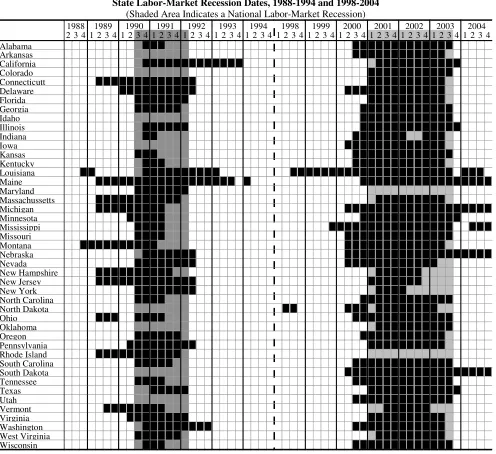
remaining 45 states the occurrence of state recessions between 1988.Q2 and 2004.Q4 is
shown in Figure 2.4 What is clear from these results is that there is great variation across
states in the timing and duration of recessions. It is this variation that we exploit in a
panel-data framework to assess the behavior of the personal-bankruptcy rate during
recessionary and recovery periods. In addition to providing more observations, our use
4
7
of state-level data has the advantage of providing a better geographic match of weak
economic conditions to the resulting bankruptcies.
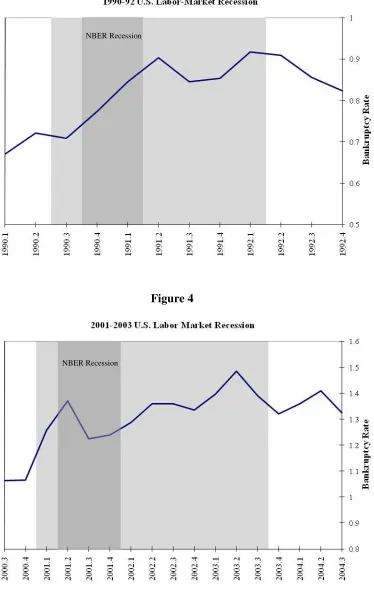
As noted above, a benefit of our approach is that, because it considers
labor-market recessions, it ameliorates the anomaly of a falling bankruptcy rate during a
recession. This can be illustrated by comparing the national bankruptcy rate with the
recession dates obtained from applying the Markov-switching model to the national
coincident index. Figures 3 and 4 compare these labor-market-recession dates to the
national bankruptcy rate during the two recession periods. Note that the national
labor-market recessions began earlier and ended later than NBER recessions and that for each
labor-market recession the bankruptcy rate was higher at its end than it was at its start.
There was, nevertheless, significant movement in the bankruptcy rate during each
labor-market recession, and we still have not removed the effect of the ongoing trend. Still,
particularly for the 2001 recession, the labor-market-recession dates match up much
better with the bankruptcy rate than do the NBER dates, reinforcing the notion that
labor-market recessions are more useful for explaining the effects of recessions on bankruptcy
rates than are NBER recession periods.
4. State Bankruptcy Rates
As at the national level, state-level bankruptcy rates have tended to rise over the
8
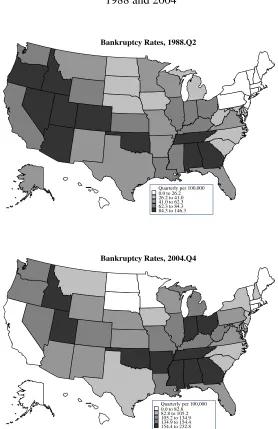
deal of cross-state variation in both levels and trends.5 For the states in our sample, the
mean quarterly bankruptcy rate over the sample period (measured henceforth as per
100,000 persons) ranged from Vermont’s average of 48.2 to Tennessee’s average of
208.1, with a cross-state average of 99.6. The levels and trends in state bankruptcy rates
are illustrated by Figure 5. In 1988, Northeastern states had the lowest bankruptcy rates
whereas the highest bankruptcy rates were in the South and West. By 2004 the pattern
had changed somewhat as only four of the ten states with the lowest bankruptcy rates
were in the Northeast and the other six were in the Far West or Upper Midwest.
As outlined below, our estimation allows for cross-state differences in levels and
trends by including state fixed effects, specific quadratic time trends, and
state-specific autoregressive errors. To capture the general movement in bankruptcy rates
during and after recessions, we will assume commonality in the states’ experiences
during those periods. As we describe below, however, we do allow for states to differ in
the lengths and strengths of their recessions.
To characterize the behavior of bankruptcies during and after recessions, we
estimate the relationship between state bankruptcy rates and sets of dummy variables that
indicate where the states are in their idiosyncratic business cycles. We take account not
only of whether or not the state is in a recession or recovery, but also where it is within
the recession or recovery. We also control for the cross-state differences in trends and
levels summarized in Figure 5.
5
9
A recessionary quarter is a period during which negative income shocks for
individuals and households are dominant, and, conversely, an expansionary quarter is one
during which positive income shocks are dominant. In an expansionary quarter,
households become more confident in the future, are willing to take on a greater debt
burden, and finance their increasing obligations based on their current income. As
economic conditions worsen and a recession hits, on net, households lose income—
through lower wages or job loss—and more find themselves overleveraged and filing for
bankruptcy. Thus, for a given period of recession, a higher-than-average number of
households are hit by a negative income shock, which means bankruptcy for some of
them, perhaps with a lag.
The pressure on personal finances accumulates as the recession continues,
suggesting a dynamic component to the link between the occurrence of negative income
shocks and the bankruptcy rate. For one thing, perhaps some households can weather a
negative income shock for a short while, but, as a recession drags on, more of them are
faced with bankruptcy. In addition, the longer a recession lasts, the more likely it is that a
household is hit by subsequent negative income shocks. The household’s personal
finances might have been able to handle the first shock, but not a second or third. As a
result, the rate of bankruptcy should rise as a recession persists.
There might also be a dynamic component to the bankruptcy rate even after the
recession ends. First, if we think of a recovery period as one in which the occurrence of
10
fall as soon as the recession ends. There could be, however, a bankruptcy hangover that
lingers into the recovery period because people close to insolvency might have to wait for
their positive shock to occur. Further, the length of time that this hangover continues
might be related to the length of the preceding recession because longer recessions result
in more at-risk households at the time the recovery begins. The speed at which the
bankruptcy rate returns to its trend level should depend, therefore, on two opposing
forces: the strength of the recovery (i.e., the rate at which positive income shocks occur)
and the length of the preceding recession.
Our use of dummy variables means that we need not assume any particular
functional form for the bankruptcy rate to follow during or after a recession. Specifically,
the dummy variable Rcit equals one if at time t state i is in its cth quarter of recession.
Similarly, the dummy variable Vkit equals one if at time t state i is in its kth quarter of
recovery. Finally, we include the interaction term VkitLit, for which Lit is the length of the
recession that preceded the recovery. The trend bankruptcy rate for state i at time t,
denoted as Bit, is, therefore,
C c K k it K k it kit k kit k cit c iit a t R V V L
B
1 1 1
)
( . (1)
Equation (1) includes the state-specific time-dependent intercept, ai(t):
11
where α0 is common across states, αi is the state-specific fixed effect, and ωi and πi are
the coefficients on the state-specific quadratic time trend. Note that ai(t) also includes
dummies to control for the quarter within a year.
We set C = 19 and K = 12, the number of recession and recovery dummies,
respectively. The value of C is dictated by the maximum recession length in our data,
which is 19 quarters. The value of K, on the other hand, is somewhat arbitrary but is not
crucial as long as it is high enough to allow for the bankruptcy rate to return to near its
non-recession/non-recovery level, while still leaving enough observations of normal
quarters to make the estimation possible.
5. Baseline Results
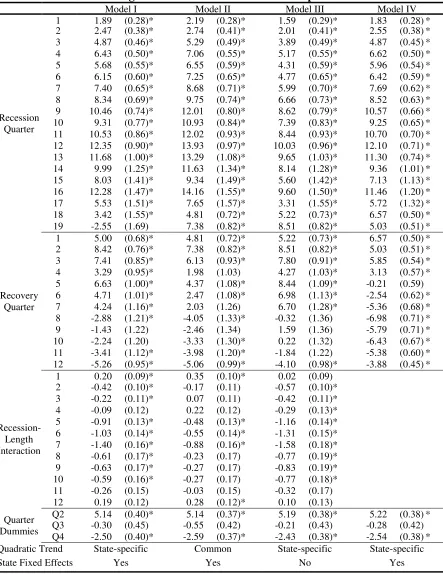
The results for our most general specification, Model I, are provided in Table 1,
which also provides the results for three restricted versions of Model I. Note that in all
four models, the error term it allows for state-specific AR(1) autocorrelation and
heteroskedastic errors with cross-state correlation. All of our estimation uses Feasible
Generalized Least Squares and a balanced panel of 67 quarterly observations for each of
the 45 states (3,105 observations).
All estimated coefficients measure the difference between the actual and trend
bankruptcy rates, where the trend bankruptcy rate is what occurs during a quarter that is
neither a recessionary quarter nor a recovery quarter (the 12 quarters after the end of a
recession). In (1) the trend bankruptcy rate for state i at time t is captured by the
12
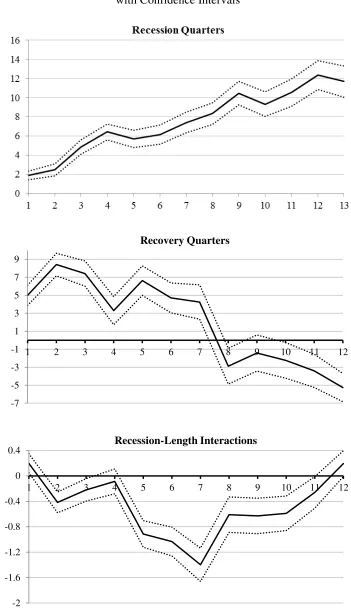
bankruptcy rate is statistically greater than trend for each of the first 18 quarters of
recession, although, because we have very few observations of recessions lasting beyond
13 quarters, results for recession quarters beyond the 13th should be interpreted with some
caution. Note also that the recovery quarters tend to be statistically different from trend,
starting above trend in the first quarters of recovery and ending below trend by the tenth
quarter of recovery. Recall that we also interacted the recovery dummies with the length
of the preceding recession. Our results show that there is a tendency for the recovery
bankruptcy rate to be decreasing in the length of the recession.
These results, along with 95 percent confidence intervals, are illustrated by Figure
6. As shown by the top panel, after the first year of recession the bankruptcy rate tends to
be about 6.4 points above trend, rising to 12.4 points above trend by the end of the third
year of recession. As illustrated by the middle panel, for a given length of the preceding
recession, the bankruptcy rate continues to rise after a recession ends and remains above
its trend rate for several quarters before falling steadily as the recovery proceeds. The
length of the preceding recession matters in determining the path by which the
bankruptcy rate returns to trend during a recovery, but not for every quarter of recovery.
The bottom panel of Figure 6 shows that the bankruptcy rate is not strongly
related to the length of the preceding recession for the first year of recovery, but it is
negatively related to the length of the recession for the fifth through tenth quarters of
13
after a year of recovery can still be below its trend rate, and the extent to which it is
below trend is increasing in the length of the preceding recession.
For example, the bankruptcy rate for the seventh quarter of recovery is about 1.4
points lower for each quarter that the preceding recession lasted. Combining this with the
estimate that, for a given recession length, the bankruptcy rate in the seventh quarter of
recovery is about 4.2 points above trend, the total effect is obtained: The bankruptcy rate
in the seventh quarter of recovery following a recession that lasted 10 quarters should be
6.2 points below trend.
This ―bounce-back effect‖ might be a reflection of that found by Kim, Morley,
and Piger (2005) for real GDP whereby growth following a recession tends to be higher
than during normal expansionary periods and is related positively to the severity of the
preceding recession. On the other hand, the bounce-back might be due to a depletion in
the stock of at-risk households. Even during normal periods there is some number of
households at risk of bankruptcy, and a certain percentage of them file for bankruptcy
during any quarter. The longer a recession lasts, the fewer at-risk households there are
when the recovery begins.
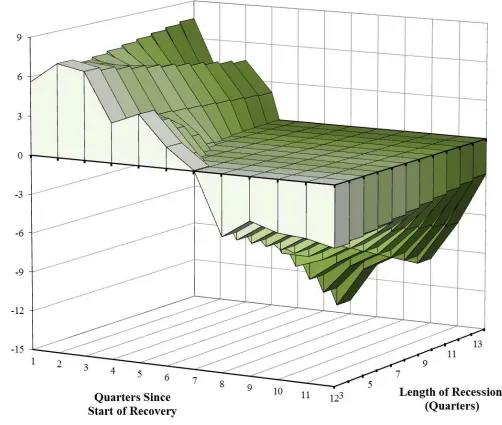
Figure 7 combines the results from the bottom two panels of Figure 6 and
illustrates the estimated path of the bankruptcy rate during recovery periods conditional
on recession lengths of from three to 13 quarters. Bankruptcy rates during the first
quarter of recovery are somewhat higher the longer the recession had lasted, but a lengthy
14
was, the bigger the bounce-back in the bankruptcy rate. So, although the bankruptcy rate
rises throughout the length of a recession, a long recession is followed by a recovery
period with bankruptcy rates that are substantially below trend for several quarters
beyond the first six quarters of recovery.
Figure 8 puts all of our results together to illustrate the entire personal-bankruptcy
cycle, conditional on recession lengths of from three to 13 quarters. Longer recessions
mean rising bankruptcy rates throughout the recession, followed by bankruptcy rates that
remain above trend during the first year of recovery. But longer recessions also mean
that bankruptcy rates return to trend earlier and a have a larger bounce-back that can last
into the fourth year of recovery. For example, for a recession that lasts one year, the
bankruptcy rate peaks at about 6.8 points above trend during the second quarter of
recovery, and then declines throughout the recovery before becoming well below trend
for several quarters. For a recession that lasts three years, the bankruptcy rate peaks in
the final quarter of the recession at about 12.4 points above trend, and returns to trend
more than one year later. This is followed by a bounce-back effect whereby about one
year later the bankruptcy rate is almost 14 points below trend.
6. Aggregate Implications
In the previous section we outlined our finding that bankruptcies respond strongly
to labor-market conditions, thereby indicating a statistically and economically significant
occurrence of nonstrategic bankruptcy. Even during recessions, however, when
15
portion of changes in bankruptcy rates. Specifically, state bankruptcy rates increased by
an average of 31.6 points during the state recessions that occurred in conjunction with the
national recessions of 1990-91 and 2001.6 Combining our results with the data the
recessions accounted for an average increase of 12.6 points, thereby accounting for about
two-fifths of the increase in the bankruptcy rate that had occurred.
So how much did the occurrence of state personal-bankruptcy cycles affect the
overall national bankruptcy picture? Recall that states entered recessions at different
times and that during some periods there are states in recession, others in recovery, and
the rest at their trend bankruptcy rates. Because state recessions are staggered in this
way, so are their personal-bankruptcy cycles, which would tend to smooth their affect on
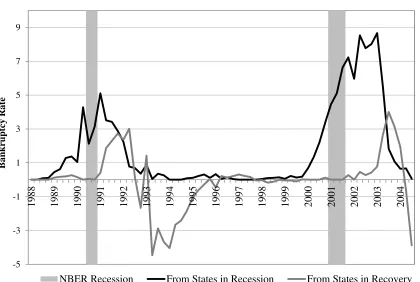
the aggregate picture. To see this, look at Figure 9, which shows the cross-state average
in the recession- and recovery-induced changes in bankruptcy rates. Note that for some
periods after the end of the two NBER recessions, the bankruptcy rates for some states
are above trend because the state is still in recession, while for other states it is because
they are in the early quarters of recovery. Eventually, as some states continue their
recoveries and other states that had experienced long recessions have just begun their
recoveries, the bounce-back effect becomes dominant.
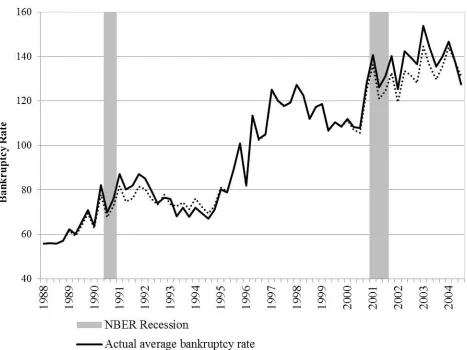
Figure 10 puts our results in the context of the actual average bankruptcy rate over
the sample period. The solid line is the actual average whereas the dashed line is what
the average would have been with the personal-bankruptcy cycle removed. The first
6
16
thing to notice from the figure is that the dominant movements in the average bankruptcy
rate have nothing to do with the recessions that occurred during the period. Still, it is
clear from the figure that the average bankruptcy rate was affected substantially before,
during, and after NBER recessions. Usually the underlying state personal-bankruptcy
cycles raised the average bankruptcy rate above trend. But during 1993 and 1994, when
states were well into their recoveries, the average bankruptcy rate was below trend
because of the preponderance of state-level bounce-back effects reversed this.
7. Restricted Specifications
We estimated three alternative specifications of (1), each of which is a restricted
version of the baseline, Model I. The first two alternatives, Models II and III, impose
commonality restrictions on the state time trends
i and i i
and state fixedeffects
i 0i
, respectively. The third alternative, Model IV, assumes that thebankruptcy rate during recovery is unrelated to the length of the preceding recession
k 0k
. The results for Models II-IV are provided in Table 1 and are compared withModel I and each other in Figure 11.7
For the most part, Model II provides results for all three categories of coefficients
that are very similar to those from the baseline estimation. This is somewhat surprising
given the large differences in state-level bankruptcy trends. Nevertheless, this suggests
that differences in state trends appear to be unrelated to the movement of state bankruptcy
7
17
rates over the business cycle, so a common trend would not have injected significant bias
into our estimation of the personal-bankruptcy cycle. Model III, on the other hand,
provides substantially different quantitative results from the baseline model, indicating
that the state fixed effects are related to each of the three components of the
personal-bankruptcy cycle. Specifically, Model III yields smaller increases in personal-bankruptcy rates
during recessions, higher bankruptcy rates during recoveries, and a stronger link between
recession length and the bounce-back effect.
If we had estimated Model IV, we would have missed much of the bounce-back
effect. Specifically, the middle panel of Figure 11 shows that this model suggests a faster
return to trend during recoveries and the entire bounce-back effect is captured by these
coefficients. Because Model IV does not allow for the differences in the length of the
recession to affect what happens during the recovery, the estimated bounce-back that it
provides is something like the average across the span of recession lengths in our sample.
It therefore misses the large differences in bounce-back across recessions of different
lengths.
8. Summary and Conclusions
By using recessionary periods to capture the persistence of weak labor markets,
we have estimated a personal-bankruptcy cycle that is related to the business cycle.
Bankruptcy rates are significantly higher than trend during recessions and rise as
recessions persist. Even after recessions end, there is a hangover whereby bankruptcy
18
recession, the faster is the return to trend. Recovery periods see a strong bounce-back
effect whereby bankruptcy rates are significantly below trend for several quarters before
returning to trend. The more severe the preceding recession, the deeper is this
bounce-back.
Although there are numerous studies that have explored the relationship between
local labor-market conditions and personal-bankruptcy decisions, there is little consensus
regarding the strength of this relationship. Our results suggest that nonstrategic
considerations can matter a great deal in personal-bankruptcy decisions, at least when
weak labor markets are endemic and persistent. This is very far from saying that strategic
considerations are not important, however. In fact, ongoing trends, which capture
everything that happens over time except for recessions, explain a larger share of the
changes in bankruptcy rates during recessions than does our model of the
19
References
Barron, John M., Michael E. Staten, and Stephanie M. Wilshusen (2002) The impact of casino gambling on personal bankruptcy filing rates. Contemporary Economic Policy 20(4), 440-455.
Crone, Theodore M. and Alan Clayton-Matthews (2005) Consistent economic indexes for the 50 states. Review of Economics and Statistics 87(4), 593-603.
Domowitz, Ian and Robert L. Sartain (1999) Determinants of the consumer bankruptcy decision. Journal of Finance 54(1), 403-420.
Durkin, Thomas A. (2000) Credit cards: Use and consumer attitudes, 1970-2000. Federal Reserve Bulletin, 623-634.
Fay, Scott, Erik Hurst, and Michelle J. White (2002) The household bankruptcy decision. American Economic Review 92(3), 706-718.
Fisher, Jonathan D. (2005) The effect of unemployment benefits, welfare benefits, and other income on personal bankruptcy. Contemporary Economic Policy 23(4), 483-492.
Garrett, Thomas A. (2007) The rise in personal bankruptcies: The eighth Federal Reserve district and beyond. Federal Reserve Bank of St. Louis Review 89(1), 15-37.
Garrett, Thomas A. and Mark W. Nichols (2008) Do casinos export bankruptcy? Journal of Socio-Economics 37(4), 1481-1494.
Gropp, Reint, John Karl Scholz, and Michelle J. White (1997) Personal bankruptcy and credit supply and demand. Quarterly Journal of Economics 112(1), 217-251.
Hamilton, James D. (1989) A new approach to the economic analysis of nonstationary time series and the business cycle. Econometrica 57(2), 357-384.
Himmelstein, David U., Elizabeth Warren, Deborah Thorne, and Steffie Woolhandler (2005) Illness and injury as contributors to bankruptcy. Health Affairs (Web Exclusives) 24, W5-63–W5-73.
Kim, Chang-Jin, James Morley, and Jeremy Piger (2005) Nonlinearity and the permanent effects of recessions. Journal of Applied Econometrics 20(2), 291-309.
Lefgren, Lars and Frank McIntyre (2009) Explaining the puzzle of cross-state differences in bankruptcy rates. Journal of Law and Economics 52(2), 367-393.
Livshits, Igor, James MacGee, and Michèle Tertilt (2010) ―Accounting for the Rise in Consumer Bankruptcies. American Economic Journal: Macroeconomics 2(2), 165-193.
Miller, Michelle M. (2009) Who files for bankruptcy? State laws and the characteristics of bankrupt households. Rutgers Business School Working Paper.
Morgan, Donald P., Benjamin Iverson, and Matthew Botsch (2009) Seismic effects of the bankruptcy reform. Federal Reserve Bank of New York Staff Report no. 358.
20
Owyang, Michael T., Jeremy Piger, and Howard J. Wall (2005) Business cycle phases in U.S. states. Review of Economics and Statistics 87(4), 604-616.
Owyang, Michael T., Jeremy Piger, and Howard J. Wall (2008) A state-level analysis of the Great Moderation. Regional Science and Urban Economics 38(6), 578-589.
Rampini, Adriano A. (2005) Default and aggregate income. Journal of Economic Theory 122(2), 225-253.
Stavins, Joanna (2000) Credit card borrowing, delinquency, and personal bankruptcy. New England Economic Review, 15-30.
Sullivan, Teresa A., Elizabeth Warren, and Jay Lawrence Westbrook (2000) The Fragile Middle Class: Americans in Debt. New Haven, CT: Yale University Press.
Thalheimer, Richard and Mukhtar M. Ali (2004) The relationship of pari-mutuel wagering and casino gaming to personal bankruptcy. Contemporary Economic Policy 22(3), 420-432.
Warren, Elizabeth (2003) Financial collapse and class status: Who goes bankrupt? Osgoode Hall Law Journal 41(1), 115-147.
White, Michelle J. (2007) Bankruptcy reform and credit cards. Journal of Economic Perspectives 21(4), 175-199.
21
Table 1. Regression Results with Alternative Specifications
Model I Model II Model III Model IV
Recession Quarter
1 1.89 (0.28) * 2.19 (0.28) * 1.59 (0.29) * 1.83 (0.28) * 2 2.47 (0.38) * 2.74 (0.41) * 2.01 (0.41) * 2.55 (0.38) * 3 4.87 (0.46) * 5.29 (0.49) * 3.89 (0.49) * 4.87 (0.45) * 4 6.43 (0.50) * 7.06 (0.55) * 5.17 (0.55) * 6.62 (0.50) * 5 5.68 (0.55) * 6.55 (0.59) * 4.31 (0.59) * 5.96 (0.54) * 6 6.15 (0.60) * 7.25 (0.65) * 4.77 (0.65) * 6.42 (0.59) * 7 7.40 (0.65) * 8.68 (0.71) * 5.99 (0.70) * 7.69 (0.62) * 8 8.34 (0.69) * 9.75 (0.74) * 6.66 (0.73) * 8.52 (0.63) * 9 10.46 (0.74) * 12.01 (0.80) * 8.62 (0.79) * 10.57 (0.66) * 10 9.31 (0.77) * 10.93 (0.84) * 7.39 (0.83) * 9.25 (0.65) * 11 10.53 (0.86) * 12.02 (0.93) * 8.44 (0.93) * 10.70 (0.70) * 12 12.35 (0.90) * 13.93 (0.97) * 10.03 (0.96) * 12.10 (0.71) * 13 11.68 (1.00) * 13.29 (1.08) * 9.65 (1.03) * 11.30 (0.74) * 14 9.99 (1.25) * 11.63 (1.34) * 8.14 (1.28) * 9.36 (1.01) * 15 8.03 (1.41) * 9.34 (1.49) * 5.60 (1.42) * 7.13 (1.13) * 16 12.28 (1.47) * 14.16 (1.55) * 9.60 (1.50) * 11.46 (1.20) * 17 5.53 (1.51) * 7.65 (1.57) * 3.31 (1.55) * 5.72 (1.32) * 18 3.42 (1.55) * 4.81 (0.72) * 5.22 (0.73) * 6.57 (0.50) * 19 -2.55 (1.69) 7.38 (0.82) * 8.51 (0.82) * 5.03 (0.51) *
Recovery Quarter
1 5.00 (0.68) * 4.81 (0.72) * 5.22 (0.73) * 6.57 (0.50) * 2 8.42 (0.76) * 7.38 (0.82) * 8.51 (0.82) * 5.03 (0.51) * 3 7.41 (0.85) * 6.13 (0.93) * 7.80 (0.91) * 5.85 (0.54) * 4 3.29 (0.95) * 1.98 (1.03) 4.27 (1.03) * 3.13 (0.57) * 5 6.63 (1.00) * 4.37 (1.08) * 8.44 (1.09) * -0.21 (0.59) 6 4.71 (1.01) * 2.47 (1.08) * 6.98 (1.13) * -2.54 (0.62) * 7 4.24 (1.16) * 2.03 (1.26) 6.70 (1.28) * -5.36 (0.68) * 8 -2.88 (1.21) * -4.05 (1.33) * -0.32 (1.36) -6.98 (0.71) * 9 -1.43 (1.22) -2.46 (1.34) 1.59 (1.36) -5.79 (0.71) * 10 -2.24 (1.20) -3.33 (1.30) * 0.22 (1.32) -6.43 (0.67) * 11 -3.41 (1.12) * -3.98 (1.20) * -1.84 (1.22) -5.38 (0.60) * 12 -5.26 (0.95) * -5.06 (0.99) * -4.10 (0.98) * -3.88 (0.45) *
Recession-Length Interaction
1 0.20 (0.09) * 0.35 (0.10) * 0.02 (0.09) 2 -0.42 (0.10) * -0.17 (0.11) -0.57 (0.10) * 3 -0.22 (0.11) * 0.07 (0.11) -0.42 (0.11) * 4 -0.09 (0.12) 0.22 (0.12) -0.29 (0.13) * 5 -0.91 (0.13) * -0.48 (0.13) * -1.16 (0.14) * 6 -1.03 (0.14) * -0.55 (0.14) * -1.31 (0.15) * 7 -1.40 (0.16) * -0.88 (0.16) * -1.58 (0.18) * 8 -0.61 (0.17) * -0.23 (0.17) -0.77 (0.19) * 9 -0.63 (0.17) * -0.27 (0.17) -0.83 (0.19) * 10 -0.59 (0.16) * -0.27 (0.17) -0.77 (0.18) * 11 -0.26 (0.15) -0.03 (0.15) -0.32 (0.17) 12 0.19 (0.12) 0.28 (0.12) * 0.10 (0.13)
Quarter Dummies
Q2 5.14 (0.40) * 5.14 (0.37) * 5.19 (0.38) * 5.22 (0.38) * Q3 -0.30 (0.45) -0.55 (0.42) -0.21 (0.43) -0.28 (0.42) Q4 -2.50 (0.40) * -2.59 (0.37) * -2.43 (0.38) * -2.54 (0.38) * Quadratic Trend State-specific Common State-specific State-specific
State Fixed Effects Yes Yes No Yes
22
0.0 0.5 1.0 1.5 2.0 2.5
1980 1981 1982 1983 1984 1985 1986 1987 1988 1989 1990 1991 1992 1993 1994 1995 1996 1997 1998 1999 2000 2001 2002 2003 2004 2005 2006 2007 2008 2009
P
e
r
so
n
a
l-B
a
n
k
r
u
p
tc
y
R
a
te
[image:24.612.96.520.126.470.2]U.S. Quarterly Personal Bankruptcies Per 1,000; 1980-2009 Figure 1
23
Figure 2
State Labor-Market Recession Dates, 1988-1994 and 1998-2004
(Shaded Area Indicates a National Labor-Market Recession)
24
Figure 4 Figure 3
NBER Recession
25
Bankruptcy Rates, 1988.Q2
[image:27.612.163.441.185.614.2]Quarterly per 100,000 0.0 to 26.2 26.2 to 41.0 41.0 to 62.3 62.3 to 84.3 84.3 to 146.3
Figure 5
State Bankruptcy Rates
1988 and 2004
Bankruptcy Rates, 2004.Q4
26
Figure 6
Model I Differences in Bankruptcy Rates Relative to Trend
with Confidence Intervals
-7 -5 -3 -1 1 3 5 7 9
1 2 3 4 5 6 7 8 9 10 11 12
Recovery Quarters
-2 -1.6 -1.2 -0.8 -0.4 0 0.4
1 2 3 4 5 6 7 8 9 10 11 12
27
28
29
Figure 9
0 100 0 200 0 300 0 400 0 500 0 600 0 700 0 800 0 900 0 100 00
-5 -3 -1 1 3 5 7 9
1988 1989 1990 1991 1992 1993 1994 1995 1996 1997 1998 1999 2000 2001 2002 2003 2004
NBER Recession From States in Recession From States in Recovery
Average Effect of the Bankruptcy Cycle on State Bankruptcy Rates
B
ank
ruptc
y
R
at
30
31
[image:33.612.131.470.64.733.2]